Mechanical Ventilation
Collected by: Mosa alfageh
outline
• Introduction
• Definition of mechanical ventilation
• Goals of Mechanical ventilation & desired outcomes
• Indication of Mechanical ventilation
• Criteria for mechanical ventilation
• Equipment of mechanical ventilation
• Types of mechanical ventilation
• Ventilator modes
• Ventilation parameters
• Ventilator alarms
• Guidelines of weaning
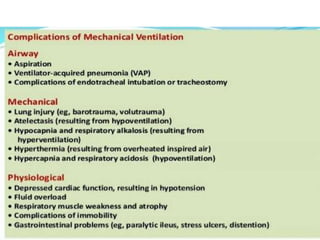
• Complication
• Nursing care
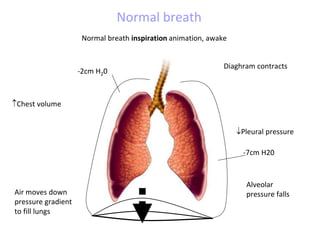
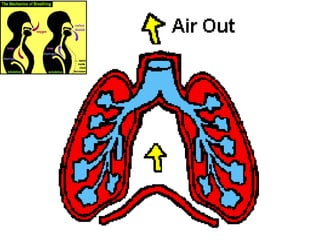
Normal breath inspiration animation, awake
Diaghram contracts
Chest volume
Pleural pressure
Air moves down
pressure gradient
to fill lungs
-2cm H20
-7cm H20
Alveolar
pressure falls
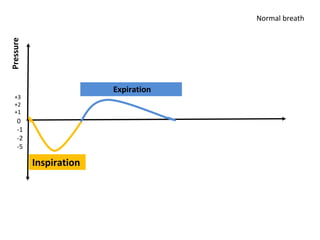
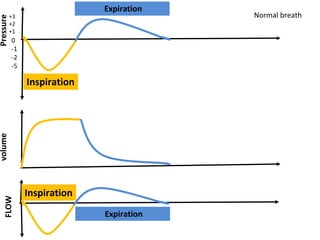
Normal breath
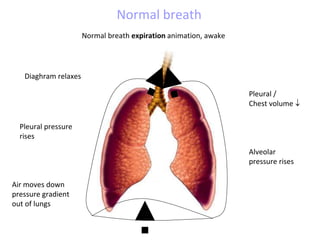
Normal breath expiration animation, awake
Diaghram relaxes
Pleural /
Chest volume 
Pleural pressure
rises
Normal breath
Alveolar
pressure rises
Air moves down
pressure gradient
out of lungs
0
-1
-2
-5
Pressure
Expiration
Inspiration
+3
+2
+1
Normal breath
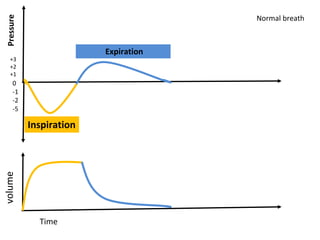
Time
volume
0
-1
-2
-5
Pressure
Expiration
Inspiration
+3
+2
+1
Normal breath
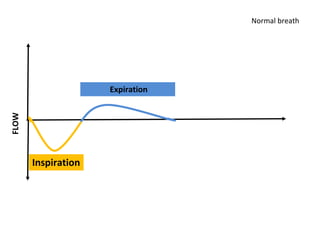
FLOW
Expiration
Inspiration
Normal breath
volume
0
-1
-2
-5
Pressure
Expiration
Inspiration
+3
+2
+1
FLOW
Expiration
Inspiration
Normal breath
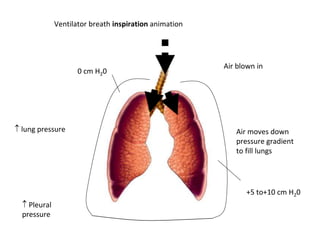
Ventilator breath inspiration animation
Air blown in
 lung pressure Air moves down
pressure gradient
to fill lungs
 Pleural
pressure
0 cm H20
+5 to+10 cm H20
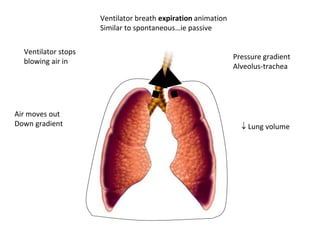
Ventilator breath expiration animation
Similar to spontaneous…ie passive
Ventilator stops
blowing air in
Pressure gradient
Alveolus-trachea
Air moves out
Down gradient  Lung volume
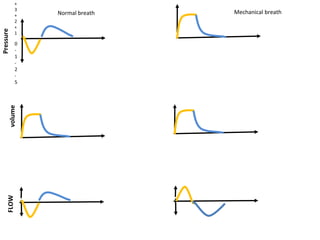
volume
0
-
1
-
2
-
5
Pressure +
3
+
2
+
1
FLOW Normal breath Mechanical breath
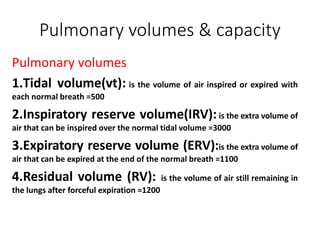
Pulmonary volumes & capacity
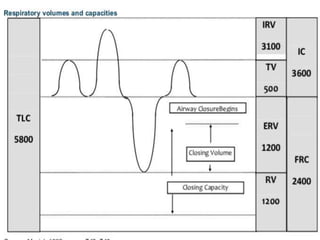
Pulmonary volumes
1.Tidal volume(vt): is the volume of air inspired or expired with
each normal breath =500
2.Inspiratory reserve volume(IRV):is the extra volume of
air that can be inspired over the normal tidal volume =3000
3.Expiratory reserve volume (ERV):is the extra volume of
air that can be expired at the end of the normal breath =1100
4.Residual volume (RV): is the volume of air still remaining in
the lungs after forceful expiration =1200
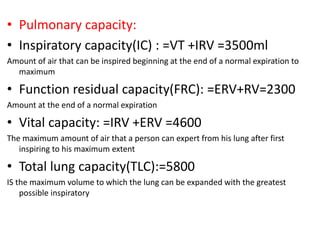
• Pulmonary capacity:
• Inspiratory capacity(IC) : =VT +IRV =3500ml
Amount of air that can be inspired beginning at the end of a normal expiration to
maximum
• Function residual capacity(FRC): =ERV+RV=2300
Amount at the end of a normal expiration
• Vital capacity: =IRV +ERV =4600
The maximum amount of air that a person can expert from his lung after first
inspiring to his maximum extent
• Total lung capacity(TLC):=5800
IS the maximum volume to which the lung can be expanded with the greatest
possible inspiratory
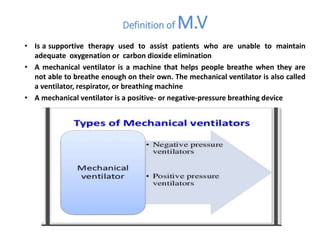
• Is a supportive therapy used to assist patients who are unable to maintain
adequate oxygenation or carbon dioxide elimination
• A mechanical ventilator is a machine that helps people breathe when they are
not able to breathe enough on their own. The mechanical ventilator is also called
a ventilator, respirator, or breathing machine
• A mechanical ventilator is a positive- or negative-pressure breathing device
Definition of M.V
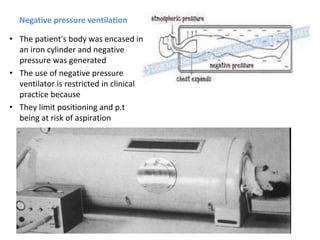
Negative pressure ventilation
• The patient's body was encased in
an iron cylinder and negative
pressure was generated
• The use of negative pressure
ventilator is restricted in clinical
practice because
• They limit positioning and p.t
being at risk of aspiration
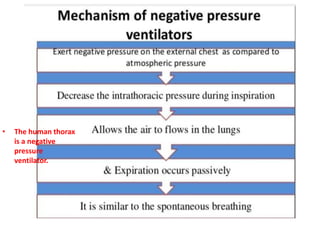
• The human thorax
is a negative
pressure
ventilator.
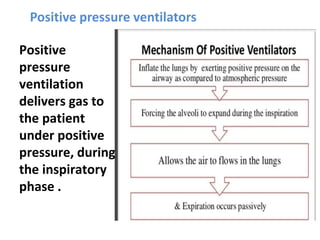
Positive pressure ventilators
Positive
pressure
ventilation
delivers gas to
the patient
under positive
pressure, during
the inspiratory
phase .
Desired clinical outcomes of M.V
• Reversal of acute respiratory acidosis
• Reversal hypoxemia
• Relief of respiratory distress
• Prevention or reversal atelectasis
• Resting of ventilatory muscles
• Reduction in systemic oxygen consummation
Myocardial oxygen consummation
The Goal of MV
To maintain alveolar ventilation appropriate for the patient metabolic needs and
correct hypoxemia and maximize oxygen transport
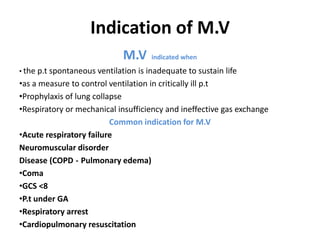
Indication of M.V
M.V indicated when
• the p.t spontaneous ventilation is inadequate to sustain life
•as a measure to control ventilation in critically ill p.t
•Prophylaxis of lung collapse
•Respiratory or mechanical insufficiency and ineffective gas exchange
Common indication for M.V
•Acute respiratory failure
Neuromuscular disorder
Disease (COPD - Pulmonary edema)
•Coma
•GCS <8
•P.t under GA
•Respiratory arrest
•Cardiopulmonary resuscitation
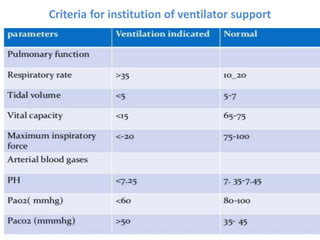
Criteria for institution of ventilator support
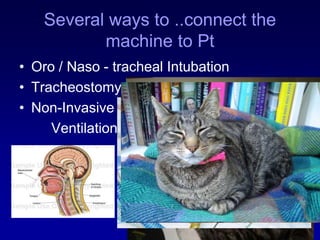
Several ways to ..connect the
machine to Pt
• Oro / Naso - tracheal Intubation
• Tracheostomy
• Non-Invasive
Ventilation
Types of Positive pressure mechanical ventilation
invasive
noon invasive
Invasive ventilation
Mechanical
ventilation via
artificial airways
which can either be
endotracheal
intubation or
tracheostomy
Non invasive ventilation
It refer to the delivery of
mechanical ventilation to the
lungs using techniques that
don't required an invasive
artificial airway (ETT , TT)
IT provide breathing support
through CPAP , BiPAP
Classification of Positive pressure ventilation
It can be classified according to how the inspiratory phase end into
1.Volume cycled ventilators
The ventilator delivers a pre-sent tidal volume ,and inspiration stops when the
pre-set tidal volume is achieved
Most commonly used in adult
2. Pressure cycled ventilators :
In which inspiration is terminated when a specific airway pressure has been
reached
3. High frequency ventilation :
Used small tidal volume 1 – 3ml/kg at frequency greater than 100 breaths/m
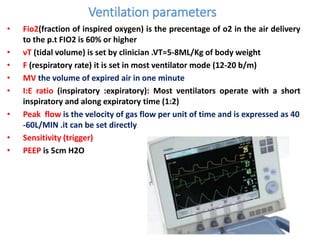
Ventilation parameters
• Fio2(fraction of inspired oxygen) is the precentage of o2 in the air delivery
to the p.t FIO2 is 60% or higher
• vT (tidal volume) is set by clinician .VT=5-8ML/Kg of body weight
• F (respiratory rate) it is set in most ventilator mode (12-20 b/m)
• MV the volume of expired air in one minute
• I:E ratio (inspiratory :expiratory): Most ventilators operate with a short
inspiratory and along expiratory time (1:2)
• Peak flow is the velocity of gas flow per unit of time and is expressed as 40
-60L/MIN .it can be set directly
• Sensitivity (trigger)
• PEEP is 5cm H2O
Sensitivity (trigger mode)
• There are two ways to initiate a ventilation –delivered breath :
- Pressure triggering
When it used a ventilator delivered breath is initiated if the demand valve senses a
negative airway pressure deflection (generated by the p.t trying to initiate a
breath)greater than the trigger sensitivity
- Flow triggering
When it used a continuous flow of gas through the ventilator circuit is monitored
A ventilator delivered breath is initiated when the return flow is less than the
delivered flow , a consequence of the patient's effort to initiate a breath
PEEP(Positive end expiratory pressure)
• Mechanically ventilated patients usually receive
Positive end expiratory pressure (PEEP) To
overcome the loss of physiological PEEP
• Applied PEEP is generally added to mitigate end-
expiratory alveolar collapse
• Atypical initial applied PEEP is 5 cmH2O. However
up to 20 cmH2O may be used in patients
undergoing low tidal volume ventilation for acute
respiratory distress syndrome
• N.B : PEEP is synonymous to CPAP but in the
intubated patient
Ventilation mode:
1. Volume modes
Common volume mode are
• SIMV(synchronized intermittent mandatory
ventilation)
• ACV (assist control Ventilation)
2. Pressure mode
Common pressure ventilation
• PCV(pressure controlled ventilation)
• PSV (pressure support ventilation)
• CPAP(continuous positive airway pressure)
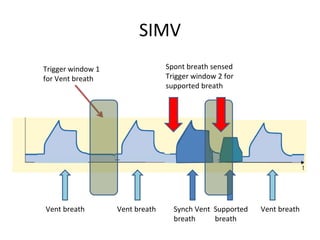
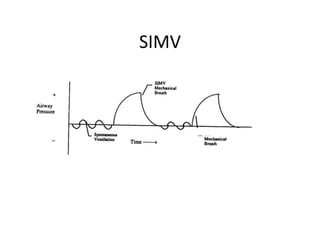
SIMV(synchronized intermittent mandatory ventilation)
- Delivers a preset tidal volume and number of breaths per minutes
- Between ventilators delivered breaths, the patient can breathe spontaneously with no
assistance from the ventilator on those extra breaths
- As the patient's ability to breathe spontaneously increase the preset number of ventilator
breaths is decreased and the p.t does more of work of breathing
• Advantage
- p.t is comfort
- Used for weaning mode
- Patient can exercise respiratory muscles .
• Disadvantages
- Increase work of breathing and respiratory muscle fatigue
SIMV
Trigger window 1
for Vent breath
Vent breath Vent breath Synch Vent Supported Vent breath
breath breath
Spont breath sensed
Trigger window 2 for
supported breath
SIMV
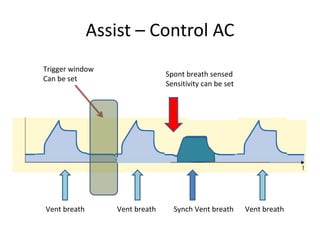
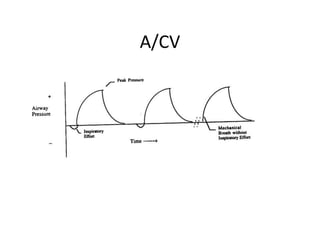
A/C MODE (assist control mode)
T.V & rate are preset , but whenever the patient makes an inspiratory effort the
ventilator senses the effort and delivers the preset T.V
•Advantages
-Allow to minimal effort and rest for muscles
-Patient can increase minute ventilation
•Disadvantages
-respiratory alkalosis
- Alveolar hyperventilation
Assist – Control AC
Trigger window
Can be set
Vent breath Vent breath Synch Vent breath Vent breath
Spont breath sensed
Sensitivity can be set
A/CV
PCV(pressure controlled ventilation)
• The breathing gas flows under constant pressure into
the lungs during the selected inspiratory time
• Advantage
- patient is comfort
- The risk for barotraumas and volutrauma are
decreased compared with breathes that are volume
set
• Disadvantages
- T.V is not guaranteed
PSV (pressure support ventilation)
• Spontaneous mode of ventilation. The patient initiate every breath and the ventilator
delivers support with the preset pressure value. With support from the ventilator , the
patient also regulates his own respiratory rate and tidal volume
• PSV is used for p.t with a stable respiratory status
• ADVANTAGES OF PSV
1. Support the p.t spontaneous tidal volume
2. Decrease in work of breathing
3. Facilitates weaning
4. The p.t feeling comfort
INDICATION
1.Spontaneously breathing patients
who require additional ventilator
support to help overcome :
increase WOB OR respiratory muscle
weakness
2. weaning
disadvantages
1.Requires consistent spontaneous breathing
2.Fatigue and tachypnea if PS level is set too low
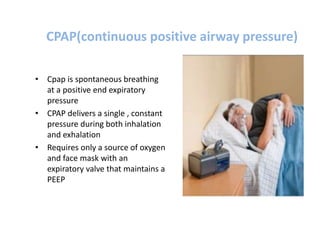
CPAP(continuous positive airway pressure)
• Cpap is spontaneous breathing
at a positive end expiratory
pressure
• CPAP delivers a single , constant
pressure during both inhalation
and exhalation
• Requires only a source of oxygen
and face mask with an
expiratory valve that maintains a
PEEP
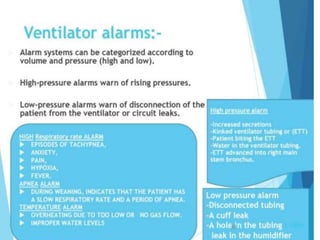
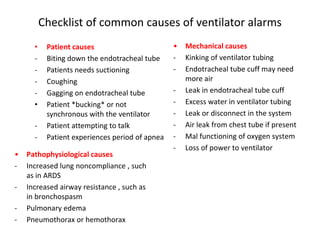
Checklist of common causes of ventilator alarms
• Patient causes
- Biting down the endotracheal tube
- Patients needs suctioning
- Coughing
- Gagging on endotracheal tube
• Patient *bucking* or not
synchronous with the ventilator
- Patient attempting to talk
- Patient experiences period of apnea
• Mechanical causes
- Kinking of ventilator tubing
- Endotracheal tube cuff may need
more air
- Leak in endotracheal tube cuff
- Excess water in ventilator tubing
- Leak or disconnect in the system
- Air leak from chest tube if present
- Mal functioning of oxygen system
- Loss of power to ventilator
• Pathophysiological causes
- Increased lung noncompliance , such
as in ARDS
- Increased airway resistance , such as
in bronchospasm
- Pulmonary edema
- Pneumothorax or hemothorax
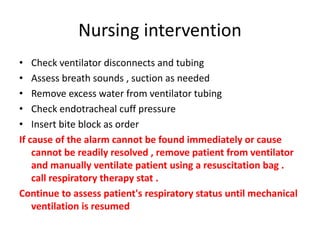
Nursing intervention
• Check ventilator disconnects and tubing
• Assess breath sounds , suction as needed
• Remove excess water from ventilator tubing
• Check endotracheal cuff pressure
• Insert bite block as order
If cause of the alarm cannot be found immediately or cause
cannot be readily resolved , remove patient from ventilator
and manually ventilate patient using a resuscitation bag .
call respiratory therapy stat .
Continue to assess patient's respiratory status until mechanical
ventilation is resumed
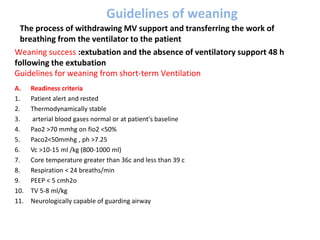
Guidelines of weaning
A. Readiness criteria
1. Patient alert and rested
2. Thermodynamically stable
3. arterial blood gases normal or at patient's baseline
4. Pao2 >70 mmhg on fio2 <50%
5. Paco2<50mmhg , ph >7.25
6. Vc >10-15 ml /kg (800-1000 ml)
7. Core temperature greater than 36c and less than 39 c
8. Respiration < 24 breaths/min
9. PEEP < 5 cmh2o
10. TV 5-8 ml/kg
11. Neurologically capable of guarding airway
Guidelines for weaning from short-term Ventilation
The process of withdrawing MV support and transferring the work of
breathing from the ventilator to the patient
Weaning success :extubation and the absence of ventilatory support 48 h
following the extubation
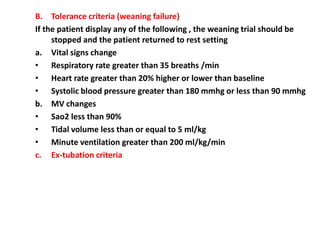
B. Tolerance criteria (weaning failure)
If the patient display any of the following , the weaning trial should be
stopped and the patient returned to rest setting
a. Vital signs change
• Respiratory rate greater than 35 breaths /min
• Heart rate greater than 20% higher or lower than baseline
• Systolic blood pressure greater than 180 mmhg or less than 90 mmhg
b. MV changes
• Sao2 less than 90%
• Tidal volume less than or equal to 5 ml/kg
• Minute ventilation greater than 200 ml/kg/min
c. Ex-tubation criteria
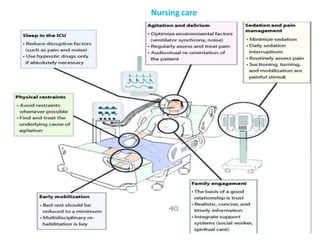
Nursing care
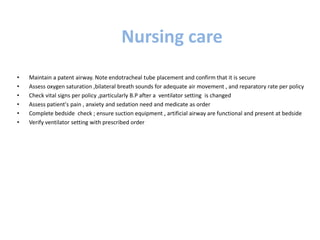
Nursing care
• Maintain a patent airway. Note endotracheal tube placement and confirm that it is secure
• Assess oxygen saturation ,bilateral breath sounds for adequate air movement , and reparatory rate per policy
• Check vital signs per policy ,particularly B.P after a ventilator setting is changed
• Assess patient's pain , anxiety and sedation need and medicate as order
• Complete bedside check ; ensure suction equipment , artificial airway are functional and present at bedside
• Verify ventilator setting with prescribed order

basic mecanical ventilation critical nursing.pptx

  • 1.
  • 2.
    outline • Introduction • Definitionof mechanical ventilation • Goals of Mechanical ventilation & desired outcomes • Indication of Mechanical ventilation • Criteria for mechanical ventilation • Equipment of mechanical ventilation • Types of mechanical ventilation • Ventilator modes • Ventilation parameters • Ventilator alarms • Guidelines of weaning • Complication • Nursing care
  • 3.
    Normal breath inspirationanimation, awake Diaghram contracts Chest volume Pleural pressure Air moves down pressure gradient to fill lungs -2cm H20 -7cm H20 Alveolar pressure falls Normal breath
  • 4.
    Normal breath expirationanimation, awake Diaghram relaxes Pleural / Chest volume  Pleural pressure rises Normal breath Alveolar pressure rises Air moves down pressure gradient out of lungs
  • 6.
  • 7.
  • 8.
  • 9.
  • 10.
    Ventilator breath inspirationanimation Air blown in  lung pressure Air moves down pressure gradient to fill lungs  Pleural pressure 0 cm H20 +5 to+10 cm H20
  • 11.
    Ventilator breath expirationanimation Similar to spontaneous…ie passive Ventilator stops blowing air in Pressure gradient Alveolus-trachea Air moves out Down gradient  Lung volume
  • 12.
  • 13.
    Pulmonary volumes &capacity Pulmonary volumes 1.Tidal volume(vt): is the volume of air inspired or expired with each normal breath =500 2.Inspiratory reserve volume(IRV):is the extra volume of air that can be inspired over the normal tidal volume =3000 3.Expiratory reserve volume (ERV):is the extra volume of air that can be expired at the end of the normal breath =1100 4.Residual volume (RV): is the volume of air still remaining in the lungs after forceful expiration =1200
  • 14.
    • Pulmonary capacity: •Inspiratory capacity(IC) : =VT +IRV =3500ml Amount of air that can be inspired beginning at the end of a normal expiration to maximum • Function residual capacity(FRC): =ERV+RV=2300 Amount at the end of a normal expiration • Vital capacity: =IRV +ERV =4600 The maximum amount of air that a person can expert from his lung after first inspiring to his maximum extent • Total lung capacity(TLC):=5800 IS the maximum volume to which the lung can be expanded with the greatest possible inspiratory
  • 16.
    • Is asupportive therapy used to assist patients who are unable to maintain adequate oxygenation or carbon dioxide elimination • A mechanical ventilator is a machine that helps people breathe when they are not able to breathe enough on their own. The mechanical ventilator is also called a ventilator, respirator, or breathing machine • A mechanical ventilator is a positive- or negative-pressure breathing device Definition of M.V
  • 17.
    Negative pressure ventilation •The patient's body was encased in an iron cylinder and negative pressure was generated • The use of negative pressure ventilator is restricted in clinical practice because • They limit positioning and p.t being at risk of aspiration
  • 18.
    • The humanthorax is a negative pressure ventilator.
  • 19.
    Positive pressure ventilators Positive pressure ventilation deliversgas to the patient under positive pressure, during the inspiratory phase .
  • 20.
    Desired clinical outcomesof M.V • Reversal of acute respiratory acidosis • Reversal hypoxemia • Relief of respiratory distress • Prevention or reversal atelectasis • Resting of ventilatory muscles • Reduction in systemic oxygen consummation Myocardial oxygen consummation The Goal of MV To maintain alveolar ventilation appropriate for the patient metabolic needs and correct hypoxemia and maximize oxygen transport
  • 21.
    Indication of M.V M.Vindicated when • the p.t spontaneous ventilation is inadequate to sustain life •as a measure to control ventilation in critically ill p.t •Prophylaxis of lung collapse •Respiratory or mechanical insufficiency and ineffective gas exchange Common indication for M.V •Acute respiratory failure Neuromuscular disorder Disease (COPD - Pulmonary edema) •Coma •GCS <8 •P.t under GA •Respiratory arrest •Cardiopulmonary resuscitation
  • 22.
    Criteria for institutionof ventilator support
  • 28.
    Several ways to..connect the machine to Pt • Oro / Naso - tracheal Intubation • Tracheostomy • Non-Invasive Ventilation
  • 29.
    Types of Positivepressure mechanical ventilation invasive noon invasive Invasive ventilation Mechanical ventilation via artificial airways which can either be endotracheal intubation or tracheostomy Non invasive ventilation It refer to the delivery of mechanical ventilation to the lungs using techniques that don't required an invasive artificial airway (ETT , TT) IT provide breathing support through CPAP , BiPAP
  • 30.
    Classification of Positivepressure ventilation It can be classified according to how the inspiratory phase end into 1.Volume cycled ventilators The ventilator delivers a pre-sent tidal volume ,and inspiration stops when the pre-set tidal volume is achieved Most commonly used in adult 2. Pressure cycled ventilators : In which inspiration is terminated when a specific airway pressure has been reached 3. High frequency ventilation : Used small tidal volume 1 – 3ml/kg at frequency greater than 100 breaths/m
  • 31.
    Ventilation parameters • Fio2(fractionof inspired oxygen) is the precentage of o2 in the air delivery to the p.t FIO2 is 60% or higher • vT (tidal volume) is set by clinician .VT=5-8ML/Kg of body weight • F (respiratory rate) it is set in most ventilator mode (12-20 b/m) • MV the volume of expired air in one minute • I:E ratio (inspiratory :expiratory): Most ventilators operate with a short inspiratory and along expiratory time (1:2) • Peak flow is the velocity of gas flow per unit of time and is expressed as 40 -60L/MIN .it can be set directly • Sensitivity (trigger) • PEEP is 5cm H2O
  • 32.
    Sensitivity (trigger mode) •There are two ways to initiate a ventilation –delivered breath : - Pressure triggering When it used a ventilator delivered breath is initiated if the demand valve senses a negative airway pressure deflection (generated by the p.t trying to initiate a breath)greater than the trigger sensitivity - Flow triggering When it used a continuous flow of gas through the ventilator circuit is monitored A ventilator delivered breath is initiated when the return flow is less than the delivered flow , a consequence of the patient's effort to initiate a breath
  • 33.
    PEEP(Positive end expiratorypressure) • Mechanically ventilated patients usually receive Positive end expiratory pressure (PEEP) To overcome the loss of physiological PEEP • Applied PEEP is generally added to mitigate end- expiratory alveolar collapse • Atypical initial applied PEEP is 5 cmH2O. However up to 20 cmH2O may be used in patients undergoing low tidal volume ventilation for acute respiratory distress syndrome • N.B : PEEP is synonymous to CPAP but in the intubated patient
  • 34.
    Ventilation mode: 1. Volumemodes Common volume mode are • SIMV(synchronized intermittent mandatory ventilation) • ACV (assist control Ventilation) 2. Pressure mode Common pressure ventilation • PCV(pressure controlled ventilation) • PSV (pressure support ventilation) • CPAP(continuous positive airway pressure)
  • 35.
    SIMV(synchronized intermittent mandatoryventilation) - Delivers a preset tidal volume and number of breaths per minutes - Between ventilators delivered breaths, the patient can breathe spontaneously with no assistance from the ventilator on those extra breaths - As the patient's ability to breathe spontaneously increase the preset number of ventilator breaths is decreased and the p.t does more of work of breathing • Advantage - p.t is comfort - Used for weaning mode - Patient can exercise respiratory muscles . • Disadvantages - Increase work of breathing and respiratory muscle fatigue
  • 36.
    SIMV Trigger window 1 forVent breath Vent breath Vent breath Synch Vent Supported Vent breath breath breath Spont breath sensed Trigger window 2 for supported breath
  • 37.
  • 38.
    A/C MODE (assistcontrol mode) T.V & rate are preset , but whenever the patient makes an inspiratory effort the ventilator senses the effort and delivers the preset T.V •Advantages -Allow to minimal effort and rest for muscles -Patient can increase minute ventilation •Disadvantages -respiratory alkalosis - Alveolar hyperventilation
  • 39.
    Assist – ControlAC Trigger window Can be set Vent breath Vent breath Synch Vent breath Vent breath Spont breath sensed Sensitivity can be set
  • 40.
  • 41.
    PCV(pressure controlled ventilation) •The breathing gas flows under constant pressure into the lungs during the selected inspiratory time • Advantage - patient is comfort - The risk for barotraumas and volutrauma are decreased compared with breathes that are volume set • Disadvantages - T.V is not guaranteed
  • 42.
    PSV (pressure supportventilation) • Spontaneous mode of ventilation. The patient initiate every breath and the ventilator delivers support with the preset pressure value. With support from the ventilator , the patient also regulates his own respiratory rate and tidal volume • PSV is used for p.t with a stable respiratory status • ADVANTAGES OF PSV 1. Support the p.t spontaneous tidal volume 2. Decrease in work of breathing 3. Facilitates weaning 4. The p.t feeling comfort INDICATION 1.Spontaneously breathing patients who require additional ventilator support to help overcome : increase WOB OR respiratory muscle weakness 2. weaning disadvantages 1.Requires consistent spontaneous breathing 2.Fatigue and tachypnea if PS level is set too low
  • 43.
    CPAP(continuous positive airwaypressure) • Cpap is spontaneous breathing at a positive end expiratory pressure • CPAP delivers a single , constant pressure during both inhalation and exhalation • Requires only a source of oxygen and face mask with an expiratory valve that maintains a PEEP
  • 45.
    Checklist of commoncauses of ventilator alarms • Patient causes - Biting down the endotracheal tube - Patients needs suctioning - Coughing - Gagging on endotracheal tube • Patient *bucking* or not synchronous with the ventilator - Patient attempting to talk - Patient experiences period of apnea • Mechanical causes - Kinking of ventilator tubing - Endotracheal tube cuff may need more air - Leak in endotracheal tube cuff - Excess water in ventilator tubing - Leak or disconnect in the system - Air leak from chest tube if present - Mal functioning of oxygen system - Loss of power to ventilator • Pathophysiological causes - Increased lung noncompliance , such as in ARDS - Increased airway resistance , such as in bronchospasm - Pulmonary edema - Pneumothorax or hemothorax
  • 46.
    Nursing intervention • Checkventilator disconnects and tubing • Assess breath sounds , suction as needed • Remove excess water from ventilator tubing • Check endotracheal cuff pressure • Insert bite block as order If cause of the alarm cannot be found immediately or cause cannot be readily resolved , remove patient from ventilator and manually ventilate patient using a resuscitation bag . call respiratory therapy stat . Continue to assess patient's respiratory status until mechanical ventilation is resumed
  • 47.
    Guidelines of weaning A.Readiness criteria 1. Patient alert and rested 2. Thermodynamically stable 3. arterial blood gases normal or at patient's baseline 4. Pao2 >70 mmhg on fio2 <50% 5. Paco2<50mmhg , ph >7.25 6. Vc >10-15 ml /kg (800-1000 ml) 7. Core temperature greater than 36c and less than 39 c 8. Respiration < 24 breaths/min 9. PEEP < 5 cmh2o 10. TV 5-8 ml/kg 11. Neurologically capable of guarding airway Guidelines for weaning from short-term Ventilation The process of withdrawing MV support and transferring the work of breathing from the ventilator to the patient Weaning success :extubation and the absence of ventilatory support 48 h following the extubation
  • 48.
    B. Tolerance criteria(weaning failure) If the patient display any of the following , the weaning trial should be stopped and the patient returned to rest setting a. Vital signs change • Respiratory rate greater than 35 breaths /min • Heart rate greater than 20% higher or lower than baseline • Systolic blood pressure greater than 180 mmhg or less than 90 mmhg b. MV changes • Sao2 less than 90% • Tidal volume less than or equal to 5 ml/kg • Minute ventilation greater than 200 ml/kg/min c. Ex-tubation criteria
  • 50.
  • 51.
    Nursing care • Maintaina patent airway. Note endotracheal tube placement and confirm that it is secure • Assess oxygen saturation ,bilateral breath sounds for adequate air movement , and reparatory rate per policy • Check vital signs per policy ,particularly B.P after a ventilator setting is changed • Assess patient's pain , anxiety and sedation need and medicate as order • Complete bedside check ; ensure suction equipment , artificial airway are functional and present at bedside • Verify ventilator setting with prescribed order