IC 8451&CONTROL SYSTEMS
Department of Electrical and Electronics Engineering
Approved by AICTE | Affiliated to Anna University | Accredited by NAAC | Accredited NBA | Recognized by UGC under 2(f) and 12(B)
Chennai Main Road, Kumbakonam- 612 501.
ARASU ENGINEERING COLLEGE
1
Prepared by
Mrs.K.Kalpana., M.E.,(Ph.D).,
Department of Electrical and Electronics Engineering
ARASU
ENGINEERING
COLLEGE
IC 8451&CONTROL SYSTEMS
2
 MECHANICAL ROTATIONAL SYSTEMS
 The model of rotational mechanical systems can be obtained by
using three elements, moment of inertia [J] of mass, dash-pot with
rotational frictional coefficient [B] and torsional spring with
stiffness [K].
 The weight of the rotational mechanical system is represented by the
moment of inertia of the mass.
 The moment of inertia of the system or body is considered to be
concentrated at the centre of gravity of the body.
 The elastic deformation of the body can be represented by a spring
(torsional spring).
 The friction existing in rotational mechanical system can be
represented by the dash-pot.
 The dash-pot is a piston rotating inside a cylinder filled with
viscous fluid.
ARASU
ENGINEERING
COLLEGE
IC 8451&CONTROL SYSTEMS
3
 When a torque is applied to a rotational mechanical system, it
is opposed by opposing torques due to moment of inertia,
friction and elasticity of the system.
 The torques acting on a rotational mechanical body are
governed by Newton s second law of motion for rotational
systems.
 It states that the sum of torques acting on a body is zero (or
Newton’s law states that the sum of applied torques is equal to
the sum of opposing torques on a body).
ARASU
ENGINEERING
COLLEGE
IC 8451&CONTROL SYSTEMS
4
ARASU
ENGINEERING
COLLEGE
IC 8451&CONTROL SYSTEMS
5
List of symbols used in mechanical rotational
system
θ = Angular displacement, rad
dθ /dt =Angular velocity, rad /s
d2θ / dt2 =Angular acceleration, rad /s2
T =Applied torque, N-m
J =Moment of inertia, kg-m2 / rad
B =Rotational frictional coefficient, N-m / (rad /s)
K =Stiffness of the spring, N –m / rad
ARASU
ENGINEERING
COLLEGE
IC 8451&CONTROL SYSTEMS
6
Torque balance equations of idealized elements
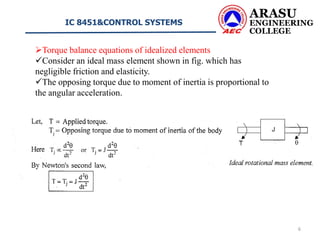
Consider an ideal mass element shown in fig. which has
negligible friction and elasticity.
The opposing torque due to moment of inertia is proportional to
the angular acceleration.
ARASU
ENGINEERING
COLLEGE
IC 8451&CONTROL SYSTEMS
7
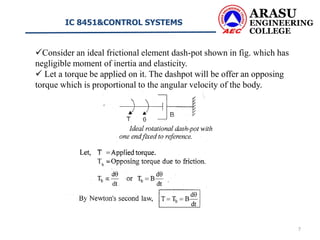
Consider an ideal frictional element dash-pot shown in fig. which has
negligible moment of inertia and elasticity.
 Let a torque be applied on it. The dashpot will be offer an opposing
torque which is proportional to the angular velocity of the body.
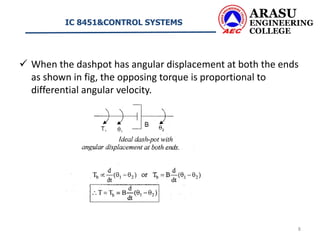
 When the dashpot has angular displacement at both the ends
as shown in fig, the opposing torque is proportional to
differential angular velocity.
ARASU
ENGINEERING
COLLEGE
IC 8451&CONTROL SYSTEMS
8
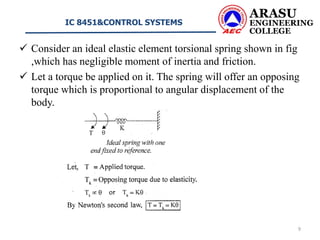
 Consider an ideal elastic element torsional spring shown in fig
,which has negligible moment of inertia and friction.
 Let a torque be applied on it. The spring will offer an opposing
torque which is proportional to angular displacement of the
body.
ARASU
ENGINEERING
COLLEGE
IC 8451&CONTROL SYSTEMS
9
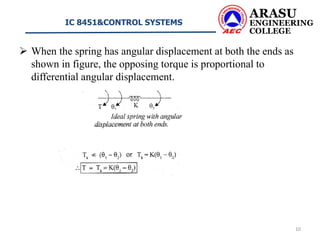
 When the spring has angular displacement at both the ends as
shown in figure, the opposing torque is proportional to
differential angular displacement.
ARASU
ENGINEERING
COLLEGE
IC 8451&CONTROL SYSTEMS
10
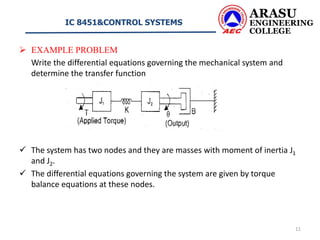
 EXAMPLE PROBLEM
Write the differential equations governing the mechanical system and
determine the transfer function
 The system has two nodes and they are masses with moment of inertia J1
and J2.
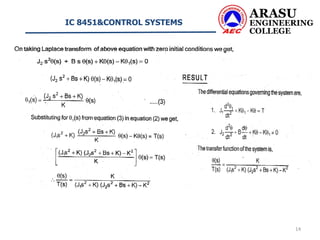
 The differential equations governing the system are given by torque
balance equations at these nodes.
ARASU
ENGINEERING
COLLEGE
IC 8451&CONTROL SYSTEMS
11
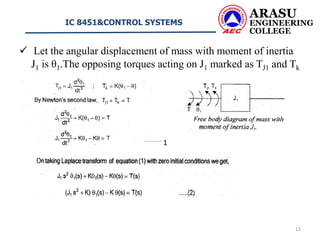
 Let the angular displacement of mass with moment of inertia
J1 is θ1.The opposing torques acting on J1 marked as TJ1 and Tk
ARASU
ENGINEERING
COLLEGE
IC 8451&CONTROL SYSTEMS
12
1
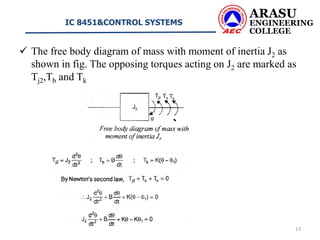
 The free body diagram of mass with moment of inertia J2 as
shown in fig. The opposing torques acting on J2 are marked as
Tj2,Tb and Tk
ARASU
ENGINEERING
COLLEGE
IC 8451&CONTROL SYSTEMS
13
ARASU
ENGINEERING
COLLEGE
IC 8451&CONTROL SYSTEMS
14
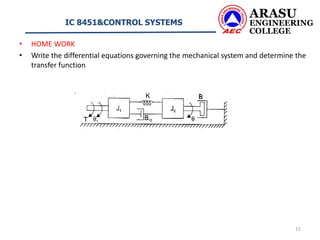
• HOME WORK
• Write the differential equations governing the mechanical system and determine the
transfer function
ARASU
ENGINEERING
COLLEGE
IC 8451&CONTROL SYSTEMS
15

Transfer function of Mechanical rotational system

  • 1.
    IC 8451&CONTROL SYSTEMS Departmentof Electrical and Electronics Engineering Approved by AICTE | Affiliated to Anna University | Accredited by NAAC | Accredited NBA | Recognized by UGC under 2(f) and 12(B) Chennai Main Road, Kumbakonam- 612 501. ARASU ENGINEERING COLLEGE 1
  • 2.
    Prepared by Mrs.K.Kalpana., M.E.,(Ph.D)., Departmentof Electrical and Electronics Engineering ARASU ENGINEERING COLLEGE IC 8451&CONTROL SYSTEMS 2
  • 3.
     MECHANICAL ROTATIONALSYSTEMS  The model of rotational mechanical systems can be obtained by using three elements, moment of inertia [J] of mass, dash-pot with rotational frictional coefficient [B] and torsional spring with stiffness [K].  The weight of the rotational mechanical system is represented by the moment of inertia of the mass.  The moment of inertia of the system or body is considered to be concentrated at the centre of gravity of the body.  The elastic deformation of the body can be represented by a spring (torsional spring).  The friction existing in rotational mechanical system can be represented by the dash-pot.  The dash-pot is a piston rotating inside a cylinder filled with viscous fluid. ARASU ENGINEERING COLLEGE IC 8451&CONTROL SYSTEMS 3
  • 4.
     When atorque is applied to a rotational mechanical system, it is opposed by opposing torques due to moment of inertia, friction and elasticity of the system.  The torques acting on a rotational mechanical body are governed by Newton s second law of motion for rotational systems.  It states that the sum of torques acting on a body is zero (or Newton’s law states that the sum of applied torques is equal to the sum of opposing torques on a body). ARASU ENGINEERING COLLEGE IC 8451&CONTROL SYSTEMS 4
  • 5.
    ARASU ENGINEERING COLLEGE IC 8451&CONTROL SYSTEMS 5 Listof symbols used in mechanical rotational system θ = Angular displacement, rad dθ /dt =Angular velocity, rad /s d2θ / dt2 =Angular acceleration, rad /s2 T =Applied torque, N-m J =Moment of inertia, kg-m2 / rad B =Rotational frictional coefficient, N-m / (rad /s) K =Stiffness of the spring, N –m / rad
  • 6.
    ARASU ENGINEERING COLLEGE IC 8451&CONTROL SYSTEMS 6 Torquebalance equations of idealized elements Consider an ideal mass element shown in fig. which has negligible friction and elasticity. The opposing torque due to moment of inertia is proportional to the angular acceleration.
  • 7.
    ARASU ENGINEERING COLLEGE IC 8451&CONTROL SYSTEMS 7 Consideran ideal frictional element dash-pot shown in fig. which has negligible moment of inertia and elasticity.  Let a torque be applied on it. The dashpot will be offer an opposing torque which is proportional to the angular velocity of the body.
  • 8.
     When thedashpot has angular displacement at both the ends as shown in fig, the opposing torque is proportional to differential angular velocity. ARASU ENGINEERING COLLEGE IC 8451&CONTROL SYSTEMS 8
  • 9.
     Consider anideal elastic element torsional spring shown in fig ,which has negligible moment of inertia and friction.  Let a torque be applied on it. The spring will offer an opposing torque which is proportional to angular displacement of the body. ARASU ENGINEERING COLLEGE IC 8451&CONTROL SYSTEMS 9
  • 10.
     When thespring has angular displacement at both the ends as shown in figure, the opposing torque is proportional to differential angular displacement. ARASU ENGINEERING COLLEGE IC 8451&CONTROL SYSTEMS 10
  • 11.
     EXAMPLE PROBLEM Writethe differential equations governing the mechanical system and determine the transfer function  The system has two nodes and they are masses with moment of inertia J1 and J2.  The differential equations governing the system are given by torque balance equations at these nodes. ARASU ENGINEERING COLLEGE IC 8451&CONTROL SYSTEMS 11
  • 12.
     Let theangular displacement of mass with moment of inertia J1 is θ1.The opposing torques acting on J1 marked as TJ1 and Tk ARASU ENGINEERING COLLEGE IC 8451&CONTROL SYSTEMS 12 1
  • 13.
     The freebody diagram of mass with moment of inertia J2 as shown in fig. The opposing torques acting on J2 are marked as Tj2,Tb and Tk ARASU ENGINEERING COLLEGE IC 8451&CONTROL SYSTEMS 13
  • 14.
  • 15.
    • HOME WORK •Write the differential equations governing the mechanical system and determine the transfer function ARASU ENGINEERING COLLEGE IC 8451&CONTROL SYSTEMS 15