Electrical analogous of mechanical translational system
This document discusses electrical analogies of mechanical translational systems. There are two types of analogies: force-voltage and force-current. Force-voltage analogy models mechanical equations as electrical mesh equations. Force-current analogy models mechanical equations as electrical node equations. Two example problems are presented to illustrate drawing the analogous electrical circuits and verifying with mesh/node equations. Homework is assigned to practice drawing and verifying additional analogous circuits.
Electrical analogous of mechanical translational system
1.
IC 8451&CONTROL SYSTEMS
Departmentof Electrical and Electronics Engineering
Approved by AICTE | Affiliated to Anna University | Accredited by NAAC | Accredited NBA | Recognized by UGC under 2(f) and 12(B)
Chennai Main Road, Kumbakonam- 612 501.
ARASU ENGINEERING COLLEGE
1
ARASU
ENGINEERING
COLLEGE
IC 8451&CONTROL SYSTEMS
3
Electrical Analogous of mechanical translational systems
There are two types of electrical analogies of translational mechanical
systems. Those are force voltage analogy and force current analogy.
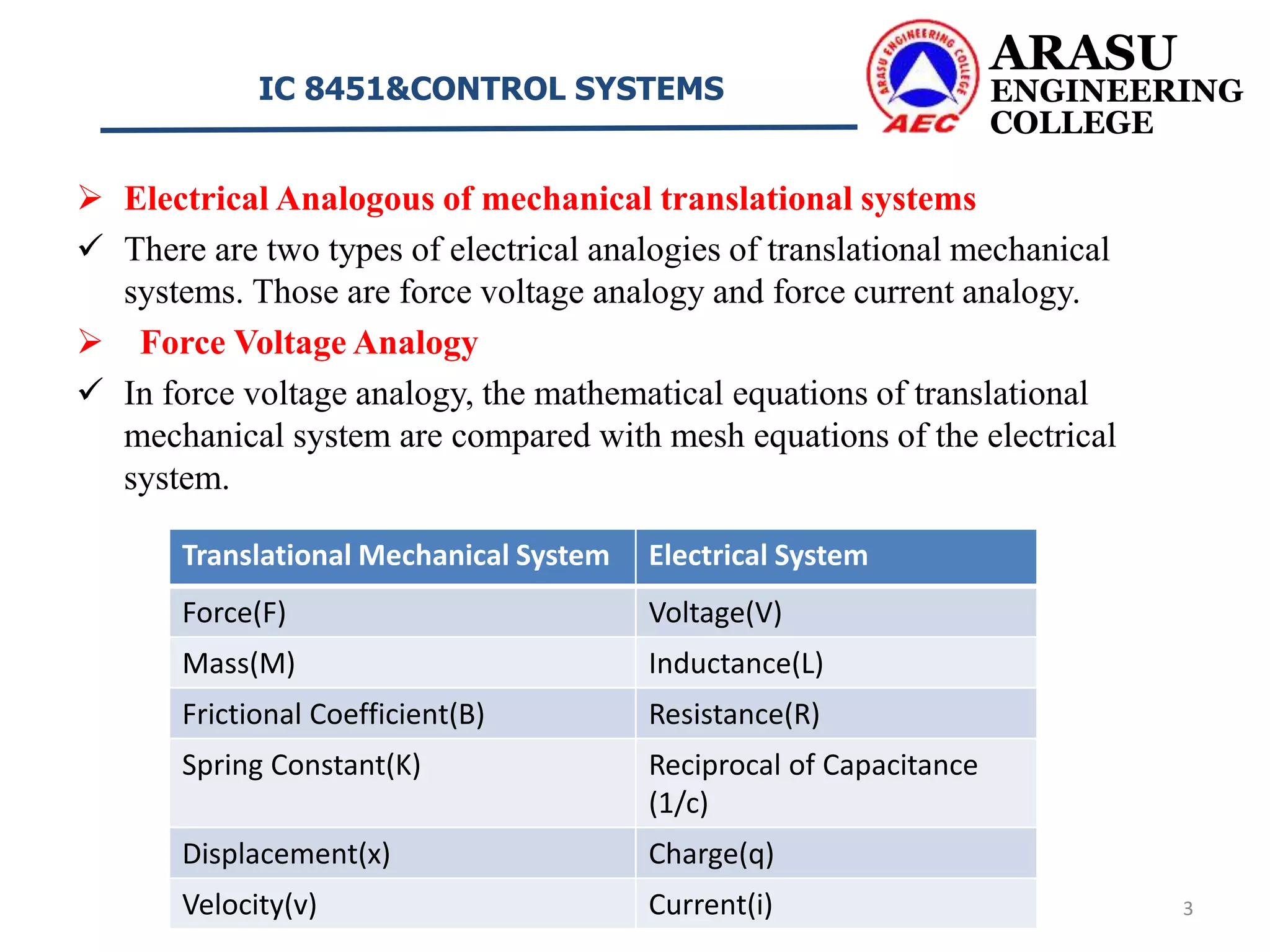
Force Voltage Analogy
In force voltage analogy, the mathematical equations of translational
mechanical system are compared with mesh equations of the electrical
system.
Translational Mechanical System Electrical System
Force(F) Voltage(V)
Mass(M) Inductance(L)
Frictional Coefficient(B) Resistance(R)
Spring Constant(K) Reciprocal of Capacitance
(1/c)
Displacement(x) Charge(q)
Velocity(v) Current(i)
4.
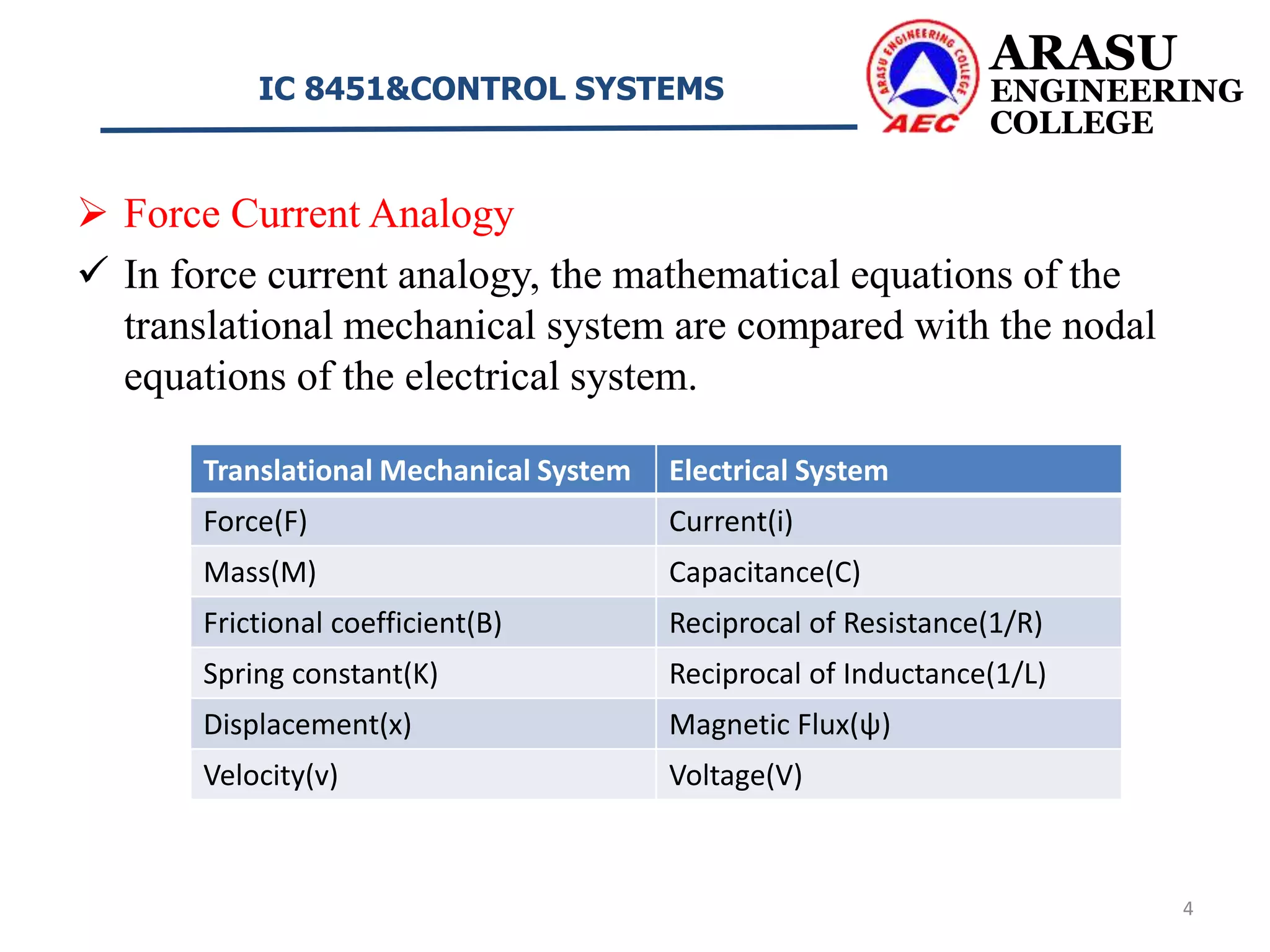
Force CurrentAnalogy
In force current analogy, the mathematical equations of the
translational mechanical system are compared with the nodal
equations of the electrical system.
ARASU
ENGINEERING
COLLEGE
IC 8451&CONTROL SYSTEMS
4
Translational Mechanical System Electrical System
Force(F) Current(i)
Mass(M) Capacitance(C)
Frictional coefficient(B) Reciprocal of Resistance(1/R)
Spring constant(K) Reciprocal of Inductance(1/L)
Displacement(x) Magnetic Flux(ψ)
Velocity(v) Voltage(V)
5.
Analogous elementsin Force voltage analogy
ARASU
ENGINEERING
COLLEGE
IC 8451&CONTROL SYSTEMS
5
ARASU
ENGINEERING
COLLEGE
IC 8451&CONTROL SYSTEMS
7
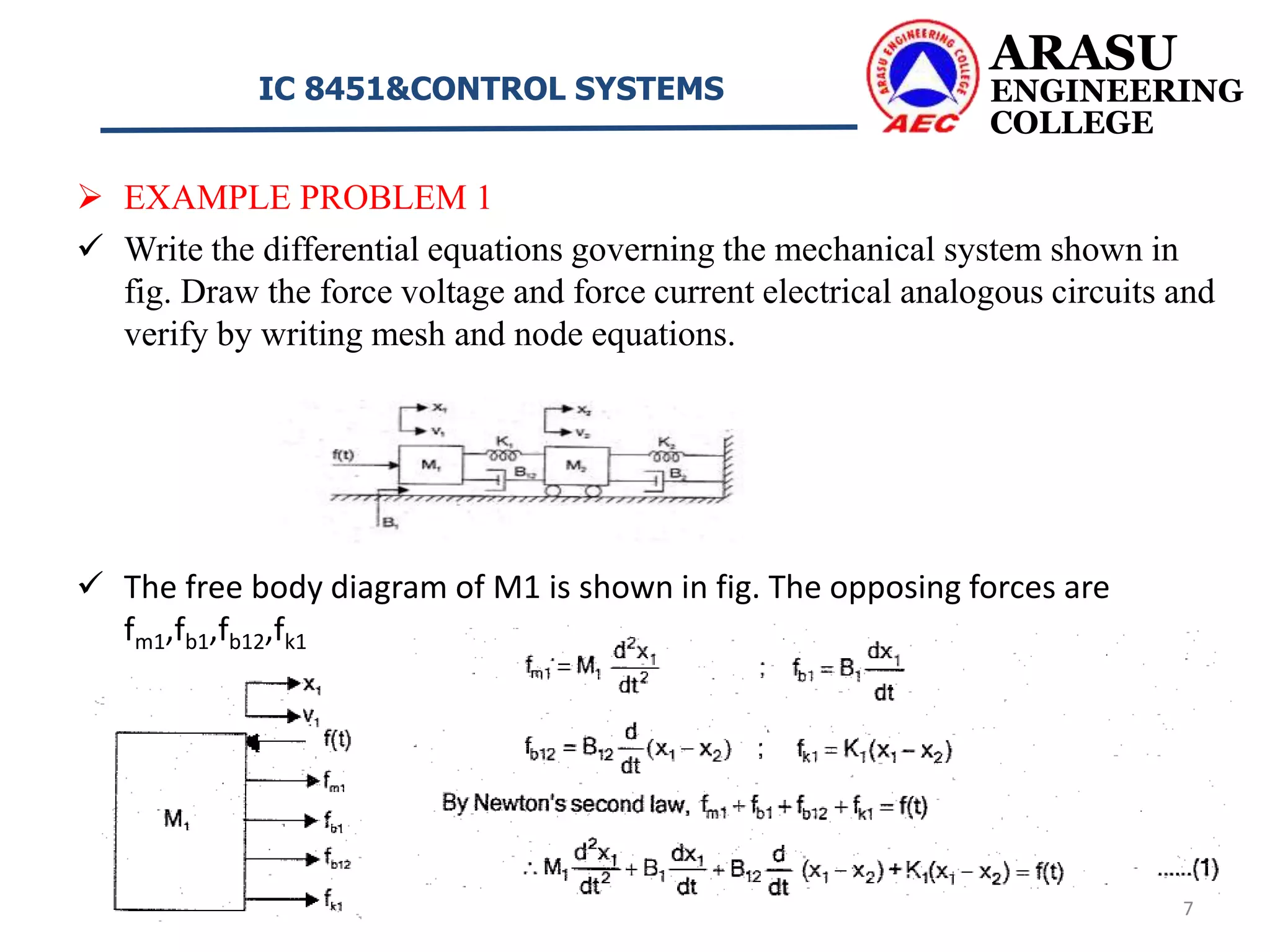
EXAMPLE PROBLEM 1
Write the differential equations governing the mechanical system shown in
fig. Draw the force voltage and force current electrical analogous circuits and
verify by writing mesh and node equations.
The free body diagram of M1 is shown in fig. The opposing forces are
fm1,fb1,fb12,fk1
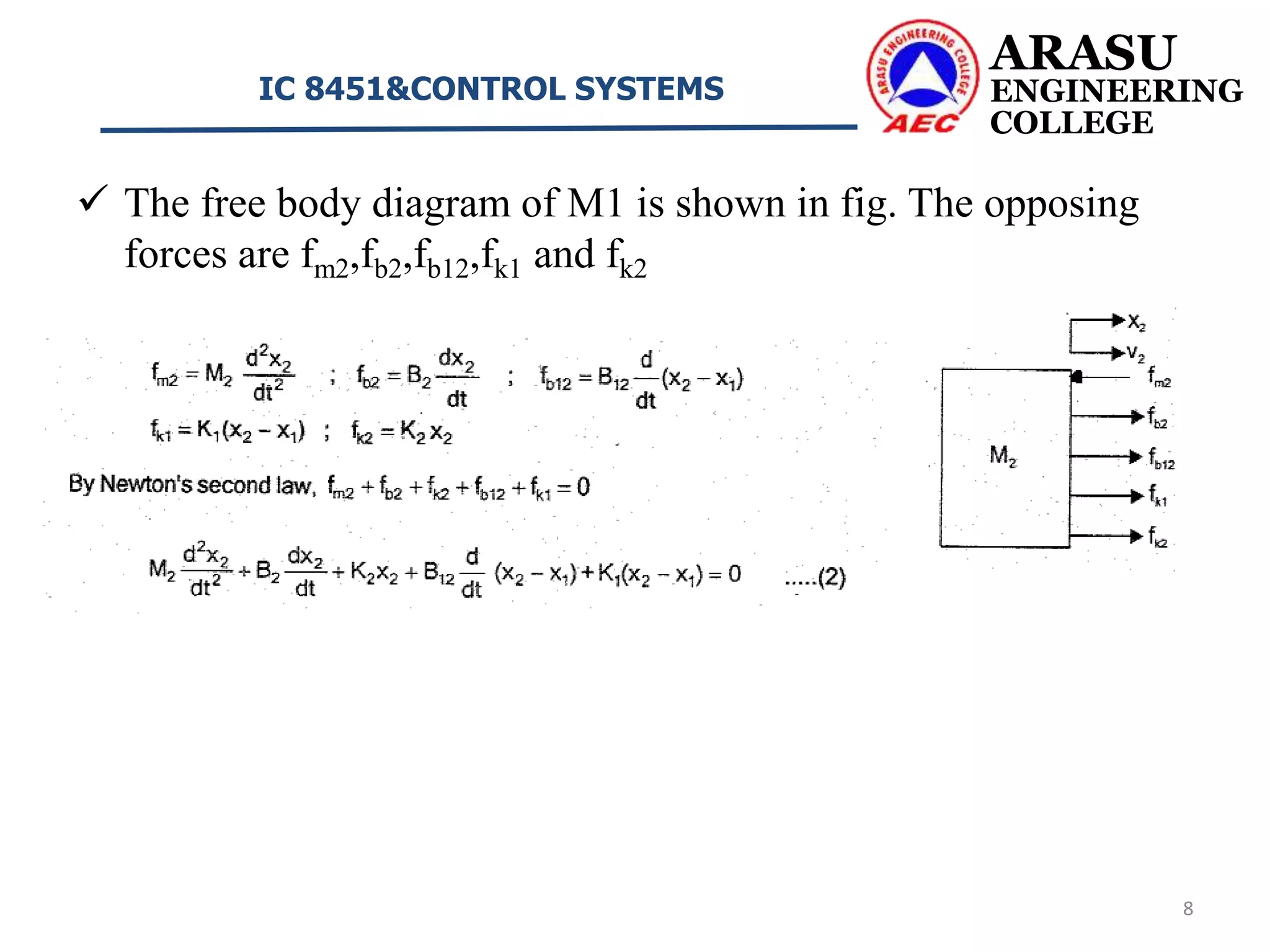
8.
The freebody diagram of M1 is shown in fig. The opposing
forces are fm2,fb2,fb12,fk1 and fk2
ARASU
ENGINEERING
COLLEGE
IC 8451&CONTROL SYSTEMS
8
9.
Force voltageanalogous circuit
The electrical analogous elements for the elements of mechanical
systems are
f(t) - e(t) , M1- L1, M2- L2, B1- R1, B2- R2 ,B12- R12, K1-1/C1, K2-1/C2
The mesh equations are
Force -voltage analogous circuit
ARASU
ENGINEERING
COLLEGE
IC 8451&CONTROL SYSTEMS
9
10.
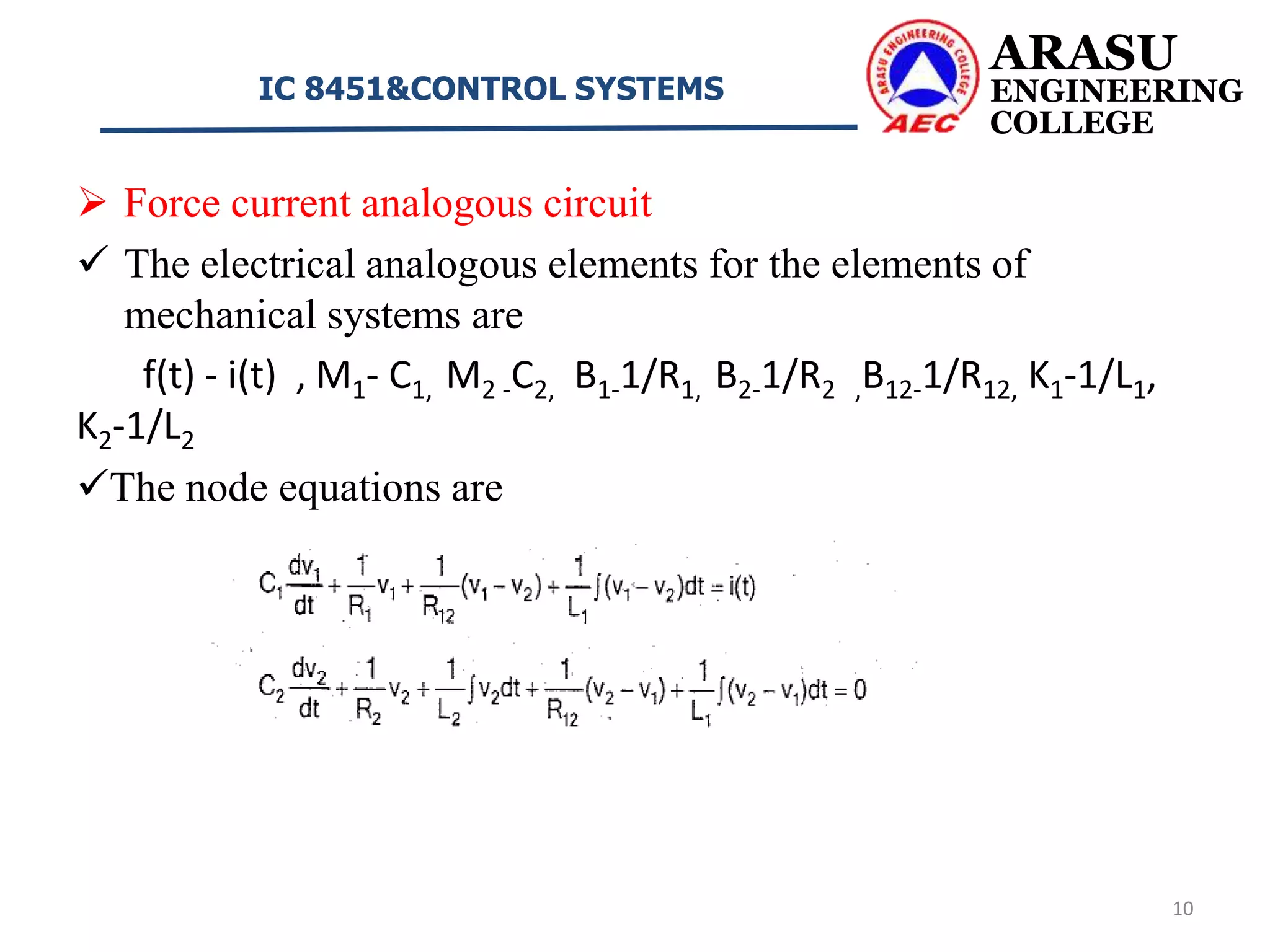
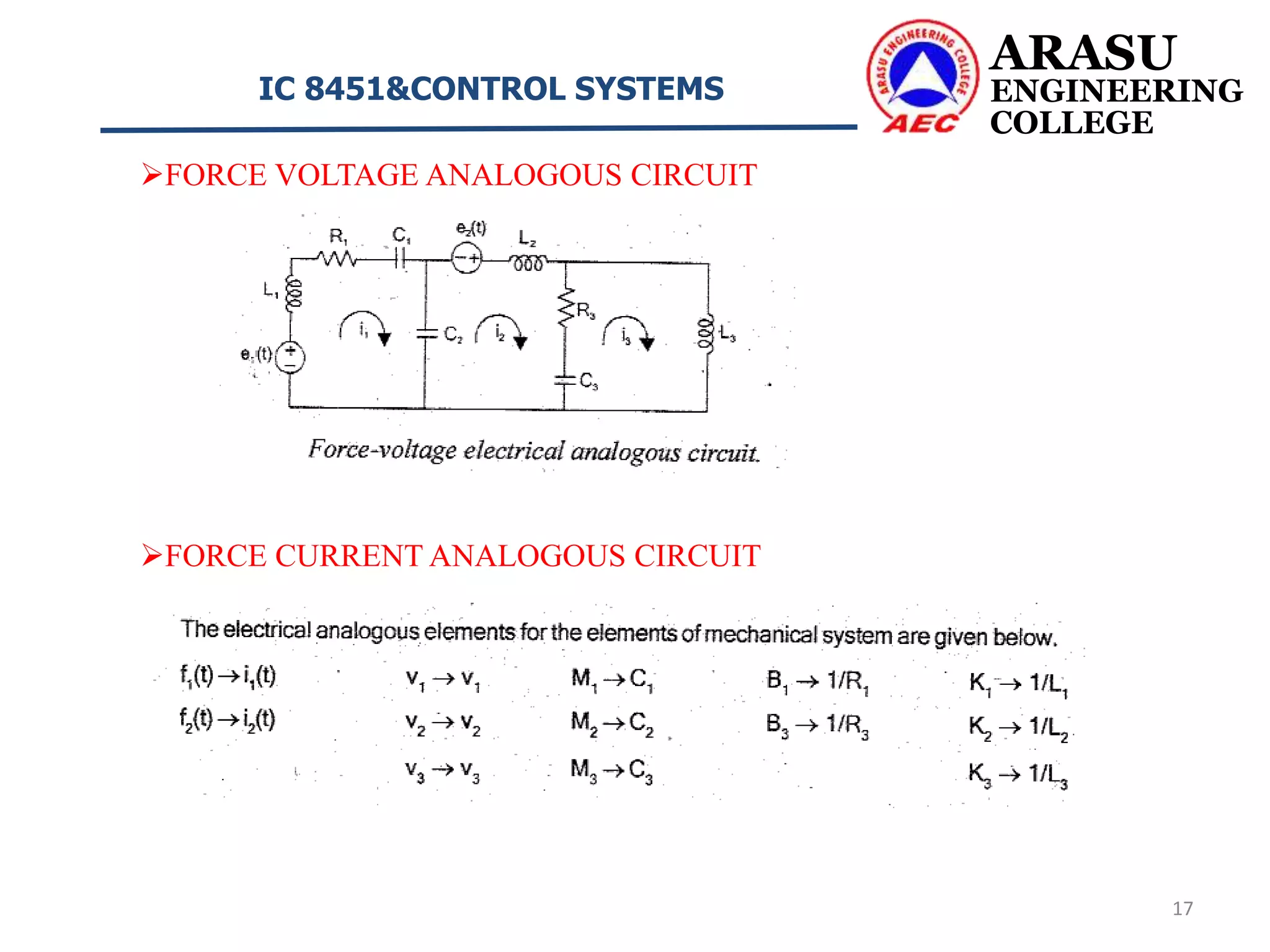
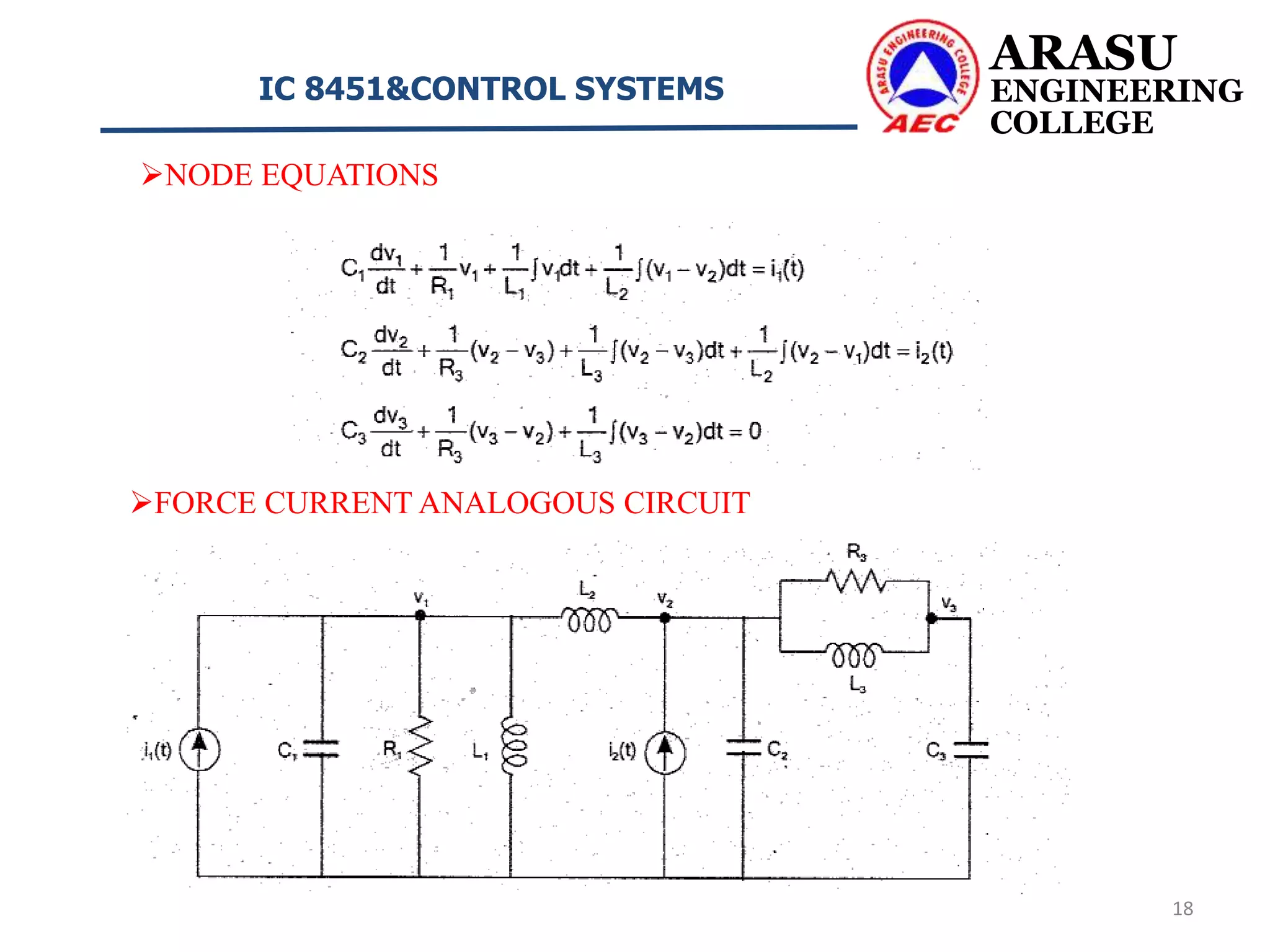
Force currentanalogous circuit
The electrical analogous elements for the elements of
mechanical systems are
f(t) - i(t) , M1- C1, M2 -C2, B1-1/R1, B2-1/R2 ,B12-1/R12, K1-1/L1,
K2-1/L2
The node equations are
ARASU
ENGINEERING
COLLEGE
IC 8451&CONTROL SYSTEMS
10
11.
Force currentanalogous circuit
ARASU
ENGINEERING
COLLEGE
IC 8451&CONTROL SYSTEMS
11
12.
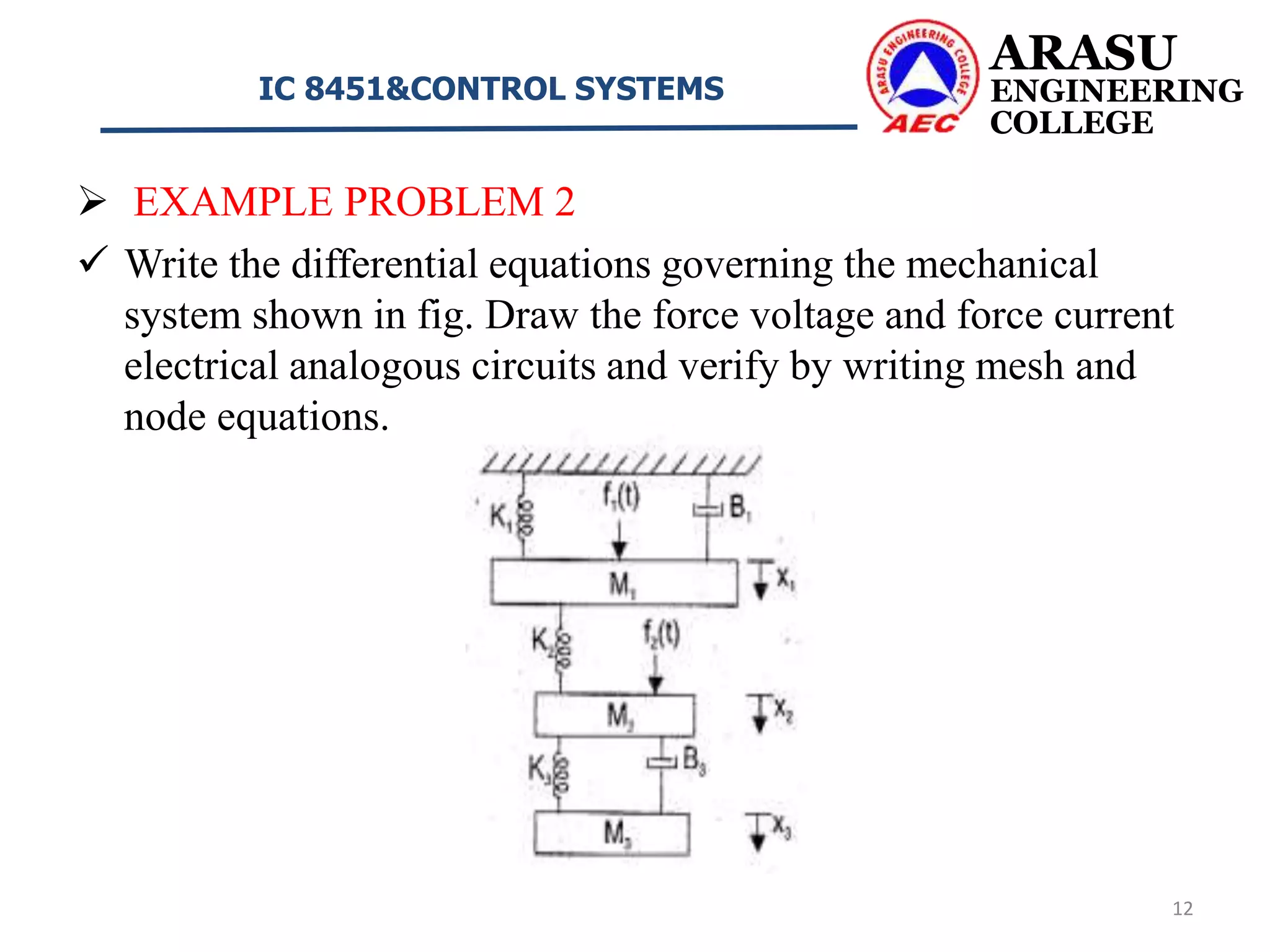
EXAMPLE PROBLEM2
Write the differential equations governing the mechanical
system shown in fig. Draw the force voltage and force current
electrical analogous circuits and verify by writing mesh and
node equations.
ARASU
ENGINEERING
COLLEGE
IC 8451&CONTROL SYSTEMS
12
13.
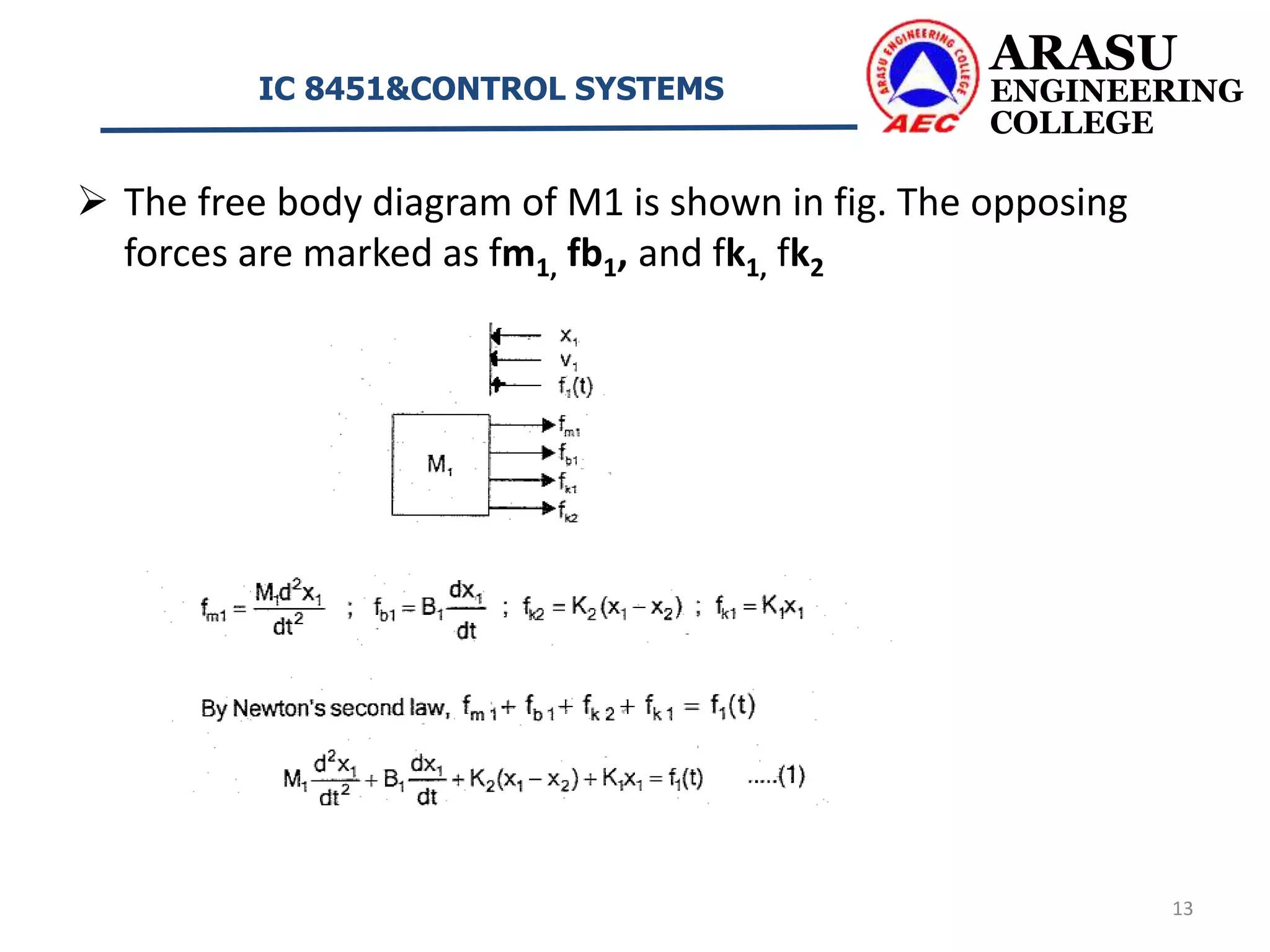
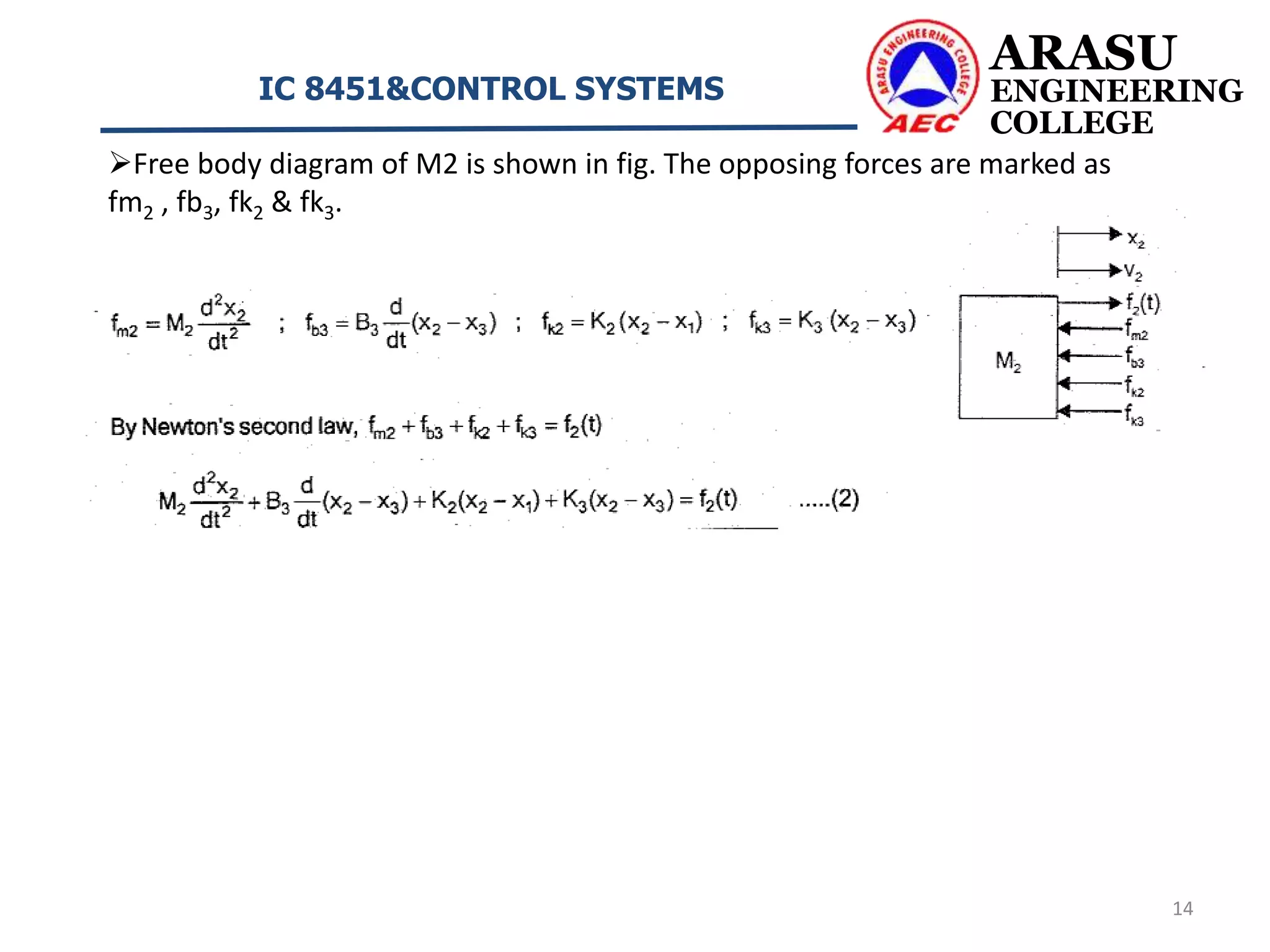
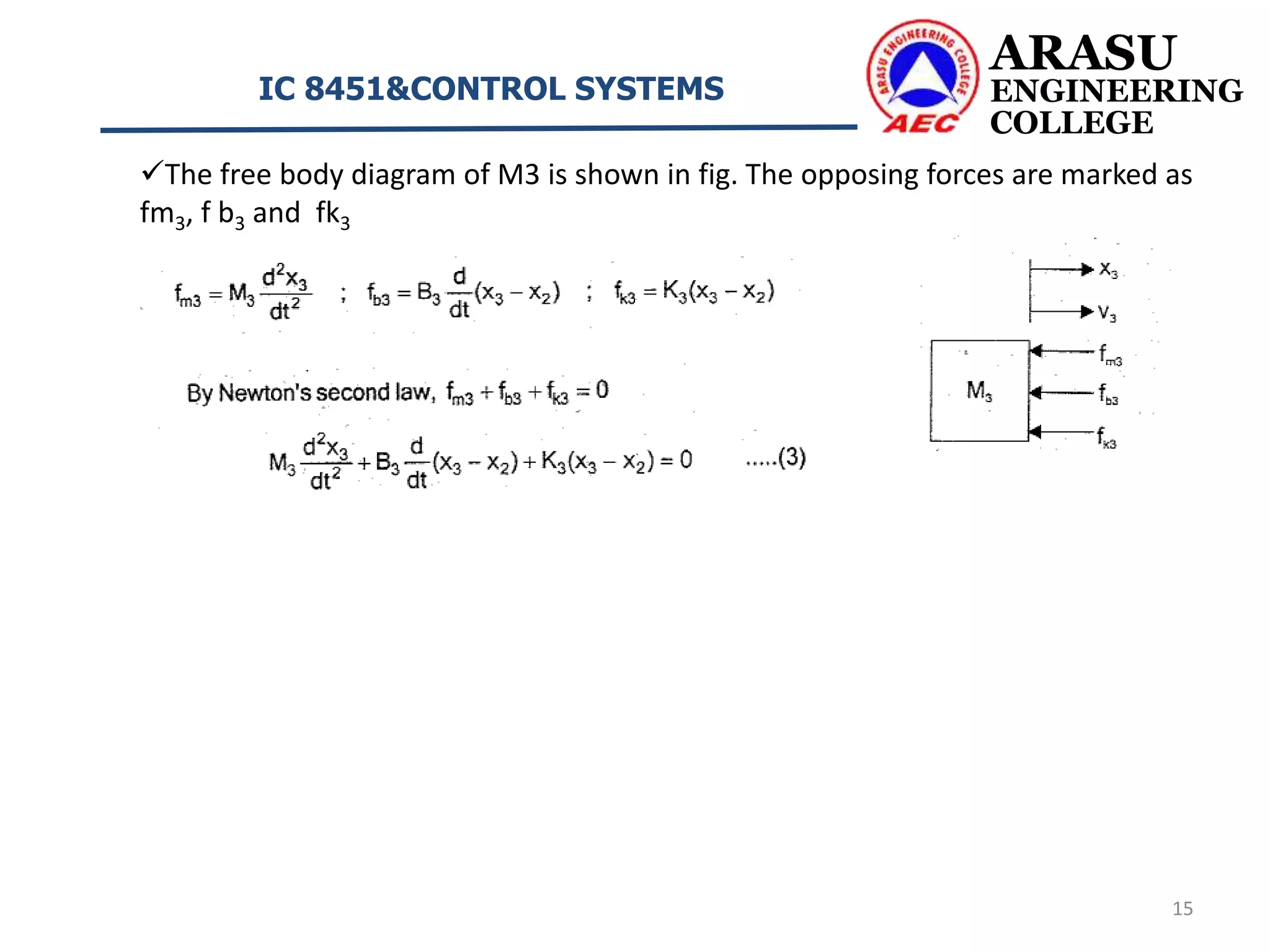
The freebody diagram of M1 is shown in fig. The opposing
forces are marked as fm1, fb1, and fk1, fk2
ARASU
ENGINEERING
COLLEGE
IC 8451&CONTROL SYSTEMS
13
ARASU
ENGINEERING
COLLEGE
IC 8451&CONTROL SYSTEMS
19
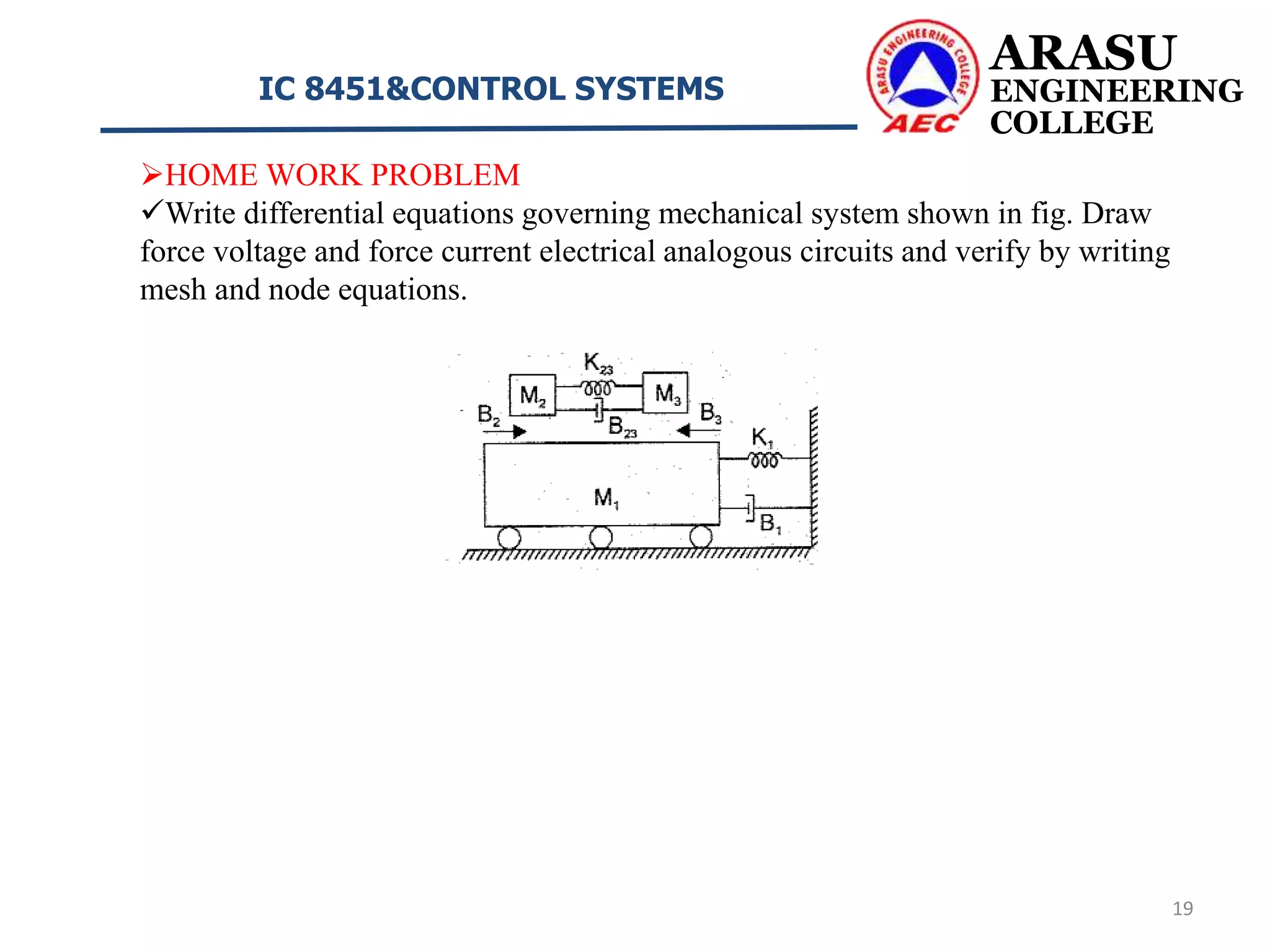
HOMEWORK PROBLEM
Write differential equations governing mechanical system shown in fig. Draw
force voltage and force current electrical analogous circuits and verify by writing
mesh and node equations.