Department of Electrical and Electronics Engineering
Approved by AICTE | Affiliated to Anna University | Accredited by NAAC | Accredited NBA | Recognized by UGC under 2(f) and 12(B)
Chennai Main Road, Kumbakonam- 612 501.
ARASU ENGINEERING COLLEGE
1
ELECTRIC CIRCUITS AND NETWORK THEOREMS
Prepared by
Mrs.K.Kalpana.,M.E.,(Ph.D).,
Assistant Professor
Department of Electrical and Electronics
Engineering
Arasu Engineering College
Kumbakonam
Department of Electrical and Electronics
Engineering
2
INTRODUCTION
 The interconnection of various electric elements in a
prescribed manner comprises as an electric circuit in
order to perform a desired function.
 An electrical network is an interconnection
of electrical components (e.g., batteries, resistors,
inductors, capacitors, switches, transistors) or a model of
such an interconnection, consisting of electrical elements
(e.g., voltage sources, current sources, resistances,
inductances, capacitances).
 The electric elements include controlled and uncontrolled
source of energy, resistors, capacitors, inductors, etc.
ARASU
ENGINEERING
COLLEGE
3
Department of Electrical and Electronics Engineering
INTRODUCTION
 Analysis of electric circuits refers to computations
required to determine the unknown quantities such as
voltage, current and power associated with one or more
elements in the circuit.
 Many other systems, like mechanical, hydraulic, thermal,
magnetic and power system are easy to analyze and
model by a circuit.
 To learn how to analyze the models of these systems,
first one needs to learn the techniques of circuit analysis.
ARASU
ENGINEERING
COLLEGE
4
Department of Electrical and Electronics Engineering
BASIC ELEMENTS & INTRODUCTORY CONCEPTS
• Electrical Network: A combination of various
electric elements (Resistor, Inductor, Capacitor,
Voltage source, Current source) connected in any
manner what so ever is called an electrical network.
We may classify circuit elements in two categories,
passive and active elements.
• Passive Element: The element which receives
energy (or absorbs energy) and then either converts
it into heat (R) or stored it in an electric (C) or magnetic
(L ) field is called passive element.
ARASU
ENGINEERING
COLLEGE
5
Department of Electrical and Electronics Engineering
Active Element: The elements that supply energy to
the circuit is called active element.
 Examples of active elements include voltage and
current sources, generators and electronic devices that
require power supplies.
 A transistor is an active circuit element, meaning that it
can amplify power of a signal.
ARASU
ENGINEERING
COLLEGE
6
Department of Electrical and Electronics Engineering
 Bilateral Element: Conduction of current in both
directions in an element (example: Resistance;
Inductance; capacitance ) with same magnitude is
termed as bilateral element.
 Unilateral Element: Conduction of current in one
direction is termed as unilateral (example: Diode,
Transistor) element.
 Response: An application of input signal to the
system will produce an output signal, the behavior of
output signal with time is known as the response of the
system
ARASU
ENGINEERING
COLLEGE
7
Department of Electrical and Electronics Engineering
Potential Energy Difference: The voltage or
potential energy difference between two points in an
electric circuit is the amount of energy required to
move a unit charge between the two points.
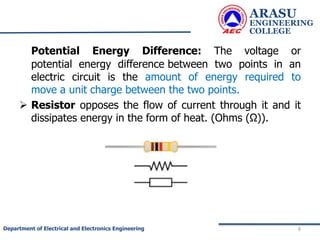
 Resistor opposes the flow of current through it and it
dissipates energy in the form of heat. (Ohms (Ω)).
ARASU
ENGINEERING
COLLEGE
8
Department of Electrical and Electronics Engineering
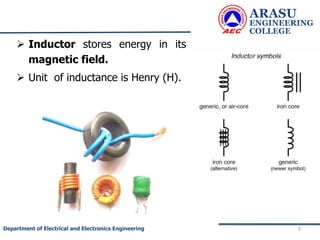
 Inductor stores energy in its
magnetic field.
 Unit of inductance is Henry (H).
ARASU
ENGINEERING
COLLEGE
9
Department of Electrical and Electronics Engineering
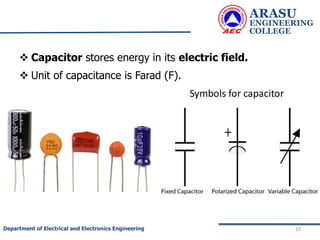
 Capacitor stores energy in its electric field.
 Unit of capacitance is Farad (F).
ARASU
ENGINEERING
COLLEGE
10
Department of Electrical and Electronics Engineering
Classification of sources( active elements)
Sources (active elements) are classified as
1. Independent sources
2. Dependent sources
1. Independent sources:
Batteries and generators are called independent sources
which can directly generate electrical energy. Independent
sources do not depend on other electrical sources.
2. Dependent sources:
Transistors and Op-amps are called dependent sources
whose output energy depends on other independent sources.
ARASU
ENGINEERING
COLLEGE
11
Department of Electrical and Electronics Engineering
EE8251- CIRCUIT THEORY
V-I characteristics of ideal and practical sources:
Ideal voltage sources:
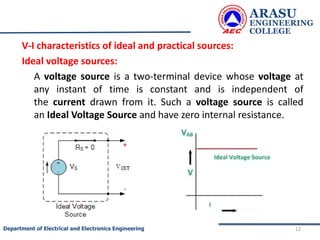
A voltage source is a two-terminal device whose voltage at
any instant of time is constant and is independent of
the current drawn from it. Such a voltage source is called
an Ideal Voltage Source and have zero internal resistance.
ARASU
ENGINEERING
COLLEGE
12
Department of Electrical and Electronics Engineering
Practical Voltage sources:
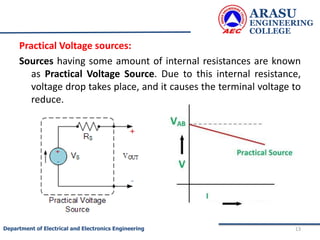
Sources having some amount of internal resistances are known
as Practical Voltage Source. Due to this internal resistance,
voltage drop takes place, and it causes the terminal voltage to
reduce.
ARASU
ENGINEERING
COLLEGE
13
Department of Electrical and Electronics Engineering
ARASU
ENGINEERING
COLLEGE
14
Department of Electrical and Electronics Engineering
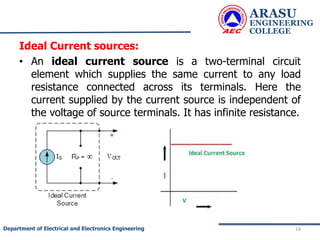
Ideal Current sources:
• An ideal current source is a two-terminal circuit
element which supplies the same current to any load
resistance connected across its terminals. Here the
current supplied by the current source is independent of
the voltage of source terminals. It has infinite resistance.
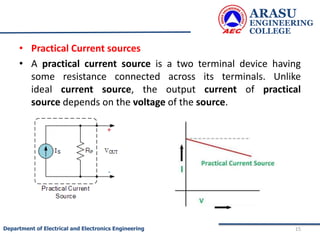
• Practical Current sources
• A practical current source is a two terminal device having
some resistance connected across its terminals. Unlike
ideal current source, the output current of practical
source depends on the voltage of the source.
ARASU
ENGINEERING
COLLEGE
15
Department of Electrical and Electronics Engineering
Active Network:
A network that contains at least one active
element, such as an independent voltage or
current source, is an active network.
Passive Network:
A network that does not contain any active
elements is a passive network.
ARASU
ENGINEERING
COLLEGE
16
Department of Electrical and Electronics Engineering
Lumped elements :
Physically separated elements such as resistor,
capacitor and inductors are called as lumped elements.
Distributed element :
It is not separable for electrical purposes. A
transmission line has distributed resistance, inductance
& capacitance along its length.
ARASU
ENGINEERING
COLLEGE
17
Department of Electrical and Electronics Engineering
Bilateral element :
 Conduction of current in both directions in an
element with same magnitude. (Ex: R,L,C)
In a bilateral element, the voltage and current
relation is the same for current flowing in either
direction.
Unilateral elements-:
Conduction of current in one direction.(Ex:
Diode, Transistor).
ARASU
ENGINEERING
COLLEGE
18
Department of Electrical and Electronics Engineering
D.C circuits:
The direction of current flow, at any point in the circuit,
does not change with time.
A.C circuits:
The direction of current flow (as well as its magnitude)
changes with time.
CHARGE
Charge is an electrical property of the atomic particles of
which matter consists, measured in coulombs (C).
Charge, positive or negative, is denoted by the letter q
or Q.
ARASU
ENGINEERING
COLLEGE
19
Department of Electrical and Electronics Engineering
EE8251- CIRCUIT THEORY
CURRENT
 Current can be defined as the rate of flow of electrons
in a conductive or semi conductive material, measured in
Ampere (A).
 Electric current, is denoted by the letter i or I.
 The unit of current is the ampere abbreviated as (A) and
corresponds to the quantity of total charge that passes
through an arbitrary cross section of a conducting
material per unit second.
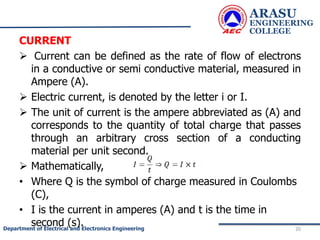
 Mathematically,
• Where Q is the symbol of charge measured in Coulombs
(C),
• I is the current in amperes (A) and t is the time in
second (s).
ARASU
ENGINEERING
COLLEGE
20
Department of Electrical and Electronics Engineering
 The current can also be defined as the rate of charge
passing through a point in an electric circuit.
 Mathematically, i= dq/dt
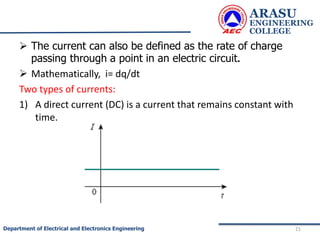
Two types of currents:
1) A direct current (DC) is a current that remains constant with
time.
ARASU
ENGINEERING
COLLEGE
21
Department of Electrical and Electronics Engineering
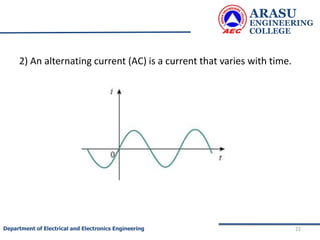
2) An alternating current (AC) is a current that varies with time.
ARASU
ENGINEERING
COLLEGE
22
Department of Electrical and Electronics Engineering
• The difference in potential energy of the charges is
called potential difference.
• It is also known as voltage.
• It is denoted by V, unit Volts
• V=W/Q or dw/dQ
ARASU
ENGINEERING
COLLEGE
23
Department of Electrical and Electronics Engineering
VOLTAGE (or) POTENTIAL DIFFERENCE :
ARASU
ENGINEERING
COLLEGE
24
Department of Electrical and Electronics Engineering
POWER
Power is the rate of change of energy, measured in
watts (W). Power, is denoted by the letter p or P.
Mathematically, P=dw/dt
Where P is power in watts (W),
w is energy in joules (J), and
t is time in seconds (s).
From voltage and current equations, it follows that;
P=dw/dt= dw/dq X dq/dt
= V X I
Thus, if the magnitude of current I and voltage are given,
then power can be evaluated as the product of the two
quantities and is measured in watts (W).
ARASU
ENGINEERING
COLLEGE
25
Department of Electrical and Electronics Engineering
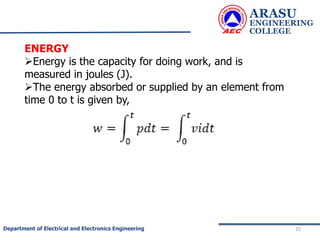
ENERGY
Energy is the capacity for doing work, and is
measured in joules (J).
The energy absorbed or supplied by an element from
time 0 to t is given by,
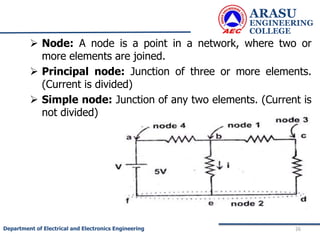
 Node: A node is a point in a network, where two or
more elements are joined.
 Principal node: Junction of three or more elements.
(Current is divided)
 Simple node: Junction of any two elements. (Current is
not divided)
ARASU
ENGINEERING
COLLEGE
26
Department of Electrical and Electronics Engineering
 Branch: Branch represents a single element connected
between two nodes such as a voltage source or resistor.
In the above circuit, the branches are: af, ab, bc, cd, be.
 Loop: Loop is an any closed path in the circuit. In the
above circuit, the loops are: abefa, bcdeb, abcdfa.
 Mesh: Mesh is a closed path that does not contain any
other loops .In the above circuit, the meshes are: abefa,
bcdeb.
ARASU
ENGINEERING
COLLEGE
27
Department of Electrical and Electronics Engineering
Ohm’s Law:
 Ohm's law states that the current through a conductor
is directly proportional to the potential difference or
voltage across the two points, that the temperature of
the conductor remains constant
V ∝ I (Or) V = IR
 The mathematical equation that describes this
relationship is: V / I= R
ARASU
ENGINEERING
COLLEGE
28
Department of Electrical and Electronics Engineering
 where I is the current through the resistance in units of
amperes,
 V is the potential difference measured across the
resistance in units of volts, and
 where R is the proportionality constant.
R is called Resistance of the conductor and is measured
in ‘Ohms’ (Ω).
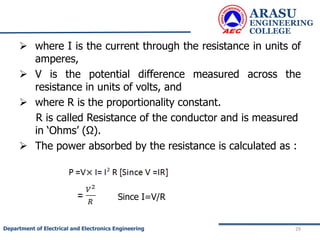
 The power absorbed by the resistance is calculated as :
ARASU
ENGINEERING
COLLEGE
29
Department of Electrical and Electronics Engineering
Since I=V/R
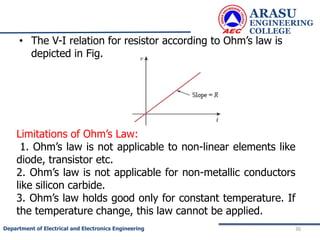
• The V-I relation for resistor according to Ohm’s law is
depicted in Fig.
ARASU
ENGINEERING
COLLEGE
30
Department of Electrical and Electronics Engineering
Limitations of Ohm’s Law:
1. Ohm’s law is not applicable to non-linear elements like
diode, transistor etc.
2. Ohm’s law is not applicable for non-metallic conductors
like silicon carbide.
3. Ohm’s law holds good only for constant temperature. If
the temperature change, this law cannot be applied.
KIRCHOFF'S LAW
Kirchoff's First Law - The Current Law, (KCL)
 It states that “the algebraic sum of currents meeting at a
junction(node) is equal to zero".
 In other words the algebraic sum of ALL the currents
entering and leaving a node must be equal to zero,
 I(exiting) + I(entering) = 0.
 In case of AC circuits, Kirchoff’s current law
states that phasor sum of incoming current is
equal to the phasor sum of outgoing current.
ARASU
ENGINEERING
COLLEGE
31
Department of Electrical and Electronics Engineering
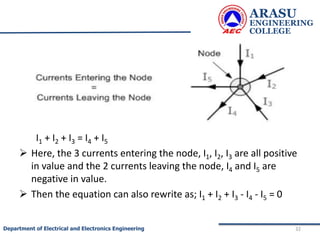
I1 + I2 + I3 = I4 + I5
 Here, the 3 currents entering the node, I1, I2, I3 are all positive
in value and the 2 currents leaving the node, I4 and I5 are
negative in value.
 Then the equation can also rewrite as; I1 + I2 + I3 - I4 - I5 = 0
ARASU
ENGINEERING
COLLEGE
32
Department of Electrical and Electronics Engineering
Kirchhoff’s Voltage Law (KVL):
 The algebraic sum of electromotive forces plus the
algebraic sum of voltages across the impedances
(resistances) in any closed electrical circuit is equal to
zero.
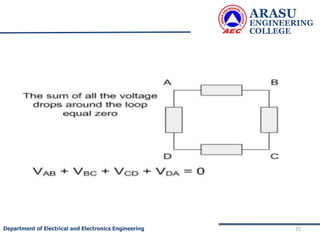
 For any closed path in a circuit, the algebraic sum of
the voltage is zero.
 In other words, for any closed path in a circuit, the
sum of voltage rise is equal to sum of voltage drop.
 Mathematically, ∑emf + ∑ IR =0 in any closed
electrical circuit.
ARASU
ENGINEERING
COLLEGE
33
Department of Electrical and Electronics Engineering
ARASU
ENGINEERING
COLLEGE
34
Department of Electrical and Electronics Engineering
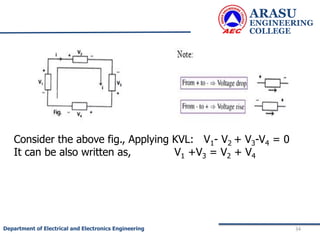
Consider the above fig., Applying KVL: V1- V2 + V3-V4 = 0
It can be also written as, V1 +V3 = V2 + V4
ARASU
ENGINEERING
COLLEGE
35
Department of Electrical and Electronics Engineering
ARASU
ENGINEERING
COLLEGE
36
Department of Electrical and Electronics Engineering
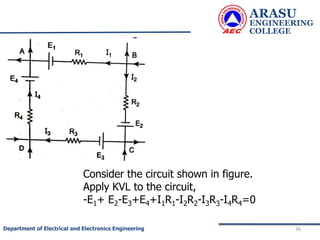
Consider the circuit shown in figure.
Apply KVL to the circuit,
-E1+ E2-E3+E4+I1R1-I2R2-I3R3-I4R4=0
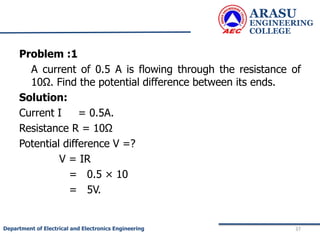
Problem :1
A current of 0.5 A is flowing through the resistance of
10Ω. Find the potential difference between its ends.
Solution:
Current I = 0.5A.
Resistance R = 10Ω
Potential difference V =?
V = IR
= 0.5 × 10
= 5V.
ARASU
ENGINEERING
COLLEGE
37
Department of Electrical and Electronics Engineering
ARASU
ENGINEERING
COLLEGE
38
Department of Electrical and Electronics Engineering
Problem: 2
A supply voltage of 220V is applied to a resistor100Ω.
Find the current flowing through it.
Solution:
Voltage V = 220V
Resistance R = 100Ω
Current I = V/ R
= 2 2 0 /100
= 2.2 A.
ARASU
ENGINEERING
COLLEGE
39
Department of Electrical and Electronics Engineering
Problem: 3
Calculate the resistance of the conductor if a current of 2A
flows through it when the potential difference across its
ends is 6V.
Solution:
Current I = 2A.
Potential difference V = 6.
Resistance R = V/I
= 6 /2
R= 3 ohm.
Problem: 4
Calculate the current and resistance of a 100 W, 200V electric
bulb.
Solution:
Power, P = 100W
Voltage, V = 200V
Power P= VI
Current I = P/V
= 100/200
= 0.5A
Resistance R = V /I
= 200/0.5
= 400Ω
ARASU
ENGINEERING
COLLEGE
40
Department of Electrical and Electronics Engineering
ARASU
ENGINEERING
COLLEGE
41
Department of Electrical and Electronics Engineering
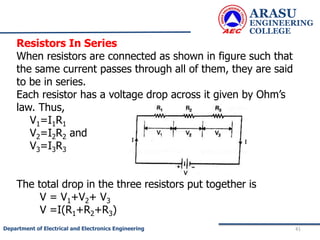
Resistors In Series
When resistors are connected as shown in figure such that
the same current passes through all of them, they are said
to be in series.
Each resistor has a voltage drop across it given by Ohm’s
law. Thus,
V1=I1R1
V2=I2R2 and
V3=I3R3
The total drop in the three resistors put together is
V = V1+V2+ V3
V =I(R1+R2+R3)
ARASU
ENGINEERING
COLLEGE
42
Department of Electrical and Electronics Engineering
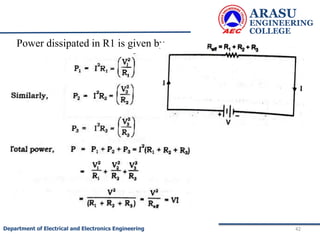
Power dissipated in R1 is given by
ARASU
ENGINEERING
COLLEGE
43
Department of Electrical and Electronics Engineering
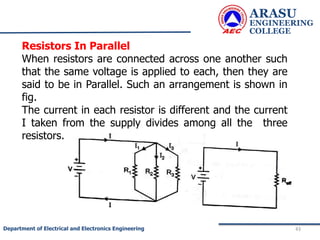
Resistors In Parallel
When resistors are connected across one another such
that the same voltage is applied to each, then they are
said to be in Parallel. Such an arrangement is shown in
fig.
The current in each resistor is different and the current
I taken from the supply divides among all the three
resistors.
ARASU
ENGINEERING
COLLEGE
44
Department of Electrical and Electronics Engineering
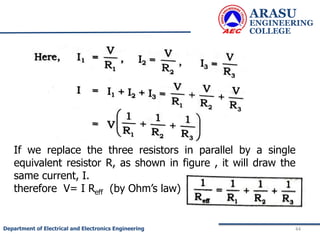
If we replace the three resistors in parallel by a single
equivalent resistor R, as shown in figure , it will draw the
same current, I.
therefore V= I Reff (by Ohm’s law)
ARASU
ENGINEERING
COLLEGE
45
Department of Electrical and Electronics Engineering
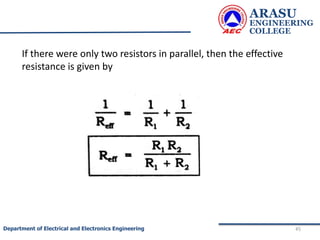
If there were only two resistors in parallel, then the effective
resistance is given by
ARASU
ENGINEERING
COLLEGE
46
Department of Electrical and Electronics Engineering
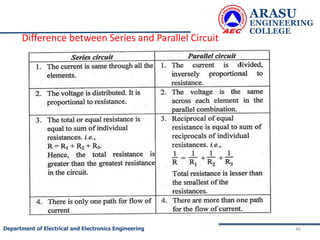
Difference between Series and Parallel Circuit
ARASU
ENGINEERING
COLLEGE
47
Department of Electrical and Electronics Engineering
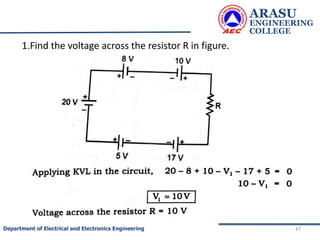
1.Find the voltage across the resistor R in figure.
ARASU
ENGINEERING
COLLEGE
48
Department of Electrical and Electronics Engineering
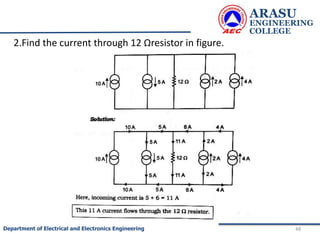
2.Find the current through 12 Ωresistor in figure.
ARASU
ENGINEERING
COLLEGE
49
Department of Electrical and Electronics Engineering
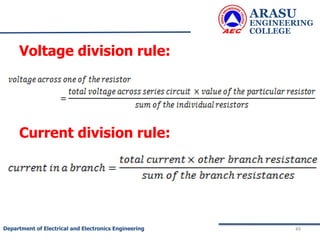
Voltage division rule:
Current division rule:
ARASU
ENGINEERING
COLLEGE
50
Department of Electrical and Electronics Engineering
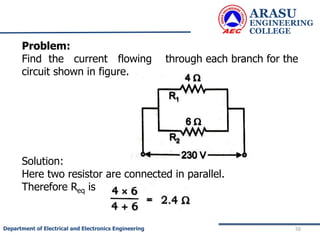
Problem:
Find the current flowing through each branch for the
circuit shown in figure.
Solution:
Here two resistor are connected in parallel.
Therefore Req is
ARASU
ENGINEERING
COLLEGE
51
Department of Electrical and Electronics Engineering
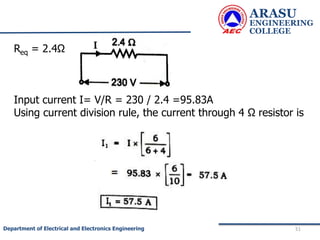
Req = 2.4Ω
Input current I= V/R = 230 / 2.4 =95.83A
Using current division rule, the current through 4 Ω resistor is
ARASU
ENGINEERING
COLLEGE
52
Department of Electrical and Electronics Engineering
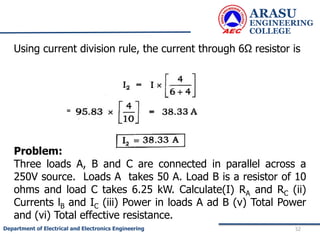
Using current division rule, the current through 6Ω resistor is
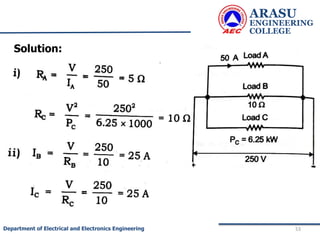
Problem:
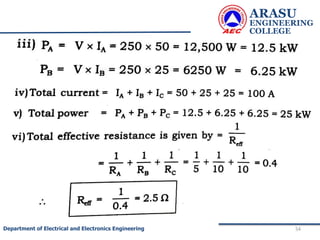
Three loads A, B and C are connected in parallel across a
250V source. Loads A takes 50 A. Load B is a resistor of 10
ohms and load C takes 6.25 kW. Calculate(I) RA and RC (ii)
Currents lB and IC (iii) Power in loads A ad B (v) Total Power
and (vi) Total effective resistance.
ARASU
ENGINEERING
COLLEGE
53
Department of Electrical and Electronics Engineering
Solution:
ARASU
ENGINEERING
COLLEGE
54
Department of Electrical and Electronics Engineering
ARASU
ENGINEERING
COLLEGE
55
Department of Electrical and Electronics Engineering
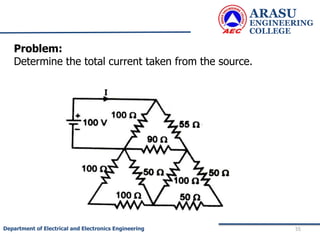
Problem:
Determine the total current taken from the source.
ARASU
ENGINEERING
COLLEGE
56
Department of Electrical and Electronics Engineering
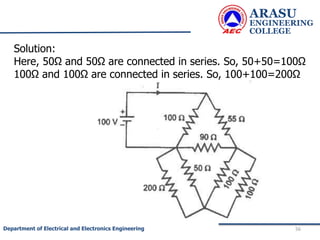
Solution:
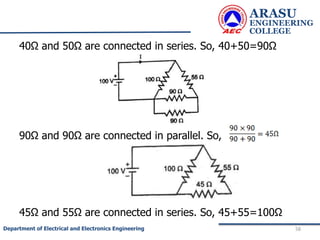
Here, 50Ω and 50Ω are connected in series. So, 50+50=100Ω
100Ω and 100Ω are connected in series. So, 100+100=200Ω
ARASU
ENGINEERING
COLLEGE
57
Department of Electrical and Electronics Engineering
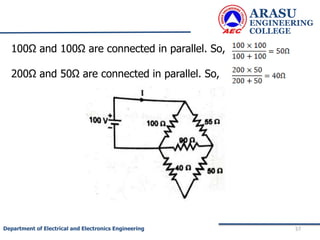
100Ω and 100Ω are connected in parallel. So,
200Ω and 50Ω are connected in parallel. So,
ARASU
ENGINEERING
COLLEGE
58
Department of Electrical and Electronics Engineering
40Ω and 50Ω are connected in series. So, 40+50=90Ω
90Ω and 90Ω are connected in parallel. So,
45Ω and 55Ω are connected in series. So, 45+55=100Ω
ARASU
ENGINEERING
COLLEGE
59
Department of Electrical and Electronics Engineering
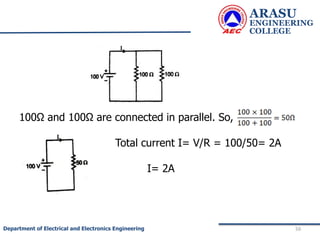
100Ω and 100Ω are connected in parallel. So,
Total current I= V/R = 100/50= 2A
I= 2A
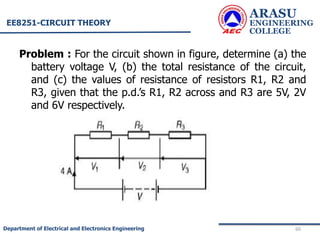
Problem : For the circuit shown in figure, determine (a) the
battery voltage V, (b) the total resistance of the circuit,
and (c) the values of resistance of resistors R1, R2 and
R3, given that the p.d.’s R1, R2 across and R3 are 5V, 2V
and 6V respectively.
ARASU
ENGINEERING
COLLEGE
60
Department of Electrical and Electronics Engineering
EE8251-CIRCUIT THEORY
ARASU
ENGINEERING
COLLEGE
61
Department of Electrical and Electronics Engineering
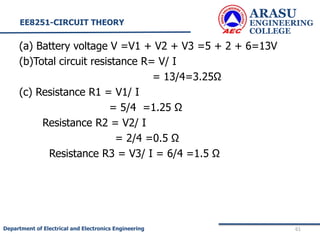
(a) Battery voltage V =V1 + V2 + V3 =5 + 2 + 6=13V
(b)Total circuit resistance R= V/ I
= 13/4=3.25Ω
(c) Resistance R1 = V1/ I
= 5/4 =1.25 Ω
Resistance R2 = V2/ I
= 2/4 =0.5 Ω
Resistance R3 = V3/ I = 6/4 =1.5 Ω
EE8251-CIRCUIT THEORY
ARASU
ENGINEERING
COLLEGE
62
Department of Electrical and Electronics Engineering
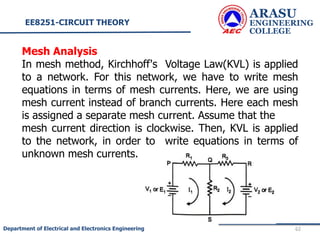
Mesh Analysis
In mesh method, Kirchhoff's Voltage Law(KVL) is applied
to a network. For this network, we have to write mesh
equations in terms of mesh currents. Here, we are using
mesh current instead of branch currents. Here each mesh
is assigned a separate mesh current. Assume that the
mesh current direction is clockwise. Then, KVL is applied
to the network, in order to write equations in terms of
unknown mesh currents.
EE8251-CIRCUIT THEORY
ARASU
ENGINEERING
COLLEGE
63
Department of Electrical and Electronics Engineering
EE8251-CIRCUIT THEORY
The branch Current can be found out by taking the
algebraic sum of the mesh currents which are common to
that branch.
The following steps should be implemented to find out the
mesh currents and branch currents.
Consider a simple network as shown in figure.
Step 1: First, each mesh is assigned a separate mesh
current. Assume all mesh currents directions are
clockwise. It consists of two meshes
(PQSP and QRSQ) and two mesh currents (I1 and I2).
Step 2: If two mesh currents (I1 and I2) are flowing
through a network elements, the actual current in the
circuit element is the algebraic sum of the two mesh
currents (I1 and I2). In this network, mesh currents, I1
and I2 are flowing through R2. First we consider one
direction i.e., Q to S, current is I1-I2 and in for another
direction. i.e., S to Q, current is I2-I1
ARASU
ENGINEERING
COLLEGE
64
Department of Electrical and Electronics Engineering
EE8251-CIRCUIT THEORY
Step 3: Write equation for each mesh in terms of mesh
currents by applying KVL. When writing mesh equations,
we assign rise in potential as positive (+) sign and fall in
potential as negative (—) sign.
Step 4: Suppose any value of mesh current becomes
negative in the solution, the actual or true direction of
the mesh current is anticlockwise, i.e., opposite to the
clockwise direction.
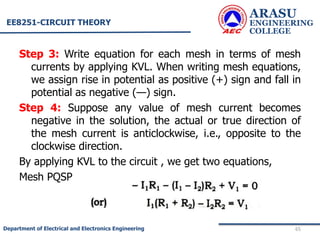
By applying KVL to the circuit , we get two equations,
Mesh PQSP
ARASU
ENGINEERING
COLLEGE
65
Department of Electrical and Electronics Engineering
EE8251-CIRCUIT THEORY
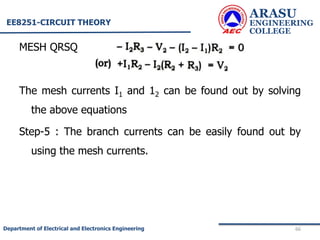
MESH QRSQ
The mesh currents I1 and 12 can be found out by solving
the above equations
Step-5 : The branch currents can be easily found out by
using the mesh currents.
ARASU
ENGINEERING
COLLEGE
66
Department of Electrical and Electronics Engineering
EE8251-CIRCUIT THEORY
ARASU
ENGINEERING
COLLEGE
67
Department of Electrical and Electronics Engineering
Mesh Analysis by Inspection Method
Step 1: Convert the current source into equivalent voltage
source by source transformation.
Step 2: All the resistance through which the loop current I1
flows are summed up and denoted by R11. It is called self
resistance of loop 1.
Step 3: All the resistance through which loop currents I1
in the first loop, and I2 in the second loop flow are
summed up. This is denoted by R12. The sign of the term
R12 is negative, if the two currents I1 and I2 through R12
are in opposite directions; otherwise the sign is positive.
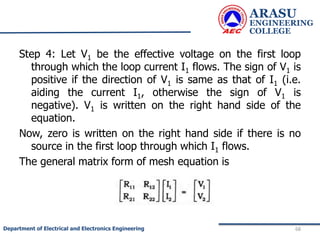
Step 4: Let V1 be the effective voltage on the first loop
through which the loop current I1 flows. The sign of V1 is
positive if the direction of V1 is same as that of I1 (i.e.
aiding the current I1, otherwise the sign of V1 is
negative). V1 is written on the right hand side of the
equation.
Now, zero is written on the right hand side if there is no
source in the first loop through which I1 flows.
The general matrix form of mesh equation is
ARASU
ENGINEERING
COLLEGE
68
Department of Electrical and Electronics Engineering
ARASU
ENGINEERING
COLLEGE
69
Department of Electrical and Electronics Engineering
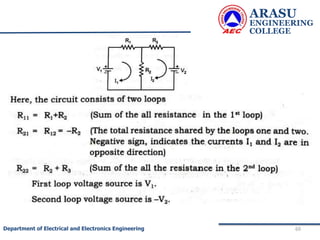
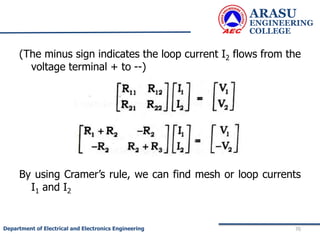
(The minus sign indicates the loop current I2 flows from the
voltage terminal + to --)
By using Cramer’s rule, we can find mesh or loop currents
I1 and I2
ARASU
ENGINEERING
COLLEGE
70
Department of Electrical and Electronics Engineering
Nodal Analysis
 The nodal method is used to analyze multisource
circuits. In this method, we solve the simultaneous
equations using Kirchhoff’s current law (KCL) applied at
various nodes in an electric circuit. Node defined as
junction or joining point of two or more component
terminals.
 In nodal method, we select one node as a reference
node, with respect to the voltages at all other nodes are
measured. Thus, the reference node acts as a ground or
common for the circuit.
ARASU
ENGINEERING
COLLEGE
71
Department of Electrical and Electronics Engineering
ARASU
ENGINEERING
COLLEGE
72
Department of Electrical and Electronics Engineering
The first step in nodal method is to convert all voltage
sources to equivalent current sources.
The second step is to identify all the principal nodes in
the circuit and to choose a reference node.
The choice is arbitrary, but it is usually convenient to
select the reference node as the one having the most of
the components connected to it.
All the nodes except the reference node are then
numbered and their corresponding voltages are designated
as V1, V2….etc.
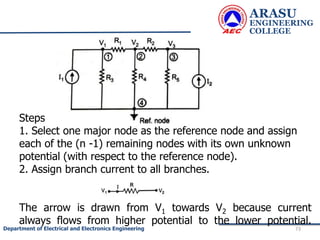
The reference node and other nodes are indicated as
shown in figure .
ARASU
ENGINEERING
COLLEGE
73
Department of Electrical and Electronics Engineering
Steps
1. Select one major node as the reference node and assign
each of the (n -1) remaining nodes with its own unknown
potential (with respect to the reference node).
2. Assign branch current to all branches.
The arrow is drawn from V1 towards V2 because current
always flows from higher potential to the lower potential.
ARASU
ENGINEERING
COLLEGE
74
Department of Electrical and Electronics Engineering
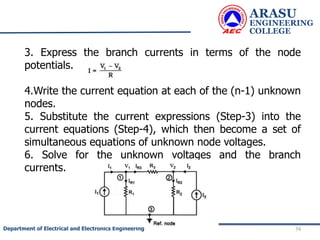
3. Express the branch currents in terms of the node
potentials.
4.Write the current equation at each of the (n-1) unknown
nodes.
5. Substitute the current expressions (Step-3) into the
current equations (Step-4), which then become a set of
simultaneous equations of unknown node voltages.
6. Solve for the unknown voltages and the branch
currents.
ARASU
ENGINEERING
COLLEGE
75
Department of Electrical and Electronics Engineering
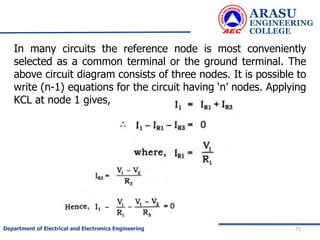
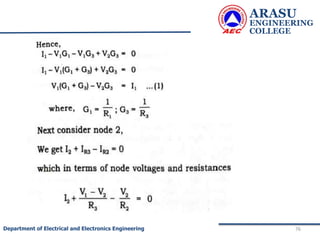
In many circuits the reference node is most conveniently
selected as a common terminal or the ground terminal. The
above circuit diagram consists of three nodes. It is possible to
write (n-1) equations for the circuit having ‘n’ nodes. Applying
KCL at node 1 gives,
ARASU
ENGINEERING
COLLEGE
76
Department of Electrical and Electronics Engineering
ARASU
ENGINEERING
COLLEGE
77
Department of Electrical and Electronics Engineering
ARASU
ENGINEERING
COLLEGE
78
Department of Electrical and Electronics Engineering
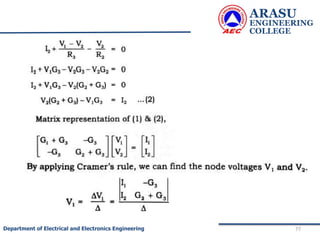
The generalized node equations can be written as
[G] [V]= [I] ……………..3
where the square matrix G is called the node
conductance matrix, V is the column matrix of the node
voltages with respect to the reference node and I is the
column matrix of input currents.
ARASU
ENGINEERING
COLLEGE
79
Department of Electrical and Electronics Engineering
Nodal Analysis by Inspection Method:
Step 1: First, convert all the voltage sources to equivalent
current sources.
Step 2: The conductances of all branches connected to
node 1 are added and denoted by G11 . G11 is called the
self conductance of node 1.
Step 3: All the conductances connected to nodes 1 and 2
are added and denoted by G12. G12 is called mutual
conductance of nodes 1 and 2. This G12 is written with
negative sign. If no conductance is connected between
nodes 1 and 2 then G12 = 0, G12=G21.
ARASU
ENGINEERING
COLLEGE
80
Department of Electrical and Electronics Engineering
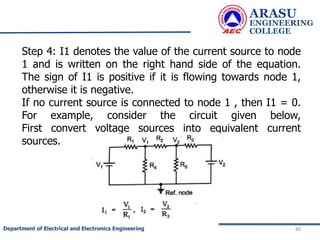
Step 4: I1 denotes the value of the current source to node
1 and is written on the right hand side of the equation.
The sign of I1 is positive if it is flowing towards node 1,
otherwise it is negative.
If no current source is connected to node 1 , then I1 = 0.
For example, consider the circuit given below,
First convert voltage sources into equivalent current
sources.
ARASU
ENGINEERING
COLLEGE
81
Department of Electrical and Electronics Engineering
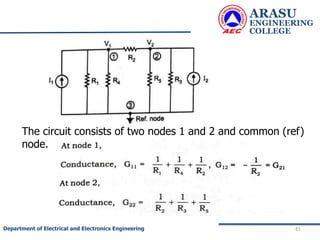
The circuit consists of two nodes 1 and 2 and common (ref)
node.
ARASU
ENGINEERING
COLLEGE
82
Department of Electrical and Electronics Engineering
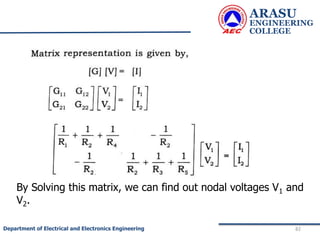
By Solving this matrix, we can find out nodal voltages V1 and
V2.
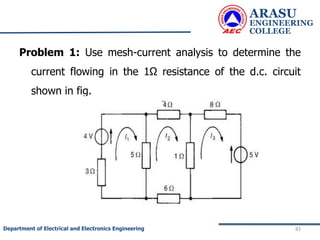
Problem 1: Use mesh-current analysis to determine the
current flowing in the 1Ω resistance of the d.c. circuit
shown in fig.
ARASU
ENGINEERING
COLLEGE
83
Department of Electrical and Electronics Engineering
ARASU
ENGINEERING
COLLEGE
84
Department of Electrical and Electronics Engineering
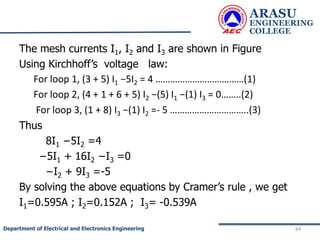
The mesh currents I1, I2 and I3 are shown in Figure
Using Kirchhoff’s voltage law:
For loop 1, (3 + 5) I1 −5I2 = 4 ………………………………(1)
For loop 2, (4 + 1 + 6 + 5) I2 −(5) I1 −(1) I3 = 0……..(2)
For loop 3, (1 + 8) I3 −(1) I2 =- 5 …………………………..(3)
Thus
8I1 −5I2 =4
−5I1 + 16I2 −I3 =0
−I2 + 9I3 =-5
By solving the above equations by Cramer’s rule , we get
I1=0.595A ; I2=0.152A ; I3= -0.539A
ARASU
ENGINEERING
COLLEGE
85
Department of Electrical and Electronics Engineering
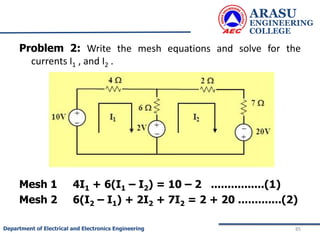
Problem 2: Write the mesh equations and solve for the
currents I1 , and I2 .
Mesh 1 4I1 + 6(I1 – I2) = 10 – 2 ................(1)
Mesh 2 6(I2 – I1) + 2I2 + 7I2 = 2 + 20 .............(2)
ARASU
ENGINEERING
COLLEGE
86
Department of Electrical and Electronics Engineering
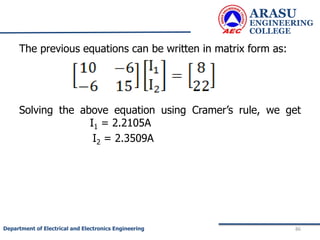
The previous equations can be written in matrix form as:
Solving the above equation using Cramer’s rule, we get
I1 = 2.2105A
I2 = 2.3509A
ARASU
ENGINEERING
COLLEGE
87
Department of Electrical and Electronics Engineering
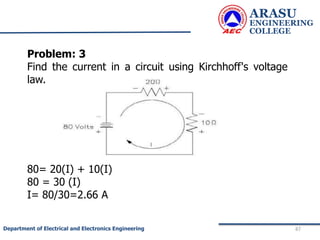
Problem: 3
Find the current in a circuit using Kirchhoff's voltage
law.
80= 20(I) + 10(I)
80 = 30 (I)
I= 80/30=2.66 A
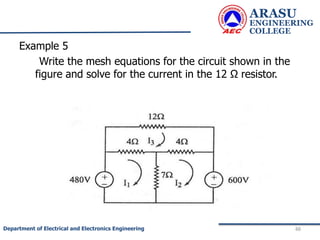
Example 5
Write the mesh equations for the circuit shown in the
figure and solve for the current in the 12 Ω resistor.
ARASU
ENGINEERING
COLLEGE
88
Department of Electrical and Electronics Engineering
ARASU
ENGINEERING
COLLEGE
89
Department of Electrical and Electronics Engineering
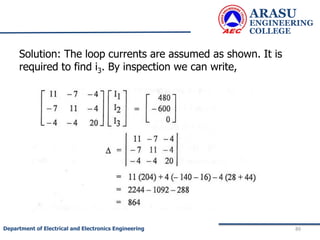
Solution: The loop currents are assumed as shown. It is
required to find i3. By inspection we can write,
ARASU
ENGINEERING
COLLEGE
90
Department of Electrical and Electronics Engineering
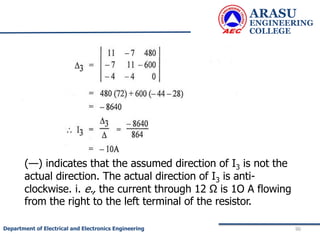
(—) indicates that the assumed direction of I3 is not the
actual direction. The actual direction of I3 is anti-
clockwise. i. e., the current through 12 Ω is 1O A flowing
from the right to the left terminal of the resistor.
Example 6
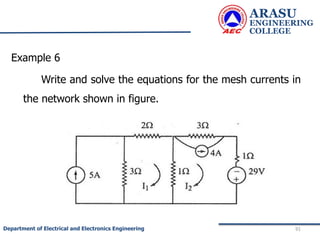
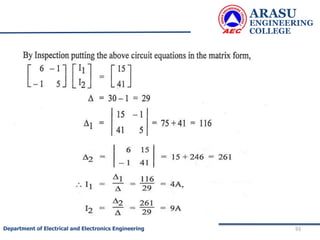
Write and solve the equations for the mesh currents in
the network shown in figure.
ARASU
ENGINEERING
COLLEGE
91
Department of Electrical and Electronics Engineering
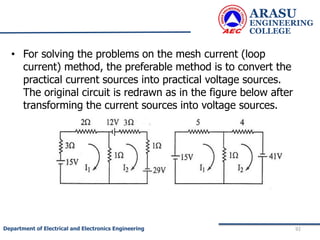
• For solving the problems on the mesh current (loop
current) method, the preferable method is to convert the
practical current sources into practical voltage sources.
The original circuit is redrawn as in the figure below after
transforming the current sources into voltage sources.
ARASU
ENGINEERING
COLLEGE
92
Department of Electrical and Electronics Engineering
ARASU
ENGINEERING
COLLEGE
93
Department of Electrical and Electronics Engineering
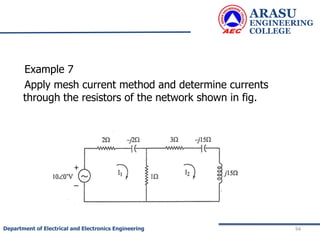
Example 7
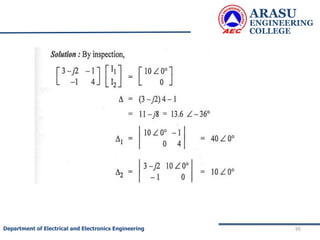
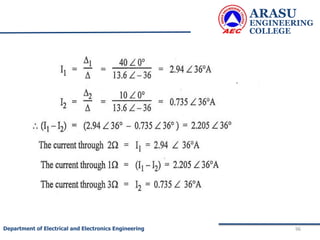
Apply mesh current method and determine currents
through the resistors of the network shown in fig.
ARASU
ENGINEERING
COLLEGE
94
Department of Electrical and Electronics Engineering
ARASU
ENGINEERING
COLLEGE
95
Department of Electrical and Electronics Engineering
ARASU
ENGINEERING
COLLEGE
96
Department of Electrical and Electronics Engineering
ARASU
ENGINEERING
COLLEGE
97
Department of Electrical and Electronics Engineering
Example 8
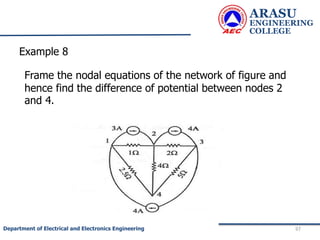
Frame the nodal equations of the network of figure and
hence find the difference of potential between nodes 2
and 4.
ARASU
ENGINEERING
COLLEGE
98
Department of Electrical and Electronics Engineering
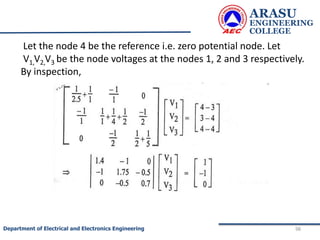
Let the node 4 be the reference i.e. zero potential node. Let
V1,V2,V3 be the node voltages at the nodes 1, 2 and 3 respectively.
By inspection,
ARASU
ENGINEERING
COLLEGE
99
Department of Electrical and Electronics Engineering
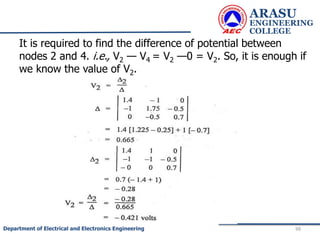
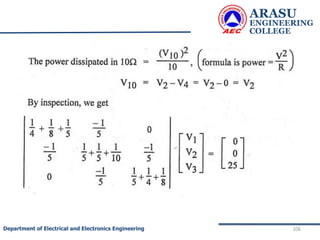
It is required to find the difference of potential between
nodes 2 and 4. i.e., V2 — V4 = V2 —0 = V2. So, it is enough if
we know the value of V2.
ARASU
ENGINEERING
COLLEGE
100
Department of Electrical and Electronics Engineering
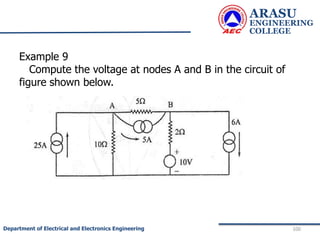
Example 9
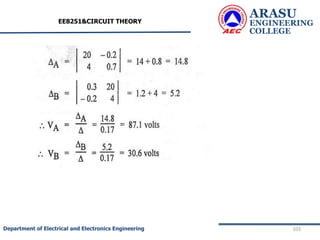
Compute the voltage at nodes A and B in the circuit of
figure shown below.
ARASU
ENGINEERING
COLLEGE
101
Department of Electrical and Electronics Engineering
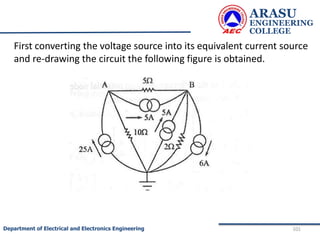
First converting the voltage source into its equivalent current source
and re-drawing the circuit the following figure is obtained.
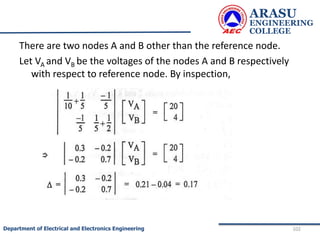
There are two nodes A and B other than the reference node.
Let VA and VB be the voltages of the nodes A and B respectively
with respect to reference node. By inspection,
ARASU
ENGINEERING
COLLEGE
102
Department of Electrical and Electronics Engineering
ARASU
ENGINEERING
COLLEGE
103
Department of Electrical and Electronics Engineering
EE8251&CIRCUIT THEORY
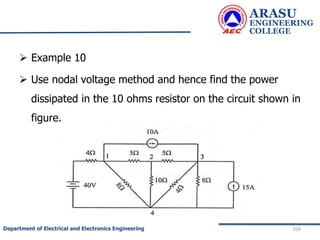
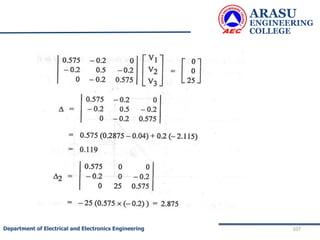
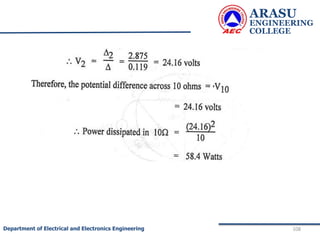
 Example 10
 Use nodal voltage method and hence find the power
dissipated in the 10 ohms resistor on the circuit shown in
figure.
ARASU
ENGINEERING
COLLEGE
104
Department of Electrical and Electronics Engineering
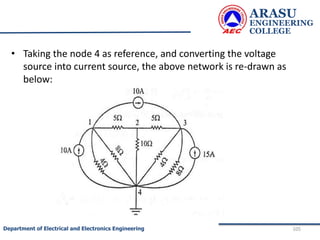
• Taking the node 4 as reference, and converting the voltage
source into current source, the above network is re-drawn as
below:
ARASU
ENGINEERING
COLLEGE
105
Department of Electrical and Electronics Engineering
ARASU
ENGINEERING
COLLEGE
106
Department of Electrical and Electronics Engineering
ARASU
ENGINEERING
COLLEGE
107
Department of Electrical and Electronics Engineering
ARASU
ENGINEERING
COLLEGE
108
Department of Electrical and Electronics Engineering
ARASU
ENGINEERING
COLLEGE
109
Department of Electrical and Electronics Engineering
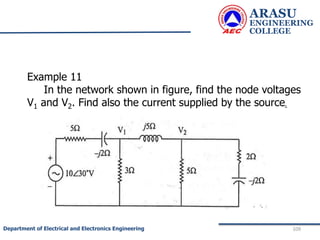
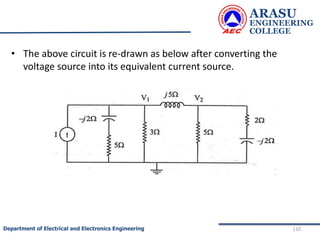
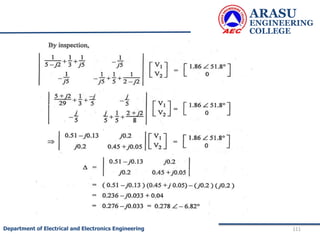
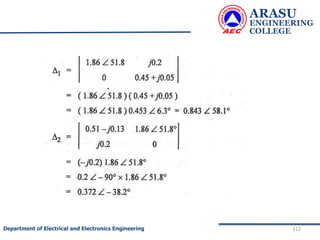
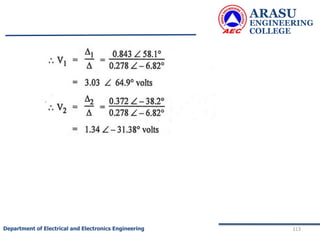
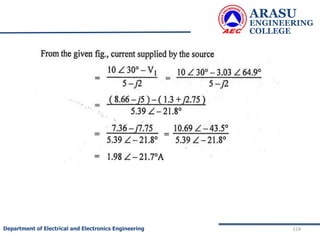
Example 11
In the network shown in figure, find the node voltages
V1 and V2. Find also the current supplied by the source.
• The above circuit is re-drawn as below after converting the
voltage source into its equivalent current source.
ARASU
ENGINEERING
COLLEGE
110
Department of Electrical and Electronics Engineering
ARASU
ENGINEERING
COLLEGE
111
Department of Electrical and Electronics Engineering
ARASU
ENGINEERING
COLLEGE
112
Department of Electrical and Electronics Engineering
ARASU
ENGINEERING
COLLEGE
113
Department of Electrical and Electronics Engineering
ARASU
ENGINEERING
COLLEGE
114
Department of Electrical and Electronics Engineering
ARASU
ENGINEERING
COLLEGE
115
Department of Electrical and Electronics Engineering
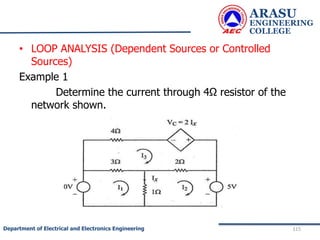
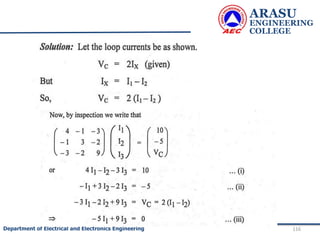
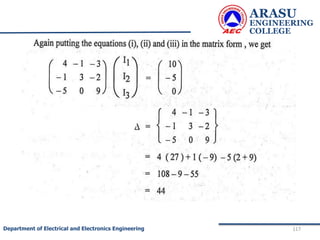
• LOOP ANALYSIS (Dependent Sources or Controlled
Sources)
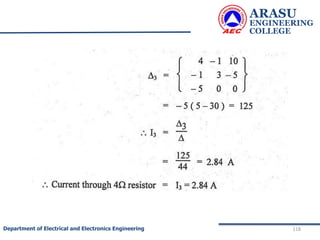
Example 1
Determine the current through 4Ω resistor of the
network shown.
ARASU
ENGINEERING
COLLEGE
116
Department of Electrical and Electronics Engineering
ARASU
ENGINEERING
COLLEGE
117
Department of Electrical and Electronics Engineering
ARASU
ENGINEERING
COLLEGE
118
Department of Electrical and Electronics Engineering
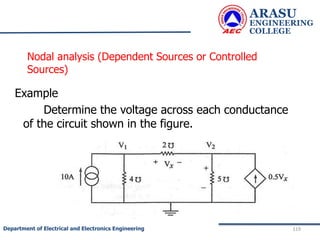
Example
Determine the voltage across each conductance
of the circuit shown in the figure.
ARASU
ENGINEERING
COLLEGE
119
Department of Electrical and Electronics Engineering
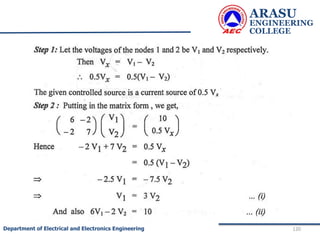
Nodal analysis (Dependent Sources or Controlled
Sources)
ARASU
ENGINEERING
COLLEGE
120
Department of Electrical and Electronics Engineering
ARASU
ENGINEERING
COLLEGE
121
Department of Electrical and Electronics Engineering
ARASU
ENGINEERING
COLLEGE
122
Department of Electrical and Electronics Engineering
DC CIRCUITS:
A DC circuit (Direct Current circuit) is an electrical
circuit that consists of any combination of constant
voltage sources, constant current sources, and resistors.
 In this case, the circuit voltages and currents are
constant, i.e., independent of time.
 More technically, a DC circuit has no memory.
 That is, a particular circuit voltage or current does not
depend on the past value of any circuit voltage or
current.
This implies that the system of equations that
represent a DC circuit do not involve integrals or
derivatives.
ARASU
ENGINEERING
COLLEGE
123
Department of Electrical and Electronics Engineering
AC CIRCUITS:
Fundamentals of AC:
An alternating current (AC) is an electrical current, where the
magnitude of the current varies in a cyclical form, as opposed
to direct current, where the polarity of the current stays
constant.
The usual waveform of an AC circuit is generally that of a
sine wave, as these results in the most efficient transmission
of energy. However in certain applications different waveforms
are used, such as triangular or square waves.
Used generically, AC refers to the form in which electricity is
delivered to businesses and residences. However, audio and
radio signals carried on electrical wire are also examples of
alternating current.
ARASU
ENGINEERING
COLLEGE
124
Department of Electrical and Electronics Engineering
Sinusoidal alternating quantity
An alternating quantity which varies according to the sine of
the angle θ is known as sinusoidal alternating quantity.
All over the world sinusoidal voltages and currents are
selected for generation of electric power.
The following are the reasons:
a)The sinusoidal voltage and currents produce low iron and
copper losses in AC rotating machines and transformers.
b)Sinusoidal voltage and current will offer less interference to
nearby telephone lines.
c)They produce less disturbance in the electrical circuit.
ARASU
ENGINEERING
COLLEGE
125
Department of Electrical and Electronics Engineering
Cycle:
One complete set of positive and negative values of an
alternating quantity is called cycle.
Time period:
The time taken to complete one complete cycle.
Frequency:
The number of cycles made by an alternating quantity per
second is called frequency. The unit of frequency is Hertz (Hz)
Amplitude or Peak value:
The maximum positive or negative value of an alternating
quantity is called amplitude or peak value. In the voltage
waveform the peak value is Em. It occurs when the angle is
π/2 (positive cycle) and 3π/2 (negative cycle).
Average value:
This is the average of instantaneous values of an
alternating quantity over one complete cycle of the wave.
Sinusoidal Voltage and current equations
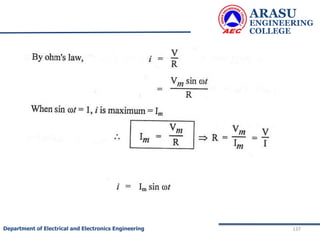
A sinusoidal voltage and current can be represented as
E=Em Sinωt or V=Vm Sinωt and
I=Im Sinωt
• Where E or V and I are instantaneous values and Em or Vm
and Im are the peak values.
• ω = angular frequency in radians per second.
V=Vm Sin (2πf)t and
I=Im Sin(2πf)t
Where, ω = 2πf
f= ω / 2 π = 1/ T
Where, f is the frequency in cycles per second(Hz)
ARASU
ENGINEERING
COLLEGE
126
Department of Electrical and Electronics Engineering
ARASU
ENGINEERING
COLLEGE
127
Department of Electrical and Electronics Engineering
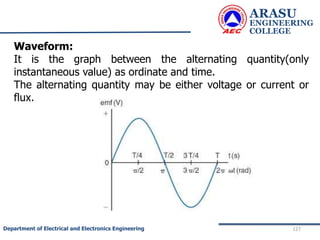
Waveform:
It is the graph between the alternating quantity(only
instantaneous value) as ordinate and time.
The alternating quantity may be either voltage or current or
flux.
ARASU
ENGINEERING
COLLEGE
128
Department of Electrical and Electronics Engineering
ARASU
ENGINEERING
COLLEGE
129
Department of Electrical and Electronics Engineering
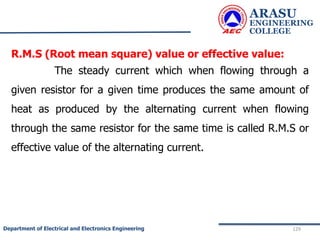
R.M.S (Root mean square) value or effective value:
The steady current which when flowing through a
given resistor for a given time produces the same amount of
heat as produced by the alternating current when flowing
through the same resistor for the same time is called R.M.S or
effective value of the alternating current.
ARASU
ENGINEERING
COLLEGE
130
Department of Electrical and Electronics Engineering
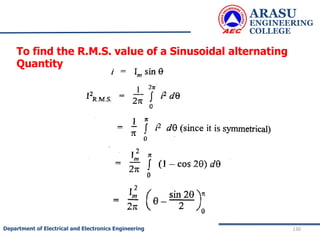
To find the R.M.S. value of a Sinusoidal alternating
Quantity
ARASU
ENGINEERING
COLLEGE
131
Department of Electrical and Electronics Engineering
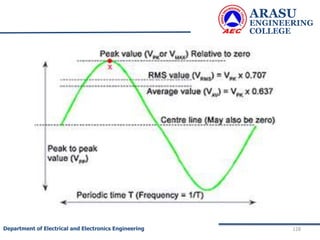
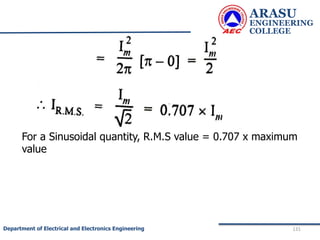
For a Sinusoidal quantity, R.M.S value = 0.707 x maximum
value
ARASU
ENGINEERING
COLLEGE
132
Department of Electrical and Electronics Engineering
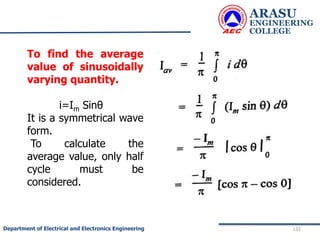
To find the average
value of sinusoidally
varying quantity.
i=Im Sinθ
It is a symmetrical wave
form.
To calculate the
average value, only half
cycle must be
considered.
ARASU
ENGINEERING
COLLEGE
133
Department of Electrical and Electronics Engineering
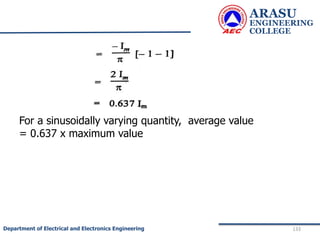
For a sinusoidally varying quantity, average value
= 0.637 x maximum value
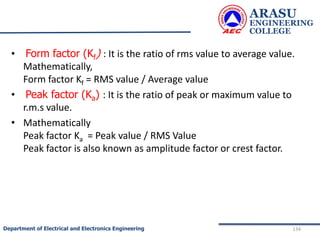
• Form factor (Kf) : It is the ratio of rms value to average value.
Mathematically,
Form factor Kf = RMS value / Average value
• Peak factor (Ka) : It is the ratio of peak or maximum value to
r.m.s value.
• Mathematically
Peak factor Ka = Peak value / RMS Value
Peak factor is also known as amplitude factor or crest factor.
ARASU
ENGINEERING
COLLEGE
134
Department of Electrical and Electronics Engineering
ARASU
ENGINEERING
COLLEGE
135
Department of Electrical and Electronics Engineering
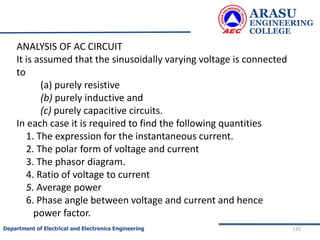
ANALYSIS OF AC CIRCUIT
It is assumed that the sinusoidally varying voltage is connected
to
(a) purely resistive
(b) purely inductive and
(c) purely capacitive circuits.
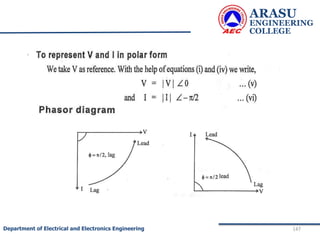
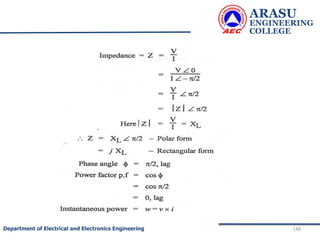
In each case it is required to find the following quantities
1. The expression for the instantaneous current.
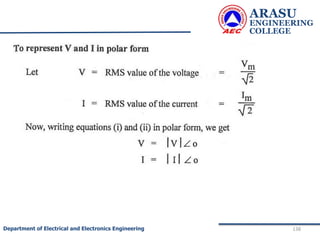
2. The polar form of voltage and current
3. The phasor diagram.
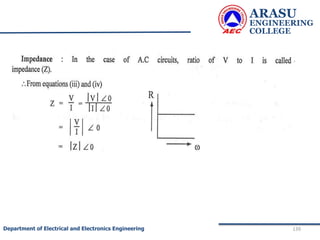
4. Ratio of voltage to current
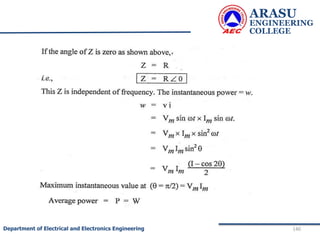
5. Average power
6. Phase angle between voltage and current and hence
power factor.
ARASU
ENGINEERING
COLLEGE
136
Department of Electrical and Electronics Engineering
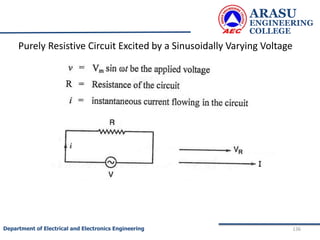
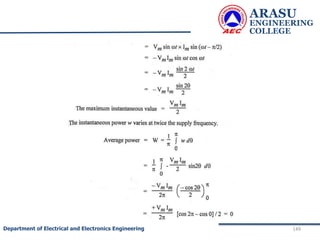
Purely Resistive Circuit Excited by a Sinusoidally Varying Voltage
ARASU
ENGINEERING
COLLEGE
137
Department of Electrical and Electronics Engineering
ARASU
ENGINEERING
COLLEGE
138
Department of Electrical and Electronics Engineering
ARASU
ENGINEERING
COLLEGE
139
Department of Electrical and Electronics Engineering
ARASU
ENGINEERING
COLLEGE
140
Department of Electrical and Electronics Engineering
ARASU
ENGINEERING
COLLEGE
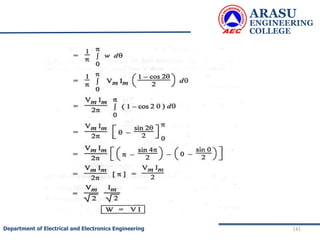
141
Department of Electrical and Electronics Engineering
ARASU
ENGINEERING
COLLEGE
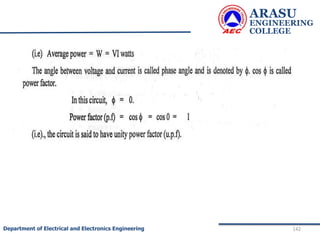
142
Department of Electrical and Electronics Engineering
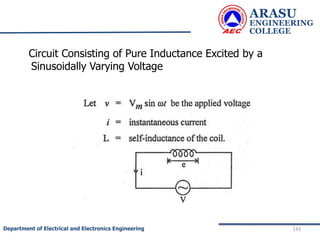
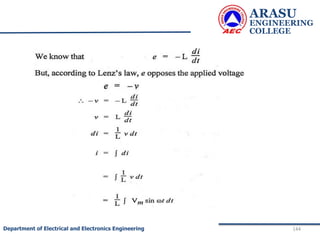
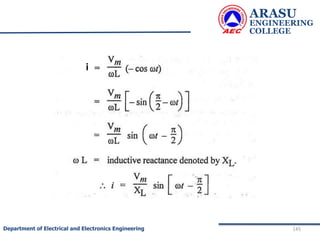
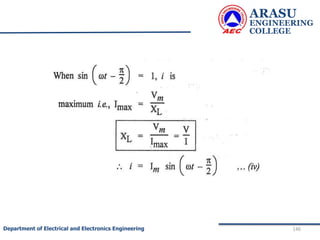
Circuit Consisting of Pure Inductance Excited by a
Sinusoidally Varying Voltage
ARASU
ENGINEERING
COLLEGE
143
Department of Electrical and Electronics Engineering
ARASU
ENGINEERING
COLLEGE
144
Department of Electrical and Electronics Engineering
ARASU
ENGINEERING
COLLEGE
145
Department of Electrical and Electronics Engineering
i
ARASU
ENGINEERING
COLLEGE
146
Department of Electrical and Electronics Engineering
ARASU
ENGINEERING
COLLEGE
147
Department of Electrical and Electronics Engineering
ARASU
ENGINEERING
COLLEGE
148
Department of Electrical and Electronics Engineering
ARASU
ENGINEERING
COLLEGE
149
Department of Electrical and Electronics Engineering
ARASU
ENGINEERING
COLLEGE
150
Department of Electrical and Electronics Engineering
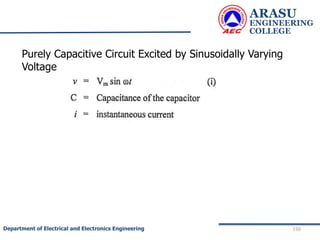
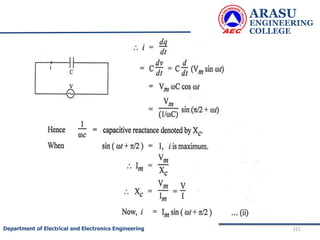
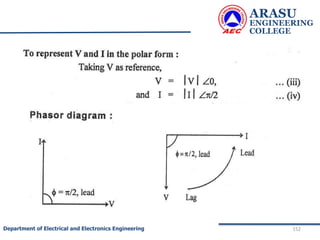
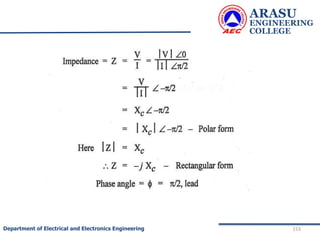
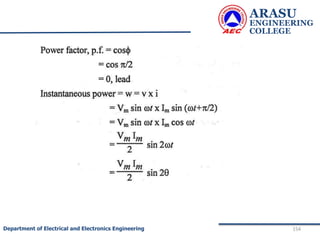
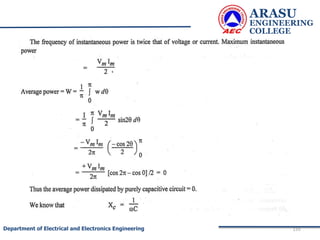
Purely Capacitive Circuit Excited by Sinusoidally Varying
Voltage
ARASU
ENGINEERING
COLLEGE
151
Department of Electrical and Electronics Engineering
ARASU
ENGINEERING
COLLEGE
152
Department of Electrical and Electronics Engineering
ARASU
ENGINEERING
COLLEGE
153
Department of Electrical and Electronics Engineering
ARASU
ENGINEERING
COLLEGE
154
Department of Electrical and Electronics Engineering
ARASU
ENGINEERING
COLLEGE
155
Department of Electrical and Electronics Engineering
ARASU
ENGINEERING
COLLEGE
156
Department of Electrical and Electronics Engineering
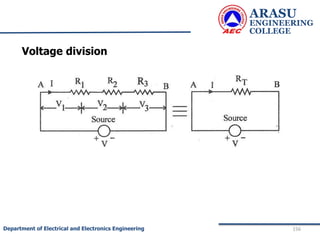
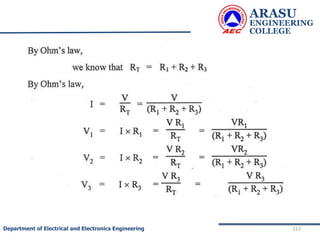
Voltage division
ARASU
ENGINEERING
COLLEGE
157
Department of Electrical and Electronics Engineering
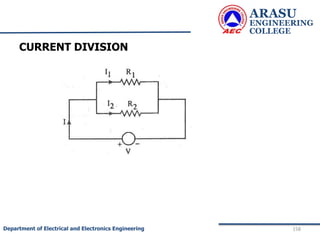
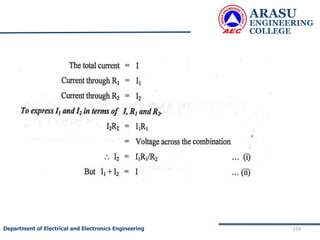
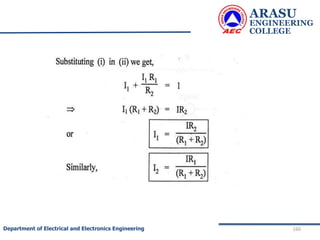
CURRENT DIVISION
ARASU
ENGINEERING
COLLEGE
158
Department of Electrical and Electronics Engineering
ARASU
ENGINEERING
COLLEGE
159
Department of Electrical and Electronics Engineering
ARASU
ENGINEERING
COLLEGE
160
Department of Electrical and Electronics Engineering
ARASU
ENGINEERING
COLLEGE
161
Department of Electrical and Electronics Engineering
EE8251-CIRCUIT THEORY
ARASU
ENGINEERING
COLLEGE
162
Department of Electrical and Electronics Engineering
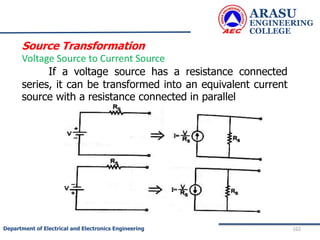
Source Transformation
Voltage Source to Current Source
If a voltage source has a resistance connected
series, it can be transformed into an equivalent current
source with a resistance connected in parallel
ARASU
ENGINEERING
COLLEGE
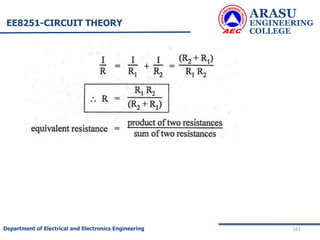
163
Department of Electrical and Electronics Engineering
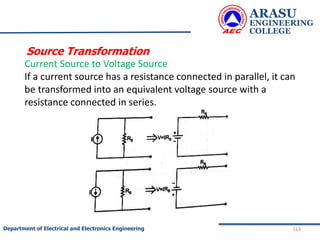
Source Transformation
Current Source to Voltage Source
If a current source has a resistance connected in parallel, it can
be transformed into an equivalent voltage source with a
resistance connected in series.
ARASU
ENGINEERING
COLLEGE
164
Department of Electrical and Electronics Engineering
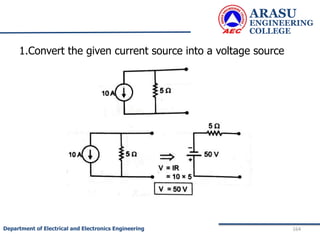
1.Convert the given current source into a voltage source
ARASU
ENGINEERING
COLLEGE
165
Department of Electrical and Electronics Engineering
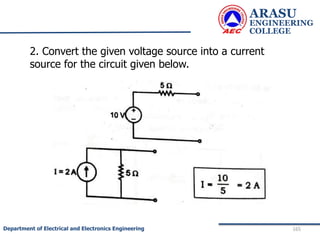
2. Convert the given voltage source into a current
source for the circuit given below.
Star(Y) and Delta (Δ) transformation or T and π:
ARASU
ENGINEERING
COLLEGE
166
Department of Electrical and Electronics Engineering
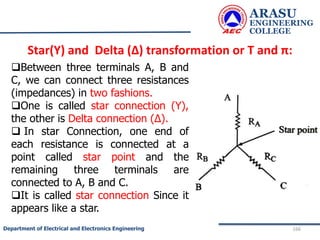
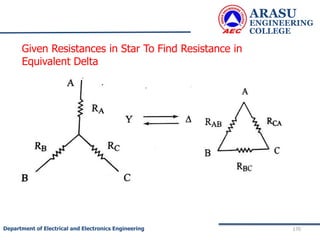
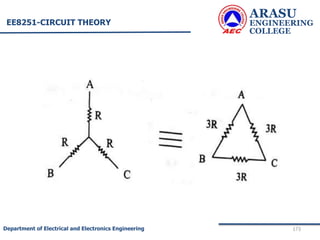
Between three terminals A, B and
C, we can connect three resistances
(impedances) in two fashions.
One is called star connection (Y),
the other is Delta connection (Δ).
 In star Connection, one end of
each resistance is connected at a
point called star point and the
remaining three terminals are
connected to A, B and C.
It is called star connection Since it
appears like a star.
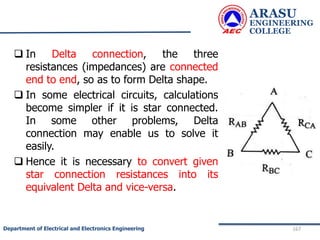
 In Delta connection, the three
resistances (impedances) are connected
end to end, so as to form Delta shape.
 In some electrical circuits, calculations
become simpler if it is star connected.
In some other problems, Delta
connection may enable us to solve it
easily.
 Hence it is necessary to convert given
star connection resistances into its
equivalent Delta and vice-versa.
ARASU
ENGINEERING
COLLEGE
167
Department of Electrical and Electronics Engineering
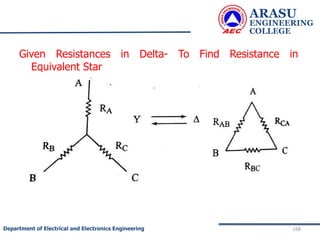
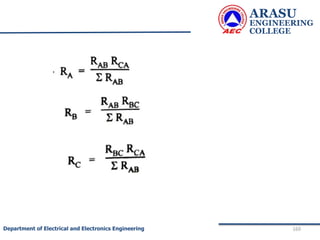
Given Resistances in Delta- To Find Resistance in
Equivalent Star
ARASU
ENGINEERING
COLLEGE
168
Department of Electrical and Electronics Engineering
ARASU
ENGINEERING
COLLEGE
169
Department of Electrical and Electronics Engineering
ARASU
ENGINEERING
COLLEGE
170
Department of Electrical and Electronics Engineering
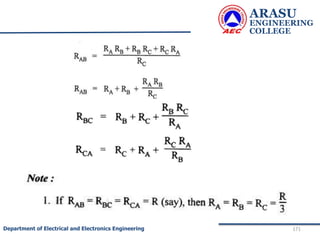
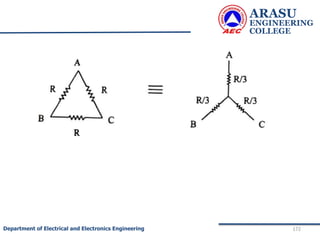
Given Resistances in Star To Find Resistance in
Equivalent Delta
ARASU
ENGINEERING
COLLEGE
171
Department of Electrical and Electronics Engineering
ARASU
ENGINEERING
COLLEGE
172
Department of Electrical and Electronics Engineering
ARASU
ENGINEERING
COLLEGE
173
Department of Electrical and Electronics Engineering
EE8251-CIRCUIT THEORY
ARASU
ENGINEERING
COLLEGE
174
Department of Electrical and Electronics Engineering
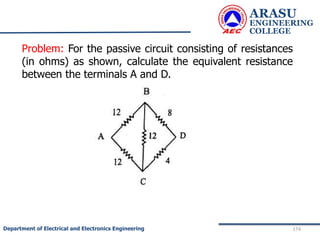
Problem: For the passive circuit consisting of resistances
(in ohms) as shown, calculate the equivalent resistance
between the terminals A and D.
ARASU
ENGINEERING
COLLEGE
175
Department of Electrical and Electronics Engineering
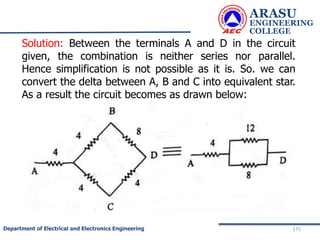
Solution: Between the terminals A and D in the circuit
given, the combination is neither series nor parallel.
Hence simplification is not possible as it is. So. we can
convert the delta between A, B and C into equivalent star.
As a result the circuit becomes as drawn below:
ARASU
ENGINEERING
COLLEGE
176
Department of Electrical and Electronics Engineering
Now, it is series parallel combination of resistances.
Hence the total resistance between A and D is equal to,
ARASU
ENGINEERING
COLLEGE
177
Department of Electrical and Electronics Engineering
Problem: For the network shown in the figure below, find the
equivalent resistance between the terminals B and C.
ARASU
ENGINEERING
COLLEGE
178
Department of Electrical and Electronics Engineering
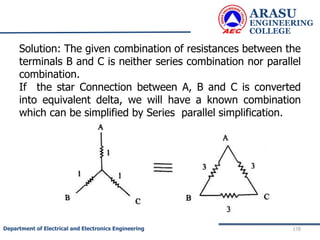
Solution: The given combination of resistances between the
terminals B and C is neither series combination nor parallel
combination.
If the star Connection between A, B and C is converted
into equivalent delta, we will have a known combination
which can be simplified by Series parallel simplification.
ARASU
ENGINEERING
COLLEGE
179
Department of Electrical and Electronics Engineering
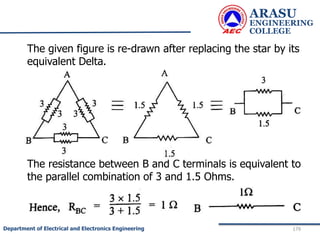
The given figure is re-drawn after replacing the star by its
equivalent Delta.
The resistance between B and C terminals is equivalent to
the parallel combination of 3 and 1.5 Ohms.
Super position theorem
 With the help of this theorem, we can find the current
through or the voltage across a given element in a linear
circuit consisting of two or more sources.
 The statement is as follows:
“In a linear circuit containing more than one source, the
current that flows at any point or the voltage that exists
between any two points is the algebraic sum of the
currents or the voltages that would have been produced
by each source taken separately with all other sources
removed.”
ARASU
ENGINEERING
COLLEGE
180
Department of Electrical and Electronics Engineering
Note:
1. Removal of an ideal voltage source means short
circuiting.
2. Removal of an ideal current source means replacing it
by an open circuit.
3. Removal of practical voltage source means replacing it
by an internal resistance.
ARASU
ENGINEERING
COLLEGE
181
Department of Electrical and Electronics Engineering
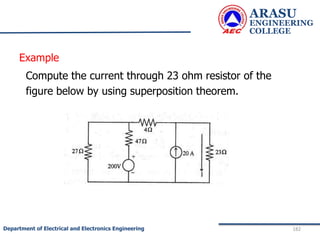
Example
Compute the current through 23 ohm resistor of the
figure below by using superposition theorem.
ARASU
ENGINEERING
COLLEGE
182
Department of Electrical and Electronics Engineering
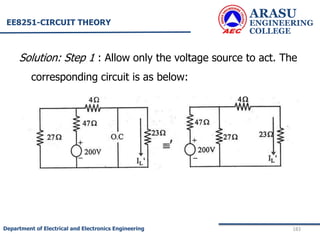
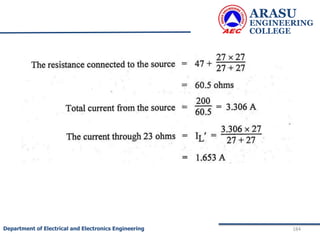
Solution: Step 1 : Allow only the voltage source to act. The
corresponding circuit is as below:
ARASU
ENGINEERING
COLLEGE
183
Department of Electrical and Electronics Engineering
EE8251-CIRCUIT THEORY
ARASU
ENGINEERING
COLLEGE
184
Department of Electrical and Electronics Engineering
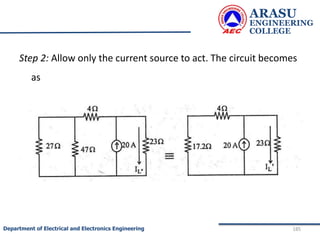
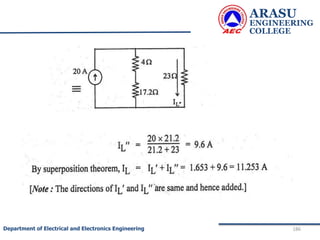
Step 2: Allow only the current source to act. The circuit becomes
as
ARASU
ENGINEERING
COLLEGE
185
Department of Electrical and Electronics Engineering
ARASU
ENGINEERING
COLLEGE
186
Department of Electrical and Electronics Engineering
ARASU
ENGINEERING
COLLEGE
187
Department of Electrical and Electronics Engineering
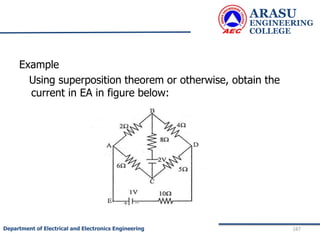
Example
Using superposition theorem or otherwise, obtain the
current in EA in figure below:
ARASU
ENGINEERING
COLLEGE
188
Department of Electrical and Electronics Engineering
EE8251-CIRCUIT THEORY
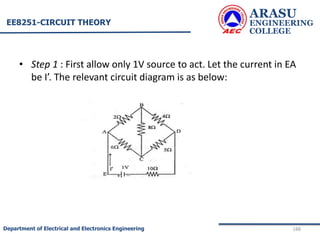
• Step 1 : First allow only 1V source to act. Let the current in EA
be I’. The relevant circuit diagram is as below:
ARASU
ENGINEERING
COLLEGE
189
Department of Electrical and Electronics Engineering
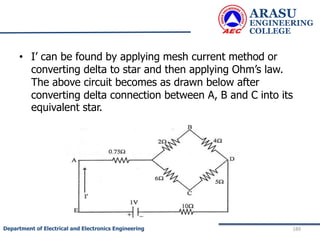
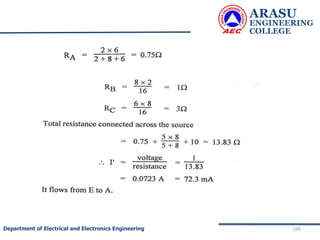
• I’ can be found by applying mesh current method or
converting delta to star and then applying Ohm’s law.
The above circuit becomes as drawn below after
converting delta connection between A, B and C into its
equivalent star.
ARASU
ENGINEERING
COLLEGE
190
Department of Electrical and Electronics Engineering
ARASU
ENGINEERING
COLLEGE
191
Department of Electrical and Electronics Engineering
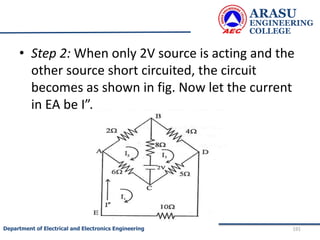
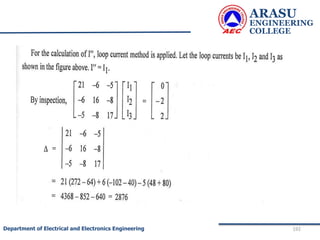
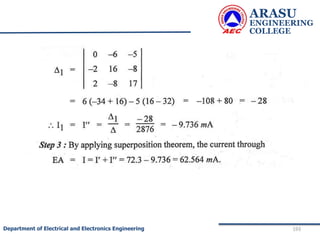
• Step 2: When only 2V source is acting and the
other source short circuited, the circuit
becomes as shown in fig. Now let the current
in EA be I”.
ARASU
ENGINEERING
COLLEGE
192
Department of Electrical and Electronics Engineering
ARASU
ENGINEERING
COLLEGE
193
Department of Electrical and Electronics Engineering
Thevenin’s theorem:
A linear network consisting of a number of voltage
sources and resistances can be replaced by an
equivalent network having a single voltage source called
Thevenin’s voltage (VTh ) and a single resistance called
Thevenin’s resistance (RTh )
ARASU
ENGINEERING
COLLEGE
194
Department of Electrical and Electronics Engineering
ARASU
ENGINEERING
COLLEGE
195
Department of Electrical and Electronics Engineering
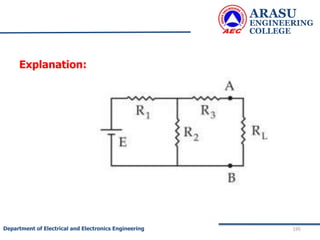
Explanation:
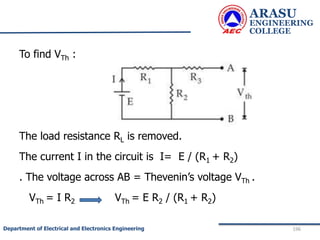
To find VTh :
The load resistance RL is removed.
The current I in the circuit is I= E / (R1 + R2)
. The voltage across AB = Thevenin’s voltage VTh .
VTh = I R2 VTh = E R2 / (R1 + R2)
ARASU
ENGINEERING
COLLEGE
196
Department of Electrical and Electronics Engineering
ARASU
ENGINEERING
COLLEGE
197
Department of Electrical and Electronics Engineering
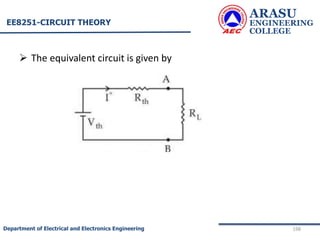
• To find RTh :
• The load resistance RL is removed. The cell is
disconnected and the wires are short as shown.
• The effective resistance across AB = Thevenin’s
resistance RTh .
• R1 is parallel to R2 and this combination in series with R3 ]
 The equivalent circuit is given by
ARASU
ENGINEERING
COLLEGE
198
Department of Electrical and Electronics Engineering
EE8251-CIRCUIT THEORY
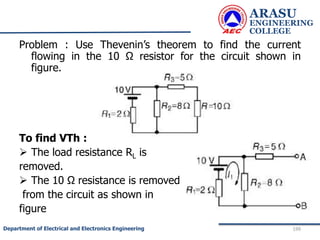
Problem : Use Thevenin’s theorem to find the current
flowing in the 10 Ω resistor for the circuit shown in
figure.
To find VTh :
 The load resistance RL is
removed.
 The 10 Ω resistance is removed
from the circuit as shown in
figure
ARASU
ENGINEERING
COLLEGE
199
Department of Electrical and Electronics Engineering
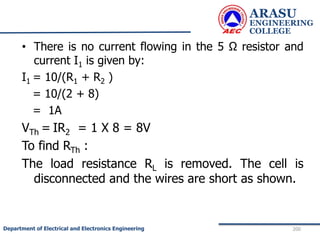
• There is no current flowing in the 5 Ω resistor and
current I1 is given by:
I1 = 10/(R1 + R2 )
= 10/(2 + 8)
= 1A
VTh = IR2 = 1 X 8 = 8V
To find RTh :
The load resistance RL is removed. The cell is
disconnected and the wires are short as shown.
ARASU
ENGINEERING
COLLEGE
200
Department of Electrical and Electronics Engineering
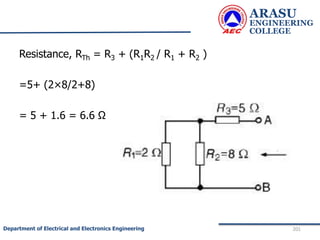
Resistance, RTh = R3 + (R1R2 / R1 + R2 )
=5+ (2×8/2+8)
= 5 + 1.6 = 6.6 Ω
ARASU
ENGINEERING
COLLEGE
201
Department of Electrical and Electronics Engineering
ARASU
ENGINEERING
COLLEGE
202
Department of Electrical and Electronics Engineering
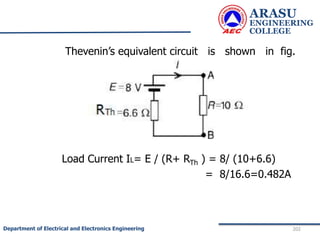
Thevenin’s equivalent circuit is shown in fig.
Load Current IL= E / (R+ RTh ) = 8/ (10+6.6)
= 8/16.6=0.482A
ARASU
ENGINEERING
COLLEGE
203
Department of Electrical and Electronics Engineering
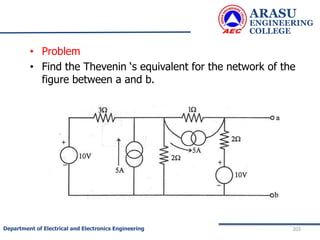
• Problem
• Find the Thevenin ‘s equivalent for the network of the
figure between a and b.
ARASU
ENGINEERING
COLLEGE
204
Department of Electrical and Electronics Engineering
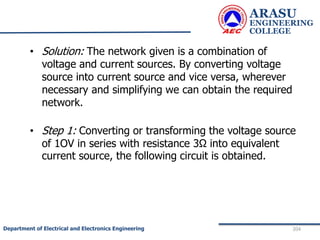
• Solution: The network given is a combination of
voltage and current sources. By converting voltage
source into current source and vice versa, wherever
necessary and simplifying we can obtain the required
network.
• Step 1: Converting or transforming the voltage source
of 1OV in series with resistance 3Ω into equivalent
current source, the following circuit is obtained.
ARASU
ENGINEERING
COLLEGE
205
Department of Electrical and Electronics Engineering
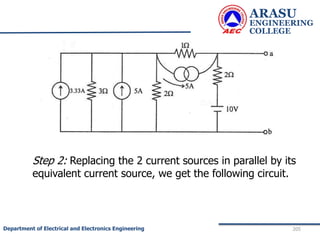
Step 2: Replacing the 2 current sources in parallel by its
equivalent current source, we get the following circuit.
ARASU
ENGINEERING
COLLEGE
206
Department of Electrical and Electronics Engineering
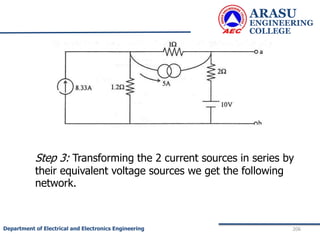
Step 3: Transforming the 2 current sources in series by
their equivalent voltage sources we get the following
network.
ARASU
ENGINEERING
COLLEGE
207
Department of Electrical and Electronics Engineering
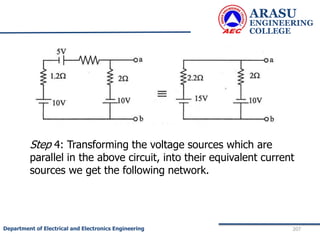
Step 4: Transforming the voltage sources which are
parallel in the above circuit, into their equivalent current
sources we get the following network.
ARASU
ENGINEERING
COLLEGE
208
Department of Electrical and Electronics Engineering
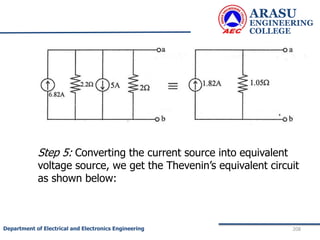
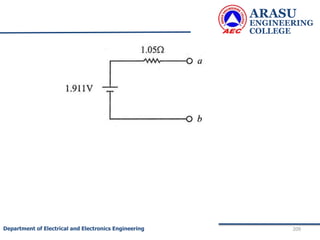
Step 5: Converting the current source into equivalent
voltage source, we get the Thevenin’s equivalent circuit
as shown below:
ARASU
ENGINEERING
COLLEGE
209
Department of Electrical and Electronics Engineering
Maximum Power Transfer Theorem
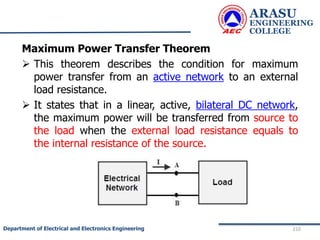
 This theorem describes the condition for maximum
power transfer from an active network to an external
load resistance.
 It states that in a linear, active, bilateral DC network,
the maximum power will be transferred from source to
the load when the external load resistance equals to
the internal resistance of the source.
ARASU
ENGINEERING
COLLEGE
210
Department of Electrical and Electronics Engineering
ARASU
ENGINEERING
COLLEGE
211
Department of Electrical and Electronics Engineering
Explanation of Maximum Power Transfer Theorem:
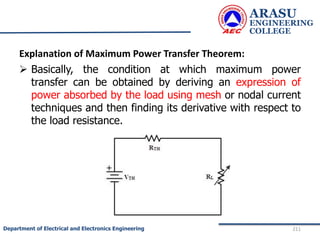
 Basically, the condition at which maximum power
transfer can be obtained by deriving an expression of
power absorbed by the load using mesh or nodal current
techniques and then finding its derivative with respect to
the load resistance.
ARASU
ENGINEERING
COLLEGE
212
Department of Electrical and Electronics Engineering
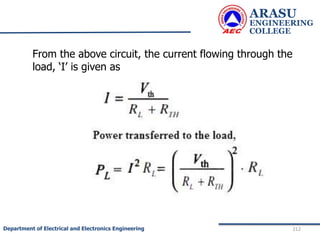
From the above circuit, the current flowing through the
load, ‘I’ is given as
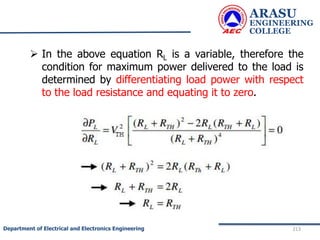
 In the above equation RL is a variable, therefore the
condition for maximum power delivered to the load is
determined by differentiating load power with respect
to the load resistance and equating it to zero.
ARASU
ENGINEERING
COLLEGE
213
Department of Electrical and Electronics Engineering
ARASU
ENGINEERING
COLLEGE
214
Department of Electrical and Electronics Engineering
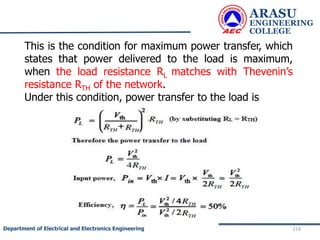
This is the condition for maximum power transfer, which
states that power delivered to the load is maximum,
when the load resistance RL matches with Thevenin’s
resistance RTH of the network.
Under this condition, power transfer to the load is
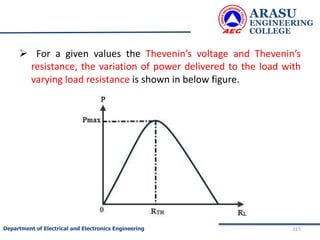
 For a given values the Thevenin’s voltage and Thevenin’s
resistance, the variation of power delivered to the load with
varying load resistance is shown in below figure.
ARASU
ENGINEERING
COLLEGE
215
Department of Electrical and Electronics Engineering
ARASU
ENGINEERING
COLLEGE
216
Department of Electrical and Electronics Engineering
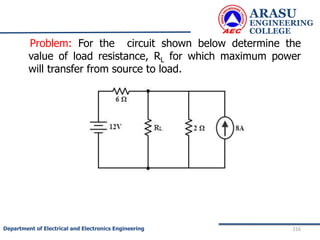
Problem: For the circuit shown below determine the
value of load resistance, RL for which maximum power
will transfer from source to load.
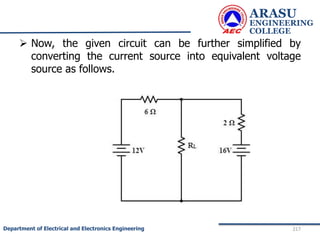
 Now, the given circuit can be further simplified by
converting the current source into equivalent voltage
source as follows.
ARASU
ENGINEERING
COLLEGE
217
Department of Electrical and Electronics Engineering
ARASU
ENGINEERING
COLLEGE
218
Department of Electrical and Electronics Engineering
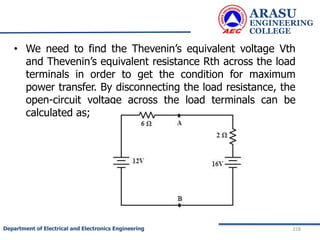
• We need to find the Thevenin’s equivalent voltage Vth
and Thevenin’s equivalent resistance Rth across the load
terminals in order to get the condition for maximum
power transfer. By disconnecting the load resistance, the
open-circuit voltage across the load terminals can be
calculated as;
By applying Kirchhoff’s voltage law, we get
12 – 6I – 2I – 16 = 0
– 8I = 4
I = –0.5 A
The open-circuit voltage across the terminals A and B,
VAB = 16 – 2 ×0.5
= 15 V
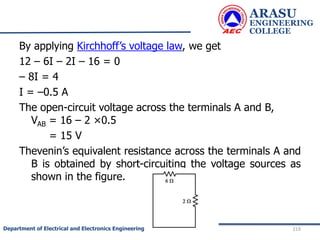
Thevenin’s equivalent resistance across the terminals A and
B is obtained by short-circuiting the voltage sources as
shown in the figure.
ARASU
ENGINEERING
COLLEGE
219
Department of Electrical and Electronics Engineering
ARASU
ENGINEERING
COLLEGE
220
Department of Electrical and Electronics Engineering
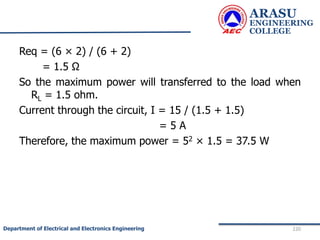
Req = (6 × 2) / (6 + 2)
= 1.5 Ω
So the maximum power will transferred to the load when
RL = 1.5 ohm.
Current through the circuit, I = 15 / (1.5 + 1.5)
= 5 A
Therefore, the maximum power = 52 × 1.5 = 37.5 W
ARASU
ENGINEERING
COLLEGE
221
Department of Electrical and Electronics Engineering
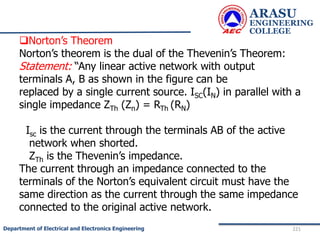
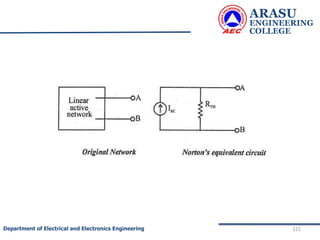
Norton’s Theorem
Norton’s theorem is the dual of the Thevenin’s Theorem:
Statement: “Any linear active network with output
terminals A, B as shown in the figure can be
replaced by a single current source. ISC(IN) in parallel with a
single impedance ZTh (Zn) = RTh (RN)
Isc is the current through the terminals AB of the active
network when shorted.
ZTh is the Thevenin’s impedance.
The current through an impedance connected to the
terminals of the Norton’s equivalent circuit must have the
same direction as the current through the same impedance
connected to the original active network.
ARASU
ENGINEERING
COLLEGE
222
Department of Electrical and Electronics Engineering
ARASU
ENGINEERING
COLLEGE
223
Department of Electrical and Electronics Engineering
EE8251-CIRCUIT THEORY
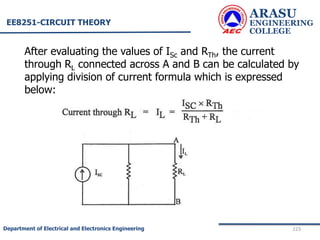
After evaluating the values of ISc and RTh, the current
through RL connected across A and B can be calculated by
applying division of current formula which is expressed
below:
ARASU
ENGINEERING
COLLEGE
224
Department of Electrical and Electronics Engineering
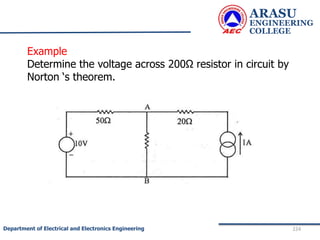
Example
Determine the voltage across 200Ω resistor in circuit by
Norton ‘s theorem.
ARASU
ENGINEERING
COLLEGE
225
Department of Electrical and Electronics Engineering
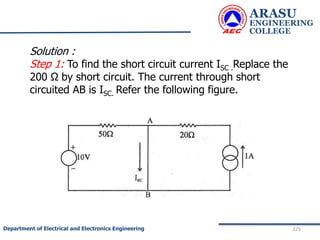
Solution :
Step 1: To find the short circuit current ISC .Replace the
200 Ω by short circuit. The current through short
circuited AB is ISC. Refer the following figure.
ARASU
ENGINEERING
COLLEGE
226
Department of Electrical and Electronics Engineering
The voltage source will drive a current of 10/50= 0.2 A,
which flows through short circuited AB only. Similarly the
current of 1A flows through 20 and then through short-
circuited AB only. 0.2 A will not flow through 2OΩ and 1A will
not flow through 50Ω .It is because of short-circuit. So, Isc=
0.2+1=1.2A.
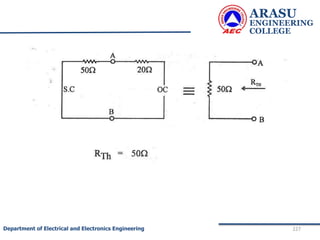
Step 2: To find RTh, : From the given circuit, disconnect RL
= 200 Ω between A and B and also kill the sources. The
resultant circuit becomes as below:
ARASU
ENGINEERING
COLLEGE
227
Department of Electrical and Electronics Engineering
ARASU
ENGINEERING
COLLEGE
228
Department of Electrical and Electronics Engineering
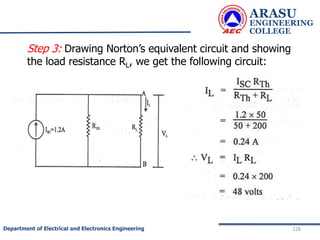
Step 3: Drawing Norton’s equivalent circuit and showing
the load resistance RL, we get the following circuit:
ARASU
ENGINEERING
COLLEGE
229
Department of Electrical and Electronics Engineering
Reciprocity Theorem
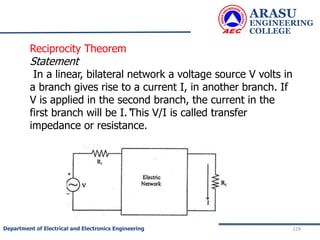
Statement
In a linear, bilateral network a voltage source V volts in
a branch gives rise to a current I, in another branch. If
V is applied in the second branch, the current in the
first branch will be I.‘This V/I is called transfer
impedance or resistance.
ARASU
ENGINEERING
COLLEGE
230
Department of Electrical and Electronics Engineering
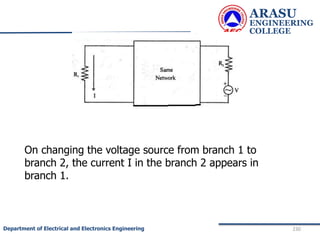
On changing the voltage source from branch 1 to
branch 2, the current I in the branch 2 appears in
branch 1.
ARASU
ENGINEERING
COLLEGE
231
Department of Electrical and Electronics Engineering
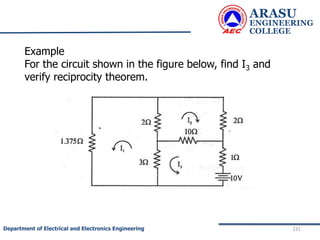
Example
For the circuit shown in the figure below, find I3 and
verify reciprocity theorem.
ARASU
ENGINEERING
COLLEGE
232
Department of Electrical and Electronics Engineering
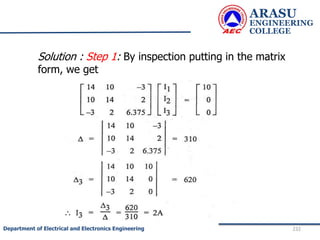
Solution : Step 1: By inspection putting in the matrix
form, we get
ARASU
ENGINEERING
COLLEGE
233
Department of Electrical and Electronics Engineering
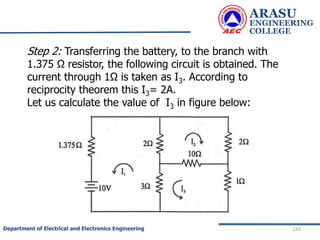
Step 2: Transferring the battery, to the branch with
1.375 Ω resistor, the following circuit is obtained. The
current through 1Ω is taken as I3. According to
reciprocity theorem this I3= 2A.
Let us calculate the value of I3 in figure below:
ARASU
ENGINEERING
COLLEGE
234
Department of Electrical and Electronics Engineering
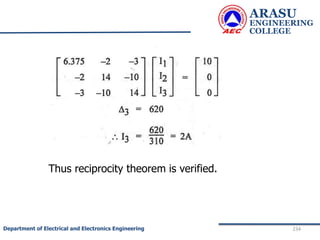
Thus reciprocity theorem is verified.
ARASU
ENGINEERING
COLLEGE
235
Department of Electrical and Electronics Engineering
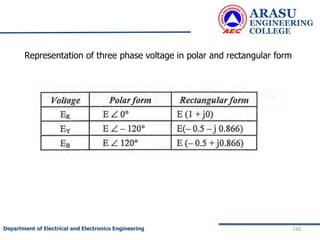
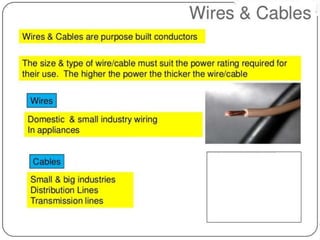
GENERATION OF 3-PHASE VOLTAGE
 The 3-phase voltage can be produced in a
stationary armature with rotating field or in a rotating
armature with a stationary field.
 3-phase voltages are generated in three separate but
identical sets of windings or coils which are displaced by
120 electrical degrees in the armature.
 Hence, the voltages generated in them are 120 degree
apart in time phase. This arrangement is shown in Fig.
 Here, RR’ constitutes one coil (R-phase) ; YY’ another
coil (Y-phase) and BB’ constitutes the third coil (B phase).
The field magnets are assumed to be rotating in clock-
wise direction.
ARASU
ENGINEERING
COLLEGE
236
Department of Electrical and Electronics Engineering
ARASU
ENGINEERING
COLLEGE
237
Department of Electrical and Electronics Engineering
Three phase wave form
ARASU
ENGINEERING
COLLEGE
238
Department of Electrical and Electronics Engineering
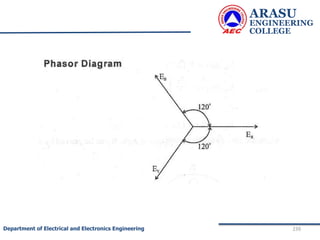
Representation of three phase voltage in polar and rectangular form
ARASU
ENGINEERING
COLLEGE
239
Department of Electrical and Electronics Engineering
ARASU
ENGINEERING
COLLEGE
240
Department of Electrical and Electronics Engineering
ARASU
ENGINEERING
COLLEGE
241
Department of Electrical and Electronics Engineering
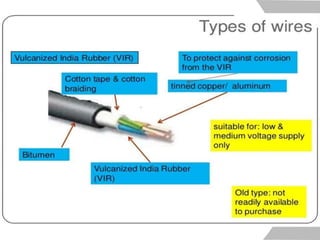
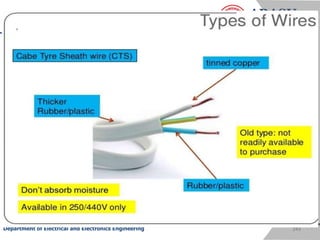
There are six types of wires
Vulcanized Indian rubber wire(VIR)
Tough rubber sheathed wire(TRS)
Poly vinyl chloride wire(PVC)
Lead alloy sheathed wire
Weather proof wires
Flexible wires
ARASU
ENGINEERING
COLLEGE
243
Department of Electrical and Electronics Engineering
ARASU
ENGINEERING
COLLEGE
244
Department of Electrical and Electronics Engineering
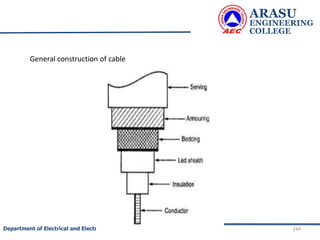
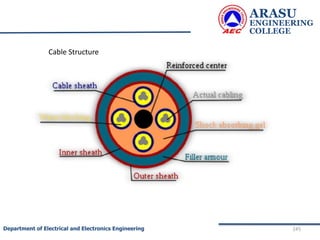
General construction of cable
ARASU
ENGINEERING
COLLEGE
245
Department of Electrical and Electronics Engineering
Cable Structure
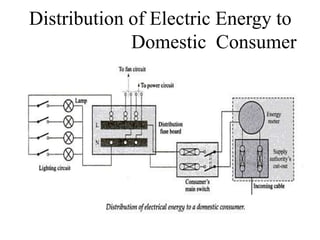
Distribution of Electric Energy to
Domestic Consumer
•Types of wiring
•Suitability of a particular wiring system for a
given installation
•Corridor and staircase lighting
•Necessity of earthing
•Different types of earthing
•Fuses
•Different types of fuses
•Imp VTU Questions
Wiring
Introduction
•A network of wires drawn from the meter board to
the various energy consuming points (lamps,
fans, motors etc) through control and protective
devices for efficient distribution of power is known as
electrical wiring.
•Electrical wiring done in residential and commercial
buildings to provide power for lights, fans, pumps and
other domestic appliances is known as domestic
wiring. There are several wiring systems in practice.
They can be classified into different Types
Types of
Wiring:
1. Cleat wiring
2. CTS wiring or TRS wiring or batten wiring
3. Metal sheathed wiring or lead sheathed
wiring
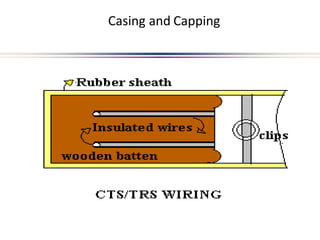
4. Casing and capping
5. Conduit wiring
Cleat
wiring
•: In this type of wiring, insulated conductors (usually
VIR, Vulcanized Indian Rubber) are supported on
porcelain or wooden cleats.
•The cleats have two halves one base and the other
cap.
•The cables are placed in the grooves provided in the
base and then the cap is placed. Both are fixed
securely on the walls by 40mm long screws.
•The cleats are easy to erect and are fixed 4.5 – 15
cms apart.
•This wiring is suitable for temporary installations
where cost is the mPravaeeinnkumcarr.Cit, Deeprt.iaof EEbE,uSKtIT,not
Bangalore
Cleat
wiring
Advantages and
Disadvantages:
Advantages:
1.Easy installation
2.Materials can be retrieved for
reuse
3.Flexibility provided for
inspection, modifications and
expansion.
4.Relatively economical
5.Skilled manpower not
required.
Disadvantages:
1.Appearance is not good
CTS ( Cable Tyre Sheathed) / TRS ( Tough
Rubber Sheathed ) / Batten wiring:
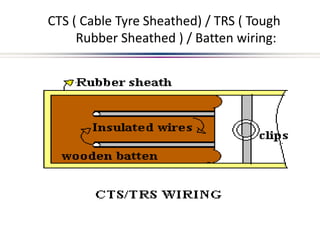
• In this wiring system, wires sheathed in tough
rubber are used which are quite flexible. They are
clipped on wooden battens with brass clips (link
or joint) and fixed on to the walls or ceilings by
flat head screws.
• These cables are moisture and chemical proof.
• They are suitable for damp climate but not
suitable for outdoor use in sunlight.
• TRS wiring is suitable for lighting in low voltage
Bangalore
installations. Praveen kumar .C, Dept. of EEE, SKIT,
CTS ( Cable Tyre Sheathed) / TRS ( Tough
Rubber Sheathed ) / Batten wiring:
Advantages and
Disadvantages:
Advantages:
1.Easy installation and is
durable
2.Lower risk of short circuit.
3.Cheaper than casing and
capping system of wiring
4.Gives a good appearance
if properly erected.
Disadvantages:
1.Danger of mechanical
injury.
2.Danger of fire hazard.
Metal Sheathed or Lead Sheathed wiring
•The wiring is similar to that of CTS but the
conductors (two or three) are individually
insulated and covered with a common outer
lead-aluminum alloy sheath.
•The sheath protects the cable against
dampness, atmospheric extremities and
mechanical damages.
Metal Sheathed or Lead Sheathed wiring
•The sheath is earthed at every junction to
provide a path to ground for the leakage
current.
•They are fixed by means of metal clips on
wooden battens.
•The wiring system is very expensive. It is
suitable for low voltage installations.
Metal Sheathed or Lead Sheathed wiring
Precautions to be taken during
installation
•The clips used to fix the cables on battens
should not react with the sheath
2.Lead sheath should be properly earthed to
prevent shocks due to leakage currents.
3.Cables should not be run in damp places
and in areas where chemicals (may react with
the lead) are used.
Advantages and
Disadvantages:
Advantages:
1.Easy installation and
is aesthetic in
appearance.
2.Highly durable
3.Suitable in adverse
climatic conditions
provided the joints are
not exposed
Disadvantages:
1.Requires skilled
labor
Casing and Capping
•It consists of insulated conductors laid inside
rectangular, teakwood or PVC boxes having
grooves inside it.
•A rectangular strip of wood called capping having
same width as that of casing is fixed over it.
•Both the casing and the capping are screwed
together at every 15 cms.
•Casing is attached to the wall. Two or more wires
of same polarity are drawn through different
grooves.
•The system is suitable for indoor and domestic
Bangalore
installations. Praveen kumar .C, Dept. of EEE, SKIT,
Casing and Capping
Advantages and
Disadvantages:
Advantages:
1.Cheaper than lead sheathed
and conduit wiring.
2.Provides good isolation as
the conductors are placed
apart reducing the risk of
short circuit.
3.Easily accessible for
inspection and repairs.
4.Since the wires are not
exposed to atmosphere,
insulation is less affected by
dust, dirt and climatic
Bangalore
Conduit wiring
Praveen kumar .C, Dept. of EEE, SKIT,
•In this system PVC (polyvinyl chloride) or VIR cables
are run through metallic or PVC pipes providing good
protection against mechanical injury and fire due to
short circuit.
•They are either embedded inside the walls or
supported over the walls, and are known as concealed
wiring or surface conduit wiring (open conduit)
respectively.
•The conduits are buried inside the walls on wooden
gutties and the wires are drawn through them with fish
(steel) wires.
•The system is best suited for public buildings,
industries and workshopBsan.galore
Conduit wiring
Advantages and
Disadvantages:
Advantages:
1.No risk of fire and good protection
against mechanical injury.
2.The lead and return wires can be
carried in the same tube.
3.Earthing and continuity is assured.
4.Waterproof and trouble shooting is
easy.
5.Shock- proof with proper earthing
and bonding
6.Durable and maintenance free
7.Aesthetic in appearance
Disadvantages:
1.Very expensive system of wiring.
2.Requires good skilled workmanship.
FACTORS AFFECTING THE CHOICE
OF WIRING SYSTEM
The choice of wiring system for a particular installation
depends on technical factors and economic viability.
1.Durability: Type of wiring selected should conform to
standard specifications, so that it is durable i.e. without
being affected by the weather conditions, fumes etc.
2.Safety: The wiring must provide safety against
leakage, shock and fire hazards for the operating
personnel.
3.Appearance: Electrical wiring should give an
aesthetic appeal to the interiors.
4.Cost: It should not be prohibitively expensive.
Cnt.
.
5.Accessibility: The switches and plug points
provided should be easily accessible. There must be
provision for further extension of the wiring system, if
necessary.
6.Maintenance Cost: The maintenance cost should
be a minimum
7.Mechanical safety: The wiring must be protected
against any mechanical damage
Two- way and Three- way Control
of Lamps:
•The domestic lighting circuits are quite simple
and they are usually controlled from one point.
But in certain cases it might be necessary to
control a single lamp from more than one point
(Two or Three different points).
•For example: staircases, long corridors, large
halls etc.
1 Two-way Control of lamp:
•Two-way control is usually used for staircase
lighting.
•The lamp can be controlled from two different
points: one at the top and the other at the bottom -
using two- way switches which strap wires
interconnect.
•They are also used in bedrooms, big halls and large
corridors.
•The circuit is shown in the following figure.
1 Two-way Control of lamp:
Explanation: -Switches S1 and S2 are two-way
switches with a pair of terminals 1&2, and 3&4
respectively. When the switch S1 is in position1 and
switch S2 is in position 4, the circuit does not form a
closed loop and there is no path for the current to flow
and hence the lamp will be OFF. When S1 is changed to
position 2 the circuit gets completed and hence the lamp
glows or is ON. Now if S2 is changed to position 3 with
S1 at position 2 the circuit continuity is broken and the
lamp is off. Thus the lamp can be controlled from two
different points.
1 Two-way Control of lamp:
Explanation: -Switches S1 and S2 are two-way
switches with a pair of terminals 1&2, and 3&4
respectively. When the switch S1 is in position1 and
switch S2 is in position 4, the circuit does not form a
closed loop and there is no path for the current to flow
and hence the lamp will be OFF. When S1 is changed to
position 2 the circuit gets completed and hence the lamp
glows or is ON. Now if S2 is changed to position 3 with
S1 at position 2 the circuit continuity is broken and the
lamp is off. Thus the lamp can be controlled from two
different points.
2. Three- way Control of
lamp:
•In case of very long corridors it may be necessary to
control the lamp from 3 different points. In such cases,
the circuit connection requires two; two-way switches
S1and S2 and an intermediate switch S3.
•An intermediate switch is a combination of two, two
way switches coupled together. It has 4 terminals ABCD.
It can be connected in two ways.
a) Straight connection
b) Cross connection
• In case of straight connection, the terminals or points
AB and CD are connected as shown in figure 1(a)
while in case of cross connection, the terminals AB
and C D is connected as shown in figure 1(b). As
explained in two – way control the lamp is ON if the
circuit is complete and is OFF if the circuit does not
form a closed loop.
2. Three- way Control of
lamp:
2. Three- way Control of
lamp:
2. Three- way Control of
lamp:
Truth table :
2. Three- way Control of lamp:
BLOCK DIAGRAM
1.To protect the operating personnel from danger
of shock in case they come in contact with the
charged frame due to defective insulation.
2.To maintain the line voltage constant under
unbalanced load condition.
3.Protection of the equipments
4.Protection of large buildings and all machines
fed from overhead lines against lightning.
Necessity of Earthing:
1 ohm.
•The important methods of earthing are the plate
earthing and the pipe earthing.
•The earth resistance for copper wire is 1 ohm
and that of G I wire less than 3 ohms.
•The earth resistance should be kept as low as
possible so that the neutral of any electrical
system, which is earthed, is maintained almost at
the earth potential.
•The typical value of the earth resistance at
powerhouse is 0. 5 ohm and that at substation is
Methods of Earthing:
.
•In this method a copper plate of 60cm x 60cm x 3.18cm
or a GI plate of the size 60cm x 60cm x 6.35cm is used
for earthing.
•The plate is placed vertically down inside the ground at
a depth of 3m and is embedded in alternate layers of
coal and salt for a thickness of 15 cm.
•In addition, water is poured for keeping the earth
electrode resistance value well below a maximum of 5
ohms.
•The earth wire is securely bolted to the earth plate.
•A cement masonry chamber is built with a cast iron
cover for easy regular maintenance.
1. Plate Earthing:
Plate Earthing:
•Earth electrode made of a GI (galvanized) iron pipe of
38mm in diameter and length of 2m (depending on the
current) with 12mm holes on the surface is placed
upright at a depth of 4.75m in a permanently wet ground.
•To keep the value of the earth resistance at the desired
level, the area (15 cms) surrounding the GI pipe is filled
with a mixture of salt and coal..
•the efficiency of the earthing system is improved by
pouring water through the funnel periodically. The GI
earth wires of sufficient cross- sectional area are run
through a 12.7mm diameter pipe (at 60cms below) from
the 19mm diameter pipe and secured tightly at the top
as shown in the figure.
2. Pipe Earthing
Pipe Earthing :
•Protection for electrical installation must be provided in
the event of faults such as short circuit, overload and
earth faults.
•The protective circuit or device must be fast acting and
isolate the faulty part of the circuit immediately.
•It also helps in isolating only required part of the circuit
without affecting the remaining circuit during
maintenance.
•The following devices are usually used to provide the
necessary protection:
PROTECTIVE DEVICES
1. Fuses
2. Relays
3. Miniature circuit breakers (MCB)
4. Earth leakage circuit breakers (ELCB)
Types
1. Re-wirable or kit -kat fuses: These fuses are simple in
construction, cheap and available up-to a current
rating of 200A. They are erratic in operation and their
performance deteriorates with time.
2. Plug fuse: The fuse carrier is provided with a glass
window for visual inspection of the fuse wire.
3. Cartridge fuse: Fuse wire usually an alloy of lead is
enclosed in a strong fiber casing. The fuse element is
fastened to copper caps at the ends of the casing. They
are available up-to a voltage rating of 25kV. They are
used for protection in lighting installations and power
lines.
circuits.
4. Miniature Cartridge fuses: These are the miniature version of the
higher rating cartridge fuses, which are extensively used in
automobiles, TV sets, and other electronic equipment‟s.
5. Transformer fuse blocks: These porcelain housed fuses are placed
on secondary of the distribution transformers for protection
against short circuits and overloads.
6. Expulsion fuses: These consist of fuse wire placed in hollow tube
of fiber lined with asbestos. These are suited only for out door use
for example, protection of high voltage circuits.
7. Semi-enclosed re-wirable fuses: These have limited use because of
low breaking capacity.
8. Time-delay fuse: These are specially designed to withstand a
current overload for a limited time and find application in motor
Under abnormal conditions such as short circuit, overload or
any fault the current raises above this value, damaging the
equipment and sometimes resulting in fire hazard. Fuses are
pressed into operation under such situations.
Fuse is a safety device used in any electrical installation,
which forms the weakest link between the supply and the
load. It is a short length of wire made of lead / tin /alloy of
lead and tin/ zinc having a low melting point and low ohmic
losses. Under normal operating conditions it is designed to
carry the full load current. If the current increases beyond
this designed value due any of the reasons mentioned
above, the fuse melts (said to be blown) isolating the power
supply from the load as shown in the following figures.
FUSE
FUSE

Electric circuits and network theorems

  • 1.
    Department of Electricaland Electronics Engineering Approved by AICTE | Affiliated to Anna University | Accredited by NAAC | Accredited NBA | Recognized by UGC under 2(f) and 12(B) Chennai Main Road, Kumbakonam- 612 501. ARASU ENGINEERING COLLEGE 1 ELECTRIC CIRCUITS AND NETWORK THEOREMS
  • 2.
    Prepared by Mrs.K.Kalpana.,M.E.,(Ph.D)., Assistant Professor Departmentof Electrical and Electronics Engineering Arasu Engineering College Kumbakonam Department of Electrical and Electronics Engineering 2
  • 3.
    INTRODUCTION  The interconnectionof various electric elements in a prescribed manner comprises as an electric circuit in order to perform a desired function.  An electrical network is an interconnection of electrical components (e.g., batteries, resistors, inductors, capacitors, switches, transistors) or a model of such an interconnection, consisting of electrical elements (e.g., voltage sources, current sources, resistances, inductances, capacitances).  The electric elements include controlled and uncontrolled source of energy, resistors, capacitors, inductors, etc. ARASU ENGINEERING COLLEGE 3 Department of Electrical and Electronics Engineering
  • 4.
    INTRODUCTION  Analysis ofelectric circuits refers to computations required to determine the unknown quantities such as voltage, current and power associated with one or more elements in the circuit.  Many other systems, like mechanical, hydraulic, thermal, magnetic and power system are easy to analyze and model by a circuit.  To learn how to analyze the models of these systems, first one needs to learn the techniques of circuit analysis. ARASU ENGINEERING COLLEGE 4 Department of Electrical and Electronics Engineering
  • 5.
    BASIC ELEMENTS &INTRODUCTORY CONCEPTS • Electrical Network: A combination of various electric elements (Resistor, Inductor, Capacitor, Voltage source, Current source) connected in any manner what so ever is called an electrical network. We may classify circuit elements in two categories, passive and active elements. • Passive Element: The element which receives energy (or absorbs energy) and then either converts it into heat (R) or stored it in an electric (C) or magnetic (L ) field is called passive element. ARASU ENGINEERING COLLEGE 5 Department of Electrical and Electronics Engineering
  • 6.
    Active Element: Theelements that supply energy to the circuit is called active element.  Examples of active elements include voltage and current sources, generators and electronic devices that require power supplies.  A transistor is an active circuit element, meaning that it can amplify power of a signal. ARASU ENGINEERING COLLEGE 6 Department of Electrical and Electronics Engineering
  • 7.
     Bilateral Element:Conduction of current in both directions in an element (example: Resistance; Inductance; capacitance ) with same magnitude is termed as bilateral element.  Unilateral Element: Conduction of current in one direction is termed as unilateral (example: Diode, Transistor) element.  Response: An application of input signal to the system will produce an output signal, the behavior of output signal with time is known as the response of the system ARASU ENGINEERING COLLEGE 7 Department of Electrical and Electronics Engineering
  • 8.
    Potential Energy Difference:The voltage or potential energy difference between two points in an electric circuit is the amount of energy required to move a unit charge between the two points.  Resistor opposes the flow of current through it and it dissipates energy in the form of heat. (Ohms (Ω)). ARASU ENGINEERING COLLEGE 8 Department of Electrical and Electronics Engineering
  • 9.
     Inductor storesenergy in its magnetic field.  Unit of inductance is Henry (H). ARASU ENGINEERING COLLEGE 9 Department of Electrical and Electronics Engineering
  • 10.
     Capacitor storesenergy in its electric field.  Unit of capacitance is Farad (F). ARASU ENGINEERING COLLEGE 10 Department of Electrical and Electronics Engineering
  • 11.
    Classification of sources(active elements) Sources (active elements) are classified as 1. Independent sources 2. Dependent sources 1. Independent sources: Batteries and generators are called independent sources which can directly generate electrical energy. Independent sources do not depend on other electrical sources. 2. Dependent sources: Transistors and Op-amps are called dependent sources whose output energy depends on other independent sources. ARASU ENGINEERING COLLEGE 11 Department of Electrical and Electronics Engineering EE8251- CIRCUIT THEORY
  • 12.
    V-I characteristics ofideal and practical sources: Ideal voltage sources: A voltage source is a two-terminal device whose voltage at any instant of time is constant and is independent of the current drawn from it. Such a voltage source is called an Ideal Voltage Source and have zero internal resistance. ARASU ENGINEERING COLLEGE 12 Department of Electrical and Electronics Engineering
  • 13.
    Practical Voltage sources: Sourceshaving some amount of internal resistances are known as Practical Voltage Source. Due to this internal resistance, voltage drop takes place, and it causes the terminal voltage to reduce. ARASU ENGINEERING COLLEGE 13 Department of Electrical and Electronics Engineering
  • 14.
    ARASU ENGINEERING COLLEGE 14 Department of Electricaland Electronics Engineering Ideal Current sources: • An ideal current source is a two-terminal circuit element which supplies the same current to any load resistance connected across its terminals. Here the current supplied by the current source is independent of the voltage of source terminals. It has infinite resistance.
  • 15.
    • Practical Currentsources • A practical current source is a two terminal device having some resistance connected across its terminals. Unlike ideal current source, the output current of practical source depends on the voltage of the source. ARASU ENGINEERING COLLEGE 15 Department of Electrical and Electronics Engineering
  • 16.
    Active Network: A networkthat contains at least one active element, such as an independent voltage or current source, is an active network. Passive Network: A network that does not contain any active elements is a passive network. ARASU ENGINEERING COLLEGE 16 Department of Electrical and Electronics Engineering
  • 17.
    Lumped elements : Physicallyseparated elements such as resistor, capacitor and inductors are called as lumped elements. Distributed element : It is not separable for electrical purposes. A transmission line has distributed resistance, inductance & capacitance along its length. ARASU ENGINEERING COLLEGE 17 Department of Electrical and Electronics Engineering
  • 18.
    Bilateral element : Conduction of current in both directions in an element with same magnitude. (Ex: R,L,C) In a bilateral element, the voltage and current relation is the same for current flowing in either direction. Unilateral elements-: Conduction of current in one direction.(Ex: Diode, Transistor). ARASU ENGINEERING COLLEGE 18 Department of Electrical and Electronics Engineering
  • 19.
    D.C circuits: The directionof current flow, at any point in the circuit, does not change with time. A.C circuits: The direction of current flow (as well as its magnitude) changes with time. CHARGE Charge is an electrical property of the atomic particles of which matter consists, measured in coulombs (C). Charge, positive or negative, is denoted by the letter q or Q. ARASU ENGINEERING COLLEGE 19 Department of Electrical and Electronics Engineering EE8251- CIRCUIT THEORY
  • 20.
    CURRENT  Current canbe defined as the rate of flow of electrons in a conductive or semi conductive material, measured in Ampere (A).  Electric current, is denoted by the letter i or I.  The unit of current is the ampere abbreviated as (A) and corresponds to the quantity of total charge that passes through an arbitrary cross section of a conducting material per unit second.  Mathematically, • Where Q is the symbol of charge measured in Coulombs (C), • I is the current in amperes (A) and t is the time in second (s). ARASU ENGINEERING COLLEGE 20 Department of Electrical and Electronics Engineering
  • 21.
     The currentcan also be defined as the rate of charge passing through a point in an electric circuit.  Mathematically, i= dq/dt Two types of currents: 1) A direct current (DC) is a current that remains constant with time. ARASU ENGINEERING COLLEGE 21 Department of Electrical and Electronics Engineering
  • 22.
    2) An alternatingcurrent (AC) is a current that varies with time. ARASU ENGINEERING COLLEGE 22 Department of Electrical and Electronics Engineering
  • 23.
    • The differencein potential energy of the charges is called potential difference. • It is also known as voltage. • It is denoted by V, unit Volts • V=W/Q or dw/dQ ARASU ENGINEERING COLLEGE 23 Department of Electrical and Electronics Engineering VOLTAGE (or) POTENTIAL DIFFERENCE :
  • 24.
    ARASU ENGINEERING COLLEGE 24 Department of Electricaland Electronics Engineering POWER Power is the rate of change of energy, measured in watts (W). Power, is denoted by the letter p or P. Mathematically, P=dw/dt Where P is power in watts (W), w is energy in joules (J), and t is time in seconds (s). From voltage and current equations, it follows that; P=dw/dt= dw/dq X dq/dt = V X I Thus, if the magnitude of current I and voltage are given, then power can be evaluated as the product of the two quantities and is measured in watts (W).
  • 25.
    ARASU ENGINEERING COLLEGE 25 Department of Electricaland Electronics Engineering ENERGY Energy is the capacity for doing work, and is measured in joules (J). The energy absorbed or supplied by an element from time 0 to t is given by,
  • 26.
     Node: Anode is a point in a network, where two or more elements are joined.  Principal node: Junction of three or more elements. (Current is divided)  Simple node: Junction of any two elements. (Current is not divided) ARASU ENGINEERING COLLEGE 26 Department of Electrical and Electronics Engineering
  • 27.
     Branch: Branchrepresents a single element connected between two nodes such as a voltage source or resistor. In the above circuit, the branches are: af, ab, bc, cd, be.  Loop: Loop is an any closed path in the circuit. In the above circuit, the loops are: abefa, bcdeb, abcdfa.  Mesh: Mesh is a closed path that does not contain any other loops .In the above circuit, the meshes are: abefa, bcdeb. ARASU ENGINEERING COLLEGE 27 Department of Electrical and Electronics Engineering
  • 28.
    Ohm’s Law:  Ohm'slaw states that the current through a conductor is directly proportional to the potential difference or voltage across the two points, that the temperature of the conductor remains constant V ∝ I (Or) V = IR  The mathematical equation that describes this relationship is: V / I= R ARASU ENGINEERING COLLEGE 28 Department of Electrical and Electronics Engineering
  • 29.
     where Iis the current through the resistance in units of amperes,  V is the potential difference measured across the resistance in units of volts, and  where R is the proportionality constant. R is called Resistance of the conductor and is measured in ‘Ohms’ (Ω).  The power absorbed by the resistance is calculated as : ARASU ENGINEERING COLLEGE 29 Department of Electrical and Electronics Engineering Since I=V/R
  • 30.
    • The V-Irelation for resistor according to Ohm’s law is depicted in Fig. ARASU ENGINEERING COLLEGE 30 Department of Electrical and Electronics Engineering Limitations of Ohm’s Law: 1. Ohm’s law is not applicable to non-linear elements like diode, transistor etc. 2. Ohm’s law is not applicable for non-metallic conductors like silicon carbide. 3. Ohm’s law holds good only for constant temperature. If the temperature change, this law cannot be applied.
  • 31.
    KIRCHOFF'S LAW Kirchoff's FirstLaw - The Current Law, (KCL)  It states that “the algebraic sum of currents meeting at a junction(node) is equal to zero".  In other words the algebraic sum of ALL the currents entering and leaving a node must be equal to zero,  I(exiting) + I(entering) = 0.  In case of AC circuits, Kirchoff’s current law states that phasor sum of incoming current is equal to the phasor sum of outgoing current. ARASU ENGINEERING COLLEGE 31 Department of Electrical and Electronics Engineering
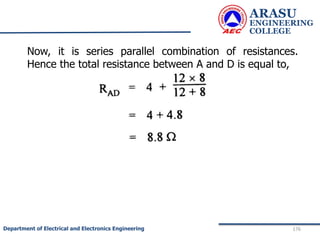
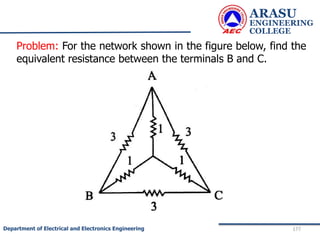
  • 32.
    I1 + I2+ I3 = I4 + I5  Here, the 3 currents entering the node, I1, I2, I3 are all positive in value and the 2 currents leaving the node, I4 and I5 are negative in value.  Then the equation can also rewrite as; I1 + I2 + I3 - I4 - I5 = 0 ARASU ENGINEERING COLLEGE 32 Department of Electrical and Electronics Engineering
  • 33.
    Kirchhoff’s Voltage Law(KVL):  The algebraic sum of electromotive forces plus the algebraic sum of voltages across the impedances (resistances) in any closed electrical circuit is equal to zero.  For any closed path in a circuit, the algebraic sum of the voltage is zero.  In other words, for any closed path in a circuit, the sum of voltage rise is equal to sum of voltage drop.  Mathematically, ∑emf + ∑ IR =0 in any closed electrical circuit. ARASU ENGINEERING COLLEGE 33 Department of Electrical and Electronics Engineering
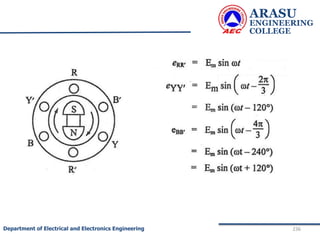
  • 34.
    ARASU ENGINEERING COLLEGE 34 Department of Electricaland Electronics Engineering Consider the above fig., Applying KVL: V1- V2 + V3-V4 = 0 It can be also written as, V1 +V3 = V2 + V4
  • 35.
  • 36.
    ARASU ENGINEERING COLLEGE 36 Department of Electricaland Electronics Engineering Consider the circuit shown in figure. Apply KVL to the circuit, -E1+ E2-E3+E4+I1R1-I2R2-I3R3-I4R4=0
  • 37.
    Problem :1 A currentof 0.5 A is flowing through the resistance of 10Ω. Find the potential difference between its ends. Solution: Current I = 0.5A. Resistance R = 10Ω Potential difference V =? V = IR = 0.5 × 10 = 5V. ARASU ENGINEERING COLLEGE 37 Department of Electrical and Electronics Engineering
  • 38.
    ARASU ENGINEERING COLLEGE 38 Department of Electricaland Electronics Engineering Problem: 2 A supply voltage of 220V is applied to a resistor100Ω. Find the current flowing through it. Solution: Voltage V = 220V Resistance R = 100Ω Current I = V/ R = 2 2 0 /100 = 2.2 A.
  • 39.
    ARASU ENGINEERING COLLEGE 39 Department of Electricaland Electronics Engineering Problem: 3 Calculate the resistance of the conductor if a current of 2A flows through it when the potential difference across its ends is 6V. Solution: Current I = 2A. Potential difference V = 6. Resistance R = V/I = 6 /2 R= 3 ohm.
  • 40.
    Problem: 4 Calculate thecurrent and resistance of a 100 W, 200V electric bulb. Solution: Power, P = 100W Voltage, V = 200V Power P= VI Current I = P/V = 100/200 = 0.5A Resistance R = V /I = 200/0.5 = 400Ω ARASU ENGINEERING COLLEGE 40 Department of Electrical and Electronics Engineering
  • 41.
    ARASU ENGINEERING COLLEGE 41 Department of Electricaland Electronics Engineering Resistors In Series When resistors are connected as shown in figure such that the same current passes through all of them, they are said to be in series. Each resistor has a voltage drop across it given by Ohm’s law. Thus, V1=I1R1 V2=I2R2 and V3=I3R3 The total drop in the three resistors put together is V = V1+V2+ V3 V =I(R1+R2+R3)
  • 42.
    ARASU ENGINEERING COLLEGE 42 Department of Electricaland Electronics Engineering Power dissipated in R1 is given by
  • 43.
    ARASU ENGINEERING COLLEGE 43 Department of Electricaland Electronics Engineering Resistors In Parallel When resistors are connected across one another such that the same voltage is applied to each, then they are said to be in Parallel. Such an arrangement is shown in fig. The current in each resistor is different and the current I taken from the supply divides among all the three resistors.
  • 44.
    ARASU ENGINEERING COLLEGE 44 Department of Electricaland Electronics Engineering If we replace the three resistors in parallel by a single equivalent resistor R, as shown in figure , it will draw the same current, I. therefore V= I Reff (by Ohm’s law)
  • 45.
    ARASU ENGINEERING COLLEGE 45 Department of Electricaland Electronics Engineering If there were only two resistors in parallel, then the effective resistance is given by
  • 46.
    ARASU ENGINEERING COLLEGE 46 Department of Electricaland Electronics Engineering Difference between Series and Parallel Circuit
  • 47.
    ARASU ENGINEERING COLLEGE 47 Department of Electricaland Electronics Engineering 1.Find the voltage across the resistor R in figure.
  • 48.
    ARASU ENGINEERING COLLEGE 48 Department of Electricaland Electronics Engineering 2.Find the current through 12 Ωresistor in figure.
  • 49.
    ARASU ENGINEERING COLLEGE 49 Department of Electricaland Electronics Engineering Voltage division rule: Current division rule:
  • 50.
    ARASU ENGINEERING COLLEGE 50 Department of Electricaland Electronics Engineering Problem: Find the current flowing through each branch for the circuit shown in figure. Solution: Here two resistor are connected in parallel. Therefore Req is
  • 51.
    ARASU ENGINEERING COLLEGE 51 Department of Electricaland Electronics Engineering Req = 2.4Ω Input current I= V/R = 230 / 2.4 =95.83A Using current division rule, the current through 4 Ω resistor is
  • 52.
    ARASU ENGINEERING COLLEGE 52 Department of Electricaland Electronics Engineering Using current division rule, the current through 6Ω resistor is Problem: Three loads A, B and C are connected in parallel across a 250V source. Loads A takes 50 A. Load B is a resistor of 10 ohms and load C takes 6.25 kW. Calculate(I) RA and RC (ii) Currents lB and IC (iii) Power in loads A ad B (v) Total Power and (vi) Total effective resistance.
  • 53.
    ARASU ENGINEERING COLLEGE 53 Department of Electricaland Electronics Engineering Solution:
  • 54.
  • 55.
    ARASU ENGINEERING COLLEGE 55 Department of Electricaland Electronics Engineering Problem: Determine the total current taken from the source.
  • 56.
    ARASU ENGINEERING COLLEGE 56 Department of Electricaland Electronics Engineering Solution: Here, 50Ω and 50Ω are connected in series. So, 50+50=100Ω 100Ω and 100Ω are connected in series. So, 100+100=200Ω
  • 57.
    ARASU ENGINEERING COLLEGE 57 Department of Electricaland Electronics Engineering 100Ω and 100Ω are connected in parallel. So, 200Ω and 50Ω are connected in parallel. So,
  • 58.
    ARASU ENGINEERING COLLEGE 58 Department of Electricaland Electronics Engineering 40Ω and 50Ω are connected in series. So, 40+50=90Ω 90Ω and 90Ω are connected in parallel. So, 45Ω and 55Ω are connected in series. So, 45+55=100Ω
  • 59.
    ARASU ENGINEERING COLLEGE 59 Department of Electricaland Electronics Engineering 100Ω and 100Ω are connected in parallel. So, Total current I= V/R = 100/50= 2A I= 2A
  • 60.
    Problem : Forthe circuit shown in figure, determine (a) the battery voltage V, (b) the total resistance of the circuit, and (c) the values of resistance of resistors R1, R2 and R3, given that the p.d.’s R1, R2 across and R3 are 5V, 2V and 6V respectively. ARASU ENGINEERING COLLEGE 60 Department of Electrical and Electronics Engineering EE8251-CIRCUIT THEORY
  • 61.
    ARASU ENGINEERING COLLEGE 61 Department of Electricaland Electronics Engineering (a) Battery voltage V =V1 + V2 + V3 =5 + 2 + 6=13V (b)Total circuit resistance R= V/ I = 13/4=3.25Ω (c) Resistance R1 = V1/ I = 5/4 =1.25 Ω Resistance R2 = V2/ I = 2/4 =0.5 Ω Resistance R3 = V3/ I = 6/4 =1.5 Ω EE8251-CIRCUIT THEORY
  • 62.
    ARASU ENGINEERING COLLEGE 62 Department of Electricaland Electronics Engineering Mesh Analysis In mesh method, Kirchhoff's Voltage Law(KVL) is applied to a network. For this network, we have to write mesh equations in terms of mesh currents. Here, we are using mesh current instead of branch currents. Here each mesh is assigned a separate mesh current. Assume that the mesh current direction is clockwise. Then, KVL is applied to the network, in order to write equations in terms of unknown mesh currents. EE8251-CIRCUIT THEORY
  • 63.
    ARASU ENGINEERING COLLEGE 63 Department of Electricaland Electronics Engineering EE8251-CIRCUIT THEORY The branch Current can be found out by taking the algebraic sum of the mesh currents which are common to that branch. The following steps should be implemented to find out the mesh currents and branch currents. Consider a simple network as shown in figure. Step 1: First, each mesh is assigned a separate mesh current. Assume all mesh currents directions are clockwise. It consists of two meshes (PQSP and QRSQ) and two mesh currents (I1 and I2).
  • 64.
    Step 2: Iftwo mesh currents (I1 and I2) are flowing through a network elements, the actual current in the circuit element is the algebraic sum of the two mesh currents (I1 and I2). In this network, mesh currents, I1 and I2 are flowing through R2. First we consider one direction i.e., Q to S, current is I1-I2 and in for another direction. i.e., S to Q, current is I2-I1 ARASU ENGINEERING COLLEGE 64 Department of Electrical and Electronics Engineering EE8251-CIRCUIT THEORY
  • 65.
    Step 3: Writeequation for each mesh in terms of mesh currents by applying KVL. When writing mesh equations, we assign rise in potential as positive (+) sign and fall in potential as negative (—) sign. Step 4: Suppose any value of mesh current becomes negative in the solution, the actual or true direction of the mesh current is anticlockwise, i.e., opposite to the clockwise direction. By applying KVL to the circuit , we get two equations, Mesh PQSP ARASU ENGINEERING COLLEGE 65 Department of Electrical and Electronics Engineering EE8251-CIRCUIT THEORY
  • 66.
    MESH QRSQ The meshcurrents I1 and 12 can be found out by solving the above equations Step-5 : The branch currents can be easily found out by using the mesh currents. ARASU ENGINEERING COLLEGE 66 Department of Electrical and Electronics Engineering EE8251-CIRCUIT THEORY
  • 67.
    ARASU ENGINEERING COLLEGE 67 Department of Electricaland Electronics Engineering Mesh Analysis by Inspection Method Step 1: Convert the current source into equivalent voltage source by source transformation. Step 2: All the resistance through which the loop current I1 flows are summed up and denoted by R11. It is called self resistance of loop 1. Step 3: All the resistance through which loop currents I1 in the first loop, and I2 in the second loop flow are summed up. This is denoted by R12. The sign of the term R12 is negative, if the two currents I1 and I2 through R12 are in opposite directions; otherwise the sign is positive.
  • 68.
    Step 4: LetV1 be the effective voltage on the first loop through which the loop current I1 flows. The sign of V1 is positive if the direction of V1 is same as that of I1 (i.e. aiding the current I1, otherwise the sign of V1 is negative). V1 is written on the right hand side of the equation. Now, zero is written on the right hand side if there is no source in the first loop through which I1 flows. The general matrix form of mesh equation is ARASU ENGINEERING COLLEGE 68 Department of Electrical and Electronics Engineering
  • 69.
  • 70.
    (The minus signindicates the loop current I2 flows from the voltage terminal + to --) By using Cramer’s rule, we can find mesh or loop currents I1 and I2 ARASU ENGINEERING COLLEGE 70 Department of Electrical and Electronics Engineering
  • 71.
    Nodal Analysis  Thenodal method is used to analyze multisource circuits. In this method, we solve the simultaneous equations using Kirchhoff’s current law (KCL) applied at various nodes in an electric circuit. Node defined as junction or joining point of two or more component terminals.  In nodal method, we select one node as a reference node, with respect to the voltages at all other nodes are measured. Thus, the reference node acts as a ground or common for the circuit. ARASU ENGINEERING COLLEGE 71 Department of Electrical and Electronics Engineering
  • 72.
    ARASU ENGINEERING COLLEGE 72 Department of Electricaland Electronics Engineering The first step in nodal method is to convert all voltage sources to equivalent current sources. The second step is to identify all the principal nodes in the circuit and to choose a reference node. The choice is arbitrary, but it is usually convenient to select the reference node as the one having the most of the components connected to it. All the nodes except the reference node are then numbered and their corresponding voltages are designated as V1, V2….etc. The reference node and other nodes are indicated as shown in figure .
  • 73.
    ARASU ENGINEERING COLLEGE 73 Department of Electricaland Electronics Engineering Steps 1. Select one major node as the reference node and assign each of the (n -1) remaining nodes with its own unknown potential (with respect to the reference node). 2. Assign branch current to all branches. The arrow is drawn from V1 towards V2 because current always flows from higher potential to the lower potential.
  • 74.
    ARASU ENGINEERING COLLEGE 74 Department of Electricaland Electronics Engineering 3. Express the branch currents in terms of the node potentials. 4.Write the current equation at each of the (n-1) unknown nodes. 5. Substitute the current expressions (Step-3) into the current equations (Step-4), which then become a set of simultaneous equations of unknown node voltages. 6. Solve for the unknown voltages and the branch currents.
  • 75.
    ARASU ENGINEERING COLLEGE 75 Department of Electricaland Electronics Engineering In many circuits the reference node is most conveniently selected as a common terminal or the ground terminal. The above circuit diagram consists of three nodes. It is possible to write (n-1) equations for the circuit having ‘n’ nodes. Applying KCL at node 1 gives,
  • 76.
  • 77.
  • 78.
    ARASU ENGINEERING COLLEGE 78 Department of Electricaland Electronics Engineering The generalized node equations can be written as [G] [V]= [I] ……………..3 where the square matrix G is called the node conductance matrix, V is the column matrix of the node voltages with respect to the reference node and I is the column matrix of input currents.
  • 79.
    ARASU ENGINEERING COLLEGE 79 Department of Electricaland Electronics Engineering Nodal Analysis by Inspection Method: Step 1: First, convert all the voltage sources to equivalent current sources. Step 2: The conductances of all branches connected to node 1 are added and denoted by G11 . G11 is called the self conductance of node 1. Step 3: All the conductances connected to nodes 1 and 2 are added and denoted by G12. G12 is called mutual conductance of nodes 1 and 2. This G12 is written with negative sign. If no conductance is connected between nodes 1 and 2 then G12 = 0, G12=G21.
  • 80.
    ARASU ENGINEERING COLLEGE 80 Department of Electricaland Electronics Engineering Step 4: I1 denotes the value of the current source to node 1 and is written on the right hand side of the equation. The sign of I1 is positive if it is flowing towards node 1, otherwise it is negative. If no current source is connected to node 1 , then I1 = 0. For example, consider the circuit given below, First convert voltage sources into equivalent current sources.
  • 81.
    ARASU ENGINEERING COLLEGE 81 Department of Electricaland Electronics Engineering The circuit consists of two nodes 1 and 2 and common (ref) node.
  • 82.
    ARASU ENGINEERING COLLEGE 82 Department of Electricaland Electronics Engineering By Solving this matrix, we can find out nodal voltages V1 and V2.
  • 83.
    Problem 1: Usemesh-current analysis to determine the current flowing in the 1Ω resistance of the d.c. circuit shown in fig. ARASU ENGINEERING COLLEGE 83 Department of Electrical and Electronics Engineering
  • 84.
    ARASU ENGINEERING COLLEGE 84 Department of Electricaland Electronics Engineering The mesh currents I1, I2 and I3 are shown in Figure Using Kirchhoff’s voltage law: For loop 1, (3 + 5) I1 −5I2 = 4 ………………………………(1) For loop 2, (4 + 1 + 6 + 5) I2 −(5) I1 −(1) I3 = 0……..(2) For loop 3, (1 + 8) I3 −(1) I2 =- 5 …………………………..(3) Thus 8I1 −5I2 =4 −5I1 + 16I2 −I3 =0 −I2 + 9I3 =-5 By solving the above equations by Cramer’s rule , we get I1=0.595A ; I2=0.152A ; I3= -0.539A
  • 85.
    ARASU ENGINEERING COLLEGE 85 Department of Electricaland Electronics Engineering Problem 2: Write the mesh equations and solve for the currents I1 , and I2 . Mesh 1 4I1 + 6(I1 – I2) = 10 – 2 ................(1) Mesh 2 6(I2 – I1) + 2I2 + 7I2 = 2 + 20 .............(2)
  • 86.
    ARASU ENGINEERING COLLEGE 86 Department of Electricaland Electronics Engineering The previous equations can be written in matrix form as: Solving the above equation using Cramer’s rule, we get I1 = 2.2105A I2 = 2.3509A
  • 87.
    ARASU ENGINEERING COLLEGE 87 Department of Electricaland Electronics Engineering Problem: 3 Find the current in a circuit using Kirchhoff's voltage law. 80= 20(I) + 10(I) 80 = 30 (I) I= 80/30=2.66 A
  • 88.
    Example 5 Write themesh equations for the circuit shown in the figure and solve for the current in the 12 Ω resistor. ARASU ENGINEERING COLLEGE 88 Department of Electrical and Electronics Engineering
  • 89.
    ARASU ENGINEERING COLLEGE 89 Department of Electricaland Electronics Engineering Solution: The loop currents are assumed as shown. It is required to find i3. By inspection we can write,
  • 90.
    ARASU ENGINEERING COLLEGE 90 Department of Electricaland Electronics Engineering (—) indicates that the assumed direction of I3 is not the actual direction. The actual direction of I3 is anti- clockwise. i. e., the current through 12 Ω is 1O A flowing from the right to the left terminal of the resistor.
  • 91.
    Example 6 Write andsolve the equations for the mesh currents in the network shown in figure. ARASU ENGINEERING COLLEGE 91 Department of Electrical and Electronics Engineering
  • 92.
    • For solvingthe problems on the mesh current (loop current) method, the preferable method is to convert the practical current sources into practical voltage sources. The original circuit is redrawn as in the figure below after transforming the current sources into voltage sources. ARASU ENGINEERING COLLEGE 92 Department of Electrical and Electronics Engineering
  • 93.
  • 94.
    Example 7 Apply meshcurrent method and determine currents through the resistors of the network shown in fig. ARASU ENGINEERING COLLEGE 94 Department of Electrical and Electronics Engineering
  • 95.
  • 96.
  • 97.
    ARASU ENGINEERING COLLEGE 97 Department of Electricaland Electronics Engineering Example 8 Frame the nodal equations of the network of figure and hence find the difference of potential between nodes 2 and 4.
  • 98.
    ARASU ENGINEERING COLLEGE 98 Department of Electricaland Electronics Engineering Let the node 4 be the reference i.e. zero potential node. Let V1,V2,V3 be the node voltages at the nodes 1, 2 and 3 respectively. By inspection,
  • 99.
    ARASU ENGINEERING COLLEGE 99 Department of Electricaland Electronics Engineering It is required to find the difference of potential between nodes 2 and 4. i.e., V2 — V4 = V2 —0 = V2. So, it is enough if we know the value of V2.
  • 100.
    ARASU ENGINEERING COLLEGE 100 Department of Electricaland Electronics Engineering Example 9 Compute the voltage at nodes A and B in the circuit of figure shown below.
  • 101.
    ARASU ENGINEERING COLLEGE 101 Department of Electricaland Electronics Engineering First converting the voltage source into its equivalent current source and re-drawing the circuit the following figure is obtained.
  • 102.
    There are twonodes A and B other than the reference node. Let VA and VB be the voltages of the nodes A and B respectively with respect to reference node. By inspection, ARASU ENGINEERING COLLEGE 102 Department of Electrical and Electronics Engineering
  • 103.
    ARASU ENGINEERING COLLEGE 103 Department of Electricaland Electronics Engineering EE8251&CIRCUIT THEORY
  • 104.
     Example 10 Use nodal voltage method and hence find the power dissipated in the 10 ohms resistor on the circuit shown in figure. ARASU ENGINEERING COLLEGE 104 Department of Electrical and Electronics Engineering
  • 105.
    • Taking thenode 4 as reference, and converting the voltage source into current source, the above network is re-drawn as below: ARASU ENGINEERING COLLEGE 105 Department of Electrical and Electronics Engineering
  • 106.
  • 107.
  • 108.
  • 109.
    ARASU ENGINEERING COLLEGE 109 Department of Electricaland Electronics Engineering Example 11 In the network shown in figure, find the node voltages V1 and V2. Find also the current supplied by the source.
  • 110.
    • The abovecircuit is re-drawn as below after converting the voltage source into its equivalent current source. ARASU ENGINEERING COLLEGE 110 Department of Electrical and Electronics Engineering
  • 111.
  • 112.
  • 113.
  • 114.
  • 115.
    ARASU ENGINEERING COLLEGE 115 Department of Electricaland Electronics Engineering • LOOP ANALYSIS (Dependent Sources or Controlled Sources) Example 1 Determine the current through 4Ω resistor of the network shown.
  • 116.
  • 117.
  • 118.
  • 119.
    Example Determine the voltageacross each conductance of the circuit shown in the figure. ARASU ENGINEERING COLLEGE 119 Department of Electrical and Electronics Engineering Nodal analysis (Dependent Sources or Controlled Sources)
  • 120.
  • 121.
  • 122.
    ARASU ENGINEERING COLLEGE 122 Department of Electricaland Electronics Engineering DC CIRCUITS: A DC circuit (Direct Current circuit) is an electrical circuit that consists of any combination of constant voltage sources, constant current sources, and resistors.  In this case, the circuit voltages and currents are constant, i.e., independent of time.  More technically, a DC circuit has no memory.  That is, a particular circuit voltage or current does not depend on the past value of any circuit voltage or current. This implies that the system of equations that represent a DC circuit do not involve integrals or derivatives.
  • 123.
    ARASU ENGINEERING COLLEGE 123 Department of Electricaland Electronics Engineering AC CIRCUITS: Fundamentals of AC: An alternating current (AC) is an electrical current, where the magnitude of the current varies in a cyclical form, as opposed to direct current, where the polarity of the current stays constant. The usual waveform of an AC circuit is generally that of a sine wave, as these results in the most efficient transmission of energy. However in certain applications different waveforms are used, such as triangular or square waves. Used generically, AC refers to the form in which electricity is delivered to businesses and residences. However, audio and radio signals carried on electrical wire are also examples of alternating current.
  • 124.
    ARASU ENGINEERING COLLEGE 124 Department of Electricaland Electronics Engineering Sinusoidal alternating quantity An alternating quantity which varies according to the sine of the angle θ is known as sinusoidal alternating quantity. All over the world sinusoidal voltages and currents are selected for generation of electric power. The following are the reasons: a)The sinusoidal voltage and currents produce low iron and copper losses in AC rotating machines and transformers. b)Sinusoidal voltage and current will offer less interference to nearby telephone lines. c)They produce less disturbance in the electrical circuit.
  • 125.
    ARASU ENGINEERING COLLEGE 125 Department of Electricaland Electronics Engineering Cycle: One complete set of positive and negative values of an alternating quantity is called cycle. Time period: The time taken to complete one complete cycle. Frequency: The number of cycles made by an alternating quantity per second is called frequency. The unit of frequency is Hertz (Hz) Amplitude or Peak value: The maximum positive or negative value of an alternating quantity is called amplitude or peak value. In the voltage waveform the peak value is Em. It occurs when the angle is π/2 (positive cycle) and 3π/2 (negative cycle). Average value: This is the average of instantaneous values of an alternating quantity over one complete cycle of the wave.
  • 126.
    Sinusoidal Voltage andcurrent equations A sinusoidal voltage and current can be represented as E=Em Sinωt or V=Vm Sinωt and I=Im Sinωt • Where E or V and I are instantaneous values and Em or Vm and Im are the peak values. • ω = angular frequency in radians per second. V=Vm Sin (2πf)t and I=Im Sin(2πf)t Where, ω = 2πf f= ω / 2 π = 1/ T Where, f is the frequency in cycles per second(Hz) ARASU ENGINEERING COLLEGE 126 Department of Electrical and Electronics Engineering
  • 127.
    ARASU ENGINEERING COLLEGE 127 Department of Electricaland Electronics Engineering Waveform: It is the graph between the alternating quantity(only instantaneous value) as ordinate and time. The alternating quantity may be either voltage or current or flux.
  • 128.
  • 129.
    ARASU ENGINEERING COLLEGE 129 Department of Electricaland Electronics Engineering R.M.S (Root mean square) value or effective value: The steady current which when flowing through a given resistor for a given time produces the same amount of heat as produced by the alternating current when flowing through the same resistor for the same time is called R.M.S or effective value of the alternating current.
  • 130.
    ARASU ENGINEERING COLLEGE 130 Department of Electricaland Electronics Engineering To find the R.M.S. value of a Sinusoidal alternating Quantity
  • 131.
    ARASU ENGINEERING COLLEGE 131 Department of Electricaland Electronics Engineering For a Sinusoidal quantity, R.M.S value = 0.707 x maximum value
  • 132.
    ARASU ENGINEERING COLLEGE 132 Department of Electricaland Electronics Engineering To find the average value of sinusoidally varying quantity. i=Im Sinθ It is a symmetrical wave form. To calculate the average value, only half cycle must be considered.
  • 133.
    ARASU ENGINEERING COLLEGE 133 Department of Electricaland Electronics Engineering For a sinusoidally varying quantity, average value = 0.637 x maximum value
  • 134.
    • Form factor(Kf) : It is the ratio of rms value to average value. Mathematically, Form factor Kf = RMS value / Average value • Peak factor (Ka) : It is the ratio of peak or maximum value to r.m.s value. • Mathematically Peak factor Ka = Peak value / RMS Value Peak factor is also known as amplitude factor or crest factor. ARASU ENGINEERING COLLEGE 134 Department of Electrical and Electronics Engineering
  • 135.
    ARASU ENGINEERING COLLEGE 135 Department of Electricaland Electronics Engineering ANALYSIS OF AC CIRCUIT It is assumed that the sinusoidally varying voltage is connected to (a) purely resistive (b) purely inductive and (c) purely capacitive circuits. In each case it is required to find the following quantities 1. The expression for the instantaneous current. 2. The polar form of voltage and current 3. The phasor diagram. 4. Ratio of voltage to current 5. Average power 6. Phase angle between voltage and current and hence power factor.
  • 136.
    ARASU ENGINEERING COLLEGE 136 Department of Electricaland Electronics Engineering Purely Resistive Circuit Excited by a Sinusoidally Varying Voltage
  • 137.
  • 138.
  • 139.
  • 140.
  • 141.
  • 142.
  • 143.
    Circuit Consisting ofPure Inductance Excited by a Sinusoidally Varying Voltage ARASU ENGINEERING COLLEGE 143 Department of Electrical and Electronics Engineering
  • 144.
  • 145.
  • 146.
  • 147.
  • 148.
  • 149.
  • 150.
    ARASU ENGINEERING COLLEGE 150 Department of Electricaland Electronics Engineering Purely Capacitive Circuit Excited by Sinusoidally Varying Voltage
  • 151.
  • 152.
  • 153.
  • 154.
  • 155.
  • 156.
    ARASU ENGINEERING COLLEGE 156 Department of Electricaland Electronics Engineering Voltage division
  • 157.
  • 158.
  • 159.
  • 160.
  • 161.
    ARASU ENGINEERING COLLEGE 161 Department of Electricaland Electronics Engineering EE8251-CIRCUIT THEORY
  • 162.
    ARASU ENGINEERING COLLEGE 162 Department of Electricaland Electronics Engineering Source Transformation Voltage Source to Current Source If a voltage source has a resistance connected series, it can be transformed into an equivalent current source with a resistance connected in parallel
  • 163.
    ARASU ENGINEERING COLLEGE 163 Department of Electricaland Electronics Engineering Source Transformation Current Source to Voltage Source If a current source has a resistance connected in parallel, it can be transformed into an equivalent voltage source with a resistance connected in series.
  • 164.
    ARASU ENGINEERING COLLEGE 164 Department of Electricaland Electronics Engineering 1.Convert the given current source into a voltage source
  • 165.
    ARASU ENGINEERING COLLEGE 165 Department of Electricaland Electronics Engineering 2. Convert the given voltage source into a current source for the circuit given below.
  • 166.
    Star(Y) and Delta(Δ) transformation or T and π: ARASU ENGINEERING COLLEGE 166 Department of Electrical and Electronics Engineering Between three terminals A, B and C, we can connect three resistances (impedances) in two fashions. One is called star connection (Y), the other is Delta connection (Δ).  In star Connection, one end of each resistance is connected at a point called star point and the remaining three terminals are connected to A, B and C. It is called star connection Since it appears like a star.
  • 167.
     In Deltaconnection, the three resistances (impedances) are connected end to end, so as to form Delta shape.  In some electrical circuits, calculations become simpler if it is star connected. In some other problems, Delta connection may enable us to solve it easily.  Hence it is necessary to convert given star connection resistances into its equivalent Delta and vice-versa. ARASU ENGINEERING COLLEGE 167 Department of Electrical and Electronics Engineering
  • 168.
    Given Resistances inDelta- To Find Resistance in Equivalent Star ARASU ENGINEERING COLLEGE 168 Department of Electrical and Electronics Engineering
  • 169.
  • 170.
    ARASU ENGINEERING COLLEGE 170 Department of Electricaland Electronics Engineering Given Resistances in Star To Find Resistance in Equivalent Delta
  • 171.
  • 172.
  • 173.
    ARASU ENGINEERING COLLEGE 173 Department of Electricaland Electronics Engineering EE8251-CIRCUIT THEORY
  • 174.
    ARASU ENGINEERING COLLEGE 174 Department of Electricaland Electronics Engineering Problem: For the passive circuit consisting of resistances (in ohms) as shown, calculate the equivalent resistance between the terminals A and D.
  • 175.
    ARASU ENGINEERING COLLEGE 175 Department of Electricaland Electronics Engineering Solution: Between the terminals A and D in the circuit given, the combination is neither series nor parallel. Hence simplification is not possible as it is. So. we can convert the delta between A, B and C into equivalent star. As a result the circuit becomes as drawn below:
  • 176.
    ARASU ENGINEERING COLLEGE 176 Department of Electricaland Electronics Engineering Now, it is series parallel combination of resistances. Hence the total resistance between A and D is equal to,
  • 177.
    ARASU ENGINEERING COLLEGE 177 Department of Electricaland Electronics Engineering Problem: For the network shown in the figure below, find the equivalent resistance between the terminals B and C.
  • 178.
    ARASU ENGINEERING COLLEGE 178 Department of Electricaland Electronics Engineering Solution: The given combination of resistances between the terminals B and C is neither series combination nor parallel combination. If the star Connection between A, B and C is converted into equivalent delta, we will have a known combination which can be simplified by Series parallel simplification.
  • 179.
    ARASU ENGINEERING COLLEGE 179 Department of Electricaland Electronics Engineering The given figure is re-drawn after replacing the star by its equivalent Delta. The resistance between B and C terminals is equivalent to the parallel combination of 3 and 1.5 Ohms.
  • 180.
    Super position theorem With the help of this theorem, we can find the current through or the voltage across a given element in a linear circuit consisting of two or more sources.  The statement is as follows: “In a linear circuit containing more than one source, the current that flows at any point or the voltage that exists between any two points is the algebraic sum of the currents or the voltages that would have been produced by each source taken separately with all other sources removed.” ARASU ENGINEERING COLLEGE 180 Department of Electrical and Electronics Engineering
  • 181.
    Note: 1. Removal ofan ideal voltage source means short circuiting. 2. Removal of an ideal current source means replacing it by an open circuit. 3. Removal of practical voltage source means replacing it by an internal resistance. ARASU ENGINEERING COLLEGE 181 Department of Electrical and Electronics Engineering
  • 182.
    Example Compute the currentthrough 23 ohm resistor of the figure below by using superposition theorem. ARASU ENGINEERING COLLEGE 182 Department of Electrical and Electronics Engineering
  • 183.
    Solution: Step 1: Allow only the voltage source to act. The corresponding circuit is as below: ARASU ENGINEERING COLLEGE 183 Department of Electrical and Electronics Engineering EE8251-CIRCUIT THEORY
  • 184.
  • 185.
    Step 2: Allowonly the current source to act. The circuit becomes as ARASU ENGINEERING COLLEGE 185 Department of Electrical and Electronics Engineering
  • 186.
  • 187.
    ARASU ENGINEERING COLLEGE 187 Department of Electricaland Electronics Engineering Example Using superposition theorem or otherwise, obtain the current in EA in figure below:
  • 188.
    ARASU ENGINEERING COLLEGE 188 Department of Electricaland Electronics Engineering EE8251-CIRCUIT THEORY • Step 1 : First allow only 1V source to act. Let the current in EA be I’. The relevant circuit diagram is as below:
  • 189.
    ARASU ENGINEERING COLLEGE 189 Department of Electricaland Electronics Engineering • I’ can be found by applying mesh current method or converting delta to star and then applying Ohm’s law. The above circuit becomes as drawn below after converting delta connection between A, B and C into its equivalent star.
  • 190.
  • 191.
    ARASU ENGINEERING COLLEGE 191 Department of Electricaland Electronics Engineering • Step 2: When only 2V source is acting and the other source short circuited, the circuit becomes as shown in fig. Now let the current in EA be I”.
  • 192.
  • 193.
  • 194.
    Thevenin’s theorem: A linearnetwork consisting of a number of voltage sources and resistances can be replaced by an equivalent network having a single voltage source called Thevenin’s voltage (VTh ) and a single resistance called Thevenin’s resistance (RTh ) ARASU ENGINEERING COLLEGE 194 Department of Electrical and Electronics Engineering
  • 195.
    ARASU ENGINEERING COLLEGE 195 Department of Electricaland Electronics Engineering Explanation:
  • 196.
    To find VTh: The load resistance RL is removed. The current I in the circuit is I= E / (R1 + R2) . The voltage across AB = Thevenin’s voltage VTh . VTh = I R2 VTh = E R2 / (R1 + R2) ARASU ENGINEERING COLLEGE 196 Department of Electrical and Electronics Engineering
  • 197.
    ARASU ENGINEERING COLLEGE 197 Department of Electricaland Electronics Engineering • To find RTh : • The load resistance RL is removed. The cell is disconnected and the wires are short as shown. • The effective resistance across AB = Thevenin’s resistance RTh . • R1 is parallel to R2 and this combination in series with R3 ]
  • 198.
     The equivalentcircuit is given by ARASU ENGINEERING COLLEGE 198 Department of Electrical and Electronics Engineering EE8251-CIRCUIT THEORY
  • 199.
    Problem : UseThevenin’s theorem to find the current flowing in the 10 Ω resistor for the circuit shown in figure. To find VTh :  The load resistance RL is removed.  The 10 Ω resistance is removed from the circuit as shown in figure ARASU ENGINEERING COLLEGE 199 Department of Electrical and Electronics Engineering
  • 200.
    • There isno current flowing in the 5 Ω resistor and current I1 is given by: I1 = 10/(R1 + R2 ) = 10/(2 + 8) = 1A VTh = IR2 = 1 X 8 = 8V To find RTh : The load resistance RL is removed. The cell is disconnected and the wires are short as shown. ARASU ENGINEERING COLLEGE 200 Department of Electrical and Electronics Engineering
  • 201.
    Resistance, RTh =R3 + (R1R2 / R1 + R2 ) =5+ (2×8/2+8) = 5 + 1.6 = 6.6 Ω ARASU ENGINEERING COLLEGE 201 Department of Electrical and Electronics Engineering
  • 202.
    ARASU ENGINEERING COLLEGE 202 Department of Electricaland Electronics Engineering Thevenin’s equivalent circuit is shown in fig. Load Current IL= E / (R+ RTh ) = 8/ (10+6.6) = 8/16.6=0.482A
  • 203.
    ARASU ENGINEERING COLLEGE 203 Department of Electricaland Electronics Engineering • Problem • Find the Thevenin ‘s equivalent for the network of the figure between a and b.
  • 204.
    ARASU ENGINEERING COLLEGE 204 Department of Electricaland Electronics Engineering • Solution: The network given is a combination of voltage and current sources. By converting voltage source into current source and vice versa, wherever necessary and simplifying we can obtain the required network. • Step 1: Converting or transforming the voltage source of 1OV in series with resistance 3Ω into equivalent current source, the following circuit is obtained.
  • 205.
    ARASU ENGINEERING COLLEGE 205 Department of Electricaland Electronics Engineering Step 2: Replacing the 2 current sources in parallel by its equivalent current source, we get the following circuit.
  • 206.
    ARASU ENGINEERING COLLEGE 206 Department of Electricaland Electronics Engineering Step 3: Transforming the 2 current sources in series by their equivalent voltage sources we get the following network.
  • 207.
    ARASU ENGINEERING COLLEGE 207 Department of Electricaland Electronics Engineering Step 4: Transforming the voltage sources which are parallel in the above circuit, into their equivalent current sources we get the following network.
  • 208.
    ARASU ENGINEERING COLLEGE 208 Department of Electricaland Electronics Engineering Step 5: Converting the current source into equivalent voltage source, we get the Thevenin’s equivalent circuit as shown below:
  • 209.
  • 210.
    Maximum Power TransferTheorem  This theorem describes the condition for maximum power transfer from an active network to an external load resistance.  It states that in a linear, active, bilateral DC network, the maximum power will be transferred from source to the load when the external load resistance equals to the internal resistance of the source. ARASU ENGINEERING COLLEGE 210 Department of Electrical and Electronics Engineering
  • 211.
    ARASU ENGINEERING COLLEGE 211 Department of Electricaland Electronics Engineering Explanation of Maximum Power Transfer Theorem:  Basically, the condition at which maximum power transfer can be obtained by deriving an expression of power absorbed by the load using mesh or nodal current techniques and then finding its derivative with respect to the load resistance.
  • 212.
    ARASU ENGINEERING COLLEGE 212 Department of Electricaland Electronics Engineering From the above circuit, the current flowing through the load, ‘I’ is given as
  • 213.
     In theabove equation RL is a variable, therefore the condition for maximum power delivered to the load is determined by differentiating load power with respect to the load resistance and equating it to zero. ARASU ENGINEERING COLLEGE 213 Department of Electrical and Electronics Engineering
  • 214.
    ARASU ENGINEERING COLLEGE 214 Department of Electricaland Electronics Engineering This is the condition for maximum power transfer, which states that power delivered to the load is maximum, when the load resistance RL matches with Thevenin’s resistance RTH of the network. Under this condition, power transfer to the load is
  • 215.
     For agiven values the Thevenin’s voltage and Thevenin’s resistance, the variation of power delivered to the load with varying load resistance is shown in below figure. ARASU ENGINEERING COLLEGE 215 Department of Electrical and Electronics Engineering
  • 216.
    ARASU ENGINEERING COLLEGE 216 Department of Electricaland Electronics Engineering Problem: For the circuit shown below determine the value of load resistance, RL for which maximum power will transfer from source to load.
  • 217.
     Now, thegiven circuit can be further simplified by converting the current source into equivalent voltage source as follows. ARASU ENGINEERING COLLEGE 217 Department of Electrical and Electronics Engineering
  • 218.
    ARASU ENGINEERING COLLEGE 218 Department of Electricaland Electronics Engineering • We need to find the Thevenin’s equivalent voltage Vth and Thevenin’s equivalent resistance Rth across the load terminals in order to get the condition for maximum power transfer. By disconnecting the load resistance, the open-circuit voltage across the load terminals can be calculated as;
  • 219.
    By applying Kirchhoff’svoltage law, we get 12 – 6I – 2I – 16 = 0 – 8I = 4 I = –0.5 A The open-circuit voltage across the terminals A and B, VAB = 16 – 2 ×0.5 = 15 V Thevenin’s equivalent resistance across the terminals A and B is obtained by short-circuiting the voltage sources as shown in the figure. ARASU ENGINEERING COLLEGE 219 Department of Electrical and Electronics Engineering
  • 220.
    ARASU ENGINEERING COLLEGE 220 Department of Electricaland Electronics Engineering Req = (6 × 2) / (6 + 2) = 1.5 Ω So the maximum power will transferred to the load when RL = 1.5 ohm. Current through the circuit, I = 15 / (1.5 + 1.5) = 5 A Therefore, the maximum power = 52 × 1.5 = 37.5 W
  • 221.
    ARASU ENGINEERING COLLEGE 221 Department of Electricaland Electronics Engineering Norton’s Theorem Norton’s theorem is the dual of the Thevenin’s Theorem: Statement: “Any linear active network with output terminals A, B as shown in the figure can be replaced by a single current source. ISC(IN) in parallel with a single impedance ZTh (Zn) = RTh (RN) Isc is the current through the terminals AB of the active network when shorted. ZTh is the Thevenin’s impedance. The current through an impedance connected to the terminals of the Norton’s equivalent circuit must have the same direction as the current through the same impedance connected to the original active network.
  • 222.
  • 223.
    ARASU ENGINEERING COLLEGE 223 Department of Electricaland Electronics Engineering EE8251-CIRCUIT THEORY After evaluating the values of ISc and RTh, the current through RL connected across A and B can be calculated by applying division of current formula which is expressed below:
  • 224.
    ARASU ENGINEERING COLLEGE 224 Department of Electricaland Electronics Engineering Example Determine the voltage across 200Ω resistor in circuit by Norton ‘s theorem.
  • 225.
    ARASU ENGINEERING COLLEGE 225 Department of Electricaland Electronics Engineering Solution : Step 1: To find the short circuit current ISC .Replace the 200 Ω by short circuit. The current through short circuited AB is ISC. Refer the following figure.
  • 226.
    ARASU ENGINEERING COLLEGE 226 Department of Electricaland Electronics Engineering The voltage source will drive a current of 10/50= 0.2 A, which flows through short circuited AB only. Similarly the current of 1A flows through 20 and then through short- circuited AB only. 0.2 A will not flow through 2OΩ and 1A will not flow through 50Ω .It is because of short-circuit. So, Isc= 0.2+1=1.2A. Step 2: To find RTh, : From the given circuit, disconnect RL = 200 Ω between A and B and also kill the sources. The resultant circuit becomes as below:
  • 227.
  • 228.
    ARASU ENGINEERING COLLEGE 228 Department of Electricaland Electronics Engineering Step 3: Drawing Norton’s equivalent circuit and showing the load resistance RL, we get the following circuit:
  • 229.
    ARASU ENGINEERING COLLEGE 229 Department of Electricaland Electronics Engineering Reciprocity Theorem Statement In a linear, bilateral network a voltage source V volts in a branch gives rise to a current I, in another branch. If V is applied in the second branch, the current in the first branch will be I.‘This V/I is called transfer impedance or resistance.
  • 230.
    ARASU ENGINEERING COLLEGE 230 Department of Electricaland Electronics Engineering On changing the voltage source from branch 1 to branch 2, the current I in the branch 2 appears in branch 1.
  • 231.
    ARASU ENGINEERING COLLEGE 231 Department of Electricaland Electronics Engineering Example For the circuit shown in the figure below, find I3 and verify reciprocity theorem.
  • 232.
    ARASU ENGINEERING COLLEGE 232 Department of Electricaland Electronics Engineering Solution : Step 1: By inspection putting in the matrix form, we get
  • 233.
    ARASU ENGINEERING COLLEGE 233 Department of Electricaland Electronics Engineering Step 2: Transferring the battery, to the branch with 1.375 Ω resistor, the following circuit is obtained. The current through 1Ω is taken as I3. According to reciprocity theorem this I3= 2A. Let us calculate the value of I3 in figure below:
  • 234.
    ARASU ENGINEERING COLLEGE 234 Department of Electricaland Electronics Engineering Thus reciprocity theorem is verified.
  • 235.
    ARASU ENGINEERING COLLEGE 235 Department of Electricaland Electronics Engineering GENERATION OF 3-PHASE VOLTAGE  The 3-phase voltage can be produced in a stationary armature with rotating field or in a rotating armature with a stationary field.  3-phase voltages are generated in three separate but identical sets of windings or coils which are displaced by 120 electrical degrees in the armature.  Hence, the voltages generated in them are 120 degree apart in time phase. This arrangement is shown in Fig.  Here, RR’ constitutes one coil (R-phase) ; YY’ another coil (Y-phase) and BB’ constitutes the third coil (B phase). The field magnets are assumed to be rotating in clock- wise direction.
  • 236.
  • 237.
    ARASU ENGINEERING COLLEGE 237 Department of Electricaland Electronics Engineering Three phase wave form
  • 238.
    ARASU ENGINEERING COLLEGE 238 Department of Electricaland Electronics Engineering Representation of three phase voltage in polar and rectangular form
  • 239.
  • 240.
  • 241.
    ARASU ENGINEERING COLLEGE 241 Department of Electricaland Electronics Engineering There are six types of wires Vulcanized Indian rubber wire(VIR) Tough rubber sheathed wire(TRS) Poly vinyl chloride wire(PVC) Lead alloy sheathed wire Weather proof wires Flexible wires
  • 243.
  • 244.
    ARASU ENGINEERING COLLEGE 244 Department of Electricaland Electronics Engineering General construction of cable
  • 245.
    ARASU ENGINEERING COLLEGE 245 Department of Electricaland Electronics Engineering Cable Structure
  • 246.
    Distribution of ElectricEnergy to Domestic Consumer
  • 247.
    •Types of wiring •Suitabilityof a particular wiring system for a given installation •Corridor and staircase lighting •Necessity of earthing •Different types of earthing •Fuses •Different types of fuses •Imp VTU Questions Wiring
  • 248.
    Introduction •A network ofwires drawn from the meter board to the various energy consuming points (lamps, fans, motors etc) through control and protective devices for efficient distribution of power is known as electrical wiring. •Electrical wiring done in residential and commercial buildings to provide power for lights, fans, pumps and other domestic appliances is known as domestic wiring. There are several wiring systems in practice. They can be classified into different Types
  • 249.
    Types of Wiring: 1. Cleatwiring 2. CTS wiring or TRS wiring or batten wiring 3. Metal sheathed wiring or lead sheathed wiring 4. Casing and capping 5. Conduit wiring
  • 250.
    Cleat wiring •: In thistype of wiring, insulated conductors (usually VIR, Vulcanized Indian Rubber) are supported on porcelain or wooden cleats. •The cleats have two halves one base and the other cap. •The cables are placed in the grooves provided in the base and then the cap is placed. Both are fixed securely on the walls by 40mm long screws. •The cleats are easy to erect and are fixed 4.5 – 15 cms apart. •This wiring is suitable for temporary installations where cost is the mPravaeeinnkumcarr.Cit, Deeprt.iaof EEbE,uSKtIT,not Bangalore
  • 251.
  • 253.
    Advantages and Disadvantages: Advantages: 1.Easy installation 2.Materialscan be retrieved for reuse 3.Flexibility provided for inspection, modifications and expansion. 4.Relatively economical 5.Skilled manpower not required. Disadvantages: 1.Appearance is not good
  • 254.
    CTS ( CableTyre Sheathed) / TRS ( Tough Rubber Sheathed ) / Batten wiring: • In this wiring system, wires sheathed in tough rubber are used which are quite flexible. They are clipped on wooden battens with brass clips (link or joint) and fixed on to the walls or ceilings by flat head screws. • These cables are moisture and chemical proof. • They are suitable for damp climate but not suitable for outdoor use in sunlight. • TRS wiring is suitable for lighting in low voltage Bangalore installations. Praveen kumar .C, Dept. of EEE, SKIT,
  • 255.
    CTS ( CableTyre Sheathed) / TRS ( Tough Rubber Sheathed ) / Batten wiring:
  • 256.
    Advantages and Disadvantages: Advantages: 1.Easy installationand is durable 2.Lower risk of short circuit. 3.Cheaper than casing and capping system of wiring 4.Gives a good appearance if properly erected. Disadvantages: 1.Danger of mechanical injury. 2.Danger of fire hazard.
  • 257.
    Metal Sheathed orLead Sheathed wiring •The wiring is similar to that of CTS but the conductors (two or three) are individually insulated and covered with a common outer lead-aluminum alloy sheath. •The sheath protects the cable against dampness, atmospheric extremities and mechanical damages.
  • 258.
    Metal Sheathed orLead Sheathed wiring •The sheath is earthed at every junction to provide a path to ground for the leakage current. •They are fixed by means of metal clips on wooden battens. •The wiring system is very expensive. It is suitable for low voltage installations.
  • 259.
    Metal Sheathed orLead Sheathed wiring Precautions to be taken during installation •The clips used to fix the cables on battens should not react with the sheath 2.Lead sheath should be properly earthed to prevent shocks due to leakage currents. 3.Cables should not be run in damp places and in areas where chemicals (may react with the lead) are used.
  • 260.
    Advantages and Disadvantages: Advantages: 1.Easy installationand is aesthetic in appearance. 2.Highly durable 3.Suitable in adverse climatic conditions provided the joints are not exposed Disadvantages: 1.Requires skilled labor
  • 261.
    Casing and Capping •Itconsists of insulated conductors laid inside rectangular, teakwood or PVC boxes having grooves inside it. •A rectangular strip of wood called capping having same width as that of casing is fixed over it. •Both the casing and the capping are screwed together at every 15 cms. •Casing is attached to the wall. Two or more wires of same polarity are drawn through different grooves. •The system is suitable for indoor and domestic Bangalore installations. Praveen kumar .C, Dept. of EEE, SKIT,
  • 262.
  • 263.
    Advantages and Disadvantages: Advantages: 1.Cheaper thanlead sheathed and conduit wiring. 2.Provides good isolation as the conductors are placed apart reducing the risk of short circuit. 3.Easily accessible for inspection and repairs. 4.Since the wires are not exposed to atmosphere, insulation is less affected by dust, dirt and climatic Bangalore
  • 264.
    Conduit wiring Praveen kumar.C, Dept. of EEE, SKIT, •In this system PVC (polyvinyl chloride) or VIR cables are run through metallic or PVC pipes providing good protection against mechanical injury and fire due to short circuit. •They are either embedded inside the walls or supported over the walls, and are known as concealed wiring or surface conduit wiring (open conduit) respectively. •The conduits are buried inside the walls on wooden gutties and the wires are drawn through them with fish (steel) wires. •The system is best suited for public buildings, industries and workshopBsan.galore
  • 266.
  • 267.
    Advantages and Disadvantages: Advantages: 1.No riskof fire and good protection against mechanical injury. 2.The lead and return wires can be carried in the same tube. 3.Earthing and continuity is assured. 4.Waterproof and trouble shooting is easy. 5.Shock- proof with proper earthing and bonding 6.Durable and maintenance free 7.Aesthetic in appearance Disadvantages: 1.Very expensive system of wiring. 2.Requires good skilled workmanship.
  • 268.
    FACTORS AFFECTING THECHOICE OF WIRING SYSTEM The choice of wiring system for a particular installation depends on technical factors and economic viability. 1.Durability: Type of wiring selected should conform to standard specifications, so that it is durable i.e. without being affected by the weather conditions, fumes etc. 2.Safety: The wiring must provide safety against leakage, shock and fire hazards for the operating personnel. 3.Appearance: Electrical wiring should give an aesthetic appeal to the interiors. 4.Cost: It should not be prohibitively expensive.
  • 269.
    Cnt. . 5.Accessibility: The switchesand plug points provided should be easily accessible. There must be provision for further extension of the wiring system, if necessary. 6.Maintenance Cost: The maintenance cost should be a minimum 7.Mechanical safety: The wiring must be protected against any mechanical damage
  • 270.
    Two- way andThree- way Control of Lamps: •The domestic lighting circuits are quite simple and they are usually controlled from one point. But in certain cases it might be necessary to control a single lamp from more than one point (Two or Three different points). •For example: staircases, long corridors, large halls etc.
  • 271.
    1 Two-way Controlof lamp: •Two-way control is usually used for staircase lighting. •The lamp can be controlled from two different points: one at the top and the other at the bottom - using two- way switches which strap wires interconnect. •They are also used in bedrooms, big halls and large corridors. •The circuit is shown in the following figure.
  • 272.
  • 273.
    1 Two-way Controlof lamp: Explanation: -Switches S1 and S2 are two-way switches with a pair of terminals 1&2, and 3&4 respectively. When the switch S1 is in position1 and switch S2 is in position 4, the circuit does not form a closed loop and there is no path for the current to flow and hence the lamp will be OFF. When S1 is changed to position 2 the circuit gets completed and hence the lamp glows or is ON. Now if S2 is changed to position 3 with S1 at position 2 the circuit continuity is broken and the lamp is off. Thus the lamp can be controlled from two different points.
  • 274.
  • 275.
    1 Two-way Controlof lamp: Explanation: -Switches S1 and S2 are two-way switches with a pair of terminals 1&2, and 3&4 respectively. When the switch S1 is in position1 and switch S2 is in position 4, the circuit does not form a closed loop and there is no path for the current to flow and hence the lamp will be OFF. When S1 is changed to position 2 the circuit gets completed and hence the lamp glows or is ON. Now if S2 is changed to position 3 with S1 at position 2 the circuit continuity is broken and the lamp is off. Thus the lamp can be controlled from two different points.
  • 276.
    2. Three- wayControl of lamp: •In case of very long corridors it may be necessary to control the lamp from 3 different points. In such cases, the circuit connection requires two; two-way switches S1and S2 and an intermediate switch S3. •An intermediate switch is a combination of two, two way switches coupled together. It has 4 terminals ABCD. It can be connected in two ways.
  • 277.
    a) Straight connection b)Cross connection • In case of straight connection, the terminals or points AB and CD are connected as shown in figure 1(a) while in case of cross connection, the terminals AB and C D is connected as shown in figure 1(b). As explained in two – way control the lamp is ON if the circuit is complete and is OFF if the circuit does not form a closed loop. 2. Three- way Control of lamp:
  • 278.
    2. Three- wayControl of lamp:
  • 279.
    2. Three- wayControl of lamp:
  • 280.
    Truth table : 2.Three- way Control of lamp:
  • 281.
  • 282.
    1.To protect theoperating personnel from danger of shock in case they come in contact with the charged frame due to defective insulation. 2.To maintain the line voltage constant under unbalanced load condition. 3.Protection of the equipments 4.Protection of large buildings and all machines fed from overhead lines against lightning. Necessity of Earthing:
  • 283.
    1 ohm. •The importantmethods of earthing are the plate earthing and the pipe earthing. •The earth resistance for copper wire is 1 ohm and that of G I wire less than 3 ohms. •The earth resistance should be kept as low as possible so that the neutral of any electrical system, which is earthed, is maintained almost at the earth potential. •The typical value of the earth resistance at powerhouse is 0. 5 ohm and that at substation is Methods of Earthing:
  • 284.
    . •In this methoda copper plate of 60cm x 60cm x 3.18cm or a GI plate of the size 60cm x 60cm x 6.35cm is used for earthing. •The plate is placed vertically down inside the ground at a depth of 3m and is embedded in alternate layers of coal and salt for a thickness of 15 cm. •In addition, water is poured for keeping the earth electrode resistance value well below a maximum of 5 ohms. •The earth wire is securely bolted to the earth plate. •A cement masonry chamber is built with a cast iron cover for easy regular maintenance. 1. Plate Earthing:
  • 285.
  • 286.
    •Earth electrode madeof a GI (galvanized) iron pipe of 38mm in diameter and length of 2m (depending on the current) with 12mm holes on the surface is placed upright at a depth of 4.75m in a permanently wet ground. •To keep the value of the earth resistance at the desired level, the area (15 cms) surrounding the GI pipe is filled with a mixture of salt and coal.. •the efficiency of the earthing system is improved by pouring water through the funnel periodically. The GI earth wires of sufficient cross- sectional area are run through a 12.7mm diameter pipe (at 60cms below) from the 19mm diameter pipe and secured tightly at the top as shown in the figure. 2. Pipe Earthing
  • 287.
  • 288.
    •Protection for electricalinstallation must be provided in the event of faults such as short circuit, overload and earth faults. •The protective circuit or device must be fast acting and isolate the faulty part of the circuit immediately. •It also helps in isolating only required part of the circuit without affecting the remaining circuit during maintenance. •The following devices are usually used to provide the necessary protection: PROTECTIVE DEVICES
  • 289.
    1. Fuses 2. Relays 3.Miniature circuit breakers (MCB) 4. Earth leakage circuit breakers (ELCB) Types
  • 290.
    1. Re-wirable orkit -kat fuses: These fuses are simple in construction, cheap and available up-to a current rating of 200A. They are erratic in operation and their performance deteriorates with time. 2. Plug fuse: The fuse carrier is provided with a glass window for visual inspection of the fuse wire. 3. Cartridge fuse: Fuse wire usually an alloy of lead is enclosed in a strong fiber casing. The fuse element is fastened to copper caps at the ends of the casing. They are available up-to a voltage rating of 25kV. They are used for protection in lighting installations and power lines.
  • 291.
    circuits. 4. Miniature Cartridgefuses: These are the miniature version of the higher rating cartridge fuses, which are extensively used in automobiles, TV sets, and other electronic equipment‟s. 5. Transformer fuse blocks: These porcelain housed fuses are placed on secondary of the distribution transformers for protection against short circuits and overloads. 6. Expulsion fuses: These consist of fuse wire placed in hollow tube of fiber lined with asbestos. These are suited only for out door use for example, protection of high voltage circuits. 7. Semi-enclosed re-wirable fuses: These have limited use because of low breaking capacity. 8. Time-delay fuse: These are specially designed to withstand a current overload for a limited time and find application in motor
  • 292.
    Under abnormal conditionssuch as short circuit, overload or any fault the current raises above this value, damaging the equipment and sometimes resulting in fire hazard. Fuses are pressed into operation under such situations. Fuse is a safety device used in any electrical installation, which forms the weakest link between the supply and the load. It is a short length of wire made of lead / tin /alloy of lead and tin/ zinc having a low melting point and low ohmic losses. Under normal operating conditions it is designed to carry the full load current. If the current increases beyond this designed value due any of the reasons mentioned above, the fuse melts (said to be blown) isolating the power supply from the load as shown in the following figures. FUSE
  • 293.