Praveen Kumara J
Introduction
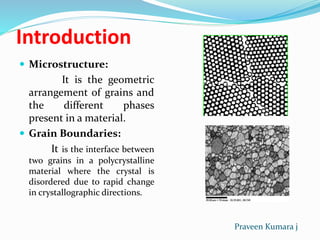
 Microstructure:
It is the geometric
arrangement of grains and
the different phases
present in a material.
 Grain Boundaries:
It is the interface between
two grains in a polycrystalline
material where the crystal is
disordered due to rapid change
in crystallographic directions.
Praveen Kumara j
Why is Microstructural Analysis
used for?
 Quality Control: Analysis is used to determine whether the structural
parameters are within specifications: a criteria for ACCEPTANCE or
REJECTION of products
 Failure Analysis: to determine the cause of failure. Failure occur due to
several factors (incorrect material selection, improper processing
treatment, poor quality control).Failure analysis provides information
about the cause of failure
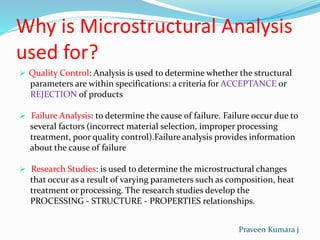
 Research Studies: is used to determine the microstructural changes
that occur as a result of varying parameters such as composition, heat
treatment or processing. The research studies develop the
PROCESSING - STRUCTURE - PROPERTIES relationships.
Praveen Kumara j
Application
 Study and characterization of materials.
 Ensure that the associations between properties and
structure are properly understood.
 Predict properties of materials.
 Design alloys with new properties.
 Check if the material has been correctly heat treated.
Praveen Kumara j
Safety Instructions
 Optical Metallography
involves the use of
etchants (standard
solutions containing a
variety of chemicals
such as strong acids
and solvents) which
can be very corrosive
and poisonous.
Praveen Kumara j
SPECIMEN PREPARATION
• Specimen preparation is an important part of
metallography
• A specimen must be appropriately prepared to
ensure correct observation and interpretation of the
microstructure.
Specimen preparation requirements
 Deformation-free specimen
 Flat specimen
 No thermal damage
 No scratches
Praveen Kumara j
Specimen preparation consists of :
Sample Selection: The number, location orientation of the
samples examined are important parameters in selection
samples.
 SECTIONING
 MOUNTING
 GRINDING
 POLISHING
 ETCHING
Praveen Kumara j
SECTIONING
 Sectioning is the first step in the overall process of
sample preparation.
 Sectioning of the test sample is performed carefully to
avoid altering the structure of the material.
 Abrassive cutting is the most common cutting
method.
 The cutting tool is made of Silicon carbide(Sic) of
diamond particles.
 Use coolant fluid to avoid overheating of specimen
and possible change in material structure.
Praveen Kumara j
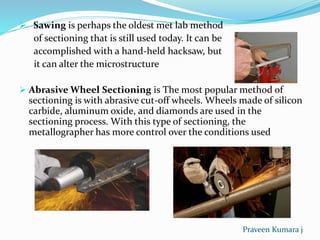
 Sawing is perhaps the oldest met lab method
of sectioning that is still used today. It can be
accomplished with a hand-held hacksaw, but
it can alter the microstructure
 Abrasive Wheel Sectioning is The most popular method of
sectioning is with abrasive cut-off wheels. Wheels made of silicon
carbide, aluminum oxide, and diamonds are used in the
sectioning process. With this type of sectioning, the
metallographer has more control over the conditions used
Praveen Kumara j
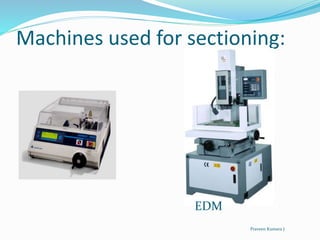
Machines used for sectioning:
EDM
Praveen Kumara J
Mounting
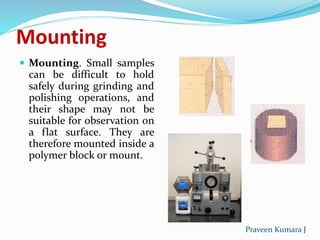
 Mounting. Small samples
can be difficult to hold
safely during grinding and
polishing operations, and
their shape may not be
suitable for observation on
a flat surface. They are
therefore mounted inside a
polymer block or mount.
Praveen Kumara J
Mounting
Cold mounting:
 It can be done using two components resins
(epoxies) which are liquid to start with but which
set solid shortly after mixing.
 It requires very simple equipment consisting of a
cylindrical ring which serves as a mould and a flat
piece which serves as the base of the mould. the
sample is placed on the flat piece within the
mould and the mixture poured in and allowed to
set. Cold mounting takes few hours to complete.
Praveen Kumara J
Mounting
Hot-mounting
 The sample is surrounded by an organic polymeric
powder which melts under the influence of heat
(about 200 C).
 Pressure is also applied by a piston, ensuring a
high quality mould free of porosity and with
intimate contact between the sample and the
polymer.
Praveen Kumara J
Grinding
 Grinding is done using rotating discs covered
with silicon carbide paper and water.
 There are a number of grades of paper, with 180,
240, 400, 1200, grains of silicon carbide per square
inch. 180 grade therefore represents the coarsest
particles and this is the grade to begin the grinding
operation. Always use light pressure applied at the
centre of the sample.
 Wash the sample in water and move to the next
grade, orienting the scratches from the previous
grade normal to the rotation direction. This makes
it easy to see when the coarser scratches have all
been removed.
 After the final grinding operation on 1200 paper,
wash the sample in water followed by alcohol and
dry it before moving to the polishers.
Praveen Kumara J
Polishing
 The polishers consist of rotating discs covered with soft
cloth impregnated with a pre-prepared slurry of hard
powdery alumina particles (Al2O3, the size ranges from 0.5
to 0.03 µm).
 Begin with the coarse slurry and continue polishing until
the grinding scratches have been removed. It is of vital
importance that the sample is thoroughly cleaned using
soapy water, followed by alcohol, and dried before moving
onto the final stage. Any contamination of the final
polishing disc will make it impossible to achieve a
satisfactory polish.
 Examining the specimen in the microscope after polishing
should reveal mirror like surface.
Praveen Kumara J
Etching
 The purpose of etching is two-fold.
1.Grinding and polishing operations produce a
highly deformed, thin layer on the surface which is
removed chemically during etching.
2. Attacks the surface with preference for those sites
with the highest energy, leading to surface relief
which allows different crystal orientations, grain
boundaries, precipitates, phases and defects to be
distinguished in reflected light microscopy.
Praveen Kumara J
Etching
 Etching should always be done in stages, beginning with light
attack, an examination in the microscope and further etching
only if required.
 If you overetch a sample on the first step then the polishing
procedure will have to be repeated.
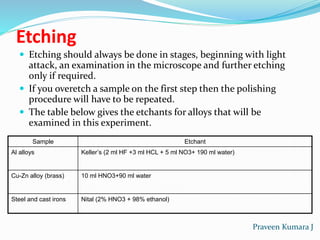
 The table below gives the etchants for alloys that will be
examined in this experiment.
EtchantSample
Keller’s (2 ml HF +3 ml HCL + 5 ml NO3+ 190 ml water)Al alloys
10 ml HNO3+90 ml waterCu-Zn alloy (brass)
Nital (2% HNO3 + 98% ethanol)Steel and cast irons
Praveen Kumara J
Industrial etching
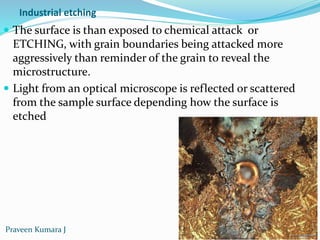
 The surface is than exposed to chemical attack or
ETCHING, with grain boundaries being attacked more
aggressively than reminder of the grain to reveal the
microstructure.
 Light from an optical microscope is reflected or scattered
from the sample surface depending how the surface is
etched
Praveen Kumara J
 The micrograph in the figure below was created by taking optical micrographs from a specimen, after polishing (&
etching) to various depths (sectioning). This gives a ‘3D’ view of the sample.
Grain
Grain boundary
Triple line
Praveen Kumara J
Praveen Kumara J

Metallography and microscopy

  • 1.
  • 2.
    Introduction  Microstructure: It isthe geometric arrangement of grains and the different phases present in a material.  Grain Boundaries: It is the interface between two grains in a polycrystalline material where the crystal is disordered due to rapid change in crystallographic directions. Praveen Kumara j
  • 3.
    Why is MicrostructuralAnalysis used for?  Quality Control: Analysis is used to determine whether the structural parameters are within specifications: a criteria for ACCEPTANCE or REJECTION of products  Failure Analysis: to determine the cause of failure. Failure occur due to several factors (incorrect material selection, improper processing treatment, poor quality control).Failure analysis provides information about the cause of failure  Research Studies: is used to determine the microstructural changes that occur as a result of varying parameters such as composition, heat treatment or processing. The research studies develop the PROCESSING - STRUCTURE - PROPERTIES relationships. Praveen Kumara j
  • 4.
    Application  Study andcharacterization of materials.  Ensure that the associations between properties and structure are properly understood.  Predict properties of materials.  Design alloys with new properties.  Check if the material has been correctly heat treated. Praveen Kumara j
  • 5.
    Safety Instructions  OpticalMetallography involves the use of etchants (standard solutions containing a variety of chemicals such as strong acids and solvents) which can be very corrosive and poisonous. Praveen Kumara j
  • 6.
    SPECIMEN PREPARATION • Specimenpreparation is an important part of metallography • A specimen must be appropriately prepared to ensure correct observation and interpretation of the microstructure. Specimen preparation requirements  Deformation-free specimen  Flat specimen  No thermal damage  No scratches Praveen Kumara j
  • 7.
    Specimen preparation consistsof : Sample Selection: The number, location orientation of the samples examined are important parameters in selection samples.  SECTIONING  MOUNTING  GRINDING  POLISHING  ETCHING Praveen Kumara j
  • 8.
    SECTIONING  Sectioning isthe first step in the overall process of sample preparation.  Sectioning of the test sample is performed carefully to avoid altering the structure of the material.  Abrassive cutting is the most common cutting method.  The cutting tool is made of Silicon carbide(Sic) of diamond particles.  Use coolant fluid to avoid overheating of specimen and possible change in material structure. Praveen Kumara j
  • 9.
     Sawing isperhaps the oldest met lab method of sectioning that is still used today. It can be accomplished with a hand-held hacksaw, but it can alter the microstructure  Abrasive Wheel Sectioning is The most popular method of sectioning is with abrasive cut-off wheels. Wheels made of silicon carbide, aluminum oxide, and diamonds are used in the sectioning process. With this type of sectioning, the metallographer has more control over the conditions used Praveen Kumara j
  • 10.
    Machines used forsectioning: EDM Praveen Kumara J
  • 11.
    Mounting  Mounting. Smallsamples can be difficult to hold safely during grinding and polishing operations, and their shape may not be suitable for observation on a flat surface. They are therefore mounted inside a polymer block or mount. Praveen Kumara J
  • 12.
    Mounting Cold mounting:  Itcan be done using two components resins (epoxies) which are liquid to start with but which set solid shortly after mixing.  It requires very simple equipment consisting of a cylindrical ring which serves as a mould and a flat piece which serves as the base of the mould. the sample is placed on the flat piece within the mould and the mixture poured in and allowed to set. Cold mounting takes few hours to complete. Praveen Kumara J
  • 13.
    Mounting Hot-mounting  The sampleis surrounded by an organic polymeric powder which melts under the influence of heat (about 200 C).  Pressure is also applied by a piston, ensuring a high quality mould free of porosity and with intimate contact between the sample and the polymer. Praveen Kumara J
  • 14.
    Grinding  Grinding isdone using rotating discs covered with silicon carbide paper and water.  There are a number of grades of paper, with 180, 240, 400, 1200, grains of silicon carbide per square inch. 180 grade therefore represents the coarsest particles and this is the grade to begin the grinding operation. Always use light pressure applied at the centre of the sample.  Wash the sample in water and move to the next grade, orienting the scratches from the previous grade normal to the rotation direction. This makes it easy to see when the coarser scratches have all been removed.  After the final grinding operation on 1200 paper, wash the sample in water followed by alcohol and dry it before moving to the polishers. Praveen Kumara J
  • 15.
    Polishing  The polishersconsist of rotating discs covered with soft cloth impregnated with a pre-prepared slurry of hard powdery alumina particles (Al2O3, the size ranges from 0.5 to 0.03 µm).  Begin with the coarse slurry and continue polishing until the grinding scratches have been removed. It is of vital importance that the sample is thoroughly cleaned using soapy water, followed by alcohol, and dried before moving onto the final stage. Any contamination of the final polishing disc will make it impossible to achieve a satisfactory polish.  Examining the specimen in the microscope after polishing should reveal mirror like surface. Praveen Kumara J
  • 16.
    Etching  The purposeof etching is two-fold. 1.Grinding and polishing operations produce a highly deformed, thin layer on the surface which is removed chemically during etching. 2. Attacks the surface with preference for those sites with the highest energy, leading to surface relief which allows different crystal orientations, grain boundaries, precipitates, phases and defects to be distinguished in reflected light microscopy. Praveen Kumara J
  • 17.
    Etching  Etching shouldalways be done in stages, beginning with light attack, an examination in the microscope and further etching only if required.  If you overetch a sample on the first step then the polishing procedure will have to be repeated.  The table below gives the etchants for alloys that will be examined in this experiment. EtchantSample Keller’s (2 ml HF +3 ml HCL + 5 ml NO3+ 190 ml water)Al alloys 10 ml HNO3+90 ml waterCu-Zn alloy (brass) Nital (2% HNO3 + 98% ethanol)Steel and cast irons Praveen Kumara J
  • 18.
    Industrial etching  Thesurface is than exposed to chemical attack or ETCHING, with grain boundaries being attacked more aggressively than reminder of the grain to reveal the microstructure.  Light from an optical microscope is reflected or scattered from the sample surface depending how the surface is etched Praveen Kumara J
  • 19.
     The micrographin the figure below was created by taking optical micrographs from a specimen, after polishing (& etching) to various depths (sectioning). This gives a ‘3D’ view of the sample. Grain Grain boundary Triple line Praveen Kumara J
  • 20.