The document provides an overview of key concepts in metal forming including:
1) Metal forming processes use plastic deformation to change the shape of metal workpieces using dies that exceed the metal's yield strength.
2) Material properties like low yield strength and high ductility are desirable and affected by temperature.
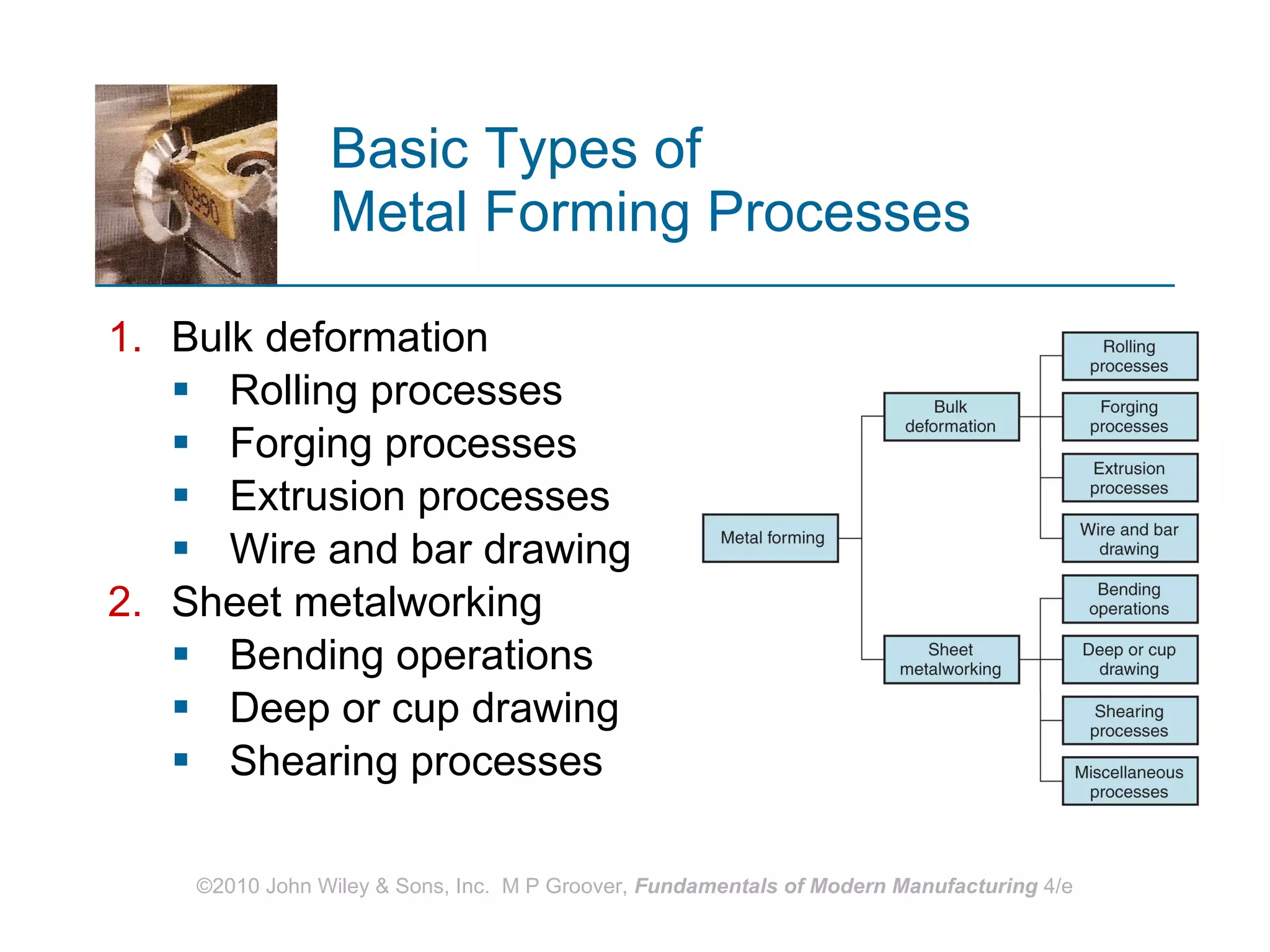
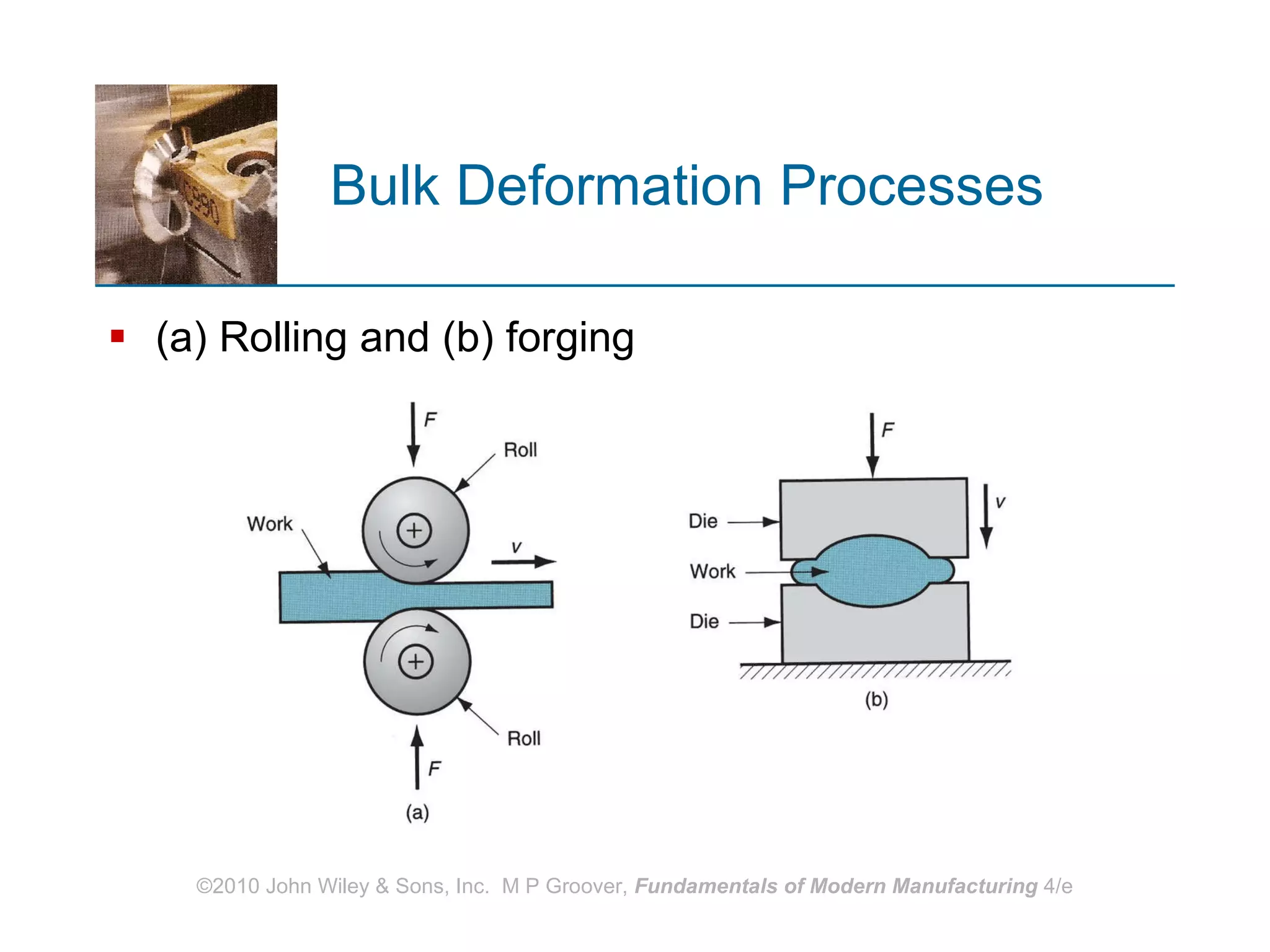
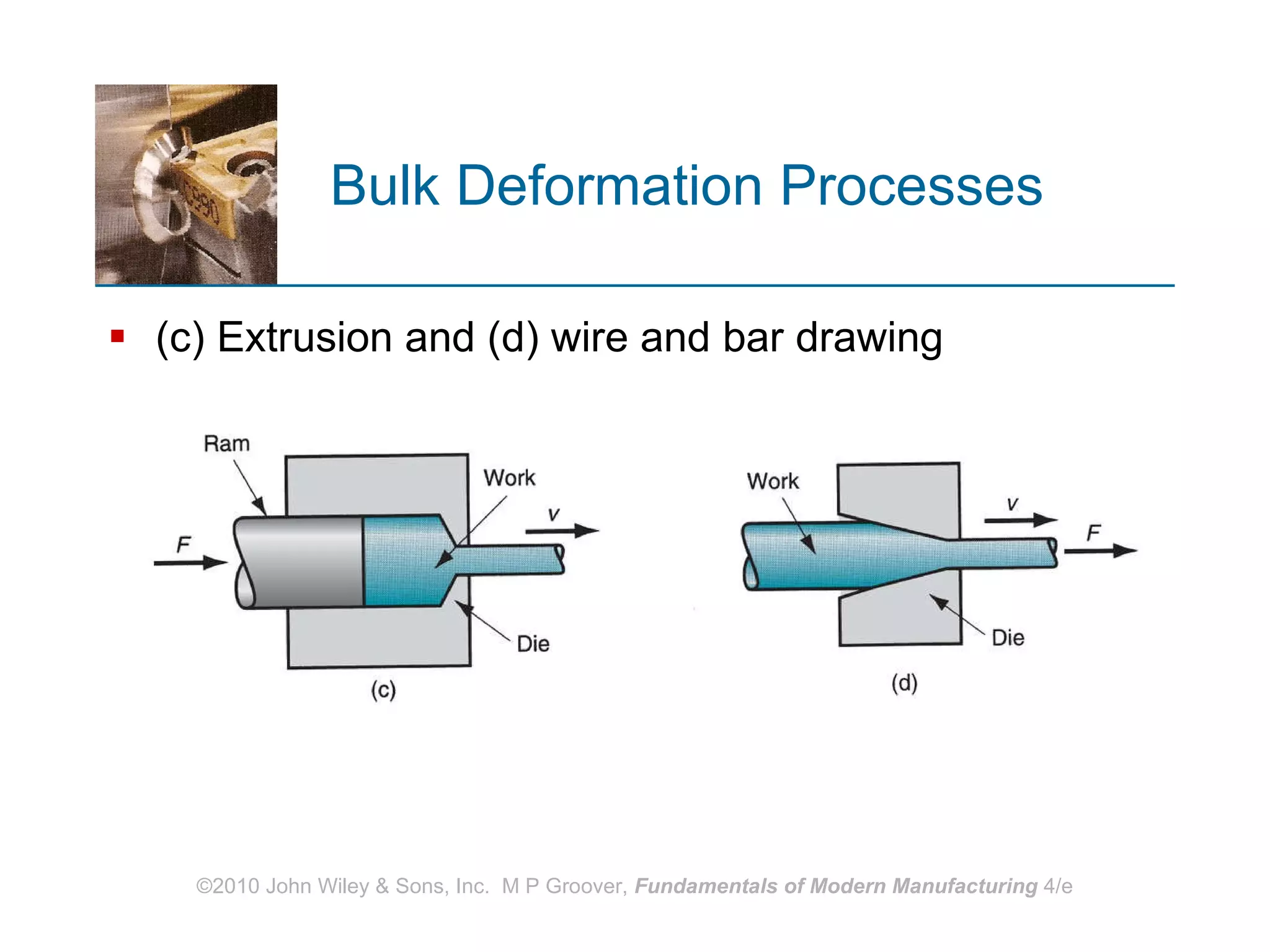
3) Processes are classified by the scale of deformation from bulk to sheet metal and include rolling, forging, extrusion, drawing, bending, and shearing.
4) Temperature, strain rate, and friction influence how metal flows during forming. Lubricants are used to reduce friction.
FUNDAMENTALS OF METALFORMING Overview of Metal Forming Material Behavior in Metal Forming Temperature in Metal Forming Strain Rate Sensitivity Friction and Lubrication in Metal Forming
2.
Metal Forming Largegroup of manufacturing processes in which plastic deformation is used to change the shape of metal workpieces The tool, usually called a die , applies stresses that exceed the yield strength of the metal The metal takes a shape determined by the geometry of the die
3.
Stresses in MetalForming Stresses to plastically deform the metal are usually compressive Examples: rolling, forging, extrusion However, some forming processes Stretch the metal (tensile stresses) Others bend the metal (tensile and compressive) Still others apply shear stresses
4.
Material Properties inMetal Forming Desirable material properties: Low yield strength High ductility These properties are affected by temperature: Ductility increases and yield strength decreases when work temperature is raised Other factors: Strain rate and friction
5.
Basic Types of Metal Forming Processes Bulk deformation Rolling processes Forging processes Extrusion processes Wire and bar drawing Sheet metalworking Bending operations Deep or cup drawing Shearing processes
6.
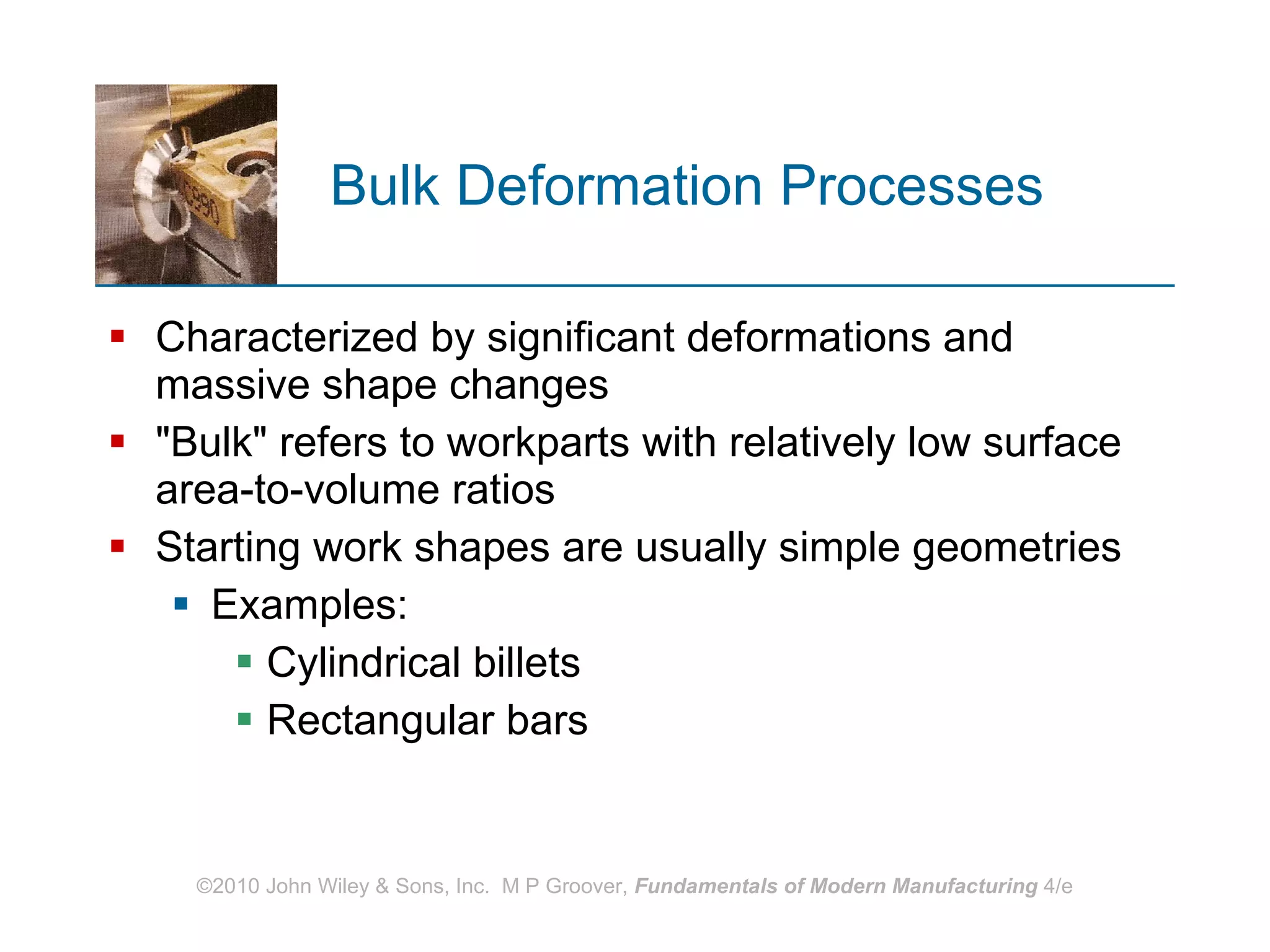
Bulk Deformation ProcessesCharacterized by significant deformations and massive shape changes "Bulk" refers to workparts with relatively low surface area‑to‑volume ratios Starting work shapes are usually simple geometries Examples: Cylindrical billets Rectangular bars
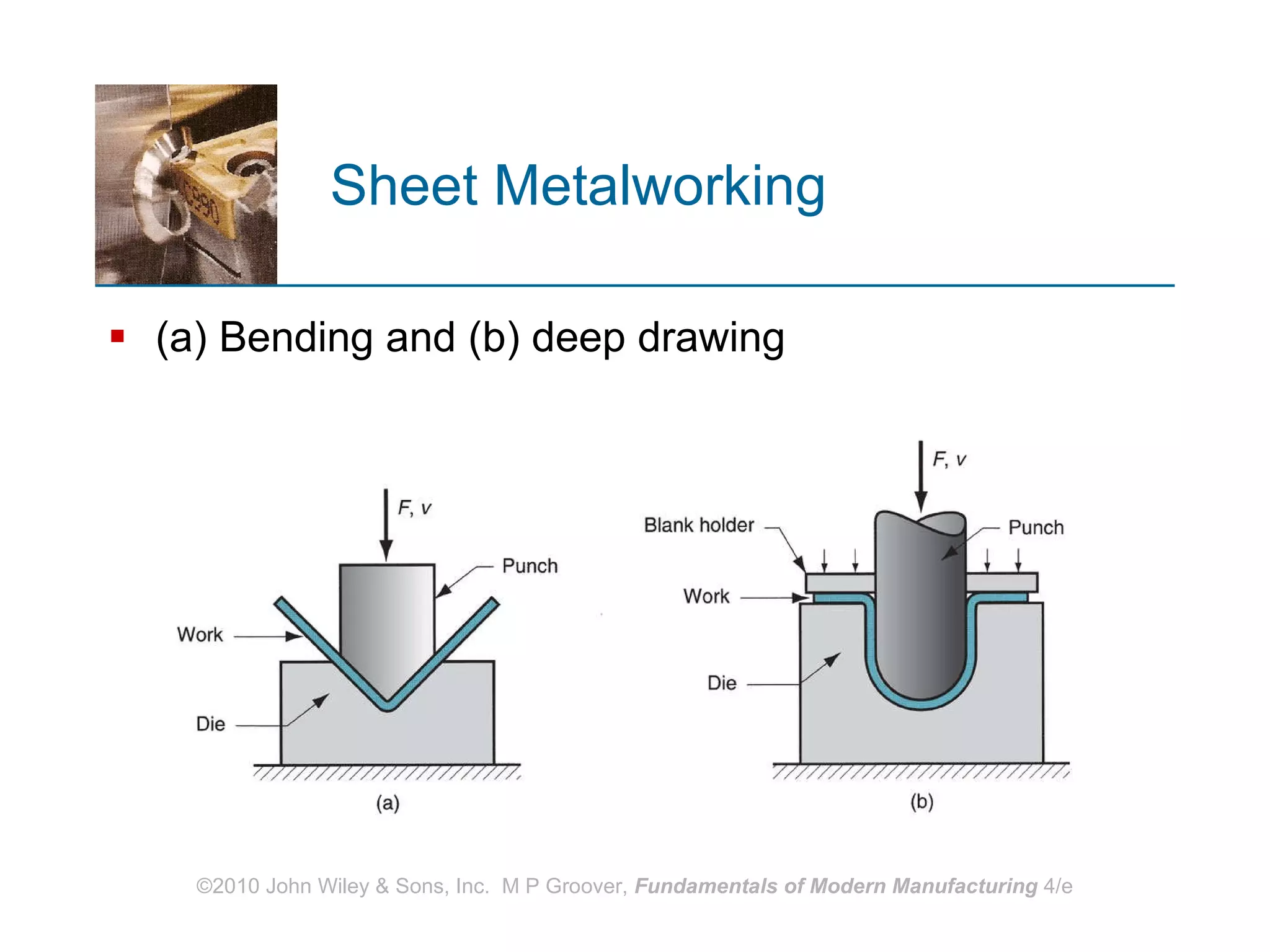
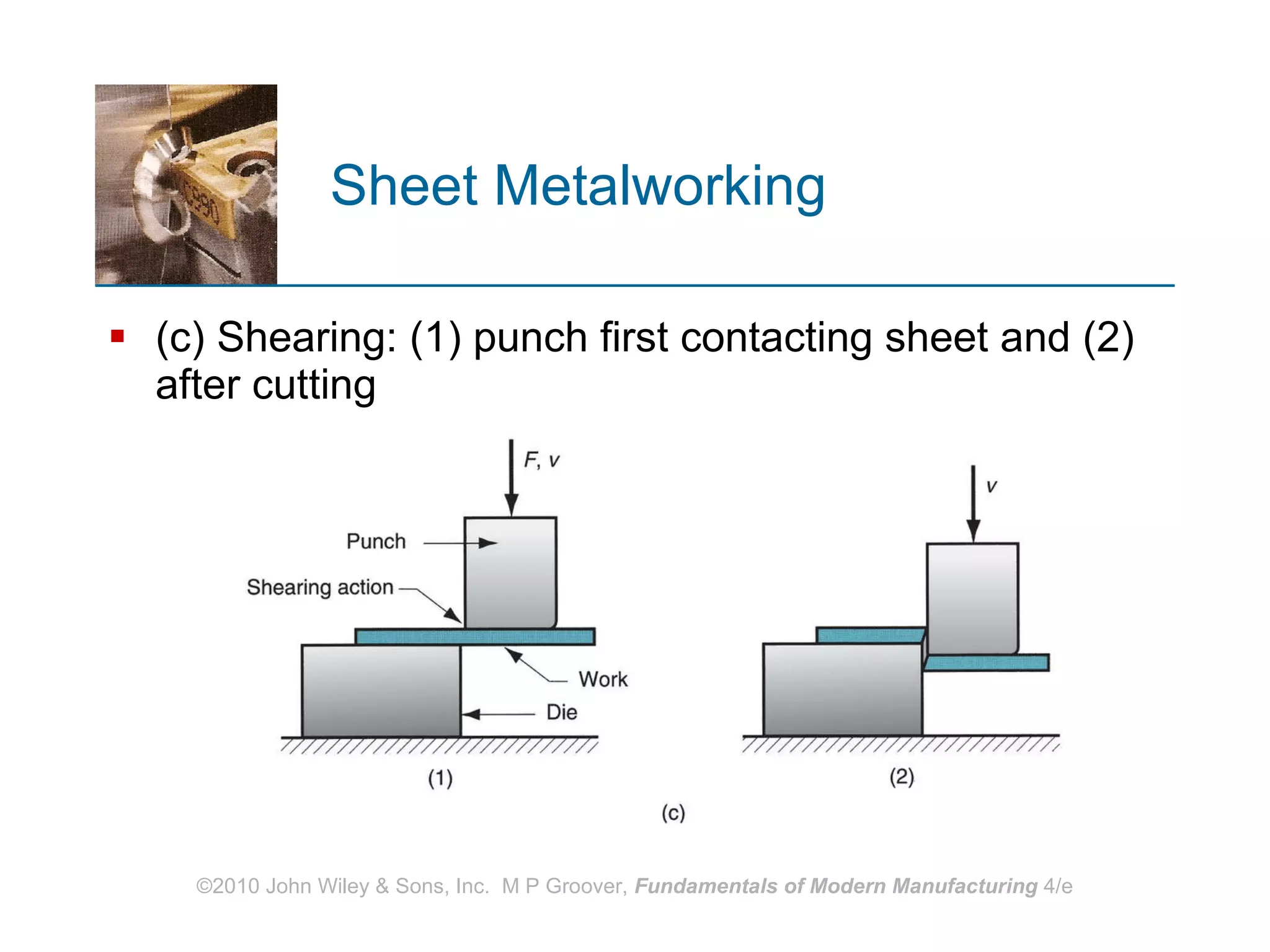
Sheet Metalworking Formingand related operations performed on metal sheets, strips, and coils High surface area‑to‑volume ratio of starting metal, which distinguishes these from bulk deformation Often called pressworking because these operations are performed on presses Parts are called stampings Usual tooling: punch and die
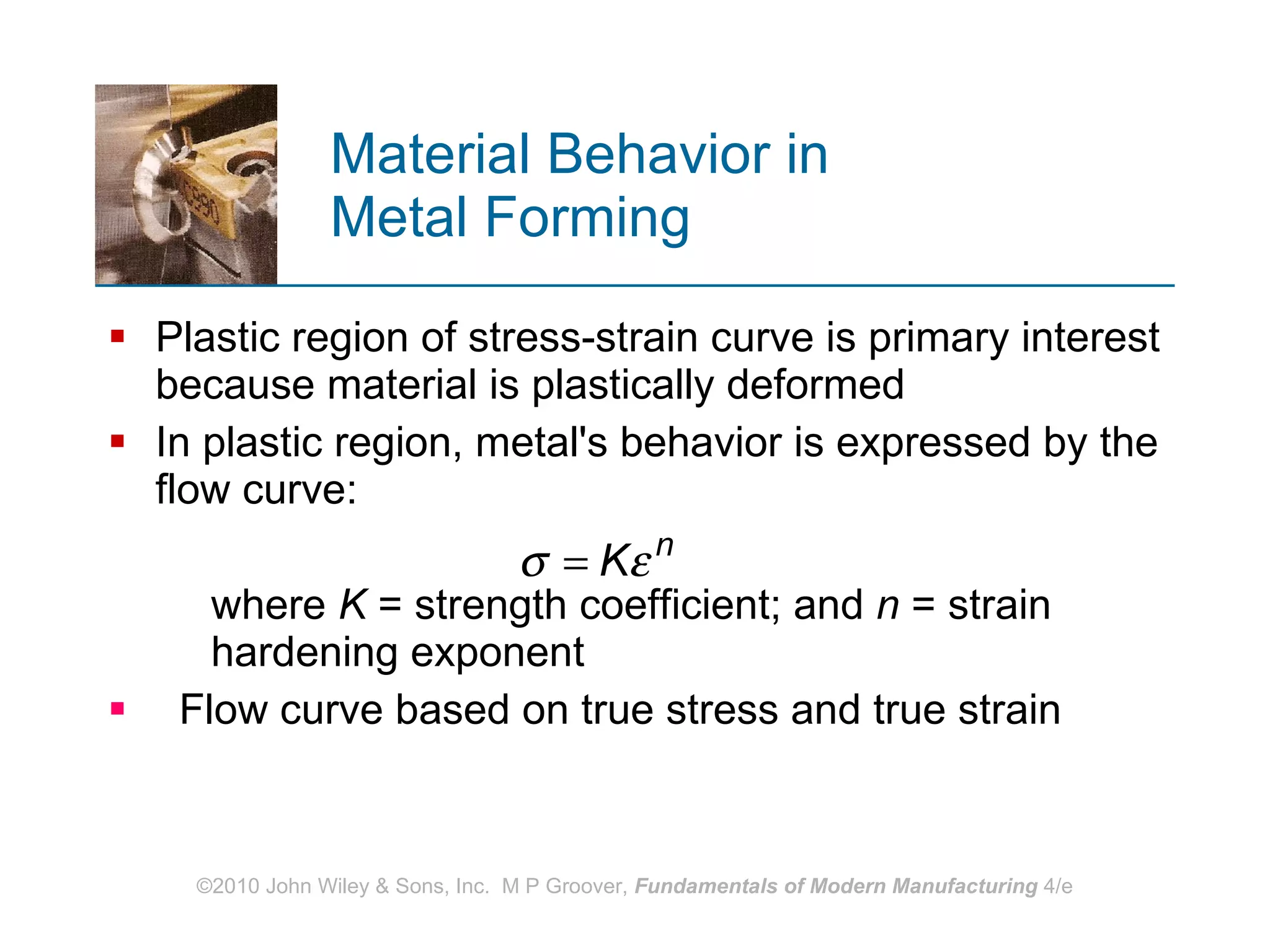
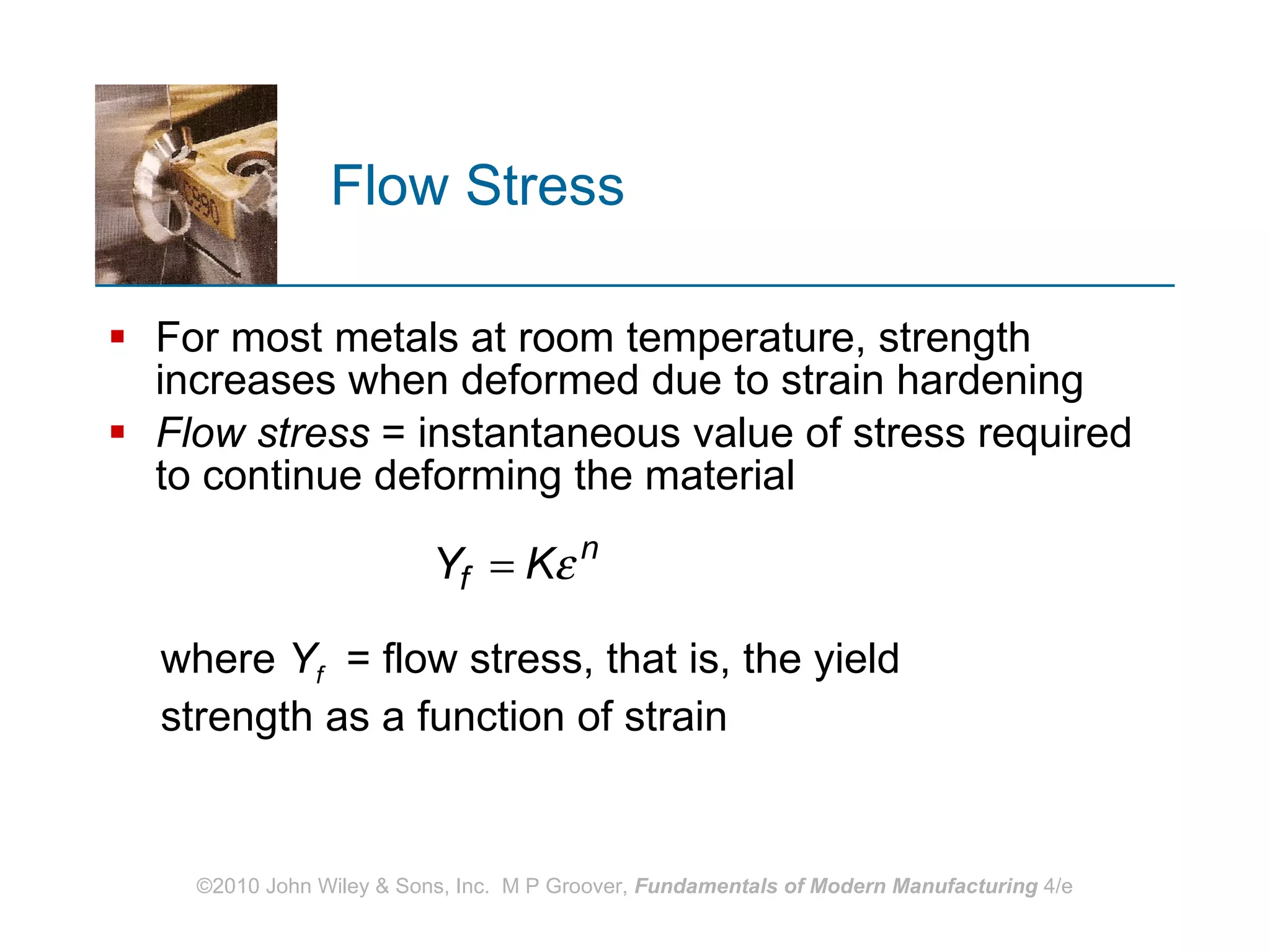
Material Behavior in Metal Forming Plastic region of stress-strain curve is primary interest because material is plastically deformed In plastic region, metal's behavior is expressed by the flow curve: where K = strength coefficient; and n = strain hardening exponent Flow curve based on true stress and true strain
13.
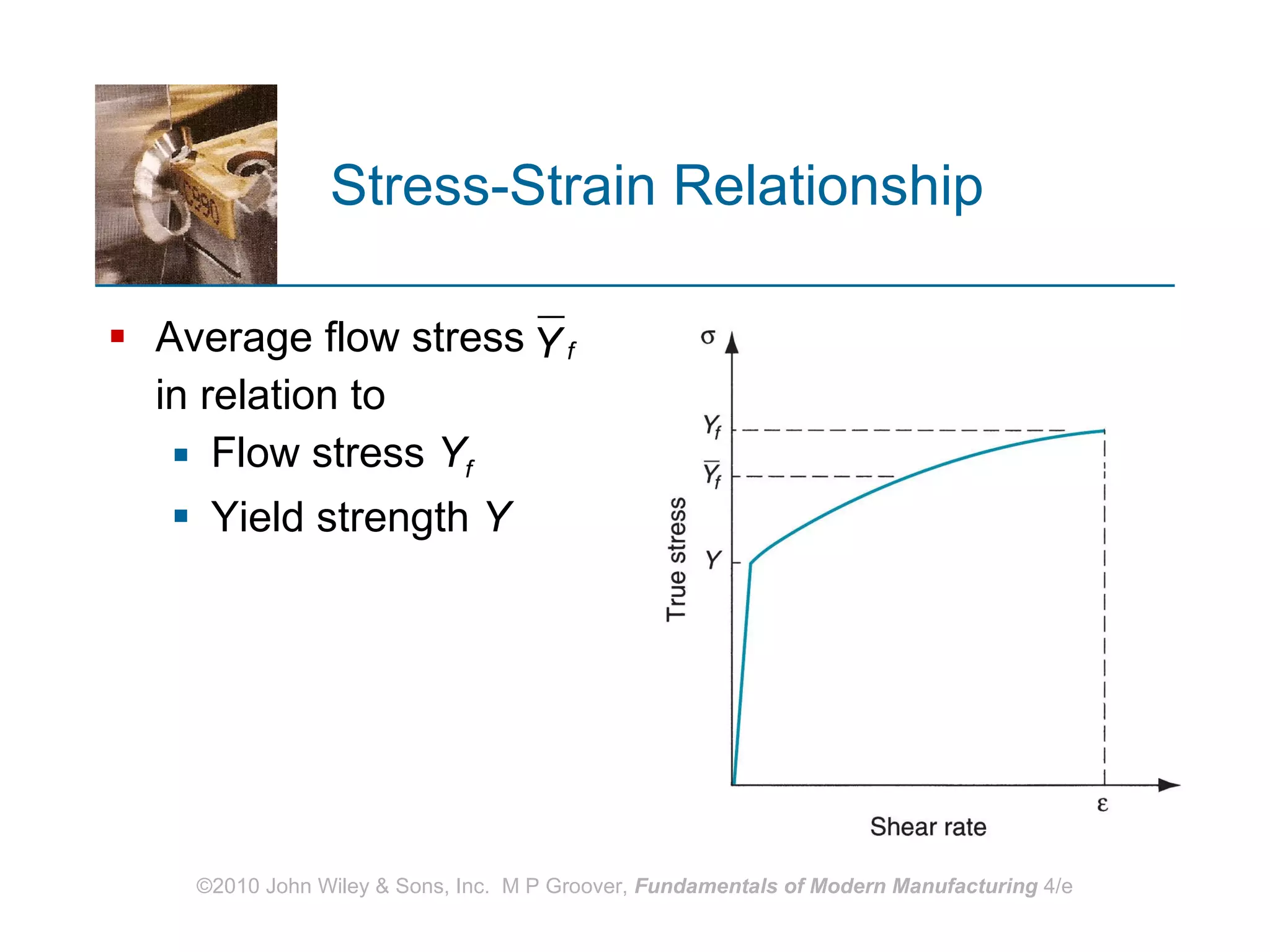
Flow Stress Formost metals at room temperature, strength increases when deformed due to strain hardening Flow stress = instantaneous value of stress required to continue deforming the material where Y f = flow stress, that is, the yield strength as a function of strain
14.
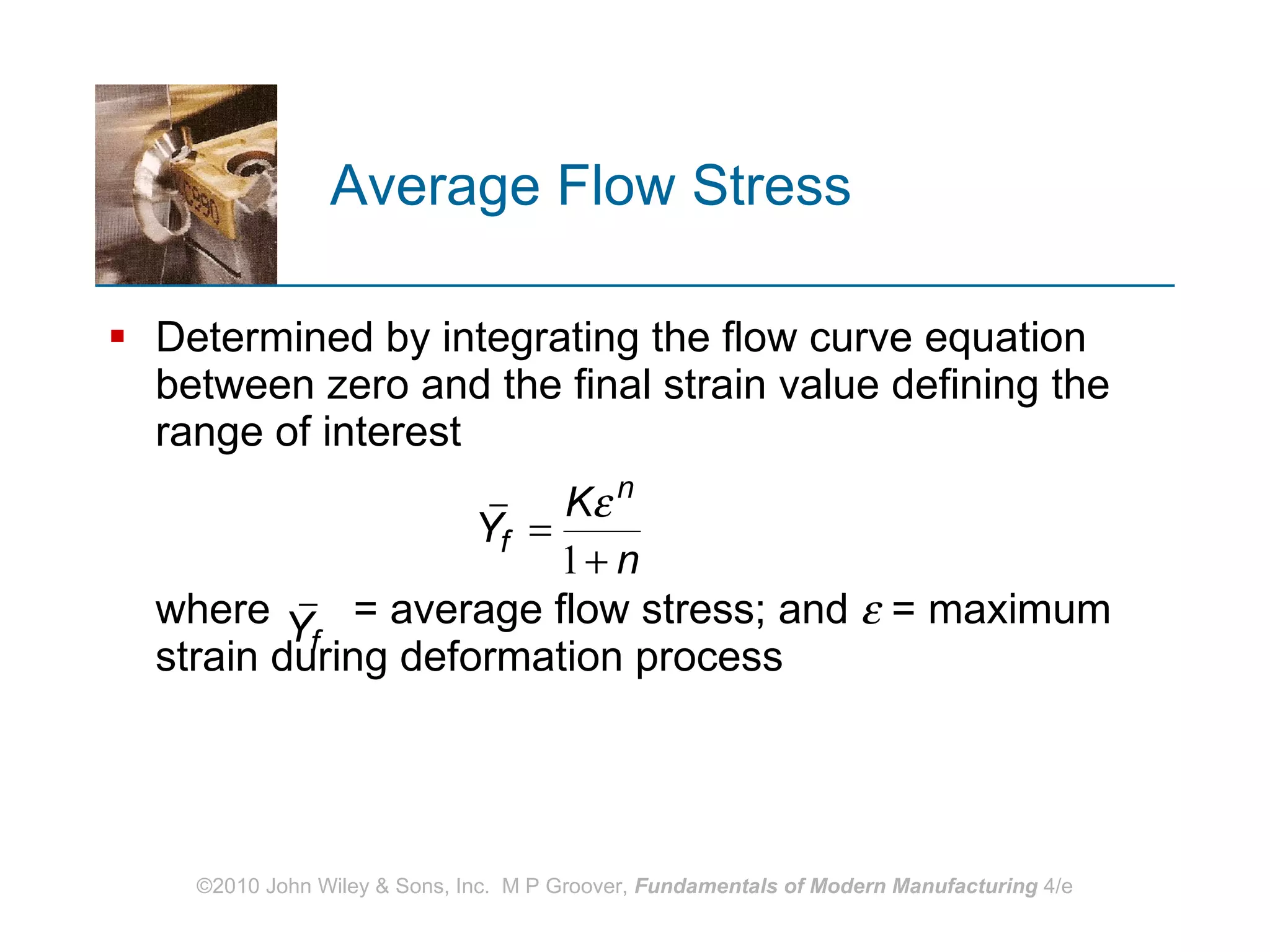
Average Flow StressDetermined by integrating the flow curve equation between zero and the final strain value defining the range of interest where = average flow stress; and = maximum strain during deformation process
Temperature in MetalForming For any metal, K and n in the flow curve depend on temperature Both strength ( K ) and strain hardening ( n ) are reduced at higher temperatures In addition, ductility is increased at higher temperatures
17.
Temperature in MetalForming Any deformation operation can be accomplished with lower forces and power at elevated temperature Three temperature ranges in metal forming: Cold working Warm working Hot working
18.
Cold Working Performedat room temperature or slightly above Many cold forming processes are important mass production operations Minimum or no machining usually required These operations are near net shape or net shape processes
19.
Advantages of ColdForming Better accuracy, closer tolerances Better surface finish Strain hardening increases strength and hardness Grain flow during deformation can cause desirable directional properties in product No heating of work required
20.
Disadvantages of ColdForming Higher forces and power required for deformation Surfaces of starting work must be free of scale and dirt Ductility and strain hardening limit the amount of forming that can be done In some cases, metal must be annealed before further deformation can be accomplished In other cases, metal is simply not ductile enough to be cold worked
21.
Warm Working Performedat temperatures above room temperature but below recrystallization temperature Dividing line between cold working and warm working often expressed in terms of melting point: 0.3 T m , where T m = melting point (absolute temperature) for metal
22.
Advantages and Disadvantagesof Warm Working Advantages Lower forces and power than in cold working More intricate work geometries possible Need for annealing may be reduced or eliminated Disadvantage Workpiece must be heated
23.
Hot Working Deformationat temperatures above the recrystallization temperature Recrystallization temperature = about one‑half of melting point on absolute scale In practice, hot working usually performed somewhat above 0.5 T m Metal continues to soften as temperature increases above 0.5 T m , enhancing advantage of hot working above this level
24.
Why Hot Working?Capability for substantial plastic deformation - far more than is possible with cold working or warm working Why? Strength coefficient ( K ) is substantially less than at room temperature Strain hardening exponent ( n ) is zero (theoretically) Ductility is significantly increased
25.
Advantages of HotWorking Workpart shape can be significantly altered Lower forces and power required Metals that usually fracture in cold working can be hot formed Strength properties of product are generally isotropic No strengthening of part occurs from work hardening Advantageous in cases when part is to be subsequently processed by cold forming
26.
Disadvantages of HotWorking Lower dimensional accuracy Higher total energy required, which is the sum of The thermal energy needed to heat the workpiece Energy to deform the metal Work surface oxidation (scale) Thus, poorer surface finish Shorter tool life Dies and rolls in bulk deformation
27.
Strain Rate SensitivityTheoretically, a metal in hot working behaves like a perfectly plastic material, with strain hardening exponent n = 0 The metal should continue to flow at the same flow stress, once that stress is reached However, an additional phenomenon occurs during deformation, especially at elevated temperatures: Strain rate sensitivity
28.
What is StrainRate? Strain rate in forming is directly related to speed of deformation v Deformation speed v = velocity of the ram or other movement of the equipment Strain rate is defined: where = true strain rate; and h = instantaneous height of workpiece being deformed
29.
Evaluation of StrainRate In most practical operations, valuation of strain rate is complicated by Workpart geometry Variations in strain rate in different regions of the part Strain rate can reach 1000 s -1 or more for some metal forming operations
30.
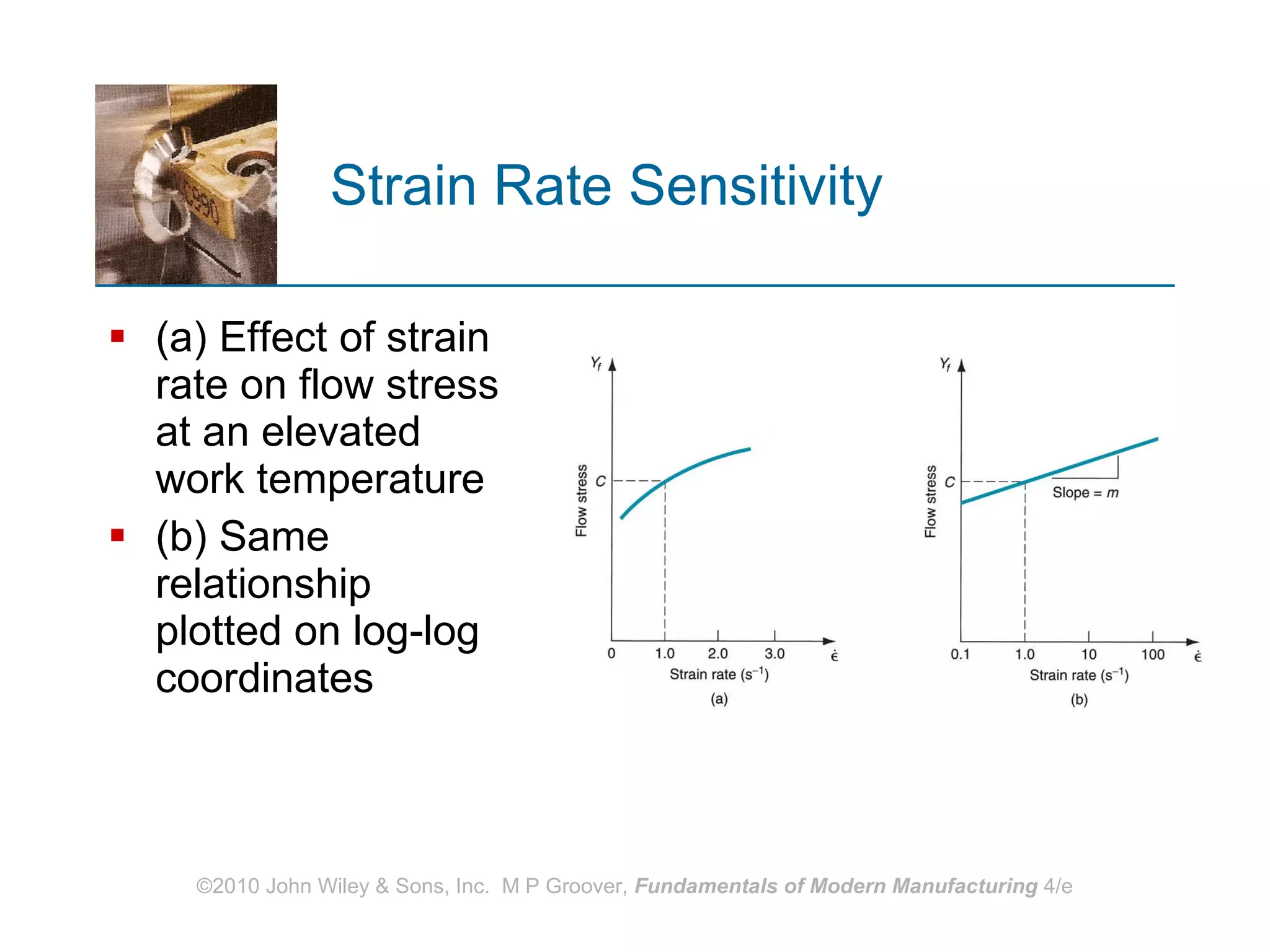
Effect of StrainRate on Flow Stress Flow stress is a function of temperature At hot working temperatures, flow stress also depends on strain rate As strain rate increases, resistance to deformation increases This is the effect known as strain‑rate sensitivity
31.
Strain Rate Sensitivity(a) Effect of strain rate on flow stress at an elevated work temperature (b) Same relationship plotted on log‑log coordinates
32.
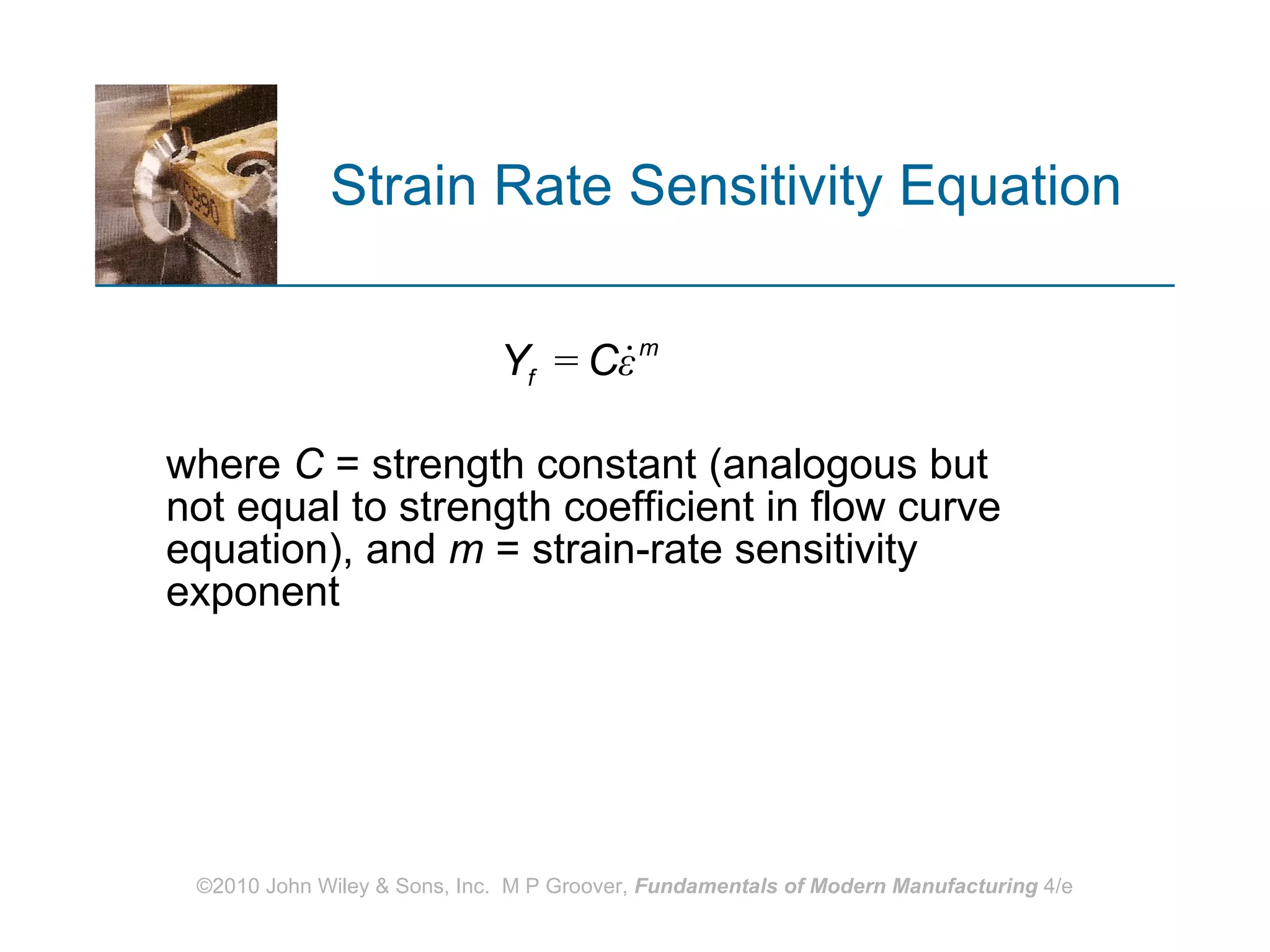
Strain Rate SensitivityEquation where C = strength constant (analogous but not equal to strength coefficient in flow curve equation), and m = strain‑rate sensitivity exponent
33.
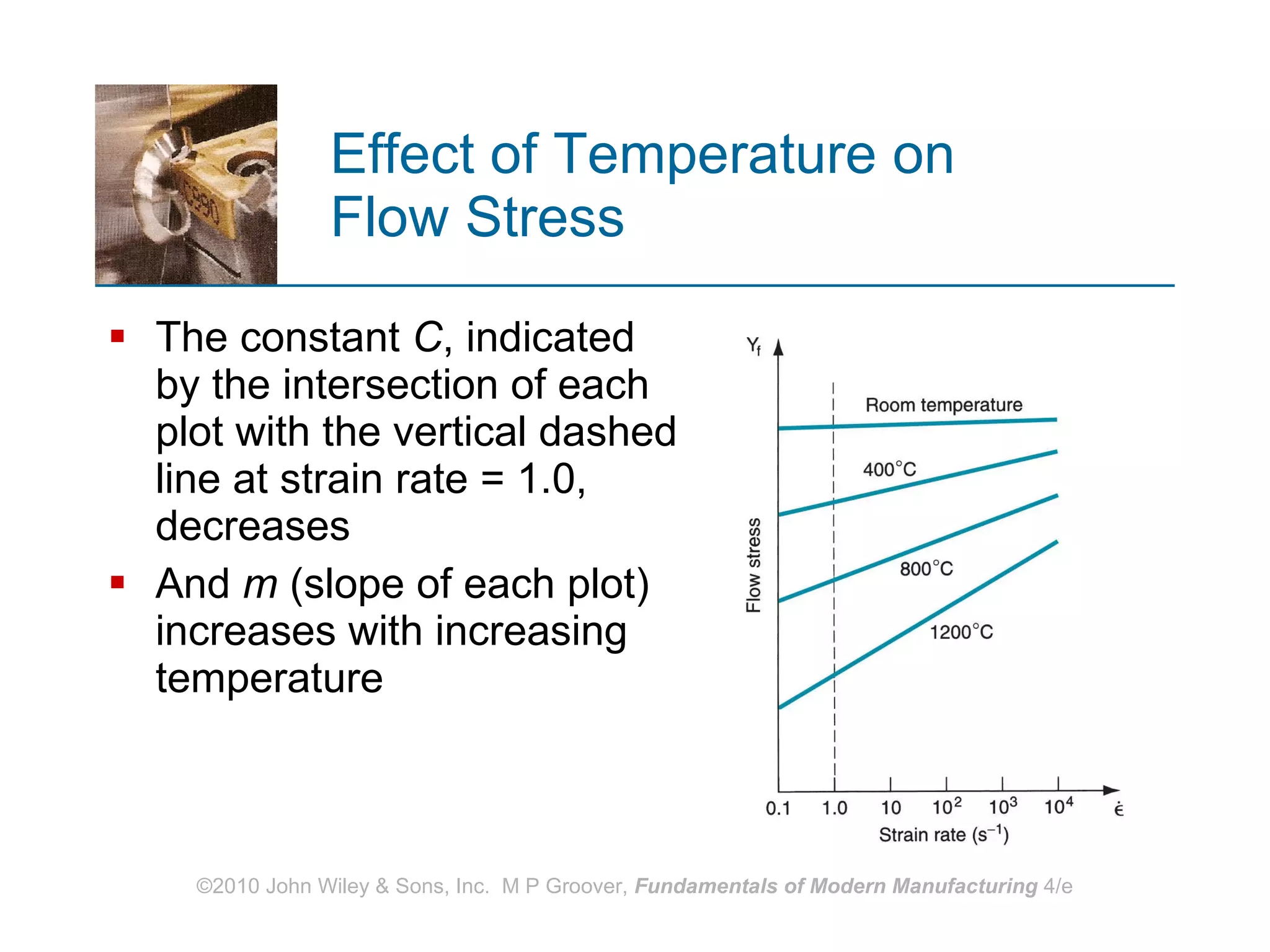
Effect of Temperatureon Flow Stress The constant C , indicated by the intersection of each plot with the vertical dashed line at strain rate = 1.0, decreases And m (slope of each plot) increases with increasing temperature
34.
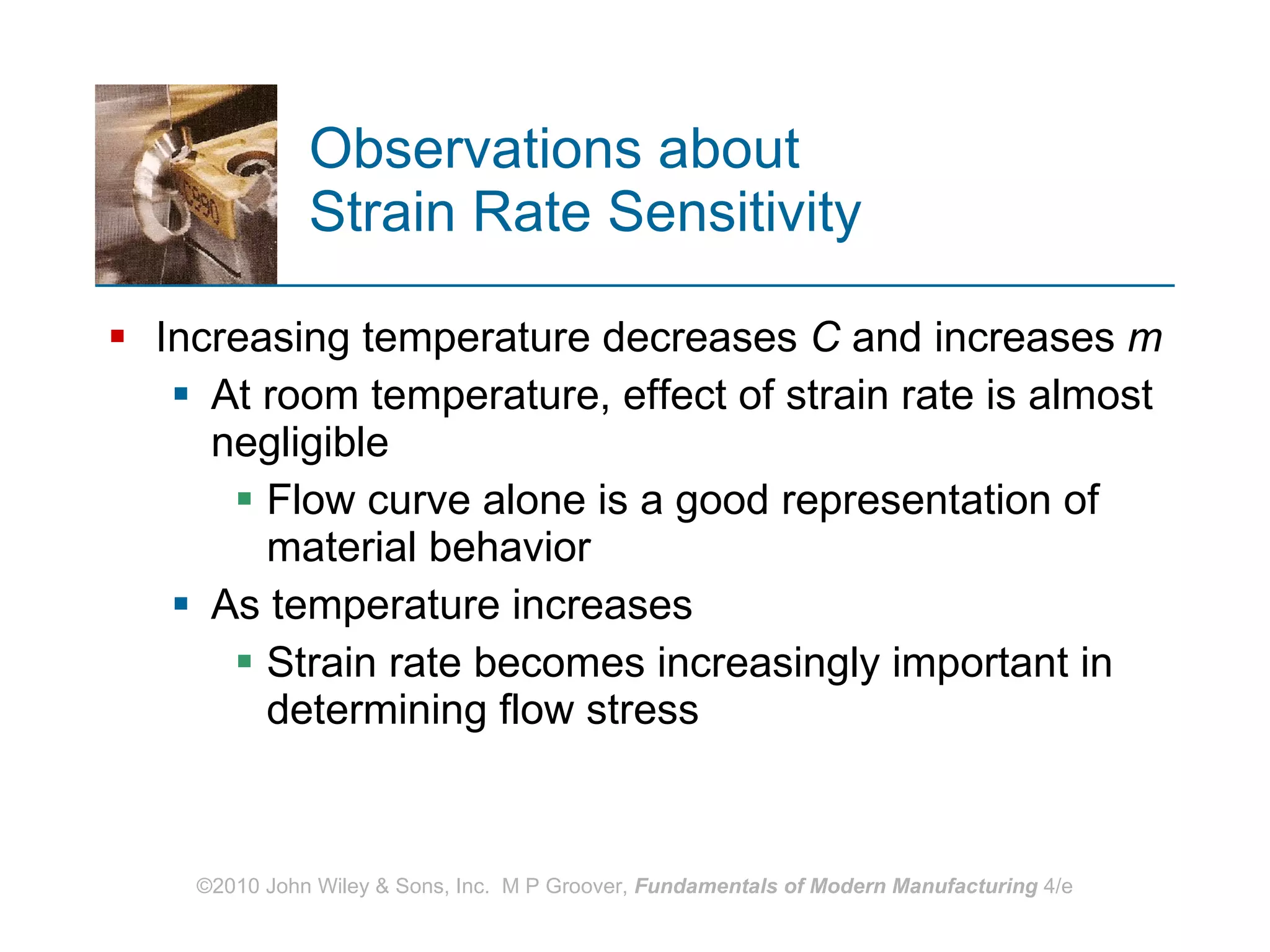
Observations about Strain Rate Sensitivity Increasing temperature decreases C and increases m At room temperature, effect of strain rate is almost negligible Flow curve alone is a good representation of material behavior As temperature increases Strain rate becomes increasingly important in determining flow stress
35.
Friction in MetalForming In most metal forming processes, friction is undesirable: Metal flow is reduced Forces and power are increased Tools wear faster Friction and tool wear are more severe in hot working
36.
Lubrication in MetalForming Metalworking lubricants are applied to tool‑work interface in many forming operations to reduce harmful effects of friction Benefits: Reduced sticking, forces, power, tool wear Better surface finish Removes heat from the tooling
37.
Considerations in Choosing a Lubricant Type of forming process (rolling, forging, sheet metal drawing, etc.) Hot working or cold working Work material Chemical reactivity with tool and work metals Ease of application Cost