Improvement of fatigue strength by
chemical/metallurgical processes
and mechanical work
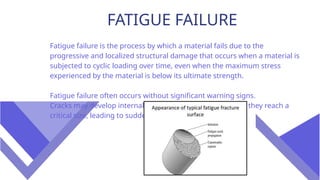
Fatigue failure is the process by which a material fails due to the
progressive and localized structural damage that occurs when a material is
subjected to cyclic loading over time, even when the maximum stress
experienced by the material is below its ultimate strength.
Fatigue failure often occurs without significant warning signs.
Cracks may develop internally and remain undetected until they reach a
critical size, leading to sudden fracture.
FATIGUE FAILURE
Improvement of Fatigue
Strength
Altering the material's composition, microstructure, or
surface characteristics to enhance its resistance to
fatigue failure
By chemical and metallurgical
processes
Nitriding
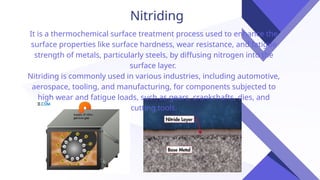
It is a thermochemical surface treatment process used to enhance the
surface properties like surface hardness, wear resistance, and fatigue
strength of metals, particularly steels, by diffusing nitrogen into the
surface layer.
Nitriding is commonly used in various industries, including automotive,
aerospace, tooling, and manufacturing, for components subjected to
high wear and fatigue loads, such as gears, crankshafts, dies, and
cutting tools.
Mechanis
m
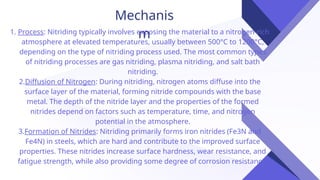
1. Process: Nitriding typically involves exposing the material to a nitrogen-rich
atmosphere at elevated temperatures, usually between 500°C to 1200°C,
depending on the type of nitriding process used. The most common types
of nitriding processes are gas nitriding, plasma nitriding, and salt bath
nitriding.
2.Diffusion of Nitrogen: During nitriding, nitrogen atoms diffuse into the
surface layer of the material, forming nitride compounds with the base
metal. The depth of the nitride layer and the properties of the formed
nitrides depend on factors such as temperature, time, and nitrogen
potential in the atmosphere.
3.Formation of Nitrides: Nitriding primarily forms iron nitrides (Fe3N and
Fe4N) in steels, which are hard and contribute to the improved surface
properties. These nitrides increase surface hardness, wear resistance, and
fatigue strength, while also providing some degree of corrosion resistance.
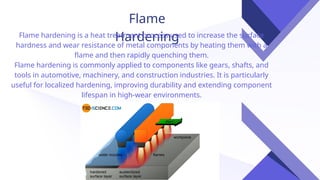
Flame
Hardening
Flame hardening is a heat treatment process used to increase the surface
hardness and wear resistance of metal components by heating them with a
flame and then rapidly quenching them.
Flame hardening is commonly applied to components like gears, shafts, and
tools in automotive, machinery, and construction industries. It is particularly
useful for localized hardening, improving durability and extending component
lifespan in high-wear environments.
Mechanis
m
1.Preparation: The metal component is cleaned to remove any contaminants
that could affect the heating process.
2.Heating: A focused flame, often generated by oxyacetylene or oxy-propane
torches, is applied to the surface of the metal. The temperature is raised to
a critical point determined by the material and desired hardness.
3.Quenching: Once the desired temperature is reached, the heated area is
rapidly cooled by immersing it in a quenching medium such as water, oil, or
air. This rapid cooling transforms the surface into a hardened layer while
preserving the core's toughness.
4.Tempering (optional): In some cases, especially with higher carbon steels, a
tempering process follows to relieve internal stresses and improve
toughness. This involves reheating the hardened part to a lower
temperature and allowing it to cool slowly.
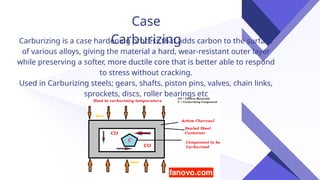
Case
Carburizing
Carburizing is a case hardening process that adds carbon to the surface
of various alloys, giving the material a hard, wear-resistant outer layer
while preserving a softer, more ductile core that is better able to respond
to stress without cracking.
Used in Carburizing steels; gears, shafts, piston pins, valves, chain links,
sprockets, discs, roller bearings etc
Mechanism
1.Preparation: Clean the metal component to remove
contaminants.
2.Carburization: Heat the component in a carbon-rich
environment at high temperatures (870°C to 980°C). Carbon
atoms from the atmosphere or a carbon source diffuse into
the surface layer
3.Diffusion: Carbon atoms penetrate the surface, forming a
carbon-rich layer of increased hardness.
4.Quenching: Rapidly cool the component to transform the
carbon-rich layer into martensite, a hard phase.
By mechanical
processes
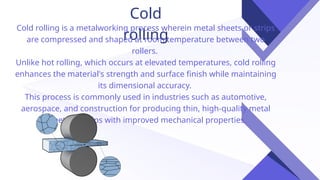
Cold
rolling
Cold rolling is a metalworking process wherein metal sheets or strips
are compressed and shaped at room temperature between two
rollers.
Unlike hot rolling, which occurs at elevated temperatures, cold rolling
enhances the material's strength and surface finish while maintaining
its dimensional accuracy.
This process is commonly used in industries such as automotive,
aerospace, and construction for producing thin, high-quality metal
sheets or strips with improved mechanical properties.
Mechanism
1.Preparation: Metal sheets or strips are cleaned and inspected for defects
before being fed into the rolling mill.
2.Feeding: The metal is fed between two rollers in the rolling mill. These rollers
exert compressive force on the metal, causing it to deform and reduce in
thickness as it passes through the mill.
3.Rolling: As the metal passes through the rollers, it undergoes plastic
deformation. The compressive force applied by the rollers causes the grains
within the metal to deform and elongate along the rolling direction, resulting
in a reduction in thickness and an increase in length.
4.Work Hardening: The cold rolling process induces work hardening in the
metal, which increases its strength and hardness. Work hardening occurs as
a result of the dislocation movement within the metal's crystal lattice during
deformation.
Peening
Peening is a surface treatment process where small impacts are
applied to a metal component to induce compressive residual
stresses in its surface layer.
This process improves the component's fatigue resistance,
strength, and resistance to cracking and corrosion by
redistributing stresses and strengthening the surface.
Peening is applied in aerospace, automotive, manufacturing, and
marine industries to enhance fatigue resistance and durability of
critical components like turbine blades, gears, and ship
propellers.
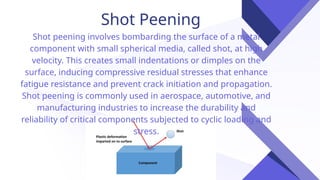
Shot Peening
Shot peening involves bombarding the surface of a metal
component with small spherical media, called shot, at high
velocity. This creates small indentations or dimples on the
surface, inducing compressive residual stresses that enhance
fatigue resistance and prevent crack initiation and propagation.
Shot peening is commonly used in aerospace, automotive, and
manufacturing industries to increase the durability and
reliability of critical components subjected to cyclic loading and
stress.
Mechanism
1.Surface Compression: When shot particles impact the metal surface at
high velocity, they create small indentations or dimples. These
indentations plastically deform the surface, generating compressive
stresses.
2.Residual Stress: The compressive stresses induced by shot peening result
in a redistribution of stresses within the material. The surface layer
experiences compressive stresses, while the interior maintains tensile
stresses.
3.Crack Prevention: The compressive residual stresses act as a barrier
against crack initiation and propagation. They counteract tensile stresses
arising from cyclic loading, preventing cracks from forming and
spreading.
4.Resistance to Fatigue: By inhibiting crack formation and growth, shot
peening significantly improves the component's resistance to fatigue
failure. Components treated with shot peening exhibit enhanced fatigue
Thank You

FATIGUE FRACTURE IN MECHANICAL ENGINEERING.pptx

  • 1.
    Improvement of fatiguestrength by chemical/metallurgical processes and mechanical work
  • 2.
    Fatigue failure isthe process by which a material fails due to the progressive and localized structural damage that occurs when a material is subjected to cyclic loading over time, even when the maximum stress experienced by the material is below its ultimate strength. Fatigue failure often occurs without significant warning signs. Cracks may develop internally and remain undetected until they reach a critical size, leading to sudden fracture. FATIGUE FAILURE
  • 3.
    Improvement of Fatigue Strength Alteringthe material's composition, microstructure, or surface characteristics to enhance its resistance to fatigue failure
  • 4.
    By chemical andmetallurgical processes
  • 5.
    Nitriding It is athermochemical surface treatment process used to enhance the surface properties like surface hardness, wear resistance, and fatigue strength of metals, particularly steels, by diffusing nitrogen into the surface layer. Nitriding is commonly used in various industries, including automotive, aerospace, tooling, and manufacturing, for components subjected to high wear and fatigue loads, such as gears, crankshafts, dies, and cutting tools.
  • 6.
    Mechanis m 1. Process: Nitridingtypically involves exposing the material to a nitrogen-rich atmosphere at elevated temperatures, usually between 500°C to 1200°C, depending on the type of nitriding process used. The most common types of nitriding processes are gas nitriding, plasma nitriding, and salt bath nitriding. 2.Diffusion of Nitrogen: During nitriding, nitrogen atoms diffuse into the surface layer of the material, forming nitride compounds with the base metal. The depth of the nitride layer and the properties of the formed nitrides depend on factors such as temperature, time, and nitrogen potential in the atmosphere. 3.Formation of Nitrides: Nitriding primarily forms iron nitrides (Fe3N and Fe4N) in steels, which are hard and contribute to the improved surface properties. These nitrides increase surface hardness, wear resistance, and fatigue strength, while also providing some degree of corrosion resistance.
  • 7.
    Flame Hardening Flame hardening isa heat treatment process used to increase the surface hardness and wear resistance of metal components by heating them with a flame and then rapidly quenching them. Flame hardening is commonly applied to components like gears, shafts, and tools in automotive, machinery, and construction industries. It is particularly useful for localized hardening, improving durability and extending component lifespan in high-wear environments.
  • 8.
    Mechanis m 1.Preparation: The metalcomponent is cleaned to remove any contaminants that could affect the heating process. 2.Heating: A focused flame, often generated by oxyacetylene or oxy-propane torches, is applied to the surface of the metal. The temperature is raised to a critical point determined by the material and desired hardness. 3.Quenching: Once the desired temperature is reached, the heated area is rapidly cooled by immersing it in a quenching medium such as water, oil, or air. This rapid cooling transforms the surface into a hardened layer while preserving the core's toughness. 4.Tempering (optional): In some cases, especially with higher carbon steels, a tempering process follows to relieve internal stresses and improve toughness. This involves reheating the hardened part to a lower temperature and allowing it to cool slowly.
  • 9.
    Case Carburizing Carburizing is acase hardening process that adds carbon to the surface of various alloys, giving the material a hard, wear-resistant outer layer while preserving a softer, more ductile core that is better able to respond to stress without cracking. Used in Carburizing steels; gears, shafts, piston pins, valves, chain links, sprockets, discs, roller bearings etc
  • 10.
    Mechanism 1.Preparation: Clean themetal component to remove contaminants. 2.Carburization: Heat the component in a carbon-rich environment at high temperatures (870°C to 980°C). Carbon atoms from the atmosphere or a carbon source diffuse into the surface layer 3.Diffusion: Carbon atoms penetrate the surface, forming a carbon-rich layer of increased hardness. 4.Quenching: Rapidly cool the component to transform the carbon-rich layer into martensite, a hard phase.
  • 11.
  • 12.
    Cold rolling Cold rolling isa metalworking process wherein metal sheets or strips are compressed and shaped at room temperature between two rollers. Unlike hot rolling, which occurs at elevated temperatures, cold rolling enhances the material's strength and surface finish while maintaining its dimensional accuracy. This process is commonly used in industries such as automotive, aerospace, and construction for producing thin, high-quality metal sheets or strips with improved mechanical properties.
  • 13.
    Mechanism 1.Preparation: Metal sheetsor strips are cleaned and inspected for defects before being fed into the rolling mill. 2.Feeding: The metal is fed between two rollers in the rolling mill. These rollers exert compressive force on the metal, causing it to deform and reduce in thickness as it passes through the mill. 3.Rolling: As the metal passes through the rollers, it undergoes plastic deformation. The compressive force applied by the rollers causes the grains within the metal to deform and elongate along the rolling direction, resulting in a reduction in thickness and an increase in length. 4.Work Hardening: The cold rolling process induces work hardening in the metal, which increases its strength and hardness. Work hardening occurs as a result of the dislocation movement within the metal's crystal lattice during deformation.
  • 14.
    Peening Peening is asurface treatment process where small impacts are applied to a metal component to induce compressive residual stresses in its surface layer. This process improves the component's fatigue resistance, strength, and resistance to cracking and corrosion by redistributing stresses and strengthening the surface. Peening is applied in aerospace, automotive, manufacturing, and marine industries to enhance fatigue resistance and durability of critical components like turbine blades, gears, and ship propellers.
  • 15.
    Shot Peening Shot peeninginvolves bombarding the surface of a metal component with small spherical media, called shot, at high velocity. This creates small indentations or dimples on the surface, inducing compressive residual stresses that enhance fatigue resistance and prevent crack initiation and propagation. Shot peening is commonly used in aerospace, automotive, and manufacturing industries to increase the durability and reliability of critical components subjected to cyclic loading and stress.
  • 16.
    Mechanism 1.Surface Compression: Whenshot particles impact the metal surface at high velocity, they create small indentations or dimples. These indentations plastically deform the surface, generating compressive stresses. 2.Residual Stress: The compressive stresses induced by shot peening result in a redistribution of stresses within the material. The surface layer experiences compressive stresses, while the interior maintains tensile stresses. 3.Crack Prevention: The compressive residual stresses act as a barrier against crack initiation and propagation. They counteract tensile stresses arising from cyclic loading, preventing cracks from forming and spreading. 4.Resistance to Fatigue: By inhibiting crack formation and growth, shot peening significantly improves the component's resistance to fatigue failure. Components treated with shot peening exhibit enhanced fatigue
  • 17.