Ashley Lane
                                          MSE 440
                                       January 24, 2012


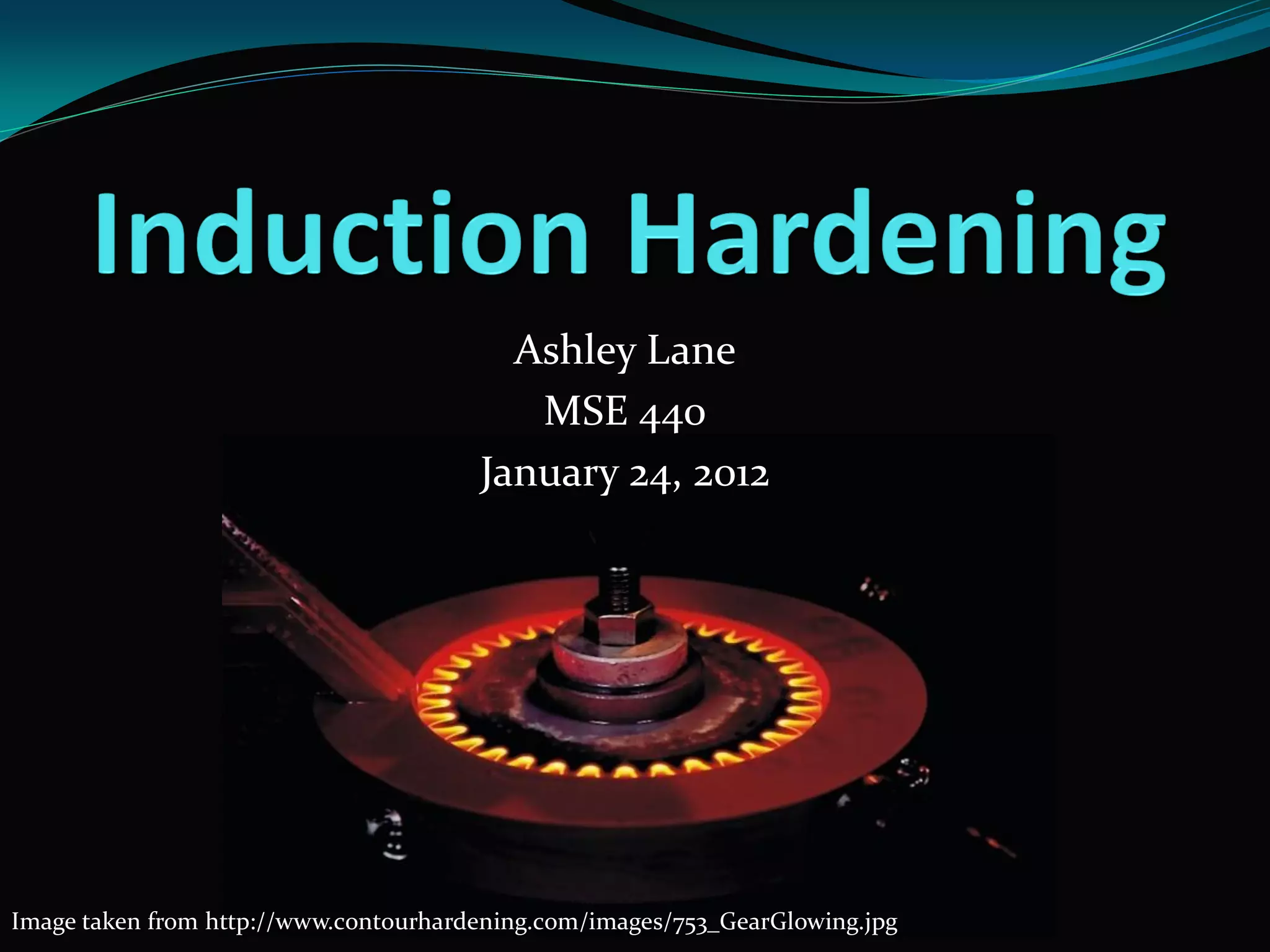
Image taken from http://www.contourhardening.com/images/753_GearGlowing.jpg
Transmission Components
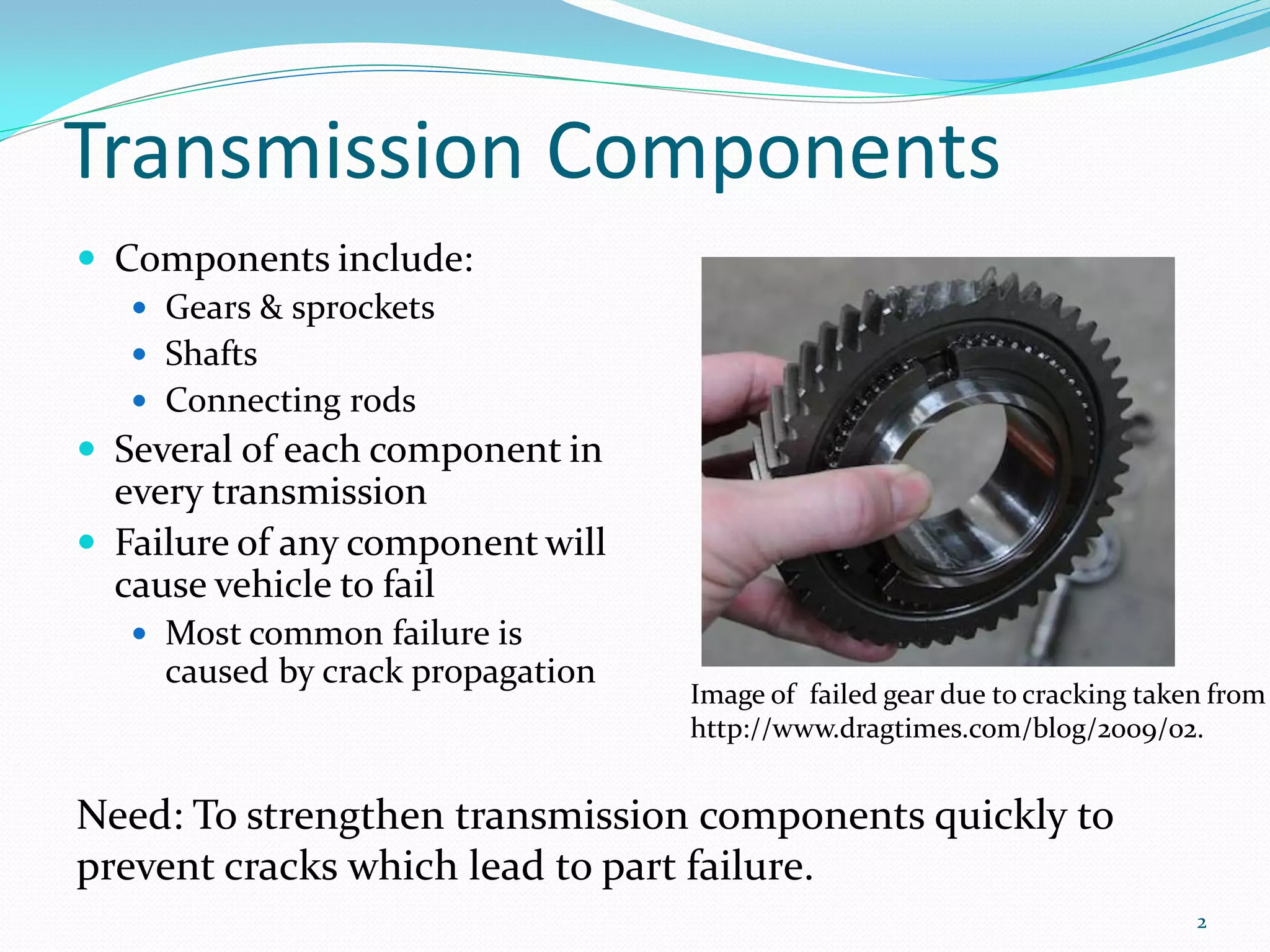
 Components include:
    Gears & sprockets
    Shafts
    Connecting rods
 Several of each component in
  every transmission
 Failure of any component will
  cause vehicle to fail
    Most common failure is
     caused by crack propagation
                                   Image of failed gear due to cracking taken from
                                   http://www.dragtimes.com/blog/2009/02.


Need: To strengthen transmission components quickly to
prevent cracks which lead to part failure.
                                                                            2
Popular Hardening Treatments*
      Flame hardening (~50 HRC)                                   (a)                    (b)
            Only for gray cast iron
            Anneals core material during process
      Nitriding (~69 HRC)
            Uses ammonia or cyanide salt baths Images of gear teeth hardened by (a)
                                                                 nitriding and (b) carburizing taken from
            Depth of 1 mm
                                                                 http://www.gearsolutions.com/media//uplo
            Roughly 4 hours per work piece                      ads/assets//PDF/Articles/Jan_10/0110_Boeing
                                                                 .pdf
      Carburizing (~50 HRC)
            Used on low carbon content steel
             (<0.2%C)                                                 Need more efficient
            Depth up to 6 mm                                        process with required
            Typically 12-72 hrs. per work piece                    product properties with
                                                                     shorter process time!
                                                                                                          3
*Davis, et. al, Surface Engineering of Cast Irons, Surface Engineering, ASM Handbook [5] 683-700 (1994)
Why Choose Induction?
      Produces ideal properties
           Hardness (~67 HRC)
           Strength and wear resistance of part
      Has much faster heating rate than traditional furnace
       treatments
      Provides for more control over outcome
          Less distortion of work piece*
             Warpage is roughly 0.03mm compared to 0.3mm from furnace treatments*
      Heating can be localized for surface hardening
           Allows the core metal to be unaffected
           Creates higher residual stresses


                                                                                                          4
*Rudnev, Simulation of Induction Heat Treating, Metals Process Simulation, ASM Handbook, [22B]501–546 (2009).
Induction Hardening
      Heat treatment used for metal
       (typically steel)
      Uses electromagnetic induction*
           Eddy currents are generated in
            metal
           Resistive heating is proportional to
            resistance in metal and currents
            produced
      Hardening may be done on the
         surface or throughout entire work                           Image of hardened gear teeth taken
         piece                                                       from
                                                                     http://www.ersengine.com/gains-
           Utilizes localized heating
                                                                     ground-through-advances-in-
           Does not affect properties of the                        technology/.
             part as a whole

                                                                                                          5
*Rudnev, Simulation of Induction Heat Treating, Metals Process Simulation, ASM Handbook, [22B]501–546 (2009).
Currents and Magnetic Field
       Eddy currents
            Current induced in conductors
             when exposed to a
             changing magnetic field
            Due to variations of the field with
             time
            Generates resistive heating in metal
                 Can reaustenitize metal in 0.5 s*
            Induced as result of Faraday’s law
              of induction*
                                   𝑑Φ
                           𝑒 = −𝑁                                     Image of currents and magnetic field
                                    𝑑𝑡                                induced during hardening process.*
            e =induced voltage
            N=number of coil turns
            Φ= magnetic field

                                                                                                         6
*Hassell, et. al, Induction Heat Treating of Steel, Heat Treating, ASM Handbook [4] 164–202 (1991).
Electrical Properties of Steel
        Only adjustable parameter is the
         frequency
        High frequencies are used for
         surface hardening


                                                                            Frequency (kHz)
        Lower frequencies are used for
         through-hardening
                                   ρ
                         𝑑=
                                 πμ0 μ f
   d=depth of hardening
   ρ= resistivity                                                                             Diameter (mm)
   μ0= 4π×10−7 V·s/(A·m) (magnetic permeability of vacuum)
   μ =magnetic permeability of part                                         Plot of diameter versus frequency in
   f=frequency of magnetic field                                            plain carbon steel.*

                                                                                                              7
*Hassell, et. al, Induction Heat Treating of Steel, Heat Treating, ASM Handbook [4] 164–202 (1991).
Typical Heat Treatment Procedure
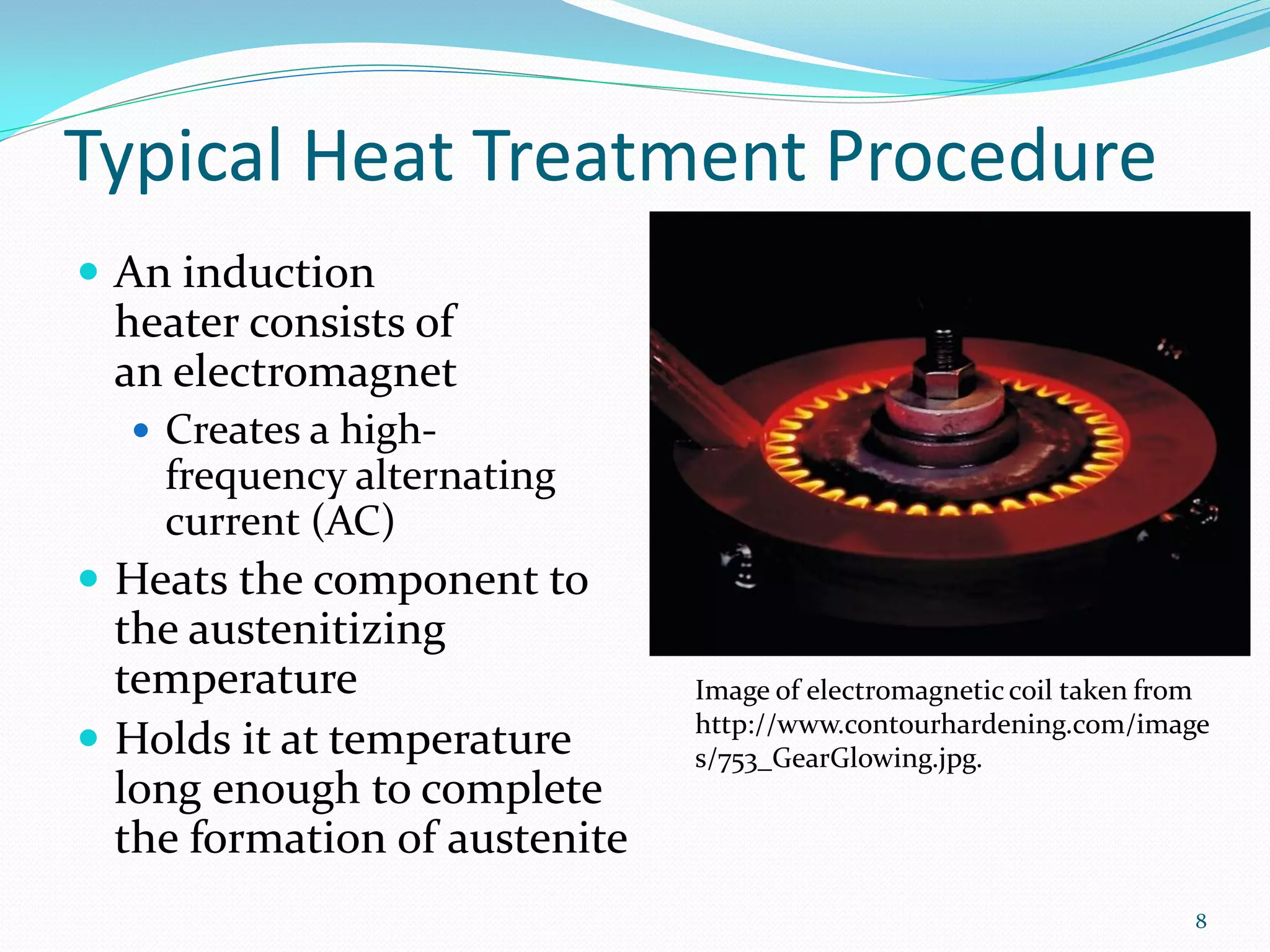
 An induction
  heater consists of
  an electromagnet
    Creates a high-
     frequency alternating
     current (AC)
 Heats the component to
  the austenitizing
  temperature                  Image of electromagnetic coil taken from
                               http://www.contourhardening.com/image
 Holds it at temperature      s/753_GearGlowing.jpg.
  long enough to complete
  the formation of austenite
                                                                     8
Quenching Stage of Heat Cycle
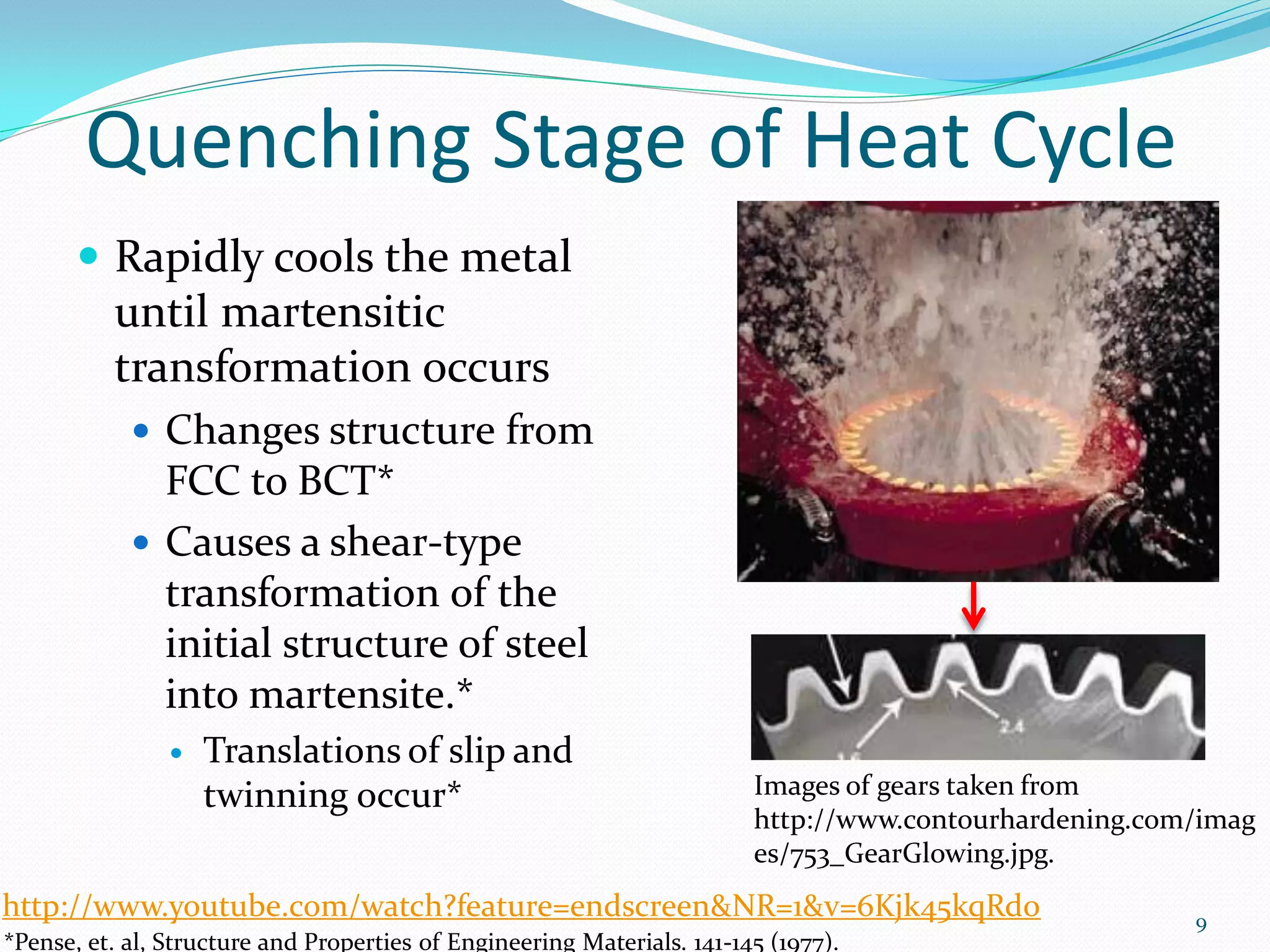
        Rapidly cools the metal
         until martensitic
         transformation occurs
           Changes structure from
            FCC to BCT*
           Causes a shear-type
            transformation of the
            initial structure of steel
            into martensite.*
                   Translations of slip and
                    twinning occur*                                      Images of gears taken from
                                                                         http://www.contourhardening.com/imag
                                                                         es/753_GearGlowing.jpg.
http://www.youtube.com/watch?feature=endscreen&NR=1&v=6Kjk45kqRdo                                       9
*Pense, et. al, Structure and Properties of Engineering Materials. 141-145 (1977).
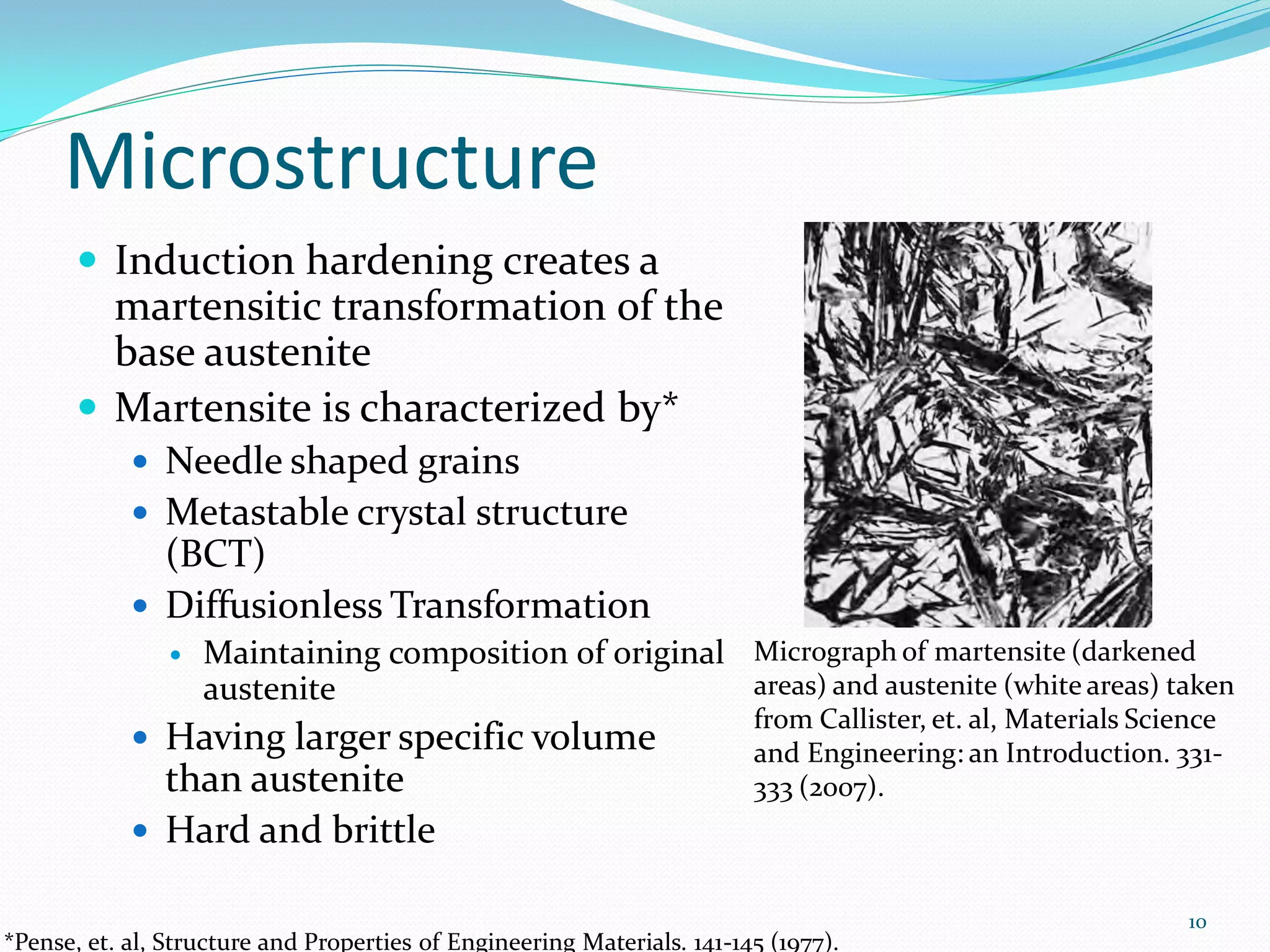
Microstructure
        Induction hardening creates a
         martensitic transformation of the
         base austenite
        Martensite is characterized by*
             Needle shaped grains
             Metastable crystal structure
              (BCT)
             Diffusionless Transformation
                   Maintaining composition of original Micrograph of martensite (darkened
                    austenite                           areas) and austenite (white areas) taken
                                                                         from Callister, et. al, Materials Science
             Having larger specific volume                              and Engineering: an Introduction. 331-
              than austenite                                             333 (2007).
             Hard and brittle

                                                                                                               10
*Pense, et. al, Structure and Properties of Engineering Materials. 141-145 (1977).
Microstructural Relations
        Hardness of austenitized
         parts depends mainly on
         chemical composition
         and quench medium*
        Desired Microstructures
         for reaustenization*
           Finer bainite and
            martensite> pearlite>
                                                               Effect of carbon on hardness in plain carbon
            spheroidite                                        steels for (A) induction hardening, (B) furnace
                                                               hardening with water quench and (C) furnace
                                                               hardening with water quench and temper. The
                                                               quenched-and-tempered steels were treated in
                                                               liquid nitrogen following water quenching
                                                               prior to tempering at 100 °C for 2 hrs.*
                                                                                                          11
*Hassell, et. al, Induction Heat Treating of Steel, Heat Treating, ASM Handbook [4] 164–202 (1991).
Induced Stresses
      Treatment induces compressive
         stresses at surface (>205 Mpa)*
           Surface has volume expansion
           Non-treated core remains
              unchanged
      Martensite retains residual
         stresses**


                                                                  Typical hardness and residual stress profile of
   Image of gear teeth being heated taken from
                                                                  induced-hardened steels using general
   http://www.ersengine.com/gains-ground-through-
                                                                  dissection method. **
   advances-in-technology/.

*Sinha, et. al, Defects and Distortion in Heat-Treated Parts, Heat Treating, ASM Handbook [4] 601-619 (1991).   12
**Davis, et. al, Surface Engineering of Cast Irons, Surface Engineering, ASM Handbook [5] 683-700 (1994)
Maximum Residual Stresses in
     Surface-treated Steel*
                      Heat treatment                                     Residual Stress (MPa)
             Carburized and quenched                                                     340

      Nitrided to case depth of about 0.5
                                                                                         600
                mm (0.02 in.)
       Induction hardened, untempered                                                   1000
  Stress measurements taken at 0.05mm from surface


                                                                                                                13
*Sinha, et. al, Defects and Distortion in Heat-Treated Parts, Heat Treating, ASM Handbook [4] 601-619 (1991).
Review of Surface Hardening *
     Induction hardening (~67 HRC)                               (a)
                                                                                          (b)
           Can be used on any type of steel
           Utilizes localized heating
           Has clean transition pattern
           Process takes less than 1 minute
     Nitriding (~69 HRC)                                                   (c)
           Uses ammonia or cyanide salt baths
           Depth of 1 mm
           Roughly 4 hours per work piece
     Carburizing (~50 HRC)
                                                                 Images of gear teeth hardened by (a)
           Used on low carbon content steel                     nitriding (b) carburizing and (c) induction
            (<0.2%C)                                             hardening found at
                                                                 http://www.gearsolutions.com/media//uplo
           Depth up to 6 mm
                                                                 ads/assets//PDF/Articles/Jan_10/0110_Boeing
           Typically 12-72 hrs. per work piece                  .pdf
                                                                                                          14
*Davis, et. al, Surface Engineering of Cast Irons, Surface Engineering, ASM Handbook [5] 683-700 (1994)
Summary
 Induction is an efficient means of heat treatment
 Produces eddy currents for resistive heating in metal
 Rapid quenching to induce martensitic transformation
 Has much faster heating rate than traditional furnace
  treatments
 Creates increases in:
    Residual Stresses
    Hardness
    Strength
    Wear resistance


                                                          15
Questions


            16

Induction Hardening

  • 1.
    Ashley Lane MSE 440 January 24, 2012 Image taken from http://www.contourhardening.com/images/753_GearGlowing.jpg
  • 2.
    Transmission Components  Componentsinclude:  Gears & sprockets  Shafts  Connecting rods  Several of each component in every transmission  Failure of any component will cause vehicle to fail  Most common failure is caused by crack propagation Image of failed gear due to cracking taken from http://www.dragtimes.com/blog/2009/02. Need: To strengthen transmission components quickly to prevent cracks which lead to part failure. 2
  • 3.
    Popular Hardening Treatments*  Flame hardening (~50 HRC) (a) (b)  Only for gray cast iron  Anneals core material during process  Nitriding (~69 HRC)  Uses ammonia or cyanide salt baths Images of gear teeth hardened by (a) nitriding and (b) carburizing taken from  Depth of 1 mm http://www.gearsolutions.com/media//uplo  Roughly 4 hours per work piece ads/assets//PDF/Articles/Jan_10/0110_Boeing .pdf  Carburizing (~50 HRC)  Used on low carbon content steel (<0.2%C) Need more efficient  Depth up to 6 mm process with required  Typically 12-72 hrs. per work piece product properties with shorter process time! 3 *Davis, et. al, Surface Engineering of Cast Irons, Surface Engineering, ASM Handbook [5] 683-700 (1994)
  • 4.
    Why Choose Induction?  Produces ideal properties  Hardness (~67 HRC)  Strength and wear resistance of part  Has much faster heating rate than traditional furnace treatments  Provides for more control over outcome  Less distortion of work piece*  Warpage is roughly 0.03mm compared to 0.3mm from furnace treatments*  Heating can be localized for surface hardening  Allows the core metal to be unaffected  Creates higher residual stresses 4 *Rudnev, Simulation of Induction Heat Treating, Metals Process Simulation, ASM Handbook, [22B]501–546 (2009).
  • 5.
    Induction Hardening  Heat treatment used for metal (typically steel)  Uses electromagnetic induction*  Eddy currents are generated in metal  Resistive heating is proportional to resistance in metal and currents produced  Hardening may be done on the surface or throughout entire work Image of hardened gear teeth taken piece from http://www.ersengine.com/gains-  Utilizes localized heating ground-through-advances-in-  Does not affect properties of the technology/. part as a whole 5 *Rudnev, Simulation of Induction Heat Treating, Metals Process Simulation, ASM Handbook, [22B]501–546 (2009).
  • 6.
    Currents and MagneticField  Eddy currents  Current induced in conductors when exposed to a changing magnetic field  Due to variations of the field with time  Generates resistive heating in metal  Can reaustenitize metal in 0.5 s*  Induced as result of Faraday’s law of induction* 𝑑Φ 𝑒 = −𝑁 Image of currents and magnetic field 𝑑𝑡 induced during hardening process.* e =induced voltage N=number of coil turns Φ= magnetic field 6 *Hassell, et. al, Induction Heat Treating of Steel, Heat Treating, ASM Handbook [4] 164–202 (1991).
  • 7.
    Electrical Properties ofSteel  Only adjustable parameter is the frequency  High frequencies are used for surface hardening Frequency (kHz)  Lower frequencies are used for through-hardening ρ 𝑑= πμ0 μ f d=depth of hardening ρ= resistivity Diameter (mm) μ0= 4π×10−7 V·s/(A·m) (magnetic permeability of vacuum) μ =magnetic permeability of part Plot of diameter versus frequency in f=frequency of magnetic field plain carbon steel.* 7 *Hassell, et. al, Induction Heat Treating of Steel, Heat Treating, ASM Handbook [4] 164–202 (1991).
  • 8.
    Typical Heat TreatmentProcedure  An induction heater consists of an electromagnet  Creates a high- frequency alternating current (AC)  Heats the component to the austenitizing temperature Image of electromagnetic coil taken from http://www.contourhardening.com/image  Holds it at temperature s/753_GearGlowing.jpg. long enough to complete the formation of austenite 8
  • 9.
    Quenching Stage ofHeat Cycle  Rapidly cools the metal until martensitic transformation occurs  Changes structure from FCC to BCT*  Causes a shear-type transformation of the initial structure of steel into martensite.*  Translations of slip and twinning occur* Images of gears taken from http://www.contourhardening.com/imag es/753_GearGlowing.jpg. http://www.youtube.com/watch?feature=endscreen&NR=1&v=6Kjk45kqRdo 9 *Pense, et. al, Structure and Properties of Engineering Materials. 141-145 (1977).
  • 10.
    Microstructure  Induction hardening creates a martensitic transformation of the base austenite  Martensite is characterized by*  Needle shaped grains  Metastable crystal structure (BCT)  Diffusionless Transformation  Maintaining composition of original Micrograph of martensite (darkened austenite areas) and austenite (white areas) taken from Callister, et. al, Materials Science  Having larger specific volume and Engineering: an Introduction. 331- than austenite 333 (2007).  Hard and brittle 10 *Pense, et. al, Structure and Properties of Engineering Materials. 141-145 (1977).
  • 11.
    Microstructural Relations  Hardness of austenitized parts depends mainly on chemical composition and quench medium*  Desired Microstructures for reaustenization*  Finer bainite and martensite> pearlite> Effect of carbon on hardness in plain carbon spheroidite steels for (A) induction hardening, (B) furnace hardening with water quench and (C) furnace hardening with water quench and temper. The quenched-and-tempered steels were treated in liquid nitrogen following water quenching prior to tempering at 100 °C for 2 hrs.* 11 *Hassell, et. al, Induction Heat Treating of Steel, Heat Treating, ASM Handbook [4] 164–202 (1991).
  • 12.
    Induced Stresses  Treatment induces compressive stresses at surface (>205 Mpa)*  Surface has volume expansion  Non-treated core remains unchanged  Martensite retains residual stresses** Typical hardness and residual stress profile of Image of gear teeth being heated taken from induced-hardened steels using general http://www.ersengine.com/gains-ground-through- dissection method. ** advances-in-technology/. *Sinha, et. al, Defects and Distortion in Heat-Treated Parts, Heat Treating, ASM Handbook [4] 601-619 (1991). 12 **Davis, et. al, Surface Engineering of Cast Irons, Surface Engineering, ASM Handbook [5] 683-700 (1994)
  • 13.
    Maximum Residual Stressesin Surface-treated Steel* Heat treatment Residual Stress (MPa) Carburized and quenched 340 Nitrided to case depth of about 0.5 600 mm (0.02 in.) Induction hardened, untempered 1000 Stress measurements taken at 0.05mm from surface 13 *Sinha, et. al, Defects and Distortion in Heat-Treated Parts, Heat Treating, ASM Handbook [4] 601-619 (1991).
  • 14.
    Review of SurfaceHardening *  Induction hardening (~67 HRC) (a) (b)  Can be used on any type of steel  Utilizes localized heating  Has clean transition pattern  Process takes less than 1 minute  Nitriding (~69 HRC) (c)  Uses ammonia or cyanide salt baths  Depth of 1 mm  Roughly 4 hours per work piece  Carburizing (~50 HRC) Images of gear teeth hardened by (a)  Used on low carbon content steel nitriding (b) carburizing and (c) induction (<0.2%C) hardening found at http://www.gearsolutions.com/media//uplo  Depth up to 6 mm ads/assets//PDF/Articles/Jan_10/0110_Boeing  Typically 12-72 hrs. per work piece .pdf 14 *Davis, et. al, Surface Engineering of Cast Irons, Surface Engineering, ASM Handbook [5] 683-700 (1994)
  • 15.
    Summary  Induction isan efficient means of heat treatment  Produces eddy currents for resistive heating in metal  Rapid quenching to induce martensitic transformation  Has much faster heating rate than traditional furnace treatments  Creates increases in:  Residual Stresses  Hardness  Strength  Wear resistance 15
  • 16.