HEAT TREATMENT
&
ITS APPLICATION IN AUTOMOTIVE
INDUSTRY
G.VEERAPPAN M.E, M.B.A
4/28/2021 1
GRATITUDE TO MY MENTOR
Dr.M.RAVICHANDRAN
ASSOCIATE PROFESSOR
K.RAMAKRISHNAN COLLEGE OF
ENGINEERING, TIRUCHIRAPALLI.
4/28/2021 2
Topics to be Covered
• Heat treatment and its purpose
• Types of Heat treatment
• Case Hardening and it types
• Masking of components
• Piston
• Gears
• Crankshaft
• Connecting Rod
• Leaf Spring
4/28/2021 3
Heat Treatment and its purpose
• An operation or combination of operations
involving heating and cooling of a metal/ alloy
in solid state to obtain desirable condition.
• Purpose
• Relief internal stresses
• Harden and strngthen metals
• Improve machinability
• Improve ductility and toughness
• Increase wear and corrosion resistance of materials
4/28/2021 4
STAGES OF HEAT TREATMENT
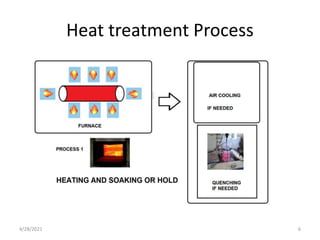
• Heating a metal rod to specified temperature.
• Holding at that definite temperature for a
sufficient period to allow necessary changes
to occur.
• Cooling at a rate necessary to obtain desired
properties.
4/28/2021 5
Heat treatment Process
4/28/2021 6
TYPES OF HEAT TREATMENT PROCESS
4/28/2021 7
TYPES OF HEAT TREATMENT
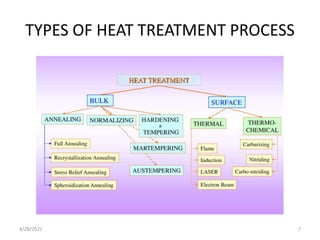
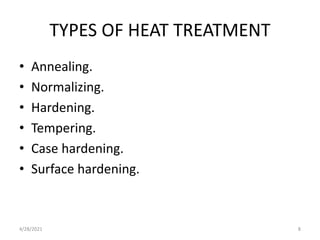
• Annealing.
• Normalizing.
• Hardening.
• Tempering.
• Case hardening.
• Surface hardening.
4/28/2021 8
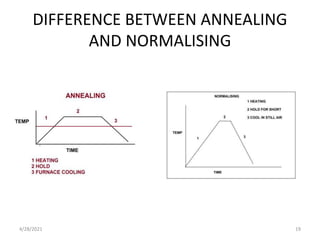
ANNEALING
4/28/2021 9
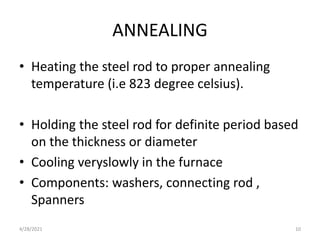
ANNEALING
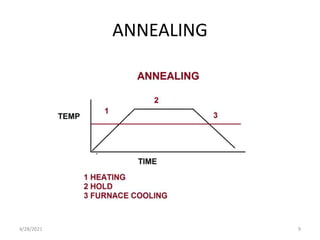
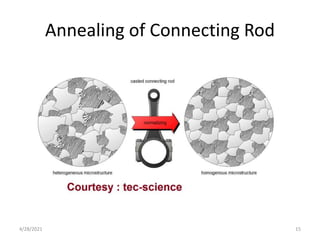
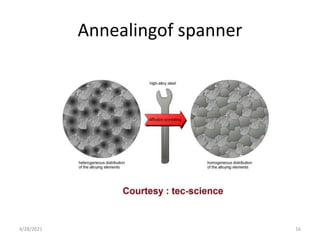
• Heating the steel rod to proper annealing
temperature (i.e 823 degree celsius).
• Holding the steel rod for definite period based
on the thickness or diameter
• Cooling veryslowly in the furnace
• Components: washers, connecting rod ,
Spanners
4/28/2021 10
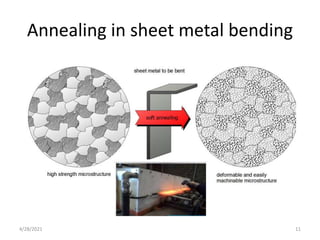
Annealing in sheet metal bending
4/28/2021 11
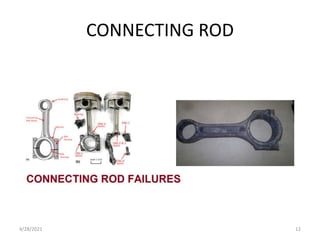
CONNECTING ROD
4/28/2021 12
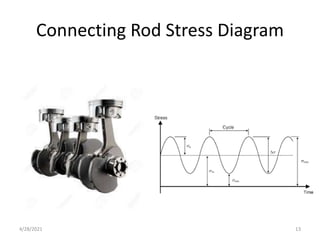
Connecting Rod Stress Diagram
4/28/2021 13
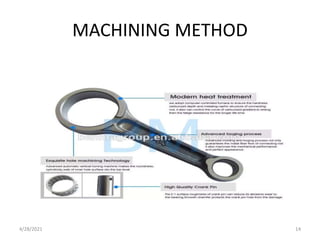
MACHINING METHOD
4/28/2021 14
Annealing of Connecting Rod
4/28/2021 15
Annealingof spanner
4/28/2021 16
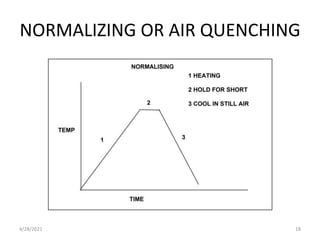
NORMALIZING OR AIR QUENCHING
• It is the process of heating steel to about 40 -
50⁰ C above its critical temperature.
• Hold for short time.
• Cooling in still air.
4/28/2021 17
NORMALIZING OR AIR QUENCHING
4/28/2021 18
DIFFERENCE BETWEEN ANNEALING
AND NORMALISING
4/28/2021 19
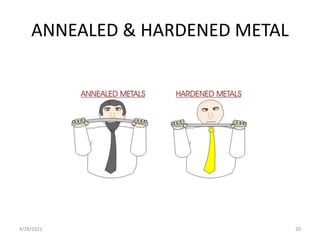
ANNEALED & HARDENED METAL
4/28/2021 20
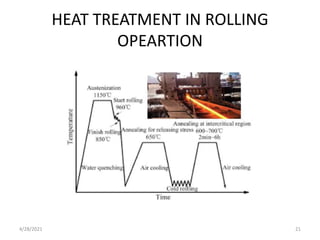
HEAT TREATMENT IN ROLLING
OPEARTION
4/28/2021 21
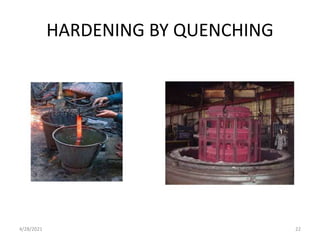
HARDENING BY QUENCHING
4/28/2021 22
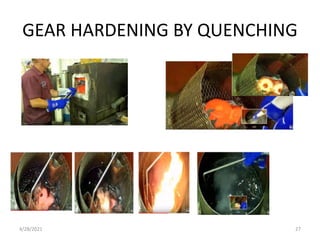
Hardening by quenching
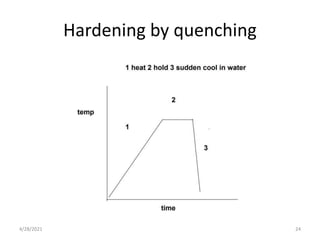
• Alloys are heated above the critical
transformation temperature for the material,
then cooled rapidly enough to cause the soft
initial material to transform to a much harder,
stronger structure.
• Microstructure obtained is martensite.
4/28/2021 23
Hardening by quenching
4/28/2021 24
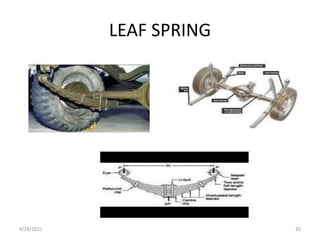
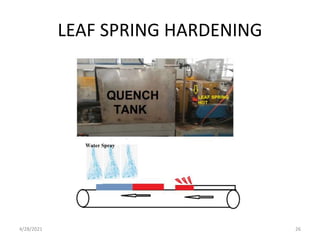
LEAF SPRING
4/28/2021 25
LEAF SPRING HARDENING
4/28/2021 26
GEAR HARDENING BY QUENCHING
4/28/2021 27
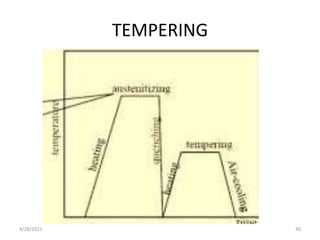
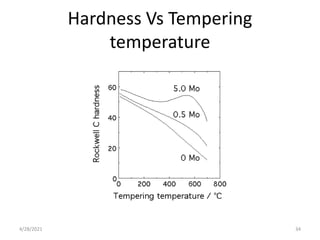
TEMPERING
• The process involves reheating the hardened
steel to a temperature below the lower critical
temperature, holding it at that temperature
for sufficient time and then cooling it slowly
down to the room temperature.
4/28/2021 28
TEMPERING PURPOSE
• A hardened steel piece, due to martensitic
structure, is extremely hard and brittle, due to
which it is found unsuitable for most practical
purposes. So a subsequent treatment is
required to obtain a desired degree of
toughness at the cost of some strength and
hardness to make it suitable for use. It is
especially true in case of the tools. This is
exactly what is mainly aimed at through
tempering of steel.
4/28/2021 29
TEMPERING
4/28/2021 30
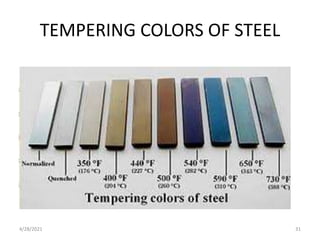
TEMPERING COLORS OF STEEL
4/28/2021 31
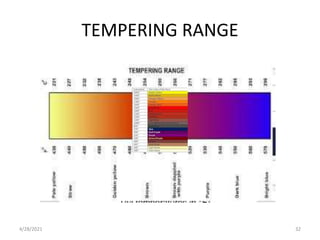
TEMPERING RANGE
4/28/2021 32
4/28/2021 33
Hardness Vs Tempering
temperature
4/28/2021 34
4/28/2021 35
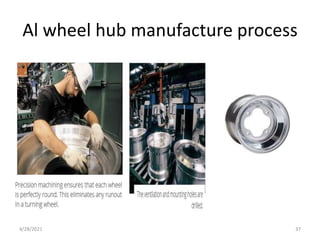
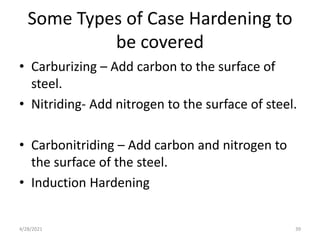
Al wheel hub manufacture process
& Heat treatment
4/28/2021 36
Al wheel hub manufacture process
4/28/2021 37
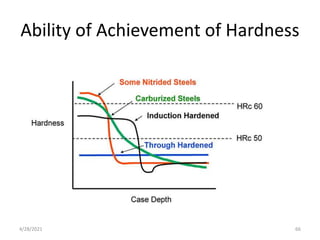
Case hardening
• Case hardening produces a hard and wear-
resistant outer layer while preserving the
ductile-strength of the interior. Case
hardening a gearbox components creates a
hard outer-shell and a pliable inner layer. The
hardened layer is called the case. The
thickness of the hardened layer is referred to
as the case depth.
4/28/2021 38
Some Types of Case Hardening to
be covered
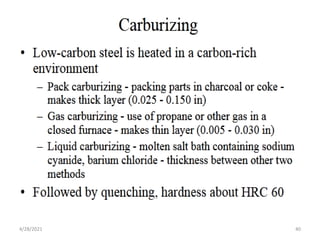
• Carburizing – Add carbon to the surface of
steel.
• Nitriding- Add nitrogen to the surface of steel.
• Carbonitriding – Add carbon and nitrogen to
the surface of the steel.
• Induction Hardening
4/28/2021 39
4/28/2021 40
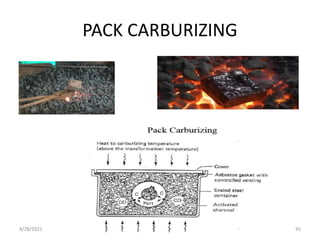
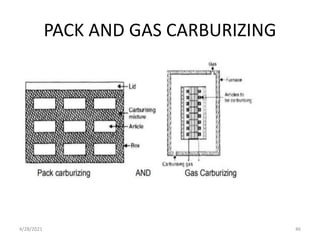
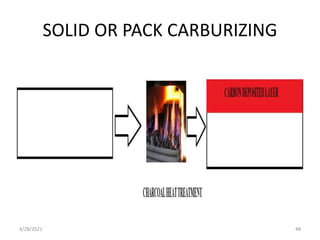
Carburizing case hardening
• Carburizing processes, which mean that
carbon is introduced into the steel to increase
its strength. Carburizing treatments are useful
for steels that have a carbon content between
0.15 to 0.25 percent. After the treatment, the
carbon content at the surface of the steel
should be raised to 0.8 to 1.0 percent.
4/28/2021 41
Atmosphere carburizing process
• In the atmosphere carburizing process, steel parts
are heated in a furnace and mixed with carbon-
containing gases such as methane, carbon monoxide,
and carbon dioxide. The steel absorbs the carbon
from these gases and diffuses from the surface of the
steel inwards. Once they are mixed, the parts are
then cooled, typically using oil, but brine, molten
salt, water, or a polymer solution can also be used.
4/28/2021 42
Vacuum carburizing
• Vacuum carburizing involves heating the steel in a
vacuum chamber. Once the parts reach the
necessary temperature, the carbon gases are
injected into the chamber. This method offers several
advantages over atmosphere carburizing, including
better control of carbon diffusion, which minimizes
dimensional distortions. The steel parts are then
quenched in an inert gas, such as nitrogen, or in one
of the liquids described above. Finally, the parts are
tempered in a similar manner to atmosphere
carburizing.
4/28/2021 43
4/28/2021 44
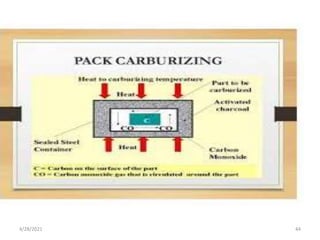
PACK CARBURIZING
4/28/2021 45
PACK AND GAS CARBURIZING
4/28/2021 46
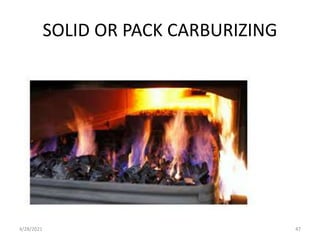
SOLID OR PACK CARBURIZING
4/28/2021 47
SOLID OR PACK CARBURIZING
4/28/2021 48
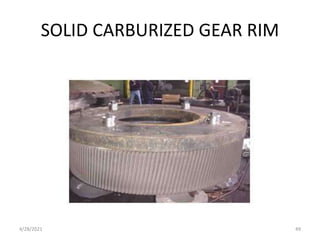
SOLID CARBURIZED GEAR RIM
4/28/2021 49
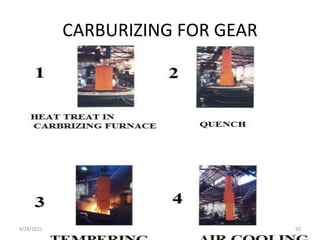
CARBURIZING FOR GEAR
4/28/2021 50
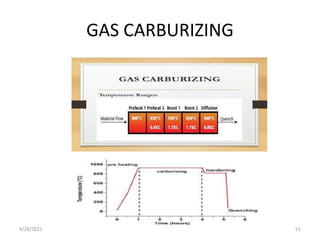
GAS CARBURIZING
4/28/2021 51
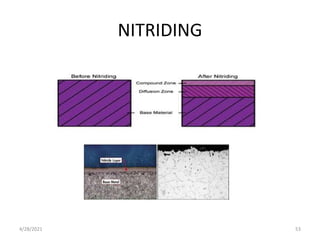
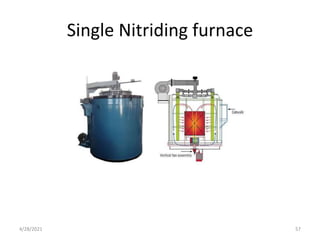
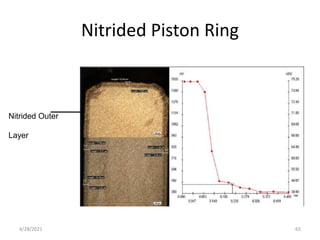
NITRIDING
• Addition of Nitrogen in the outer case of the
base metal is Nitriding.
• The nitriding of metals is a process that allows
you to change the properties of surface
hardness, wear, corrosion and thermal
resistance of the material, They are used, in
order of importance in the treatment of
ferrous metals, refractory metals and, more
recently, of aluminium
4/28/2021 52
NITRIDING
4/28/2021 53
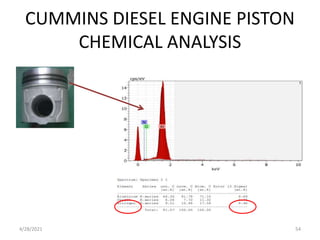
CUMMINS DIESEL ENGINE PISTON
CHEMICAL ANALYSIS
4/28/2021 54
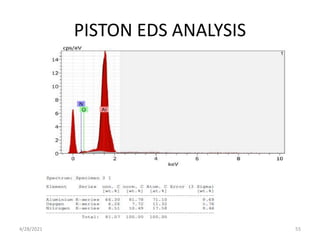
PISTON EDS ANALYSIS
4/28/2021 55
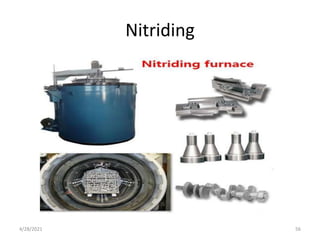
Nitriding
4/28/2021 56
Single Nitriding furnace
4/28/2021 57
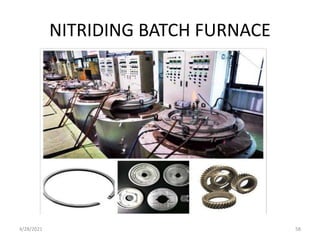
NITRIDING BATCH FURNACE
4/28/2021 58
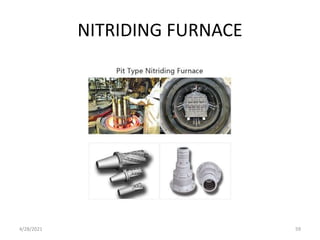
NITRIDING FURNACE
4/28/2021 59
NitridING Application
• The process is used in the treatment of plastic
injection moldings, automotive parts (valves,
gears, pistons, etc.), aluminium extrusion dies,
cutting tools and machining metal, cutting
punches matrices in general treatment
prostheses, etc.
4/28/2021 60
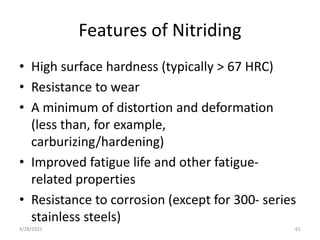
Features of Nitriding
• High surface hardness (typically > 67 HRC)
• Resistance to wear
• A minimum of distortion and deformation
(less than, for example,
carburizing/hardening)
• Improved fatigue life and other fatigue-
related properties
• Resistance to corrosion (except for 300- series
stainless steels)
4/28/2021 61
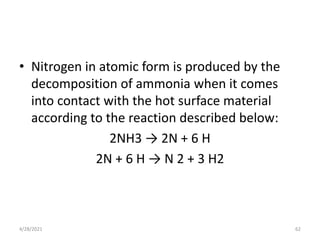
• Nitrogen in atomic form is produced by the
decomposition of ammonia when it comes
into contact with the hot surface material
according to the reaction described below:
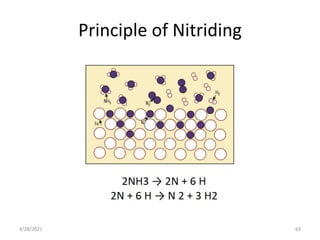
2NH3 → 2N + 6 H
2N + 6 H → N 2 + 3 H2
4/28/2021 62
Principle of Nitriding
4/28/2021 63
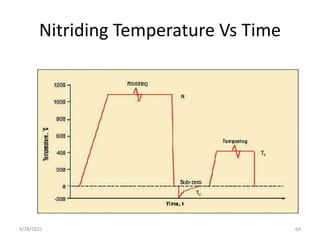
Nitriding Temperature Vs Time
4/28/2021 64
Nitrided Piston Ring
Nitrided Outer
Layer
4/28/2021 65
Ability of Achievement of Hardness
4/28/2021 66
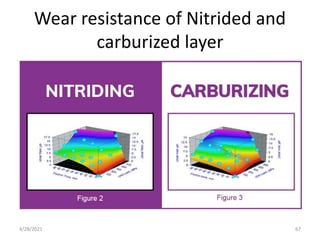
Wear resistance of Nitrided and
carburized layer
4/28/2021 67
4/28/2021 68
MASKING TECHNIQUE FOR HEAT
TREATMENT
• COPPER PLATING
• STOP OFF PAINTS
4/28/2021 69
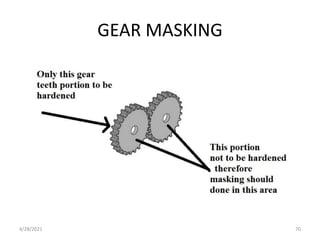
GEAR MASKING
4/28/2021 70
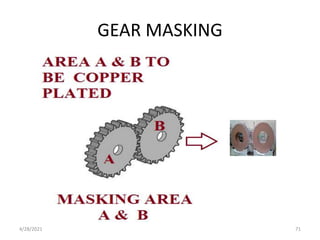
GEAR MASKING
4/28/2021 71
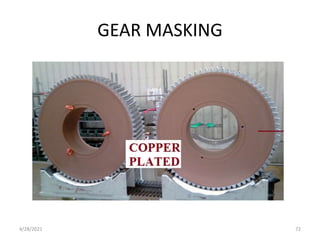
GEAR MASKING
4/28/2021 72
Fiat Avio studied the effects of copper
plating on gears
• Copper plating experienced a chemical interaction between the
tooth flanks and the copper plating. This interaction is known as
hydrogen embrittlement where the hydrogen enters the material
during the electro-plating process. The result is a diminishment of
strength and fatigue life of the gear (but not hardness).
• Additional tests show the embrittlement effect can be reduced by
heating the pinions to 150 deg C and tempering. The resulting
residual loss in strength was reduced to 7%.
• A common cure for hydrogen embrittlement is tempering at the
proper temperature, but it must be done immediately after plating.
Thus, with tempering you can reduce the loss of bending strength
to 7%. However, 7% is well within the usual scatter in bending
fatigue tests.
4/28/2021 73
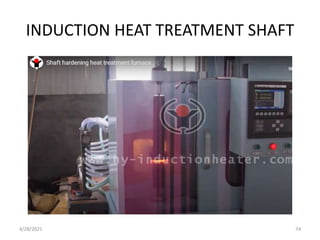
INDUCTION HEAT TREATMENT SHAFT
4/28/2021 74
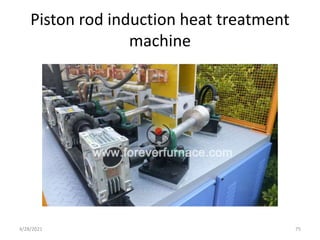
Piston rod induction heat treatment
machine
4/28/2021 75
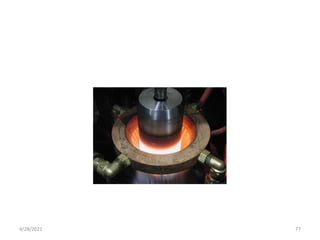
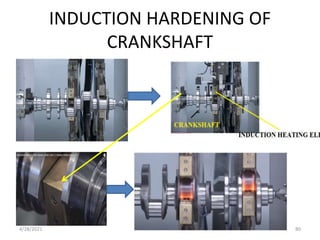
Induction hardening
• Induction hardening is a method of quickly
and selectively hardening the surface of a
metal part. A copper coil carrying a significant
level of alternating current is placed near (not
touching) the part. Heat is generated at, and
near the surface by eddy current and
hysteresis losses. Quench, usually water-based
with an addition such as a polymer, is directed
at the part or it is submerged. This transforms
the structure to martensite, which is much
4/28/2021 76
4/28/2021 77
Benefits of Induction Hardening
• Increased Wear Resistance
• Increased Strength & Fatigue Life due to the Soft Core & Residual Compressive
Stress at the Surface
• Parts may be Tempered after Induction Hardening to Adjust Hardness Level, as
desired
• Deep Case with Tough Core
• Typical case depth is .030” - .120” which is deeper on average than processes such as
carburizing, carbonitriding, and various forms of nitriding performed at sub-critical temperatures.
• Selective Hardening Process with No Masking Required
• Relatively Minimal Distortion
• Allows use of Low Cost Steels such as 1045
4/28/2021 78
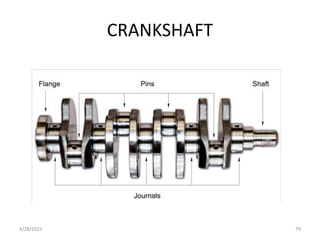
CRANKSHAFT
4/28/2021 79
INDUCTION HARDENING OF
CRANKSHAFT
4/28/2021 80
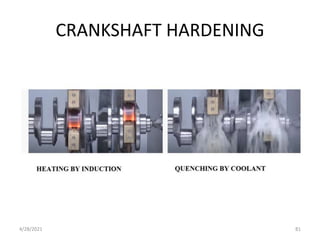
CRANKSHAFT HARDENING
4/28/2021 81
• Induction hardening is a method of quickly
and selectively hardening the surface of a
metal part. A copper coil carrying a significant
level of alternating current is placed near (not
touching) the part. Heat is generated at, and
near the surface by eddy current and
hysteresis losses. Quench, usually water-based
with an addition such as a polymer, is directed
at the part or it is submerged. This transforms
the structure to martensite, which is much
4/28/2021 82
THANK YOU
4/28/2021 83
ANY QUERIES
• Email id: veerappangopathy@gmail.com
4/28/2021 84