Measurement Scales


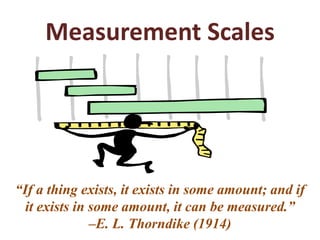
“If a thing exists, it exists in some amount; and if
  it exists in some amount, it can be measured.”
               –E. L. Thorndike (1914)
Background
 The "levels of measurement" is an expression which typically
  refers to the theory of scale types developed by the psychologist
  Stanley Smith Stevens.

 Stevens proposed his theory in a 1946 article titled "On the
  theory of scales of measurement”.

 In this article Stevens claimed that all measurement in science
  was conducted using four different types of numerical scales
  which he called "nominal", "ordinal", "interval" and "ratio".
The Theory Of Scale Types
Stevens (1946, 1951) proposed that measurements can
be classified into four different types of scales. These
were:
            Nominal
            Ordinal
            Interval
            Ratio
Nominal Scale
 A categorical variable, also called a nominal
  variable, is for       mutual   exclusive,   but   not
  ordered, categories.
 Nominal scales are mere codes assigned to objects as
  labels, they are not measurements.
 Not a measure of quantity. Measures identity and
 difference. People either belong to a group or they do
 not.
 Sometimes numbers are used to designate       category
 membership.
Examples
 Eye color: blue, brown, green, etc.
 Biological sex (male or female)
 Democrat, republican, green, libertarian, etc.
 Married, single, divorced, widowed
 Country of Origin
           1 = United States               3 = Canada
           2 = Mexico                      4 = Other
(Here, the numbers do not have numeric implications; they are simply
convenient labels)
What Statistic Can I Apply?
OK to compute....                             Nominal

Frequency Distribution and mode                 Yes
Median And Percentiles.                         No
Add Or Subtract.                                No
Mean, Standard Deviation, Standard Error Of
                                                No
The Mean.
Ratio, Or Coefficient Of Variation.             No
                                                Yes
Chi-square
Ordinal Scale
Ordinal Scale
 This scale has the ability to rank the individual attributes
  of to items in same group but unit of measurement is not
  available in this scale, like student A is taller than
  student B but their actual heights are not available.
 Designates an ordering: greater than, less than.
 Does not assume that the intervals between numbers are
  equal.
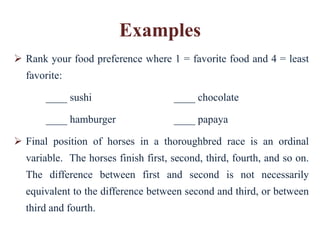
Examples
 Rank your food preference where 1 = favorite food and 4 = least
  favorite:

       ____ sushi                    ____ chocolate

       ____ hamburger                ____ papaya

 Final position of horses in a thoroughbred race is an ordinal
  variable. The horses finish first, second, third, fourth, and so on.
  The difference between first and second is not necessarily
  equivalent to the difference between second and third, or between
  third and fourth.
What Statistic Can I Apply?
OK To Compute....                                 Ordinal
Frequency Distribution.                           Yes
Median And Percentiles.                           Yes
Add Or Subtract.                                  No
Mean, Standard Deviation, Standard Error Of The
                                                  No
Mean.
Ratio, Or Coefficient Of Variation.               No
Interval Scale
Interval Scale
 Classifies data into groups or categories

 Determines the preferences between items

 Zero point on the internal scale is arbitrary zero, it is not the true zero
   point

 Designates an equal-interval ordering.

 The difference in temperature between 20 degrees f and 25 degrees f is
   the same as the difference between 76 degrees f and 81 degrees f.
Examples
 Temperature in Fahrenheit is interval.

 Celsius temperature is an interval variable. It is meaningful to
  say that 25 degrees Celsius is 3 degrees hotter than 22 degrees
  Celsius, and that 17 degrees Celsius is the same amount hotter (3
  degrees) than 14 degrees Celsius.        Notice, however, that 0
  degrees Celsius does not have a natural meaning. That is, 0
  degrees Celsius does not mean the absence of heat!

 Common IQ tests are assumed to use an interval metric.
Examples
Likert scale: How do you feel about Stats?

   1 = I’m totally dreading this class!

   2 = I’d rather not take this class.

   3 = I feel neutral about this class.

   4 = I’m interested in this class.

   5 = I’m SO excited to take this class!
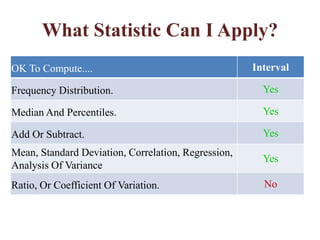
What Statistic Can I Apply?
OK To Compute....                                    Interval

Frequency Distribution.                                Yes

Median And Percentiles.                                Yes

Add Or Subtract.                                       Yes
Mean, Standard Deviation, Correlation, Regression,
                                                       Yes
Analysis Of Variance
Ratio, Or Coefficient Of Variation.                    No
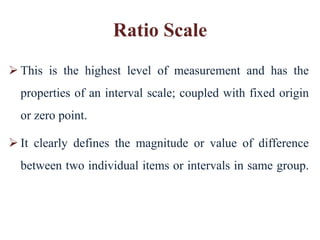
Ratio Scale
 This is the highest level of measurement and has the
  properties of an interval scale; coupled with fixed origin
  or zero point.

 It clearly defines the magnitude or value of difference
  between two individual items or intervals in same group.
Examples
 Temperature in Kelvin (zero is the absence of heat. Can’t get
  colder).

 Measurements of heights of students in this class (zero means
  complete lack of height).

 Someone 6 ft tall is twice as tall as someone 3 feet tall.

 Heart beats per minute has a very natural zero point. Zero
  means no heart beats.
What Statistic Can I Apply?

OK To Compute....                                    Ratio

Frequency Distribution.                              Yes

Median And Percentiles.                              Yes

Add Or Subtract.                                     Yes
Mean, Standard Deviation, Correlation, Regression,
                                                     Yes
Analysis Of Variance
Ratio, Or Coefficient Of Variation.                  Yes
Putting It Together
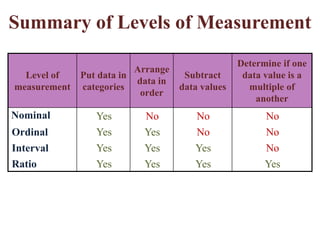
Summary of Levels of Measurement
                                                  Determine if one
                          Arrange
  Level of    Put data in            Subtract      data value is a
                          data in
measurement   categories            data values     multiple of
                           order
                                                      another
Nominal          Yes       No          No               No
Ordinal          Yes       Yes         No               No
Interval         Yes       Yes         Yes              No
Ratio            Yes       Yes         Yes              Yes
Test Your Knowledge
A professor is interested in the relationship between the number
of times students are absent from class and the letter grade that
students receive on the final exam. He records the number of
absences for each student,        as well as the letter grade
(A,B,C,D,F) each student earns on the final exam. In this
example, what is the measurement scale for number of
absences?

   a) Nominal        b) Ordinal    c) Interval   d) Ratio
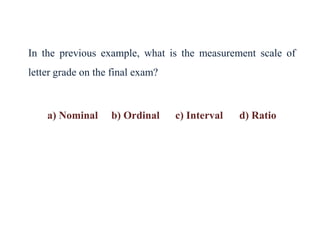
In the previous example, what is the measurement scale of
letter grade on the final exam?


    a) Nominal     b) Ordinal     c) Interval   d) Ratio
Attitude Measurement
Nature of Attitudes
 Cognitive            I think oatmeal is healthier than corn
                       flakes for breakfast.

 Affective Behavior   I hate corn flakes.

 Behavior             I intend to eat more oatmeal for
                       breakfast.
Improving the Predictability of Attitudes


                Specific
                           Multiple
        Basis              measures

                Factors

      Direct               Reference
                            groups
                Strong
Selecting a Measurement Scale
 Research objectives
 Response Types
 Data properties
 Number of Dimensions
 Forced or unforced choices
 Balanced or unbalanced
 Rater errors
 Number of scale points
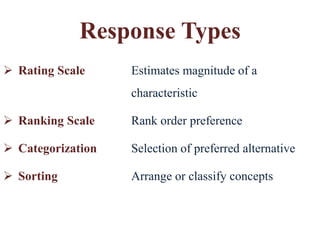
Response Types
 Rating Scale     Estimates magnitude of a
                   characteristic

 Ranking Scale    Rank order preference

 Categorization   Selection of preferred alternative

 Sorting          Arrange or classify concepts
Rating
Asks the respondent to
estimate the magnitude of a
characteristic,   or   quality,
that an object possesses.
The respondent’s position
on a scale(s) is where he or
she would rate an object.
Response Type
                 Rating
1. Simple Category:
          i. Dichotomy
          ii. Multiple choice – single response
          iii. Multiple choice – multiple responses
2. Likert
3. Semantic Differential
4. Numerical/Multiple Rating List
5. Staple
6. Constant-Sum
7. Graphic Rating
Ranking
Tasks   require   that   the
respondent rank order a
small number of objects in
overall performance on the
basis of some characteristic
or stimulus.
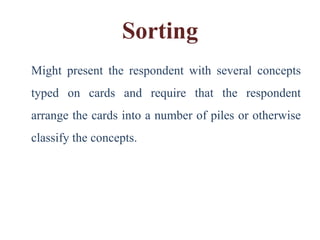
Sorting
Might present the respondent with several concepts
typed on cards and require that the respondent
arrange the cards into a number of piles or otherwise
classify the concepts.
Categorization

Between two or more alternatives is another
type of attitude measurement - it is assumed
that the chosen object is preferred over the
other.

Spss measurement scales

  • 1.
    Measurement Scales “If athing exists, it exists in some amount; and if it exists in some amount, it can be measured.” –E. L. Thorndike (1914)
  • 2.
    Background  The "levelsof measurement" is an expression which typically refers to the theory of scale types developed by the psychologist Stanley Smith Stevens.  Stevens proposed his theory in a 1946 article titled "On the theory of scales of measurement”.  In this article Stevens claimed that all measurement in science was conducted using four different types of numerical scales which he called "nominal", "ordinal", "interval" and "ratio".
  • 3.
    The Theory OfScale Types Stevens (1946, 1951) proposed that measurements can be classified into four different types of scales. These were:  Nominal  Ordinal  Interval  Ratio
  • 4.
    Nominal Scale  Acategorical variable, also called a nominal variable, is for mutual exclusive, but not ordered, categories.  Nominal scales are mere codes assigned to objects as labels, they are not measurements.  Not a measure of quantity. Measures identity and difference. People either belong to a group or they do not.  Sometimes numbers are used to designate category membership.
  • 5.
    Examples  Eye color:blue, brown, green, etc.  Biological sex (male or female)  Democrat, republican, green, libertarian, etc.  Married, single, divorced, widowed  Country of Origin  1 = United States 3 = Canada  2 = Mexico 4 = Other (Here, the numbers do not have numeric implications; they are simply convenient labels)
  • 6.
    What Statistic CanI Apply? OK to compute.... Nominal Frequency Distribution and mode Yes Median And Percentiles. No Add Or Subtract. No Mean, Standard Deviation, Standard Error Of No The Mean. Ratio, Or Coefficient Of Variation. No Yes Chi-square
  • 7.
  • 8.
    Ordinal Scale  Thisscale has the ability to rank the individual attributes of to items in same group but unit of measurement is not available in this scale, like student A is taller than student B but their actual heights are not available.  Designates an ordering: greater than, less than.  Does not assume that the intervals between numbers are equal.
  • 9.
    Examples  Rank yourfood preference where 1 = favorite food and 4 = least favorite: ____ sushi ____ chocolate ____ hamburger ____ papaya  Final position of horses in a thoroughbred race is an ordinal variable. The horses finish first, second, third, fourth, and so on. The difference between first and second is not necessarily equivalent to the difference between second and third, or between third and fourth.
  • 10.
    What Statistic CanI Apply? OK To Compute.... Ordinal Frequency Distribution. Yes Median And Percentiles. Yes Add Or Subtract. No Mean, Standard Deviation, Standard Error Of The No Mean. Ratio, Or Coefficient Of Variation. No
  • 11.
  • 12.
    Interval Scale  Classifiesdata into groups or categories  Determines the preferences between items  Zero point on the internal scale is arbitrary zero, it is not the true zero point  Designates an equal-interval ordering.  The difference in temperature between 20 degrees f and 25 degrees f is the same as the difference between 76 degrees f and 81 degrees f.
  • 13.
    Examples  Temperature inFahrenheit is interval.  Celsius temperature is an interval variable. It is meaningful to say that 25 degrees Celsius is 3 degrees hotter than 22 degrees Celsius, and that 17 degrees Celsius is the same amount hotter (3 degrees) than 14 degrees Celsius. Notice, however, that 0 degrees Celsius does not have a natural meaning. That is, 0 degrees Celsius does not mean the absence of heat!  Common IQ tests are assumed to use an interval metric.
  • 14.
    Examples Likert scale: Howdo you feel about Stats? 1 = I’m totally dreading this class! 2 = I’d rather not take this class. 3 = I feel neutral about this class. 4 = I’m interested in this class. 5 = I’m SO excited to take this class!
  • 15.
    What Statistic CanI Apply? OK To Compute.... Interval Frequency Distribution. Yes Median And Percentiles. Yes Add Or Subtract. Yes Mean, Standard Deviation, Correlation, Regression, Yes Analysis Of Variance Ratio, Or Coefficient Of Variation. No
  • 16.
    Ratio Scale  Thisis the highest level of measurement and has the properties of an interval scale; coupled with fixed origin or zero point.  It clearly defines the magnitude or value of difference between two individual items or intervals in same group.
  • 17.
    Examples  Temperature inKelvin (zero is the absence of heat. Can’t get colder).  Measurements of heights of students in this class (zero means complete lack of height).  Someone 6 ft tall is twice as tall as someone 3 feet tall.  Heart beats per minute has a very natural zero point. Zero means no heart beats.
  • 18.
    What Statistic CanI Apply? OK To Compute.... Ratio Frequency Distribution. Yes Median And Percentiles. Yes Add Or Subtract. Yes Mean, Standard Deviation, Correlation, Regression, Yes Analysis Of Variance Ratio, Or Coefficient Of Variation. Yes
  • 19.
  • 21.
    Summary of Levelsof Measurement Determine if one Arrange Level of Put data in Subtract data value is a data in measurement categories data values multiple of order another Nominal Yes No No No Ordinal Yes Yes No No Interval Yes Yes Yes No Ratio Yes Yes Yes Yes
  • 22.
  • 23.
    A professor isinterested in the relationship between the number of times students are absent from class and the letter grade that students receive on the final exam. He records the number of absences for each student, as well as the letter grade (A,B,C,D,F) each student earns on the final exam. In this example, what is the measurement scale for number of absences? a) Nominal b) Ordinal c) Interval d) Ratio
  • 24.
    In the previousexample, what is the measurement scale of letter grade on the final exam? a) Nominal b) Ordinal c) Interval d) Ratio
  • 25.
  • 26.
    Nature of Attitudes Cognitive I think oatmeal is healthier than corn flakes for breakfast.  Affective Behavior I hate corn flakes.  Behavior I intend to eat more oatmeal for breakfast.
  • 27.
    Improving the Predictabilityof Attitudes Specific Multiple Basis measures Factors Direct Reference groups Strong
  • 28.
    Selecting a MeasurementScale  Research objectives  Response Types  Data properties  Number of Dimensions  Forced or unforced choices  Balanced or unbalanced  Rater errors  Number of scale points
  • 29.
    Response Types  RatingScale Estimates magnitude of a characteristic  Ranking Scale Rank order preference  Categorization Selection of preferred alternative  Sorting Arrange or classify concepts
  • 30.
    Rating Asks the respondentto estimate the magnitude of a characteristic, or quality, that an object possesses. The respondent’s position on a scale(s) is where he or she would rate an object.
  • 31.
    Response Type Rating 1. Simple Category: i. Dichotomy ii. Multiple choice – single response iii. Multiple choice – multiple responses 2. Likert 3. Semantic Differential 4. Numerical/Multiple Rating List 5. Staple 6. Constant-Sum 7. Graphic Rating
  • 32.
    Ranking Tasks require that the respondent rank order a small number of objects in overall performance on the basis of some characteristic or stimulus.
  • 33.
    Sorting Might present therespondent with several concepts typed on cards and require that the respondent arrange the cards into a number of piles or otherwise classify the concepts.
  • 34.
    Categorization Between two ormore alternatives is another type of attitude measurement - it is assumed that the chosen object is preferred over the other.