National Quality month celebration - Nov 2023
Quality Knowledge Sharing
Session # 3
“Measurement System Analysis”
Trainers:
1. S. Sasikumar
2. M. Krishnan
Contents
1. What is Measurement System
2. What is Measurement System Analysis (MSA)
3. Understanding Variation
4. Accuracy Vs Precision
5. Elements of MSA
a. Bias
b. Linearity
c. Stability
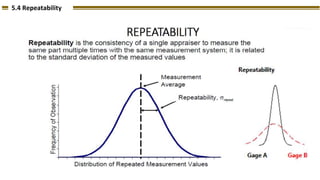
d. Repeatability
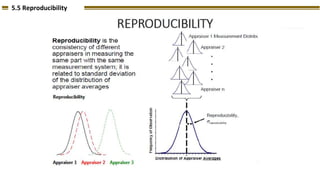
e. Reproducibility
6. Conditions for performing MSA study
7. Benefits of MSA
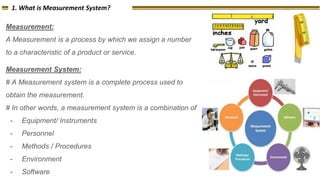
1. What is Measurement System?
Measurement:
A Measurement is a process by which we assign a number
to a characteristic of a product or service.
Measurement System:
# A Measurement system is a complete process used to
obtain the measurement.
# In other words, a measurement system is a combination of
- Equipment/ Instruments
- Personnel
- Methods / Procedures
- Environment
- Software
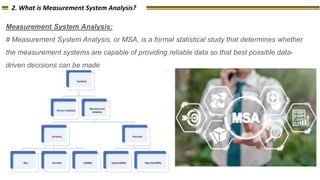
2. What is Measurement System Analysis?
Measurement System Analysis:
# Measurement System Analysis, or MSA, is a formal statistical study that determines whether
the measurement systems are capable of providing reliable data so that best possible data-
driven decisions can be made
3. Understanding Variation
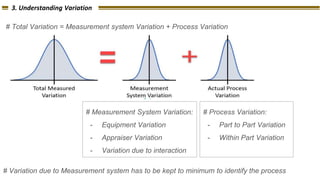
# Total Variation = Measurement system Variation + Process Variation
# Process Variation:
- Part to Part Variation
- Within Part Variation
# Measurement System Variation:
- Equipment Variation
- Appraiser Variation
- Variation due to interaction
# Variation due to Measurement system has to be kept to minimum to identify the process
3. Understanding Variation
# Too much of salt in Soup due to Taste
checker (Measurement system) variation
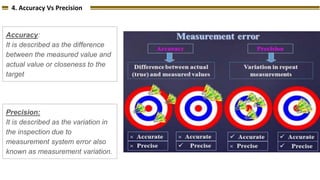
4. Accuracy Vs Precision
Accuracy:
It is described as the difference
between the measured value and
actual value or closeness to the
target
Precision:
It is described as the variation in
the inspection due to
measurement system error also
known as measurement variation.
Accuracy Vs Precision
Accurate but not Precise
Precise but not Accurate
Neither Accurate Nor Precise
Accurate & Precise
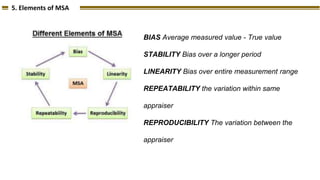
5. Elements of MSA
BIAS Average measured value - True value
STABILITY Bias over a longer period
LINEARITY Bias over entire measurement range
REPEATABILITY the variation within same
appraiser
REPRODUCIBILITY The variation between the
appraiser
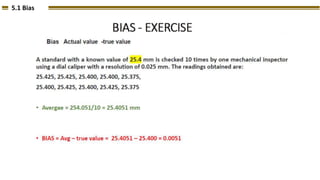
5.1 Bias
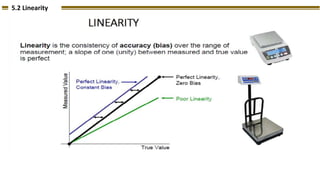
5.2 Linearity
5.2 Linearity
5.3 Stability
5.3 Stability
6.45 am 6.43 am 6.46 am
6.45 am 6.44 am 7.30 am
Common
Cause
Variation
Special Cause
Variation
(Accident/
Traffic)
5.4 Repeatability
5.5 Reproducibility
5.5 Reproducibility
0 0 0 W
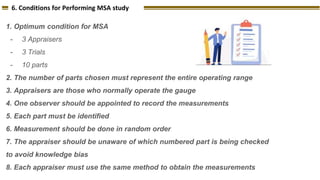
6. Conditions for Performing MSA study
1. Optimum condition for MSA
- 3 Appraisers
- 3 Trials
- 10 parts
2. The number of parts chosen must represent the entire operating range
3. Appraisers are those who normally operate the gauge
4. One observer should be appointed to record the measurements
5. Each part must be identified
6. Measurement should be done in random order
7. The appraiser should be unaware of which numbered part is being checked
to avoid knowledge bias
8. Each appraiser must use the same method to obtain the measurements
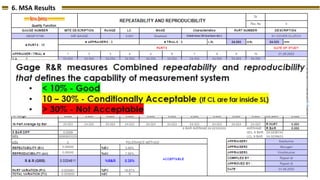
6. MSA Results
7. Benefits of MSA
# Evaluates the reliability of the measurement system
# Equipment variation can be identified
# Appraiser variation can be identified
# It is possible to assess the correctness of the measurement system.
# The method is not only applicable continuous data but also to discrete data type.
# It is possible to compare the existing system with its’ future state in a reliable way
21
Trainers:
1. S. Sasikumar
2. M. Krishnan

Measurement System Analysis.pptx

  • 1.
    National Quality monthcelebration - Nov 2023 Quality Knowledge Sharing Session # 3 “Measurement System Analysis” Trainers: 1. S. Sasikumar 2. M. Krishnan
  • 2.
    Contents 1. What isMeasurement System 2. What is Measurement System Analysis (MSA) 3. Understanding Variation 4. Accuracy Vs Precision 5. Elements of MSA a. Bias b. Linearity c. Stability d. Repeatability e. Reproducibility 6. Conditions for performing MSA study 7. Benefits of MSA
  • 3.
    1. What isMeasurement System? Measurement: A Measurement is a process by which we assign a number to a characteristic of a product or service. Measurement System: # A Measurement system is a complete process used to obtain the measurement. # In other words, a measurement system is a combination of - Equipment/ Instruments - Personnel - Methods / Procedures - Environment - Software
  • 4.
    2. What isMeasurement System Analysis? Measurement System Analysis: # Measurement System Analysis, or MSA, is a formal statistical study that determines whether the measurement systems are capable of providing reliable data so that best possible data- driven decisions can be made
  • 5.
    3. Understanding Variation #Total Variation = Measurement system Variation + Process Variation # Process Variation: - Part to Part Variation - Within Part Variation # Measurement System Variation: - Equipment Variation - Appraiser Variation - Variation due to interaction # Variation due to Measurement system has to be kept to minimum to identify the process
  • 6.
    3. Understanding Variation #Too much of salt in Soup due to Taste checker (Measurement system) variation
  • 7.
    4. Accuracy VsPrecision Accuracy: It is described as the difference between the measured value and actual value or closeness to the target Precision: It is described as the variation in the inspection due to measurement system error also known as measurement variation.
  • 8.
    Accuracy Vs Precision Accuratebut not Precise Precise but not Accurate Neither Accurate Nor Precise Accurate & Precise
  • 9.
    5. Elements ofMSA BIAS Average measured value - True value STABILITY Bias over a longer period LINEARITY Bias over entire measurement range REPEATABILITY the variation within same appraiser REPRODUCIBILITY The variation between the appraiser
  • 10.
  • 11.
  • 12.
  • 13.
  • 14.
    5.3 Stability 6.45 am6.43 am 6.46 am 6.45 am 6.44 am 7.30 am Common Cause Variation Special Cause Variation (Accident/ Traffic)
  • 15.
  • 16.
  • 17.
  • 18.
    6. Conditions forPerforming MSA study 1. Optimum condition for MSA - 3 Appraisers - 3 Trials - 10 parts 2. The number of parts chosen must represent the entire operating range 3. Appraisers are those who normally operate the gauge 4. One observer should be appointed to record the measurements 5. Each part must be identified 6. Measurement should be done in random order 7. The appraiser should be unaware of which numbered part is being checked to avoid knowledge bias 8. Each appraiser must use the same method to obtain the measurements
  • 19.
  • 20.
    7. Benefits ofMSA # Evaluates the reliability of the measurement system # Equipment variation can be identified # Appraiser variation can be identified # It is possible to assess the correctness of the measurement system. # The method is not only applicable continuous data but also to discrete data type. # It is possible to compare the existing system with its’ future state in a reliable way
  • 21.