Piezoelectric Materials
Dr. Mohammad Tawfik
What is Piezoelectric
Material?
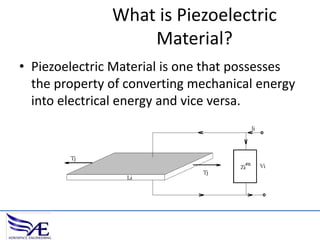
• Piezoelectric Material is one that possesses
the property of converting mechanical energy
into electrical energy and vice versa.
Piezoelectric Materials
• Mechanical Stresses  Electrical Potential
Field : Sensor (Direct Effect)
• Electric Field  Mechanical Strain :
Actuator (Converse Effect)
Clark, Sounders, Gibbs, 1998
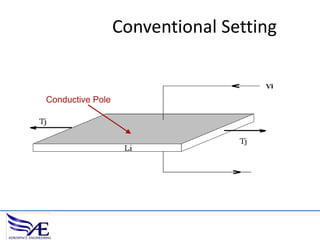
Conventional Setting

Conductive Pole
Piezoelectric Sensor
• When mechanical stresses are applied on the
surface, electric charges are generated
(sensor, direct effect).
• If those charges are collected on a conductor
that is connected to a circuit, current is
generated
Piezoelectric Actuator
• When electric potential (voltage) is applied to
the surface of the piezoelectric material,
mechanical strain is generated (actuator).
• If the piezoelectric material is bonded to a
surface of a structure, it forces the structure
to move with it.
Applications of Piezoelectric Materials in
Vibration Control
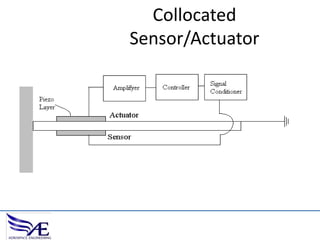
Collocated
Sensor/Actuator
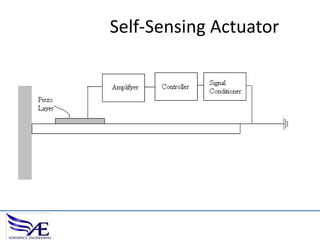
Self-Sensing Actuator
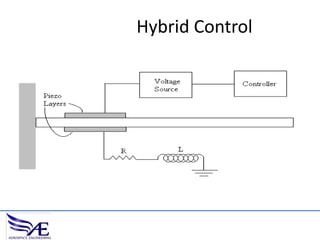
Hybrid Control
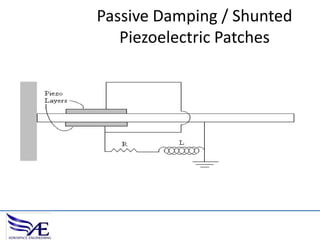
Passive Damping / Shunted
Piezoelectric Patches
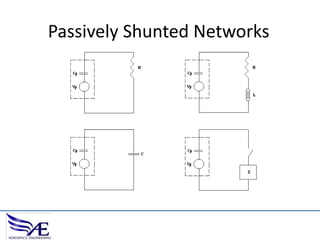
Passively Shunted Networks

Resistive

Capacitive

Resonant

Switched
Modeling of Piezoelectric
Structures
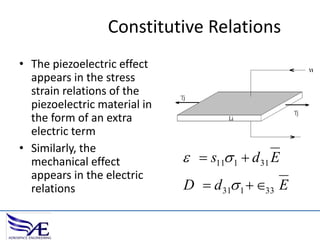
Constitutive Relations
• The piezoelectric effect
appears in the stress
strain relations of the
piezoelectric material in
the form of an extra
electric term
• Similarly, the
mechanical effect
appears in the electric
relations

  s11 1  d 31 E
D  d 31 1  33 E
Constitutive Relations
•
•
•
•

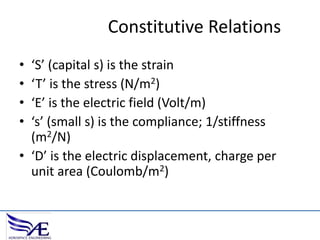
‘S’ (capital s) is the strain
‘T’ is the stress (N/m2)
‘E’ is the electric field (Volt/m)
‘s’ (small s) is the compliance; 1/stiffness
(m2/N)
• ‘D’ is the electric displacement, charge per
unit area (Coulomb/m2)
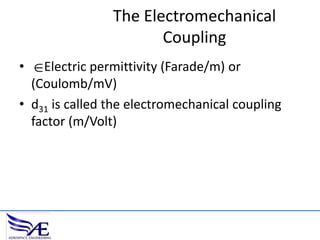
The Electromechanical
Coupling
•

Electric permittivity (Farade/m) or

(Coulomb/mV)
• d31 is called the electromechanical coupling
factor (m/Volt)
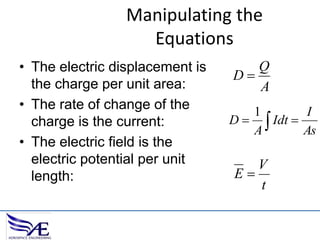
Manipulating the
Equations
• The electric displacement is
the charge per unit area:
• The rate of change of the
charge is the current:
• The electric field is the
electric potential per unit
length:

Q
D
A
1
I
D   Idt 
A
As

V
E
t
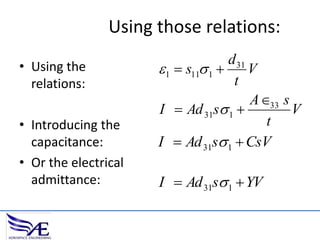
Using those relations:
• Using the
relations:
• Introducing the
capacitance:
• Or the electrical
admittance:

d 31
 1  s11 1  V
t
A 33 s
I  Ad 31s 1 
V
t
I  Ad 31s 1  CsV

I  Ad 31s 1  YV
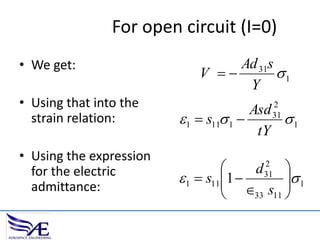
For open circuit (I=0)
• We get:
• Using that into the
strain relation:
• Using the expression
for the electric
admittance:

Ad 31s
V 
1
Y
2
31

Asd
1  s11 1 
1
tY
2

d 31 
 1
 1  s11 1 
  s 
33 11 

The electromechanical
coupling factor
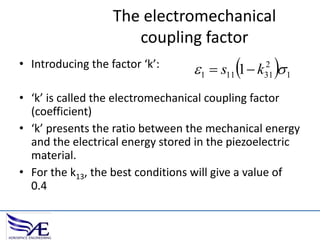
• Introducing the factor ‘k’:

1  s11 1  k  1
2
31

• ‘k’ is called the electromechanical coupling factor
(coefficient)
• ‘k’ presents the ratio between the mechanical energy
and the electrical energy stored in the piezoelectric
material.
• For the k13, the best conditions will give a value of
0.4
Different Conditions
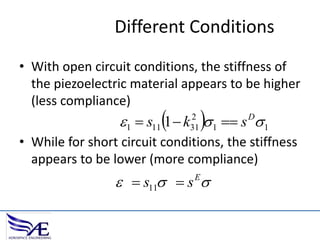
• With open circuit conditions, the stiffness of
the piezoelectric material appears to be higher
(less compliance)

1  s11 1  k  1  s  1
2
31

D

• While for short circuit conditions, the stiffness
appears to be lower (more compliance)

  s11  s 
E
Different Conditions
• Similar results could be obtained for the
electric properties; electric properties are
affected by the mechanical boundary
conditions.
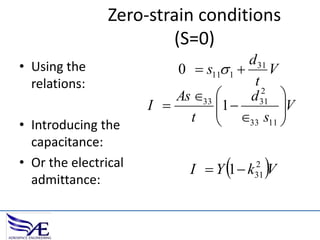
Zero-strain conditions
(S=0)
• Using the
relations:
• Introducing the
capacitance:
• Or the electrical
admittance:

d 31
0  s11 1 
V
t
2

As 33
d 31 
1 
V
I 
t  33 s11 



I  Y 1 k V
2
31
Other types of Piezo!
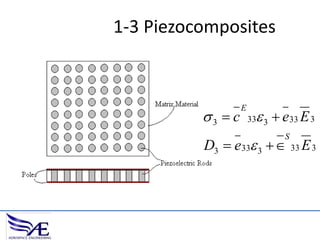
1-3 Piezocomposites

3  c

E

  e33 E 3

33 3

S

D3  e33 3  

33

E3
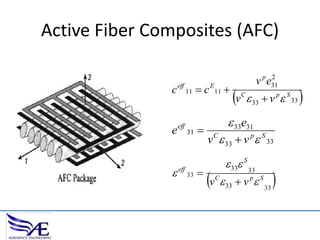
Active Fiber Composites (AFC)
c eff 11  c E11 

e

eff

31



v 
C

2
v p e31

 v p S 33
33

 33e31

v C  33  v p S 33

 33 S 33
 eff 33  C
v  33  v p S 33






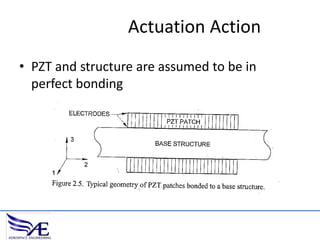
Actuation Action
• PZT and structure are assumed to be in
perfect bonding
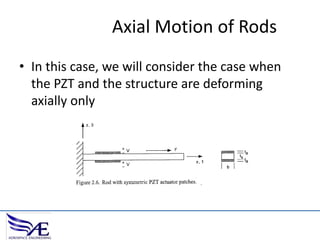
Axial Motion of Rods
• In this case, we will consider the case when
the PZT and the structure are deforming
axially only
Zero Voltage case
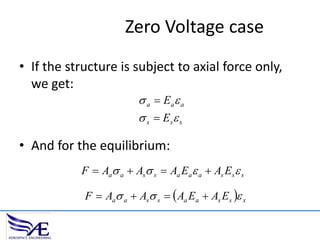
• If the structure is subject to axial force only,
we get:
 a  Ea  a
 s  Es s

• And for the equilibrium:
F  Aa a  As s  Aa Ea a  As Es s
F  Aa a  As s   Aa Ea  As Es  x
Zero Voltage case
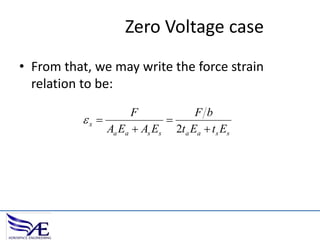
• From that, we may write the force strain
relation to be:
F
F b
x 

Aa Ea  As Es 2ta Ea  t s Es
Zero Force case
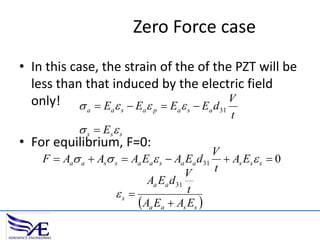
• In this case, the strain of the of the PZT will be
less than that induced by the electric field
only!   E   E   E   E d V
a

a s

a

p

a s

a

31

t

 s  Es  s

• For equilibrium, F=0:

V
F  Aa a  As s  Aa Ea s  Aa Ea d31  As Es s  0
t
V
Aa Ea d 31
t
s 
 Aa Ea  As Es 
Homework #2
• Solve problems 1,2,&3 from textbook
• Due 27/11/2013 (11:59PM)
Beams with Piezoelectric
Material
Review of Thin-Beam
Theory
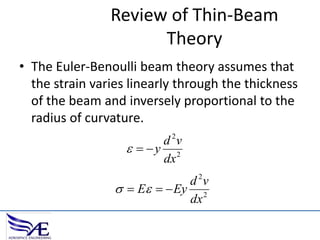
• The Euler-Benoulli beam theory assumes that
the strain varies linearly through the thickness
of the beam and inversely proportional to the
radius of curvature.
d 2v
  y 2
dx
d 2v
  E   Ey 2
dx
Equilibrium
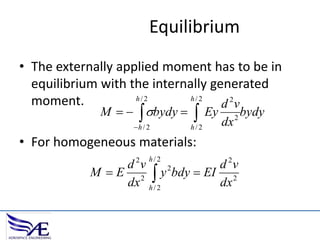
• The externally applied moment has to be in
equilibrium with the internally generated
h/2
h/2
moment.
d 2v
M    bydy 
h / 2

 Ey dx

2

h/2

• For homogeneous materials:
2

h/2

d v
d 2v
2
M  E 2  y bdy  EI 2
dx h / 2
dx

bydy
Equilibrium
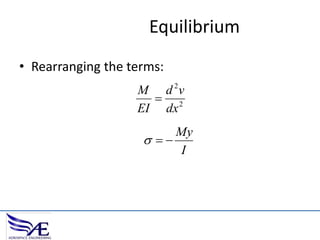
• Rearranging the terms:
M d 2v
 2
EI dx

My
 
I
With piezoelectric
materials
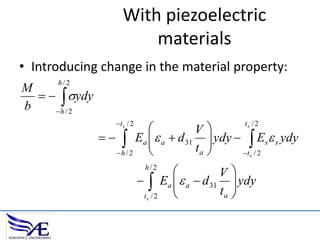
• Introducing change in the material property:
h/2

M
   ydy
b
h / 2
t s / 2


V
   Ea   a  d 31  ydy   Es s ydy

ta 


h / 2
t s / 2
ts / 2


V
  Ea   a  d 31  ydy

ta 


ts / 2
h/2
With piezoelectric
materials
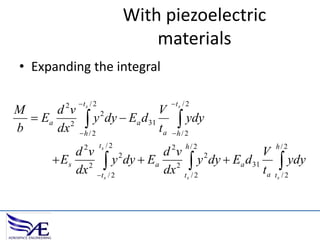
• Expanding the integral
2

M
d v
 Ea 2
b
dx

ts / 2

V
/ 2y dy  Ea d31 ta
h

ts / 2

 ydy

2

2

ts / 2

h / 2
2

h/2

d v
d v
V
2
2
 Es 2  y dy  Ea 2  y dy  Ea d 31
dx t s / 2
dx t s / 2
ta

h/2

 ydy

ts / 2
With piezoelectric
materials
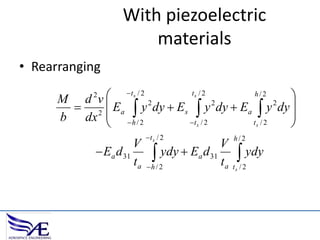
• Rearranging
ts / 2
h/2
 ts / 2 2

M d v
 2 Ea  y dy  Es  y 2 dy  Ea  y 2 dy 

b dx   h / 2
t s / 2
ts / 2


2

V
 Ea d 31
ta

t s / 2

V
/ 2ydy  Ea d31 ta
h

h/2

 ydy

ts / 2
With piezoelectric
materials
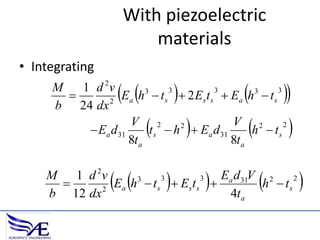
• Integrating

 











M
1 d 2v
3
3
3

Ea h 3  t s  2 E s t s  Ea h 3  t s
b 24 dx 2
V 2
V 2
2
2
 Ea d 31
t s  h  Ea d 31
h  ts
8t a
8t a



 









Ea d 31V 2
M
1 d 2v
3
3
2
3

Ea h  t s  E s t s 
h  ts
2
b 12 dx
4ta


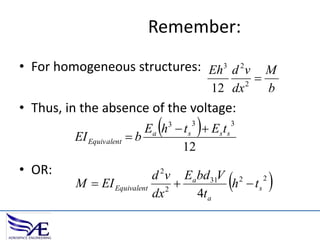
Remember:
• For homogeneous structures: Eh3 d 2v

M

2
12 dx
b

• Thus, in the absence of the voltage:





Ea h  t s  Es t s
EI Equivalent  b
12

• OR:

M  EI Equivalent

3

3

3



d 2 v Ea bd31V 2
2

h  ts
2
dx
4t a


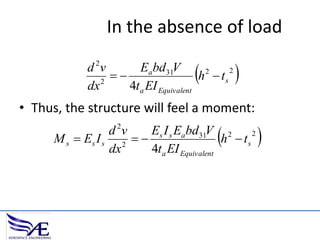
In the absence of load
2



Ea bd31V
d v
2
2

h  ts
2
dx
4ta EI Equivalent



• Thus, the structure will feel a moment:



Es I s Eabd31V 2
d 2v
2
M s  Es I s 2  
h  ts
dx
4ta EI Equivalent


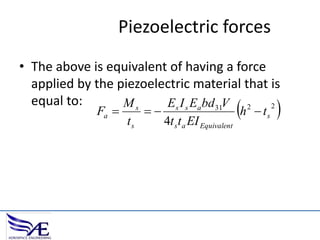
Piezoelectric forces
• The above is equivalent of having a force
applied by the piezoelectric material that is
equal to:
Ms
Es I s Ea bd 31V 2
2
Fa 

ts



4t s t a EI Equivalent

h

 ts


Homework #3
• Solve problems 4,5,&6 from textbook
• Due 30/11/2013 (11:59PM)

Piezoelectric Materials

  • 1.
  • 2.
    What is Piezoelectric Material? •Piezoelectric Material is one that possesses the property of converting mechanical energy into electrical energy and vice versa.
  • 3.
    Piezoelectric Materials • MechanicalStresses  Electrical Potential Field : Sensor (Direct Effect) • Electric Field  Mechanical Strain : Actuator (Converse Effect) Clark, Sounders, Gibbs, 1998
  • 4.
  • 5.
    Piezoelectric Sensor • Whenmechanical stresses are applied on the surface, electric charges are generated (sensor, direct effect). • If those charges are collected on a conductor that is connected to a circuit, current is generated
  • 6.
    Piezoelectric Actuator • Whenelectric potential (voltage) is applied to the surface of the piezoelectric material, mechanical strain is generated (actuator). • If the piezoelectric material is bonded to a surface of a structure, it forces the structure to move with it.
  • 7.
    Applications of PiezoelectricMaterials in Vibration Control
  • 8.
  • 9.
  • 10.
  • 11.
    Passive Damping /Shunted Piezoelectric Patches
  • 12.
  • 13.
  • 14.
    Constitutive Relations • Thepiezoelectric effect appears in the stress strain relations of the piezoelectric material in the form of an extra electric term • Similarly, the mechanical effect appears in the electric relations   s11 1  d 31 E D  d 31 1  33 E
  • 15.
    Constitutive Relations • • • • ‘S’ (capitals) is the strain ‘T’ is the stress (N/m2) ‘E’ is the electric field (Volt/m) ‘s’ (small s) is the compliance; 1/stiffness (m2/N) • ‘D’ is the electric displacement, charge per unit area (Coulomb/m2)
  • 16.
    The Electromechanical Coupling • Electric permittivity(Farade/m) or (Coulomb/mV) • d31 is called the electromechanical coupling factor (m/Volt)
  • 17.
    Manipulating the Equations • Theelectric displacement is the charge per unit area: • The rate of change of the charge is the current: • The electric field is the electric potential per unit length: Q D A 1 I D   Idt  A As V E t
  • 18.
    Using those relations: •Using the relations: • Introducing the capacitance: • Or the electrical admittance: d 31  1  s11 1  V t A 33 s I  Ad 31s 1  V t I  Ad 31s 1  CsV I  Ad 31s 1  YV
  • 19.
    For open circuit(I=0) • We get: • Using that into the strain relation: • Using the expression for the electric admittance: Ad 31s V  1 Y 2 31 Asd 1  s11 1  1 tY 2  d 31   1  1  s11 1    s  33 11  
  • 20.
    The electromechanical coupling factor •Introducing the factor ‘k’: 1  s11 1  k  1 2 31 • ‘k’ is called the electromechanical coupling factor (coefficient) • ‘k’ presents the ratio between the mechanical energy and the electrical energy stored in the piezoelectric material. • For the k13, the best conditions will give a value of 0.4
  • 21.
    Different Conditions • Withopen circuit conditions, the stiffness of the piezoelectric material appears to be higher (less compliance) 1  s11 1  k  1  s  1 2 31 D • While for short circuit conditions, the stiffness appears to be lower (more compliance)   s11  s  E
  • 22.
    Different Conditions • Similarresults could be obtained for the electric properties; electric properties are affected by the mechanical boundary conditions.
  • 23.
    Zero-strain conditions (S=0) • Usingthe relations: • Introducing the capacitance: • Or the electrical admittance: d 31 0  s11 1  V t 2  As 33 d 31  1  V I  t  33 s11    I  Y 1 k V 2 31
  • 24.
  • 25.
    1-3 Piezocomposites 3 c E   e33 E 3 33 3 S D3  e33 3   33 E3
  • 26.
    Active Fiber Composites(AFC) c eff 11  c E11  e eff 31  v  C 2 v p e31  v p S 33 33  33e31 v C  33  v p S 33  33 S 33  eff 33  C v  33  v p S 33   
  • 27.
    Actuation Action • PZTand structure are assumed to be in perfect bonding
  • 28.
    Axial Motion ofRods • In this case, we will consider the case when the PZT and the structure are deforming axially only
  • 29.
    Zero Voltage case •If the structure is subject to axial force only, we get:  a  Ea  a  s  Es s • And for the equilibrium: F  Aa a  As s  Aa Ea a  As Es s F  Aa a  As s   Aa Ea  As Es  x
  • 30.
    Zero Voltage case •From that, we may write the force strain relation to be: F F b x   Aa Ea  As Es 2ta Ea  t s Es
  • 31.
    Zero Force case •In this case, the strain of the of the PZT will be less than that induced by the electric field only!   E   E   E   E d V a a s a p a s a 31 t  s  Es  s • For equilibrium, F=0: V F  Aa a  As s  Aa Ea s  Aa Ea d31  As Es s  0 t V Aa Ea d 31 t s   Aa Ea  As Es 
  • 32.
    Homework #2 • Solveproblems 1,2,&3 from textbook • Due 27/11/2013 (11:59PM)
  • 33.
  • 34.
    Review of Thin-Beam Theory •The Euler-Benoulli beam theory assumes that the strain varies linearly through the thickness of the beam and inversely proportional to the radius of curvature. d 2v   y 2 dx d 2v   E   Ey 2 dx
  • 35.
    Equilibrium • The externallyapplied moment has to be in equilibrium with the internally generated h/2 h/2 moment. d 2v M    bydy  h / 2  Ey dx 2 h/2 • For homogeneous materials: 2 h/2 d v d 2v 2 M  E 2  y bdy  EI 2 dx h / 2 dx bydy
  • 36.
    Equilibrium • Rearranging theterms: M d 2v  2 EI dx My   I
  • 37.
    With piezoelectric materials • Introducingchange in the material property: h/2 M    ydy b h / 2 t s / 2  V    Ea   a  d 31  ydy   Es s ydy  ta    h / 2 t s / 2 ts / 2  V   Ea   a  d 31  ydy  ta    ts / 2 h/2
  • 38.
    With piezoelectric materials • Expandingthe integral 2 M d v  Ea 2 b dx ts / 2 V / 2y dy  Ea d31 ta h ts / 2  ydy 2 2 ts / 2 h / 2 2 h/2 d v d v V 2 2  Es 2  y dy  Ea 2  y dy  Ea d 31 dx t s / 2 dx t s / 2 ta h/2  ydy ts / 2
  • 39.
    With piezoelectric materials • Rearranging ts/ 2 h/2  ts / 2 2  M d v  2 Ea  y dy  Es  y 2 dy  Ea  y 2 dy   b dx   h / 2 t s / 2 ts / 2   2 V  Ea d 31 ta t s / 2 V / 2ydy  Ea d31 ta h h/2  ydy ts / 2
  • 40.
    With piezoelectric materials • Integrating       M 1 d 2v 3 3 3  Ea h 3  t s  2 E s t s  Ea h 3  t s b 24 dx 2 V 2 V 2 2 2  Ea d 31 t s  h  Ea d 31 h  ts 8t a 8t a        Ea d 31V 2 M 1 d 2v 3 3 2 3  Ea h  t s  E s t s  h  ts 2 b 12 dx 4ta 
  • 41.
    Remember: • For homogeneousstructures: Eh3 d 2v M  2 12 dx b • Thus, in the absence of the voltage:   Ea h  t s  Es t s EI Equivalent  b 12 • OR: M  EI Equivalent 3 3 3  d 2 v Ea bd31V 2 2  h  ts 2 dx 4t a 
  • 42.
    In the absenceof load 2  Ea bd31V d v 2 2  h  ts 2 dx 4ta EI Equivalent  • Thus, the structure will feel a moment:  Es I s Eabd31V 2 d 2v 2 M s  Es I s 2   h  ts dx 4ta EI Equivalent 
  • 43.
    Piezoelectric forces • Theabove is equivalent of having a force applied by the piezoelectric material that is equal to: Ms Es I s Ea bd 31V 2 2 Fa  ts  4t s t a EI Equivalent h  ts 
  • 44.
    Homework #3 • Solveproblems 4,5,&6 from textbook • Due 30/11/2013 (11:59PM)