PIEZOELECTRIC
CURRENT
SUBMITTED BY:
M SAQLAIN (2017-CH-271)
SARMAD ALI (2017-CH-235)
FAIZAN AHMAD (2017-CH-277)
ALI AHMAD (2017-CH-263)
INTRODUCTION TO
PIZEOELECTRCITY
BY M SAQLAIN
PIZEOELECTRIC CURRENT
Piezo electric current
The type of current which is generated by applying a
stress on specific materials know as piezoelectric
current
Piezeoelectric effect
The ability of material to generate an electric charge in
response to apply mechanical stress
TYPES OF PIEZOELECTRIC EFFECT
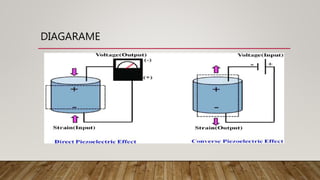
• Direct piezoelectric effect
The type of effect in which elecetricv charge
develop as a result of mechanical stress
• Converse piezoelectric effect
The type of effect in which mechanical stress
develop as a result of applying electric field
DIAGARAME
PIOEZOELECTRIC MATERIAL;
The type of material which has an ability to produce an
electric current on applying mechanical stre4ss
Example
• Quartz
• sucrose
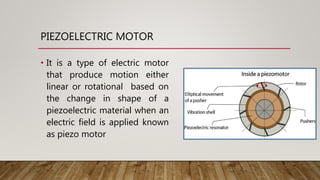
PIEZOELECTRIC MOTOR
• It is a type of electric motor
that produce motion either
linear or rotational based on
the change in shape of a
piezoelectric material when an
electric field is applied known
as piezo motor
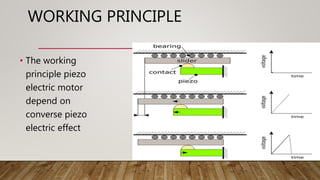
WORKING PRINCIPLE
• The working
principle piezo
electric motor
depend on
converse piezo
electric effect
OBJECTIVE
•To convert mechanical energy into
electrical energy
•To get more precise value
•To increase efficiency of motor in
industry
APPLICATIION
It is used in production and detection of sound
It is used in generation of electronic frequency
It is used in generation of high voltage
it is used in medical engineering
It is used in flow control application
ADVANTAGE AND DISADVANTAGE
ADVANTAGE
• They require very small size for
producing very high torque
• Fast response time
• High resolution
• They are flexible
DISADVANTAHE
• Its life time is short
• It is handmade so it is difficult to
control
• Its production is not on large scale
• expensive
CASE STUDY
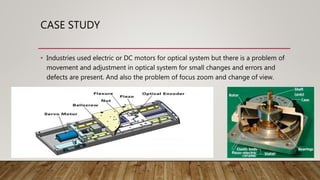
• Industries used electric or DC motors for optical system but there is a problem of
movement and adjustment in optical system for small changes and errors and
defects are present. And also the problem of focus zoom and change of view.
CASE STUDY
• Fast response time, compact size, and self-locking at the rest position make
piezoelectric motors suitable candidates for focusing, zooming, and optical image
stabilization in cameras.
• Many camera manufacturers have piezoelectric motor solutions especially inertia-
and resonant-drive types for lens moving mechanisms
• These all problem can be solve by using piezoelectric motor instead of DC motor.
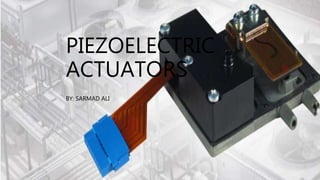
PIEZOELECTRIC
ACTUATORS
BY: SARMAD ALI
•Actuators:
An actuator is a component of a machine that is responsible for moving
and controlling a mechanism or system, for example by opening a valve.
• An actuator requires a control signal and a source of energy.
OBJECTIVE
•To convert an Electric signal into a Precisely
controlled displacement
CHARACTERISTICS
• Unlimited Resolution
• High Force Generation
• No wear and tear
• Low energy Consumption
• No magnetic fields
• Rapid Response
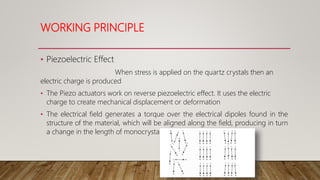
WORKING PRINCIPLE
• Piezoelectric Effect
When stress is applied on the quartz crystals then an
electric charge is produced
• The Piezo actuators work on reverse piezoelectric effect. It uses the electric
charge to create mechanical displacement or deformation
• The electrical field generates a torque over the electrical dipoles found in the
structure of the material, which will be aligned along the field, producing in turn
a change in the length of monocrystalline partitions.
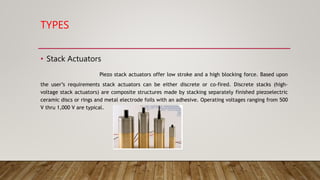
TYPES
• Stack Actuators
Piezo stack actuators offer low stroke and a high blocking force. Based upon
the user’s requirements stack actuators can be either discrete or co-fired. Discrete stacks (high-
voltage stack actuators) are composite structures made by stacking separately finished piezoelectric
ceramic discs or rings and metal electrode foils with an adhesive. Operating voltages ranging from 500
V thru 1,000 V are typical.
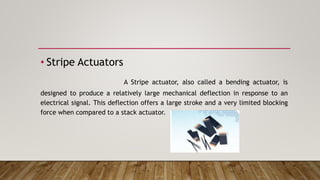
• Stripe Actuators
A Stripe actuator, also called a bending actuator, is
designed to produce a relatively large mechanical deflection in response to an
electrical signal. This deflection offers a large stroke and a very limited blocking
force when compared to a stack actuator.
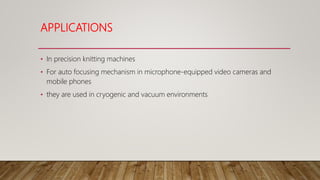
APPLICATIONS
• In precision knitting machines
• For auto focusing mechanism in microphone-equipped video cameras and
mobile phones
• they are used in cryogenic and vacuum environments
CASE STUDY
SOLUTION
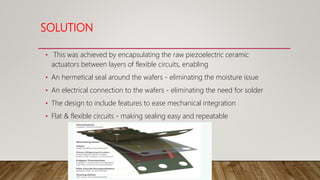
• This was achieved by encapsulating the raw piezoelectric ceramic
actuators between layers of flexible circuits, enabling
• An hermetical seal around the wafers - eliminating the moisture issue
• An electrical connection to the wafers - eliminating the need for solder
• The design to include features to ease mechanical integration
• Flat & flexible circuits - making sealing easy and repeatable
PIEZOELECTRIC
TRANSFORMERS
2017-CH-277
OBJECTIVES:
• To convert mechanical pressure into electrical
energy
• To reduce the cost of production of electrical
energy
• To produce reliable method of production
• improve the performance of power electronic
PCBAs
INTRODUCTION:
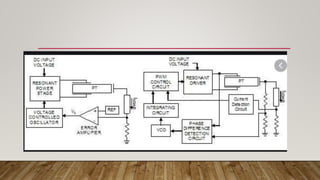
• Piezoelectric transformers, are basically energy converters.
• A magnetic transformer operates by converting electrical input to magnetic energy and
then reconverting that magnetic energy back to electrical output.
• This mechanical conversion is achieved by a standing wave vibrating at a frequency
equal to a multiple of the mechanical resonance frequency of the transformer body,
which is typically in the range of 50 to 150 kHz.
WORKING PRINCIPLE:
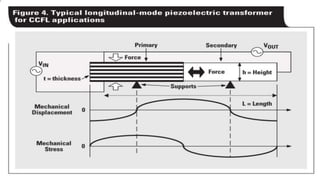
• The operational principle is that the primary element or section of the
transformer is excited by an electrical AC voltage, which induces a deformation
of the joined structure.

• The deformation of the secondary element or section will generate a charge
displacement and an electrical output voltage.
• And through the PT design (structure, section size, layer thickness), a desired
voltage conversion can be achieved, matching a specific load and application.
ADVANTAGES:
• Electromechanical energy conversion
• No magnetic field generation, as well as
immunity to magnetic fields.
• Low EMI prole, due to the nature of
resonance converter and soft switching
• Potential high efficiency and power
density.
DISADVANTAGES:
• Best suited for constant resistive AC loads.
• Mechanical mounting of PT, without
restricting the free mechanical movement.
• Low thermal conductivity of ceramics,
limiting heat dissipation.
• Limited current carrying capacity, due to
thin electrodes.
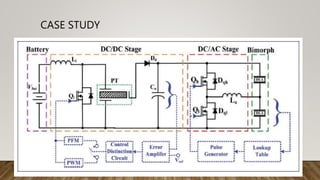
CASE STUDY
SOLUTION:
• PTS can be used to improve the performance of power electronic
PCBAs(Printed circuit board) deployed in industrial systems and environments.
• At Tempo Automation, the industry leader in high-quality, fast PCBA prototyping
and low-volume production, it can accommodate piezoelectric transformers
and other power electronics technology for industrial PCBAs.
PIEZOELECTRIC
SENSOR
2017CH263
PIEZOELECTRIC SENSOR:
• A piezoelectric sensor is a device that uses
the piezoelectric effect to measure changes in pressure,
acceleration, temperature, strain, or force by converting
them to an electrical charge.
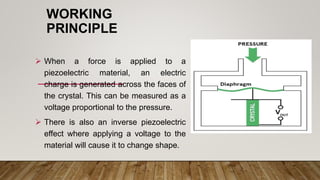
WORKING
PRINCIPLE
 When a force is applied to a
piezoelectric material, an electric
charge is generated across the faces of
the crystal. This can be measured as a
voltage proportional to the pressure.
 There is also an inverse piezoelectric
effect where applying a voltage to the
material will cause it to change shape.
CHARACTERISTICS:
Piezoelectric sensors are not normally suitable for measuring static
pressure. The output signal will gradually drop to zero, even in the
presence of constant pressure. They are, however, sensitive to
dynamic changes in pressure across a wide range of frequencies
and pressures.
This dynamic sensitivity means they are good at measuring small
changes in pressure, even in a very high-pressure environment.
APPLICATIONS:
Used in a wide range of industrial and aerospace applications where
they’ll be exposed to high temperatures and pressures.
They are often used for measuring dynamic pressure, for example in
turbulence, blast, and engine combustion.
Their sensitivity and low power consumption also makes them useful for
some medical applications. For example, a thin-film plastic sensor can be
attached to the skin and used for real-time monitoring of the arterial pulse.
ADVANTAGES AND DISADVANTAGES
One of the main advantages of piezoelectric pressure sensors is their
ruggedness. This makes them suitable for use in a variety of harsh
environments.
Apart from the associated electronics, piezoelectric sensors can be used
at high temperatures. Some materials will work at up to 1,000ºC.
Piezoelectric sensors can be easily made using inexpensive materials
The output signal is generated by the piezoelectric element itself, so they
are inherently low-power devices.
If we use the high temperature, it may get affected.
CASE STUDY:
• THERMO FISHER SCIENTIFIC is USA Based Bio-Technology and
Healthcare Company. In early 2000s they recognized that they need better
shock alarm system, The current old technology that was too slow.
SOLUTION
• A piezoelectric crystal is placed between two metal plates
which are normally in a perfect balance (even if they’re not
symmetrically arranged) and does not conduct any electric
current.
• Mechanical stress or force are applied on the material by the
metal plates, which forces the electric charges within the
crystal out of balance.
REFERENCES
 Holler, F. James; Skoog, Douglas A. & Crouch, Stanley R. (2007). Principles of Instrumental Analysis (6th ed.).
Cengage Learning. p. 9. ISBN 978-0-495-01201-6.
 ^ Harper, Douglas. "piezoelectric". Online Etymology Dictionary.
 ^ πιέζειν, ἤλεκτρον. Liddell, Henry George; Scott, Robert; A Greek–English Lexiconat the Perseus Project.
 ^ Jump up to:a b Manbachi, A. & Cobbold, R.S.C. (2011). "Development and Application of Piezoelectric
Materials for Ultrasound Generation and Detection". Ultrasound. 19 (4): 187–
96. doi:10.1258/ult.2011.011027. S2CID 56655834.
 ^ Gautschi, G. (2002). Piezoelectric Sensorics: Force, Strain, Pressure, Acceleration and Acoustic Emission
Sensors, Materials and Amplifiers. Springer. doi:10.1007/978-3-662-04732-3. ISBN 978-3-662-04732-3.
 ^ Krautkrämer, J. & Krautkrämer, H. (1990). Ultrasonic Testing of Materials. Springer. pp. 119–149. ISBN 978-3-
662-10680-8.

Piezo Electric Effect

  • 1.
    PIEZOELECTRIC CURRENT SUBMITTED BY: M SAQLAIN(2017-CH-271) SARMAD ALI (2017-CH-235) FAIZAN AHMAD (2017-CH-277) ALI AHMAD (2017-CH-263)
  • 2.
  • 3.
    PIZEOELECTRIC CURRENT Piezo electriccurrent The type of current which is generated by applying a stress on specific materials know as piezoelectric current Piezeoelectric effect The ability of material to generate an electric charge in response to apply mechanical stress
  • 4.
    TYPES OF PIEZOELECTRICEFFECT • Direct piezoelectric effect The type of effect in which elecetricv charge develop as a result of mechanical stress • Converse piezoelectric effect The type of effect in which mechanical stress develop as a result of applying electric field
  • 5.
  • 6.
    PIOEZOELECTRIC MATERIAL; The typeof material which has an ability to produce an electric current on applying mechanical stre4ss Example • Quartz • sucrose
  • 7.
    PIEZOELECTRIC MOTOR • Itis a type of electric motor that produce motion either linear or rotational based on the change in shape of a piezoelectric material when an electric field is applied known as piezo motor
  • 8.
    WORKING PRINCIPLE • Theworking principle piezo electric motor depend on converse piezo electric effect
  • 9.
    OBJECTIVE •To convert mechanicalenergy into electrical energy •To get more precise value •To increase efficiency of motor in industry
  • 10.
    APPLICATIION It is usedin production and detection of sound It is used in generation of electronic frequency It is used in generation of high voltage it is used in medical engineering It is used in flow control application
  • 11.
    ADVANTAGE AND DISADVANTAGE ADVANTAGE •They require very small size for producing very high torque • Fast response time • High resolution • They are flexible DISADVANTAHE • Its life time is short • It is handmade so it is difficult to control • Its production is not on large scale • expensive
  • 12.
    CASE STUDY • Industriesused electric or DC motors for optical system but there is a problem of movement and adjustment in optical system for small changes and errors and defects are present. And also the problem of focus zoom and change of view.
  • 13.
    CASE STUDY • Fastresponse time, compact size, and self-locking at the rest position make piezoelectric motors suitable candidates for focusing, zooming, and optical image stabilization in cameras. • Many camera manufacturers have piezoelectric motor solutions especially inertia- and resonant-drive types for lens moving mechanisms • These all problem can be solve by using piezoelectric motor instead of DC motor.
  • 14.
  • 15.
    •Actuators: An actuator isa component of a machine that is responsible for moving and controlling a mechanism or system, for example by opening a valve. • An actuator requires a control signal and a source of energy.
  • 16.
    OBJECTIVE •To convert anElectric signal into a Precisely controlled displacement
  • 17.
    CHARACTERISTICS • Unlimited Resolution •High Force Generation • No wear and tear • Low energy Consumption • No magnetic fields • Rapid Response
  • 18.
    WORKING PRINCIPLE • PiezoelectricEffect When stress is applied on the quartz crystals then an electric charge is produced • The Piezo actuators work on reverse piezoelectric effect. It uses the electric charge to create mechanical displacement or deformation • The electrical field generates a torque over the electrical dipoles found in the structure of the material, which will be aligned along the field, producing in turn a change in the length of monocrystalline partitions.
  • 19.
    TYPES • Stack Actuators Piezostack actuators offer low stroke and a high blocking force. Based upon the user’s requirements stack actuators can be either discrete or co-fired. Discrete stacks (high- voltage stack actuators) are composite structures made by stacking separately finished piezoelectric ceramic discs or rings and metal electrode foils with an adhesive. Operating voltages ranging from 500 V thru 1,000 V are typical.
  • 20.
    • Stripe Actuators AStripe actuator, also called a bending actuator, is designed to produce a relatively large mechanical deflection in response to an electrical signal. This deflection offers a large stroke and a very limited blocking force when compared to a stack actuator.
  • 21.
    APPLICATIONS • In precisionknitting machines • For auto focusing mechanism in microphone-equipped video cameras and mobile phones • they are used in cryogenic and vacuum environments
  • 22.
  • 24.
    SOLUTION • This wasachieved by encapsulating the raw piezoelectric ceramic actuators between layers of flexible circuits, enabling • An hermetical seal around the wafers - eliminating the moisture issue • An electrical connection to the wafers - eliminating the need for solder • The design to include features to ease mechanical integration • Flat & flexible circuits - making sealing easy and repeatable
  • 25.
  • 26.
    OBJECTIVES: • To convertmechanical pressure into electrical energy • To reduce the cost of production of electrical energy • To produce reliable method of production • improve the performance of power electronic PCBAs
  • 27.
    INTRODUCTION: • Piezoelectric transformers,are basically energy converters. • A magnetic transformer operates by converting electrical input to magnetic energy and then reconverting that magnetic energy back to electrical output. • This mechanical conversion is achieved by a standing wave vibrating at a frequency equal to a multiple of the mechanical resonance frequency of the transformer body, which is typically in the range of 50 to 150 kHz.
  • 28.
    WORKING PRINCIPLE: • Theoperational principle is that the primary element or section of the transformer is excited by an electrical AC voltage, which induces a deformation of the joined structure. • The deformation of the secondary element or section will generate a charge displacement and an electrical output voltage. • And through the PT design (structure, section size, layer thickness), a desired voltage conversion can be achieved, matching a specific load and application.
  • 30.
    ADVANTAGES: • Electromechanical energyconversion • No magnetic field generation, as well as immunity to magnetic fields. • Low EMI prole, due to the nature of resonance converter and soft switching • Potential high efficiency and power density. DISADVANTAGES: • Best suited for constant resistive AC loads. • Mechanical mounting of PT, without restricting the free mechanical movement. • Low thermal conductivity of ceramics, limiting heat dissipation. • Limited current carrying capacity, due to thin electrodes.
  • 31.
  • 32.
    SOLUTION: • PTS canbe used to improve the performance of power electronic PCBAs(Printed circuit board) deployed in industrial systems and environments. • At Tempo Automation, the industry leader in high-quality, fast PCBA prototyping and low-volume production, it can accommodate piezoelectric transformers and other power electronics technology for industrial PCBAs.
  • 33.
  • 34.
    PIEZOELECTRIC SENSOR: • Apiezoelectric sensor is a device that uses the piezoelectric effect to measure changes in pressure, acceleration, temperature, strain, or force by converting them to an electrical charge.
  • 35.
    WORKING PRINCIPLE  When aforce is applied to a piezoelectric material, an electric charge is generated across the faces of the crystal. This can be measured as a voltage proportional to the pressure.  There is also an inverse piezoelectric effect where applying a voltage to the material will cause it to change shape.
  • 36.
    CHARACTERISTICS: Piezoelectric sensors arenot normally suitable for measuring static pressure. The output signal will gradually drop to zero, even in the presence of constant pressure. They are, however, sensitive to dynamic changes in pressure across a wide range of frequencies and pressures. This dynamic sensitivity means they are good at measuring small changes in pressure, even in a very high-pressure environment.
  • 37.
    APPLICATIONS: Used in awide range of industrial and aerospace applications where they’ll be exposed to high temperatures and pressures. They are often used for measuring dynamic pressure, for example in turbulence, blast, and engine combustion. Their sensitivity and low power consumption also makes them useful for some medical applications. For example, a thin-film plastic sensor can be attached to the skin and used for real-time monitoring of the arterial pulse.
  • 38.
    ADVANTAGES AND DISADVANTAGES Oneof the main advantages of piezoelectric pressure sensors is their ruggedness. This makes them suitable for use in a variety of harsh environments. Apart from the associated electronics, piezoelectric sensors can be used at high temperatures. Some materials will work at up to 1,000ºC. Piezoelectric sensors can be easily made using inexpensive materials The output signal is generated by the piezoelectric element itself, so they are inherently low-power devices. If we use the high temperature, it may get affected.
  • 39.
    CASE STUDY: • THERMOFISHER SCIENTIFIC is USA Based Bio-Technology and Healthcare Company. In early 2000s they recognized that they need better shock alarm system, The current old technology that was too slow.
  • 40.
    SOLUTION • A piezoelectriccrystal is placed between two metal plates which are normally in a perfect balance (even if they’re not symmetrically arranged) and does not conduct any electric current. • Mechanical stress or force are applied on the material by the metal plates, which forces the electric charges within the crystal out of balance.
  • 41.
    REFERENCES  Holler, F.James; Skoog, Douglas A. & Crouch, Stanley R. (2007). Principles of Instrumental Analysis (6th ed.). Cengage Learning. p. 9. ISBN 978-0-495-01201-6.  ^ Harper, Douglas. "piezoelectric". Online Etymology Dictionary.  ^ πιέζειν, ἤλεκτρον. Liddell, Henry George; Scott, Robert; A Greek–English Lexiconat the Perseus Project.  ^ Jump up to:a b Manbachi, A. & Cobbold, R.S.C. (2011). "Development and Application of Piezoelectric Materials for Ultrasound Generation and Detection". Ultrasound. 19 (4): 187– 96. doi:10.1258/ult.2011.011027. S2CID 56655834.  ^ Gautschi, G. (2002). Piezoelectric Sensorics: Force, Strain, Pressure, Acceleration and Acoustic Emission Sensors, Materials and Amplifiers. Springer. doi:10.1007/978-3-662-04732-3. ISBN 978-3-662-04732-3.  ^ Krautkrämer, J. & Krautkrämer, H. (1990). Ultrasonic Testing of Materials. Springer. pp. 119–149. ISBN 978-3- 662-10680-8.