Menatalla M. Elhindawy
Morphology!!!
A branch of biology that deals with the form and structure of
animals and plants.
 The form and structure of an organism or any of its parts.
Maxillary Second
Premolar
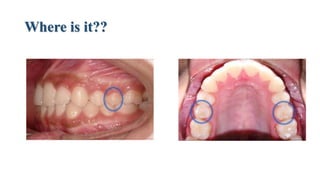
Where is it??
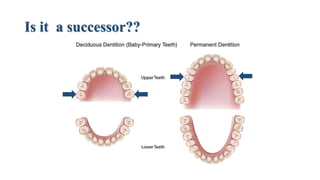
Is it a successor??
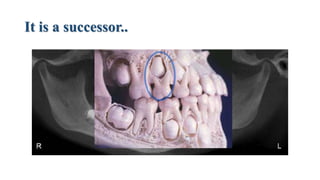
It is a successor..
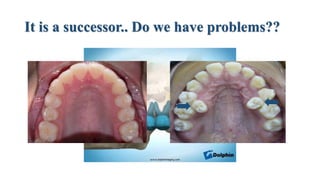
It is a successor.. Do we have problems??
Max. 2nd premolar..
CHOROLOGY
 First evidence of calcification.. 2- 2 12 years.
Enamel completed.. 6-7 years.
Eruption.. 10-12 years.
Root completion.. 12-14 years.
Max. 2nd premolar..
In each aspect we need to full fill these requirements:
I. Geometric outline.
II. Outlines “M., D., B., L., cusp”.
III. Contact areas or crest of curvatures.
IV. Surface anatomy.
V. Cervical line.
VI. Root.
Max. 2nd premolar..
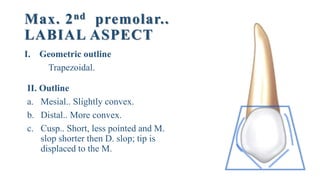
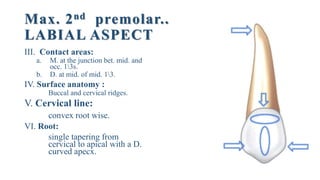
LABIAL ASPECT
I. Geometric outline
Trapezoidal.
II. Outline
a. Mesial.. Slightly convex.
b. Distal.. More convex.
c. Cusp.. Short, less pointed and M.
slop shorter then D. slop; tip is
displaced to the M.
Max. 2nd premolar..
LABIAL ASPECT
III. Contact areas:
a. M. at the junction bet. mid. and
occ. 13s.
b. D. at mid. of mid. 13.
IV. Surface anatomy :
Buccal and cervical ridges.
V. Cervical line:
convex root wise.
VI. Root:
single tapering from
cervical to apical with a D.
curved apecx.
Max. 2nd premolar..
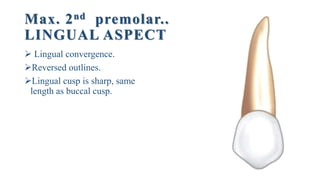
LINGUAL ASPECT
 Lingual convergence.
Reversed outlines.
Lingual cusp is sharp, same
length as buccal cusp.
Max. 2nd premolar..
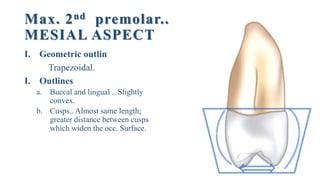
MESIAL ASPECT
I. Geometric outlin
Trapezoidal.
I. Outlines
a. Buccal and lingual .. Slightly
convex.
b. Cusps.. Almost same length;
greater distance between cusps
which widen the occ. Surface.
Max. 2nd premolar..
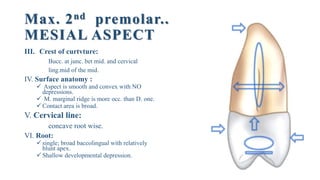
MESIAL ASPECT
III. Crest of curtvture:
Bucc. at junc. bet mid. and cervical
ling.mid of the mid.
IV. Surface anatomy :
 Aspect is smooth and convex with NO
depressions.
 M. marginal ridge is more occ. than D. one.
 Contact area is broad.
V. Cervical line:
concave root wise.
VI. Root:
 single; broad baccolingual with relatively
blunt apex.
 Shallow developmental depression.
Max. 2nd premolar..
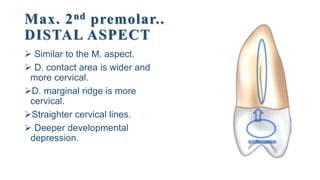
DISTAL ASPECT
 Similar to the M. aspect.
 D. contact area is wider and
more cervical.
D. marginal ridge is more
cervical.
Straighter cervical lines.
 Deeper developmental
depression.
Max. 2nd premolar..
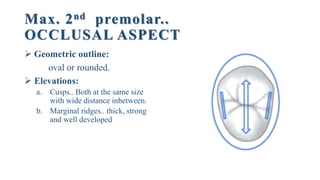
OCCLUSAL ASPECT
 Geometric outline:
oval or rounded.
 Elevations:
a. Cusps.. Both at the same size
with wide distance inbetween.
b. Marginal ridges.. thick, strong
and well developed
Max. 2nd premolar..
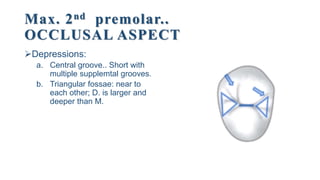
OCCLUSAL ASPECT
Depressions:
a. Central groove.. Short with
multiple supplemtal grooves.
b. Triangular fossae: near to
each other; D. is larger and
deeper than M.
Any questions??
Now
Let’s compare 1st and 2nd maxillary premolars…
Let’s compare..
1st premolar
Buccal aspect
2nd premolar
Buccal aspect
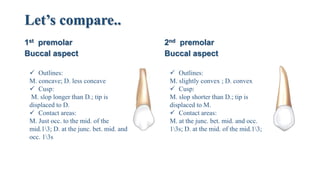
 Outlines:
M. concave; D. less concave
 Cusp:
M. slop longer than D.; tip is
displaced to D.
 Contact areas:
M. Just occ. to the mid. of the
mid.13; D. at the junc. bet. mid. and
occ. 13s
 Outlines:
M. slightly convex ; D. convex
 Cusp:
M. slop shorter than D.; tip is
displaced to M.
 Contact areas:
M. at the junc. bet. mid. and occ.
13s; D. at the mid. of the mid.13;
Let’s compare..
1st premolar
Lingual aspect
2nd premolar
Lingual aspect
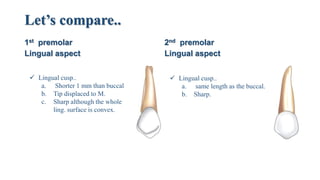
 Lingual cusp..
a. Shorter 1 mm than buccal
b. Tip displaced to M.
c. Sharp although the whole
ling. surface is convex.
 Lingual cusp..
a. same length as the buccal.
b. Sharp.
Let’s compare..
1st premolar
Mesial aspect
2nd premolar
Mesial aspect
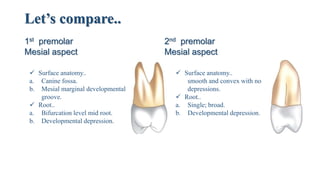
 Surface anatomy..
a. Canine fossa.
b. Mesial marginal developmental
groove.
 Root..
a. Bifurcation level mid root.
b. Developmental depression.
 Surface anatomy..
smooth and convex with no
depressions.
 Root..
a. Single; broad.
b. Developmental depression.
Let’s compare..
1st premolar
Distal aspect
2nd premolar
Distal aspect
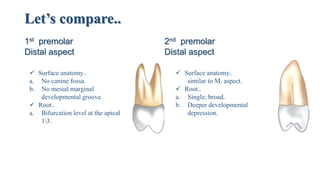
 Surface anatomy..
a. No canine fossa.
b. No mesial marginal
developmental groove.
 Root..
a. Bifurcation level at the apical
13.
 Surface anatomy..
similar to M. aspect.
 Root..
a. Single; broad.
b. Deeper developmental
depression.
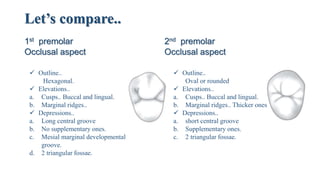
Let’s compare..
1st premolar
Occlusal aspect
2nd premolar
Occlusal aspect
 Outline..
Hexagonal.
 Elevations..
a. Cusps.. Buccal and lingual.
b. Marginal ridges..
 Depressions..
a. Long central groove
b. No supplementary ones.
c. Mesial marginal developmental
groove.
d. 2 triangular fossae.
 Outline..
Oval or rounded
 Elevations..
a. Cusps.. Buccal and lingual.
b. Marginal ridges.. Thicker ones
 Depressions..
a. short central groove
b. Supplementary ones.
c. 2 triangular fossae.
Any questions??
Thank you

Maxillary second premolar

  • 1.
  • 2.
    Morphology!!! A branch ofbiology that deals with the form and structure of animals and plants.  The form and structure of an organism or any of its parts.
  • 3.
  • 4.
  • 5.
    Is it asuccessor??
  • 6.
    It is asuccessor..
  • 7.
    It is asuccessor.. Do we have problems??
  • 8.
    Max. 2nd premolar.. CHOROLOGY First evidence of calcification.. 2- 2 12 years. Enamel completed.. 6-7 years. Eruption.. 10-12 years. Root completion.. 12-14 years.
  • 9.
    Max. 2nd premolar.. Ineach aspect we need to full fill these requirements: I. Geometric outline. II. Outlines “M., D., B., L., cusp”. III. Contact areas or crest of curvatures. IV. Surface anatomy. V. Cervical line. VI. Root.
  • 10.
    Max. 2nd premolar.. LABIALASPECT I. Geometric outline Trapezoidal. II. Outline a. Mesial.. Slightly convex. b. Distal.. More convex. c. Cusp.. Short, less pointed and M. slop shorter then D. slop; tip is displaced to the M.
  • 11.
    Max. 2nd premolar.. LABIALASPECT III. Contact areas: a. M. at the junction bet. mid. and occ. 13s. b. D. at mid. of mid. 13. IV. Surface anatomy : Buccal and cervical ridges. V. Cervical line: convex root wise. VI. Root: single tapering from cervical to apical with a D. curved apecx.
  • 12.
    Max. 2nd premolar.. LINGUALASPECT  Lingual convergence. Reversed outlines. Lingual cusp is sharp, same length as buccal cusp.
  • 13.
    Max. 2nd premolar.. MESIALASPECT I. Geometric outlin Trapezoidal. I. Outlines a. Buccal and lingual .. Slightly convex. b. Cusps.. Almost same length; greater distance between cusps which widen the occ. Surface.
  • 14.
    Max. 2nd premolar.. MESIALASPECT III. Crest of curtvture: Bucc. at junc. bet mid. and cervical ling.mid of the mid. IV. Surface anatomy :  Aspect is smooth and convex with NO depressions.  M. marginal ridge is more occ. than D. one.  Contact area is broad. V. Cervical line: concave root wise. VI. Root:  single; broad baccolingual with relatively blunt apex.  Shallow developmental depression.
  • 15.
    Max. 2nd premolar.. DISTALASPECT  Similar to the M. aspect.  D. contact area is wider and more cervical. D. marginal ridge is more cervical. Straighter cervical lines.  Deeper developmental depression.
  • 16.
    Max. 2nd premolar.. OCCLUSALASPECT  Geometric outline: oval or rounded.  Elevations: a. Cusps.. Both at the same size with wide distance inbetween. b. Marginal ridges.. thick, strong and well developed
  • 17.
    Max. 2nd premolar.. OCCLUSALASPECT Depressions: a. Central groove.. Short with multiple supplemtal grooves. b. Triangular fossae: near to each other; D. is larger and deeper than M.
  • 18.
  • 19.
    Now Let’s compare 1stand 2nd maxillary premolars…
  • 20.
    Let’s compare.. 1st premolar Buccalaspect 2nd premolar Buccal aspect  Outlines: M. concave; D. less concave  Cusp: M. slop longer than D.; tip is displaced to D.  Contact areas: M. Just occ. to the mid. of the mid.13; D. at the junc. bet. mid. and occ. 13s  Outlines: M. slightly convex ; D. convex  Cusp: M. slop shorter than D.; tip is displaced to M.  Contact areas: M. at the junc. bet. mid. and occ. 13s; D. at the mid. of the mid.13;
  • 21.
    Let’s compare.. 1st premolar Lingualaspect 2nd premolar Lingual aspect  Lingual cusp.. a. Shorter 1 mm than buccal b. Tip displaced to M. c. Sharp although the whole ling. surface is convex.  Lingual cusp.. a. same length as the buccal. b. Sharp.
  • 22.
    Let’s compare.. 1st premolar Mesialaspect 2nd premolar Mesial aspect  Surface anatomy.. a. Canine fossa. b. Mesial marginal developmental groove.  Root.. a. Bifurcation level mid root. b. Developmental depression.  Surface anatomy.. smooth and convex with no depressions.  Root.. a. Single; broad. b. Developmental depression.
  • 23.
    Let’s compare.. 1st premolar Distalaspect 2nd premolar Distal aspect  Surface anatomy.. a. No canine fossa. b. No mesial marginal developmental groove.  Root.. a. Bifurcation level at the apical 13.  Surface anatomy.. similar to M. aspect.  Root.. a. Single; broad. b. Deeper developmental depression.
  • 24.
    Let’s compare.. 1st premolar Occlusalaspect 2nd premolar Occlusal aspect  Outline.. Hexagonal.  Elevations.. a. Cusps.. Buccal and lingual. b. Marginal ridges..  Depressions.. a. Long central groove b. No supplementary ones. c. Mesial marginal developmental groove. d. 2 triangular fossae.  Outline.. Oval or rounded  Elevations.. a. Cusps.. Buccal and lingual. b. Marginal ridges.. Thicker ones  Depressions.. a. short central groove b. Supplementary ones. c. 2 triangular fossae.
  • 25.
  • 26.