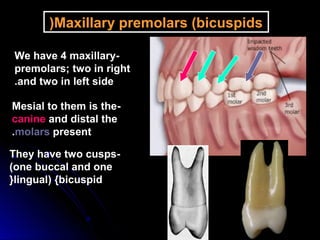
Maxillary premolars (bicuspids(
-We have 4 maxillary
premolars; two in right
and two in left side.
-Mesial to them is the
canine and distal the
molars present.
-They have two cusps
(one buccal and one
lingual( {bicuspid{
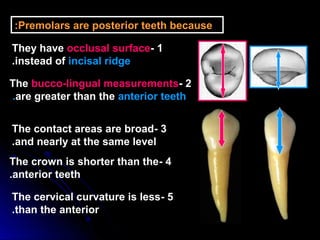
Premolars are posterior teeth because:
1-They have occlusal surface
instead of incisal ridge.
2-The bucco-lingual measurements
are greater than the anterior teeth.
4-The crown is shorter than the
anterior teeth.
5-The cervical curvature is less
than the anterior.
3-The contact areas are broad
and nearly at the same level.
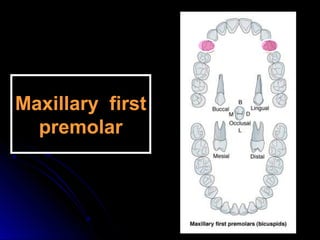
Maxillary firstMaxillary first
premolarpremolar
Chronology
Appearance of the dental organ 7 m.i.u
First evidence of calcification 11/2-13/4 years.
Enamel completed 5-6 years
Eruption 10-11 years
Root completed 12-13 years
Type and function
This tooth has the function of tearing and grinding
food.
No. of lobes
It has four lobes (three buccal -the middle is well
developed (the buccal cusp(- and one lingual (the
lingual cusp(.
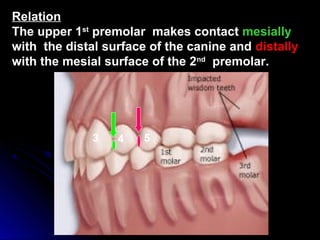
43 5
Relation
The upper 1st
premolar makes contact mesially
with the distal surface of the canine and distally
with the mesial surface of the 2nd
premolar.
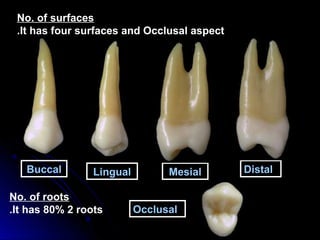
No. of surfaces
It has four surfaces and Occlusal aspect.
Buccal Lingual Mesial Distal
Occlusal
No. of roots
It has 80% 2 roots.
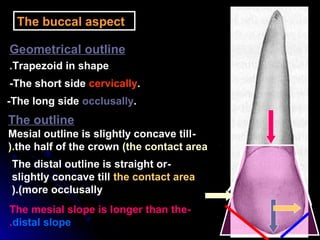
The buccal aspect
Geometrical outline
-The short side cervically.
-The long side occlusally.
Trapezoid in shape.
The outline
-Mesial outline is slightly concave till
the half of the crown (the contact area(.
-The distal outline is straight or
slightly concave till the contact area
(more occlusally(.
-The mesial slope is longer than the
distal slope.
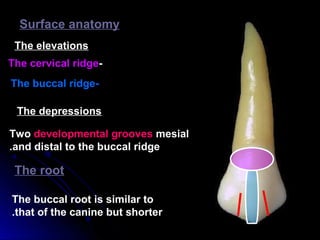
Surface anatomy
The elevations
-The cervical ridge
-The buccal ridge
The depressions
Two developmental grooves mesial
and distal to the buccal ridge.
The root
The buccal root is similar to
that of the canine but shorter.
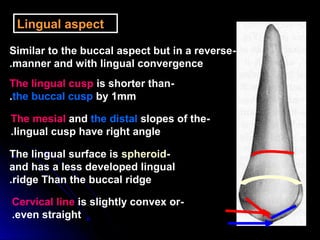
Lingual aspect
-Similar to the buccal aspect but in a reverse
manner and with lingual convergence.
-The lingual cusp is shorter than
the buccal cusp by 1mm.
-The mesial and the distal slopes of the
lingual cusp have right angle.
-The lingual surface is spheroid
and has a less developed lingual
ridge Than the buccal ridge.
-Cervical line is slightly convex or
even straight.
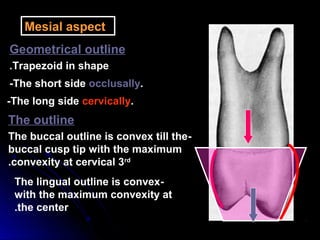
Mesial aspect
Geometrical outline
Trapezoid in shape.
-The short side occlusally.
-The long side cervically.
The outline
-The buccal outline is convex till the
buccal cusp tip with the maximum
convexity at cervical 3rd
.
-The lingual outline is convex
with the maximum convexity at
the center.
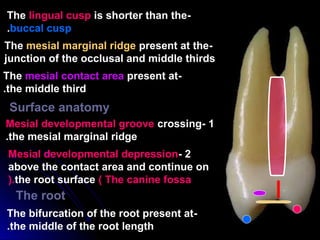
-The lingual cusp is shorter than the
buccal cusp.
-The mesial marginal ridge present at the
junction of the occlusal and middle thirds
-The mesial contact area present at
the middle third.
Surface anatomy
1-Mesial developmental groove crossing
the mesial marginal ridge.
2-Mesial developmental depression
above the contact area and continue on
the root surface ( The canine fossa(.
-The bifurcation of the root present at
the middle of the root length.
The root
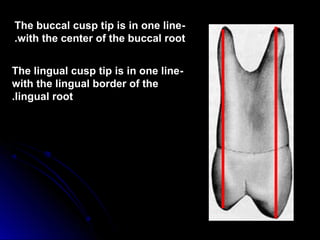
-The buccal cusp tip is in one line
with the center of the buccal root.
-The lingual cusp tip is in one line
with the lingual border of the
lingual root.
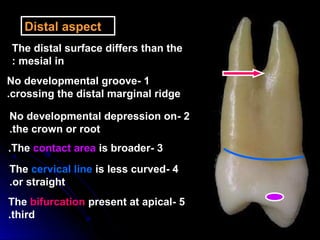
Distal aspect
The distal surface differs than the
mesial in:
1-No developmental groove
crossing the distal marginal ridge.
2-No developmental depression on
the crown or root.
4-The cervical line is less curved
or straight.
5-The bifurcation present at apical
third.
3-The contact area is broader.
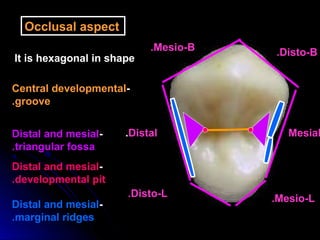
Occlusal aspect
It is hexagonal in shape
Mesio-B. Disto-B.
Distal. Mesial
Disto-L. Mesio-L.
-Central developmental
groove.
-Distal and mesial
triangular fossa.
-Distal and mesial
developmental pit.
-Distal and mesial
marginal ridges.
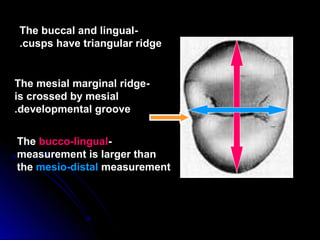
-The buccal and lingual
cusps have triangular ridge.
-The mesial marginal ridge
is crossed by mesial
developmental groove.
-The bucco-lingual
measurement is larger than
the mesio-distal measurement
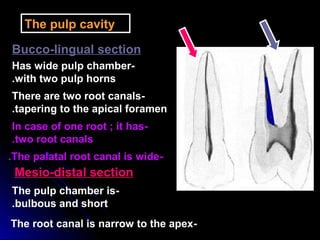
The pulp cavity
Bucco-lingual section
-Has wide pulp chamber
with two pulp horns.
-There are two root canals
tapering to the apical foramen.
-In case of one root ; it has
two root canals.
Mesio-distal section
-The pulp chamber is
bulbous and short.
-The root canal is narrow to the apex
-The palatal root canal is wide.
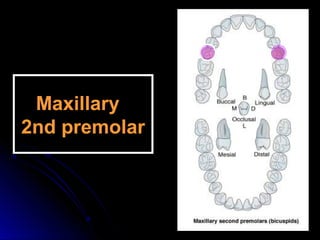
MaxillaryMaxillary
2nd premolar2nd premolar
Chronology
Appearance of the dental organ 8 m.i.u
First evidence of calcification 2-21/4 years.
Enamel completed 6-7 years
Eruption 10-12 years
Root completed 13-15 years
Type and function
This tooth supplements the maxillary first
premolar in function of tearing and grinding food.
No. of lobes
It has four lobes (three buccal -the middle is well
developed (the buccal cusp)- and one lingual (the
lingual cusp).
4 5
Relation
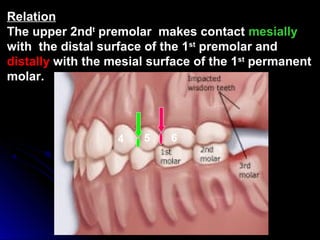
The upper 2ndt
premolar makes contact mesially
with the distal surface of the 1st
premolar and
distally with the mesial surface of the 1st
permanent
molar.
6
No. of surfaces
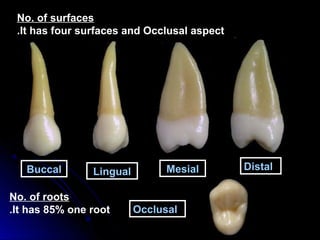
It has four surfaces and Occlusal aspect.
Buccal Lingual Mesial Distal
Occlusal
No. of roots
It has 85% one root.
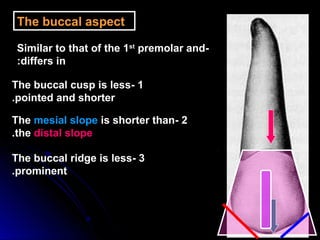
The buccal aspect
1-The buccal cusp is less
pointed and shorter.
2-The mesial slope is shorter than
the distal slope.
3-The buccal ridge is less
prominent.
-Similar to that of the 1st
premolar and
differs in:
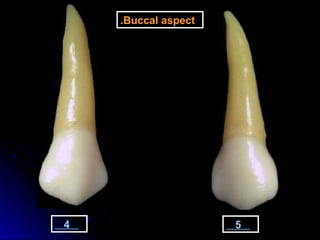
4 5
Buccal aspect.
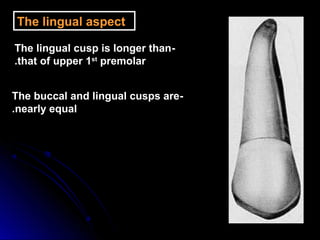
The lingual aspect
-The lingual cusp is longer than
that of upper 1st
premolar.
-The buccal and lingual cusps are
nearly equal.
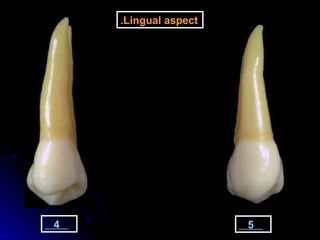
4 5
Lingual aspect.
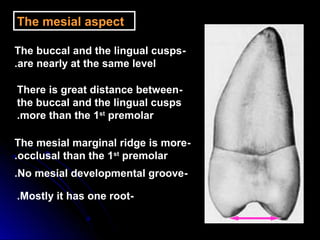
The mesial aspect
-The buccal and the lingual cusps
are nearly at the same level.
-The mesial marginal ridge is more
occlusal than the 1st
premolar.
-No mesial developmental groove.
-Mostly it has one root.
-There is great distance between
the buccal and the lingual cusps
more than the 1st
premolar.
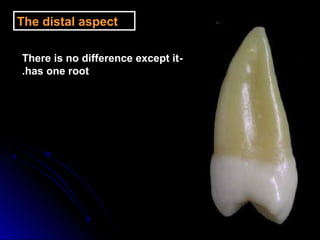
The distal aspect
-There is no difference except it
has one root.
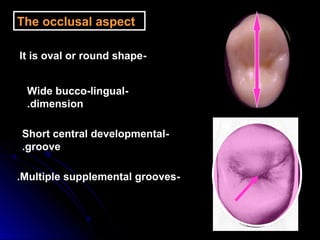
The occlusal aspect
-It is oval or round shape
-Wide bucco-lingual
dimension.
-Short central developmental
groove.
-Multiple supplemental grooves.

Maxillary Premolars

  • 2.
    Maxillary premolars (bicuspids( -Wehave 4 maxillary premolars; two in right and two in left side. -Mesial to them is the canine and distal the molars present. -They have two cusps (one buccal and one lingual( {bicuspid{
  • 3.
    Premolars are posteriorteeth because: 1-They have occlusal surface instead of incisal ridge. 2-The bucco-lingual measurements are greater than the anterior teeth. 4-The crown is shorter than the anterior teeth. 5-The cervical curvature is less than the anterior. 3-The contact areas are broad and nearly at the same level.
  • 4.
  • 5.
    Chronology Appearance of thedental organ 7 m.i.u First evidence of calcification 11/2-13/4 years. Enamel completed 5-6 years Eruption 10-11 years Root completed 12-13 years Type and function This tooth has the function of tearing and grinding food. No. of lobes It has four lobes (three buccal -the middle is well developed (the buccal cusp(- and one lingual (the lingual cusp(.
  • 6.
    43 5 Relation The upper1st premolar makes contact mesially with the distal surface of the canine and distally with the mesial surface of the 2nd premolar.
  • 7.
    No. of surfaces Ithas four surfaces and Occlusal aspect. Buccal Lingual Mesial Distal Occlusal No. of roots It has 80% 2 roots.
  • 8.
    The buccal aspect Geometricaloutline -The short side cervically. -The long side occlusally. Trapezoid in shape. The outline -Mesial outline is slightly concave till the half of the crown (the contact area(. -The distal outline is straight or slightly concave till the contact area (more occlusally(. -The mesial slope is longer than the distal slope.
  • 9.
    Surface anatomy The elevations -Thecervical ridge -The buccal ridge The depressions Two developmental grooves mesial and distal to the buccal ridge. The root The buccal root is similar to that of the canine but shorter.
  • 10.
    Lingual aspect -Similar tothe buccal aspect but in a reverse manner and with lingual convergence. -The lingual cusp is shorter than the buccal cusp by 1mm. -The mesial and the distal slopes of the lingual cusp have right angle. -The lingual surface is spheroid and has a less developed lingual ridge Than the buccal ridge. -Cervical line is slightly convex or even straight.
  • 11.
    Mesial aspect Geometrical outline Trapezoidin shape. -The short side occlusally. -The long side cervically. The outline -The buccal outline is convex till the buccal cusp tip with the maximum convexity at cervical 3rd . -The lingual outline is convex with the maximum convexity at the center.
  • 12.
    -The lingual cuspis shorter than the buccal cusp. -The mesial marginal ridge present at the junction of the occlusal and middle thirds -The mesial contact area present at the middle third. Surface anatomy 1-Mesial developmental groove crossing the mesial marginal ridge. 2-Mesial developmental depression above the contact area and continue on the root surface ( The canine fossa(. -The bifurcation of the root present at the middle of the root length. The root
  • 13.
    -The buccal cusptip is in one line with the center of the buccal root. -The lingual cusp tip is in one line with the lingual border of the lingual root.
  • 14.
    Distal aspect The distalsurface differs than the mesial in: 1-No developmental groove crossing the distal marginal ridge. 2-No developmental depression on the crown or root. 4-The cervical line is less curved or straight. 5-The bifurcation present at apical third. 3-The contact area is broader.
  • 15.
    Occlusal aspect It ishexagonal in shape Mesio-B. Disto-B. Distal. Mesial Disto-L. Mesio-L. -Central developmental groove. -Distal and mesial triangular fossa. -Distal and mesial developmental pit. -Distal and mesial marginal ridges.
  • 16.
    -The buccal andlingual cusps have triangular ridge. -The mesial marginal ridge is crossed by mesial developmental groove. -The bucco-lingual measurement is larger than the mesio-distal measurement
  • 17.
    The pulp cavity Bucco-lingualsection -Has wide pulp chamber with two pulp horns. -There are two root canals tapering to the apical foramen. -In case of one root ; it has two root canals. Mesio-distal section -The pulp chamber is bulbous and short. -The root canal is narrow to the apex -The palatal root canal is wide.
  • 18.
  • 19.
    Chronology Appearance of thedental organ 8 m.i.u First evidence of calcification 2-21/4 years. Enamel completed 6-7 years Eruption 10-12 years Root completed 13-15 years Type and function This tooth supplements the maxillary first premolar in function of tearing and grinding food. No. of lobes It has four lobes (three buccal -the middle is well developed (the buccal cusp)- and one lingual (the lingual cusp).
  • 20.
    4 5 Relation The upper2ndt premolar makes contact mesially with the distal surface of the 1st premolar and distally with the mesial surface of the 1st permanent molar. 6
  • 21.
    No. of surfaces Ithas four surfaces and Occlusal aspect. Buccal Lingual Mesial Distal Occlusal No. of roots It has 85% one root.
  • 22.
    The buccal aspect 1-Thebuccal cusp is less pointed and shorter. 2-The mesial slope is shorter than the distal slope. 3-The buccal ridge is less prominent. -Similar to that of the 1st premolar and differs in:
  • 23.
  • 24.
    The lingual aspect -Thelingual cusp is longer than that of upper 1st premolar. -The buccal and lingual cusps are nearly equal.
  • 25.
  • 26.
    The mesial aspect -Thebuccal and the lingual cusps are nearly at the same level. -The mesial marginal ridge is more occlusal than the 1st premolar. -No mesial developmental groove. -Mostly it has one root. -There is great distance between the buccal and the lingual cusps more than the 1st premolar.
  • 27.
    The distal aspect -Thereis no difference except it has one root.
  • 28.
    The occlusal aspect -Itis oval or round shape -Wide bucco-lingual dimension. -Short central developmental groove. -Multiple supplemental grooves.