The direct factors are:
1. Proximal contact areas.
2. Inter proximal spaces.
3. Embrasures ( spillways ).
4. Facial and lingual contours of the
crowns .
5. Curvatures of the cervical lines.
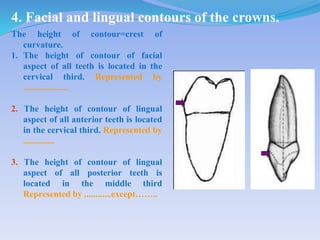
4. Facial and lingual contours of the crowns.

The height of contour=crest of
curvature.
1. The height of contour of facial
aspect of all teeth is located in the
cervical third. Represented by
....................
2. The height of contour of lingual
aspect of all anterior teeth is located
in the cervical third. Represented by
..............
3. The height of contour of lingual
aspect of all posterior teeth is
located in the middle third
Represented by ............except……..
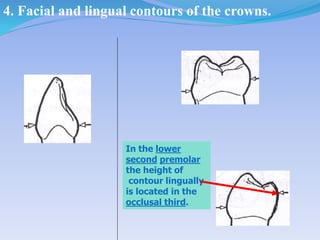
4. Facial and lingual contours of the crowns.
In the lower
second premolar
the height of
contour lingually
is located in the
occlusal third.
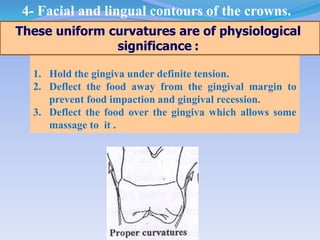
1. Hold the gingiva under definite tension.
2. Deflect the food away from the gingival margin to
prevent food impaction and gingival recession.
3. Deflect the food over the gingiva which allows some
massage to it .
These uniform curvatures are of physiological
significance :
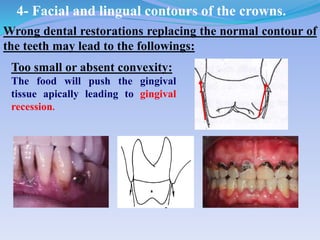
4- Facial and lingual contours of the crowns.
Too small or absent convexity:
The food will push the gingival
tissue apically leading to gingival
recession.
.
Wrong dental restorations replacing the normal contour of
the teeth may lead to the followings:
4- Facial and lingual contours of the crowns.
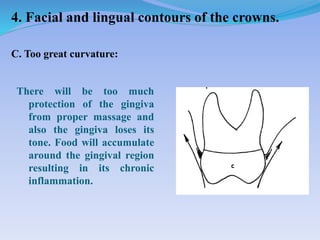
4. Facial and lingual contours of the crowns.
There will be too much
protection of the gingiva
from proper massage and
also the gingiva loses its
tone. Food will accumulate
around the gingival region
resulting in its chronic
inflammation.
C. Too great curvature:
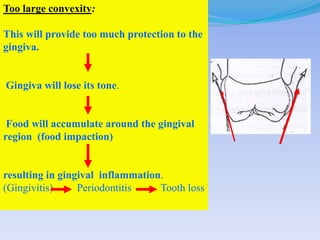
Too large convexity:
This will provide too much protection to the
gingiva.
Gingiva will lose its tone.
Food will accumulate around the gingival
region (food impaction)
resulting in gingival inflammation.
(Gingivitis) Periodontitis Tooth loss
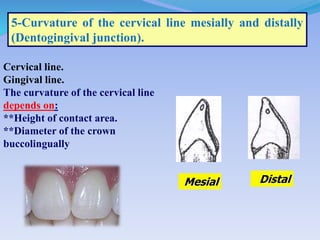
5-Curvature of the cervical line mesially and distally
(Dentogingival junction).
Cervical line.
Gingival line.
The curvature of the cervical line
depends on:
**Height of contact area.
**Diameter of the crown
buccolingually
Mesial Distal
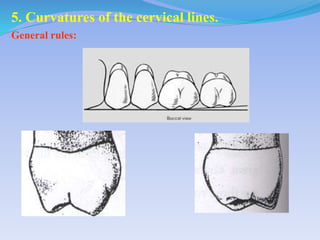
5. Curvatures of the cervical lines.
General rules:
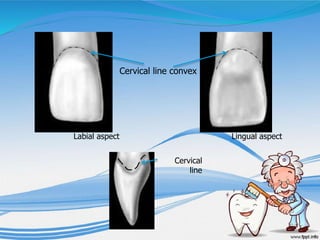
Cervical line convex
Lingual aspectLabial aspect
Cervical
line
5. Curvatures of the cervical lines.
Normal attachment epithelium follows the curvature
of the cervical line. The cervical line is at stable
entity, in contrast to the gingival margin and the
attachment epithelium which recede often a lower
level as the individual becomes older.
Physiologic role:
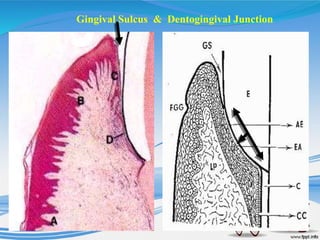
Gingival Sulcus & Dentogingival Junction
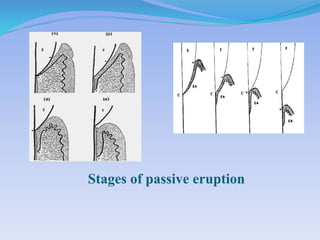
Stages of passive eruption
II. The indirect factors are:
1-Crown form: Which includes:
a)Proximal maximal contour
b)Facial and lingual maximal contour.
c)Crown outline
2- Roof form:
a) Length, number and distribution.
b) Root outline.
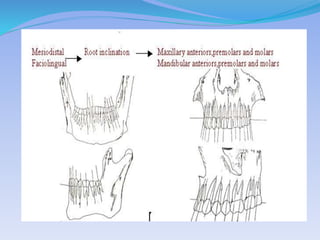
3- Angulation of crown and root:
a) Lingual angulations of the crown of lower posterior teeth.
b) Distal angulations of crown and root of permanent molars.
4- The self-cleansing ability of the tooth.
5-Cusp form and angles at which teeth and set in jaws (Occlusal anatomy).
6- Continuity of marginal ridges has a direct effect on embrasures.
7- Continuity of central grooves of post. Teeth provide more efficient food f low
pattern during mastication.
8- Facial line angles have a direct effect on the symmetry of embrasure.
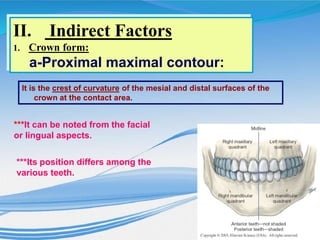
It is the crest of curvature of the mesial and distal surfaces of the
crown at the contact area.
***It can be noted from the facial
or lingual aspects.
***Its position differs among the
various teeth.
II. Indirect Factors
1. Crown form:
a-Proximal maximal contour:
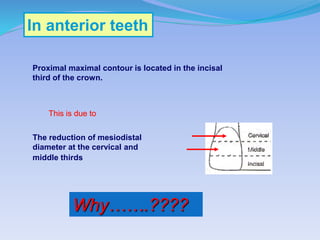
In anterior teeth
Proximal maximal contour is located in the incisal
third of the crown.
The reduction of mesiodistal
diameter at the cervical and
middle thirds
This is due to
Why…….????
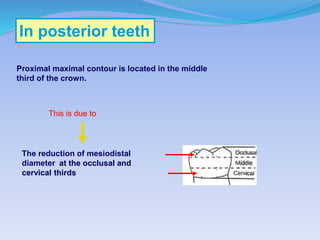
The reduction of mesiodistal
diameter at the occlusal and
cervical thirds
In posterior teeth
Proximal maximal contour is located in the middle
third of the crown.
This is due to
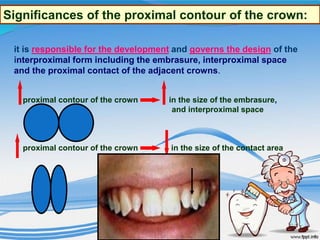
Significances of the proximal contour of the crown:
it is responsible for the development and governs the design of the
interproximal form including the embrasure, interproximal space
and the proximal contact of the adjacent crowns.
proximal contour of the crown in the size of the embrasure,
and interproximal space
proximal contour of the crown in the size of the contact area
 B- Facial , lingual maximal
contour:
It is discussed before in direct factors
 C - crown out line:
It is discussed before
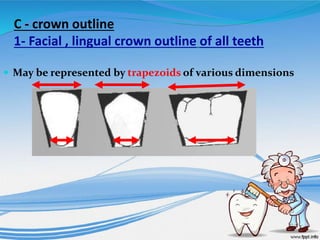
C - crown outline
1- Facial , lingual crown outline of all teeth
 May be represented by trapezoids of various dimensions
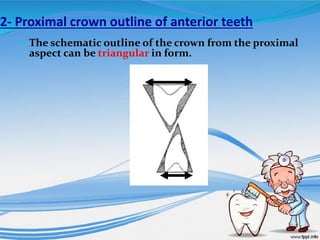
2- Proximal crown outline of anterior teeth
 The schematic outline of the crown from the proximal
aspect can be triangular in form.
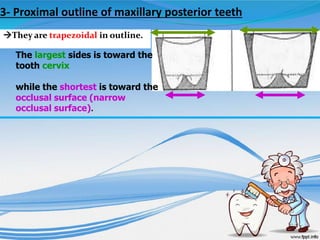
3- Proximal outline of maxillary posterior teeth
They are trapezoidal in outline.
The largest sides is toward the
tooth cervix
while the shortest is toward the
occlusal surface (narrow
occlusal surface).
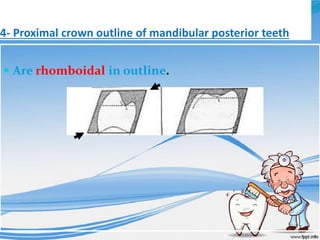
4- Proximal crown outline of mandibular posterior teeth
 Are rhomboidal in outline.
*The roots are the tools responsible for the transmission of
occlusal forces to the jaw.
*They must do this with the least injurious to the investing periodontium
2- Root form:
Length
Number
Distribution
Root outline
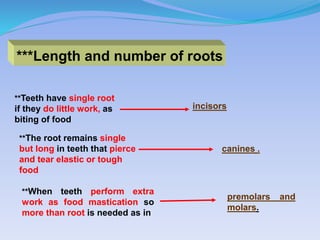
***Length and number of roots
**Teeth have single root
if they do little work, as
biting of food
**The root remains single
but long in teeth that pierce
and tear elastic or tough
food
**When teeth perform extra
work as food mastication so
more than root is needed as in
incisors
canines .
premolars and
molars.
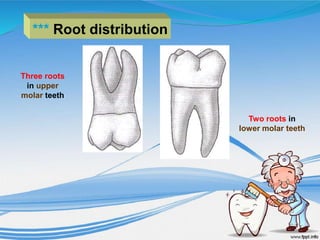
*** Root distribution
Three roots
in upper
molar teeth
Two roots in
lower molar teeth
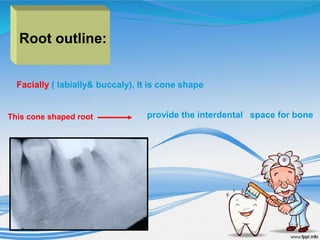
Facially ( labially& buccaly), It is cone shape
Root outline:
This cone shaped root provide the interdental space for bone
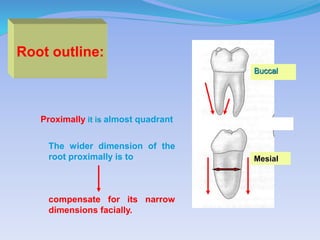
The wider dimension of the
root proximally is to
compensate for its narrow
dimensions facially.
Proximally it is almost quadrant
Root outline:
Buccal
Mesial
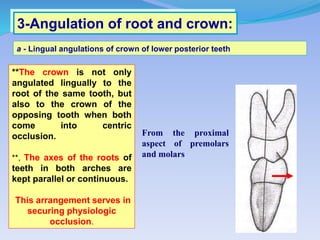
3-Angulation of root and crown:
a - Lingual angulations of crown of lower posterior teeth
From the proximal
aspect of premolars
and molars
**The crown is not only
angulated lingually to the
root of the same tooth, but
also to the crown of the
opposing tooth when both
come into centric
occlusion.
**, The axes of the roots of
teeth in both arches are
kept parallel or continuous.
This arrangement serves in
securing physiologic
occlusion.
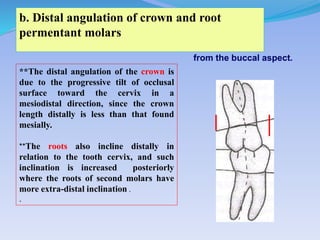
b. Distal angulation of crown and root
permentant molars
from the buccal aspect.
**The distal angulation of the crown is
due to the progressive tilt of occlusal
surface toward the cervix in a
mesiodistal direction, since the crown
length distally is less than that found
mesially.
**The roots also incline distally in
relation to the tooth cervix, and such
inclination is increased posteriorly
where the roots of second molars have
more extra-distal inclination .
.
4. The self cleaning ability of the tooth:
In addition to the direct and indirect factors, There are other
factors that also protect the periodontium:
Physiologic tooth form part 2

Physiologic tooth form part 2

  • 2.
    The direct factorsare: 1. Proximal contact areas. 2. Inter proximal spaces. 3. Embrasures ( spillways ). 4. Facial and lingual contours of the crowns . 5. Curvatures of the cervical lines.
  • 3.
    4. Facial andlingual contours of the crowns. The height of contour=crest of curvature. 1. The height of contour of facial aspect of all teeth is located in the cervical third. Represented by .................... 2. The height of contour of lingual aspect of all anterior teeth is located in the cervical third. Represented by .............. 3. The height of contour of lingual aspect of all posterior teeth is located in the middle third Represented by ............except……..
  • 4.
    4. Facial andlingual contours of the crowns. In the lower second premolar the height of contour lingually is located in the occlusal third.
  • 5.
    1. Hold thegingiva under definite tension. 2. Deflect the food away from the gingival margin to prevent food impaction and gingival recession. 3. Deflect the food over the gingiva which allows some massage to it . These uniform curvatures are of physiological significance : 4- Facial and lingual contours of the crowns.
  • 6.
    Too small orabsent convexity: The food will push the gingival tissue apically leading to gingival recession. . Wrong dental restorations replacing the normal contour of the teeth may lead to the followings: 4- Facial and lingual contours of the crowns.
  • 7.
    4. Facial andlingual contours of the crowns. There will be too much protection of the gingiva from proper massage and also the gingiva loses its tone. Food will accumulate around the gingival region resulting in its chronic inflammation. C. Too great curvature:
  • 8.
    Too large convexity: Thiswill provide too much protection to the gingiva. Gingiva will lose its tone. Food will accumulate around the gingival region (food impaction) resulting in gingival inflammation. (Gingivitis) Periodontitis Tooth loss
  • 9.
    5-Curvature of thecervical line mesially and distally (Dentogingival junction). Cervical line. Gingival line. The curvature of the cervical line depends on: **Height of contact area. **Diameter of the crown buccolingually Mesial Distal
  • 10.
    5. Curvatures ofthe cervical lines. General rules:
  • 11.
    Cervical line convex LingualaspectLabial aspect Cervical line
  • 12.
    5. Curvatures ofthe cervical lines. Normal attachment epithelium follows the curvature of the cervical line. The cervical line is at stable entity, in contrast to the gingival margin and the attachment epithelium which recede often a lower level as the individual becomes older. Physiologic role:
  • 13.
    Gingival Sulcus &Dentogingival Junction
  • 14.
  • 15.
    II. The indirectfactors are: 1-Crown form: Which includes: a)Proximal maximal contour b)Facial and lingual maximal contour. c)Crown outline 2- Roof form: a) Length, number and distribution. b) Root outline. 3- Angulation of crown and root: a) Lingual angulations of the crown of lower posterior teeth. b) Distal angulations of crown and root of permanent molars. 4- The self-cleansing ability of the tooth. 5-Cusp form and angles at which teeth and set in jaws (Occlusal anatomy). 6- Continuity of marginal ridges has a direct effect on embrasures. 7- Continuity of central grooves of post. Teeth provide more efficient food f low pattern during mastication. 8- Facial line angles have a direct effect on the symmetry of embrasure.
  • 16.
    It is thecrest of curvature of the mesial and distal surfaces of the crown at the contact area. ***It can be noted from the facial or lingual aspects. ***Its position differs among the various teeth. II. Indirect Factors 1. Crown form: a-Proximal maximal contour:
  • 17.
    In anterior teeth Proximalmaximal contour is located in the incisal third of the crown. The reduction of mesiodistal diameter at the cervical and middle thirds This is due to Why…….????
  • 18.
    The reduction ofmesiodistal diameter at the occlusal and cervical thirds In posterior teeth Proximal maximal contour is located in the middle third of the crown. This is due to
  • 19.
    Significances of theproximal contour of the crown: it is responsible for the development and governs the design of the interproximal form including the embrasure, interproximal space and the proximal contact of the adjacent crowns. proximal contour of the crown in the size of the embrasure, and interproximal space proximal contour of the crown in the size of the contact area
  • 20.
     B- Facial, lingual maximal contour: It is discussed before in direct factors  C - crown out line: It is discussed before
  • 21.
    C - crownoutline 1- Facial , lingual crown outline of all teeth  May be represented by trapezoids of various dimensions
  • 22.
    2- Proximal crownoutline of anterior teeth  The schematic outline of the crown from the proximal aspect can be triangular in form.
  • 23.
    3- Proximal outlineof maxillary posterior teeth They are trapezoidal in outline. The largest sides is toward the tooth cervix while the shortest is toward the occlusal surface (narrow occlusal surface).
  • 24.
    4- Proximal crownoutline of mandibular posterior teeth  Are rhomboidal in outline.
  • 25.
    *The roots arethe tools responsible for the transmission of occlusal forces to the jaw. *They must do this with the least injurious to the investing periodontium 2- Root form: Length Number Distribution Root outline
  • 26.
    ***Length and numberof roots **Teeth have single root if they do little work, as biting of food **The root remains single but long in teeth that pierce and tear elastic or tough food **When teeth perform extra work as food mastication so more than root is needed as in incisors canines . premolars and molars.
  • 27.
    *** Root distribution Threeroots in upper molar teeth Two roots in lower molar teeth
  • 28.
    Facially ( labially&buccaly), It is cone shape Root outline: This cone shaped root provide the interdental space for bone
  • 29.
    The wider dimensionof the root proximally is to compensate for its narrow dimensions facially. Proximally it is almost quadrant Root outline: Buccal Mesial
  • 31.
    3-Angulation of rootand crown: a - Lingual angulations of crown of lower posterior teeth From the proximal aspect of premolars and molars **The crown is not only angulated lingually to the root of the same tooth, but also to the crown of the opposing tooth when both come into centric occlusion. **, The axes of the roots of teeth in both arches are kept parallel or continuous. This arrangement serves in securing physiologic occlusion.
  • 33.
    b. Distal angulationof crown and root permentant molars from the buccal aspect. **The distal angulation of the crown is due to the progressive tilt of occlusal surface toward the cervix in a mesiodistal direction, since the crown length distally is less than that found mesially. **The roots also incline distally in relation to the tooth cervix, and such inclination is increased posteriorly where the roots of second molars have more extra-distal inclination . .
  • 35.
    4. The selfcleaning ability of the tooth:
  • 36.
    In addition tothe direct and indirect factors, There are other factors that also protect the periodontium: