BY

Dr. Rehab Ali
Lecturer
Oral biology department
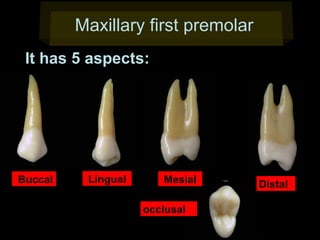
Maxillary first premolar
It has 5 aspects:

Buccal

Lingual

Mesial
occlusal

Distal
Maxillary second premolar
It has 5 aspects:

Buccal

Lingual

Mesial

occlusal

Distal
1.5-2y
2-2.5y
4-5m

Eruption

Root
completed

10-11
10-12

10-12
11-12

11
9

years
3+

4
4
5
5
3
3

Crown
completed

years
5-

Beginning
of calc.
(month)
Geometric outline of the crown
• Facial and lingual aspects have
trapezoidal out line.
The smallest uneven side
cervically.
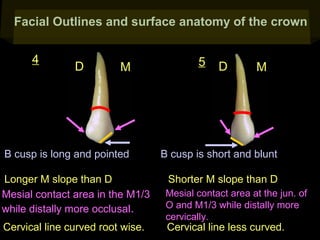
Facial Outlines and surface anatomy of the crown
4

D

M

B cusp is long and pointed
Longer M slope than D
Mesial contact area in the M1/3
while distally more occlusal.
Cervical line curved root wise.

5

D

M

B cusp is short and blunt
Shorter M slope than D
Mesial contact area at the jun. of
O and M1/3 while distally more
cervically.

Cervical line less curved.
4

D

M

5

D

M

Prominent B ridge

Less prominent B ridge

Short root.

Longer root.
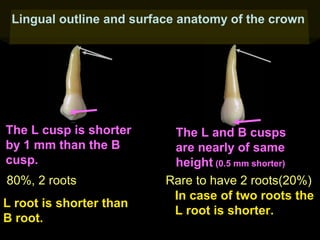
Lingual outline and surface anatomy of the crown
4

The L cusp is shorter
by 1 mm than the B
cusp.
80%, 2 roots
L root is shorter than
B root.

5

The L and B cusps
are nearly of same
height (0.5 mm shorter)
Rare to have 2 roots(20%)
In case of two roots the
L root is shorter.
Do
or… you
..? like t
o

be

a re
al d
ent
i

st
Geometric outline of the proximal aspect
Distal aspect

Trapezoidal in shape

Mesial aspect

Smallest uneven sides occlusaly
Mesial aspect
4

5

B cusp is longer than L
cusp by 1mm

The cusps are nearly at the
same level.

The occlusal table is
wide.

The occlusal table is
wide,but narrower than 4.

Mesial DG and canine
fossa.
Root trunk about half the
root length.

The crown surface is smooth
and convex while root has
shallow developmental
depression.
Mesial aspect
4

MMR at the M1/3
Contact area:
At the middle third (OC
dimension) and slightly
buccal to midline (BL
dimension)

5

MMR positioned more
occlusal.
At the jun. of O and M 1/3
(OC dimension) and
slightly buccal to midline
(BL dimension)
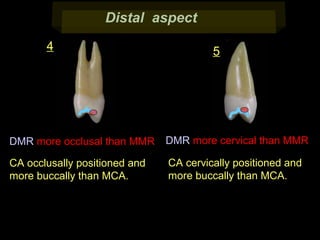
Distal aspect
4

5

DMR more occlusal than MMR

DMR more cervical than MMR

CA occlusally positioned and
more buccally than MCA.

CA cervically positioned and
more buccally than MCA.
Distal aspect
4

Root trunk is long as
the bifurcation is near
apical 1/3
Surface is smooth and
convex except shallower
DD on the root trunk than
mesially.

5

One root and if 2 the
bifurcation will be
more apically.
Surface is smooth and
convex except deeper
DD in the middle of the
root than mesially.
Ih

op
e

yo

ua

re
b

e tt

er
n

ow
,
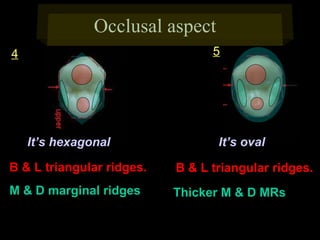
Occlusal aspect
5

4
D

M

It’s hexagonal

D

M

It’s oval

B & L triangular ridges.

B & L triangular ridges.

M & D marginal ridges

Thicker M & D MRs
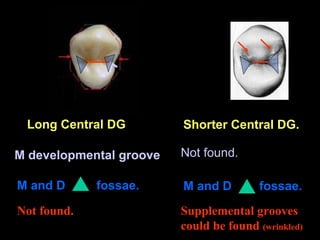
4

5

Long Central DG

Shorter Central DG.

M developmental groove

Not found.

M and D

M and D

Not found.

fossae.

fossae.

Supplemental grooves
could be found (wrinkled)
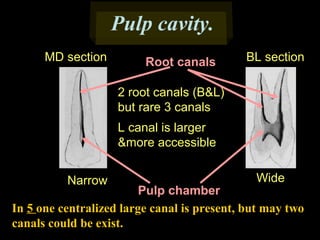
Pulp cavity.
MD section

Root canals

BL section

2 root canals (B&L)
but rare 3 canals
L canal is larger
&more accessible
Narrow

Wide

Pulp chamber
In 5 one centralized large canal is present, but may two
canals could be exist.
Mandibular first premolar
It has 5 aspects:

Buccal

Lingual

Mesial
occlusal

Distal
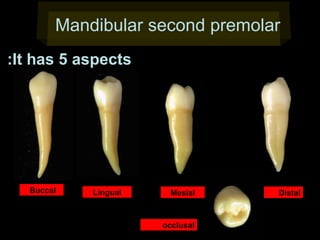
Mandibular second premolar
:It has 5 aspects

Buccal

Lingual

Mesial

occlusal

Distal
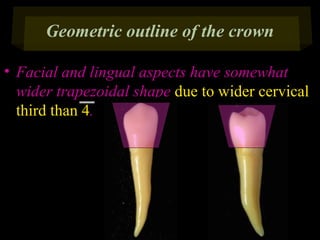
Geometric outline of the crown
• Facial and lingual aspects have somewhat
wider trapezoidal shape due to wider cervical
third than 4.
Facial Outlines and surface anatomy
4

B cusp
pointed and long
Well prominent B ridge

5

B cusp
short and less pointed
Less prominent B ridge
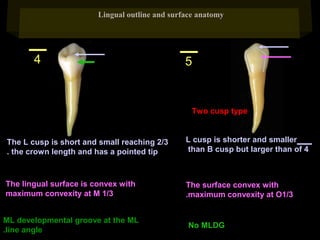
Lingual outline and surface anatomy

4

5

Two cusp type

The L cusp is short and small reaching 2/3
. the crown length and has a pointed tip

L cusp is shorter and smaller
than B cusp but larger than of 4

The lingual surface is convex with
maximum convexity at M 1/3

The surface convex with
.maximum convexity at O1/3

ML developmental groove at the ML
.line angle

No MLDG
:Three

cusp type 5

ML cusp is longer and larger than M
DL cusp. They both shorter than B
. cusp and less pointed
The surface convex with maximum
.convixty at O1/3
The L developmental groove between
the 2 cusps
N.B. Very little or no lingual
.convergancy

D
Proximal outlines
4

5

.Rhomboidal

in shape with narrow occlusal table

Lingual inclination well
prominent

Lingual inclination less
prominent
4

5

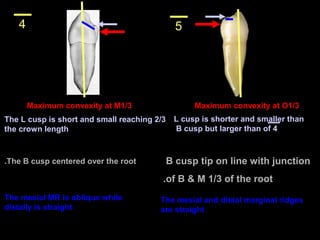
Maximum convexity at M1/3

Maximum convexity at O1/3

The L cusp is short and small reaching 2/3
the crown length

.The B cusp centered over the root

L cusp is shorter and smaller than
B cusp but larger than of 4

B cusp tip on line with junction
.of B & M 1/3 of the root

The mesial MR is oblique while
distally is straight

The mesial and distal marginal ridges
are straight
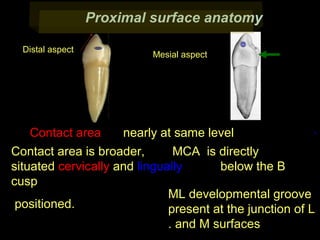
Proximal surface anatomy
Distal aspect

Mesial aspect

.
Contact area
nearly at same level
Contact area is broader,
MCA is directly
situated cervically and lingually
below the B
cusp
ML developmental groove
positioned.
present at the junction of L
. and M surfaces
Mesial aspect

Distal aspect

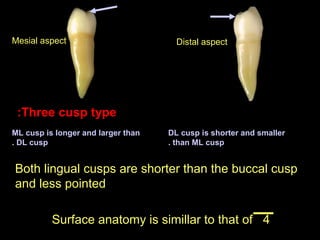
:Three cusp type
ML cusp is longer and larger than
. DL cusp

DL cusp is shorter and smaller
. than ML cusp

Both lingual cusps are shorter than the buccal cusp
and less pointed
Surface anatomy is simillar to that of 4
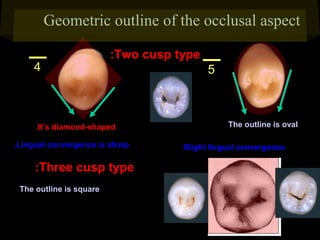
Geometric outline of the occlusal aspect
4

:Two cusp type

.It’s diamond-shaped
.Lingual convergence is sharp

:Three cusp type
The outline is square

5

The outline is oval
Slight lingual convergence
:Surface anatomy of occlusal aspect
4

:Elevations

5

.B triangular ridge
.L triangular ridge
Transverse ridge
M & D marginal ridges
4

:Depressions 5

Central developmental groove Central developmental groove
M and D triangular fossae )M
fossa is oval while D fossa is
circular,larger & deeper(
snake eyes
Mesiolingual developmental
groove

.(H

or U shaped)

.M and D triangular fossae
both r circular,but D is)
(deeper
:Three cusp type
:Elevations
.B

triangular ridge

(. L triangular ridges )ML &DL
M & D marginal ridges

:Depressions
Developmental groove )Y shape formed of MB,DB & L
.(grooves
.M and D triangular fossae
Central fossa with central pit.
Remember the supplemental grooves!!!
Premolars Revision - Dentition

Premolars Revision - Dentition

  • 3.
  • 4.
    Maxillary first premolar Ithas 5 aspects: Buccal Lingual Mesial occlusal Distal
  • 5.
    Maxillary second premolar Ithas 5 aspects: Buccal Lingual Mesial occlusal Distal
  • 6.
  • 7.
    Geometric outline ofthe crown • Facial and lingual aspects have trapezoidal out line. The smallest uneven side cervically.
  • 8.
    Facial Outlines andsurface anatomy of the crown 4 D M B cusp is long and pointed Longer M slope than D Mesial contact area in the M1/3 while distally more occlusal. Cervical line curved root wise. 5 D M B cusp is short and blunt Shorter M slope than D Mesial contact area at the jun. of O and M1/3 while distally more cervically. Cervical line less curved.
  • 9.
    4 D M 5 D M Prominent B ridge Lessprominent B ridge Short root. Longer root.
  • 10.
    Lingual outline andsurface anatomy of the crown 4 The L cusp is shorter by 1 mm than the B cusp. 80%, 2 roots L root is shorter than B root. 5 The L and B cusps are nearly of same height (0.5 mm shorter) Rare to have 2 roots(20%) In case of two roots the L root is shorter.
  • 11.
    Do or… you ..? liket o be a re al d ent i st
  • 12.
    Geometric outline ofthe proximal aspect Distal aspect Trapezoidal in shape Mesial aspect Smallest uneven sides occlusaly
  • 13.
    Mesial aspect 4 5 B cuspis longer than L cusp by 1mm The cusps are nearly at the same level. The occlusal table is wide. The occlusal table is wide,but narrower than 4. Mesial DG and canine fossa. Root trunk about half the root length. The crown surface is smooth and convex while root has shallow developmental depression.
  • 14.
    Mesial aspect 4 MMR atthe M1/3 Contact area: At the middle third (OC dimension) and slightly buccal to midline (BL dimension) 5 MMR positioned more occlusal. At the jun. of O and M 1/3 (OC dimension) and slightly buccal to midline (BL dimension)
  • 15.
    Distal aspect 4 5 DMR moreocclusal than MMR DMR more cervical than MMR CA occlusally positioned and more buccally than MCA. CA cervically positioned and more buccally than MCA.
  • 16.
    Distal aspect 4 Root trunkis long as the bifurcation is near apical 1/3 Surface is smooth and convex except shallower DD on the root trunk than mesially. 5 One root and if 2 the bifurcation will be more apically. Surface is smooth and convex except deeper DD in the middle of the root than mesially.
  • 17.
  • 18.
    Occlusal aspect 5 4 D M It’s hexagonal D M It’soval B & L triangular ridges. B & L triangular ridges. M & D marginal ridges Thicker M & D MRs
  • 19.
    4 5 Long Central DG ShorterCentral DG. M developmental groove Not found. M and D M and D Not found. fossae. fossae. Supplemental grooves could be found (wrinkled)
  • 20.
    Pulp cavity. MD section Rootcanals BL section 2 root canals (B&L) but rare 3 canals L canal is larger &more accessible Narrow Wide Pulp chamber In 5 one centralized large canal is present, but may two canals could be exist.
  • 22.
    Mandibular first premolar Ithas 5 aspects: Buccal Lingual Mesial occlusal Distal
  • 23.
    Mandibular second premolar :Ithas 5 aspects Buccal Lingual Mesial occlusal Distal
  • 24.
    Geometric outline ofthe crown • Facial and lingual aspects have somewhat wider trapezoidal shape due to wider cervical third than 4.
  • 25.
    Facial Outlines andsurface anatomy 4 B cusp pointed and long Well prominent B ridge 5 B cusp short and less pointed Less prominent B ridge
  • 26.
    Lingual outline andsurface anatomy 4 5 Two cusp type The L cusp is short and small reaching 2/3 . the crown length and has a pointed tip L cusp is shorter and smaller than B cusp but larger than of 4 The lingual surface is convex with maximum convexity at M 1/3 The surface convex with .maximum convexity at O1/3 ML developmental groove at the ML .line angle No MLDG
  • 27.
    :Three cusp type 5 MLcusp is longer and larger than M DL cusp. They both shorter than B . cusp and less pointed The surface convex with maximum .convixty at O1/3 The L developmental groove between the 2 cusps N.B. Very little or no lingual .convergancy D
  • 28.
    Proximal outlines 4 5 .Rhomboidal in shapewith narrow occlusal table Lingual inclination well prominent Lingual inclination less prominent
  • 29.
    4 5 Maximum convexity atM1/3 Maximum convexity at O1/3 The L cusp is short and small reaching 2/3 the crown length .The B cusp centered over the root L cusp is shorter and smaller than B cusp but larger than of 4 B cusp tip on line with junction .of B & M 1/3 of the root The mesial MR is oblique while distally is straight The mesial and distal marginal ridges are straight
  • 30.
    Proximal surface anatomy Distalaspect Mesial aspect . Contact area nearly at same level Contact area is broader, MCA is directly situated cervically and lingually below the B cusp ML developmental groove positioned. present at the junction of L . and M surfaces
  • 31.
    Mesial aspect Distal aspect :Threecusp type ML cusp is longer and larger than . DL cusp DL cusp is shorter and smaller . than ML cusp Both lingual cusps are shorter than the buccal cusp and less pointed Surface anatomy is simillar to that of 4
  • 32.
    Geometric outline ofthe occlusal aspect 4 :Two cusp type .It’s diamond-shaped .Lingual convergence is sharp :Three cusp type The outline is square 5 The outline is oval Slight lingual convergence
  • 33.
    :Surface anatomy ofocclusal aspect 4 :Elevations 5 .B triangular ridge .L triangular ridge Transverse ridge M & D marginal ridges
  • 34.
    4 :Depressions 5 Central developmentalgroove Central developmental groove M and D triangular fossae )M fossa is oval while D fossa is circular,larger & deeper( snake eyes Mesiolingual developmental groove .(H or U shaped) .M and D triangular fossae both r circular,but D is) (deeper
  • 35.
    :Three cusp type :Elevations .B triangularridge (. L triangular ridges )ML &DL M & D marginal ridges :Depressions Developmental groove )Y shape formed of MB,DB & L .(grooves .M and D triangular fossae Central fossa with central pit. Remember the supplemental grooves!!!