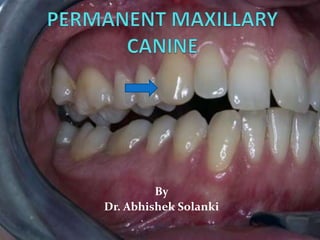
By
Dr. Abhishek Solanki
Introduction
 Canines are very long and stable teeth
 There are 4 canines (2 Maxillary & 2 Mandibular) placed
at corner of mouth & hence called ‘corner stones’ of the
dentition
 Single pointed cusp present so also called cuspids
 The canine's role in mastication is mainly tearing, which
is intermediate between incising of anterior teeth &
grinding of the posterior teeth
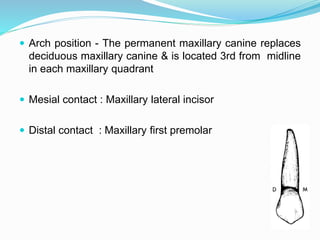
 Arch position - The permanent maxillary canine replaces
deciduous maxillary canine & is located 3rd from midline
in each maxillary quadrant
 Mesial contact : Maxillary lateral incisor
 Distal contact : Maxillary first premolar
Tooth Numbering Systems
UNIVERSAL SYSTEM - 6,11
 ZSIGMONDY / PALMER - 3 3
FDI SYSTEM - 13, 23
Chronology
 First evidence of calcification : 4-5 months
 Enamel completed : 6-7 yr
 Eruption : 11-12yrs
 Root completed : 13-15yrs
Average Dimension (in mm)
Crown Length 10
Root Length 17
Mesiodistal Diameter at Contact Area 7.5
Mesiodistal Diameter at Cervical Lines 5.5
Labiolingual Diameter at Crest of Curvature 08
Labiolingual Diameter at Cervical Lines 07
Curvature of Cervical Line : Mesial 2.5
Curvature of Cervical Line : Distal 1.5
Labial Aspect
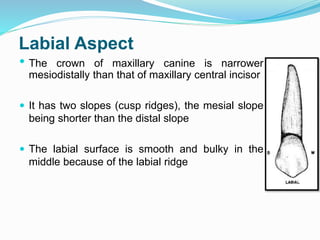
• The crown of maxillary canine is narrower
mesiodistally than that of maxillary central incisor
 It has two slopes (cusp ridges), the mesial slope
being shorter than the distal slope
 The labial surface is smooth and bulky in the
middle because of the labial ridge
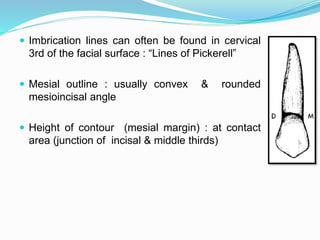
 Imbrication lines can often be found in cervical
3rd of the facial surface : “Lines of Pickerell”
 Mesial outline : usually convex & rounded
mesioincisal angle
 Height of contour (mesial margin) : at contact
area (junction of incisal & middle thirds)
 Distal margin : Shorter than the mesial margin &
also has a more rounded incisal angle
 Height of contour : at contact area (middle 3rd)
 Incisal margin - divided into two components by tip
of cusp & are termed the mesioincisal and
distoincisal slopes (or mesial & distal cusp ridges)
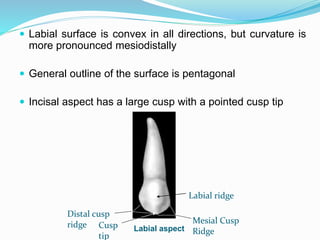
 Labial surface is convex in all directions, but curvature is
more pronounced mesiodistally
 General outline of the surface is pentagonal
 Incisal aspect has a large cusp with a pointed cusp tip
Labial aspect
Labial ridge
Cusp
tip
Distal cusp
ridge Mesial Cusp
Ridge
Lingual Aspect
 Crown and root are narrower lingually
 Cingulum is well developed, large & sometimes
pointed like a cusp
 Cervical line curves asymmetrically toward the
apex with a slight offset to the distal
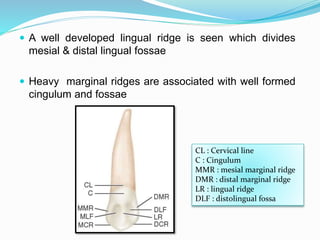
 A well developed lingual ridge is seen which divides
mesial & distal lingual fossae
 Heavy marginal ridges are associated with well formed
cingulum and fossae
CL : Cervical line
C : Cingulum
MMR : mesial marginal ridge
DMR : distal marginal ridge
LR : lingual ridge
DLF : distolingual fossa
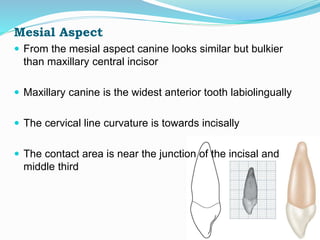
Mesial Aspect
 From the mesial aspect canine looks similar but bulkier
than maxillary central incisor
 Maxillary canine is the widest anterior tooth labiolingually
 The cervical line curvature is towards incisally
 The contact area is near the junction of the incisal and
middle third
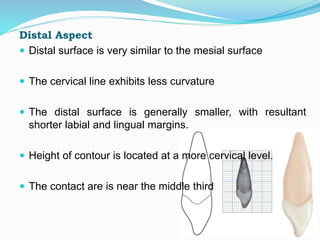
Distal Aspect
 Distal surface is very similar to the mesial surface
 The cervical line exhibits less curvature
 The distal surface is generally smaller, with resultant
shorter labial and lingual margins.
 Height of contour is located at a more cervical level.
 The contact are is near the middle third
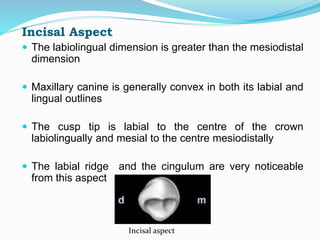
Incisal Aspect
 The labiolingual dimension is greater than the mesiodistal
dimension
 Maxillary canine is generally convex in both its labial and
lingual outlines
 The cusp tip is labial to the centre of the crown
labiolingually and mesial to the centre mesiodistally
 The labial ridge and the cingulum are very noticeable
from this aspect
Incisal aspect
MLF, mesiolingual fossa;
MCR, mesial cusp ridge;
DCR, distal cusp ridge;
DLF, distolingual fossa;
C, cingulum
Root
 Only one
 Longest and strongest of all the teeth in the mouth
 Mesial & distal surfaces of root have developmental
depressions
 From all aspects, the root tapers gradually to a sharp, or
slightly blunted apex
 Wider labiolingually than mesiodistally
 Lingual and labial surfaces are convex
Labial aspect Lingual aspect
Mesial aspect Distal aspect
Incisal aspect
Mandibular Canine
Tooth Numbering Systems
UNIVERSAL SYSTEM - 22,27
 ZSIGMONDY / PALMER - 3 3
 FDI SYSTEM - 33, 43
Chronology
 First evidence of calcification : 4-5 months
 Enamel completed : 6-7 yr
 Eruption : 9-10yrs
 Root completed : 12-14yrs
Average Dimensions in millimeters
2.5 1.07.07.55.57.016.011.0
Curvature of Cervical
Line
M D
Labiolingual
Diameter at
Cervical Line
Labiolingual
Diameter at
Crest of Curvature
Mesiodistal
Diameter at
Cervical Line
Mesiodistal
Diameter at
Contact Area
Root
Length
Crown Length
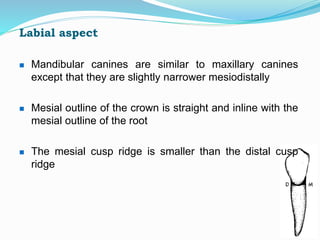
Labial aspect
 Mandibular canines are similar to maxillary canines
except that they are slightly narrower mesiodistally
 Mesial outline of the crown is straight and inline with the
mesial outline of the root
 The mesial cusp ridge is smaller than the distal cusp
ridge
 Mesial outline : straight & obtuse mesioincisal angle
 Distal outline : convex & rounded distoincisal angle
 Incisal aspect : not sharp as max canine
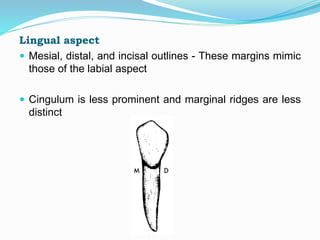
Lingual aspect
 Mesial, distal, and incisal outlines - These margins mimic
those of the labial aspect
 Cingulum is less prominent and marginal ridges are less
distinct
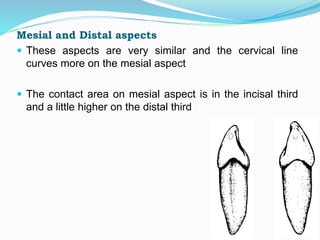
Mesial and Distal aspects
 These aspects are very similar and the cervical line
curves more on the mesial aspect
 The contact area on mesial aspect is in the incisal third
and a little higher on the distal third
Incisal aspect
 Like maxillary canine the labiolingual dimension is more
than the mesiodistal dimension
 The cusp tip appears inclined in a lingual direction
Root
 The root is shorter by 1 or 2 mm than max. canine
 The developmental depression is more pronounced on
the lower canine
References
 CONCISE DENTAL ANATOMY & MORPHOLOGY :
JAMES L FULLER
 DENTAL ANATOMY, PHYSIOLOGY & OCCLUSION:
WHEELER’S
 TEXTBOOK OF DENTAL ANATOMY, PHYSIOLOGY &
OCCLUSION: RASHMI GS (PHULARI)
 INTERNET

Permanent Maxillary & Mandibular Canine

  • 1.
  • 2.
    Introduction  Canines arevery long and stable teeth  There are 4 canines (2 Maxillary & 2 Mandibular) placed at corner of mouth & hence called ‘corner stones’ of the dentition  Single pointed cusp present so also called cuspids  The canine's role in mastication is mainly tearing, which is intermediate between incising of anterior teeth & grinding of the posterior teeth
  • 3.
     Arch position- The permanent maxillary canine replaces deciduous maxillary canine & is located 3rd from midline in each maxillary quadrant  Mesial contact : Maxillary lateral incisor  Distal contact : Maxillary first premolar
  • 4.
    Tooth Numbering Systems UNIVERSALSYSTEM - 6,11  ZSIGMONDY / PALMER - 3 3 FDI SYSTEM - 13, 23
  • 5.
    Chronology  First evidenceof calcification : 4-5 months  Enamel completed : 6-7 yr  Eruption : 11-12yrs  Root completed : 13-15yrs
  • 6.
    Average Dimension (inmm) Crown Length 10 Root Length 17 Mesiodistal Diameter at Contact Area 7.5 Mesiodistal Diameter at Cervical Lines 5.5 Labiolingual Diameter at Crest of Curvature 08 Labiolingual Diameter at Cervical Lines 07 Curvature of Cervical Line : Mesial 2.5 Curvature of Cervical Line : Distal 1.5
  • 8.
    Labial Aspect • Thecrown of maxillary canine is narrower mesiodistally than that of maxillary central incisor  It has two slopes (cusp ridges), the mesial slope being shorter than the distal slope  The labial surface is smooth and bulky in the middle because of the labial ridge
  • 9.
     Imbrication linescan often be found in cervical 3rd of the facial surface : “Lines of Pickerell”  Mesial outline : usually convex & rounded mesioincisal angle  Height of contour (mesial margin) : at contact area (junction of incisal & middle thirds)
  • 10.
     Distal margin: Shorter than the mesial margin & also has a more rounded incisal angle  Height of contour : at contact area (middle 3rd)  Incisal margin - divided into two components by tip of cusp & are termed the mesioincisal and distoincisal slopes (or mesial & distal cusp ridges)
  • 11.
     Labial surfaceis convex in all directions, but curvature is more pronounced mesiodistally  General outline of the surface is pentagonal  Incisal aspect has a large cusp with a pointed cusp tip Labial aspect Labial ridge Cusp tip Distal cusp ridge Mesial Cusp Ridge
  • 12.
    Lingual Aspect  Crownand root are narrower lingually  Cingulum is well developed, large & sometimes pointed like a cusp  Cervical line curves asymmetrically toward the apex with a slight offset to the distal
  • 13.
     A welldeveloped lingual ridge is seen which divides mesial & distal lingual fossae  Heavy marginal ridges are associated with well formed cingulum and fossae CL : Cervical line C : Cingulum MMR : mesial marginal ridge DMR : distal marginal ridge LR : lingual ridge DLF : distolingual fossa
  • 14.
    Mesial Aspect  Fromthe mesial aspect canine looks similar but bulkier than maxillary central incisor  Maxillary canine is the widest anterior tooth labiolingually  The cervical line curvature is towards incisally  The contact area is near the junction of the incisal and middle third
  • 15.
    Distal Aspect  Distalsurface is very similar to the mesial surface  The cervical line exhibits less curvature  The distal surface is generally smaller, with resultant shorter labial and lingual margins.  Height of contour is located at a more cervical level.  The contact are is near the middle third
  • 16.
    Incisal Aspect  Thelabiolingual dimension is greater than the mesiodistal dimension  Maxillary canine is generally convex in both its labial and lingual outlines  The cusp tip is labial to the centre of the crown labiolingually and mesial to the centre mesiodistally  The labial ridge and the cingulum are very noticeable from this aspect Incisal aspect
  • 17.
    MLF, mesiolingual fossa; MCR,mesial cusp ridge; DCR, distal cusp ridge; DLF, distolingual fossa; C, cingulum
  • 18.
    Root  Only one Longest and strongest of all the teeth in the mouth  Mesial & distal surfaces of root have developmental depressions  From all aspects, the root tapers gradually to a sharp, or slightly blunted apex  Wider labiolingually than mesiodistally  Lingual and labial surfaces are convex
  • 19.
    Labial aspect Lingualaspect Mesial aspect Distal aspect Incisal aspect Mandibular Canine
  • 20.
    Tooth Numbering Systems UNIVERSALSYSTEM - 22,27  ZSIGMONDY / PALMER - 3 3  FDI SYSTEM - 33, 43
  • 21.
    Chronology  First evidenceof calcification : 4-5 months  Enamel completed : 6-7 yr  Eruption : 9-10yrs  Root completed : 12-14yrs
  • 22.
    Average Dimensions inmillimeters 2.5 1.07.07.55.57.016.011.0 Curvature of Cervical Line M D Labiolingual Diameter at Cervical Line Labiolingual Diameter at Crest of Curvature Mesiodistal Diameter at Cervical Line Mesiodistal Diameter at Contact Area Root Length Crown Length
  • 23.
    Labial aspect  Mandibularcanines are similar to maxillary canines except that they are slightly narrower mesiodistally  Mesial outline of the crown is straight and inline with the mesial outline of the root  The mesial cusp ridge is smaller than the distal cusp ridge
  • 24.
     Mesial outline: straight & obtuse mesioincisal angle  Distal outline : convex & rounded distoincisal angle  Incisal aspect : not sharp as max canine
  • 25.
    Lingual aspect  Mesial,distal, and incisal outlines - These margins mimic those of the labial aspect  Cingulum is less prominent and marginal ridges are less distinct
  • 26.
    Mesial and Distalaspects  These aspects are very similar and the cervical line curves more on the mesial aspect  The contact area on mesial aspect is in the incisal third and a little higher on the distal third
  • 27.
    Incisal aspect  Likemaxillary canine the labiolingual dimension is more than the mesiodistal dimension  The cusp tip appears inclined in a lingual direction Root  The root is shorter by 1 or 2 mm than max. canine  The developmental depression is more pronounced on the lower canine
  • 28.
    References  CONCISE DENTALANATOMY & MORPHOLOGY : JAMES L FULLER  DENTAL ANATOMY, PHYSIOLOGY & OCCLUSION: WHEELER’S  TEXTBOOK OF DENTAL ANATOMY, PHYSIOLOGY & OCCLUSION: RASHMI GS (PHULARI)  INTERNET