The Physiologic Tooth
Form Protecting The
Periodontium
By
Dr/ Rehab Rizk
Factors affecting the protective functional
forms of the tooth crowns
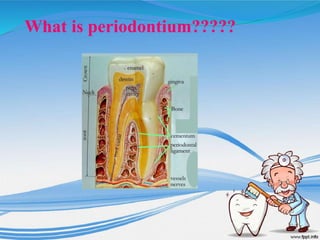
What is periodontium?????
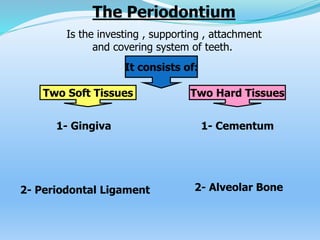
The Periodontium
Is the investing , supporting , attachment
and covering system of teeth.
It consists of:
Two Soft Tissues Two Hard Tissues
1- Gingiva
2- Periodontal Ligament
1- Cementum
2- Alveolar Bone
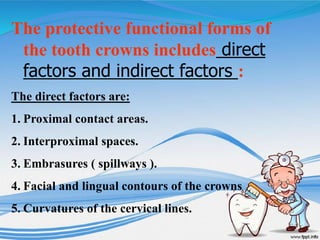
The protective functional forms of
the tooth crowns includes direct
factors and indirect factors :
The direct factors are:
1. Proximal contact areas.
2. Interproximal spaces.
3. Embrasures ( spillways ).
4. Facial and lingual contours of the crowns
5. Curvatures of the cervical lines.
1- Proximal contact areas:
DEF.
Contact areas :The crests of curvature on the proximal
surfaces of tooth crowns where the tooth touches the
adjacent tooth in the same arch.
Contours : Convexity on facial and lingual surfaces that
affords protection and stimulation of supporting tissues
during mastication.
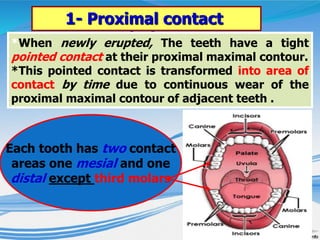
Each tooth has two contact
areas one mesial and one
distal except third molars
1- Proximal contact
relation*When newly erupted, The teeth have a tight
pointed contact at their proximal maximal contour.
*This pointed contact is transformed into area of
contact by time due to continuous wear of the
proximal maximal contour of adjacent teeth .
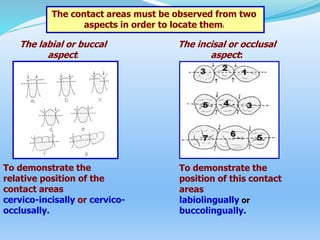
To demonstrate the
position of this contact
areas
labiolingually or
buccolingually.
The contact areas must be observed from two
aspects in order to locate them:
The labial or buccal
aspect:
To demonstrate the
relative position of the
contact areas
cervico-incisally or cervico-
occlusally.
The incisal or occlusal
aspect:
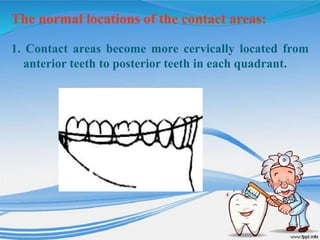
The normal locations of the contact areas:
1. Contact areas become more cervically located from
anterior teeth to posterior teeth in each quadrant.
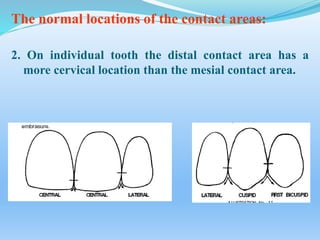
The normal locations of the contact areas:
2. On individual tooth the distal contact area has a
more cervical location than the mesial contact area.
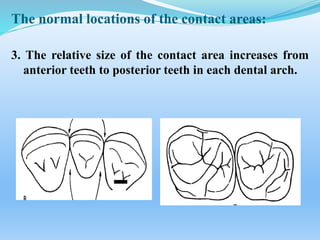
The normal locations of the contact areas:
3. The relative size of the contact area increases from
anterior teeth to posterior teeth in each dental arch.
The normal locations of the contact
areas are as follow:
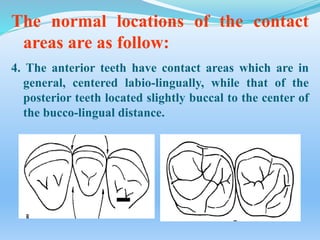
4. The anterior teeth have contact areas which are in
general, centered labio-lingually, while that of the
posterior teeth located slightly buccal to the center of
the bucco-lingual distance.
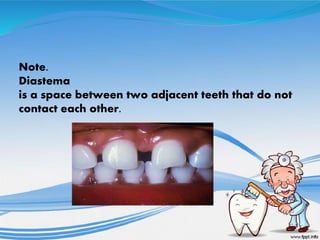
Note.
Diastema
is a space between two adjacent teeth that do not
contact each other.
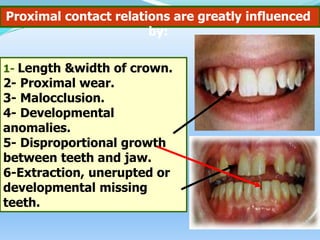
1- Length &width of crown.
2- Proximal wear.
3- Malocclusion.
4- Developmental
anomalies.
5- Disproportional growth
between teeth and jaw.
6-Extraction, unerupted or
developmental missing
teeth.
Proximal contact relations are greatly influenced
by:
The proper contact between teeth in each arch is
important for:
1. Prevent food impaction between the teeth.
2. Stabilize the dental arches by the combined
anchorage of all the teeth in either arch in positive
contact with each other.
3. Protect the interdental gingiva.
4. Distribute the masticatory forces.
5. Food flow pattern
The absence of proper contact between teeth in
each arch is important for:
1. Food impaction between the teeth with consequent
gingival inflammation which if not treated leads to
destruction of the alveolar bone and loss of the tooth.
2. Separation of the tooth causes a change in teeth
alignment which in turn bring about shifting of the
forces of mastication to an angle that is not designed
for the tooth to withstand.
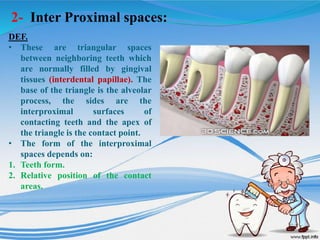
2- Inter Proximal spaces:
DEF.
• These are triangular spaces
between neighboring teeth which
are normally filled by gingival
tissues (interdental papillae). The
base of the triangle is the alveolar
process, the sides are the
interproximal surfaces of
contacting teeth and the apex of
the triangle is the contact point.
• The form of the interproximal
spaces depends on:
1. Teeth form.
2. Relative position of the contact
areas.
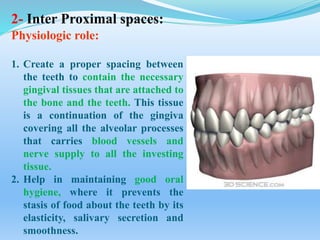
2- Inter Proximal spaces:
Physiologic role:
1. Create a proper spacing between
the teeth to contain the necessary
gingival tissues that are attached to
the bone and the teeth. This tissue
is a continuation of the gingiva
covering all the alveolar processes
that carries blood vessels and
nerve supply to all the investing
tissue.
2. Help in maintaining good oral
hygiene, where it prevents the
stasis of food about the teeth by its
elasticity, salivary secretion and
smoothness.
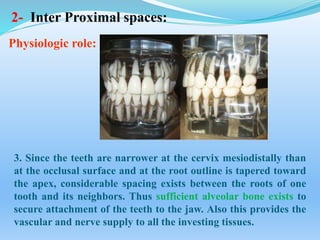
2- Inter Proximal spaces:
Physiologic role:
3. Since the teeth are narrower at the cervix mesiodistally than
at the occlusal surface and at the root outline is tapered toward
the apex, considerable spacing exists between the roots of one
tooth and its neighbors. Thus sufficient alveolar bone exists to
secure attachment of the teeth to the jaw. Also this provides the
vascular and nerve supply to all the investing tissues.
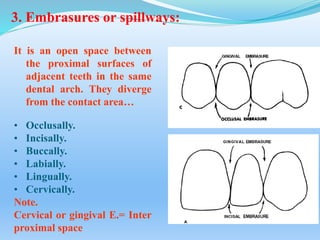
3. Embrasures or spillways:
It is an open space between
the proximal surfaces of
adjacent teeth in the same
dental arch. They diverge
from the contact area…
• Occlusally.
• Incisally.
• Buccally.
• Labially.
• Lingually.
• Cervically.
Note.
Cervical or gingival E.= Inter
proximal space
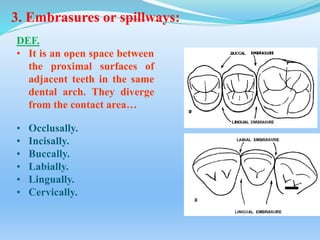
3. Embrasures or spillways:
DEF.
• It is an open space between
the proximal surfaces of
adjacent teeth in the same
dental arch. They diverge
from the contact area…
• Occlusally.
• Incisally.
• Buccally.
• Labially.
• Lingually.
• Cervically.
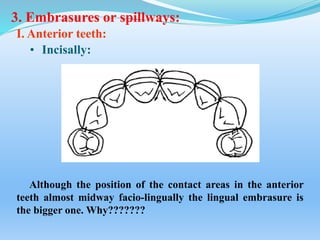
3. Embrasures or spillways:
I. Anterior teeth:
• Incisally:
Although the position of the contact areas in the anterior
teeth almost midway facio-lingually the lingual embrasure is
the bigger one. Why???????
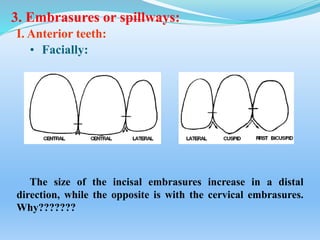
3. Embrasures or spillways:
I. Anterior teeth:
• Facially:
The size of the incisal embrasures increase in a distal
direction, while the opposite is with the cervical embrasures.
Why???????
3 -Embrasures or spillways:
II. Posterior teeth:
• Occlusally
•The position of the contact areas in
the posterior teeth are more buccally
SO the lingual embrasure is the
bigger one.
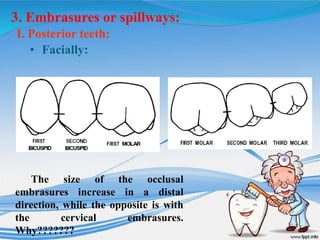
3. Embrasures or spillways:
I. Posterior teeth:
• Facially:
The size of the occlusal
embrasures increase in a distal
direction, while the opposite is with
the cervical embrasures.
Why???????
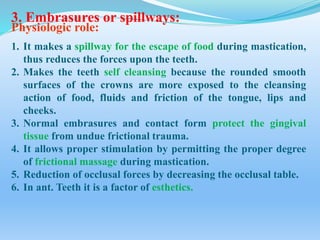
3. Embrasures or spillways:
Physiologic role:
1. It makes a spillway for the escape of food during mastication,
thus reduces the forces upon the teeth.
2. Makes the teeth self cleansing because the rounded smooth
surfaces of the crowns are more exposed to the cleansing
action of food, fluids and friction of the tongue, lips and
cheeks.
3. Normal embrasures and contact form protect the gingival
tissue from undue frictional trauma.
4. It allows proper stimulation by permitting the proper degree
of frictional massage during mastication.
5. Reduction of occlusal forces by decreasing the occlusal table.
6. In ant. Teeth it is a factor of esthetics.
2- The size of the incisal
embrasures increase in a distal
direction. ( )
Conclusion
32
Physiologic tooth part 1

Physiologic tooth part 1

  • 2.
    The Physiologic Tooth FormProtecting The Periodontium By Dr/ Rehab Rizk
  • 3.
    Factors affecting theprotective functional forms of the tooth crowns
  • 4.
  • 6.
    The Periodontium Is theinvesting , supporting , attachment and covering system of teeth. It consists of: Two Soft Tissues Two Hard Tissues 1- Gingiva 2- Periodontal Ligament 1- Cementum 2- Alveolar Bone
  • 7.
    The protective functionalforms of the tooth crowns includes direct factors and indirect factors : The direct factors are: 1. Proximal contact areas. 2. Interproximal spaces. 3. Embrasures ( spillways ). 4. Facial and lingual contours of the crowns 5. Curvatures of the cervical lines.
  • 8.
    1- Proximal contactareas: DEF. Contact areas :The crests of curvature on the proximal surfaces of tooth crowns where the tooth touches the adjacent tooth in the same arch. Contours : Convexity on facial and lingual surfaces that affords protection and stimulation of supporting tissues during mastication.
  • 9.
    Each tooth hastwo contact areas one mesial and one distal except third molars 1- Proximal contact relation*When newly erupted, The teeth have a tight pointed contact at their proximal maximal contour. *This pointed contact is transformed into area of contact by time due to continuous wear of the proximal maximal contour of adjacent teeth .
  • 11.
    To demonstrate the positionof this contact areas labiolingually or buccolingually. The contact areas must be observed from two aspects in order to locate them: The labial or buccal aspect: To demonstrate the relative position of the contact areas cervico-incisally or cervico- occlusally. The incisal or occlusal aspect:
  • 12.
    The normal locationsof the contact areas: 1. Contact areas become more cervically located from anterior teeth to posterior teeth in each quadrant.
  • 13.
    The normal locationsof the contact areas: 2. On individual tooth the distal contact area has a more cervical location than the mesial contact area.
  • 14.
    The normal locationsof the contact areas: 3. The relative size of the contact area increases from anterior teeth to posterior teeth in each dental arch.
  • 15.
    The normal locationsof the contact areas are as follow: 4. The anterior teeth have contact areas which are in general, centered labio-lingually, while that of the posterior teeth located slightly buccal to the center of the bucco-lingual distance.
  • 16.
    Note. Diastema is a spacebetween two adjacent teeth that do not contact each other.
  • 17.
    1- Length &widthof crown. 2- Proximal wear. 3- Malocclusion. 4- Developmental anomalies. 5- Disproportional growth between teeth and jaw. 6-Extraction, unerupted or developmental missing teeth. Proximal contact relations are greatly influenced by:
  • 18.
    The proper contactbetween teeth in each arch is important for: 1. Prevent food impaction between the teeth. 2. Stabilize the dental arches by the combined anchorage of all the teeth in either arch in positive contact with each other. 3. Protect the interdental gingiva. 4. Distribute the masticatory forces. 5. Food flow pattern
  • 19.
    The absence ofproper contact between teeth in each arch is important for: 1. Food impaction between the teeth with consequent gingival inflammation which if not treated leads to destruction of the alveolar bone and loss of the tooth. 2. Separation of the tooth causes a change in teeth alignment which in turn bring about shifting of the forces of mastication to an angle that is not designed for the tooth to withstand.
  • 21.
    2- Inter Proximalspaces: DEF. • These are triangular spaces between neighboring teeth which are normally filled by gingival tissues (interdental papillae). The base of the triangle is the alveolar process, the sides are the interproximal surfaces of contacting teeth and the apex of the triangle is the contact point. • The form of the interproximal spaces depends on: 1. Teeth form. 2. Relative position of the contact areas.
  • 22.
    2- Inter Proximalspaces: Physiologic role: 1. Create a proper spacing between the teeth to contain the necessary gingival tissues that are attached to the bone and the teeth. This tissue is a continuation of the gingiva covering all the alveolar processes that carries blood vessels and nerve supply to all the investing tissue. 2. Help in maintaining good oral hygiene, where it prevents the stasis of food about the teeth by its elasticity, salivary secretion and smoothness.
  • 23.
    2- Inter Proximalspaces: Physiologic role: 3. Since the teeth are narrower at the cervix mesiodistally than at the occlusal surface and at the root outline is tapered toward the apex, considerable spacing exists between the roots of one tooth and its neighbors. Thus sufficient alveolar bone exists to secure attachment of the teeth to the jaw. Also this provides the vascular and nerve supply to all the investing tissues.
  • 24.
    3. Embrasures orspillways: It is an open space between the proximal surfaces of adjacent teeth in the same dental arch. They diverge from the contact area… • Occlusally. • Incisally. • Buccally. • Labially. • Lingually. • Cervically. Note. Cervical or gingival E.= Inter proximal space
  • 25.
    3. Embrasures orspillways: DEF. • It is an open space between the proximal surfaces of adjacent teeth in the same dental arch. They diverge from the contact area… • Occlusally. • Incisally. • Buccally. • Labially. • Lingually. • Cervically.
  • 26.
    3. Embrasures orspillways: I. Anterior teeth: • Incisally: Although the position of the contact areas in the anterior teeth almost midway facio-lingually the lingual embrasure is the bigger one. Why???????
  • 27.
    3. Embrasures orspillways: I. Anterior teeth: • Facially: The size of the incisal embrasures increase in a distal direction, while the opposite is with the cervical embrasures. Why???????
  • 28.
    3 -Embrasures orspillways: II. Posterior teeth: • Occlusally •The position of the contact areas in the posterior teeth are more buccally SO the lingual embrasure is the bigger one.
  • 29.
    3. Embrasures orspillways: I. Posterior teeth: • Facially: The size of the occlusal embrasures increase in a distal direction, while the opposite is with the cervical embrasures. Why???????
  • 30.
    3. Embrasures orspillways: Physiologic role: 1. It makes a spillway for the escape of food during mastication, thus reduces the forces upon the teeth. 2. Makes the teeth self cleansing because the rounded smooth surfaces of the crowns are more exposed to the cleansing action of food, fluids and friction of the tongue, lips and cheeks. 3. Normal embrasures and contact form protect the gingival tissue from undue frictional trauma. 4. It allows proper stimulation by permitting the proper degree of frictional massage during mastication. 5. Reduction of occlusal forces by decreasing the occlusal table. 6. In ant. Teeth it is a factor of esthetics.
  • 31.
    2- The sizeof the incisal embrasures increase in a distal direction. ( )
  • 32.