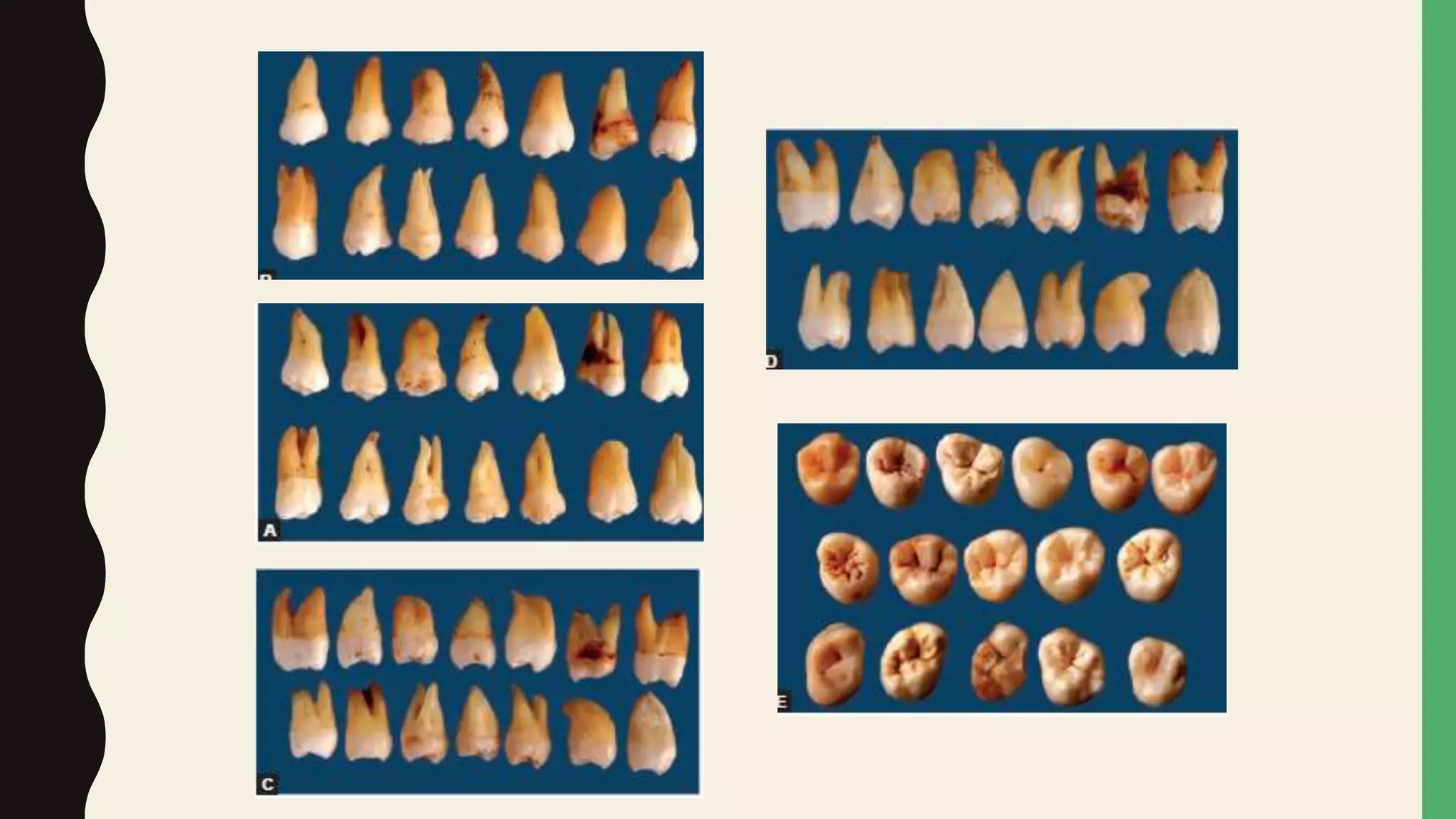
MAXILLARY
MOLARS
M E N A T A L L A M
E L H I N D A W Y
Maxillary Second Molar
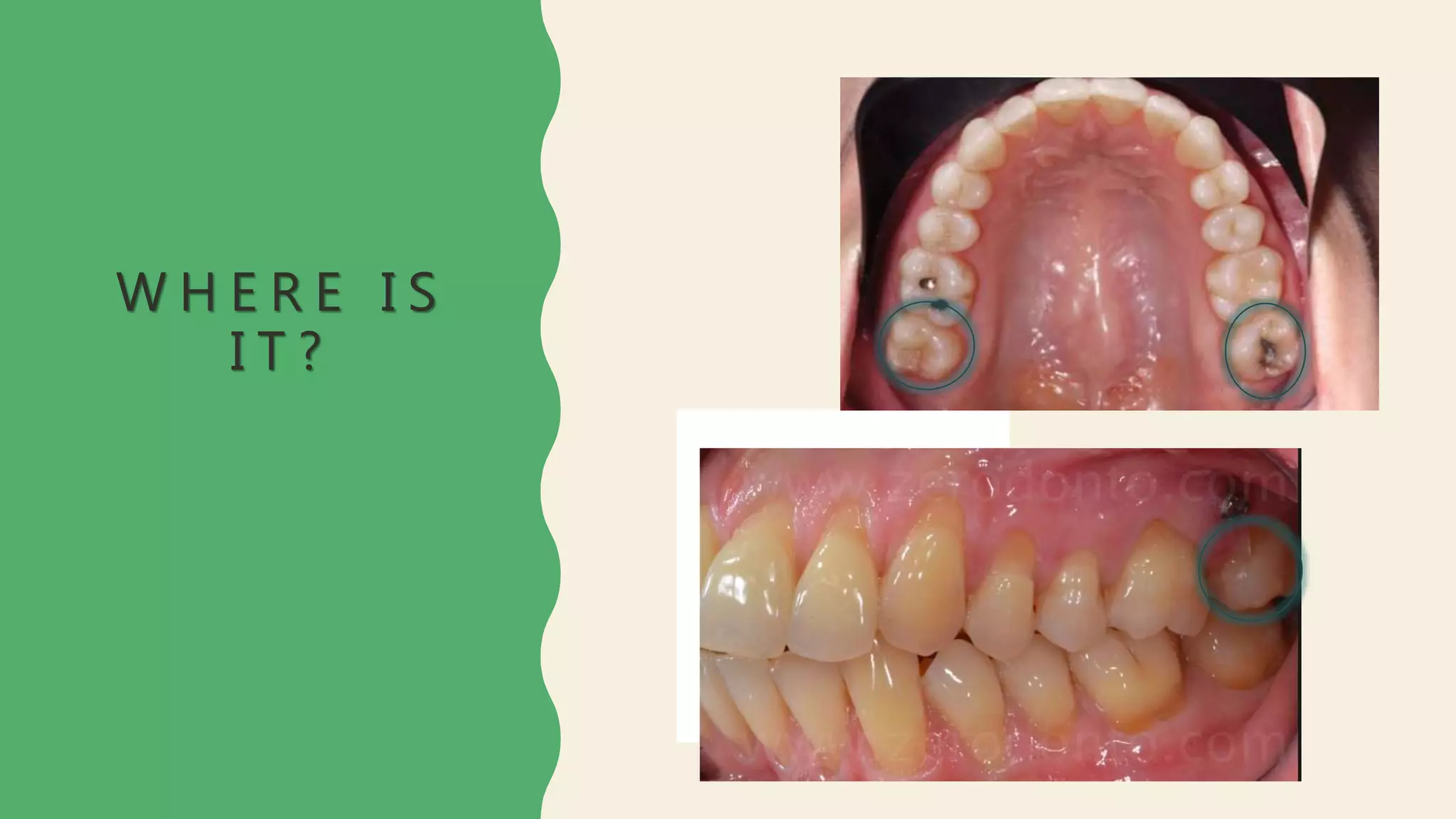
W H E R E I S
I T ?
I S I T A
S U C C E S S O
R ? ?
MAXILLARY 2ND
MOLAR
 Chronology
 Tooth aspects
 Buccal
 Palatal
 Mesial
 Distal
 Occlusal
 In Our Life
 Variations & Anomalies
MAXILLARY 2ND MOLAR
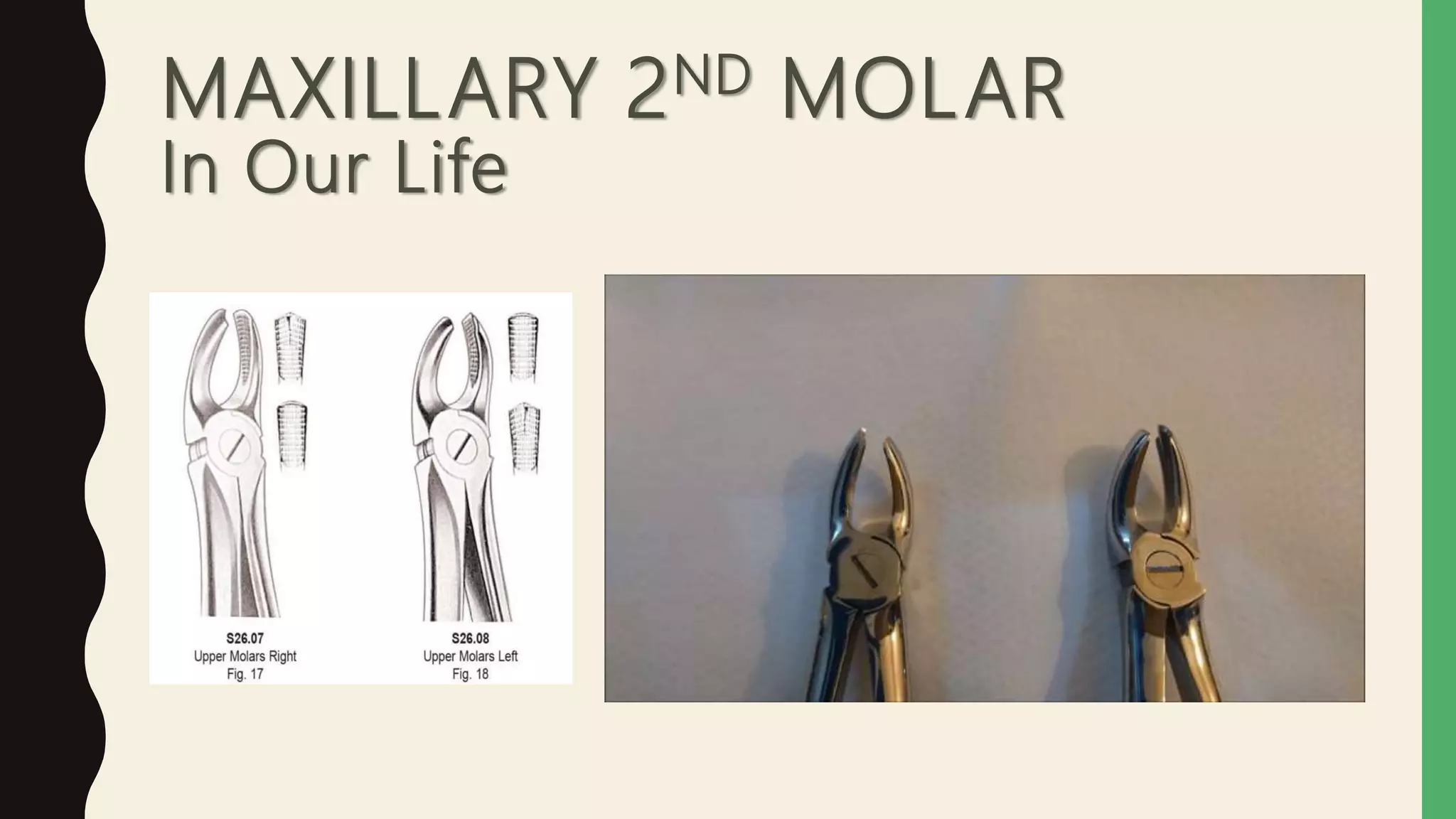
In Our Life
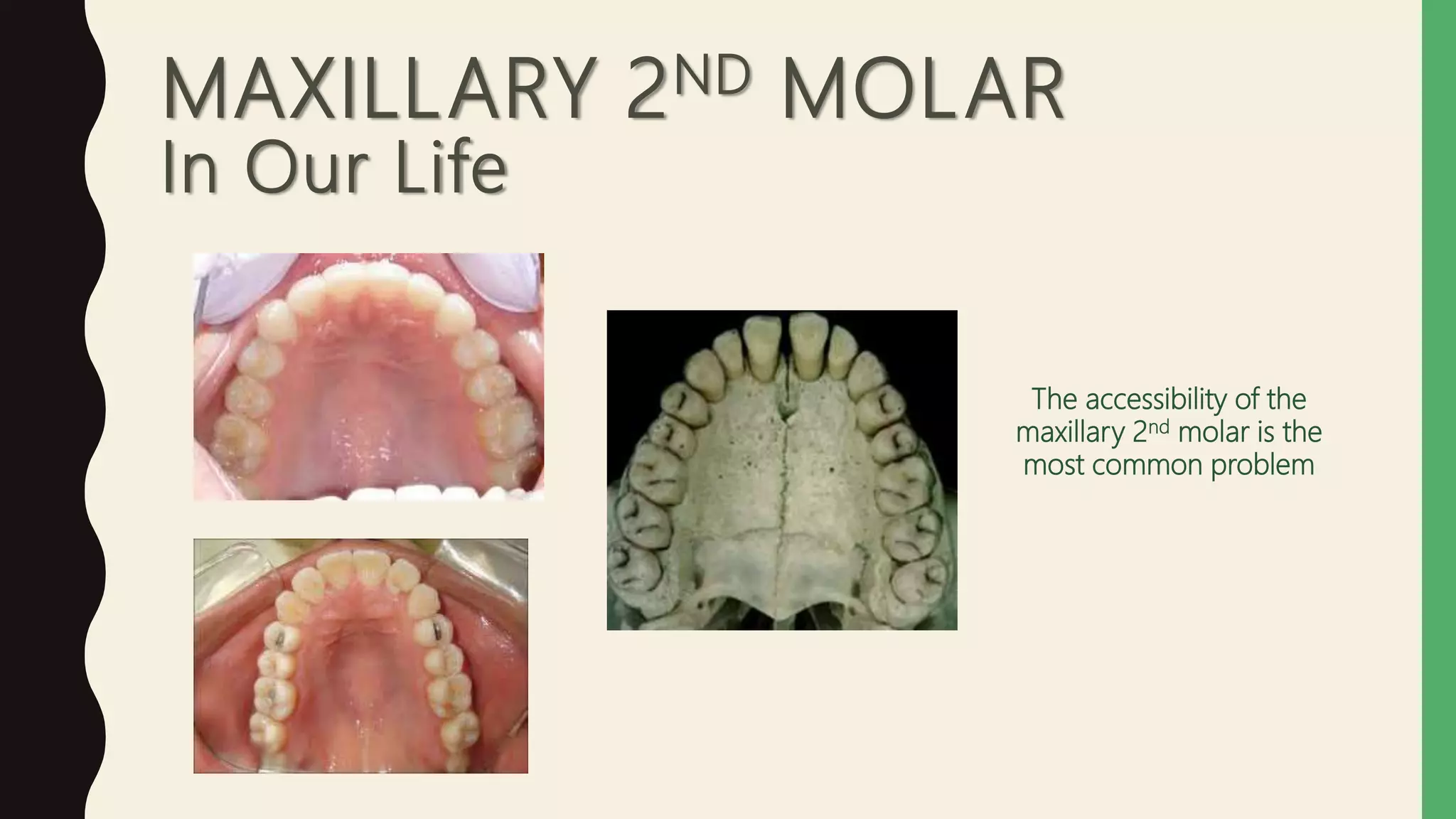
The accessibility of the
maxillary 2nd molar is the
most common problem
MAXILLARY 2ND MOLAR
In Our Life
MAXILLARY 2ND MOLAR
Chronology
First evidence of calcification.. 2 12- 3 y
Crown completed.. 7-8 y
Eruption.. 11-13 y
Root completion.. 14-16 y
MAXILLARY 2ND MOLAR
Buccal Aspect
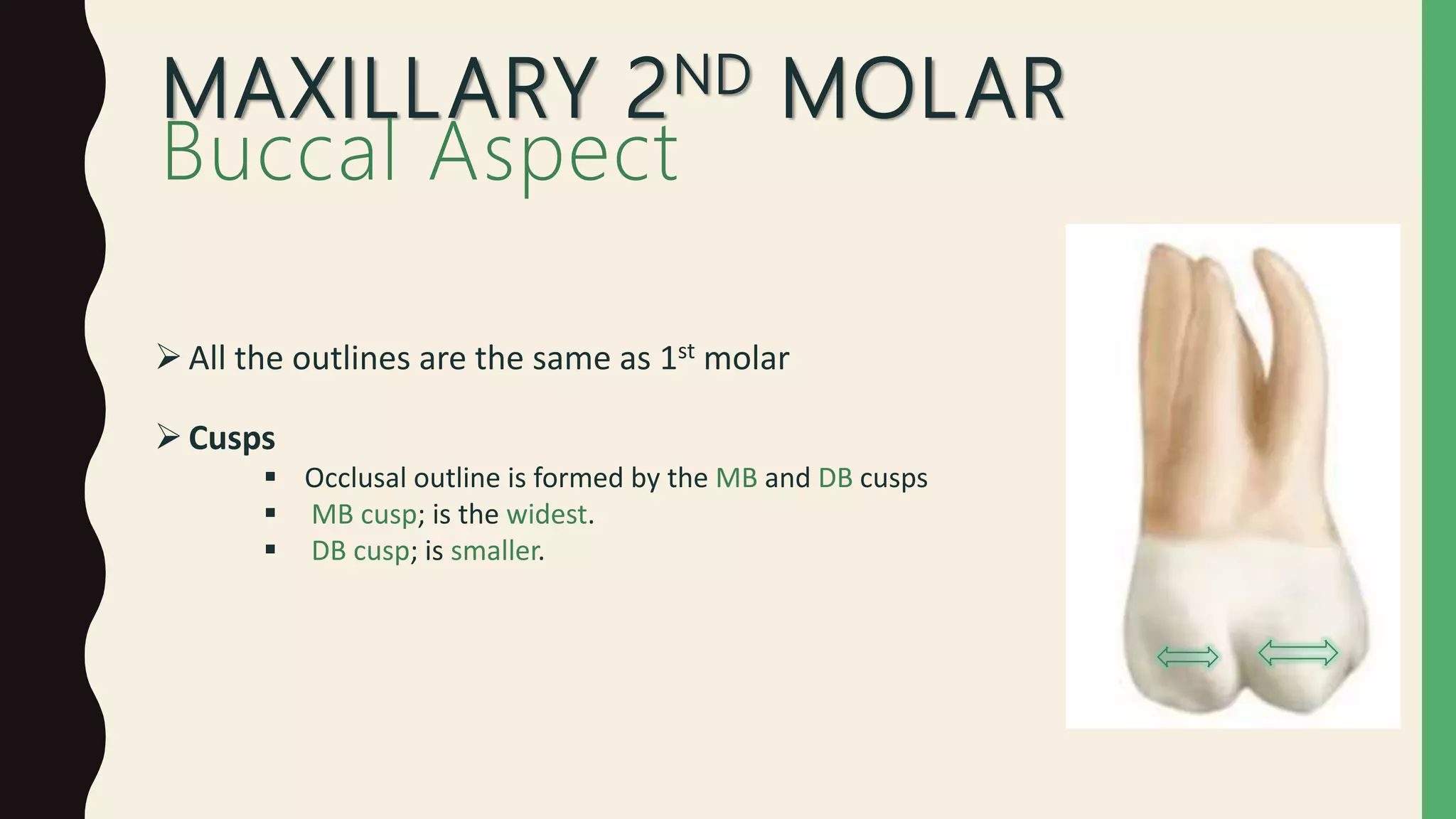
All the outlines are the same as 1st molar
Cusps
 Occlusal outline is formed by the MB and DB cusps
 MB cusp; is the widest.
 DB cusp; is smaller.
MAXILLARY 2ND MOLAR
Buccal Aspect
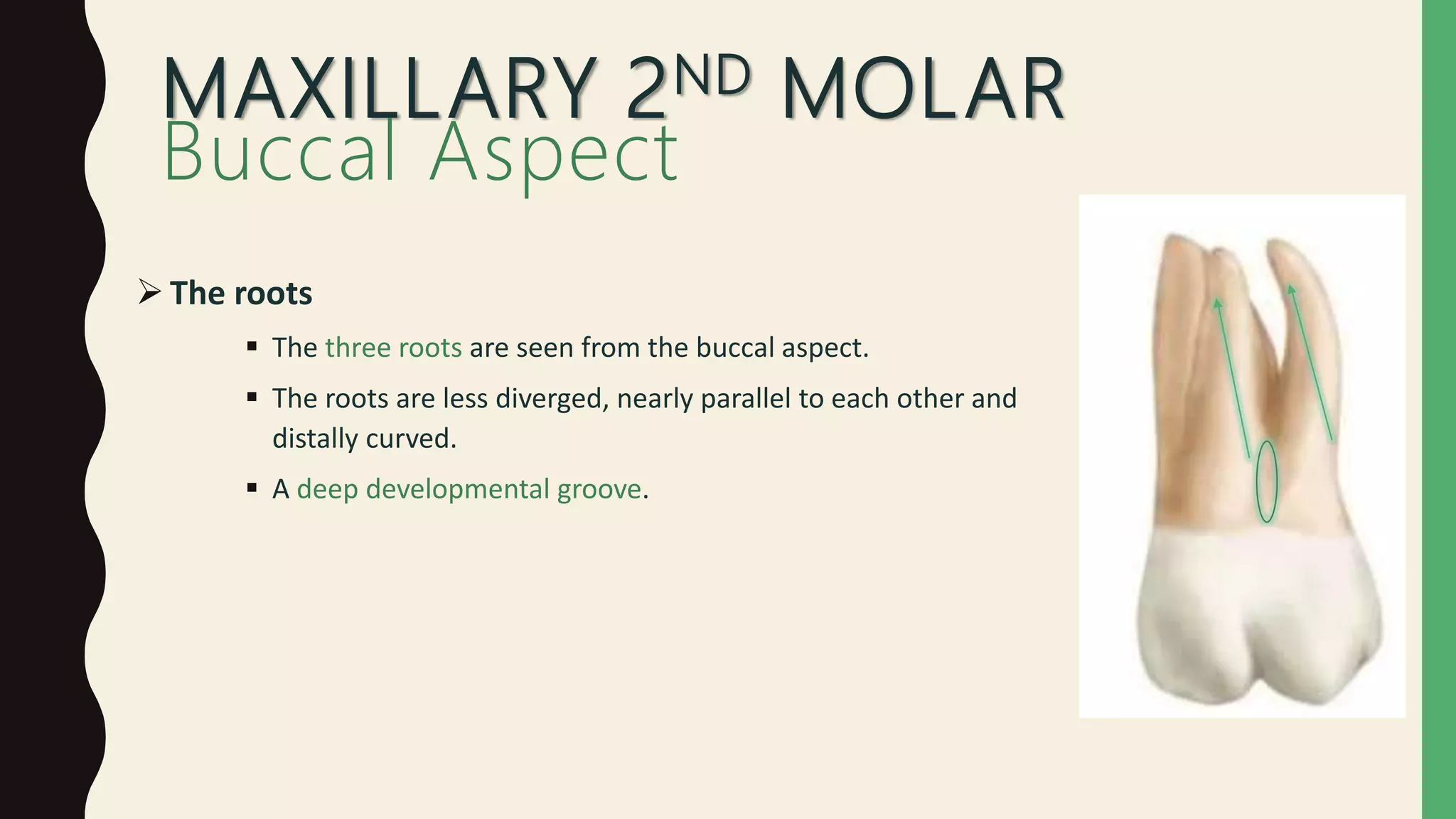
The roots
 The three roots are seen from the buccal aspect.
 The roots are less diverged, nearly parallel to each other and
distally curved.
 A deep developmental groove.
MAXILLARY 2ND MOLAR
Palatal Aspect
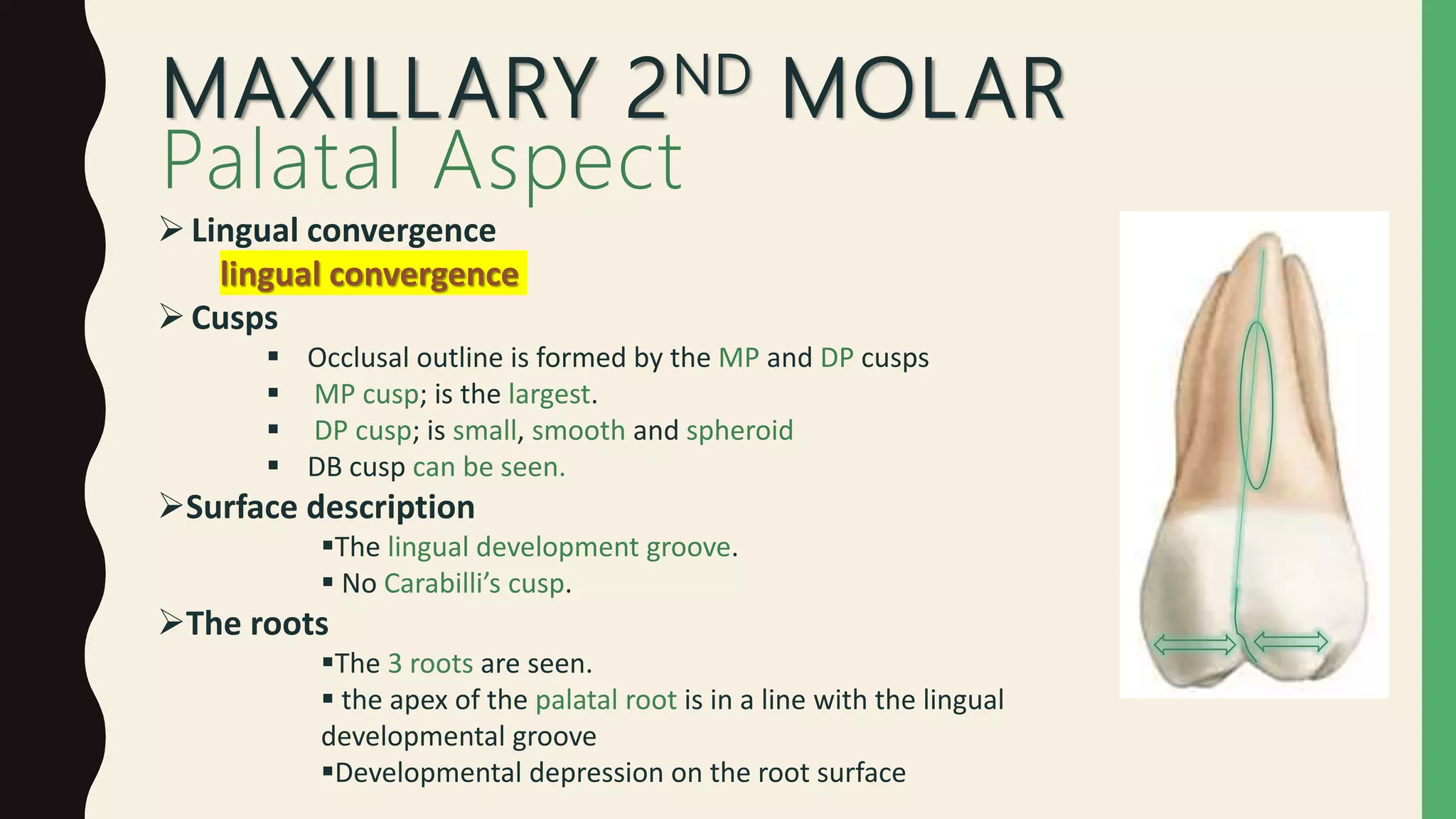
Lingual convergence
lingual convergence
Cusps
 Occlusal outline is formed by the MP and DP cusps
 MP cusp; is the largest.
 DP cusp; is small, smooth and spheroid
 DB cusp can be seen.
Surface description
The lingual development groove.
 No Carabilli’s cusp.
The roots
The 3 roots are seen.
 the apex of the palatal root is in a line with the lingual
developmental groove
Developmental depression on the root surface
MAXILLARY 2ND MOLAR
In Our Life
MAXILLARY 2ND
MOLAR
Mesial Aspect
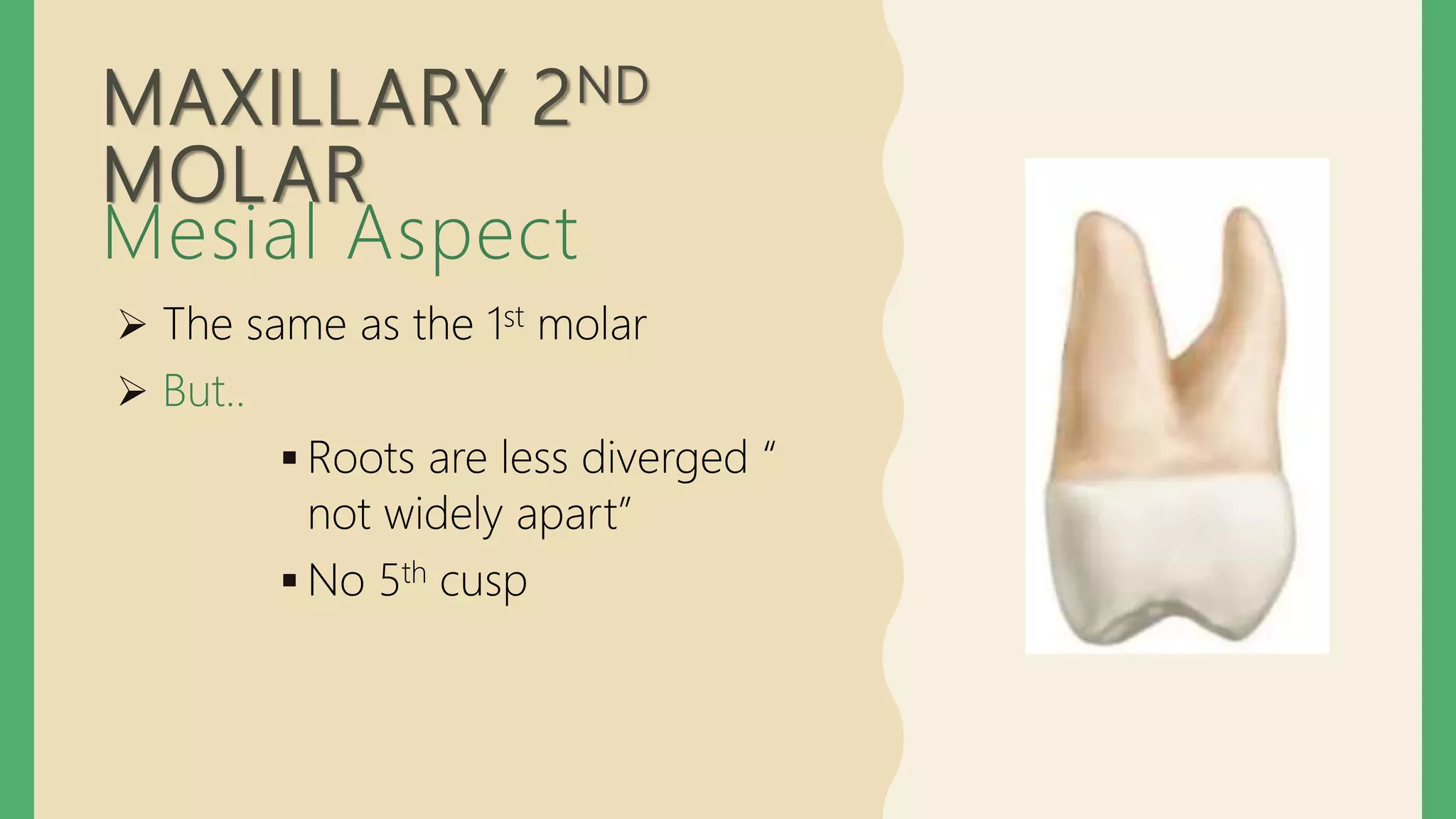
 The same as the 1st molar
 But..
 Roots are less diverged “
not widely apart”
 No 5th cusp
MAXILLARY 2ND
MOLAR
Distal Aspect
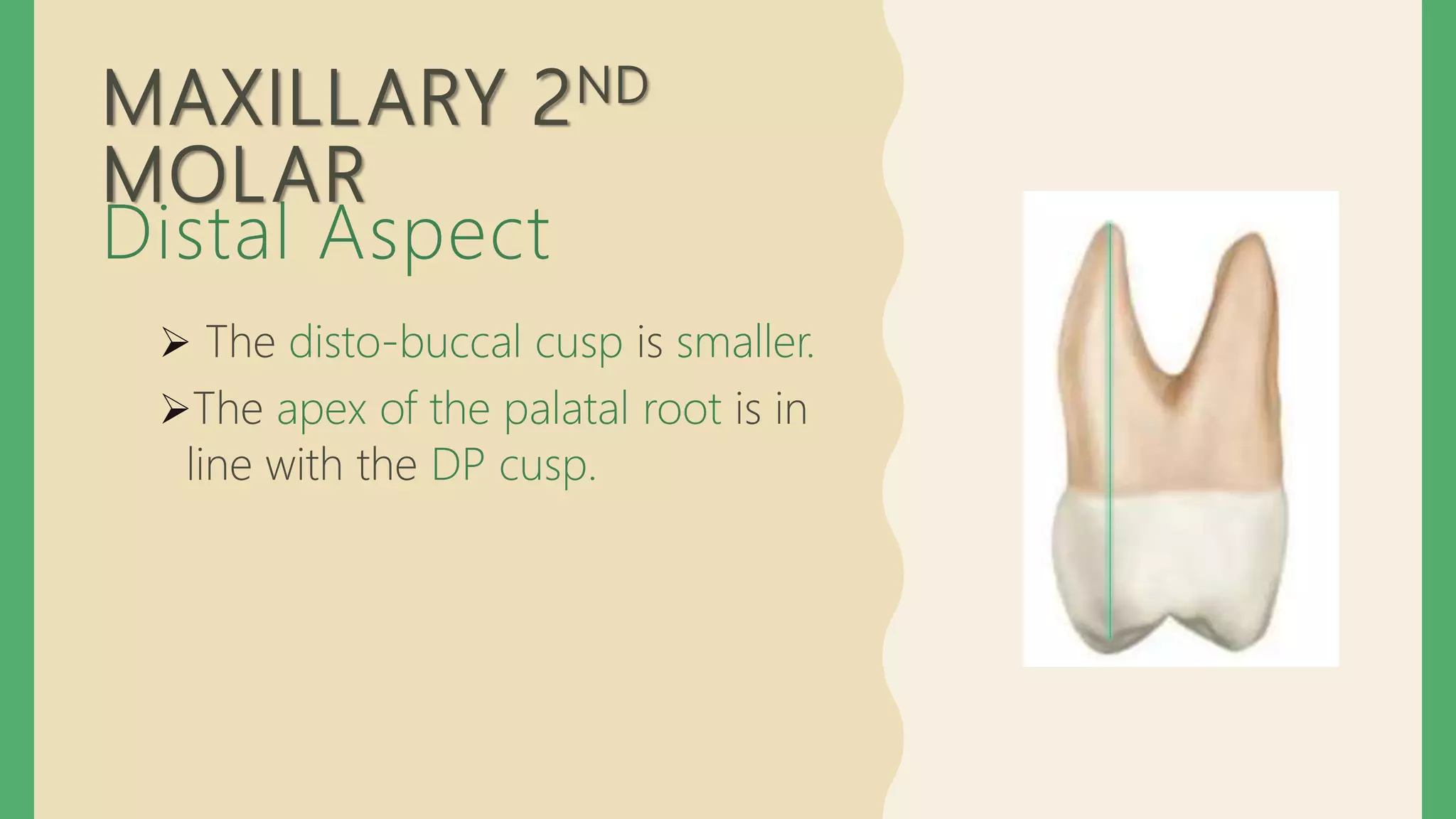
 The disto-buccal cusp is smaller.
The apex of the palatal root is in
line with the DP cusp.
MAXILLARY 2ND MOLAR
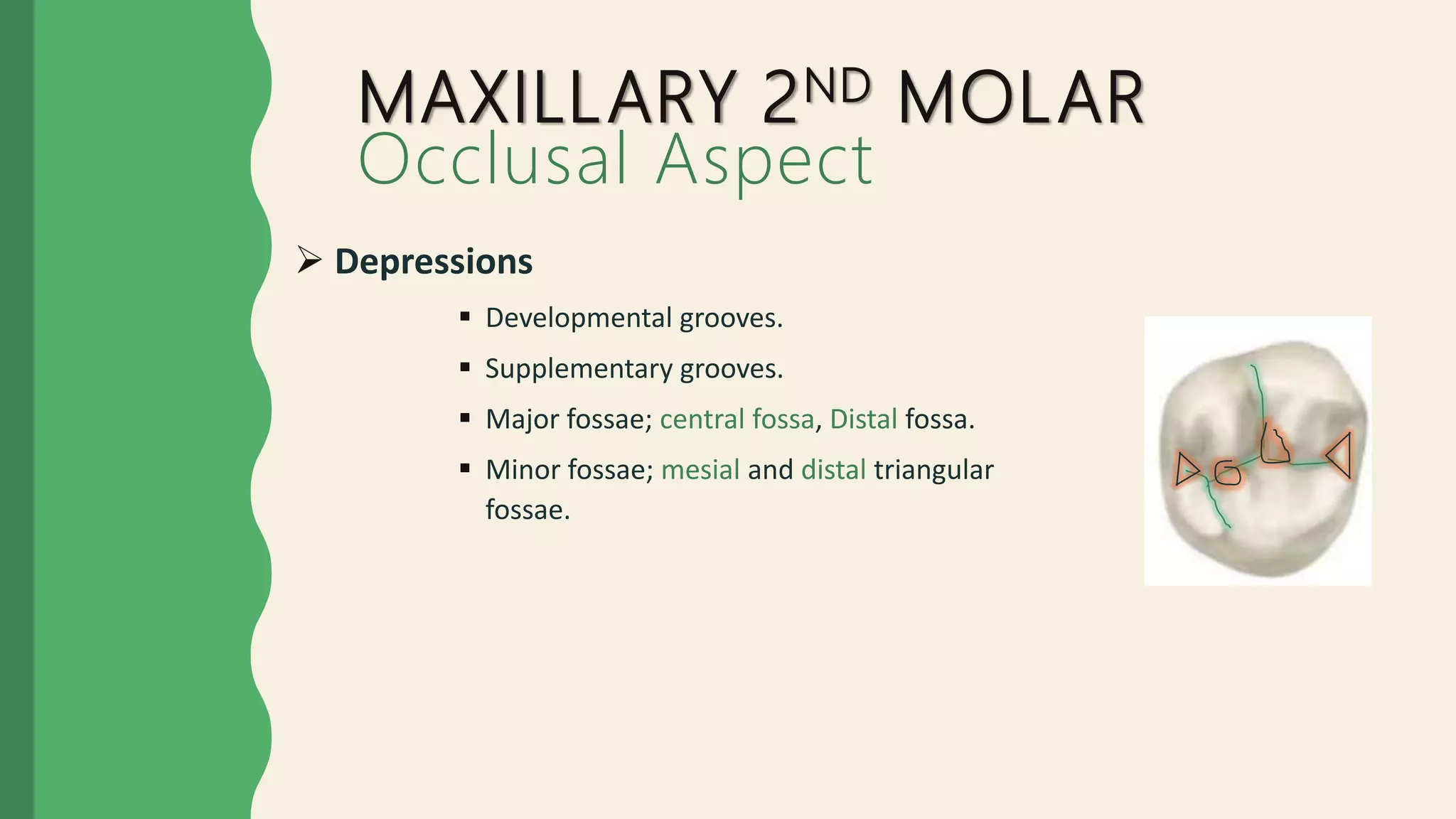
Occlusal Aspect
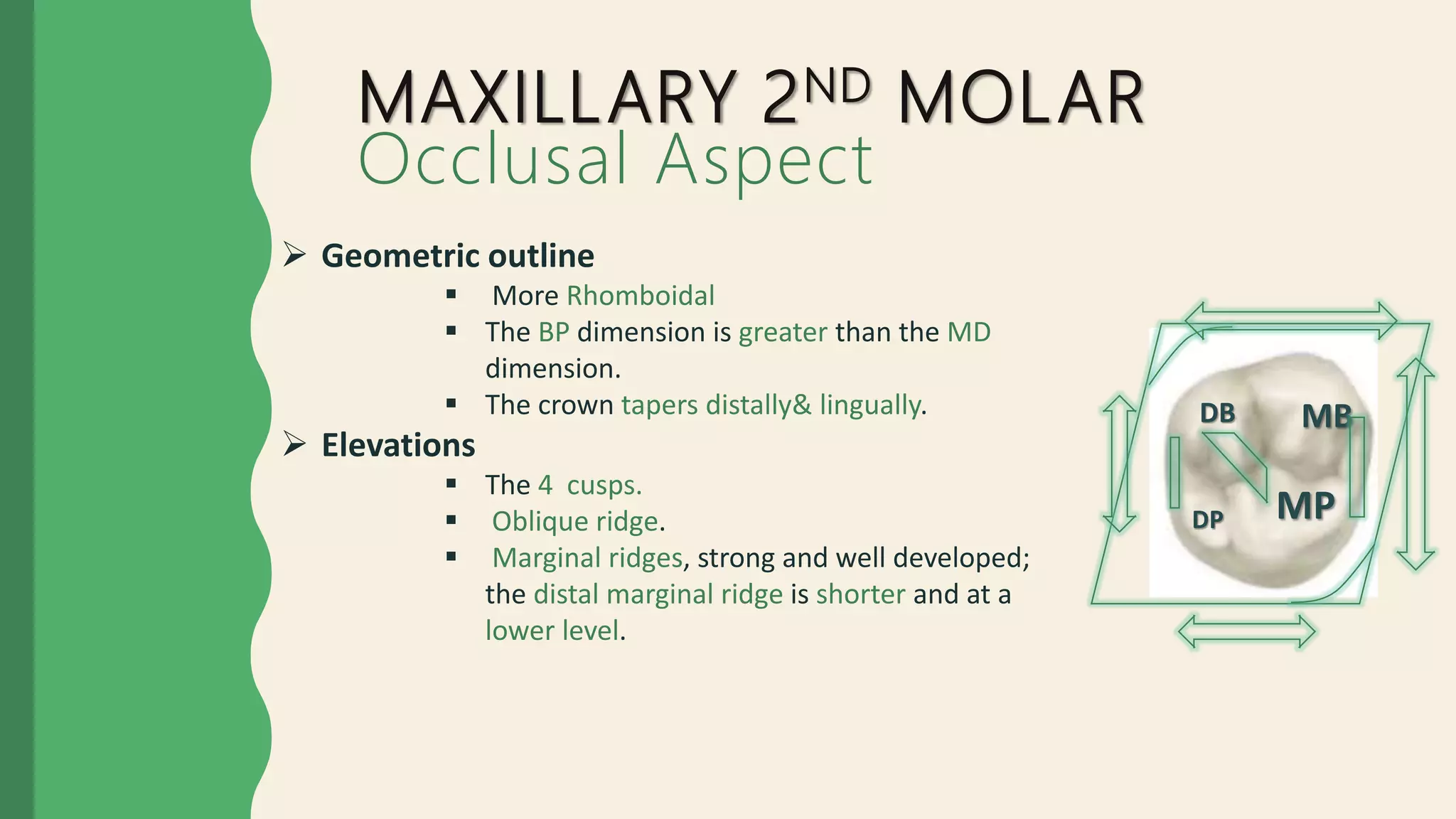
 Geometric outline
 More Rhomboidal
 The BP dimension is greater than the MD
dimension.
 The crown tapers distally& lingually.
 Elevations
 The 4 cusps.
 Oblique ridge.
 Marginal ridges, strong and well developed;
the distal marginal ridge is shorter and at a
lower level.
MP
DB MB
DP
MAXILLARY 2ND MOLAR
Occlusal Aspect
 Depressions
 Developmental grooves.
 Supplementary grooves.
 Major fossae; central fossa, Distal fossa.
 Minor fossae; mesial and distal triangular
fossae.
MAXILLARY 2ND MOLAR
Variations &
Anomalies
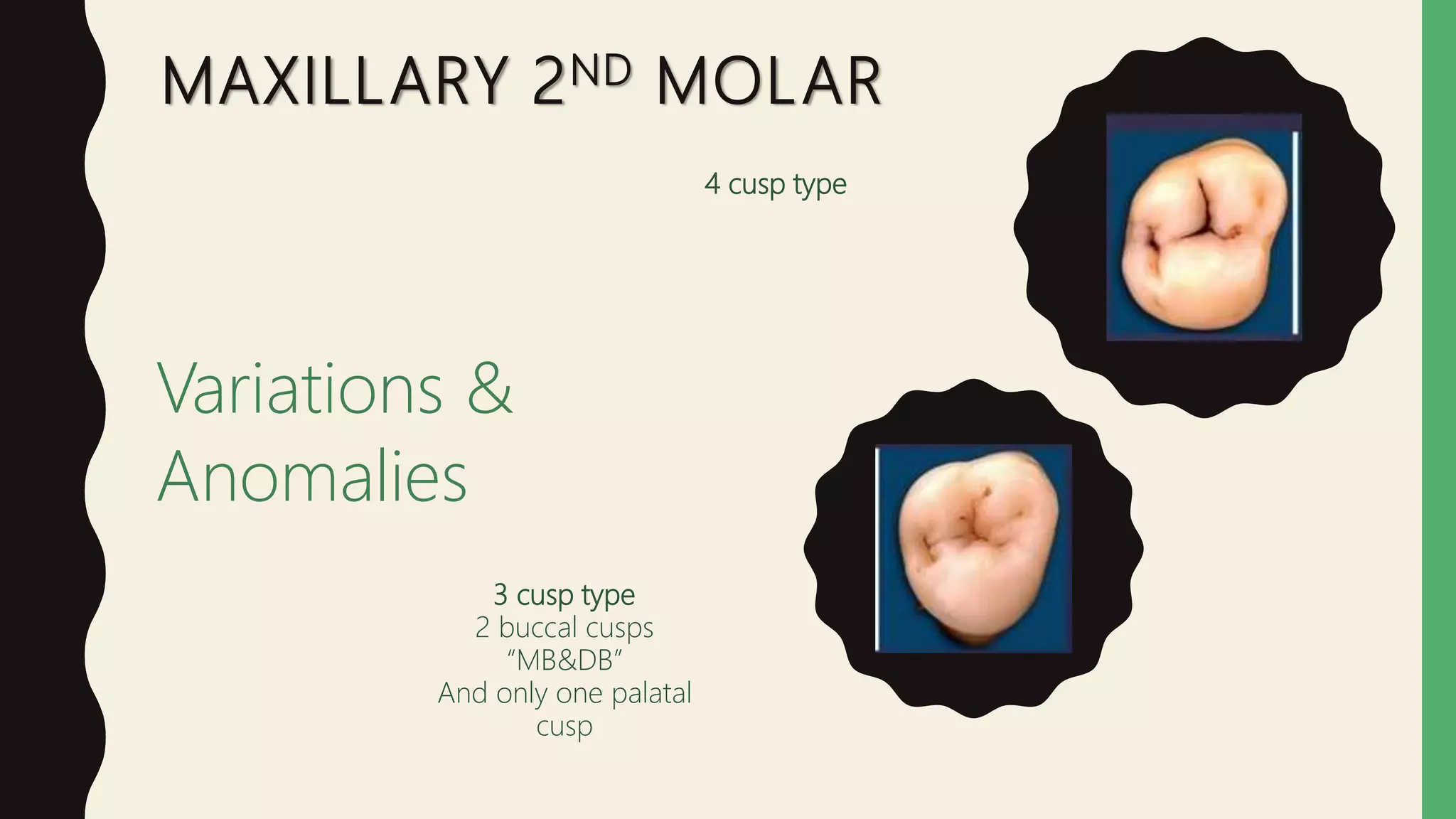
4 cusp type
3 cusp type
2 buccal cusps
“MB&DB”
And only one palatal
cusp
MAXILLARY 2ND
MOLAR
Variations &
Anomalies
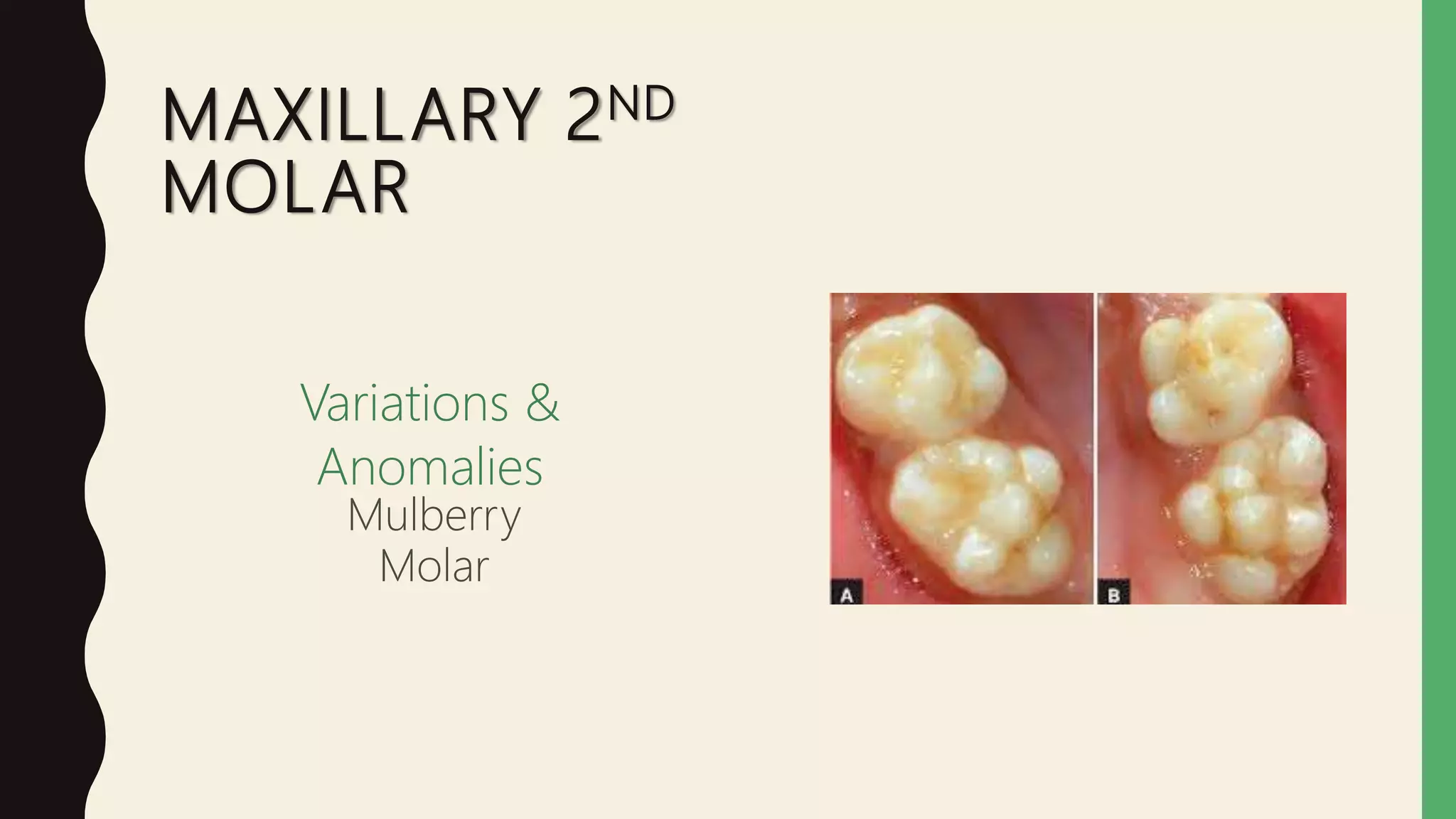
Mulberry
Molar
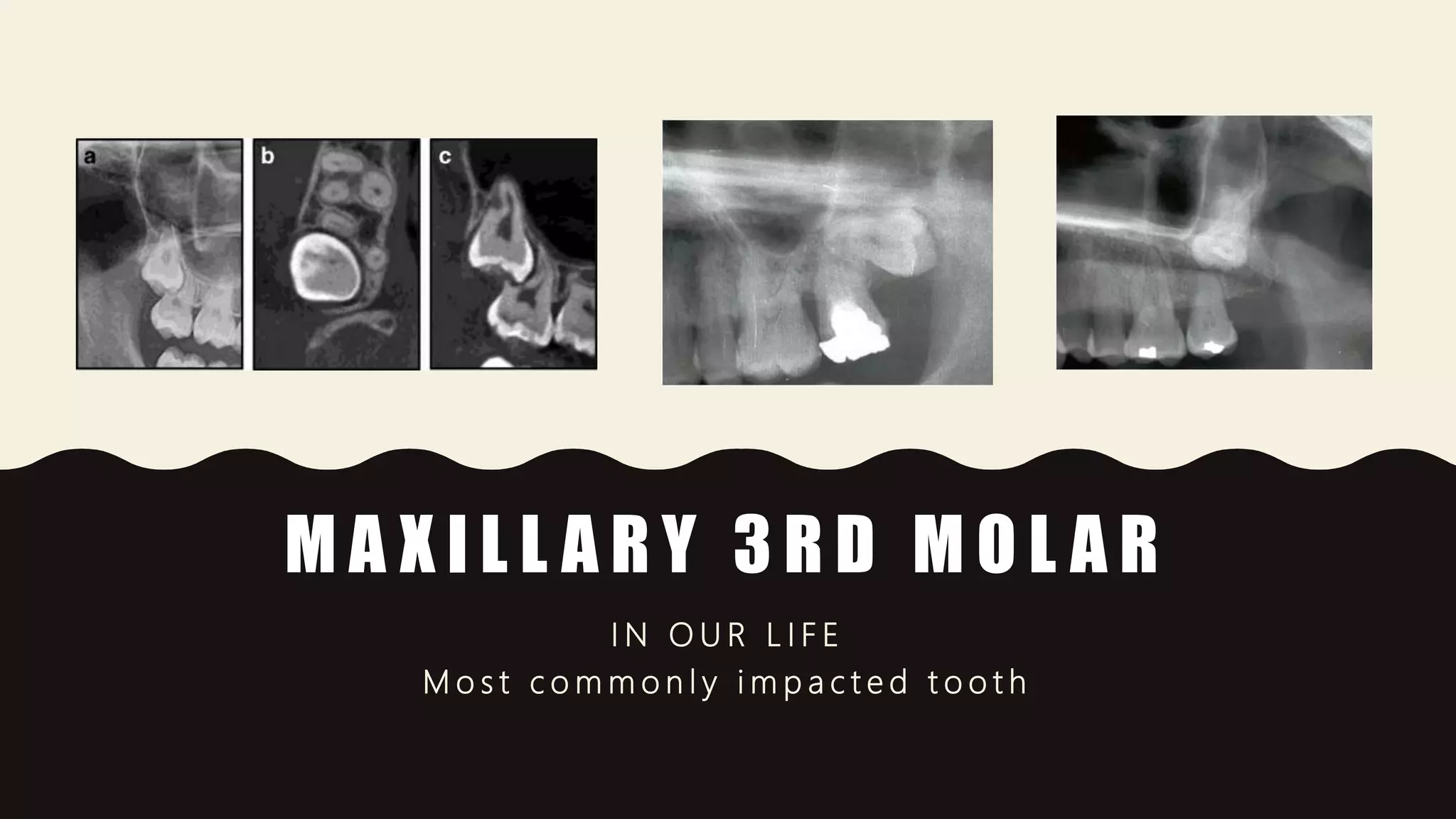
Maxillary Third Molar
M A X I L L A R Y 3 R D M O L A R
I N O U R L I F E
M o s t c o m m o n l y i m p a c t e d t o o t h
Pulp Cavities
Of Maxillary
Molars
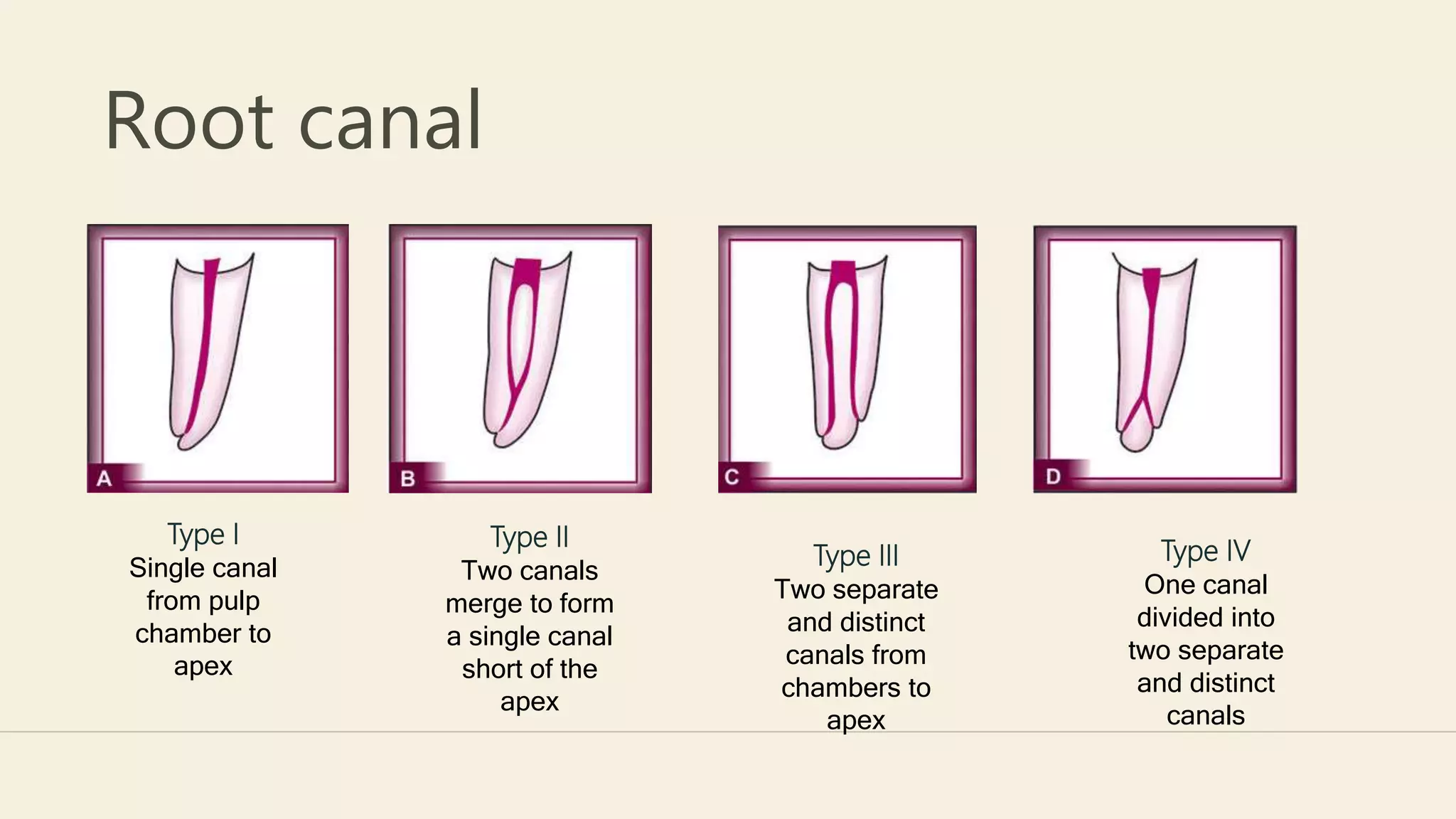
Type I
Single canal
from pulp
chamber to
apex
Type II
Two canals
merge to form
a single canal
short of the
apex
Type III
Two separate
and distinct
canals from
chambers to
apex
Type IV
One canal
divided into
two separate
and distinct
canals
Root canal
Pulp Cavities
Pulp
Cavity
Pulp
Chamber
Root
Canal
Cross
Section
Access
Cavity
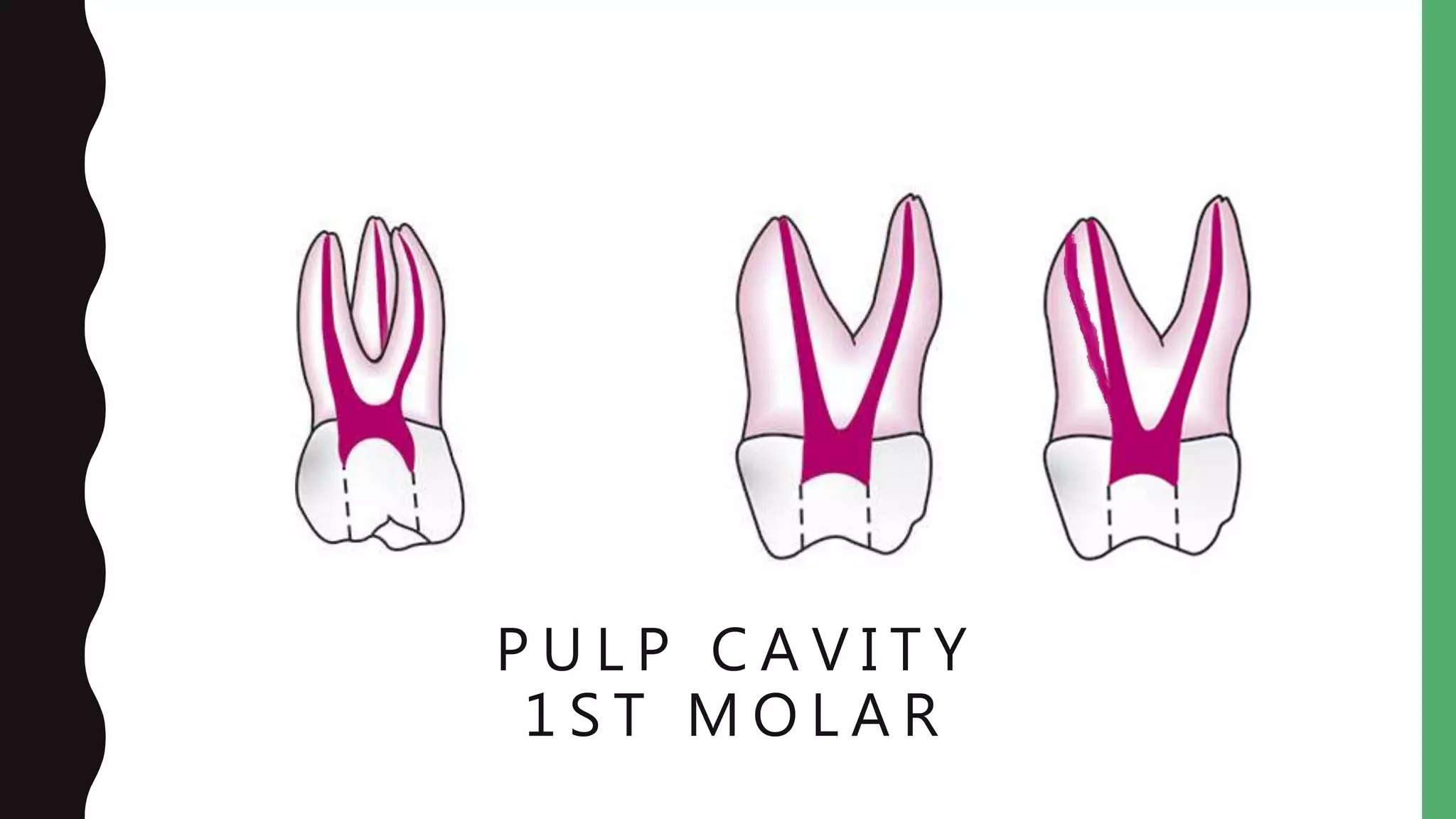
PULP CAVITY
OF MAX. 1ST
MOLAR
P U L P C A V I T Y
1 S T M O L A R
P U L P C A V I T Y
1 S T M O L A R
P U L P C A V I T Y
1 S T M O L A R
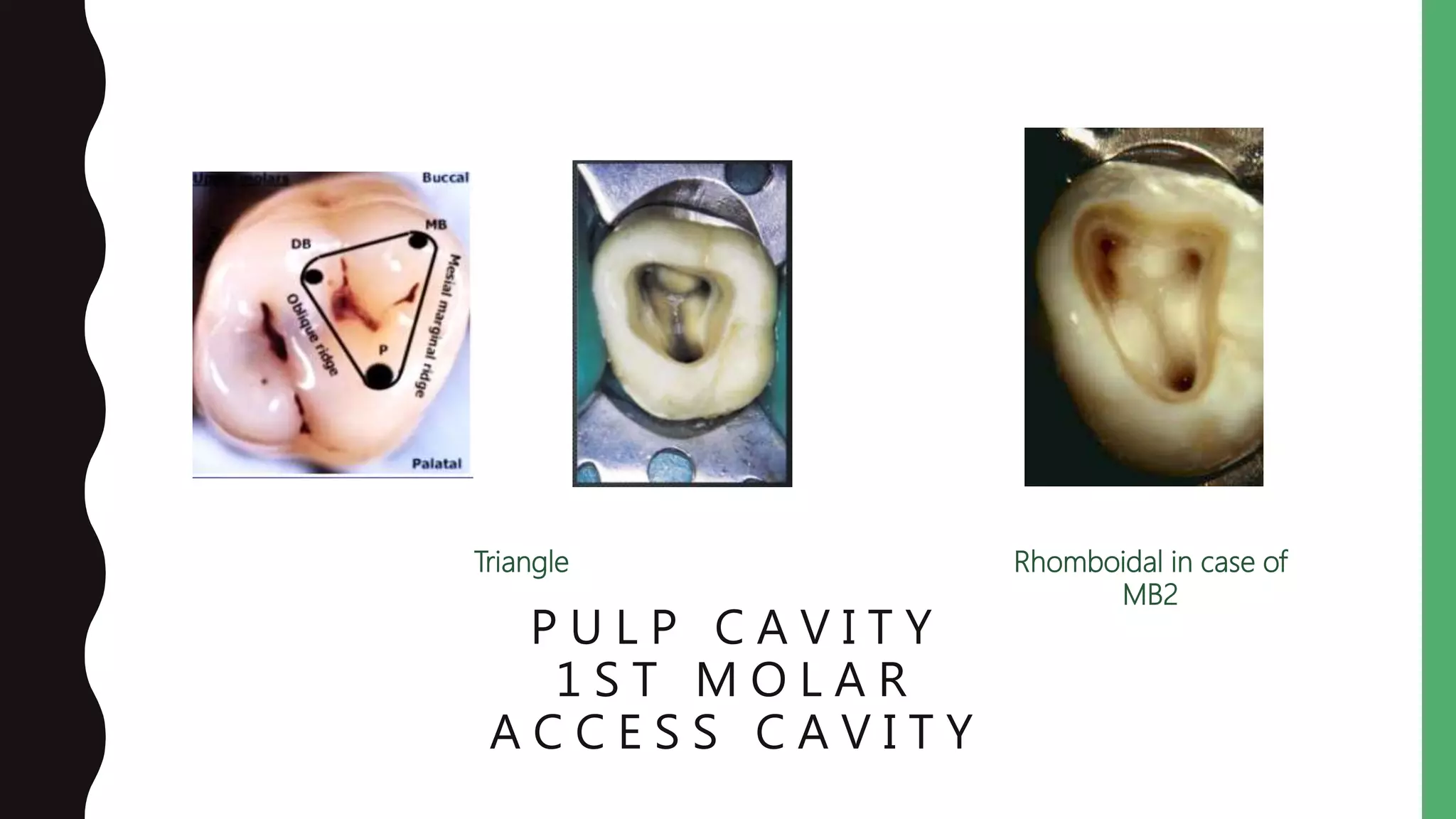
A C C E S S C A V I T Y
Triangle Rhomboidal in case of
MB2
PULP CAVITY
OF MAX. 2ND
MOLAR
PULP CAVITY
2ND MOLAR
 Canals are not flared or spaced as in 1st molar
 Two buccal root canals even if there is fused roots.
 One root canal in the mb root but two canals in the mb root
also may be seen
 Because the dl cusp is normally reduced in size, the dl pulp
horn is also relatively smaller.
 The DB orifice approaches midpoint between mb and
palatal canals.
 When the general crown form of this tooth is heart shaped,
cervical cross section is usually roughly triangular
 In mid root cross section the MB root is rectangular with
rounded corners. DB and palatal roots are round or oval.
THANK
YOU

Maxillary second molar

  • 1.
    MAXILLARY MOLARS M E NA T A L L A M E L H I N D A W Y
  • 3.
  • 4.
    W H ER E I S I T ?
  • 5.
    I S IT A S U C C E S S O R ? ?
  • 6.
    MAXILLARY 2ND MOLAR  Chronology Tooth aspects  Buccal  Palatal  Mesial  Distal  Occlusal  In Our Life  Variations & Anomalies
  • 7.
    MAXILLARY 2ND MOLAR InOur Life The accessibility of the maxillary 2nd molar is the most common problem
  • 8.
  • 9.
    MAXILLARY 2ND MOLAR Chronology Firstevidence of calcification.. 2 12- 3 y Crown completed.. 7-8 y Eruption.. 11-13 y Root completion.. 14-16 y
  • 10.
    MAXILLARY 2ND MOLAR BuccalAspect All the outlines are the same as 1st molar Cusps  Occlusal outline is formed by the MB and DB cusps  MB cusp; is the widest.  DB cusp; is smaller.
  • 11.
    MAXILLARY 2ND MOLAR BuccalAspect The roots  The three roots are seen from the buccal aspect.  The roots are less diverged, nearly parallel to each other and distally curved.  A deep developmental groove.
  • 12.
    MAXILLARY 2ND MOLAR PalatalAspect Lingual convergence lingual convergence Cusps  Occlusal outline is formed by the MP and DP cusps  MP cusp; is the largest.  DP cusp; is small, smooth and spheroid  DB cusp can be seen. Surface description The lingual development groove.  No Carabilli’s cusp. The roots The 3 roots are seen.  the apex of the palatal root is in a line with the lingual developmental groove Developmental depression on the root surface
  • 13.
  • 14.
    MAXILLARY 2ND MOLAR Mesial Aspect The same as the 1st molar  But..  Roots are less diverged “ not widely apart”  No 5th cusp
  • 15.
    MAXILLARY 2ND MOLAR Distal Aspect The disto-buccal cusp is smaller. The apex of the palatal root is in line with the DP cusp.
  • 16.
    MAXILLARY 2ND MOLAR OcclusalAspect  Geometric outline  More Rhomboidal  The BP dimension is greater than the MD dimension.  The crown tapers distally& lingually.  Elevations  The 4 cusps.  Oblique ridge.  Marginal ridges, strong and well developed; the distal marginal ridge is shorter and at a lower level. MP DB MB DP
  • 17.
    MAXILLARY 2ND MOLAR OcclusalAspect  Depressions  Developmental grooves.  Supplementary grooves.  Major fossae; central fossa, Distal fossa.  Minor fossae; mesial and distal triangular fossae.
  • 18.
    MAXILLARY 2ND MOLAR Variations& Anomalies 4 cusp type 3 cusp type 2 buccal cusps “MB&DB” And only one palatal cusp
  • 19.
  • 20.
  • 21.
    M A XI L L A R Y 3 R D M O L A R I N O U R L I F E M o s t c o m m o n l y i m p a c t e d t o o t h
  • 23.
  • 24.
    Type I Single canal frompulp chamber to apex Type II Two canals merge to form a single canal short of the apex Type III Two separate and distinct canals from chambers to apex Type IV One canal divided into two separate and distinct canals Root canal
  • 25.
  • 26.
  • 27.
    P U LP C A V I T Y 1 S T M O L A R
  • 28.
    P U LP C A V I T Y 1 S T M O L A R
  • 29.
    P U LP C A V I T Y 1 S T M O L A R A C C E S S C A V I T Y Triangle Rhomboidal in case of MB2
  • 30.
  • 31.
    PULP CAVITY 2ND MOLAR Canals are not flared or spaced as in 1st molar  Two buccal root canals even if there is fused roots.  One root canal in the mb root but two canals in the mb root also may be seen  Because the dl cusp is normally reduced in size, the dl pulp horn is also relatively smaller.  The DB orifice approaches midpoint between mb and palatal canals.  When the general crown form of this tooth is heart shaped, cervical cross section is usually roughly triangular  In mid root cross section the MB root is rectangular with rounded corners. DB and palatal roots are round or oval.
  • 33.