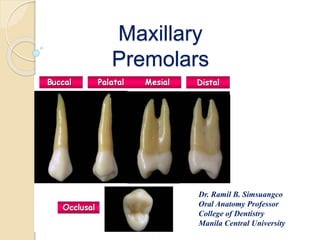
Maxillary 
Premolars 
Dr. Ramil B. Simsuangco 
Oral Anatomy Professor 
College of Dentistry 
Manila Central University
GENERAL DESCRIPTION 
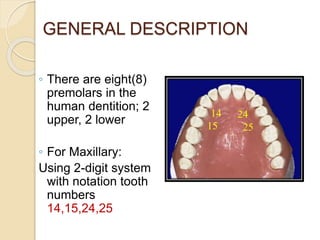
◦ There are eight(8) 
premolars in the 
human dentition; 2 
upper, 2 lower 
◦ For Maxillary: 
Using 2-digit system 
with notation tooth 
numbers 
14,15,24,25 
14 24 
15 25
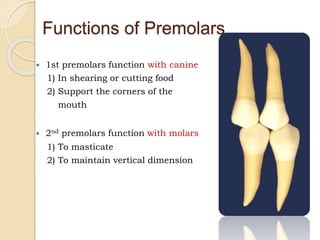
Functions of Premolars 
 1st premolars function with canine 
1) In shearing or cutting food 
2) Support the corners of the 
mouth 
 2nd premolars function with molars 
1) To masticate 
2) To maintain vertical dimension
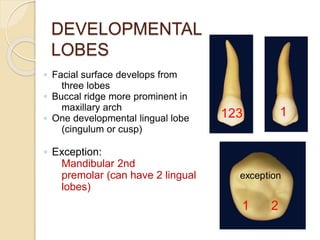
DEVELOPMENTAL 
LOBES 
1) Developmental lobes 
◦ Facial surface develops from 
three lobes 
◦ Buccal ridge more prominent in 
maxillary arch 
◦ One developmental lingual lobe 
(cingulum or cusp) 
◦ Exception: 
Mandibular 2nd 
premolar (can have 2 lingual 
lobes) 
123 1 
exception 
1 2
CURVATURE OF CEJ 
◦ Proximal CEJ is 
concave 
Facial and lingual CEJ is 
convex apically
CONVEXITY 
Convex 
4) Root shape 
◦ Lingual and facial 
surfaces are convex 
◦ Lingual side of the root and crown are 
narrower than the facial side
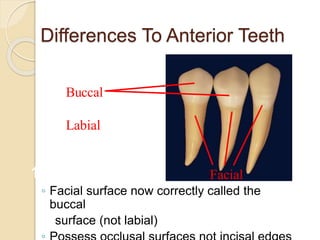
Differences To Anterior Teeth 
Buccal 
Labial 
1) Terminology 
Facial 
◦ Facial surface now correctly called the 
buccal 
surface (not labial) 
◦ Possess occlusal surfaces not incisal edges
Differences To Anterior Teeth 
2) Occlusal surface versus incisal edges 
◦ No incisal edge or cingulum 
◦ Possess one facial cusp and one or two 
lingual cusps 
Incisal 
Occlusal 
Cingulum
CONTACT AREAS 
Proximal contact areas are 
more cervically located 
than anterior teeth
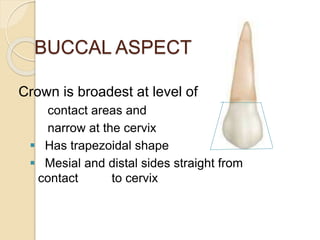
BUCCAL ASPECT 
Crown is broadest at level of 
contact areas and 
narrow at the cervix 
 Has trapezoidal shape 
 Mesial and distal sides straight from 
contact to cervix
BUCCAL ASPECT 
2) Cusp slope size 
◦ Buccal cusp tip often slightly 
mesial to long axis (like canine) 
◦ Mesial cusp slope shorter than the distal 
◦ Exception: Maxillary first premolar - cusp 
tip 
slightly to the distal
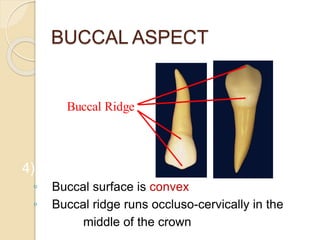
BUCCAL ASPECT 
Buccal Ridge 
4) Crown morphology 
◦ Buccal surface is convex 
◦ Buccal ridge runs occluso-cervically in the 
middle of the crown
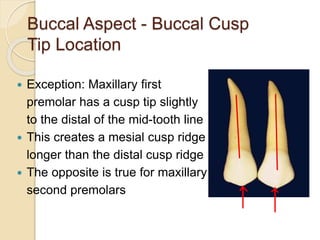
Buccal Aspect - Buccal Cusp 
Tip Location 
 Exception: Maxillary first 
premolar has a cusp tip slightly 
to the distal of the mid-tooth line 
 This creates a mesial cusp ridge 
longer than the distal cusp ridge 
 The opposite is true for maxillary 
second premolars
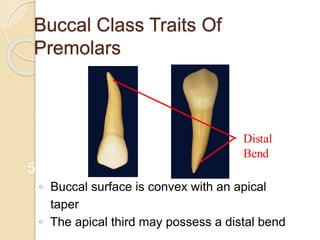
Buccal Class Traits Of 
Premolars 
Distal 
Bend 
5) Root 
◦ Buccal surface is convex with an apical 
taper 
◦ The apical third may possess a distal bend
LINGUAL ASPECT 
Exception 29 
 Crown is narrower on the lingual 
than the buccal 
 Exception: Mandibular 2nd premolars 
with three cusps 
 Lingual surface is convex 
 Mesial and Distal slope meets at 90 deg. 
angle
Lingual Class Traits Of 
Premolars 
2) Root 
◦ Lingual surface is convex and narrower 
mesiodistally than the facial aspect
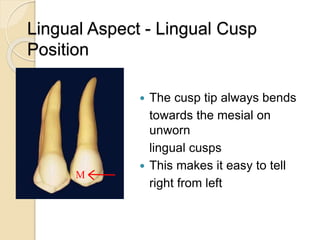
Lingual Aspect - Lingual Cusp 
Position 
 The cusp tip always bends 
towards the mesial on 
unworn 
lingual cusps 
 This makes it easy to tell 
right from left 
M
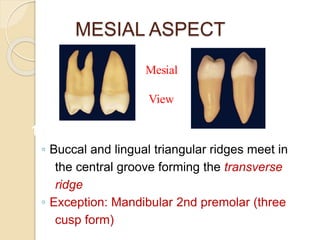
MESIAL ASPECT 
1) Triangular ridges 
◦ Buccal and lingual triangular ridges meet in 
the central groove forming the transverse 
ridge 
◦ Exception: Mandibular 2nd premolar (three 
cusp form) 
Mesial 
View
MESIAL ASPECT 
Mesial 
View 
3) Marginal ridges 
◦ Mesial marginal ridge more occlusal/higher 
than the distal 
◦ Exception: Mandibular first premolars
DISTAL ASPECT 
 Crown outline is trapezoidal 
 Crown is convex, with small flattened 
area just cervical to the CA 
 No evidence of deep developmental 
groove and depression
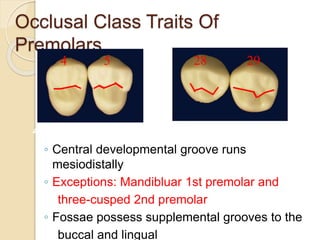
Occlusal Class Traits Of 
Premolars 
4 5 28 29 
1) Tooth proportions 
◦ Considerably wider faciolingually than 
mesiodistally
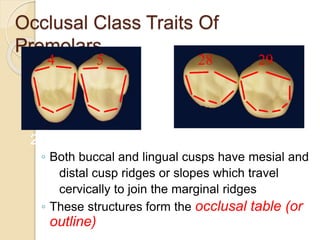
Occlusal Class Traits Of 
Premolars 
4 5 28 29 
2) Occlusal table 
◦ Both buccal and lingual cusps have mesial and 
distal cusp ridges or slopes which travel 
cervically to join the marginal ridges 
◦ These structures form the occlusal table (or 
outline)
Occlusal Class Traits Of 
Premolars 
4 5 28 29 
4) Grooves and fossae 
◦ Central developmental groove runs 
mesiodistally 
◦ Exceptions: Mandibluar 1st premolar and 
three-cusped 2nd premolar 
◦ Fossae possess supplemental grooves to the 
buccal and lingual
Buccal Aspect - Contacts 
 Mesial contact is in the middle third, near the 
junction of the middle and occlusal thirds 
 Distal contact is slightly more cervical (still in 
middle third) 
More 
Cervical 
As We 
Go Distal
COMPARISON OF CUSP 
HEIGHT 
(Max. 1st PM and Max. 2nd PM) 
Mesial Distal 
B 
5 4 4 5 
 From this view buccal cusp tip is noticeably longer 
than the lingual cusp tip on maxillary first premolars 
 Nearly equal length on second premolars
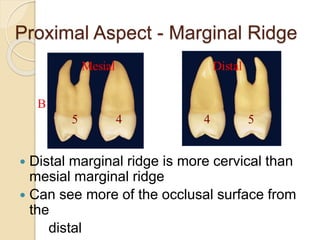
Proximal Aspect - Marginal Ridge 
Mesial Distal 
 Distal marginal ridge is more cervical than 
mesial marginal ridge 
 Can see more of the occlusal surface from 
the 
distal 
B 
5 4 4 5
NUMBER OF ROOT 
Mesial Distal 
B B 
5 4 4 5 
 Frequently two(2) roots on Maxillary 1st 
premolar 
 The bifurcation is in the apical third to 
half of the root
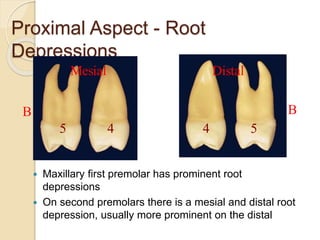
Proximal Aspect - Root 
Depressions 
Mesial Distal 
B B 
5 4 4 5 
 Maxillary first premolar has prominent root 
depressions 
 On second premolars there is a mesial and distal root 
depression, usually more prominent on the distal
Occlusal Comparison of 
1st and 2nd premolar
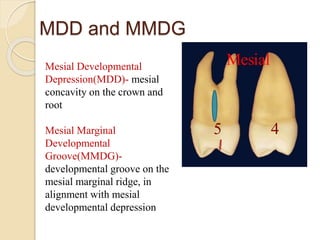
MDD and MMDG 
Mesial B Mesial Developmental 
Depression(MDD)- mesial 
concavity on the crown and 
root 
5 4 Mesial Marginal 
Developmental 
Groove(MMDG)- 
developmental groove on the 
mesial marginal ridge, in 
alignment with mesial 
developmental depression
PERMANENT MAXILLARY PREMOLARS

PERMANENT MAXILLARY PREMOLARS

  • 1.
    Maxillary Premolars Dr.Ramil B. Simsuangco Oral Anatomy Professor College of Dentistry Manila Central University
  • 2.
    GENERAL DESCRIPTION ◦There are eight(8) premolars in the human dentition; 2 upper, 2 lower ◦ For Maxillary: Using 2-digit system with notation tooth numbers 14,15,24,25 14 24 15 25
  • 3.
    Functions of Premolars  1st premolars function with canine 1) In shearing or cutting food 2) Support the corners of the mouth  2nd premolars function with molars 1) To masticate 2) To maintain vertical dimension
  • 4.
    DEVELOPMENTAL LOBES 1)Developmental lobes ◦ Facial surface develops from three lobes ◦ Buccal ridge more prominent in maxillary arch ◦ One developmental lingual lobe (cingulum or cusp) ◦ Exception: Mandibular 2nd premolar (can have 2 lingual lobes) 123 1 exception 1 2
  • 5.
    CURVATURE OF CEJ ◦ Proximal CEJ is concave Facial and lingual CEJ is convex apically
  • 6.
    CONVEXITY Convex 4)Root shape ◦ Lingual and facial surfaces are convex ◦ Lingual side of the root and crown are narrower than the facial side
  • 7.
    Differences To AnteriorTeeth Buccal Labial 1) Terminology Facial ◦ Facial surface now correctly called the buccal surface (not labial) ◦ Possess occlusal surfaces not incisal edges
  • 8.
    Differences To AnteriorTeeth 2) Occlusal surface versus incisal edges ◦ No incisal edge or cingulum ◦ Possess one facial cusp and one or two lingual cusps Incisal Occlusal Cingulum
  • 9.
    CONTACT AREAS Proximalcontact areas are more cervically located than anterior teeth
  • 10.
    BUCCAL ASPECT Crownis broadest at level of contact areas and narrow at the cervix  Has trapezoidal shape  Mesial and distal sides straight from contact to cervix
  • 11.
    BUCCAL ASPECT 2)Cusp slope size ◦ Buccal cusp tip often slightly mesial to long axis (like canine) ◦ Mesial cusp slope shorter than the distal ◦ Exception: Maxillary first premolar - cusp tip slightly to the distal
  • 12.
    BUCCAL ASPECT BuccalRidge 4) Crown morphology ◦ Buccal surface is convex ◦ Buccal ridge runs occluso-cervically in the middle of the crown
  • 13.
    Buccal Aspect -Buccal Cusp Tip Location  Exception: Maxillary first premolar has a cusp tip slightly to the distal of the mid-tooth line  This creates a mesial cusp ridge longer than the distal cusp ridge  The opposite is true for maxillary second premolars
  • 14.
    Buccal Class TraitsOf Premolars Distal Bend 5) Root ◦ Buccal surface is convex with an apical taper ◦ The apical third may possess a distal bend
  • 15.
    LINGUAL ASPECT Exception29  Crown is narrower on the lingual than the buccal  Exception: Mandibular 2nd premolars with three cusps  Lingual surface is convex  Mesial and Distal slope meets at 90 deg. angle
  • 16.
    Lingual Class TraitsOf Premolars 2) Root ◦ Lingual surface is convex and narrower mesiodistally than the facial aspect
  • 17.
    Lingual Aspect -Lingual Cusp Position  The cusp tip always bends towards the mesial on unworn lingual cusps  This makes it easy to tell right from left M
  • 18.
    MESIAL ASPECT 1)Triangular ridges ◦ Buccal and lingual triangular ridges meet in the central groove forming the transverse ridge ◦ Exception: Mandibular 2nd premolar (three cusp form) Mesial View
  • 19.
    MESIAL ASPECT Mesial View 3) Marginal ridges ◦ Mesial marginal ridge more occlusal/higher than the distal ◦ Exception: Mandibular first premolars
  • 20.
    DISTAL ASPECT Crown outline is trapezoidal  Crown is convex, with small flattened area just cervical to the CA  No evidence of deep developmental groove and depression
  • 21.
    Occlusal Class TraitsOf Premolars 4 5 28 29 1) Tooth proportions ◦ Considerably wider faciolingually than mesiodistally
  • 22.
    Occlusal Class TraitsOf Premolars 4 5 28 29 2) Occlusal table ◦ Both buccal and lingual cusps have mesial and distal cusp ridges or slopes which travel cervically to join the marginal ridges ◦ These structures form the occlusal table (or outline)
  • 23.
    Occlusal Class TraitsOf Premolars 4 5 28 29 4) Grooves and fossae ◦ Central developmental groove runs mesiodistally ◦ Exceptions: Mandibluar 1st premolar and three-cusped 2nd premolar ◦ Fossae possess supplemental grooves to the buccal and lingual
  • 24.
    Buccal Aspect -Contacts  Mesial contact is in the middle third, near the junction of the middle and occlusal thirds  Distal contact is slightly more cervical (still in middle third) More Cervical As We Go Distal
  • 25.
    COMPARISON OF CUSP HEIGHT (Max. 1st PM and Max. 2nd PM) Mesial Distal B 5 4 4 5  From this view buccal cusp tip is noticeably longer than the lingual cusp tip on maxillary first premolars  Nearly equal length on second premolars
  • 26.
    Proximal Aspect -Marginal Ridge Mesial Distal  Distal marginal ridge is more cervical than mesial marginal ridge  Can see more of the occlusal surface from the distal B 5 4 4 5
  • 27.
    NUMBER OF ROOT Mesial Distal B B 5 4 4 5  Frequently two(2) roots on Maxillary 1st premolar  The bifurcation is in the apical third to half of the root
  • 28.
    Proximal Aspect -Root Depressions Mesial Distal B B 5 4 4 5  Maxillary first premolar has prominent root depressions  On second premolars there is a mesial and distal root depression, usually more prominent on the distal
  • 29.
    Occlusal Comparison of 1st and 2nd premolar
  • 30.
    MDD and MMDG Mesial B Mesial Developmental Depression(MDD)- mesial concavity on the crown and root 5 4 Mesial Marginal Developmental Groove(MMDG)- developmental groove on the mesial marginal ridge, in alignment with mesial developmental depression