‫الرحيم‬ ‫الرحمن‬ ‫هللا‬ ‫بسم‬
IN THE NAME OF ALLAH THE MOST
GRACIOUS THE MOST MERCIFUL
Mandibular 2nd premolar
By:
Prof Dr Mohamad Helal
Head of oral Biology Department
Do U like
cabbage ?
No
THE PREMOLARS
Premolars
There are four maxillary and four mandibular
premolars.
4&4 contact:
 3 & 3 mesially and
 5 & 5 distally
5 & 5 contact:
 4 & 4 mesially and
 6 & 6 distally.
Relations:
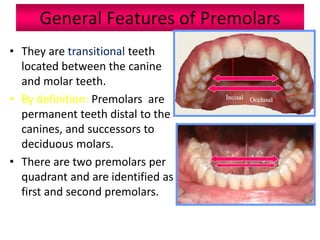
General Features of Premolars
• They are transitional teeth
located between the canine
and molar teeth.
• By definition: Premolars are
permanent teeth distal to the
canines, and successors to
deciduous molars.
• There are two premolars per
quadrant and are identified as
first and second premolars.
• They have usually two
cusps(bicuspid) :
 One large buccal cusp,
 Smaller lingual cusp
• The lower second
premolar may-
sometimes- have two
lingual cusps.
General Features of Premolars
• Generally:
1.The Mandibular 2nd premolar has a larger
crown and longer root than lower one.
2.The1st premolar like the canine while 2nd
premolar like small molar from the occlusal
3.They are similar shape from buccal surfaces
Chronology:
• First evidence of calcifi. 2 ¼ -2 ½ y
• Enamel completed 6-7 y
• Eruption 11-12y
• Root completed 13-14y
Buccal aspect:
• Like buccal surface of lower 1st premolar?
• Trapezoidal shorter cervically
• Mesial outline: slightly concave
• Distal outline: slightly concave
• Contact areas: broad and wide contact located
at the same level occlusal to midway cervico-
occlusally, the mesial one is more cevically.
• Cusp: shorter and broader than 1st one with
mesial inclined plane longer then distal one.
Lingual aspect Buccal aspect
Lingual aspect:
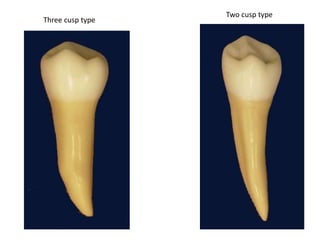
• Two type:
A-Square type (three cusps)
-Two lingual cusps with lingual groove
B-Round type ( two cusps)
- One cusp ligually
Three cusp type
Two cusp type
• 2nd 1st
Buccal surfaces
Mesial
aspect:
difference
between
1st and 2nd
premolars
Distal
aspect
Occlusal aspect
•
• 2 3
Geometric outline of the crown
Facial and lingual aspects have
trapezoid shape
But wider
cervically
than 4.
Comparison Between
Mandibular First and Second Premolars
Facial Outlines and surface anatomy
Crown is smaller & B
cusp is longer & pointed
Prominent B ridge Less prominent B ridge
Crown is larger & B cusp is
shorter and less pointed
Root: Shorter, narrower with
pointed apex
Root: longer, broader, with
blunt apex
Mandibular First Premolar Mandibular Second Premolar
Lingual outline and surface anatomy
The lingual surface is convex with maximum
convexity in middle 1/3(center of crown)
The L cusp is short and small reaching 2/3 the
crown length and has a pointed tip.
ML developmental groove at the ML line
angle.
Two cusp type
L cusp is shorter and smaller than B
cusp but larger than of 4
The surface is convex with maximum
convexity in Occ.1/3.
No MLDG
Mandibular First Premolar Mandibular Second Premolar
Ling. s. not so
narrow as in 1st
premolar
MD D M
Three cusp type:
ML cusp is longer and larger than DL
cusp. They both shorter than B cusp and
less pointed.
DM
The surface convex with maximum
convexity at occ.1/3.
The L developmental groove between
the 2 ling. cusps
No ling. convergency.
Proximal outlines
Rhomboid in shape with
narrow occlusal table.
Prominent lingual inclination
Rhomboid in shape with
wider to some extent
occlusal table.
Lingual inclination less
prominent
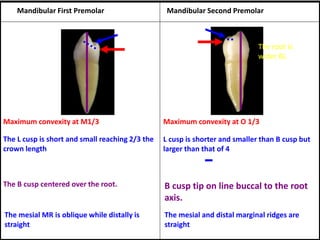
Mandibular First Premolar Mandibular Second Premolar
The crown is wider BLThe crown is narrower BL
Maximum convexity at M1/3 Maximum convexity at O 1/3
B cusp tip on line buccal to the root
axis.
The mesial and distal marginal ridges are
straight
L cusp is shorter and smaller than B cusp but
larger than that of 4
The B cusp centered over the root.
The L cusp is short and small reaching 2/3 the
crown length
The mesial MR is oblique while distally is
straight
Mandibular First Premolar Mandibular Second Premolar
The root is
wider BL
Three Cusp
Type of
Mandibular
Second
Premolar
ML cusp is shorter than the B cusp &
longer and larger than DL cusp.
DL cusp is shorter and smaller than ML cusp.
Both are seen from this aspect.
Both lingual cusps are shorter than the buccal cusp
and less pointed
Mesial
Aspect
Distal
Aspect
Develop.
depression
Cerv. line: slightly curved. Cerv. line: nearly straight.
Occlusal Aspect
Two cusp type
Diamond-shaped.
Lingual convergence is
sharp.
The outline is round
Slight lingual convergence
Three cusp type
The outline is
square
Mandibular First Premolar Mandibular Second Premolar
U- shaped H - shaped
M D
The 3 cusps are
well developed
M D
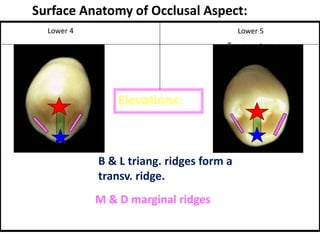
Surface Anatomy of Occlusal Aspect:
Elevations:
B & L triang. ridges form a
transv. ridge.
M & D marginal ridges
Lower 5
Two cusp type
Lower 4
Depressions:
Shallow central devel. groove
M(oval) and D(round) fossae.
Mesiolingual devel. gr.
Central devel. groove extending MD
across the occ. surface, over the
transv. ridge.
M and D fossae: Circular.
The D fossa is larger than
the M one
Lower 5
Two cusp type
Lower 4
. .
M D
M D
Type
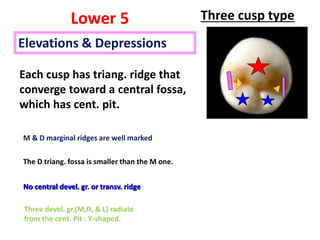
Elevations & Depressions
Each cusp has triang. ridge that
converge toward a central fossa,
which has cent. pit.
M & D marginal ridges are well marked.
No central devel. gr. or transv. ridge
Three cusp typeLower 5
Three devel. gr.(M,D, & L) radiate
from the cent. Pit : Y-shaped.
The D triang. fossa is smaller than the M one.
M D
Type
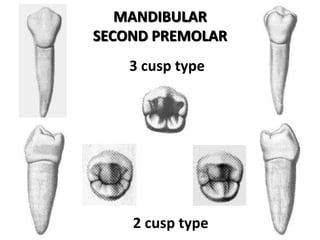
MANDIBULAR
SECOND PREMOLAR
3 cusp type
2 cusp type
PULP CAVITY
MD BL
Cross sec. at the cerv. line
round or oval
www.oralbiology.azhar.edu.eg
ANY QUESTION ?

Mandibular 2nd premolar

  • 1.
    ‫الرحيم‬ ‫الرحمن‬ ‫هللا‬‫بسم‬ IN THE NAME OF ALLAH THE MOST GRACIOUS THE MOST MERCIFUL
  • 2.
    Mandibular 2nd premolar By: ProfDr Mohamad Helal Head of oral Biology Department
  • 3.
  • 10.
  • 11.
    Premolars There are fourmaxillary and four mandibular premolars. 4&4 contact:  3 & 3 mesially and  5 & 5 distally 5 & 5 contact:  4 & 4 mesially and  6 & 6 distally. Relations:
  • 12.
    General Features ofPremolars • They are transitional teeth located between the canine and molar teeth. • By definition: Premolars are permanent teeth distal to the canines, and successors to deciduous molars. • There are two premolars per quadrant and are identified as first and second premolars.
  • 13.
    • They haveusually two cusps(bicuspid) :  One large buccal cusp,  Smaller lingual cusp • The lower second premolar may- sometimes- have two lingual cusps. General Features of Premolars
  • 14.
    • Generally: 1.The Mandibular2nd premolar has a larger crown and longer root than lower one. 2.The1st premolar like the canine while 2nd premolar like small molar from the occlusal 3.They are similar shape from buccal surfaces
  • 15.
    Chronology: • First evidenceof calcifi. 2 ¼ -2 ½ y • Enamel completed 6-7 y • Eruption 11-12y • Root completed 13-14y
  • 16.
    Buccal aspect: • Likebuccal surface of lower 1st premolar? • Trapezoidal shorter cervically • Mesial outline: slightly concave • Distal outline: slightly concave • Contact areas: broad and wide contact located at the same level occlusal to midway cervico- occlusally, the mesial one is more cevically. • Cusp: shorter and broader than 1st one with mesial inclined plane longer then distal one.
  • 17.
  • 18.
    Lingual aspect: • Twotype: A-Square type (three cusps) -Two lingual cusps with lingual groove B-Round type ( two cusps) - One cusp ligually
  • 19.
  • 20.
  • 21.
  • 22.
  • 23.
  • 24.
    Geometric outline ofthe crown Facial and lingual aspects have trapezoid shape But wider cervically than 4. Comparison Between Mandibular First and Second Premolars
  • 25.
    Facial Outlines andsurface anatomy Crown is smaller & B cusp is longer & pointed Prominent B ridge Less prominent B ridge Crown is larger & B cusp is shorter and less pointed Root: Shorter, narrower with pointed apex Root: longer, broader, with blunt apex Mandibular First Premolar Mandibular Second Premolar
  • 26.
    Lingual outline andsurface anatomy The lingual surface is convex with maximum convexity in middle 1/3(center of crown) The L cusp is short and small reaching 2/3 the crown length and has a pointed tip. ML developmental groove at the ML line angle. Two cusp type L cusp is shorter and smaller than B cusp but larger than of 4 The surface is convex with maximum convexity in Occ.1/3. No MLDG Mandibular First Premolar Mandibular Second Premolar Ling. s. not so narrow as in 1st premolar MD D M
  • 27.
    Three cusp type: MLcusp is longer and larger than DL cusp. They both shorter than B cusp and less pointed. DM The surface convex with maximum convexity at occ.1/3. The L developmental groove between the 2 ling. cusps No ling. convergency.
  • 28.
    Proximal outlines Rhomboid inshape with narrow occlusal table. Prominent lingual inclination Rhomboid in shape with wider to some extent occlusal table. Lingual inclination less prominent Mandibular First Premolar Mandibular Second Premolar The crown is wider BLThe crown is narrower BL
  • 29.
    Maximum convexity atM1/3 Maximum convexity at O 1/3 B cusp tip on line buccal to the root axis. The mesial and distal marginal ridges are straight L cusp is shorter and smaller than B cusp but larger than that of 4 The B cusp centered over the root. The L cusp is short and small reaching 2/3 the crown length The mesial MR is oblique while distally is straight Mandibular First Premolar Mandibular Second Premolar The root is wider BL
  • 30.
    Three Cusp Type of Mandibular Second Premolar MLcusp is shorter than the B cusp & longer and larger than DL cusp. DL cusp is shorter and smaller than ML cusp. Both are seen from this aspect. Both lingual cusps are shorter than the buccal cusp and less pointed Mesial Aspect Distal Aspect Develop. depression Cerv. line: slightly curved. Cerv. line: nearly straight.
  • 31.
    Occlusal Aspect Two cusptype Diamond-shaped. Lingual convergence is sharp. The outline is round Slight lingual convergence Three cusp type The outline is square Mandibular First Premolar Mandibular Second Premolar U- shaped H - shaped M D The 3 cusps are well developed M D
  • 32.
    Surface Anatomy ofOcclusal Aspect: Elevations: B & L triang. ridges form a transv. ridge. M & D marginal ridges Lower 5 Two cusp type Lower 4
  • 33.
    Depressions: Shallow central devel.groove M(oval) and D(round) fossae. Mesiolingual devel. gr. Central devel. groove extending MD across the occ. surface, over the transv. ridge. M and D fossae: Circular. The D fossa is larger than the M one Lower 5 Two cusp type Lower 4 . . M D M D
  • 34.
  • 35.
    Elevations & Depressions Eachcusp has triang. ridge that converge toward a central fossa, which has cent. pit. M & D marginal ridges are well marked. No central devel. gr. or transv. ridge Three cusp typeLower 5 Three devel. gr.(M,D, & L) radiate from the cent. Pit : Y-shaped. The D triang. fossa is smaller than the M one. M D
  • 36.
  • 37.
  • 38.
    PULP CAVITY MD BL Crosssec. at the cerv. line round or oval www.oralbiology.azhar.edu.eg
  • 40.