GROUP 3
MATTER AND THE
ATOMIC THEORY
PROPERTIES OF THE THREE STATES OF MATTER
PHASE CHANGES
MATTER
• The particulate matter is a well- accepted
description of matter. The basic principles of
the particulate model of matter are:
a) All matter is made up of tiny particles
b) There is empty spaces in between the particles.
c) The particles are in constant motion.
d) There are forces that act between the particles.
PROPERTIES OF THE THREE
STATES OF MATTER
PROPERTIES OF THE THREE
STATES OF MATTER
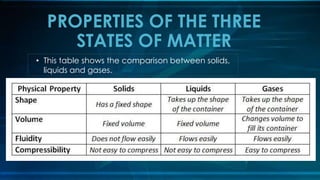
• This table shows the comparison between solids,
liquids and gases.
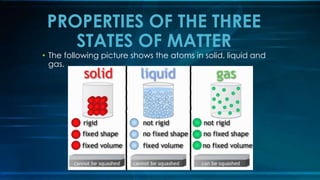
• The following picture shows the atoms in solid, liquid and
gas.
PROPERTIES OF THE THREE
STATES OF MATTER
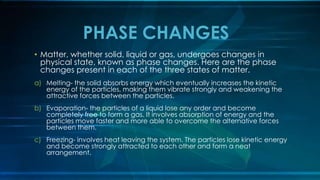
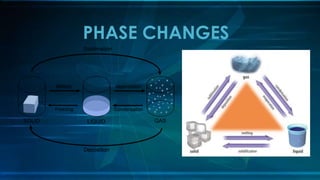
• Matter, whether solid, liquid or gas, undergoes changes in
physical state, known as phase changes. Here are the phase
changes present in each of the three states of matter.
a) Melting- the solid absorbs energy which eventually increases the kinetic
energy of the particles, making them vibrate strongly and weakening the
attractive forces between the particles.
b) Evaporation- the particles of a liquid lose any order and become
completely free to form a gas. It involves absorption of energy and the
particles move faster and more able to overcome the alternative forces
between them.
c) Freezing- involves heat leaving the system. The particles lose kinetic energy
and become strongly attracted to each other and form a neat
arrangement.
PHASE CHANGES
PHASE CHANGES
HISTORY OF ATOMIC THEORY
POSTULATES OF JOHN DALTON’S THEORY
THE SUBATOMIC PARTICLES
ATOMIC THEORY
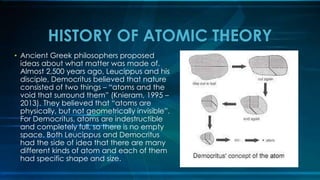
• Ancient Greek philosophers proposed
ideas about what matter was made of.
Almost 2,500 years ago, Leucippus and his
disciple, Democritus believed that nature
consisted of two things – “atoms and the
void that surround them” (Knieram, 1995 –
2013). They believed that “atoms are
physically, but not geometrically invisible”.
For Democritus, atoms are indestructible
and completely full, so there is no empty
space. Both Leucippus and Democritus
had the side of idea that there are many
different kinds of atom and each of them
had specific shape and size.
HISTORY OF ATOMIC THEORY
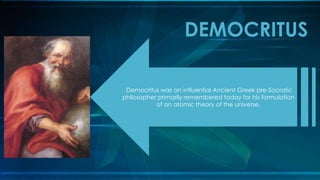
DEMOCRITUS
Democritus was an influential Ancient Greek pre-Socratic
philosopher primarily remembered today for his formulation
of an atomic theory of the universe.
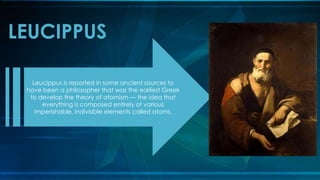
LEUCIPPUS
Leucippus is reported in some ancient sources to
have been a philosopher that was the earliest Greek
to develop the theory of atomism — the idea that
everything is composed entirely of various
imperishable, indivisible elements called atoms.
• After more than 2000 years, the ancient
philosophers’ idea about atoms became a
theory when John Dalton put together
observation and results of several experiments
done by other scientists and formulated the
atomic theory. The postulates of his theory,
which is found in his book entitled “A New
System of Chemical Philosophy” published in
1808.
ATOMIC THEORY
a. All matter is made up of tiny particles
b. There is empty space in between the
particles.
c. The particles are in constant motion
d. There are forces that act between
the particles
POSTULATES OF JOHN DALTON’S
THEORY
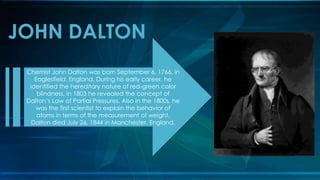
JOHN DALTON
Chemist John Dalton was born September 6, 1766, in
Eaglesfield, England. During his early career, he
identified the hereditary nature of red-green color
blindness. In 1803 he revealed the concept of
Dalton’s Law of Partial Pressures. Also in the 1800s, he
was the first scientist to explain the behavior of
atoms in terms of the measurement of weight.
Dalton died July 26, 1844 in Manchester, England.
The cathode ray experiments in 1897 of various
scientist including Sir Joseph John Thomson led to the
discovery of the electron, the negatively charged particle
found in an atom. When high voltage electric current was
applied across electrically charged plates in a cathode ray
tube containing a small amount of gas, a ray coming from
the negatively charged electrode, the cathode, was
observed.
Thomson revised the atomic theory and proposed the
raisin bread model of the atom. According to him, an atom
is positively charged sphere with loosely embedded
electrons. This is similar to a bread with embedded raisins.
THE SUBATOMIC PARTICLES
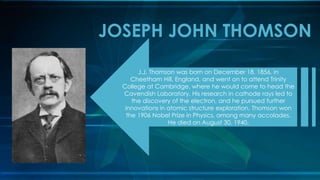
JOSEPH JOHN THOMSON
J.J. Thomson was born on December 18, 1856, in
Cheetham Hill, England, and went on to attend Trinity
College at Cambridge, where he would come to head the
Cavendish Laboratory. His research in cathode rays led to
the discovery of the electron, and he pursued further
innovations in atomic structure exploration. Thomson won
the 1906 Nobel Prize in Physics, among many accolades.
He died on August 30, 1940.
The existence of subatomic particles is
further confirmed with the discovery of
radioactivity by Henri Becquerel. He found
out that the mineral pitch blend emitted high
penetrating rays, called Becquerel rays.
Furthermore, Pierre Curie and Marie Curie
discovered the elements Polonium and
Radium and found them to emit similar rays.
THE SUBATOMIC PARTICLES
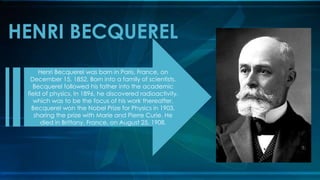
HENRI BECQUEREL
Henri Becquerel was born in Paris, France, on
December 15, 1852. Born into a family of scientists,
Becquerel followed his father into the academic
field of physics. In 1896, he discovered radioactivity,
which was to be the focus of his work thereafter.
Becquerel won the Nobel Prize for Physics in 1903,
sharing the prize with Marie and Pierre Curie. He
died in Brittany, France, on August 25, 1908.
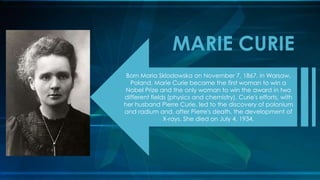
Born Maria Sklodowska on November 7, 1867, in Warsaw,
Poland, Marie Curie became the first woman to win a
Nobel Prize and the only woman to win the award in two
different fields (physics and chemistry). Curie's efforts, with
her husband Pierre Curie, led to the discovery of polonium
and radium and, after Pierre's death, the development of
X-rays. She died on July 4, 1934.
MARIE CURIE
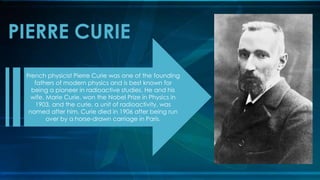
PIERRE CURIE
French physicist Pierre Curie was one of the founding
fathers of modern physics and is best known for
being a pioneer in radioactive studies. He and his
wife, Marie Curie, won the Nobel Prize in Physics in
1903, and the curie, a unit of radioactivity, was
named after him. Curie died in 1906 after being run
over by a horse-drawn carriage in Paris.
•Ernest Rutherford named the three
kinds of Becquerel rays as alpha (a)
particles, beta (B) particles, and
gamma (y) radiation. He was also
considered the Father of Nuclear
Physics.
THE SUBATOMIC PARTICLES
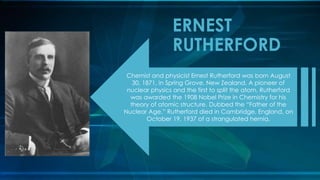
Chemist and physicist Ernest Rutherford was born August
30, 1871, in Spring Grove, New Zealand. A pioneer of
nuclear physics and the first to split the atom, Rutherford
was awarded the 1908 Nobel Prize in Chemistry for his
theory of atomic structure. Dubbed the “Father of the
Nuclear Age,” Rutherford died in Cambridge, England, on
October 19, 1937 of a strangulated hernia.
ERNEST
RUTHERFORD
Niels Bohr assumed that electrons move in
orbits around the nucleus but only orbits of certain
radii are allowed. The present model is based on a
theory which says that electrons are not confined in
fixed orbits around the nucleus. The positive charge
of the nucleus comes from the proton. Its charge
has the same magnitude as the electron but
opposite in sign.
THE SUBATOMIC PARTICLES
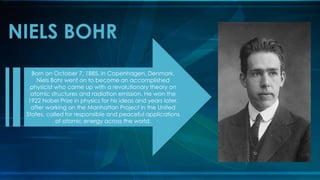
NIELS BOHR
Born on October 7, 1885, in Copenhagen, Denmark,
Niels Bohr went on to become an accomplished
physicist who came up with a revolutionary theory on
atomic structures and radiation emission. He won the
1922 Nobel Prize in physics for his ideas and years later,
after working on the Manhattan Project in the United
States, called for responsible and peaceful applications
of atomic energy across the world.
Eugene Goldstein discovered its existence
when he experiment with tubes containing gasses
at low temperature or pressures and a tube with
perforated cathode. He observed rays passing the
holes on the cathode and moving away from the
positive electrode, which are left after electrons
have been removed. This was called proton.
THE SUBATOMIC PARTICLES
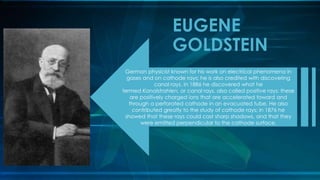
German physicist known for his work on electrical phenomena in
gases and on cathode rays; he is also credited with discovering
canal rays. In 1886 he discovered what he
termed Kanalstrahlen, or canal rays, also called positive rays; these
are positively charged ions that are accelerated toward and
through a perforated cathode in an evacuated tube. He also
contributed greatly to the study of cathode rays; in 1876 he
showed that these rays could cast sharp shadows, and that they
were emitted perpendicular to the cathode surface.
EUGENE
GOLDSTEIN
THE SUBATOMIC PARTICLES
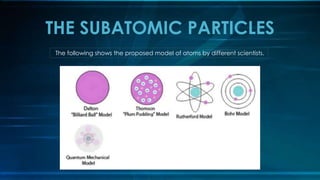
The following shows the proposed model of atoms by different scientists.
The positive charge of the nucleus comes from the
proton. Eugene Goldstein discovered its existence when he
performed experiments with tubes containing different
gases at very low pressures and a tube with a perforated
cathode.
The protons account for only part of the mass of the
nucleus. In 1932, Sir James Chadwick discovered the
neutron, also found in the nucleus of the atom. It has almost
the same mass as the protons but neutral. The charge of the
electron is measured in coulombs (c). In chemistry, the
charge of a particle is usually expressed in charge units or as
multiples of the charge of the electron.
THE SUBATOMIC PARTICLES
• The mass of the particles is commonly expressed in
atomic mass unit (amu) instead of grams. One
amu is equivalent to 1.66053892 × 10 to the
negative 24 grams. Therefore, the alpha particle,
which is the helium nucleus and which contains
two protons and two neutrons, has a mass of
around 4 amu.
One of the assumptions of Dalton’s atomic theory states that
atoms of the same element are alike and are different from the
atoms of other elements. We will now see how the atom is
identified and that the atoms of the same elements are not
identical in all aspects.
• Atomic number: the number of protons in their nuclei. The atomic
number is the identity number of an element. It provides several
information regarding the characteristics of the atoms of the
elements.
• Isotope: Isotopes are variants of a particular chemical element
such that while all isotopes of a given element have the same
number of protons in each atom, they differ in neutron number.
IDENTITY OF AN ATOM
• Ion: If electrons are removed from or added to a neutral
atom, a charged particle of the same particle, called ion,
is formed. Ions have two different charges and they are as
what follows.
a) Cation: An ion with positive charge and is formed when
an electron is removed from the atom.
b) Anion: A negatively charged ion and is formed when an
electron is added to the atom.
IDENTITY OF AN ATOM
• G5 Cariño, Ma. Fatima
• G10 Javier, Ma. Sarah
• G15 Moralejo, Ski
• G17 Reyes, Joanna Ysabella
• G21 Samson, Claire Erika
• G26 Ty, Trizsa Jasmin
• B7 Da Silva, John Julius
• B12 Francisco, James Harvey
• B16 Oamil, Ken Edward
8- Mitochondrion Group 3 Members

Matter and the Atomic Theory

  • 1.
    GROUP 3 MATTER ANDTHE ATOMIC THEORY
  • 2.
    PROPERTIES OF THETHREE STATES OF MATTER PHASE CHANGES MATTER
  • 3.
    • The particulatematter is a well- accepted description of matter. The basic principles of the particulate model of matter are: a) All matter is made up of tiny particles b) There is empty spaces in between the particles. c) The particles are in constant motion. d) There are forces that act between the particles. PROPERTIES OF THE THREE STATES OF MATTER
  • 4.
    PROPERTIES OF THETHREE STATES OF MATTER • This table shows the comparison between solids, liquids and gases.
  • 5.
    • The followingpicture shows the atoms in solid, liquid and gas. PROPERTIES OF THE THREE STATES OF MATTER
  • 6.
    • Matter, whethersolid, liquid or gas, undergoes changes in physical state, known as phase changes. Here are the phase changes present in each of the three states of matter. a) Melting- the solid absorbs energy which eventually increases the kinetic energy of the particles, making them vibrate strongly and weakening the attractive forces between the particles. b) Evaporation- the particles of a liquid lose any order and become completely free to form a gas. It involves absorption of energy and the particles move faster and more able to overcome the alternative forces between them. c) Freezing- involves heat leaving the system. The particles lose kinetic energy and become strongly attracted to each other and form a neat arrangement. PHASE CHANGES
  • 7.
  • 8.
    HISTORY OF ATOMICTHEORY POSTULATES OF JOHN DALTON’S THEORY THE SUBATOMIC PARTICLES ATOMIC THEORY
  • 9.
    • Ancient Greekphilosophers proposed ideas about what matter was made of. Almost 2,500 years ago, Leucippus and his disciple, Democritus believed that nature consisted of two things – “atoms and the void that surround them” (Knieram, 1995 – 2013). They believed that “atoms are physically, but not geometrically invisible”. For Democritus, atoms are indestructible and completely full, so there is no empty space. Both Leucippus and Democritus had the side of idea that there are many different kinds of atom and each of them had specific shape and size. HISTORY OF ATOMIC THEORY
  • 10.
    DEMOCRITUS Democritus was aninfluential Ancient Greek pre-Socratic philosopher primarily remembered today for his formulation of an atomic theory of the universe.
  • 11.
    LEUCIPPUS Leucippus is reportedin some ancient sources to have been a philosopher that was the earliest Greek to develop the theory of atomism — the idea that everything is composed entirely of various imperishable, indivisible elements called atoms.
  • 12.
    • After morethan 2000 years, the ancient philosophers’ idea about atoms became a theory when John Dalton put together observation and results of several experiments done by other scientists and formulated the atomic theory. The postulates of his theory, which is found in his book entitled “A New System of Chemical Philosophy” published in 1808. ATOMIC THEORY
  • 13.
    a. All matteris made up of tiny particles b. There is empty space in between the particles. c. The particles are in constant motion d. There are forces that act between the particles POSTULATES OF JOHN DALTON’S THEORY
  • 14.
    JOHN DALTON Chemist JohnDalton was born September 6, 1766, in Eaglesfield, England. During his early career, he identified the hereditary nature of red-green color blindness. In 1803 he revealed the concept of Dalton’s Law of Partial Pressures. Also in the 1800s, he was the first scientist to explain the behavior of atoms in terms of the measurement of weight. Dalton died July 26, 1844 in Manchester, England.
  • 15.
    The cathode rayexperiments in 1897 of various scientist including Sir Joseph John Thomson led to the discovery of the electron, the negatively charged particle found in an atom. When high voltage electric current was applied across electrically charged plates in a cathode ray tube containing a small amount of gas, a ray coming from the negatively charged electrode, the cathode, was observed. Thomson revised the atomic theory and proposed the raisin bread model of the atom. According to him, an atom is positively charged sphere with loosely embedded electrons. This is similar to a bread with embedded raisins. THE SUBATOMIC PARTICLES
  • 16.
    JOSEPH JOHN THOMSON J.J.Thomson was born on December 18, 1856, in Cheetham Hill, England, and went on to attend Trinity College at Cambridge, where he would come to head the Cavendish Laboratory. His research in cathode rays led to the discovery of the electron, and he pursued further innovations in atomic structure exploration. Thomson won the 1906 Nobel Prize in Physics, among many accolades. He died on August 30, 1940.
  • 17.
    The existence ofsubatomic particles is further confirmed with the discovery of radioactivity by Henri Becquerel. He found out that the mineral pitch blend emitted high penetrating rays, called Becquerel rays. Furthermore, Pierre Curie and Marie Curie discovered the elements Polonium and Radium and found them to emit similar rays. THE SUBATOMIC PARTICLES
  • 18.
    HENRI BECQUEREL Henri Becquerelwas born in Paris, France, on December 15, 1852. Born into a family of scientists, Becquerel followed his father into the academic field of physics. In 1896, he discovered radioactivity, which was to be the focus of his work thereafter. Becquerel won the Nobel Prize for Physics in 1903, sharing the prize with Marie and Pierre Curie. He died in Brittany, France, on August 25, 1908.
  • 19.
    Born Maria Sklodowskaon November 7, 1867, in Warsaw, Poland, Marie Curie became the first woman to win a Nobel Prize and the only woman to win the award in two different fields (physics and chemistry). Curie's efforts, with her husband Pierre Curie, led to the discovery of polonium and radium and, after Pierre's death, the development of X-rays. She died on July 4, 1934. MARIE CURIE
  • 20.
    PIERRE CURIE French physicistPierre Curie was one of the founding fathers of modern physics and is best known for being a pioneer in radioactive studies. He and his wife, Marie Curie, won the Nobel Prize in Physics in 1903, and the curie, a unit of radioactivity, was named after him. Curie died in 1906 after being run over by a horse-drawn carriage in Paris.
  • 21.
    •Ernest Rutherford namedthe three kinds of Becquerel rays as alpha (a) particles, beta (B) particles, and gamma (y) radiation. He was also considered the Father of Nuclear Physics. THE SUBATOMIC PARTICLES
  • 22.
    Chemist and physicistErnest Rutherford was born August 30, 1871, in Spring Grove, New Zealand. A pioneer of nuclear physics and the first to split the atom, Rutherford was awarded the 1908 Nobel Prize in Chemistry for his theory of atomic structure. Dubbed the “Father of the Nuclear Age,” Rutherford died in Cambridge, England, on October 19, 1937 of a strangulated hernia. ERNEST RUTHERFORD
  • 23.
    Niels Bohr assumedthat electrons move in orbits around the nucleus but only orbits of certain radii are allowed. The present model is based on a theory which says that electrons are not confined in fixed orbits around the nucleus. The positive charge of the nucleus comes from the proton. Its charge has the same magnitude as the electron but opposite in sign. THE SUBATOMIC PARTICLES
  • 24.
    NIELS BOHR Born onOctober 7, 1885, in Copenhagen, Denmark, Niels Bohr went on to become an accomplished physicist who came up with a revolutionary theory on atomic structures and radiation emission. He won the 1922 Nobel Prize in physics for his ideas and years later, after working on the Manhattan Project in the United States, called for responsible and peaceful applications of atomic energy across the world.
  • 25.
    Eugene Goldstein discoveredits existence when he experiment with tubes containing gasses at low temperature or pressures and a tube with perforated cathode. He observed rays passing the holes on the cathode and moving away from the positive electrode, which are left after electrons have been removed. This was called proton. THE SUBATOMIC PARTICLES
  • 26.
    German physicist knownfor his work on electrical phenomena in gases and on cathode rays; he is also credited with discovering canal rays. In 1886 he discovered what he termed Kanalstrahlen, or canal rays, also called positive rays; these are positively charged ions that are accelerated toward and through a perforated cathode in an evacuated tube. He also contributed greatly to the study of cathode rays; in 1876 he showed that these rays could cast sharp shadows, and that they were emitted perpendicular to the cathode surface. EUGENE GOLDSTEIN
  • 27.
    THE SUBATOMIC PARTICLES Thefollowing shows the proposed model of atoms by different scientists.
  • 28.
    The positive chargeof the nucleus comes from the proton. Eugene Goldstein discovered its existence when he performed experiments with tubes containing different gases at very low pressures and a tube with a perforated cathode. The protons account for only part of the mass of the nucleus. In 1932, Sir James Chadwick discovered the neutron, also found in the nucleus of the atom. It has almost the same mass as the protons but neutral. The charge of the electron is measured in coulombs (c). In chemistry, the charge of a particle is usually expressed in charge units or as multiples of the charge of the electron. THE SUBATOMIC PARTICLES
  • 29.
    THE SUBATOMIC PARTICLES •The mass of the particles is commonly expressed in atomic mass unit (amu) instead of grams. One amu is equivalent to 1.66053892 × 10 to the negative 24 grams. Therefore, the alpha particle, which is the helium nucleus and which contains two protons and two neutrons, has a mass of around 4 amu.
  • 30.
    One of theassumptions of Dalton’s atomic theory states that atoms of the same element are alike and are different from the atoms of other elements. We will now see how the atom is identified and that the atoms of the same elements are not identical in all aspects. • Atomic number: the number of protons in their nuclei. The atomic number is the identity number of an element. It provides several information regarding the characteristics of the atoms of the elements. • Isotope: Isotopes are variants of a particular chemical element such that while all isotopes of a given element have the same number of protons in each atom, they differ in neutron number. IDENTITY OF AN ATOM
  • 31.
    • Ion: Ifelectrons are removed from or added to a neutral atom, a charged particle of the same particle, called ion, is formed. Ions have two different charges and they are as what follows. a) Cation: An ion with positive charge and is formed when an electron is removed from the atom. b) Anion: A negatively charged ion and is formed when an electron is added to the atom. IDENTITY OF AN ATOM
  • 33.
    • G5 Cariño,Ma. Fatima • G10 Javier, Ma. Sarah • G15 Moralejo, Ski • G17 Reyes, Joanna Ysabella • G21 Samson, Claire Erika • G26 Ty, Trizsa Jasmin • B7 Da Silva, John Julius • B12 Francisco, James Harvey • B16 Oamil, Ken Edward 8- Mitochondrion Group 3 Members