HISTORY, MODELS AND SUBATOMIC PARTICLES
The Atom
History of the Atom
Speculations of what matter is made up was
prominent in Ancient Greece.
They thought matter was made up of what
they call “Primal Matter”.
Thales thought that “WATER” was the
Primal Matter because this was found
everywhere.
Anaximenes thought that “AIR” was the
Primal Matter.
History of the Atom
Heraclitus had the idea that “FIRE” must
be primal since it represents changing
world.
Aristotle claimed that substances came
from all 4 elements. Earth, Air, Fire, Water.
History of the Atom
Democritus and his teacher Leucippus
proposed that matter came from bits of
matter that could not be broken down into
smaller pieces.
This gave rise to the term “Atom” that came
from the Greek word Atomos meaning
Indivisible.
Introduction to Atoms
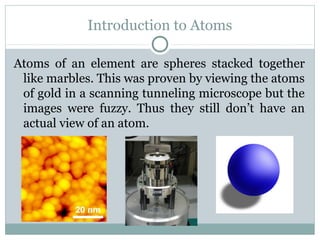
Atoms of an element are spheres stacked together
like marbles. This was proven by viewing the atoms
of gold in a scanning tunneling microscope but the
images were fuzzy. Thus they still don’t have an
actual view of an atom.
Introduction to Atoms
Two or more atoms joined together are
called molecules.
Combination of two or more different
elements chemically in the same fixed
proportion by mass forms a compound.
Electrically charged atoms or molecules are
called ions. They can be positively (cation)
or negatively (anion) charged.
Atomic Theory of John Dalton
In any chemical reaction, atoms are
rearranged or transferred to produce
different substances. The identity and
the mass of the atoms are unchanged.
Laws Governing Atoms and Matter
Joseph Proust
He claimed that a given compound
always contained the same elements in
the same proportion by mass.
Law of Definite Proportion
Laws Governing Atoms and Matter
Antoine Lavoisier
He claimed that there was no
detectable loss or gain of mass during a
chemical reaction.
Matter could neither be created nor
destroyed.
Law of Conservation of Mass
Atomic Theory of John Dalton
All elements are made up of tiny, indivisible
particles called atoms
Atoms combine only in certain whole
number combinations to produce
molecules.
Compounds are composed of molecules. All
molecules of a compound are identical to
each other.
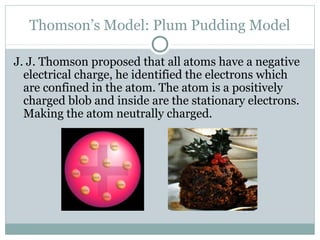
Thomson’s Model: Plum Pudding Model
J. J. Thomson proposed that all atoms have a negative
electrical charge, he identified the electrons which
are confined in the atom. The atom is a positively
charged blob and inside are the stationary electrons.
Making the atom neutrally charged.
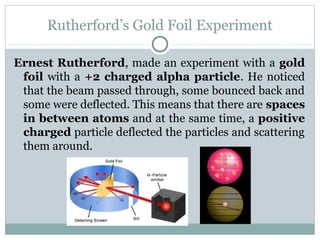
Rutherford’s Gold Foil Experiment
Ernest Rutherford, made an experiment with a gold
foil with a +2 charged alpha particle. He noticed
that the beam passed through, some bounced back and
some were deflected. This means that there are spaces
in between atoms and at the same time, a positive
charged particle deflected the particles and scattering
them around.
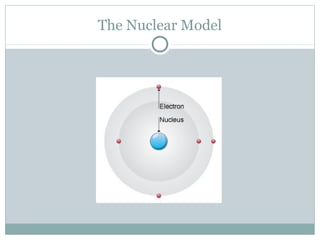
The Nuclear Model
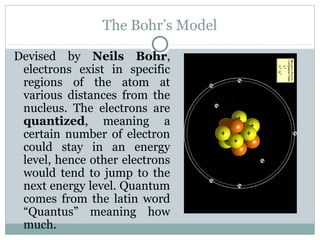
The Bohr’s Model
Devised by Neils Bohr,
electrons exist in specific
regions of the atom at
various distances from the
nucleus. The electrons are
quantized, meaning a
certain number of electron
could stay in an energy
level, hence other electrons
would tend to jump to the
next energy level. Quantum
comes from the latin word
“Quantus” meaning how
much.
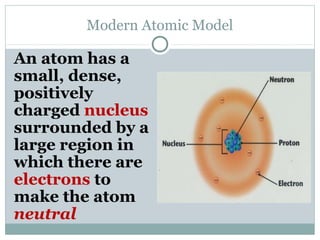
Modern Atomic Model
An atom has a
small, dense,
positively
charged nucleus
surrounded by a
large region in
which there are
electrons to
make the atom
neutral
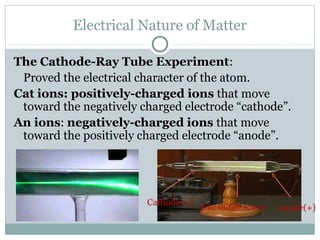
Electrical Nature of Matter
The Cathode-Ray Tube Experiment:
Proved the electrical character of the atom.
Cat ions: positively-charged ions that move
toward the negatively charged electrode “cathode”.
An ions: negatively-charged ions that move
toward the positively charged electrode “anode”.
Cathode (-)
Anode(+)Zinc sulfide screen
The Subatomic Particles
The Electron:
Was discovered by J.J. Thomson in 1897
The mass of an electron is approximately 9.110×10⁻³¹
kilograms, or 5.486×10⁻⁴
atomic mass units.
1 amu is 1.660 × 10⁻²⁴
g
The electron has no known substructure.
The size of an electron is not yet determined but it is
believed to be less than 10-12
cm.
Subatomic Particles
The Proton:
Observed by Eugene Goldstein through the canal
rays, but what he observed where only positive ions.
The discovery were credited to Earnest Rutherford
wherein he observed the + nuclei of a nitrogen gas.
It has a mass of 1.673×10⁻²⁴
g
It has a diameter of approximately 10-14
M. It is 1836
times more massive than an electron and very
slightly less massive than a neutron.
Subatomic Particles
The Neutron:
Discovered by James Chadwick in 1932
Bears neither a positive or negative charge
It has a mass of 1.675×10⁻²⁴
g
The size is 10-15
m
It is contained in the Nucleus of the atom together
with the proton making up its mass.

102730464 the-atom

  • 1.
    HISTORY, MODELS ANDSUBATOMIC PARTICLES The Atom
  • 2.
    History of theAtom Speculations of what matter is made up was prominent in Ancient Greece. They thought matter was made up of what they call “Primal Matter”. Thales thought that “WATER” was the Primal Matter because this was found everywhere. Anaximenes thought that “AIR” was the Primal Matter.
  • 3.
    History of theAtom Heraclitus had the idea that “FIRE” must be primal since it represents changing world. Aristotle claimed that substances came from all 4 elements. Earth, Air, Fire, Water.
  • 4.
    History of theAtom Democritus and his teacher Leucippus proposed that matter came from bits of matter that could not be broken down into smaller pieces. This gave rise to the term “Atom” that came from the Greek word Atomos meaning Indivisible.
  • 5.
    Introduction to Atoms Atomsof an element are spheres stacked together like marbles. This was proven by viewing the atoms of gold in a scanning tunneling microscope but the images were fuzzy. Thus they still don’t have an actual view of an atom.
  • 6.
    Introduction to Atoms Twoor more atoms joined together are called molecules. Combination of two or more different elements chemically in the same fixed proportion by mass forms a compound. Electrically charged atoms or molecules are called ions. They can be positively (cation) or negatively (anion) charged.
  • 7.
    Atomic Theory ofJohn Dalton In any chemical reaction, atoms are rearranged or transferred to produce different substances. The identity and the mass of the atoms are unchanged.
  • 8.
    Laws Governing Atomsand Matter Joseph Proust He claimed that a given compound always contained the same elements in the same proportion by mass. Law of Definite Proportion
  • 9.
    Laws Governing Atomsand Matter Antoine Lavoisier He claimed that there was no detectable loss or gain of mass during a chemical reaction. Matter could neither be created nor destroyed. Law of Conservation of Mass
  • 10.
    Atomic Theory ofJohn Dalton All elements are made up of tiny, indivisible particles called atoms Atoms combine only in certain whole number combinations to produce molecules. Compounds are composed of molecules. All molecules of a compound are identical to each other.
  • 11.
    Thomson’s Model: PlumPudding Model J. J. Thomson proposed that all atoms have a negative electrical charge, he identified the electrons which are confined in the atom. The atom is a positively charged blob and inside are the stationary electrons. Making the atom neutrally charged.
  • 12.
    Rutherford’s Gold FoilExperiment Ernest Rutherford, made an experiment with a gold foil with a +2 charged alpha particle. He noticed that the beam passed through, some bounced back and some were deflected. This means that there are spaces in between atoms and at the same time, a positive charged particle deflected the particles and scattering them around.
  • 13.
  • 14.
    The Bohr’s Model Devisedby Neils Bohr, electrons exist in specific regions of the atom at various distances from the nucleus. The electrons are quantized, meaning a certain number of electron could stay in an energy level, hence other electrons would tend to jump to the next energy level. Quantum comes from the latin word “Quantus” meaning how much.
  • 15.
    Modern Atomic Model Anatom has a small, dense, positively charged nucleus surrounded by a large region in which there are electrons to make the atom neutral
  • 16.
    Electrical Nature ofMatter The Cathode-Ray Tube Experiment: Proved the electrical character of the atom. Cat ions: positively-charged ions that move toward the negatively charged electrode “cathode”. An ions: negatively-charged ions that move toward the positively charged electrode “anode”. Cathode (-) Anode(+)Zinc sulfide screen
  • 17.
    The Subatomic Particles TheElectron: Was discovered by J.J. Thomson in 1897 The mass of an electron is approximately 9.110×10⁻³¹ kilograms, or 5.486×10⁻⁴ atomic mass units. 1 amu is 1.660 × 10⁻²⁴ g The electron has no known substructure. The size of an electron is not yet determined but it is believed to be less than 10-12 cm.
  • 18.
    Subatomic Particles The Proton: Observedby Eugene Goldstein through the canal rays, but what he observed where only positive ions. The discovery were credited to Earnest Rutherford wherein he observed the + nuclei of a nitrogen gas. It has a mass of 1.673×10⁻²⁴ g It has a diameter of approximately 10-14 M. It is 1836 times more massive than an electron and very slightly less massive than a neutron.
  • 19.
    Subatomic Particles The Neutron: Discoveredby James Chadwick in 1932 Bears neither a positive or negative charge It has a mass of 1.675×10⁻²⁴ g The size is 10-15 m It is contained in the Nucleus of the atom together with the proton making up its mass.