9/26/2024
1. What are the 3 subatomic particles?
The 3 subatomic particles are ……..
1. What is the charge for each particle?
For the ________ the charge is ________.
1. What does the period number tell you about
an atom?
From the period number I can determine the
…………
Do Now Agenda
• Do Now
• History of the Atom
• Cathode Ray experiment
• DOL
10
TEKS
Chem 6.A. Construct models using Dalton's Postulates, Thomson's
discovery of electron properties, Rutherford's nuclear atom, Bohr's
nuclear atom, and Heisenberg's Uncertainty Principle to show the
development of modern atomic theory over time;
Chem 6.B. describe the structure of atoms and ions, including the
masses, electrical charges, and locations of protons and neutrons
in the nucleus and electrons in the electron cloud;
11
Learning Objective
• Students will be able to construct models using Dalton's
Postulates, Thomson's discovery of electron properties,
Rutherford's nuclear atom, Bohr's nuclear atom, and Heisenberg's
Uncertainty Principle to show the development of modern atomic
theory over time;
• Students will be able to describe the structure of atoms and ions,
including the masses, electrical charges, and locations of protons
and neutrons in the nucleus and electrons in the electron cloud;
12
9 10
11 12
9/26/2024
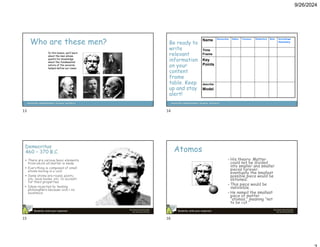
Who are these men?
In this lesson, we’ll learn
about the men whose
quests for knowledge
about the fundamental
nature of the universe
helped define our views.
Schrödinger
Heisenberg
Bohr
Rutherford
Thomson
Dalton
Democritus
Name
Time
Frame
Key
Points
describe
Model
Be ready to
write
relevant
information
on your
content
frame
table. Keep
up and stay
alert!
Democritus
460 – 370 B.C.
• There are various basic elements
from which all matter is made
• Everything is composed of small
atoms moving in a void
• Some atoms are round, pointy,
oily, have hooks, etc. to account
for their properties
• Ideas rejected by leading
philosophers because void = no
existence
Atomos
• His theory: Matter
could not be divided
into smaller and smaller
pieces forever,
eventually the smallest
possible piece would be
obtained.
• This piece would be
indivisible.
• He named the smallest
piece of matter
“atomos,” meaning “not
to be cut.”
13 14
15 16
9/26/2024
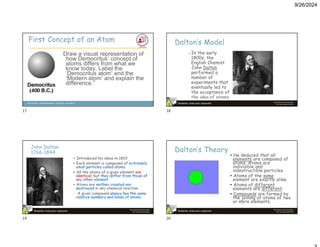
First Concept of an Atom
Draw a visual representation of
how Democritus’ concept of
atoms differs from what we
know today. Label the
‘Democritus atom’ and the
‘Modern atom’ and explain the
difference.”
Dalton’s Model
• In the early
1800s, the
English Chemist
John Dalton
performed a
number of
experiments that
eventually led to
the acceptance of
the idea of atoms.
John Dalton
1766-1844
• Introduced his ideas in 1803
• Each element is composed of extremely
small particles called atoms
• All the atoms of a given element are
identical, but they differ from those of
any other element
• Atoms are neither created nor
destroyed in any chemical reaction
• A given compound always has the same
relative numbers and kinds of atoms
Dalton’s Theory
• He deduced that all
elements are composed of
atoms. Atoms are
indivisible and
indestructible particles.
• Atoms of the same
element are exactly alike.
• Atoms of different
elements are different.
• Compounds are formed by
the joining of atoms of two
or more elements.
17 18
19 20
9/26/2024
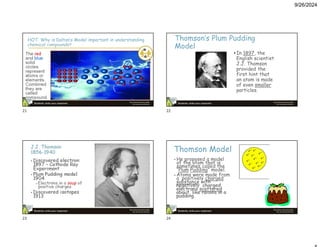
HOT: Why is Dalton’s Model important in understanding
chemical compounds?
The red
and blue
solid
circles
represent
atoms or
elements.
Combined
they are
called
compound.
Thomson’s Plum Pudding
Model
• In 1897, the
English scientist
J.J. Thomson
provided the
first hint that
an atom is made
of even smaller
particles.
J.J. Thomson
1856-1940
• Discovered electron
1897 – Cathode Ray
Experiment
• Plum Pudding model
1904
– Electrons in a soup of
positive charges
• Discovered isotopes
1913
Thomson Model
• He proposed a model
of the atom that is
sometimes called the
“Plum Pudding” model.
• Atoms were made from
a positively charged
substance with
negatively charged
electrons scattered
about, like raisins in a
pudding.
21 22
23 24
9/26/2024
JJ Thomson’s Ideas
“What are the
‘positive and
negative forces’
Thomson
referred to in his
research?” Hint:
How does something
stick to a whiteboard?
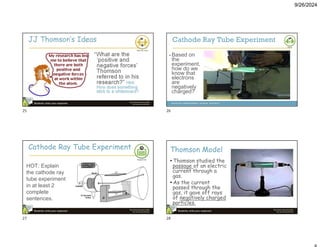
Cathode Ray Tube Experiment
• Based on
the
experiment,
how do we
know that
electrons
are
negatively
charged?
Cathode Ray Tube Experiment
HOT: Explain
the cathode ray
tube experiment
in at least 2
complete
sentences.
Thomson Model
• Thomson studied the
passage of an electric
current through a
gas.
• As the current
passed through the
gas, it gave off rays
of negatively charged
particles.
25 26
27 28
9/26/2024
Thomson Model
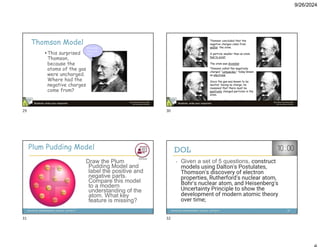
• This surprised
Thomson,
because the
atoms of the gas
were uncharged.
Where had the
negative charges
come from?
Where did
they come
from?
Thomson concluded that the
negative charges came from
within the atom.
A particle smaller than an atom
had to exist.
The atom was divisible!
Thomson called the negatively
charged “corpuscles,” today known
as electrons.
Since the gas was known to be
neutral, having no charge, he
reasoned that there must be
positively charged particles in the
atom.
But he could never find them.
Plum Pudding Model
Draw the Plum
Pudding Model and
label the positive and
negative parts.
Compare this model
to a modern
understanding of the
atom. What key
feature is missing?
DOL
• Given a set of 5 questions, construct
models using Dalton's Postulates,
Thomson's discovery of electron
properties, Rutherford's nuclear atom,
Bohr's nuclear atom, and Heisenberg's
Uncertainty Principle to show the
development of modern atomic theory
over time;
32
29 30
31 32
9/26/2024
33
Closing Procedure
Closing Procedure
❑ Make your area neat
❑ Wipe down desk
❑ Stack binders neatly [Notebook person
collects them]
❑ Return pencils in bin
❑ Grab Backpack & Phone
❑ Leave the classroom C1W5L2
Atomic History
&
Gold Foil Experiment
34
35
MRS Icons
MRS Icons
36
5 Minutes
Opening Procedure
Opening Procedure
❑ Find your seat (front first)
❑ Make your area neat
❑ Get your Binder[Notebook person]
❑ Sharpen your pencils
❑ Take out your computer
❑ Prepare for Do Now (graded)
❑ Put your phone in your pouch
❑ Backpacks in the front of the classroom
33 34
35 36
9/26/2024
Agenda
• Do Now
• History of the Atom
• Gold Foil Experiment
• DOL
37
Do Now
Based on your prior knowledge, draw a
modern model of an atom and label its parts.
After drawing, answer: Where do you think
most of the mass of the atom is located, and
why?
38
• Ok, lets talk
about the next
scientist!
• Rutherford’s
experiment
Involved firing
a stream of
tiny positively
charged
particles at a
thin sheet of
gold foil (2000
atoms thick)
Schrödinger
Heisenberg
Bohr
Rutherford
Thomson
Dalton
Democritus
Name
Time
Frame
Key
Points
describe
Model
Gold Foil Experiment
How did the
deflection patterns
observed in the
gold foil
experiment lead
to the conclusion
that the atom has
a small, dense
nucleus
surrounded by
mostly empty
space?
37 38
39 40
9/26/2024
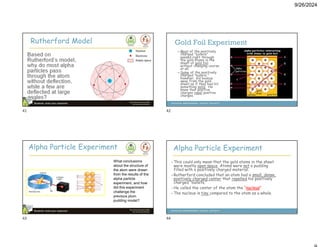
Rutherford Model
Based on
Rutherford’s model,
why do most alpha
particles pass
through the atom
without deflection,
while a few are
deflected at large
angles?
Gold Foil Experiment
– Most of the positively
charged “bullets”
passed right through
the gold atoms in the
sheet of gold foil
without changing course
at all.
– Some of the positively
charged “bullets,”
however, did bounce
away from the gold
sheet as if they had hit
something solid. He
knew that positive
charges repel positive
charges.
Alpha Particle Experiment
What conclusions
about the structure of
the atom were drawn
from the results of the
alpha particle
experiment, and how
did this experiment
challenge the
previous plum
pudding model?
Alpha Particle Experiment
• This could only mean that the gold atoms in the sheet
were mostly open space. Atoms were not a pudding
filled with a positively charged material.
• Rutherford concluded that an atom had a small, dense,
positively charged center that repelled his positively
charged “bullets.”
• He called the center of the atom the “nucleus”
• The nucleus is tiny compared to the atom as a whole.
41 42
43 44
9/26/2024
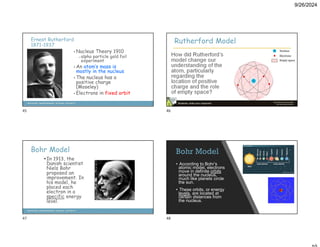
Ernest Rutherford
1871-1937
• Nucleus Theory 1910
– alpha particle gold foil
experiment
• An atom’s mass is
mostly in the nucleus
• The nucleus has a
positive charge
(Moseley)
• Electrons in fixed orbit
Rutherford Model
How did Rutherford’s
model change our
understanding of the
atom, particularly
regarding the
location of positive
charge and the role
of empty space?
Bohr Model
• In 1913, the
Danish scientist
Niels Bohr
proposed an
improvement. In
his model, he
placed each
electron in a
specific energy
level.
Bohr Model
• According to Bohr’s
atomic model, electrons
move in definite orbits
around the nucleus,
much like planets circle
the sun.
• These orbits, or energy
levels, are located at
certain distances from
the nucleus.
45 46
47 48
9/26/2024
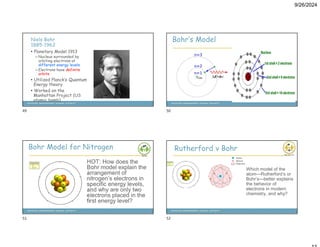
Niels Bohr
1885-1962
• Planetary Model 1913
– Nucleus surrounded by
orbiting electrons at
different energy levels
– Electrons have definite
orbits
• Utilized Planck’s Quantum
Energy theory
• Worked on the
Manhattan Project (US
atomic bomb)
Bohr’s Model
Bohr Model for Nitrogen
HOT: How does the
Bohr model explain the
arrangement of
nitrogen’s electrons in
specific energy levels,
and why are only two
electrons placed in the
first energy level?
Rutherford v Bohr
Which model of the
atom—Rutherford’s or
Bohr’s—better explains
the behavior of
electrons in modern
chemistry, and why?
49 50
51 52
9/26/2024
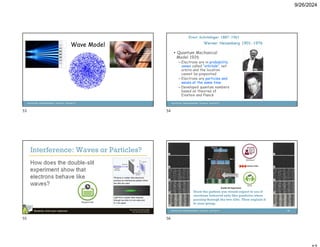
Wave Model
Ernst Schrödinger 1887-1961
• Quantum Mechanical
Model 1926
– Electrons are in probability
zones called “orbitals”, not
orbits and the location
cannot be pinpointed
– Electrons are particles and
waves at the same time
– Developed quantum numbers
based on theories of
Einstein and Planck
Werner Heisenberg 1901-1976
Interference: Waves or Particles?
How does the double-slit
experiment show that
electrons behave like
waves?
55
Draw the pattern you would expect to see if
electrons behaved only like particles when
passing through the two slits. Then explain it
to your group.
56
53 54
55 56
9/26/2024
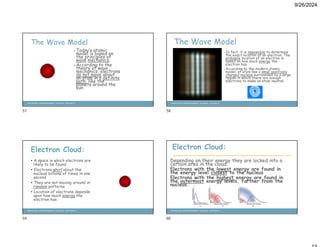
The Wave Model
• Today’s atomic
model is based on
the principles of
wave mechanics.
• According to the
theory of wave
mechanics, electrons
do not move about
an atom in a definite
path, like the
planets around the
sun.
The Wave Model
• In fact, it is impossible to determine
the exact location of an electron. The
probable location of an electron is
based on how much energy the
electron has.
• According to the modern atomic
model, at atom has a small positively
charged nucleus surrounded by a large
region in which there are enough
electrons to make an atom neutral.
Electron Cloud:
• A space in which electrons are
likely to be found.
• Electrons whirl about the
nucleus billions of times in one
second
• They are not moving around in
random patterns.
• Location of electrons depends
upon how much energy the
electron has.
Electron Cloud:
Depending on their energy they are locked into a
certain area in the cloud.
Electrons with the lowest energy are found in
the energy level closest to the nucleus
Electrons with the highest energy are found in
the outermost energy levels, farther from the
nucleus.
57 58
59 60
9/26/2024
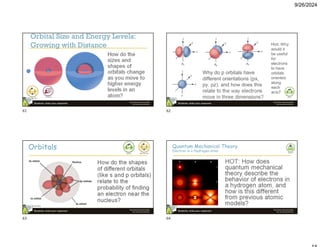
Orbital Size and Energy Levels:
Growing with Distance
How do the
sizes and
shapes of
orbitals change
as you move to
higher energy
levels in an
atom?
61 62
Why do p orbitals have
different orientations (px,
py, pz), and how does this
relate to the way electrons
move in three dimensions?
Hint: Why
would it
be useful
for
electrons
to have
orbitals
oriented
along
each
axis?
Orbitals
How do the shapes
of different orbitals
(like s and p orbitals)
relate to the
probability of finding
an electron near the
nucleus?
Quantum Mechanical Theory
Electron in a Hydrogen atom
HOT: How does
quantum mechanical
theory describe the
behavior of electrons in
a hydrogen atom, and
how is this different
from previous atomic
models?
61 62
63 64
9/26/2024
Electron
Cloud
Orbit
Nucleus
Electron
Indivisible
X
Greek
X
Dalton
X
Thomson
X
X
Rutherford
X
X
X
Bohr
X
X
X
Wave
DOL
• Given a set of 5 questions, students will
be able to identify and predict the
properties of elements in the periodic
table, including their group and period,
atomic number, and various periodic
trends.
67 68
Closing Procedure
Closing Procedure
❑ Make your area neat
❑ Wipe down desk
❑ Stack binders neatly [Notebook person
collects them]
❑ Return pencils in bin
❑ Grab Backpack & Phone
❑ Leave the classroom
65 66
67 68

Atomic history slides 24_25.pdf educational studies

  • 1.
    9/26/2024 1. What arethe 3 subatomic particles? The 3 subatomic particles are …….. 1. What is the charge for each particle? For the ________ the charge is ________. For the ________ the charge is ________. For the ________ the charge is ________. 1. What does the period number tell you about an atom? From the period number I can determine the ………… Do Now Agenda • Do Now • History of the Atom • Cathode Ray experiment • DOL 10 TEKS Chem 6.A. Construct models using Dalton's Postulates, Thomson's discovery of electron properties, Rutherford's nuclear atom, Bohr's nuclear atom, and Heisenberg's Uncertainty Principle to show the development of modern atomic theory over time; Chem 6.B. describe the structure of atoms and ions, including the masses, electrical charges, and locations of protons and neutrons in the nucleus and electrons in the electron cloud; 11 Learning Objective • Students will be able to construct models using Dalton's Postulates, Thomson's discovery of electron properties, Rutherford's nuclear atom, Bohr's nuclear atom, and Heisenberg's Uncertainty Principle to show the development of modern atomic theory over time; • Students will be able to describe the structure of atoms and ions, including the masses, electrical charges, and locations of protons and neutrons in the nucleus and electrons in the electron cloud; 12 9 10 11 12
  • 2.
    9/26/2024 Who are thesemen? In this lesson, we’ll learn about the men whose quests for knowledge about the fundamental nature of the universe helped define our views. Schrödinger Heisenberg Bohr Rutherford Thomson Dalton Democritus Name Time Frame Key Points describe Model Be ready to write relevant information on your content frame table. Keep up and stay alert! Democritus 460 – 370 B.C. • There are various basic elements from which all matter is made • Everything is composed of small atoms moving in a void • Some atoms are round, pointy, oily, have hooks, etc. to account for their properties • Ideas rejected by leading philosophers because void = no existence Atomos • His theory: Matter could not be divided into smaller and smaller pieces forever, eventually the smallest possible piece would be obtained. • This piece would be indivisible. • He named the smallest piece of matter “atomos,” meaning “not to be cut.” 13 14 15 16
  • 3.
    9/26/2024 First Concept ofan Atom Draw a visual representation of how Democritus’ concept of atoms differs from what we know today. Label the ‘Democritus atom’ and the ‘Modern atom’ and explain the difference.” Dalton’s Model • In the early 1800s, the English Chemist John Dalton performed a number of experiments that eventually led to the acceptance of the idea of atoms. John Dalton 1766-1844 • Introduced his ideas in 1803 • Each element is composed of extremely small particles called atoms • All the atoms of a given element are identical, but they differ from those of any other element • Atoms are neither created nor destroyed in any chemical reaction • A given compound always has the same relative numbers and kinds of atoms Dalton’s Theory • He deduced that all elements are composed of atoms. Atoms are indivisible and indestructible particles. • Atoms of the same element are exactly alike. • Atoms of different elements are different. • Compounds are formed by the joining of atoms of two or more elements. 17 18 19 20
  • 4.
    9/26/2024 HOT: Why isDalton’s Model important in understanding chemical compounds? The red and blue solid circles represent atoms or elements. Combined they are called compound. Thomson’s Plum Pudding Model • In 1897, the English scientist J.J. Thomson provided the first hint that an atom is made of even smaller particles. J.J. Thomson 1856-1940 • Discovered electron 1897 – Cathode Ray Experiment • Plum Pudding model 1904 – Electrons in a soup of positive charges • Discovered isotopes 1913 Thomson Model • He proposed a model of the atom that is sometimes called the “Plum Pudding” model. • Atoms were made from a positively charged substance with negatively charged electrons scattered about, like raisins in a pudding. 21 22 23 24
  • 5.
    9/26/2024 JJ Thomson’s Ideas “Whatare the ‘positive and negative forces’ Thomson referred to in his research?” Hint: How does something stick to a whiteboard? Cathode Ray Tube Experiment • Based on the experiment, how do we know that electrons are negatively charged? Cathode Ray Tube Experiment HOT: Explain the cathode ray tube experiment in at least 2 complete sentences. Thomson Model • Thomson studied the passage of an electric current through a gas. • As the current passed through the gas, it gave off rays of negatively charged particles. 25 26 27 28
  • 6.
    9/26/2024 Thomson Model • Thissurprised Thomson, because the atoms of the gas were uncharged. Where had the negative charges come from? Where did they come from? Thomson concluded that the negative charges came from within the atom. A particle smaller than an atom had to exist. The atom was divisible! Thomson called the negatively charged “corpuscles,” today known as electrons. Since the gas was known to be neutral, having no charge, he reasoned that there must be positively charged particles in the atom. But he could never find them. Plum Pudding Model Draw the Plum Pudding Model and label the positive and negative parts. Compare this model to a modern understanding of the atom. What key feature is missing? DOL • Given a set of 5 questions, construct models using Dalton's Postulates, Thomson's discovery of electron properties, Rutherford's nuclear atom, Bohr's nuclear atom, and Heisenberg's Uncertainty Principle to show the development of modern atomic theory over time; 32 29 30 31 32
  • 7.
    9/26/2024 33 Closing Procedure Closing Procedure ❑Make your area neat ❑ Wipe down desk ❑ Stack binders neatly [Notebook person collects them] ❑ Return pencils in bin ❑ Grab Backpack & Phone ❑ Leave the classroom C1W5L2 Atomic History & Gold Foil Experiment 34 35 MRS Icons MRS Icons 36 5 Minutes Opening Procedure Opening Procedure ❑ Find your seat (front first) ❑ Make your area neat ❑ Get your Binder[Notebook person] ❑ Sharpen your pencils ❑ Take out your computer ❑ Prepare for Do Now (graded) ❑ Put your phone in your pouch ❑ Backpacks in the front of the classroom 33 34 35 36
  • 8.
    9/26/2024 Agenda • Do Now •History of the Atom • Gold Foil Experiment • DOL 37 Do Now Based on your prior knowledge, draw a modern model of an atom and label its parts. After drawing, answer: Where do you think most of the mass of the atom is located, and why? 38 • Ok, lets talk about the next scientist! • Rutherford’s experiment Involved firing a stream of tiny positively charged particles at a thin sheet of gold foil (2000 atoms thick) Schrödinger Heisenberg Bohr Rutherford Thomson Dalton Democritus Name Time Frame Key Points describe Model Gold Foil Experiment How did the deflection patterns observed in the gold foil experiment lead to the conclusion that the atom has a small, dense nucleus surrounded by mostly empty space? 37 38 39 40
  • 9.
    9/26/2024 Rutherford Model Based on Rutherford’smodel, why do most alpha particles pass through the atom without deflection, while a few are deflected at large angles? Gold Foil Experiment – Most of the positively charged “bullets” passed right through the gold atoms in the sheet of gold foil without changing course at all. – Some of the positively charged “bullets,” however, did bounce away from the gold sheet as if they had hit something solid. He knew that positive charges repel positive charges. Alpha Particle Experiment What conclusions about the structure of the atom were drawn from the results of the alpha particle experiment, and how did this experiment challenge the previous plum pudding model? Alpha Particle Experiment • This could only mean that the gold atoms in the sheet were mostly open space. Atoms were not a pudding filled with a positively charged material. • Rutherford concluded that an atom had a small, dense, positively charged center that repelled his positively charged “bullets.” • He called the center of the atom the “nucleus” • The nucleus is tiny compared to the atom as a whole. 41 42 43 44
  • 10.
    9/26/2024 Ernest Rutherford 1871-1937 • NucleusTheory 1910 – alpha particle gold foil experiment • An atom’s mass is mostly in the nucleus • The nucleus has a positive charge (Moseley) • Electrons in fixed orbit Rutherford Model How did Rutherford’s model change our understanding of the atom, particularly regarding the location of positive charge and the role of empty space? Bohr Model • In 1913, the Danish scientist Niels Bohr proposed an improvement. In his model, he placed each electron in a specific energy level. Bohr Model • According to Bohr’s atomic model, electrons move in definite orbits around the nucleus, much like planets circle the sun. • These orbits, or energy levels, are located at certain distances from the nucleus. 45 46 47 48
  • 11.
    9/26/2024 Niels Bohr 1885-1962 • PlanetaryModel 1913 – Nucleus surrounded by orbiting electrons at different energy levels – Electrons have definite orbits • Utilized Planck’s Quantum Energy theory • Worked on the Manhattan Project (US atomic bomb) Bohr’s Model Bohr Model for Nitrogen HOT: How does the Bohr model explain the arrangement of nitrogen’s electrons in specific energy levels, and why are only two electrons placed in the first energy level? Rutherford v Bohr Which model of the atom—Rutherford’s or Bohr’s—better explains the behavior of electrons in modern chemistry, and why? 49 50 51 52
  • 12.
    9/26/2024 Wave Model Ernst Schrödinger1887-1961 • Quantum Mechanical Model 1926 – Electrons are in probability zones called “orbitals”, not orbits and the location cannot be pinpointed – Electrons are particles and waves at the same time – Developed quantum numbers based on theories of Einstein and Planck Werner Heisenberg 1901-1976 Interference: Waves or Particles? How does the double-slit experiment show that electrons behave like waves? 55 Draw the pattern you would expect to see if electrons behaved only like particles when passing through the two slits. Then explain it to your group. 56 53 54 55 56
  • 13.
    9/26/2024 The Wave Model •Today’s atomic model is based on the principles of wave mechanics. • According to the theory of wave mechanics, electrons do not move about an atom in a definite path, like the planets around the sun. The Wave Model • In fact, it is impossible to determine the exact location of an electron. The probable location of an electron is based on how much energy the electron has. • According to the modern atomic model, at atom has a small positively charged nucleus surrounded by a large region in which there are enough electrons to make an atom neutral. Electron Cloud: • A space in which electrons are likely to be found. • Electrons whirl about the nucleus billions of times in one second • They are not moving around in random patterns. • Location of electrons depends upon how much energy the electron has. Electron Cloud: Depending on their energy they are locked into a certain area in the cloud. Electrons with the lowest energy are found in the energy level closest to the nucleus Electrons with the highest energy are found in the outermost energy levels, farther from the nucleus. 57 58 59 60
  • 14.
    9/26/2024 Orbital Size andEnergy Levels: Growing with Distance How do the sizes and shapes of orbitals change as you move to higher energy levels in an atom? 61 62 Why do p orbitals have different orientations (px, py, pz), and how does this relate to the way electrons move in three dimensions? Hint: Why would it be useful for electrons to have orbitals oriented along each axis? Orbitals How do the shapes of different orbitals (like s and p orbitals) relate to the probability of finding an electron near the nucleus? Quantum Mechanical Theory Electron in a Hydrogen atom HOT: How does quantum mechanical theory describe the behavior of electrons in a hydrogen atom, and how is this different from previous atomic models? 61 62 63 64
  • 15.
    9/26/2024 Electron Cloud Orbit Nucleus Electron Indivisible X Greek X Dalton X Thomson X X Rutherford X X X Bohr X X X Wave DOL • Given aset of 5 questions, students will be able to identify and predict the properties of elements in the periodic table, including their group and period, atomic number, and various periodic trends. 67 68 Closing Procedure Closing Procedure ❑ Make your area neat ❑ Wipe down desk ❑ Stack binders neatly [Notebook person collects them] ❑ Return pencils in bin ❑ Grab Backpack & Phone ❑ Leave the classroom 65 66 67 68