Development Of Atomic TheoryPhysical ScienceChapter 4.1
ObjectivesDescribesome of the experiments that led to the current atomic theory.Compare the different models of the atom.Explain how the atomic theory has changed as scientists have discovered new information about the atom.BellringerThe following is a quote by Democritus (c. 460–c. 370 bce). “Color exists by convention, sweet by convention, bitter by convention; in reality nothing exists but atoms and the void.”What do you know about Democritus? And why are his thoughts important?
The Beginning of the Atomic Theory440 BCE, a Greek philosopher, Democritusthought that you would eventually end up with a particle that could not be cut. He called this particle an atom.Aristotle, another Greek philosopher, disagreed with DemocritusHe believed that you would never end up with a particle that could not be cut.atomsmallest particle into which an element can be divided and still be the same substance.
Dalton’s Atomic TheoryPublished in1803. Stated thatAll substances are made of atoms.Atoms are small particles that cannot be created, divided, or destroyed.Atoms of the same element are exactly alikeAtoms of different elements are different. Atoms join with other atoms to make new substances.Not Quite Correct  The atomic theory was then changed to describe the atom more correctly.
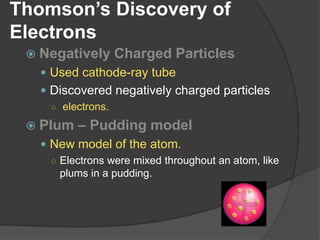
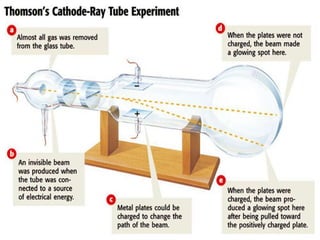
Thomson’s Discovery of Electrons Negatively Charged ParticlesUsed cathode-ray tube Discovered negatively charged particleselectrons.Plum – Pudding modelNew model of the atom. Electrons were mixed throughout an atom, like plums in a pudding.
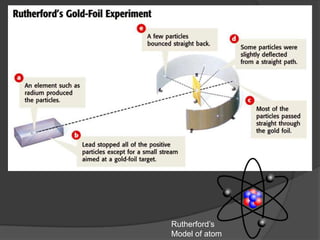
Rutherford’s Atomic “Shooting Gallery”Negatively Charged Particles1909Ernest Rutherford aimed a beam of small, positively charged particles at a thin sheet of gold foil. Surprising ResultsExpected the particles to pass right through the gold in a straight line. Surprise, some of the particles were deflected!!
Rutherford’s Model of atom
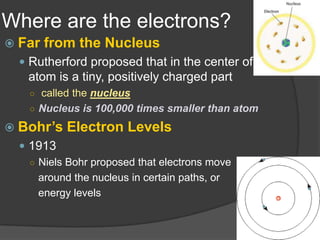
Where are the electrons?Far from the NucleusRutherford proposed that in the center of the atom is a tiny, positively charged partcalled the nucleusNucleus is 100,000 times smaller than atomBohr’s Electron Levels1913NielsBohr proposed that electrons move   around the nucleus in certain paths, or   energy levels
Size of the Nucleus
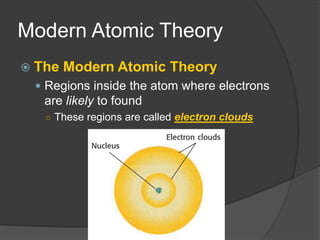
Modern Atomic TheoryThe Modern Atomic TheoryRegions inside the atom where electrons are likely to foundThese regions are called electron clouds

Physical science 4.1 : Development of Atomic Theory

  • 1.
    Development Of AtomicTheoryPhysical ScienceChapter 4.1
  • 2.
    ObjectivesDescribesome of theexperiments that led to the current atomic theory.Compare the different models of the atom.Explain how the atomic theory has changed as scientists have discovered new information about the atom.BellringerThe following is a quote by Democritus (c. 460–c. 370 bce). “Color exists by convention, sweet by convention, bitter by convention; in reality nothing exists but atoms and the void.”What do you know about Democritus? And why are his thoughts important?
  • 3.
    The Beginning ofthe Atomic Theory440 BCE, a Greek philosopher, Democritusthought that you would eventually end up with a particle that could not be cut. He called this particle an atom.Aristotle, another Greek philosopher, disagreed with DemocritusHe believed that you would never end up with a particle that could not be cut.atomsmallest particle into which an element can be divided and still be the same substance.
  • 4.
    Dalton’s Atomic TheoryPublishedin1803. Stated thatAll substances are made of atoms.Atoms are small particles that cannot be created, divided, or destroyed.Atoms of the same element are exactly alikeAtoms of different elements are different. Atoms join with other atoms to make new substances.Not Quite Correct The atomic theory was then changed to describe the atom more correctly.
  • 5.
    Thomson’s Discovery ofElectrons Negatively Charged ParticlesUsed cathode-ray tube Discovered negatively charged particleselectrons.Plum – Pudding modelNew model of the atom. Electrons were mixed throughout an atom, like plums in a pudding.
  • 7.
    Rutherford’s Atomic “ShootingGallery”Negatively Charged Particles1909Ernest Rutherford aimed a beam of small, positively charged particles at a thin sheet of gold foil. Surprising ResultsExpected the particles to pass right through the gold in a straight line. Surprise, some of the particles were deflected!!
  • 8.
  • 9.
    Where are theelectrons?Far from the NucleusRutherford proposed that in the center of the atom is a tiny, positively charged partcalled the nucleusNucleus is 100,000 times smaller than atomBohr’s Electron Levels1913NielsBohr proposed that electrons move around the nucleus in certain paths, or energy levels
  • 10.
  • 11.
    Modern Atomic TheoryTheModern Atomic TheoryRegions inside the atom where electrons are likely to foundThese regions are called electron clouds