Custom Crew Exploration Vehicle
• CONCEPT
• Custom Crew Exploration Vehicle spacecraft
  structure idea based on Apollo Command
  Module and Orion Crew Exploration Vehicle.
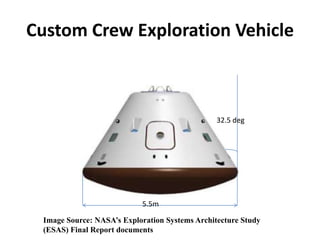
Custom Crew Exploration Vehicle


                                                32.5 deg


                           5.5m

 Image Source: NASA’s Exploration Systems Architecture Study
 (ESAS) Final Report documents
Advantages

•   The CEV pressurized volume is 30.6 m^3 .It has almost three times the internal
    volume as compared to the Apollo Command Module(10.4 m^3).

• The CEV was designed for the EOR–LOR (Earth Orbit Rendezvous- Lunar Orbit
  Rendezvous ), and volume reduction helps to reduce mass to that required for the
  mission.
• This configuration provides 29.4 m^3 of pressurized volume and 12–15 m^3 of
  habitable volume for the crew during transits between Earth and the Moon.
• The CEV operates at a nominal internal pressure of 65.5 kPa with 30 percent
  oxygen composition for lunar missions, although the pressure vessel structure is
  designed for a maximum pressure of 101.3 kPa. Operating at this higher pressure
  allows the CEV to transport crew to the ISS without the use of an intermediate
  airlock.
NOTE: The above mentioned advantages are based on “CEV Overview and
  Recommendations” by NASA (SOURCE).
Subsystem Structure
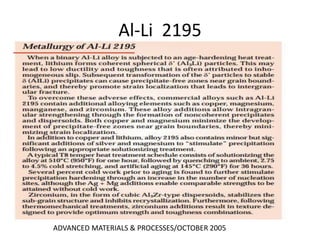
• Structure Material: Al-Li 2195
• Patch Material: Kapton
Al-Li 2195


ADVANCED MATERIALS & PROCESSES/OCTOBER 2005
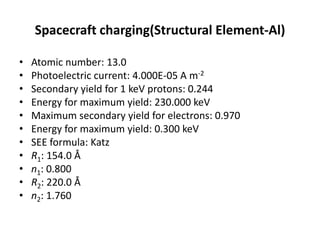
Spacecraft charging(Structural Element-Al)

•   Atomic number: 13.0
•   Photoelectric current: 4.000E-05 A m-2
•   Secondary yield for 1 keV protons: 0.244
•   Energy for maximum yield: 230.000 keV
•   Maximum secondary yield for electrons: 0.970
•   Energy for maximum yield: 0.300 keV
•   SEE formula: Katz
•   R1: 154.0 Å
•   n1: 0.800
•   R2: 220.0 Å
•   n2: 1.760
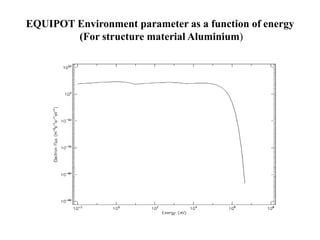
EQUIPOT Environment parameter as a function of energy
        (For structure material Aluminium)
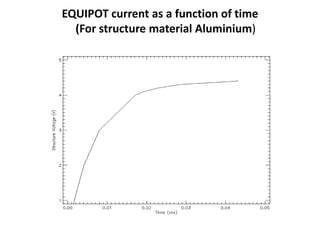
EQUIPOT current as a function of time
  (For structure material Aluminium)
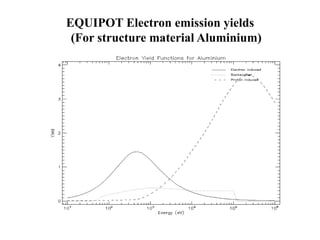
EQUIPOT Electron emission yields
 (For structure material Aluminium)
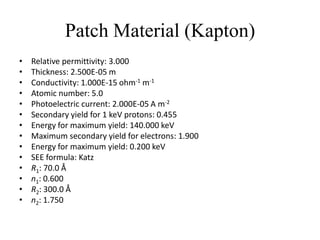
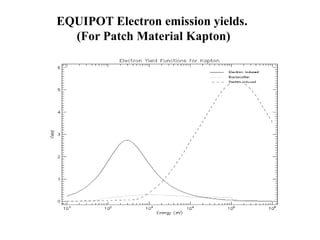
Patch Material (Kapton)
•   Relative permittivity: 3.000
•   Thickness: 2.500E-05 m
•   Conductivity: 1.000E-15 ohm-1 m-1
•   Atomic number: 5.0
•   Photoelectric current: 2.000E-05 A m-2
•   Secondary yield for 1 keV protons: 0.455
•   Energy for maximum yield: 140.000 keV
•   Maximum secondary yield for electrons: 1.900
•   Energy for maximum yield: 0.200 keV
•   SEE formula: Katz
•   R1: 70.0 Å
•   n1: 0.600
•   R2: 300.0 Å
•   n2: 1.750
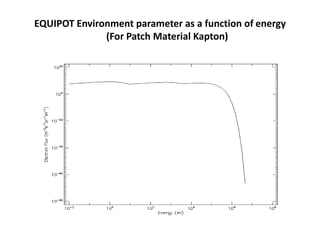
EQUIPOT Environment parameter as a function of energy
              (For Patch Material Kapton)
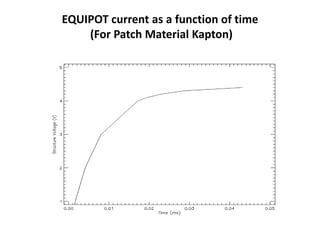
EQUIPOT current as a function of time
    (For Patch Material Kapton)
EQUIPOT Electron emission yields.
  (For Patch Material Kapton)
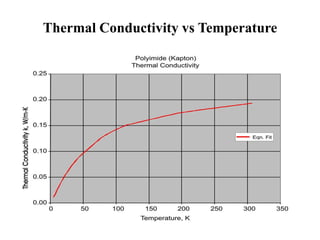
Thermal Conductivity vs Temperature
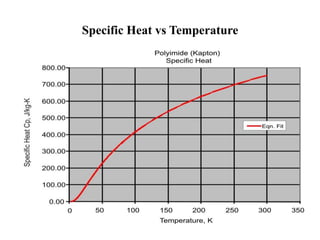
Specific Heat vs Temperature
Kapton can be used as Protective Shielding

•    The primary technique for meteoroid protection is placement of
    multi-layer insulation (MLI) blankets on critical areas of the
    spacecraft, such as propellant and helium tanks. MLI blankets are
    composed of layers of a Kapton polyamide .

• MLI effectiveness in preventing damage to critical spacecraft
  subsystems depends on the:
• Blanket material, location, and number of layers.

• Meteoroid mass, impact velocity, density, and angle of impact.

• Impacted structure material, thickness, temperature, stress level,
  and the number and spacing of the plates composing the structure
  and the subsystem package.
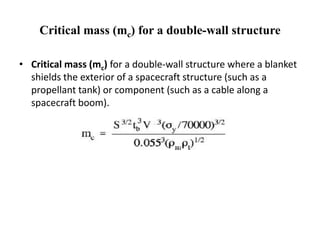
Critical mass (mc) for a double-wall structure

• Critical mass (mc) for a double-wall structure where a blanket
  shields the exterior of a spacecraft structure (such as a
  propellant tank) or component (such as a cable along a
  spacecraft boom).
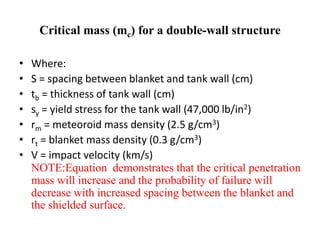
Critical mass (mc) for a double-wall structure

•   Where:
•   S = spacing between blanket and tank wall (cm)
•   tb = thickness of tank wall (cm)
•   sy = yield stress for the tank wall (47,000 lb/in2)
•   rm = meteoroid mass density (2.5 g/cm3)
•   rt = blanket mass density (0.3 g/cm3)
•   V = impact velocity (km/s)
    NOTE:Equation demonstrates that the critical penetration
    mass will increase and the probability of failure will
    decrease with increased spacing between the blanket and
    the shielded surface.
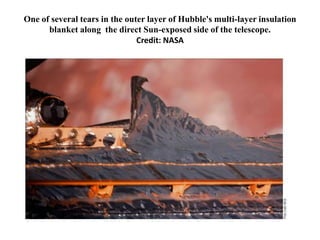
One of several tears in the outer layer of Hubble's multi-layer insulation
      blanket along the direct Sun-exposed side of the telescope.
                               Credit: NASA
Hubble's multi-layer insulation blanket

• Sixteen thin layers of dimpled aluminized
  Kapton material are covered by an outer
  aluminized Teflon shell , all together measure
  less than one-tenth of an inch thick.
Flammability Testing
• Mercury and Gemini spacecraft operated with pure oxygen
  atmospheres at all times.
• Flammability testing consists of purposely short-circuiting or
  overloading wires at strategic points throughout the spacecraft to
  start fires.
• Once the fires are started, engineers study their self-extinguishing
  characteristics.
• The spacecraft is normally tested prior to launch at a positive
  internal pressure of about 16 pounds to assure spacecraft sealing
  integrity. That is to overcome the 14.7 pounds of normal sea level
  atmosphere pressing on the spacecraft at launch.
• In orbit , a cabin pressure of from five to six pounds is maintained
  in contrast to the zero pressure of outer space.
Conclusion
• Crew Exploration Vehicle(CEV) should light
  weight.
• To increase the volume of CEV , the outer
  diameter of CEV may be increased.
• Sidewall angles can be decreased further to
  increase the volume of CEV, but it should
  increase the weight of CEV.
• It can accommodate 4 to 6 crew to ISS or
  MOON.(as CEV volume increased due to
  increase in diameter and decreases the sidewall
  angle.
Cev

Cev

  • 2.
    Custom Crew ExplorationVehicle • CONCEPT • Custom Crew Exploration Vehicle spacecraft structure idea based on Apollo Command Module and Orion Crew Exploration Vehicle.
  • 3.
    Custom Crew ExplorationVehicle 32.5 deg 5.5m Image Source: NASA’s Exploration Systems Architecture Study (ESAS) Final Report documents
  • 4.
    Advantages • The CEV pressurized volume is 30.6 m^3 .It has almost three times the internal volume as compared to the Apollo Command Module(10.4 m^3). • The CEV was designed for the EOR–LOR (Earth Orbit Rendezvous- Lunar Orbit Rendezvous ), and volume reduction helps to reduce mass to that required for the mission. • This configuration provides 29.4 m^3 of pressurized volume and 12–15 m^3 of habitable volume for the crew during transits between Earth and the Moon. • The CEV operates at a nominal internal pressure of 65.5 kPa with 30 percent oxygen composition for lunar missions, although the pressure vessel structure is designed for a maximum pressure of 101.3 kPa. Operating at this higher pressure allows the CEV to transport crew to the ISS without the use of an intermediate airlock. NOTE: The above mentioned advantages are based on “CEV Overview and Recommendations” by NASA (SOURCE).
  • 5.
    Subsystem Structure • StructureMaterial: Al-Li 2195 • Patch Material: Kapton
  • 6.
    Al-Li 2195 ADVANCED MATERIALS& PROCESSES/OCTOBER 2005
  • 7.
    Spacecraft charging(Structural Element-Al) • Atomic number: 13.0 • Photoelectric current: 4.000E-05 A m-2 • Secondary yield for 1 keV protons: 0.244 • Energy for maximum yield: 230.000 keV • Maximum secondary yield for electrons: 0.970 • Energy for maximum yield: 0.300 keV • SEE formula: Katz • R1: 154.0 Å • n1: 0.800 • R2: 220.0 Å • n2: 1.760
  • 8.
    EQUIPOT Environment parameteras a function of energy (For structure material Aluminium)
  • 9.
    EQUIPOT current asa function of time (For structure material Aluminium)
  • 10.
    EQUIPOT Electron emissionyields (For structure material Aluminium)
  • 11.
    Patch Material (Kapton) • Relative permittivity: 3.000 • Thickness: 2.500E-05 m • Conductivity: 1.000E-15 ohm-1 m-1 • Atomic number: 5.0 • Photoelectric current: 2.000E-05 A m-2 • Secondary yield for 1 keV protons: 0.455 • Energy for maximum yield: 140.000 keV • Maximum secondary yield for electrons: 1.900 • Energy for maximum yield: 0.200 keV • SEE formula: Katz • R1: 70.0 Å • n1: 0.600 • R2: 300.0 Å • n2: 1.750
  • 12.
    EQUIPOT Environment parameteras a function of energy (For Patch Material Kapton)
  • 13.
    EQUIPOT current asa function of time (For Patch Material Kapton)
  • 14.
    EQUIPOT Electron emissionyields. (For Patch Material Kapton)
  • 15.
  • 16.
    Specific Heat vsTemperature
  • 17.
    Kapton can beused as Protective Shielding • The primary technique for meteoroid protection is placement of multi-layer insulation (MLI) blankets on critical areas of the spacecraft, such as propellant and helium tanks. MLI blankets are composed of layers of a Kapton polyamide . • MLI effectiveness in preventing damage to critical spacecraft subsystems depends on the: • Blanket material, location, and number of layers. • Meteoroid mass, impact velocity, density, and angle of impact. • Impacted structure material, thickness, temperature, stress level, and the number and spacing of the plates composing the structure and the subsystem package.
  • 18.
    Critical mass (mc)for a double-wall structure • Critical mass (mc) for a double-wall structure where a blanket shields the exterior of a spacecraft structure (such as a propellant tank) or component (such as a cable along a spacecraft boom).
  • 19.
    Critical mass (mc)for a double-wall structure • Where: • S = spacing between blanket and tank wall (cm) • tb = thickness of tank wall (cm) • sy = yield stress for the tank wall (47,000 lb/in2) • rm = meteoroid mass density (2.5 g/cm3) • rt = blanket mass density (0.3 g/cm3) • V = impact velocity (km/s) NOTE:Equation demonstrates that the critical penetration mass will increase and the probability of failure will decrease with increased spacing between the blanket and the shielded surface.
  • 20.
    One of severaltears in the outer layer of Hubble's multi-layer insulation blanket along the direct Sun-exposed side of the telescope. Credit: NASA
  • 21.
    Hubble's multi-layer insulationblanket • Sixteen thin layers of dimpled aluminized Kapton material are covered by an outer aluminized Teflon shell , all together measure less than one-tenth of an inch thick.
  • 22.
    Flammability Testing • Mercuryand Gemini spacecraft operated with pure oxygen atmospheres at all times. • Flammability testing consists of purposely short-circuiting or overloading wires at strategic points throughout the spacecraft to start fires. • Once the fires are started, engineers study their self-extinguishing characteristics. • The spacecraft is normally tested prior to launch at a positive internal pressure of about 16 pounds to assure spacecraft sealing integrity. That is to overcome the 14.7 pounds of normal sea level atmosphere pressing on the spacecraft at launch. • In orbit , a cabin pressure of from five to six pounds is maintained in contrast to the zero pressure of outer space.
  • 23.
    Conclusion • Crew ExplorationVehicle(CEV) should light weight. • To increase the volume of CEV , the outer diameter of CEV may be increased. • Sidewall angles can be decreased further to increase the volume of CEV, but it should increase the weight of CEV. • It can accommodate 4 to 6 crew to ISS or MOON.(as CEV volume increased due to increase in diameter and decreases the sidewall angle.