What is Chemistry? Unit 1 – Introduction to Chemistry
What is Chemistry? Chemistry is the study of matter What is matter? Matter is anything that has  mass  and  volume
What is mass and volume? Mass: The amount of matter in an object How much an object weighs Volume: The amount of space an object occupies
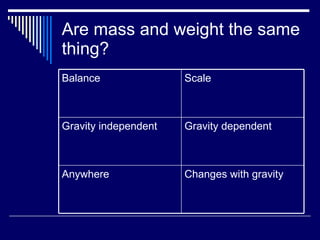
Are mass and weight the same thing? Changes with gravity Anywhere Gravity dependent Gravity independent Scale Balance
Now that we know what matter is… Can you think of 5 examples of matter? Can you think of the 4 examples of non-matter? Brainstorm with your partner please.
Matter – further break down What is the building block of matter? Atom  – the basic unit of matter What is it called when two or more atoms are combined? Molecule  – two or more atoms that behave as a unit They are chemically bonded
Classification of Matter (pg. 3) Matter can be classified into two major groups: Pure Substance Mixture
Pure Substance Definition: Made up of only one kind of atom or molecule Example: carbon
Mixture Definition: Matter that is made up of more than one kind of atom or molecule. Two or more pure substances mixed Example: salt water Not chemically bonded Can be separated by physical means
Further classification: Pure substance and mixture can be further classified Pure substance can be further classified into an  element  or  compound Mixture can be further classified into a  homogeneous  or  heterogeneous  mixture
Element Definition: A pure substance that is made of only a single kind of atom Cannot be broken down Found on periodic table Most basic form of matter Example: Copper
Compound Definition: A pure substance that is made of more than one kind of atom 2 or more elements chmically bonded Example: water
Homogeneous mixture Definition: A mixture that has a uniform composition Example: Soda
Heterogeneous mixture Definition: A mixture that is non-uniform It has layers Example: muddy water
homework Read 1-1  Answer ?s 1-10 on page 23 (write down the question)
States of matter (page 3) Also called the phases of matter Solid Liquid Gas
Solid Has both a definite shape and definite volume At the molecular level, the particles that make up the solid are close together and many times are locked into a very regular framework called a  crystal lattice The atoms and molecules are held tightly in a rigid structure but vibrate slightly about their fixed positions Cannot compress
Liquid Definite volume, but variable shape Cannot compress It conforms to the container in which it is placed Particles in the liquid are not held together in a rigid manner that is characteristic of solids However, the distances between the particles are constant on average Particles are moving much more than in the solid There are usually clumps of particles moving relatively freely among other clumps
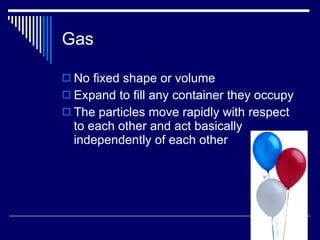
Gas No fixed shape or volume Expand to fill any container they occupy The particles move rapidly with respect to each other and act basically independently of each other
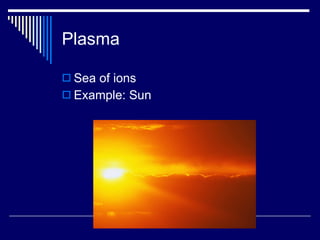
Plasma Sea of ions Example: Sun
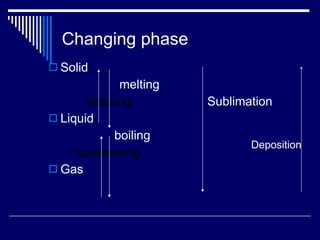
Changing phase Solid   melting freezing   Sublimation Liquid  boiling condensing Gas Deposition
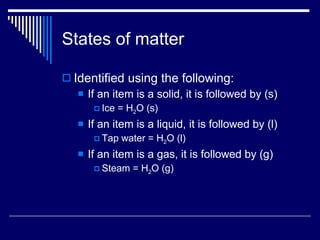
States of matter Identified using the following: If an item is a solid, it is followed by (s) Ice = H 2 O (s) If an item is a liquid, it is followed by (l) Tap water = H 2 O (l) If an item is a gas, it is followed by (g) Steam = H 2 O (g)
Methods of separating mixtures Separate by physical means Substances are not altered chemically Examples: filtration, evaporation, centrifuge, decant, chromatography, distillation, density
Identification of matter Matter can be identified by two types of properties Physical  Chemical
State Functions Intensive property Any property of a system that does not depend on how the process Density Specific heat Extensive Property  depends on amount of matter Volume Pressure Temperature Internal Energy
Physical properties Can be observed without changing the composition of the matter Appearance of physical state changes, but not the chemical composition shape Examples: color, volume, shape, mass, length, odor, solubility, density, specific heat, melting point and boiling point
Chemical properties Observed only when substances interact with one another The original substance changes into something else Different chemical substances are formed Breaks chemical bonds
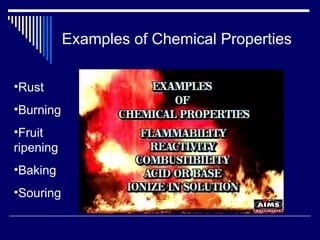
Examples of Chemical Properties Rust Burning Fruit ripening Baking  Souring
Physical vs. Chemical Changes Physical  – original substance still exists Only the form or physical appearance changes Example:  cutting in half writing on paper changing the phase of matter
Physical vs. Chemical Changes Chemical  - produces one or more new substances Observed only when substances interact with one another The original substance changes into something else Example:  bubbles (production of a gas)  change in color forms a precipitate (solid) produces heat or light (explosions)

1 What Is Chemistry

  • 1.
    What is Chemistry?Unit 1 – Introduction to Chemistry
  • 2.
    What is Chemistry?Chemistry is the study of matter What is matter? Matter is anything that has mass and volume
  • 3.
    What is massand volume? Mass: The amount of matter in an object How much an object weighs Volume: The amount of space an object occupies
  • 4.
    Are mass andweight the same thing? Changes with gravity Anywhere Gravity dependent Gravity independent Scale Balance
  • 5.
    Now that weknow what matter is… Can you think of 5 examples of matter? Can you think of the 4 examples of non-matter? Brainstorm with your partner please.
  • 6.
    Matter – furtherbreak down What is the building block of matter? Atom – the basic unit of matter What is it called when two or more atoms are combined? Molecule – two or more atoms that behave as a unit They are chemically bonded
  • 7.
    Classification of Matter(pg. 3) Matter can be classified into two major groups: Pure Substance Mixture
  • 8.
    Pure Substance Definition:Made up of only one kind of atom or molecule Example: carbon
  • 9.
    Mixture Definition: Matterthat is made up of more than one kind of atom or molecule. Two or more pure substances mixed Example: salt water Not chemically bonded Can be separated by physical means
  • 10.
    Further classification: Puresubstance and mixture can be further classified Pure substance can be further classified into an element or compound Mixture can be further classified into a homogeneous or heterogeneous mixture
  • 11.
    Element Definition: Apure substance that is made of only a single kind of atom Cannot be broken down Found on periodic table Most basic form of matter Example: Copper
  • 12.
    Compound Definition: Apure substance that is made of more than one kind of atom 2 or more elements chmically bonded Example: water
  • 13.
    Homogeneous mixture Definition:A mixture that has a uniform composition Example: Soda
  • 14.
    Heterogeneous mixture Definition:A mixture that is non-uniform It has layers Example: muddy water
  • 15.
    homework Read 1-1 Answer ?s 1-10 on page 23 (write down the question)
  • 16.
    States of matter(page 3) Also called the phases of matter Solid Liquid Gas
  • 17.
    Solid Has botha definite shape and definite volume At the molecular level, the particles that make up the solid are close together and many times are locked into a very regular framework called a crystal lattice The atoms and molecules are held tightly in a rigid structure but vibrate slightly about their fixed positions Cannot compress
  • 18.
    Liquid Definite volume,but variable shape Cannot compress It conforms to the container in which it is placed Particles in the liquid are not held together in a rigid manner that is characteristic of solids However, the distances between the particles are constant on average Particles are moving much more than in the solid There are usually clumps of particles moving relatively freely among other clumps
  • 19.
    Gas No fixedshape or volume Expand to fill any container they occupy The particles move rapidly with respect to each other and act basically independently of each other
  • 20.
    Plasma Sea ofions Example: Sun
  • 21.
    Changing phase Solid melting freezing Sublimation Liquid boiling condensing Gas Deposition
  • 22.
    States of matterIdentified using the following: If an item is a solid, it is followed by (s) Ice = H 2 O (s) If an item is a liquid, it is followed by (l) Tap water = H 2 O (l) If an item is a gas, it is followed by (g) Steam = H 2 O (g)
  • 23.
    Methods of separatingmixtures Separate by physical means Substances are not altered chemically Examples: filtration, evaporation, centrifuge, decant, chromatography, distillation, density
  • 24.
    Identification of matterMatter can be identified by two types of properties Physical Chemical
  • 25.
    State Functions Intensiveproperty Any property of a system that does not depend on how the process Density Specific heat Extensive Property depends on amount of matter Volume Pressure Temperature Internal Energy
  • 26.
    Physical properties Canbe observed without changing the composition of the matter Appearance of physical state changes, but not the chemical composition shape Examples: color, volume, shape, mass, length, odor, solubility, density, specific heat, melting point and boiling point
  • 27.
    Chemical properties Observedonly when substances interact with one another The original substance changes into something else Different chemical substances are formed Breaks chemical bonds
  • 28.
    Examples of ChemicalProperties Rust Burning Fruit ripening Baking Souring
  • 29.
    Physical vs. ChemicalChanges Physical – original substance still exists Only the form or physical appearance changes Example: cutting in half writing on paper changing the phase of matter
  • 30.
    Physical vs. ChemicalChanges Chemical - produces one or more new substances Observed only when substances interact with one another The original substance changes into something else Example: bubbles (production of a gas) change in color forms a precipitate (solid) produces heat or light (explosions)