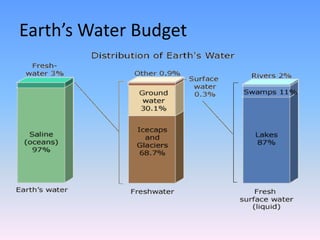
Earth’s Water Budget
• 97%  saltwater

• 3%  freshwater

• 2.59%  ice caps, glaciers, deep groundwater
• 0.41% surface freshwater, accessible
  groundwater, soil moisture
WHY is it ESSENTIAL to LIFE?
PROPERTIES of WATER
WATER has HYDROGEN
  BONDS


• Responsible for other
  special characteristics of
  water 
Water boils at 100 C and freezes at 0 C at sea
 level

• Water exist as a liquid in a wide range of
  temperature
High Heat Capacity

• Specific heat capacity of 4.184 j/g-C

• Helps protect living organisms from the shock of
  abrupt temperature changes

• Moderates earth’s climate

• Makes water as an excellent coolant
High Heat of Vaporization
• It takes a lot of heat to evaporate liquid water
• Makes evaporation of water an effective
  cooling process
Water is Polar
• Liquid water can dissolve a variety of
  compounds
  – Carry nutrients
  – Flush waste products
  – Serve as an all-purpose cleanser
  – Help remove and dilute the water-soluble wastes
    of civilization
Water is Transparent
• Water is clear and allows light to pass through.
Importance?

Density
• Liquid = 1g/ml
Importance?
Short Quiz 
What property of water is responsible for
  the following: Explain.
1. Ice floats on water.
2. Water remains a liquid in most climates
   on earth.
3. Water is an excellent solvent.
4. Animals rid their bodies of excess heat
   through evaporation of sweat.
SOURCES of WATER
WATER available as:

• SURFACE WATER

• GROUND WATER
Surface Water

• Rivers, lakes, seas, reservoirs
• Gets replenished through?

     precipitation and run-off
Ground Water
• The water that works its way below the
  ground through voids of permeable rocks

                         aquifers
           aquitards – impermeable rocks
SPRING

• Ground water that comes out from fissure or
  cracks in aquifers solid impermeable
  base, and naturally surface out the ground.
Ground water is a major source of fresh water
  in the country. How can we extract it?
Depletion of Ground water, possible?


= land subsidence or sinking area
Sea Water
• Contains high concentration of dissolved
  solids than freshwater.

• Salinity = 35 ppt

• ESTUARY
  – Region where freshwater mixes with seawater
1. Discuss the Earth’s water budget.
  a. Which part gets the largest percentage? The
     least?
  b. What are the effects of this distribution on the
     different ecosystems?


2. Make a diagram of the ground water system.
   Label its parts.
  a.   Differentiate aquifer and aquitard.
  b.   What are the effects of groundwater
       depletion?
HW
• Research on El Nino – La Nina Phenomena (1
  whole pad paper/bond paper)

• Bring the following: (Friday)
  – Sand
  – Clay
  – Gravel/pebble
  – 3 20ml colored liquid
  – Timer
Water and Atmospheric Conditions
Atmosphere : An important component of the
  Hydrologic Cycle?

HOW?
Water plays a major role in climate, or daily
 weather changes.

HOW?
Humidity in AIR
HUMIDITY

• Measure of the atmospheric water vapor
  content.

• Relative Humidity (RH) – one way of
  expressing humidity
Check-up
• Why do we feel sticky and warmer during
  summer days when the air is humid?

• When is the best time of the day to water the
  plants? Why?
El Niño - La Niña
El Niño (ENSO)                   La Niña
                                 Frequent and stronger
Warmer surface along the
                                 typhoons; rainy seasons in
coasts
                                 southeast Asia
                                 Colder and longer winter
Sharp decline in fish harvest    season in the northern
                                 hemisphere
Long dry season resulting to
                                 Flooding in coastal regions and
critical water levels in
                                 floodplains
reservoirs

Drying up of farmlands ,         Serious economic
resulting to poor crop harvest   consequences
QUIZ #3
1. What are the consequences of a major event of
   ENSO?
2.What should be done in the following situations:

a. It is high noon. The plants in the flowerbox look
   “thirsty” for water.
b. It is winter in Canada. Inside a room, friends
   huddle before the fireplace. RH is very low. Their
   skin is also becoming dry.
c. A rich farmer wants to venture into a piggery
   business along a river. Downstream, people use
   the river for irrigation.
WATER PROBLEMS
War in the Middle East
Seawater Intrusion
• Contamination of freshwater with saltwater
Land Subsidence
• Depression of the land above an area where
  massive extraction of water leaves voids
  underground
Water Scarcity
• Occurs in places surrounded by seas

• Seawater cannot be used for drinking and
  other purposes

• desalination
INDICATORS OF WATER QUALITY
Dissolved Oxygen(DO)
• Amount of diatomic oxygen dissolved in water
• Comes from air which mixes with water
• High DO = ?
• Warm water has lower DO than cold water.
  Why?
• Water movement increases DO, presence of
  pollutants decreases DO
Biological Oxygen Demand (BOD)
• The amount of oxygen needed by
  microorganisms in the water to survive

• High BOD =?
Total Suspended Solids(TSS)
• Indicates turbidity
• High TSS = ?
Total Dissolved Solids (TDS)
• A measure of the mount of dissolved
  contaminants in water
• High TDS = ?
Coliform Bacteria
• Microorganisms which come from the animal
  dung or human feces
• Presence of coliform bacteria = ?

• For drinking water coliform count = 0
• Swimming pool = <100
WATER POLLUTION
• A condition in which water becomes unfit for
  its intended use.

• Uses of water ?
Pollutants
• Human and animal wastes
• Organic wastes
• Industrial wastes
  – Organic chemicals
  – Heavy metals
  – Nitrates
  – Grease and oil
  – Radioactive chemicals
LEAD
• Neurotoxin
• Can cause hyperacidity and low attention span
• Linked to low IQ and poor performance
• High concentration in areas using lead in
  water pipes
Mercury
• Neurotoxin
• Caused the Minamata disease (Minamata
  Bay, Kyushu Japan)
Methyl
mercury
Oil
• Oil spill – most common problem in the
  industrialized world
• Prevents the entry of oxygen
• Coats the gills of fish
• Coats the feathers of birds
Nitrates and phosphates
• used in fertilizers
• Found in detergents
• Eutrophication
• algal bloom
• Massive fish kills
Acids
• Due to acid rain and acidic waste water from
  industries
• Dissolves and reacts with nutrients necessary
  for algal growth
Persistent Organic Pollutants (POPs)
• Stable compound that persists or stays in the
  environment for a long time
• “dirty dozen”
• Very toxic to humans and animals
Dead Rivers
• “one which is not suitable for any beneficial
  purpose”
• “physically lost”

• Biologically dead river – which could no
  longer support important aquatic species
• Tullahan River, Pasig River,
Thermal Pollution
• Happens when hot waste water is released in
  rivers or lakes
Mine Spills
•   Spills from mine tailings
•   High concentration of mercury and cyanide
•   Boac in Marinduque
•   Mt. Diwalwal in Campostela Valley
•   Rapu-rapu, Albay
Quiz #3
• A group of students was assigned to
  investigate on the fish kill that happened in a
  certain lake. What parameters are they going
  to test. Explain your answer.

Hydrosphere

  • 1.
  • 2.
    • 97% saltwater • 3%  freshwater • 2.59%  ice caps, glaciers, deep groundwater • 0.41% surface freshwater, accessible groundwater, soil moisture
  • 3.
    WHY is itESSENTIAL to LIFE?
  • 5.
    PROPERTIES of WATER WATERhas HYDROGEN BONDS • Responsible for other special characteristics of water 
  • 6.
    Water boils at100 C and freezes at 0 C at sea level • Water exist as a liquid in a wide range of temperature
  • 7.
    High Heat Capacity •Specific heat capacity of 4.184 j/g-C • Helps protect living organisms from the shock of abrupt temperature changes • Moderates earth’s climate • Makes water as an excellent coolant
  • 8.
    High Heat ofVaporization • It takes a lot of heat to evaporate liquid water • Makes evaporation of water an effective cooling process
  • 9.
    Water is Polar •Liquid water can dissolve a variety of compounds – Carry nutrients – Flush waste products – Serve as an all-purpose cleanser – Help remove and dilute the water-soluble wastes of civilization
  • 10.
    Water is Transparent •Water is clear and allows light to pass through. Importance? Density • Liquid = 1g/ml Importance?
  • 11.
    Short Quiz  Whatproperty of water is responsible for the following: Explain. 1. Ice floats on water. 2. Water remains a liquid in most climates on earth. 3. Water is an excellent solvent. 4. Animals rid their bodies of excess heat through evaporation of sweat.
  • 12.
    SOURCES of WATER WATERavailable as: • SURFACE WATER • GROUND WATER
  • 13.
    Surface Water • Rivers,lakes, seas, reservoirs • Gets replenished through? precipitation and run-off
  • 14.
    Ground Water • Thewater that works its way below the ground through voids of permeable rocks aquifers aquitards – impermeable rocks
  • 15.
    SPRING • Ground waterthat comes out from fissure or cracks in aquifers solid impermeable base, and naturally surface out the ground.
  • 16.
    Ground water isa major source of fresh water in the country. How can we extract it?
  • 17.
    Depletion of Groundwater, possible? = land subsidence or sinking area
  • 18.
    Sea Water • Containshigh concentration of dissolved solids than freshwater. • Salinity = 35 ppt • ESTUARY – Region where freshwater mixes with seawater
  • 19.
    1. Discuss theEarth’s water budget. a. Which part gets the largest percentage? The least? b. What are the effects of this distribution on the different ecosystems? 2. Make a diagram of the ground water system. Label its parts. a. Differentiate aquifer and aquitard. b. What are the effects of groundwater depletion?
  • 20.
    HW • Research onEl Nino – La Nina Phenomena (1 whole pad paper/bond paper) • Bring the following: (Friday) – Sand – Clay – Gravel/pebble – 3 20ml colored liquid – Timer
  • 21.
    Water and AtmosphericConditions Atmosphere : An important component of the Hydrologic Cycle? HOW?
  • 22.
    Water plays amajor role in climate, or daily weather changes. HOW?
  • 23.
    Humidity in AIR HUMIDITY •Measure of the atmospheric water vapor content. • Relative Humidity (RH) – one way of expressing humidity
  • 25.
    Check-up • Why dowe feel sticky and warmer during summer days when the air is humid? • When is the best time of the day to water the plants? Why?
  • 26.
    El Niño -La Niña El Niño (ENSO) La Niña Frequent and stronger Warmer surface along the typhoons; rainy seasons in coasts southeast Asia Colder and longer winter Sharp decline in fish harvest season in the northern hemisphere Long dry season resulting to Flooding in coastal regions and critical water levels in floodplains reservoirs Drying up of farmlands , Serious economic resulting to poor crop harvest consequences
  • 27.
    QUIZ #3 1. Whatare the consequences of a major event of ENSO? 2.What should be done in the following situations: a. It is high noon. The plants in the flowerbox look “thirsty” for water. b. It is winter in Canada. Inside a room, friends huddle before the fireplace. RH is very low. Their skin is also becoming dry. c. A rich farmer wants to venture into a piggery business along a river. Downstream, people use the river for irrigation.
  • 28.
  • 29.
    War in theMiddle East
  • 30.
    Seawater Intrusion • Contaminationof freshwater with saltwater
  • 32.
    Land Subsidence • Depressionof the land above an area where massive extraction of water leaves voids underground
  • 33.
    Water Scarcity • Occursin places surrounded by seas • Seawater cannot be used for drinking and other purposes • desalination
  • 34.
  • 35.
    Dissolved Oxygen(DO) • Amountof diatomic oxygen dissolved in water • Comes from air which mixes with water • High DO = ? • Warm water has lower DO than cold water. Why? • Water movement increases DO, presence of pollutants decreases DO
  • 37.
    Biological Oxygen Demand(BOD) • The amount of oxygen needed by microorganisms in the water to survive • High BOD =?
  • 38.
    Total Suspended Solids(TSS) •Indicates turbidity • High TSS = ?
  • 40.
    Total Dissolved Solids(TDS) • A measure of the mount of dissolved contaminants in water • High TDS = ?
  • 42.
    Coliform Bacteria • Microorganismswhich come from the animal dung or human feces • Presence of coliform bacteria = ? • For drinking water coliform count = 0 • Swimming pool = <100
  • 44.
  • 45.
    • A conditionin which water becomes unfit for its intended use. • Uses of water ?
  • 46.
    Pollutants • Human andanimal wastes • Organic wastes • Industrial wastes – Organic chemicals – Heavy metals – Nitrates – Grease and oil – Radioactive chemicals
  • 47.
    LEAD • Neurotoxin • Cancause hyperacidity and low attention span • Linked to low IQ and poor performance • High concentration in areas using lead in water pipes
  • 48.
    Mercury • Neurotoxin • Causedthe Minamata disease (Minamata Bay, Kyushu Japan)
  • 49.
  • 50.
    Oil • Oil spill– most common problem in the industrialized world • Prevents the entry of oxygen • Coats the gills of fish • Coats the feathers of birds
  • 52.
    Nitrates and phosphates •used in fertilizers • Found in detergents • Eutrophication • algal bloom • Massive fish kills
  • 54.
    Acids • Due toacid rain and acidic waste water from industries • Dissolves and reacts with nutrients necessary for algal growth
  • 55.
    Persistent Organic Pollutants(POPs) • Stable compound that persists or stays in the environment for a long time • “dirty dozen” • Very toxic to humans and animals
  • 56.
    Dead Rivers • “onewhich is not suitable for any beneficial purpose” • “physically lost” • Biologically dead river – which could no longer support important aquatic species • Tullahan River, Pasig River,
  • 57.
    Thermal Pollution • Happenswhen hot waste water is released in rivers or lakes
  • 58.
    Mine Spills • Spills from mine tailings • High concentration of mercury and cyanide • Boac in Marinduque • Mt. Diwalwal in Campostela Valley • Rapu-rapu, Albay
  • 59.
    Quiz #3 • Agroup of students was assigned to investigate on the fish kill that happened in a certain lake. What parameters are they going to test. Explain your answer.