The present study investigated the relationship of
Multiple Intelligence to the Academic Performance of the
first two sections of the fourth year high school students
of Makiling National High School. The researchers used
the Multiple Intelligences Inventory by Walter McKenzie.
The first grading grades were used as a measure of
academic performance. A total of 80 students were
selected as sample of this study. Results of the study
revealed that Multiple Intelligence is slightly correlated to
the academic performance. Since the Multiple
Intelligences correlate to the Academic Performance, it is
recommended that teachers, whenever possible, must
incorporate in their teaching strategies specific methods
that are reflective of visual, auditory, tactile, and
kinesthetic styles of learning. Students must also provide
contribution as to their preferred learning style in
designing the syllabus to be used by the teacher in the
course.
Introduction
From birth, all human beings have different abilities and every child
has unique properties. How children perceive themselves and their
educational experiences establish their self concept and also prior to the
development of self-efficiency. Until 1940s, as Rogers stated that children
are meritorious because of their inner potentials, creativity, power to
learn, ability to learn languages, potential to use brain (Akboy, 2004;
Akboy & Ikiz, 2007).
A successful transition from childhood to adolescence partially
depends upon the academic preparation and the motivation of student as
well as the school’s effectiveness in helping the student acquire life survival
skills. Do the schools use testing, orientation and advising programs to
help them take full advantage of the environmental and personal resources
necessary for their success? Since every individual has unique set of
experiences, a variety of responses to any given stimulus is possible.
Learning is essentially an active process that the attention, curiosity and
interest of the perceiver often increase. Therefore, provision for individual
differences in learning is crucial (Fraenkel, 1994). The special academic
and personal characteristics of students and how these characteristics
affect their success have to be taken into consideration.
In his theory of multiple intelligences, Gardner (1999) argued that
certain intelligences were valued in the schools while others were not.
Gardner (1983) claims that intelligence is comprised of multiple modules or
types, which are largely independent and functionally separate from each
other. To briefly describe these intelligences (Barnard & Olivarez, 2007):
Linguistic intelligence generally refers to sensitivity to spoken and written
language, the ability to learn languages, and the capacity to use language to
accomplish certain goals. Bodily-kinesthetic intelligence involves the
potential to use one’s whole body or parts of the body. Musical intelligence is
self-explanatory and consists of skill in the performance, composition and
appreciation of music. Intrapersonal intelligence consists of the capacity to
understand oneself, to appreciate one’s feelings, fears and motivations.
Logical–mathematical intelligence entails the capacity to analyze problems
logically, carry out mathematical operations and investigate issues.
Interpersonal intelligence entails the capacity to understand the
intentions, motivations and desires of other people. Spatial intelligence
refers to the potential to recognize and use patterns. Naturalistic intelligence
refers to the capacity to recognize, categorize and draw upon certain features
of the environment. The inclusion of spiritual, existentialist and moral
intelligence types creates some problems because person’s spirituality is
privileged to the privacy of the human mind and not visible.
Out of these eight multiple intelligences, Gardner (1999)
proposed that linguistic and logical-mathematical intelligences
are the “coin of the realm”, having traditionally dominated
intelligence testing and are the ones that have typically been
valued in school. Recognizing that students have different
strengths and providing activities to accommodate those
strengths while bridging to the weaker areas is at the heart of
diversified instruction based on multiple intelligences theory
(Barnard & Olivarez, 2007). Students are not merely receivers
of the given information; they should be encouraged to
construct meaning for themselves. Since, teachers should move
from the role of dispensers of knowledge into the role of
facilitators of learning (Gullatt, 2008). Therefore during
assessment procedure, intelligence types, creativity, problem
solving and wisdom should be taken into consideration.
As Gullatt (2008) indicates, scientists have found that most
thought occurs on a level well below conscious control and awareness
that involves processing of a continual stream of sensory information;
abstract thought is represented through metaphors that are
associated with physical experiences and emotions; physical
sensation and emotions are integral to thought and learning. Thus
without sensation and emotion logic may not be possible for some
researchers. It is supported that the arts may be used as a means of
making meaning of what is learned as well as to synthesize what had
been thought in schools (Gullatt 2008; Eisner, 1998; Aprill, 2001), arts
subjects are great potential partners in academic learning, arts have
impact upon numerous social and cognitive dimensions across many
academic disciplines (Gouzouasis et al., 2007). It is explained that
there is a relationship between spatial and logical mathematical
intelligences, as Gullatt (2008) indicates, as well as a strong
relationship between spatial and musical intelligences, besides the
literature. It is emphasized that a.) in order to make literature
meaningful, students must be given aesthetic opportunities; their
comprehension of text was increased and motivation for reading was
enhanced; b.) the more intelligences students were required to use for
learning, the deeper their understanding of the content presented.
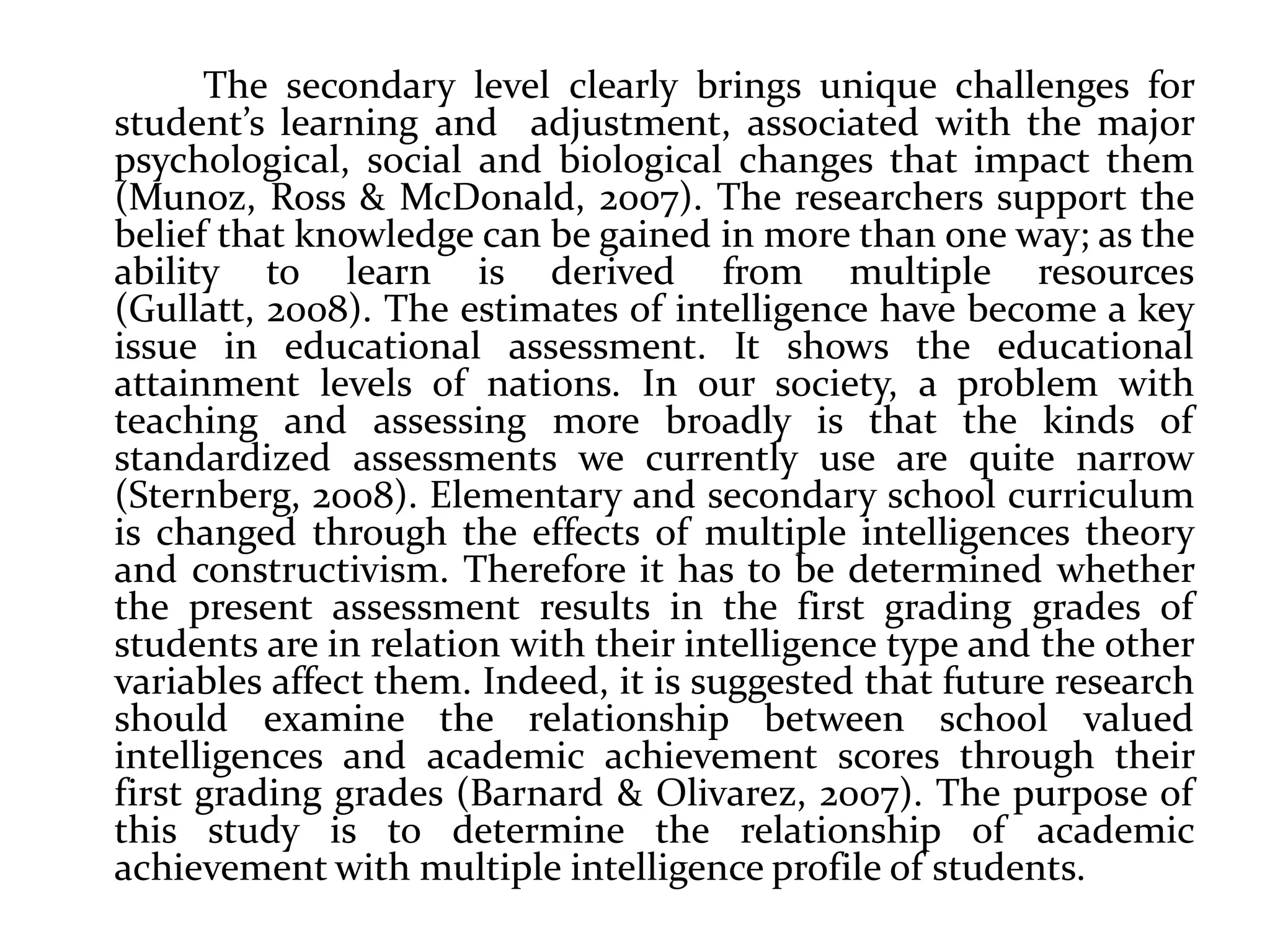
The secondary level clearly brings unique challenges for
student’s learning and adjustment, associated with the major
psychological, social and biological changes that impact them
(Munoz, Ross & McDonald, 2007). The researchers support the
belief that knowledge can be gained in more than one way; as the
ability to learn is derived from multiple resources
(Gullatt, 2008). The estimates of intelligence have become a key
issue in educational assessment. It shows the educational
attainment levels of nations. In our society, a problem with
teaching and assessing more broadly is that the kinds of
standardized assessments we currently use are quite narrow
(Sternberg, 2008). Elementary and secondary school curriculum
is changed through the effects of multiple intelligences theory
and constructivism. Therefore it has to be determined whether
the present assessment results in the first grading grades of
students are in relation with their intelligence type and the other
variables affect them. Indeed, it is suggested that future research
should examine the relationship between school valued
intelligences and academic achievement scores through their
first grading grades (Barnard & Olivarez, 2007). The purpose of
this study is to determine the relationship of academic
achievement with multiple intelligence profile of students.
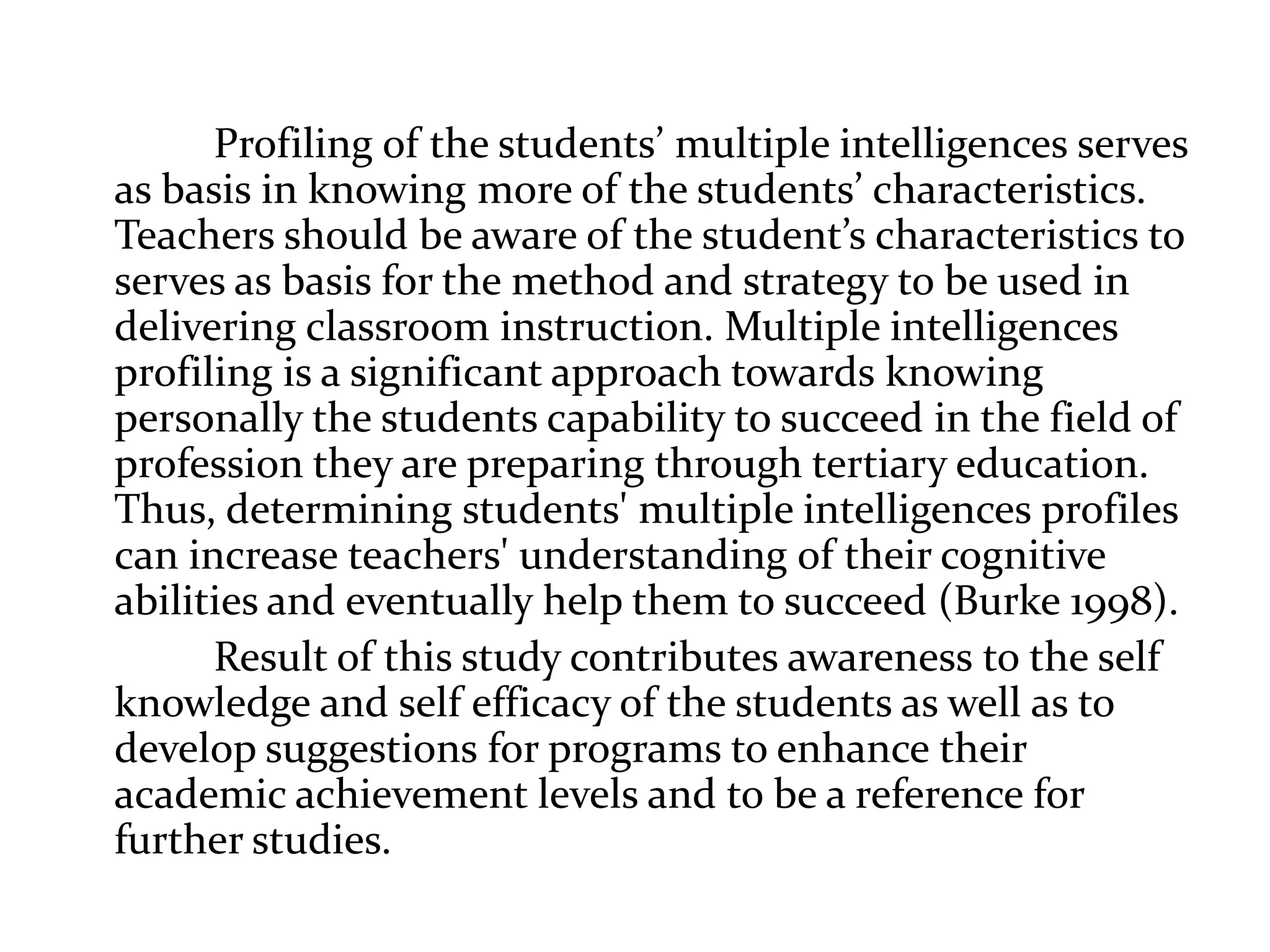
Profiling of the students’ multiple intelligences serves
as basis in knowing more of the students’ characteristics.
Teachers should be aware of the student’s characteristics to
serves as basis for the method and strategy to be used in
delivering classroom instruction. Multiple intelligences
profiling is a significant approach towards knowing
personally the students capability to succeed in the field of
profession they are preparing through tertiary education.
Thus, determining students' multiple intelligences profiles
can increase teachers' understanding of their cognitive
abilities and eventually help them to succeed (Burke 1998).
Result of this study contributes awareness to the self
knowledge and self efficacy of the students as well as to
develop suggestions for programs to enhance their
academic achievement levels and to be a reference for
further studies.
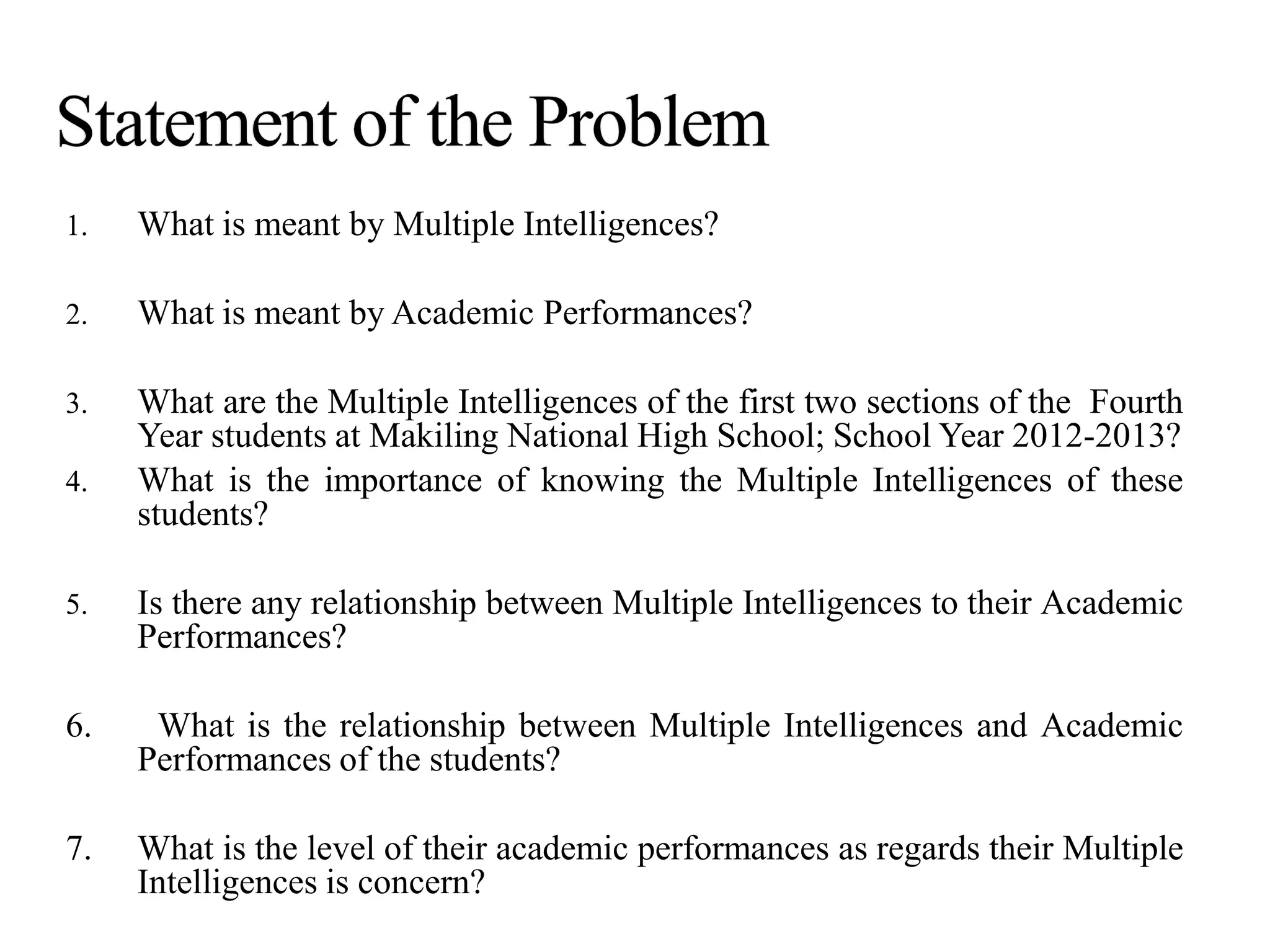
1. What is meant by Multiple Intelligences?
2. What is meant by Academic Performances?
3. What are the Multiple Intelligences of the first two sections of the Fourth
Year students at Makiling National High School; School Year 2012-2013?
4. What is the importance of knowing the Multiple Intelligences of these
students?
5. Is there any relationship between Multiple Intelligences to their Academic
Performances?
6. What is the relationship between Multiple Intelligences and Academic
Performances of the students?
7. What is the level of their academic performances as regards their Multiple
Intelligences is concern?
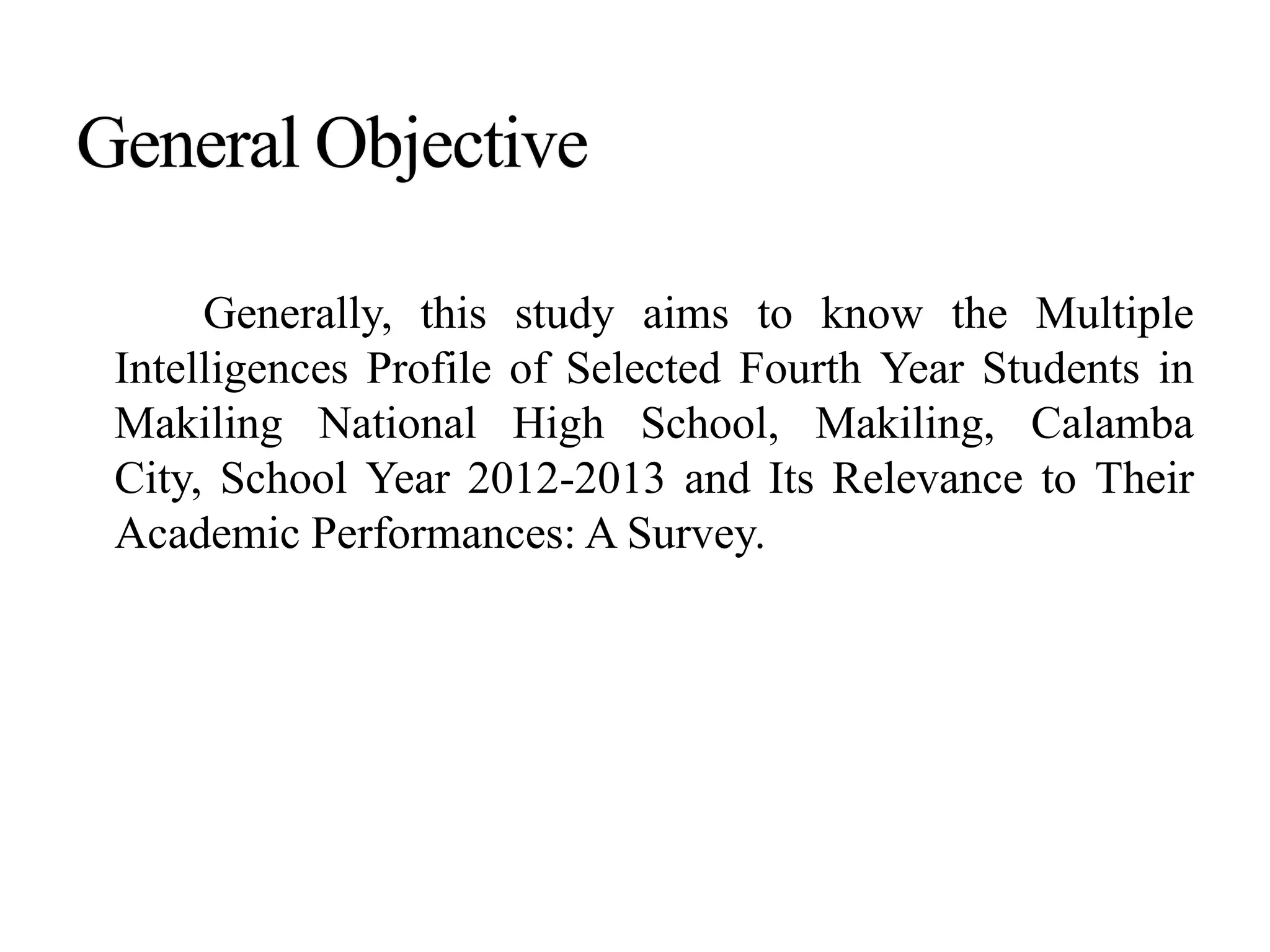
Generally, this study aims to know the Multiple
Intelligences Profile of Selected Fourth Year Students in
Makiling National High School, Makiling, Calamba
City, School Year 2012-2013 and Its Relevance to Their
Academic Performances: A Survey.
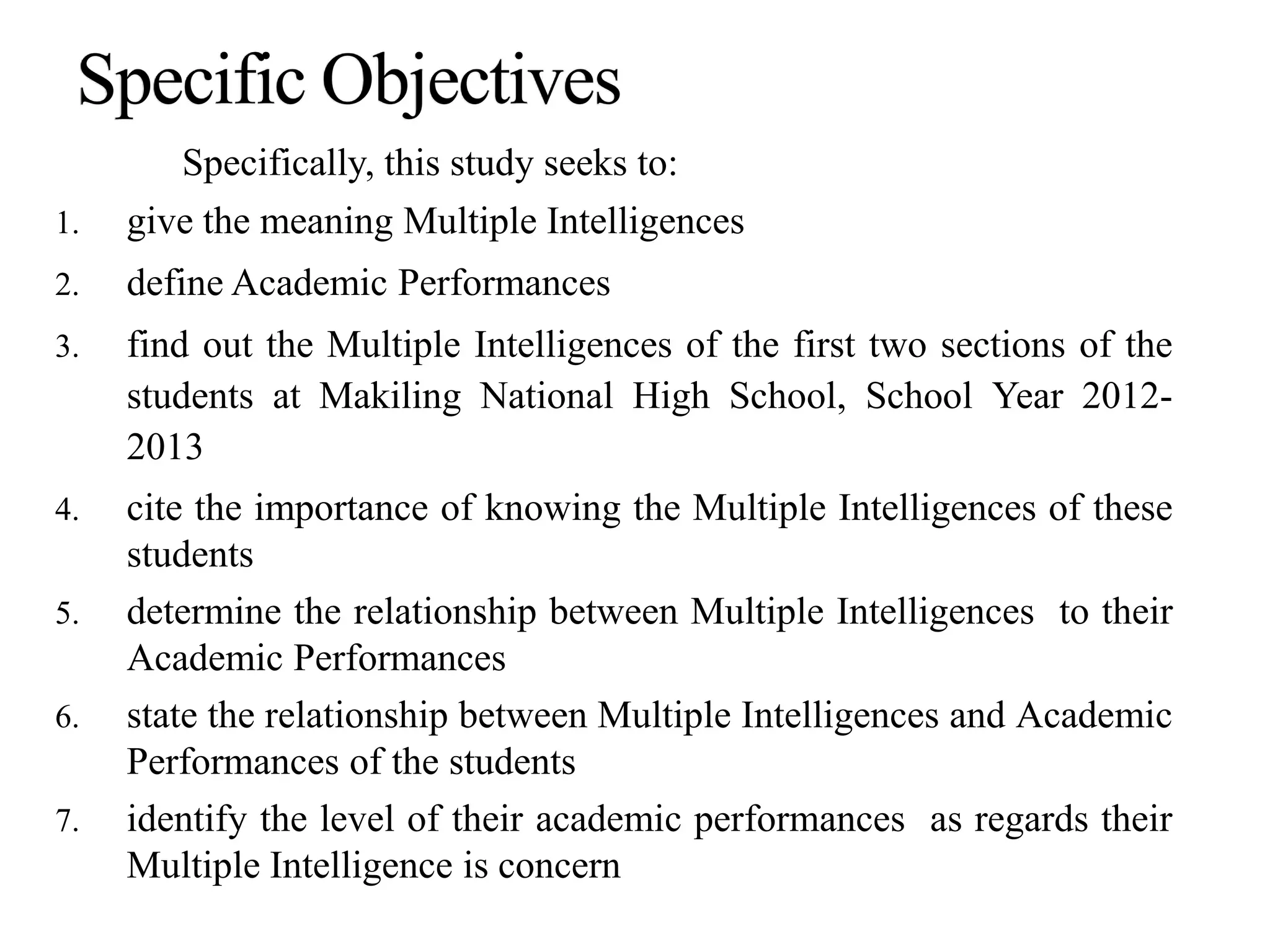
Specifically, this study seeks to:
1. give the meaning Multiple Intelligences
2. define Academic Performances
3. find out the Multiple Intelligences of the first two sections of the
students at Makiling National High School, School Year 2012-
2013
4. cite the importance of knowing the Multiple Intelligences of these
students
5. determine the relationship between Multiple Intelligences to their
Academic Performances
6. state the relationship between Multiple Intelligences and Academic
Performances of the students
7. identify the level of their academic performances as regards their
Multiple Intelligence is concern
This study is limited to the Multiple Intelligences
Profile of Selected Fourth Year Students at Makiling
National High School, Makiling, Calamba City, School
Year 2012-2013 and Its Relationship to Their Academic
Performance: A Survey
This study, Multiple Intelligences Profile of Selected
Fourth Year Students at Makiling National High
School, Makiling, Calamba City, School Year 2012-2013
and Its Relationship to Their Academic Performance: A
Survey, as a requirement is significant to the following:
1. Students- to let them know their Multiple Intelligence
and to become aware of their strengths and weaknesses.
2. Instructors- to have an idea on how they can enhance
their students of different intelligences.
3. University- to be able to provide activities that will
improve the Multiple Intelligences of the students.
4. Future Researchers- to provide information for their
researches.
 Multiple Intelligences – pluralized way of understanding intellect.
 Multiple Intelligences Profile – personal intelligence profile that is consist of
combinations of different intelligence types.
 Academic Performance – refers to how students deal with their studies and
how they cope with or accomplish different task given to them.
 Relationship – the way in which two or more concepts, objects, or people
are connected, or the state of being connected.
 Makiling National High School – is a public national high school located in
Makiling, Calamba City.
 Fourth Year Students – pertaining to the students in the fourth and final year.
 Survey – a general view, examination or description of someone or
something.
 Pearson Coefficient Correlation – is a measure of correlation between two
variables (x and y), giving a value between +1 and -1 inclusive. It is used in
the sciences as a measure of the strength of linear dependence between two
variables.
Research Design and Methodology
The researchers used the descriptive method.
According to Calmorin (1995), descriptive method
focuses at the present condition. The purpose is to find
new truth. This approach to problem-solving seeks to
answer questions to the real facts relating to existing
condition. This is a technique of a quantitative description
which determines the prevailing conditions in a group of
cases chosen for this study. This method is employed to
obtain information regarding the relationship of Multiple
Intelligences to the Academic Performances of the first
two sections of the fourth year students at Makiling
National High School, Makiling, Calamba City School
Year 2012-2013.
The questionnaires and evaluation of the learning
outcomes of the students were the instrument used to
gather the needed data. In its preparation, the researchers
read and studied standard criteria and consulted
knowledgeable authorities in the formation of
questionnaires.
With the cooperation of the guidance councilor of the
school, the researchers were able to get hold of the
evaluation of the learning outcomes of their students.
Then the researchers proceeded to their research.
The respondents of this study were composed of the
students from the first two sections, namely; Section
Einstein and Section Sampaguita. They were chosen
because they can understand the questionnaires very well
about Multiple Intelligence. Their maturity was also
considered.
The researchers made use of purposive sampling
method. Purposive sampling method is based on the
certain criteria laid down by the researchers. It is
utilized in this study to meet the purposes and to have
homogeneity.
The researchers prepared the questionnaires which
were validated by their research team
leader/adviser, language editor, and the guidance councilor
of the school. They constructed their questionnaires based
from the unpublished theses and from the internet and
then passed it to the team leader/adviser. Their team
leader/adviser made some clarifications and corrections on
the questionnaires. After that, they have made revisions
based from the suggestions by their team leader/adviser.
Finally, their team leader/adviser validated the
questionnaires and later on gave the approval for the
distribution. Then the researchers proceed to their survey.
The research was conducted at Makiling National
High School, Makiling Calamba City.
Letter-requesting permission to administer the
questionnaires was forwarded to the guidance councilor.
The guidance councilor allowed the researchers to
disseminate questionnaires to the respondents. They were
given an hour to conduct their survey. They form a single
group out of the two sections and were able to forward
questionnaires. After half an hour, the respondents were
able to answer all the questions and the researchers
collected the questionnaires. The responses were
verified, tallied, and tabulated to reveal the detailed
presentation of the data gathered. Survey questionnaires
were used as the primary instrument supported by
information gathered from references and other sources
were used as secondary instrument.
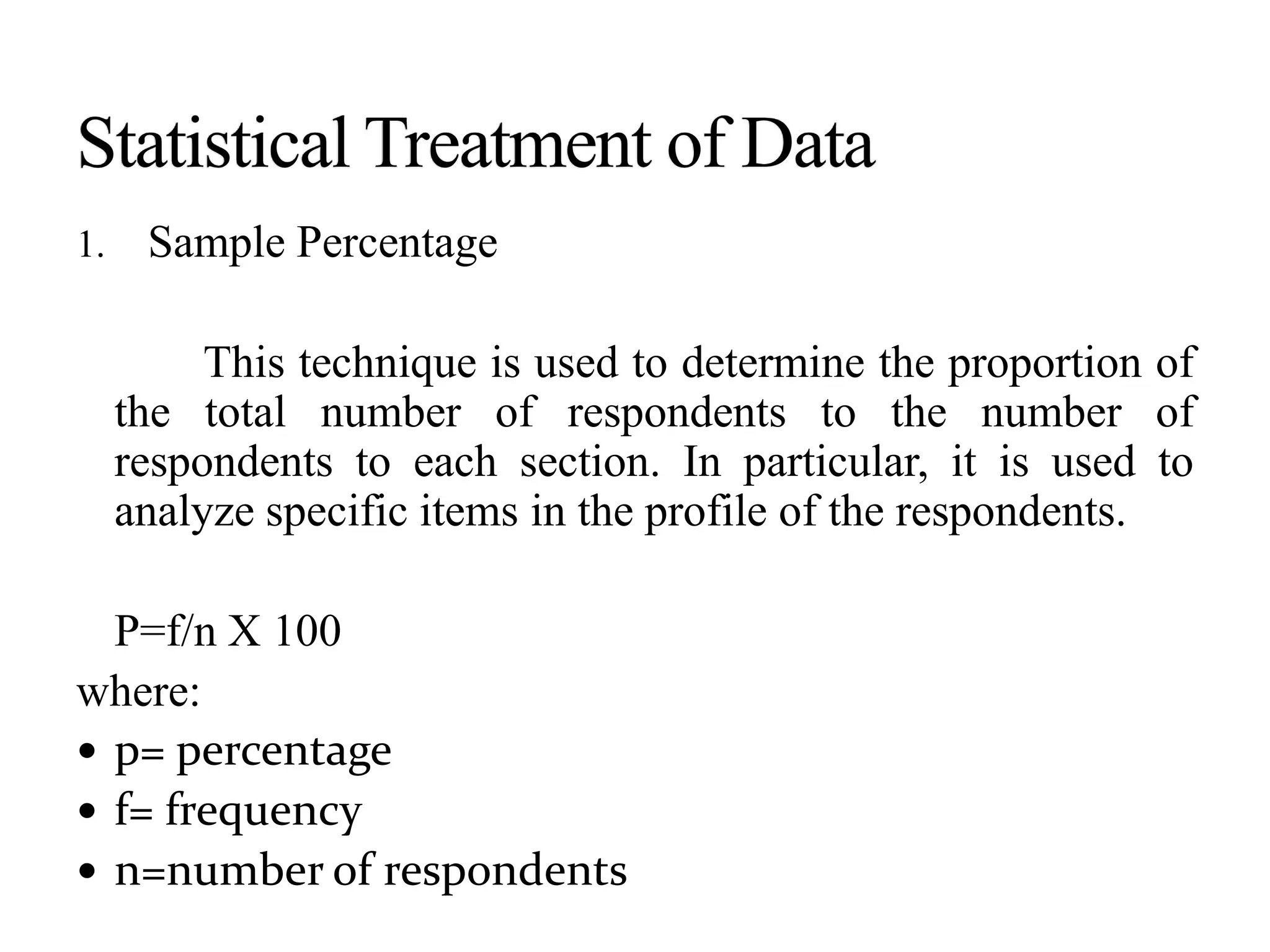
1. Sample Percentage
This technique is used to determine the proportion of
the total number of respondents to the number of
respondents to each section. In particular, it is used to
analyze specific items in the profile of the respondents.
P=f/n X 100
where:
 p= percentage
 f= frequency
 n=number of respondents
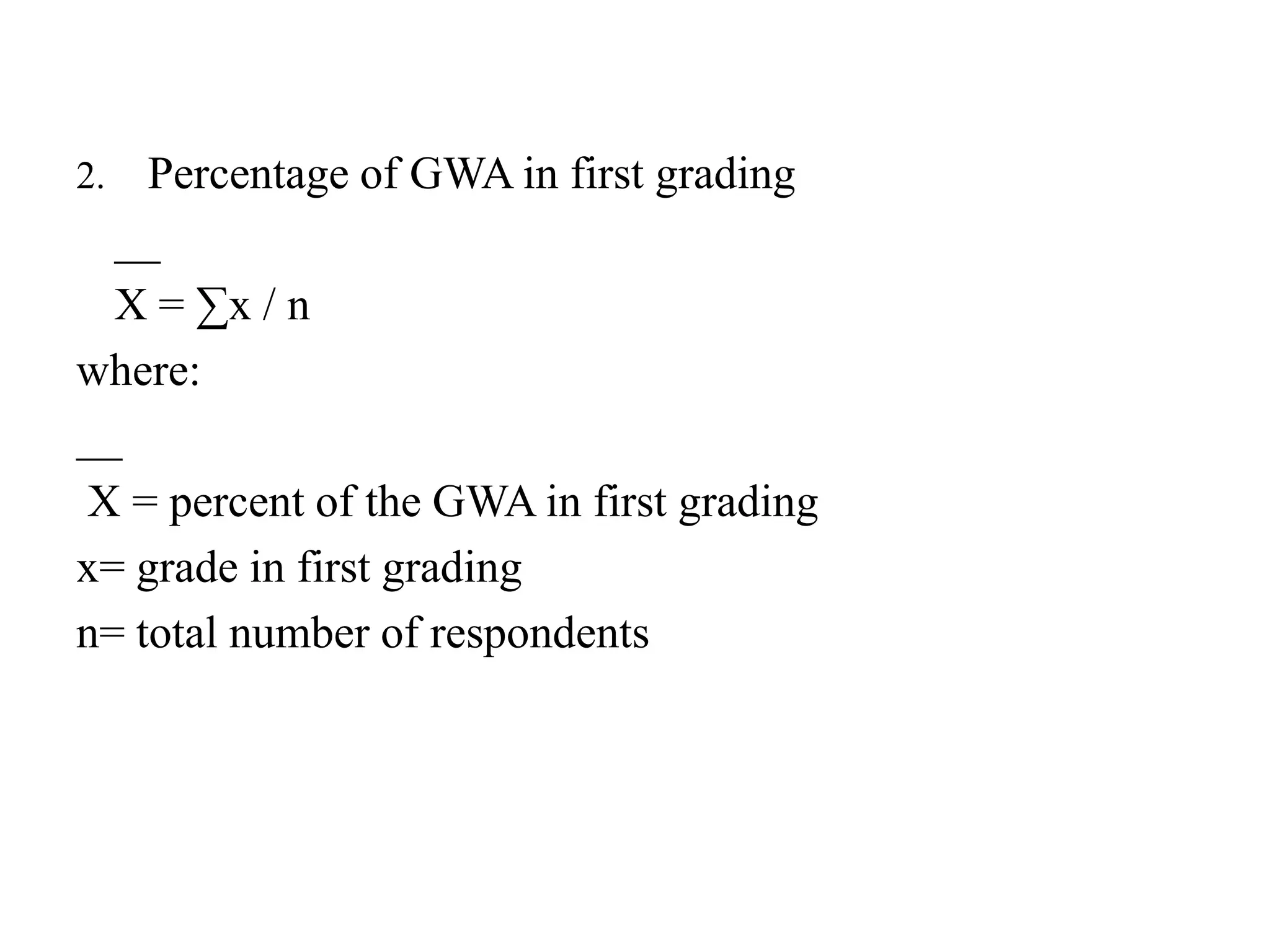
2. Percentage of GWA in first grading
__
X = ∑x / n
where:
__
X = percent of the GWA in first grading
x= grade in first grading
n= total number of respondents
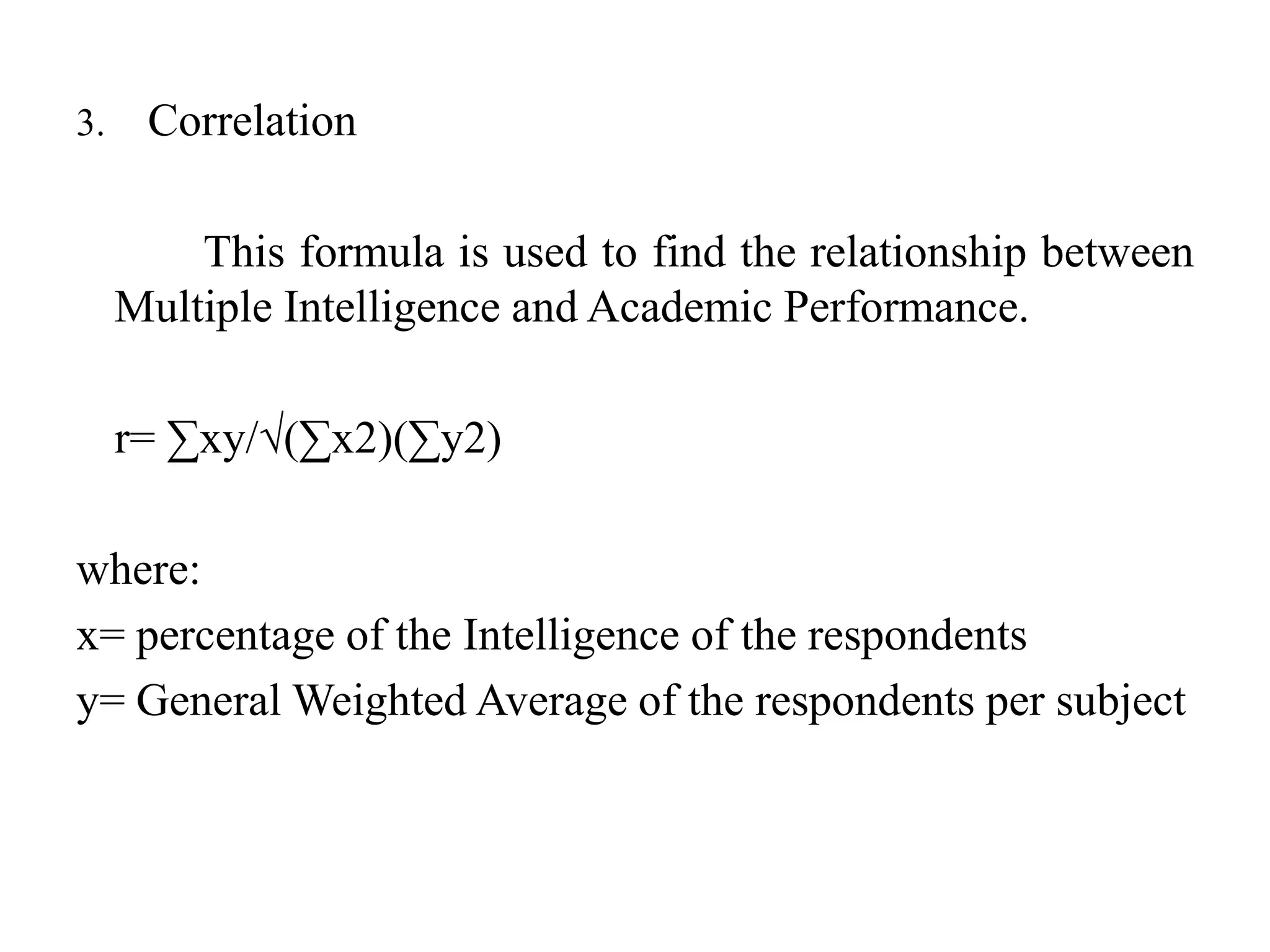
3. Correlation
This formula is used to find the relationship between
Multiple Intelligence and Academic Performance.
r= ∑xy/√(∑x2)(∑y2)
where:
x= percentage of the Intelligence of the respondents
y= General Weighted Average of the respondents per subject
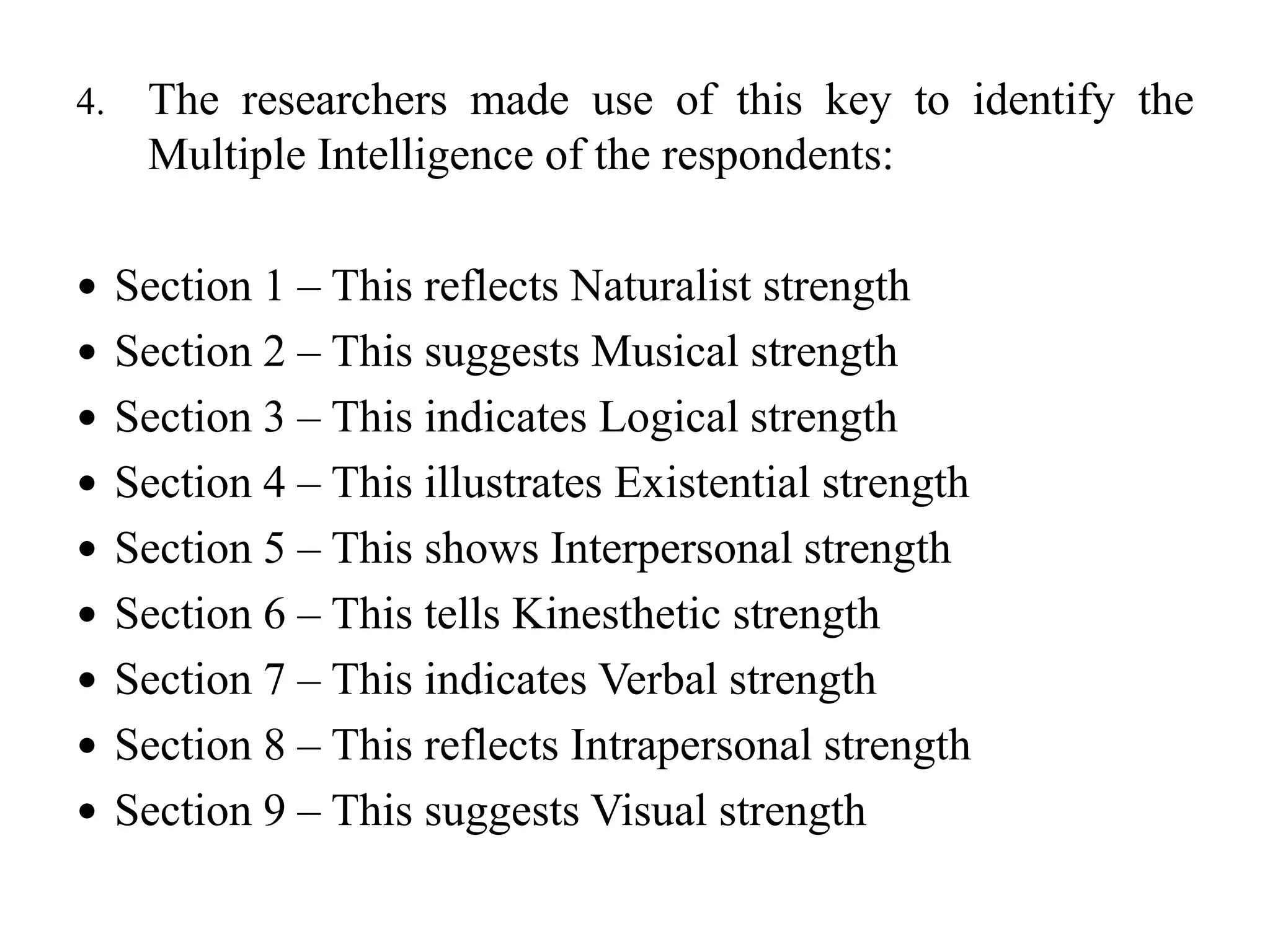
4. The researchers made use of this key to identify the
Multiple Intelligence of the respondents:
 Section 1 – This reflects Naturalist strength
 Section 2 – This suggests Musical strength
 Section 3 – This indicates Logical strength
 Section 4 – This illustrates Existential strength
 Section 5 – This shows Interpersonal strength
 Section 6 – This tells Kinesthetic strength
 Section 7 – This indicates Verbal strength
 Section 8 – This reflects Intrapersonal strength
 Section 9 – This suggests Visual strength
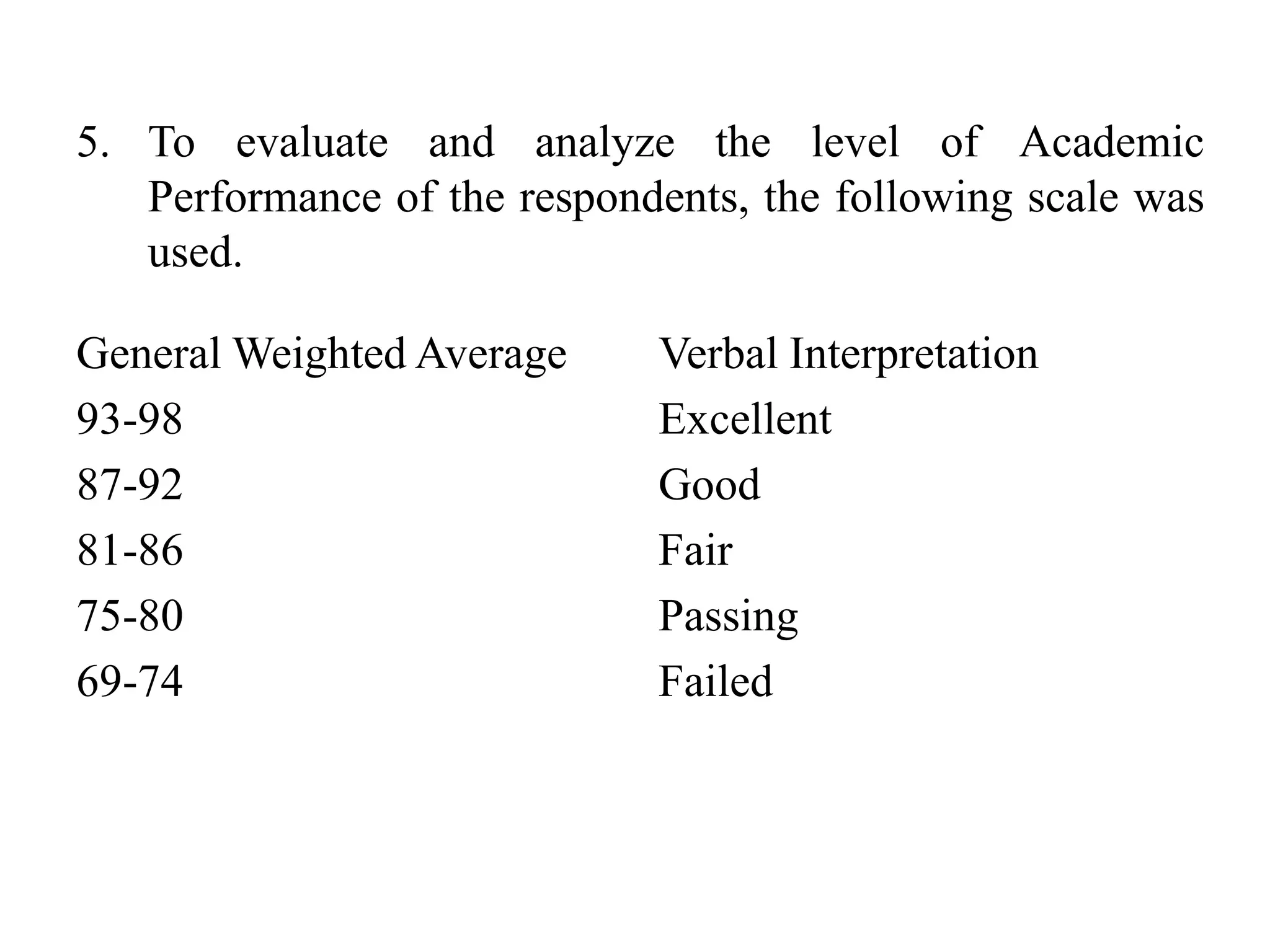
General Weighted Average
93-98
87-92
81-86
75-80
69-74
Verbal Interpretation
Excellent
Good
Fair
Passing
Failed
5. To evaluate and analyze the level of Academic
Performance of the respondents, the following scale was
used.
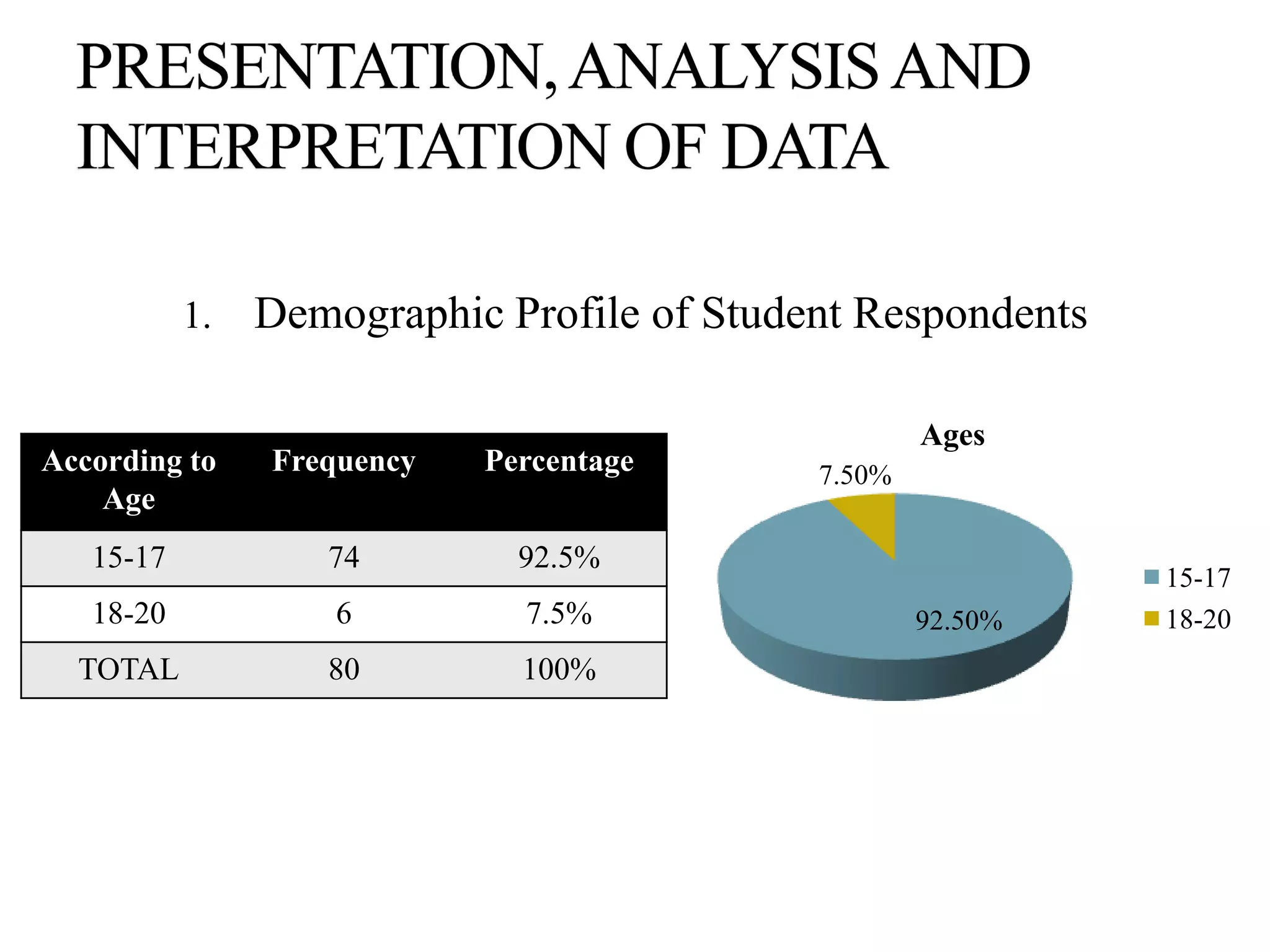
1. Demographic Profile of Student Respondents
According to
Age
Frequency Percentage
15-17 74 92.5%
18-20 6 7.5%
TOTAL 80 100%
92.50%
7.50%
Ages
15-17
18-20
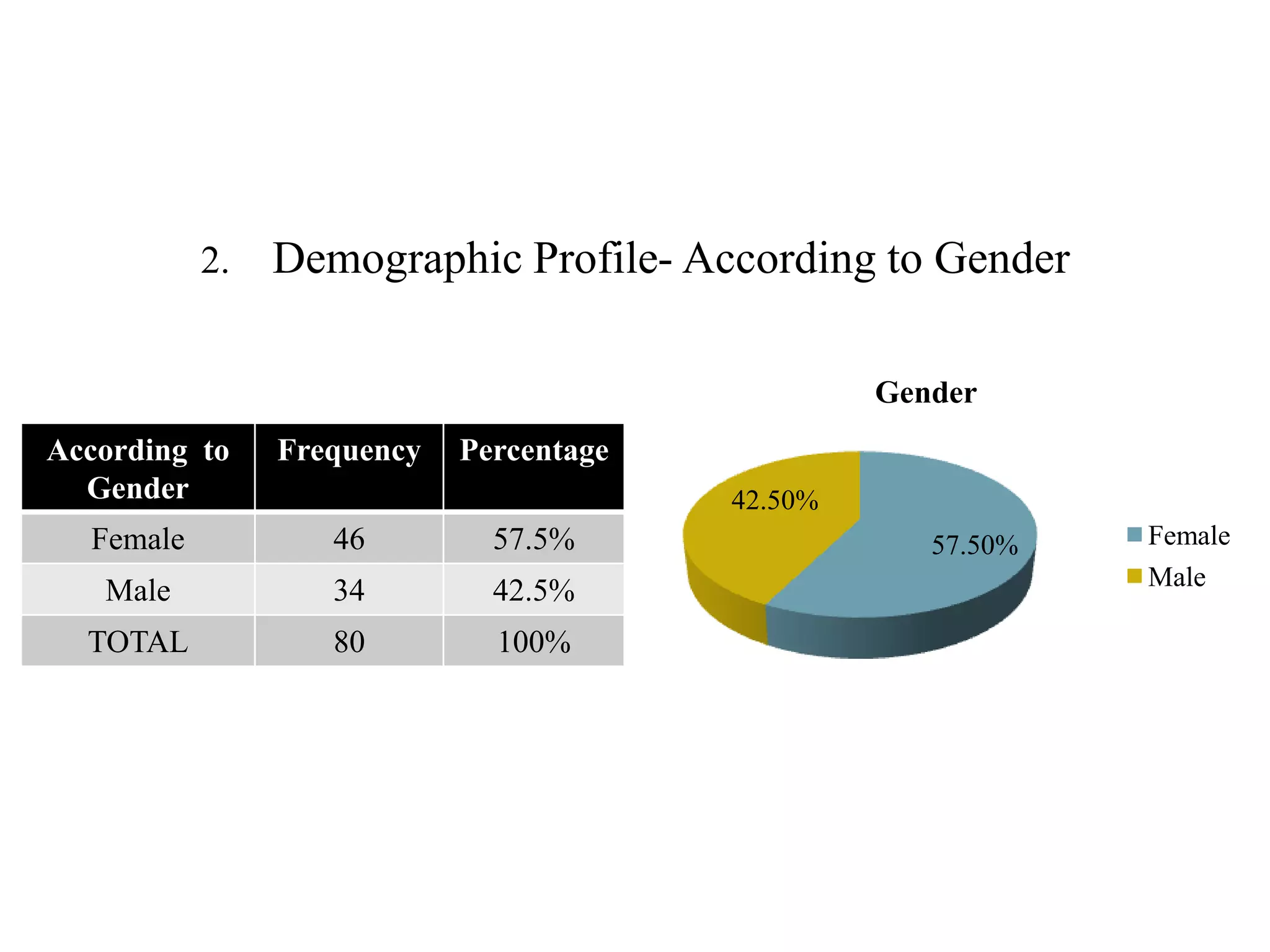
2. Demographic Profile- According to Gender
According to
Gender
Frequency Percentage
Female 46 57.5%
Male 34 42.5%
TOTAL 80 100%
57.50%
42.50%
Gender
Female
Male
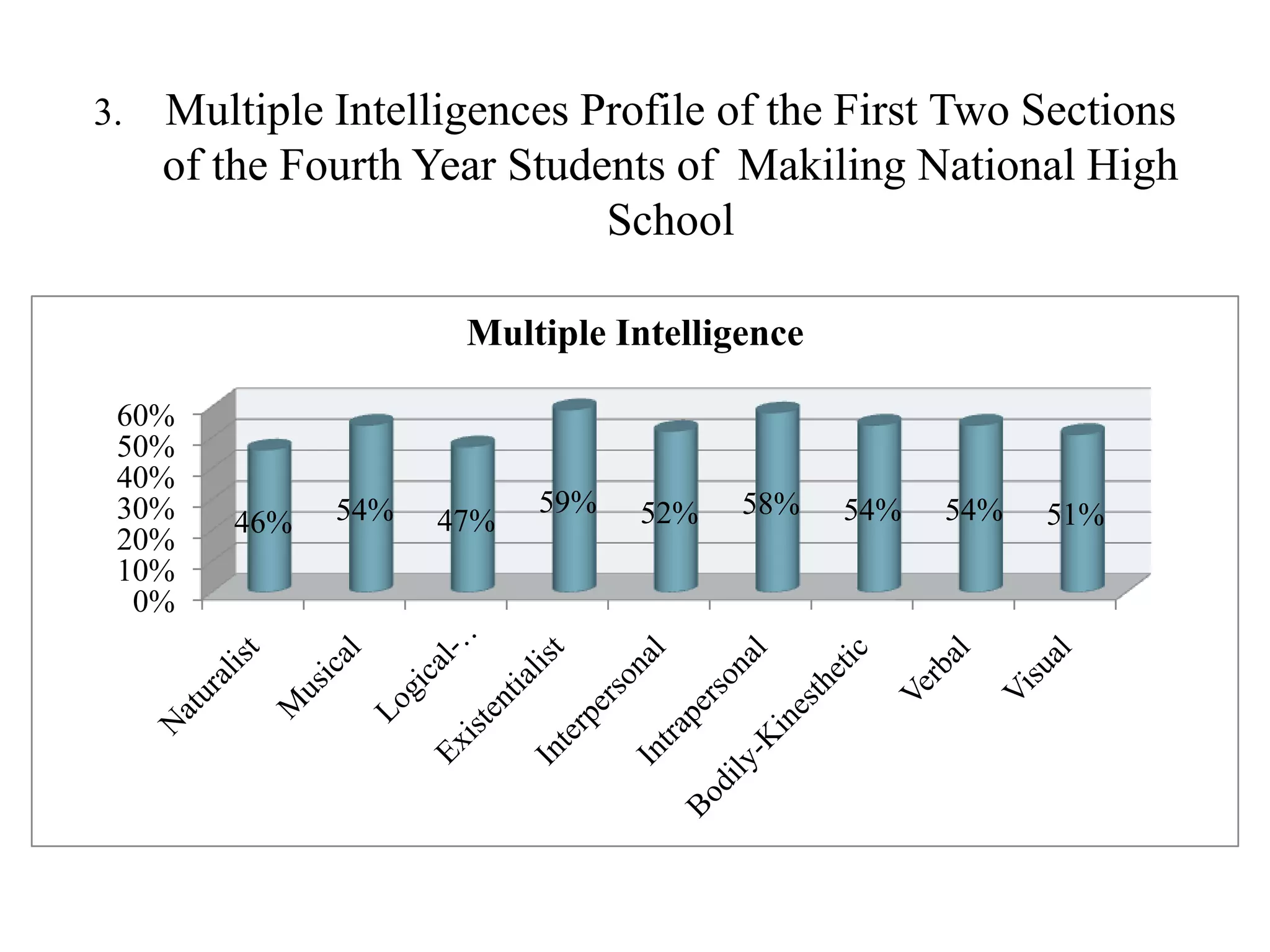
3. Multiple Intelligences Profile of the First Two Sections
of the Fourth Year Students of Makiling National High
School
0%
10%
20%
30%
40%
50%
60%
46% 54% 47%
59% 52% 58% 54% 54% 51%
Multiple Intelligence
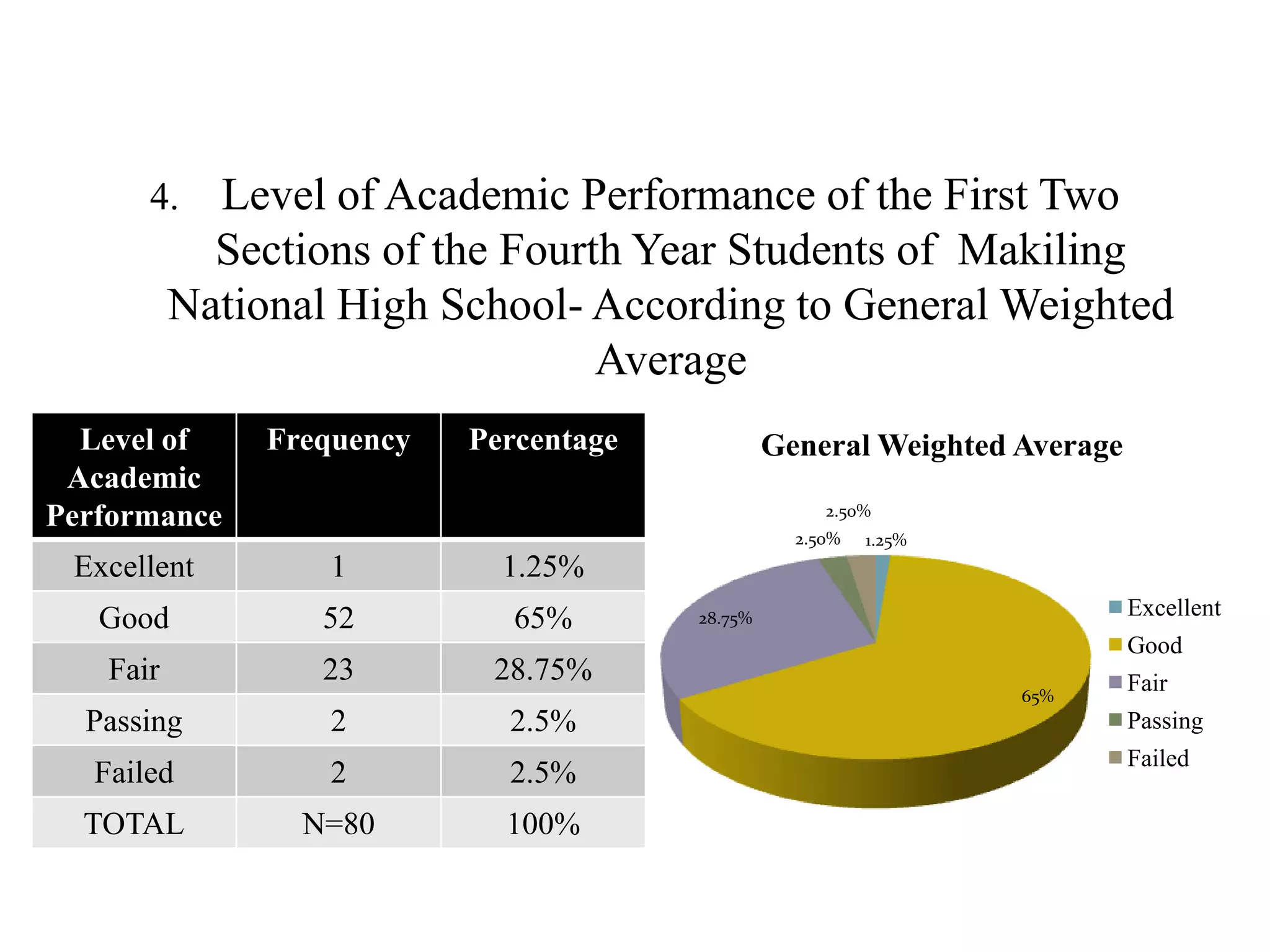
4. Level of Academic Performance of the First Two
Sections of the Fourth Year Students of Makiling
National High School- According to General Weighted
Average
Level of
Academic
Performance
Frequency Percentage
Excellent 1 1.25%
Good 52 65%
Fair 23 28.75%
Passing 2 2.5%
Failed 2 2.5%
TOTAL N=80 100%
1.25%
65%
28.75%
2.50%
2.50%
General Weighted Average
Excellent
Good
Fair
Passing
Failed
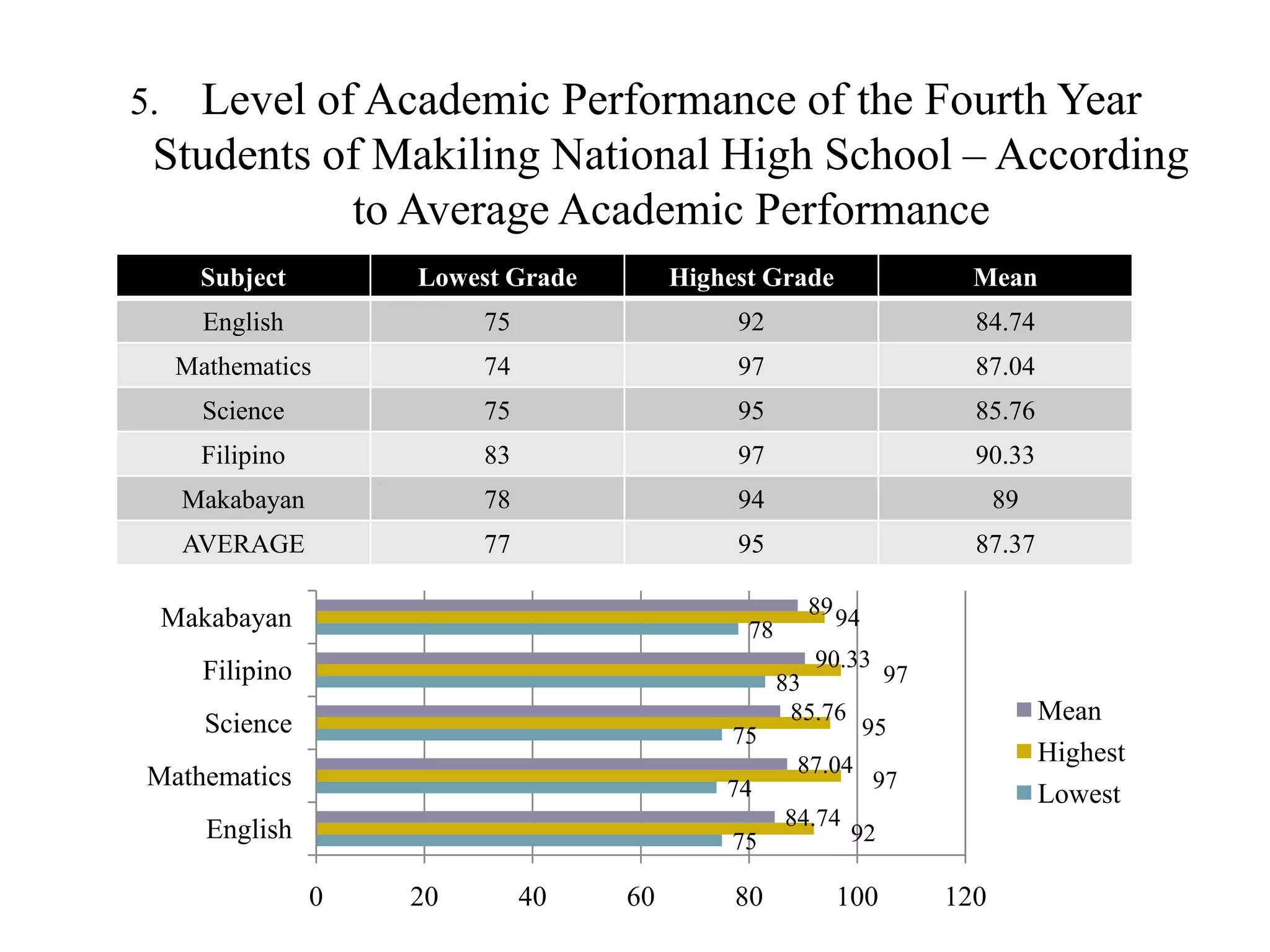
5. Level of Academic Performance of the Fourth Year
Students of Makiling National High School – According
to Average Academic Performance
Subject Lowest Grade Highest Grade Mean
English 75 92 84.74
Mathematics 74 97 87.04
Science 75 95 85.76
Filipino 83 97 90.33
Makabayan 78 94 89
AVERAGE 77 95 87.37
75
74
75
83
78
92
97
95
97
94
84.74
87.04
85.76
90.33
89
0 20 40 60 80 100 120
English
Mathematics
Science
Filipino
Makabayan
Mean
Highest
Lowest
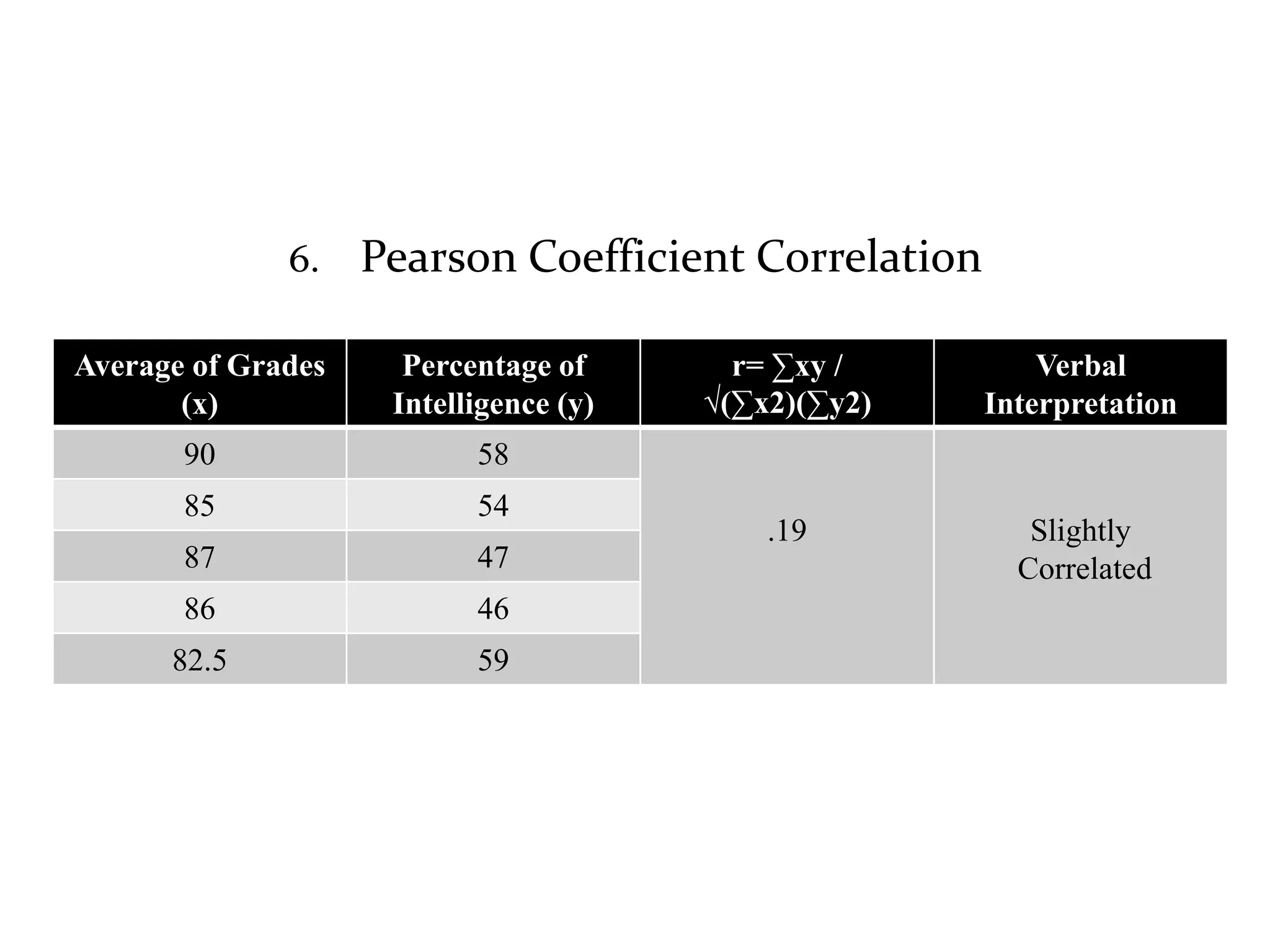
6. Pearson Coefficient Correlation
Average of Grades
(x)
Percentage of
Intelligence (y)
r= ∑xy /
√(∑x2)(∑y2)
Verbal
Interpretation
90 58
.19 Slightly
Correlated
85 54
87 47
86 46
82.5 59
Summary of Findings
Based from the data gathered, the following were
found out that:
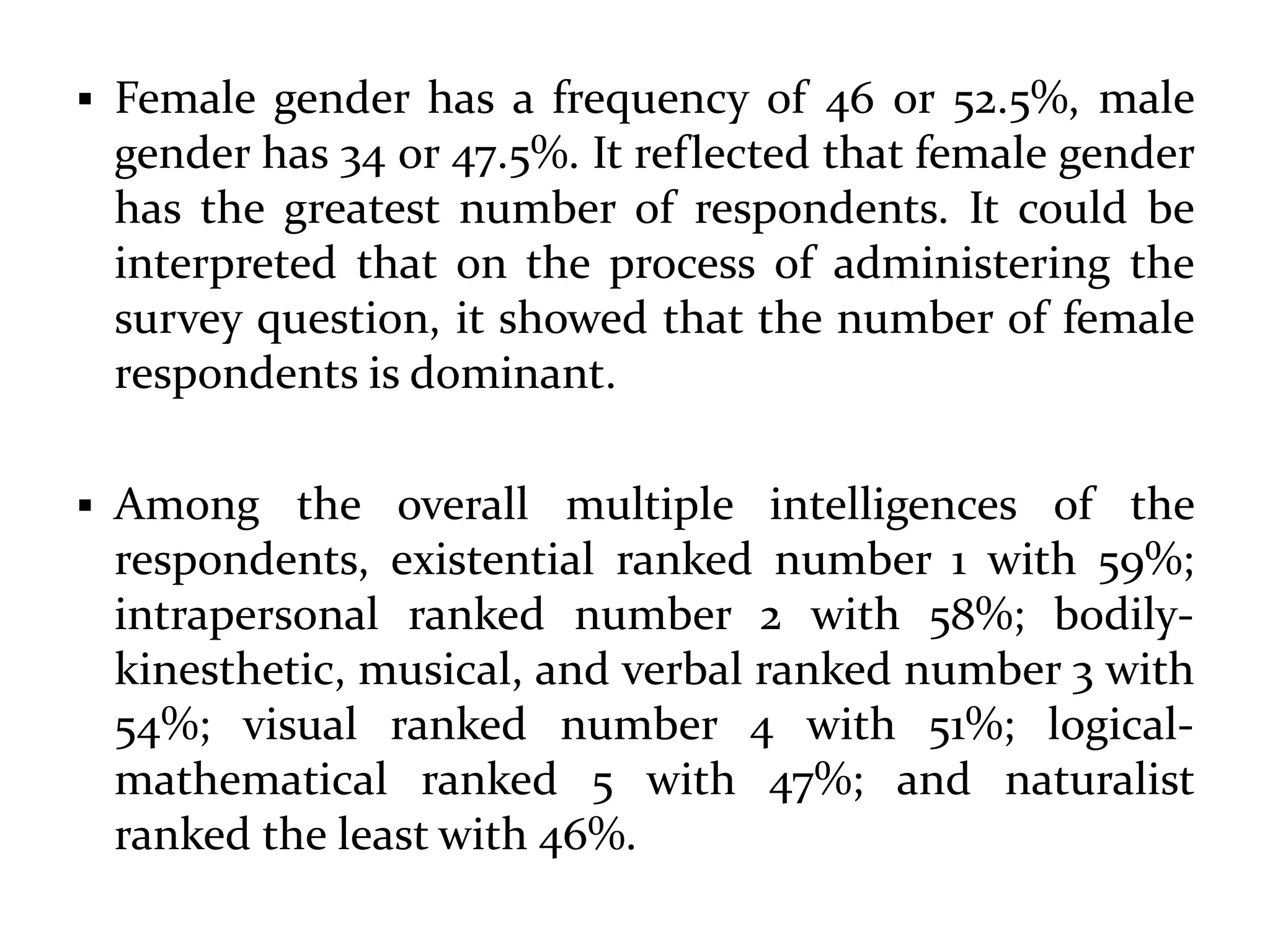
 The age of the respondents’ ages 15-17 has the
frequency of 74 or 92.5% and ages 18-20 with 6 or 7.5%.
It appeared that 15-17 has the greatest number of
respondents. It could be assumed that on the process
of administering survey question, it showed that the
number of respondents ages 15-17 is dominant
 Female gender has a frequency of 46 or 52.5%, male
gender has 34 or 47.5%. It reflected that female gender
has the greatest number of respondents. It could be
interpreted that on the process of administering the
survey question, it showed that the number of female
respondents is dominant.
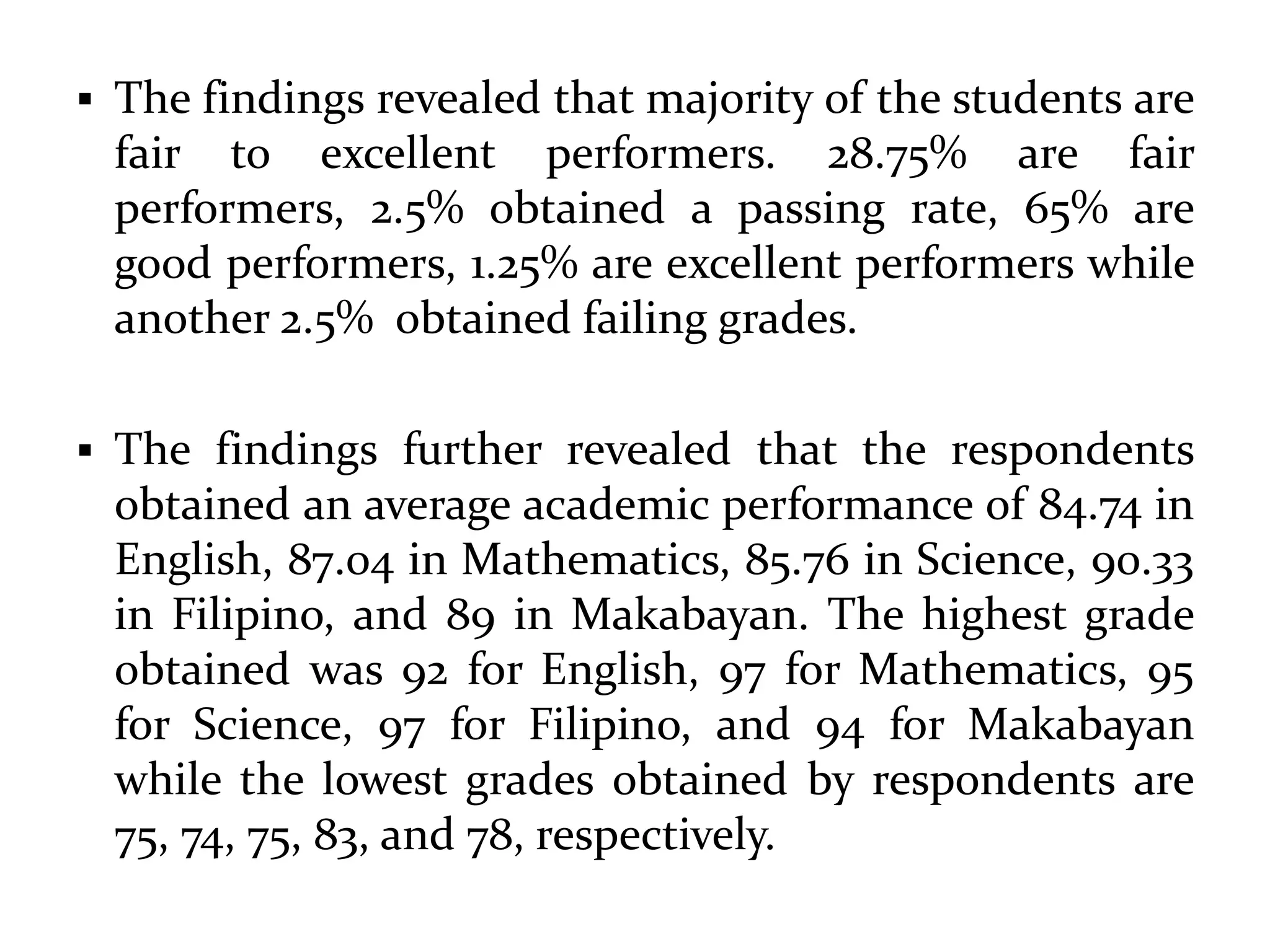
 Among the overall multiple intelligences of the
respondents, existential ranked number 1 with 59%;
intrapersonal ranked number 2 with 58%; bodily-
kinesthetic, musical, and verbal ranked number 3 with
54%; visual ranked number 4 with 51%; logical-
mathematical ranked 5 with 47%; and naturalist
ranked the least with 46%.
 The findings revealed that majority of the students are
fair to excellent performers. 28.75% are fair
performers, 2.5% obtained a passing rate, 65% are
good performers, 1.25% are excellent performers while
another 2.5% obtained failing grades.
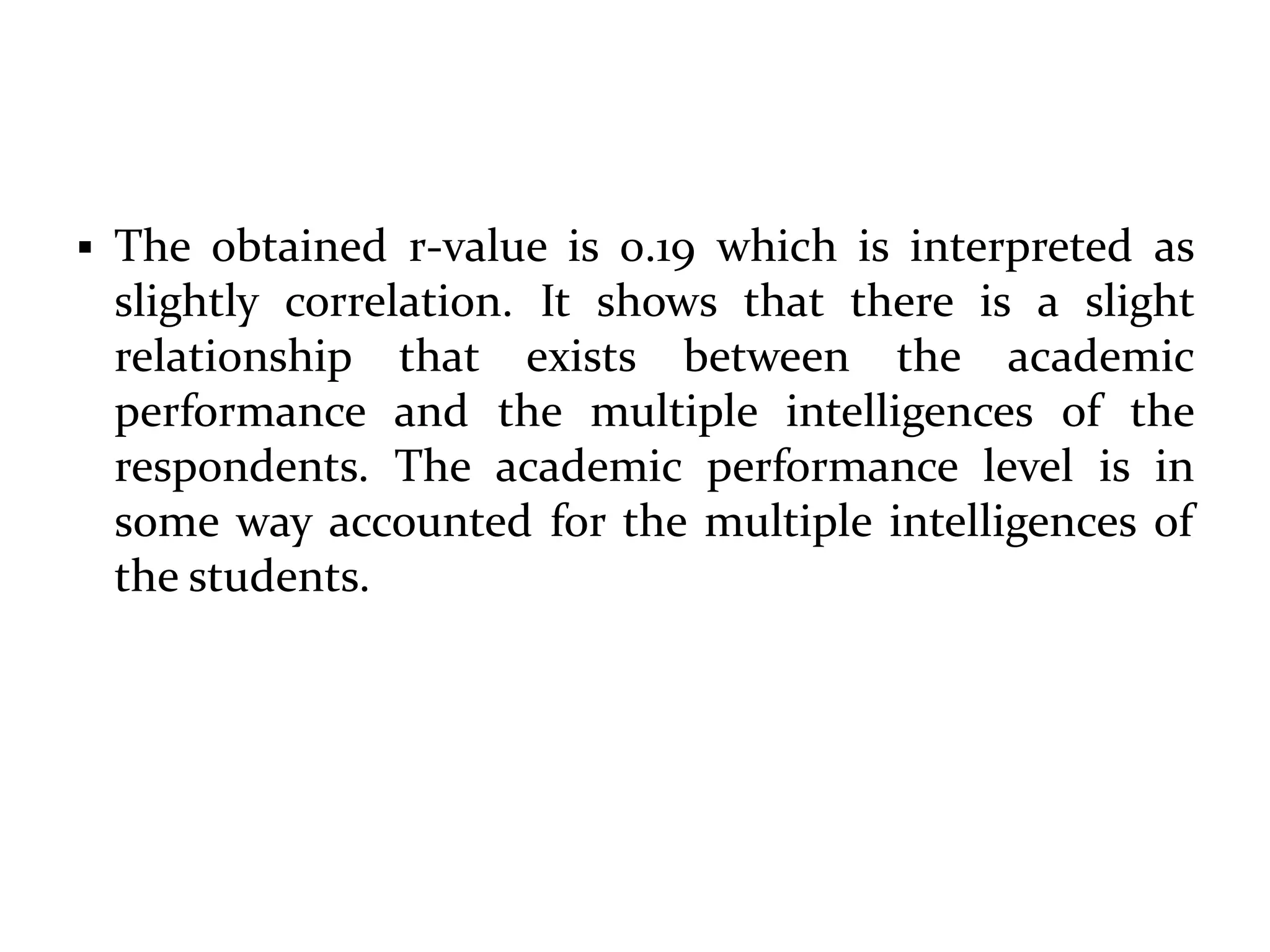
 The findings further revealed that the respondents
obtained an average academic performance of 84.74 in
English, 87.04 in Mathematics, 85.76 in Science, 90.33
in Filipino, and 89 in Makabayan. The highest grade
obtained was 92 for English, 97 for Mathematics, 95
for Science, 97 for Filipino, and 94 for Makabayan
while the lowest grades obtained by respondents are
75, 74, 75, 83, and 78, respectively.
 The obtained r-value is 0.19 which is interpreted as
slightly correlation. It shows that there is a slight
relationship that exists between the academic
performance and the multiple intelligences of the
respondents. The academic performance level is in
some way accounted for the multiple intelligences of
the students.
Suggestions and Recommendations
Based from the findings of this study, the researchers
suggested that:
 Parents should see the value of the MI approach in
education and educators should help them
understand how MI can help their children to be
successful.
 Teachers of the high school department should attend
seminars on Multiple Intelligence.
 Teachers need to help administrators understand that
students will perform better on any measure
particularly those students for whom success in school
is elusive, the kinds of students who typically fare
poorly on a standardized test – by creating a rich,
nurturing, and stimulating school environment filled
with interesting materials, activities and books, which
lays foundation for brighter students.
 Teacher Improvement Program should be
implemented and evaluated at the end of every
grading.
Based on the findings, the researchers
recommend to enhance the course syllabi to include
teaching methodologies that utilizes multiple
intelligences, develop multiple-intelligences-based
curriculum, develop instructional materials that
focuses on multiple intelligences.
The researchers also recommend conducting
further studies on the effect of multiple intelligences
on the academic performance of the students in other
schools and conducting a study on the predictive value
of multiple intelligences to get a high academic
performance.

Multiple Intelligences Profile of the First Two Sections of the Fourth Year Students at Makiling National High School, Makiling, Calamba City, School Year 2012-2013 and Its Relationship to Their Academic Performance: A Survey

  • 3.
    The present studyinvestigated the relationship of Multiple Intelligence to the Academic Performance of the first two sections of the fourth year high school students of Makiling National High School. The researchers used the Multiple Intelligences Inventory by Walter McKenzie. The first grading grades were used as a measure of academic performance. A total of 80 students were selected as sample of this study. Results of the study revealed that Multiple Intelligence is slightly correlated to the academic performance. Since the Multiple Intelligences correlate to the Academic Performance, it is recommended that teachers, whenever possible, must incorporate in their teaching strategies specific methods that are reflective of visual, auditory, tactile, and kinesthetic styles of learning. Students must also provide contribution as to their preferred learning style in designing the syllabus to be used by the teacher in the course.
  • 4.
  • 5.
    From birth, allhuman beings have different abilities and every child has unique properties. How children perceive themselves and their educational experiences establish their self concept and also prior to the development of self-efficiency. Until 1940s, as Rogers stated that children are meritorious because of their inner potentials, creativity, power to learn, ability to learn languages, potential to use brain (Akboy, 2004; Akboy & Ikiz, 2007). A successful transition from childhood to adolescence partially depends upon the academic preparation and the motivation of student as well as the school’s effectiveness in helping the student acquire life survival skills. Do the schools use testing, orientation and advising programs to help them take full advantage of the environmental and personal resources necessary for their success? Since every individual has unique set of experiences, a variety of responses to any given stimulus is possible. Learning is essentially an active process that the attention, curiosity and interest of the perceiver often increase. Therefore, provision for individual differences in learning is crucial (Fraenkel, 1994). The special academic and personal characteristics of students and how these characteristics affect their success have to be taken into consideration.
  • 6.
    In his theoryof multiple intelligences, Gardner (1999) argued that certain intelligences were valued in the schools while others were not. Gardner (1983) claims that intelligence is comprised of multiple modules or types, which are largely independent and functionally separate from each other. To briefly describe these intelligences (Barnard & Olivarez, 2007): Linguistic intelligence generally refers to sensitivity to spoken and written language, the ability to learn languages, and the capacity to use language to accomplish certain goals. Bodily-kinesthetic intelligence involves the potential to use one’s whole body or parts of the body. Musical intelligence is self-explanatory and consists of skill in the performance, composition and appreciation of music. Intrapersonal intelligence consists of the capacity to understand oneself, to appreciate one’s feelings, fears and motivations. Logical–mathematical intelligence entails the capacity to analyze problems logically, carry out mathematical operations and investigate issues. Interpersonal intelligence entails the capacity to understand the intentions, motivations and desires of other people. Spatial intelligence refers to the potential to recognize and use patterns. Naturalistic intelligence refers to the capacity to recognize, categorize and draw upon certain features of the environment. The inclusion of spiritual, existentialist and moral intelligence types creates some problems because person’s spirituality is privileged to the privacy of the human mind and not visible.
  • 7.
    Out of theseeight multiple intelligences, Gardner (1999) proposed that linguistic and logical-mathematical intelligences are the “coin of the realm”, having traditionally dominated intelligence testing and are the ones that have typically been valued in school. Recognizing that students have different strengths and providing activities to accommodate those strengths while bridging to the weaker areas is at the heart of diversified instruction based on multiple intelligences theory (Barnard & Olivarez, 2007). Students are not merely receivers of the given information; they should be encouraged to construct meaning for themselves. Since, teachers should move from the role of dispensers of knowledge into the role of facilitators of learning (Gullatt, 2008). Therefore during assessment procedure, intelligence types, creativity, problem solving and wisdom should be taken into consideration.
  • 8.
    As Gullatt (2008)indicates, scientists have found that most thought occurs on a level well below conscious control and awareness that involves processing of a continual stream of sensory information; abstract thought is represented through metaphors that are associated with physical experiences and emotions; physical sensation and emotions are integral to thought and learning. Thus without sensation and emotion logic may not be possible for some researchers. It is supported that the arts may be used as a means of making meaning of what is learned as well as to synthesize what had been thought in schools (Gullatt 2008; Eisner, 1998; Aprill, 2001), arts subjects are great potential partners in academic learning, arts have impact upon numerous social and cognitive dimensions across many academic disciplines (Gouzouasis et al., 2007). It is explained that there is a relationship between spatial and logical mathematical intelligences, as Gullatt (2008) indicates, as well as a strong relationship between spatial and musical intelligences, besides the literature. It is emphasized that a.) in order to make literature meaningful, students must be given aesthetic opportunities; their comprehension of text was increased and motivation for reading was enhanced; b.) the more intelligences students were required to use for learning, the deeper their understanding of the content presented.
  • 9.
    The secondary levelclearly brings unique challenges for student’s learning and adjustment, associated with the major psychological, social and biological changes that impact them (Munoz, Ross & McDonald, 2007). The researchers support the belief that knowledge can be gained in more than one way; as the ability to learn is derived from multiple resources (Gullatt, 2008). The estimates of intelligence have become a key issue in educational assessment. It shows the educational attainment levels of nations. In our society, a problem with teaching and assessing more broadly is that the kinds of standardized assessments we currently use are quite narrow (Sternberg, 2008). Elementary and secondary school curriculum is changed through the effects of multiple intelligences theory and constructivism. Therefore it has to be determined whether the present assessment results in the first grading grades of students are in relation with their intelligence type and the other variables affect them. Indeed, it is suggested that future research should examine the relationship between school valued intelligences and academic achievement scores through their first grading grades (Barnard & Olivarez, 2007). The purpose of this study is to determine the relationship of academic achievement with multiple intelligence profile of students.
  • 10.
    Profiling of thestudents’ multiple intelligences serves as basis in knowing more of the students’ characteristics. Teachers should be aware of the student’s characteristics to serves as basis for the method and strategy to be used in delivering classroom instruction. Multiple intelligences profiling is a significant approach towards knowing personally the students capability to succeed in the field of profession they are preparing through tertiary education. Thus, determining students' multiple intelligences profiles can increase teachers' understanding of their cognitive abilities and eventually help them to succeed (Burke 1998). Result of this study contributes awareness to the self knowledge and self efficacy of the students as well as to develop suggestions for programs to enhance their academic achievement levels and to be a reference for further studies.
  • 11.
    1. What ismeant by Multiple Intelligences? 2. What is meant by Academic Performances? 3. What are the Multiple Intelligences of the first two sections of the Fourth Year students at Makiling National High School; School Year 2012-2013? 4. What is the importance of knowing the Multiple Intelligences of these students? 5. Is there any relationship between Multiple Intelligences to their Academic Performances? 6. What is the relationship between Multiple Intelligences and Academic Performances of the students? 7. What is the level of their academic performances as regards their Multiple Intelligences is concern?
  • 12.
    Generally, this studyaims to know the Multiple Intelligences Profile of Selected Fourth Year Students in Makiling National High School, Makiling, Calamba City, School Year 2012-2013 and Its Relevance to Their Academic Performances: A Survey.
  • 13.
    Specifically, this studyseeks to: 1. give the meaning Multiple Intelligences 2. define Academic Performances 3. find out the Multiple Intelligences of the first two sections of the students at Makiling National High School, School Year 2012- 2013 4. cite the importance of knowing the Multiple Intelligences of these students 5. determine the relationship between Multiple Intelligences to their Academic Performances 6. state the relationship between Multiple Intelligences and Academic Performances of the students 7. identify the level of their academic performances as regards their Multiple Intelligence is concern
  • 14.
    This study islimited to the Multiple Intelligences Profile of Selected Fourth Year Students at Makiling National High School, Makiling, Calamba City, School Year 2012-2013 and Its Relationship to Their Academic Performance: A Survey
  • 15.
    This study, MultipleIntelligences Profile of Selected Fourth Year Students at Makiling National High School, Makiling, Calamba City, School Year 2012-2013 and Its Relationship to Their Academic Performance: A Survey, as a requirement is significant to the following: 1. Students- to let them know their Multiple Intelligence and to become aware of their strengths and weaknesses. 2. Instructors- to have an idea on how they can enhance their students of different intelligences. 3. University- to be able to provide activities that will improve the Multiple Intelligences of the students. 4. Future Researchers- to provide information for their researches.
  • 16.
     Multiple Intelligences– pluralized way of understanding intellect.  Multiple Intelligences Profile – personal intelligence profile that is consist of combinations of different intelligence types.  Academic Performance – refers to how students deal with their studies and how they cope with or accomplish different task given to them.  Relationship – the way in which two or more concepts, objects, or people are connected, or the state of being connected.  Makiling National High School – is a public national high school located in Makiling, Calamba City.  Fourth Year Students – pertaining to the students in the fourth and final year.  Survey – a general view, examination or description of someone or something.  Pearson Coefficient Correlation – is a measure of correlation between two variables (x and y), giving a value between +1 and -1 inclusive. It is used in the sciences as a measure of the strength of linear dependence between two variables.
  • 17.
  • 18.
    The researchers usedthe descriptive method. According to Calmorin (1995), descriptive method focuses at the present condition. The purpose is to find new truth. This approach to problem-solving seeks to answer questions to the real facts relating to existing condition. This is a technique of a quantitative description which determines the prevailing conditions in a group of cases chosen for this study. This method is employed to obtain information regarding the relationship of Multiple Intelligences to the Academic Performances of the first two sections of the fourth year students at Makiling National High School, Makiling, Calamba City School Year 2012-2013.
  • 19.
    The questionnaires andevaluation of the learning outcomes of the students were the instrument used to gather the needed data. In its preparation, the researchers read and studied standard criteria and consulted knowledgeable authorities in the formation of questionnaires. With the cooperation of the guidance councilor of the school, the researchers were able to get hold of the evaluation of the learning outcomes of their students. Then the researchers proceeded to their research.
  • 20.
    The respondents ofthis study were composed of the students from the first two sections, namely; Section Einstein and Section Sampaguita. They were chosen because they can understand the questionnaires very well about Multiple Intelligence. Their maturity was also considered.
  • 21.
    The researchers madeuse of purposive sampling method. Purposive sampling method is based on the certain criteria laid down by the researchers. It is utilized in this study to meet the purposes and to have homogeneity.
  • 22.
    The researchers preparedthe questionnaires which were validated by their research team leader/adviser, language editor, and the guidance councilor of the school. They constructed their questionnaires based from the unpublished theses and from the internet and then passed it to the team leader/adviser. Their team leader/adviser made some clarifications and corrections on the questionnaires. After that, they have made revisions based from the suggestions by their team leader/adviser. Finally, their team leader/adviser validated the questionnaires and later on gave the approval for the distribution. Then the researchers proceed to their survey.
  • 23.
    The research wasconducted at Makiling National High School, Makiling Calamba City.
  • 24.
    Letter-requesting permission toadminister the questionnaires was forwarded to the guidance councilor. The guidance councilor allowed the researchers to disseminate questionnaires to the respondents. They were given an hour to conduct their survey. They form a single group out of the two sections and were able to forward questionnaires. After half an hour, the respondents were able to answer all the questions and the researchers collected the questionnaires. The responses were verified, tallied, and tabulated to reveal the detailed presentation of the data gathered. Survey questionnaires were used as the primary instrument supported by information gathered from references and other sources were used as secondary instrument.
  • 25.
    1. Sample Percentage Thistechnique is used to determine the proportion of the total number of respondents to the number of respondents to each section. In particular, it is used to analyze specific items in the profile of the respondents. P=f/n X 100 where:  p= percentage  f= frequency  n=number of respondents
  • 26.
    2. Percentage ofGWA in first grading __ X = ∑x / n where: __ X = percent of the GWA in first grading x= grade in first grading n= total number of respondents
  • 27.
    3. Correlation This formulais used to find the relationship between Multiple Intelligence and Academic Performance. r= ∑xy/√(∑x2)(∑y2) where: x= percentage of the Intelligence of the respondents y= General Weighted Average of the respondents per subject
  • 28.
    4. The researchersmade use of this key to identify the Multiple Intelligence of the respondents:  Section 1 – This reflects Naturalist strength  Section 2 – This suggests Musical strength  Section 3 – This indicates Logical strength  Section 4 – This illustrates Existential strength  Section 5 – This shows Interpersonal strength  Section 6 – This tells Kinesthetic strength  Section 7 – This indicates Verbal strength  Section 8 – This reflects Intrapersonal strength  Section 9 – This suggests Visual strength
  • 29.
    General Weighted Average 93-98 87-92 81-86 75-80 69-74 VerbalInterpretation Excellent Good Fair Passing Failed 5. To evaluate and analyze the level of Academic Performance of the respondents, the following scale was used.
  • 30.
    1. Demographic Profileof Student Respondents According to Age Frequency Percentage 15-17 74 92.5% 18-20 6 7.5% TOTAL 80 100% 92.50% 7.50% Ages 15-17 18-20
  • 31.
    2. Demographic Profile-According to Gender According to Gender Frequency Percentage Female 46 57.5% Male 34 42.5% TOTAL 80 100% 57.50% 42.50% Gender Female Male
  • 32.
    3. Multiple IntelligencesProfile of the First Two Sections of the Fourth Year Students of Makiling National High School 0% 10% 20% 30% 40% 50% 60% 46% 54% 47% 59% 52% 58% 54% 54% 51% Multiple Intelligence
  • 33.
    4. Level ofAcademic Performance of the First Two Sections of the Fourth Year Students of Makiling National High School- According to General Weighted Average Level of Academic Performance Frequency Percentage Excellent 1 1.25% Good 52 65% Fair 23 28.75% Passing 2 2.5% Failed 2 2.5% TOTAL N=80 100% 1.25% 65% 28.75% 2.50% 2.50% General Weighted Average Excellent Good Fair Passing Failed
  • 34.
    5. Level ofAcademic Performance of the Fourth Year Students of Makiling National High School – According to Average Academic Performance Subject Lowest Grade Highest Grade Mean English 75 92 84.74 Mathematics 74 97 87.04 Science 75 95 85.76 Filipino 83 97 90.33 Makabayan 78 94 89 AVERAGE 77 95 87.37 75 74 75 83 78 92 97 95 97 94 84.74 87.04 85.76 90.33 89 0 20 40 60 80 100 120 English Mathematics Science Filipino Makabayan Mean Highest Lowest
  • 35.
    6. Pearson CoefficientCorrelation Average of Grades (x) Percentage of Intelligence (y) r= ∑xy / √(∑x2)(∑y2) Verbal Interpretation 90 58 .19 Slightly Correlated 85 54 87 47 86 46 82.5 59
  • 36.
  • 37.
    Based from thedata gathered, the following were found out that:  The age of the respondents’ ages 15-17 has the frequency of 74 or 92.5% and ages 18-20 with 6 or 7.5%. It appeared that 15-17 has the greatest number of respondents. It could be assumed that on the process of administering survey question, it showed that the number of respondents ages 15-17 is dominant
  • 38.
     Female genderhas a frequency of 46 or 52.5%, male gender has 34 or 47.5%. It reflected that female gender has the greatest number of respondents. It could be interpreted that on the process of administering the survey question, it showed that the number of female respondents is dominant.  Among the overall multiple intelligences of the respondents, existential ranked number 1 with 59%; intrapersonal ranked number 2 with 58%; bodily- kinesthetic, musical, and verbal ranked number 3 with 54%; visual ranked number 4 with 51%; logical- mathematical ranked 5 with 47%; and naturalist ranked the least with 46%.
  • 39.
     The findingsrevealed that majority of the students are fair to excellent performers. 28.75% are fair performers, 2.5% obtained a passing rate, 65% are good performers, 1.25% are excellent performers while another 2.5% obtained failing grades.  The findings further revealed that the respondents obtained an average academic performance of 84.74 in English, 87.04 in Mathematics, 85.76 in Science, 90.33 in Filipino, and 89 in Makabayan. The highest grade obtained was 92 for English, 97 for Mathematics, 95 for Science, 97 for Filipino, and 94 for Makabayan while the lowest grades obtained by respondents are 75, 74, 75, 83, and 78, respectively.
  • 40.
     The obtainedr-value is 0.19 which is interpreted as slightly correlation. It shows that there is a slight relationship that exists between the academic performance and the multiple intelligences of the respondents. The academic performance level is in some way accounted for the multiple intelligences of the students.
  • 41.
  • 42.
    Based from thefindings of this study, the researchers suggested that:  Parents should see the value of the MI approach in education and educators should help them understand how MI can help their children to be successful.  Teachers of the high school department should attend seminars on Multiple Intelligence.
  • 43.
     Teachers needto help administrators understand that students will perform better on any measure particularly those students for whom success in school is elusive, the kinds of students who typically fare poorly on a standardized test – by creating a rich, nurturing, and stimulating school environment filled with interesting materials, activities and books, which lays foundation for brighter students.  Teacher Improvement Program should be implemented and evaluated at the end of every grading.
  • 44.
    Based on thefindings, the researchers recommend to enhance the course syllabi to include teaching methodologies that utilizes multiple intelligences, develop multiple-intelligences-based curriculum, develop instructional materials that focuses on multiple intelligences. The researchers also recommend conducting further studies on the effect of multiple intelligences on the academic performance of the students in other schools and conducting a study on the predictive value of multiple intelligences to get a high academic performance.