* Planning the Test
* Selecting and
Constructing Test
Items and Tasks
* Improving a
Classroom-Based
Assessment
Reporter:
MARY GRACE M. ORTIZ
MAT - ENGLISH
DEVELOPING
TOOLS FOR
CLASSROOM-
BASED
ASSESSMENT
is an integral part of instruction
that enhances, empowers, and
celebrates student learning.
 The process of collecting, synthesizing and interpreting
information to aid in classroom decision making.(Airasian
2005)
Definitions:
 Assessment refers to assessment carried out by teachers in
the classroom. (Mckay 2006)
 Plays a significant role in collecting information about learners'
learning and can also be used to support teachers' teaching
and learning (Rea-Dickins, 2001).
Source:https://www.ukessays.com/essays/english-language/definitions-of-assessment-and-classroom-based-assessment-
english-language-essay.php
– Classroom-Based Assessments are the occasions when the
teacher assesses the students in the specific assessment(s)
that are set out in the subject or short course specification.
– The Classroom-Based Assessment can be produced in
written, digital, visual or audio formats and it may be
supported in these formats through the use of an interview or
presentation.
Source: https://www.curriculumonline.ie/Junior-cycle/Short-Courses/SPHE/Assessment-and-reporting/Classroom-
Based-Assessment. Retrieved May 7
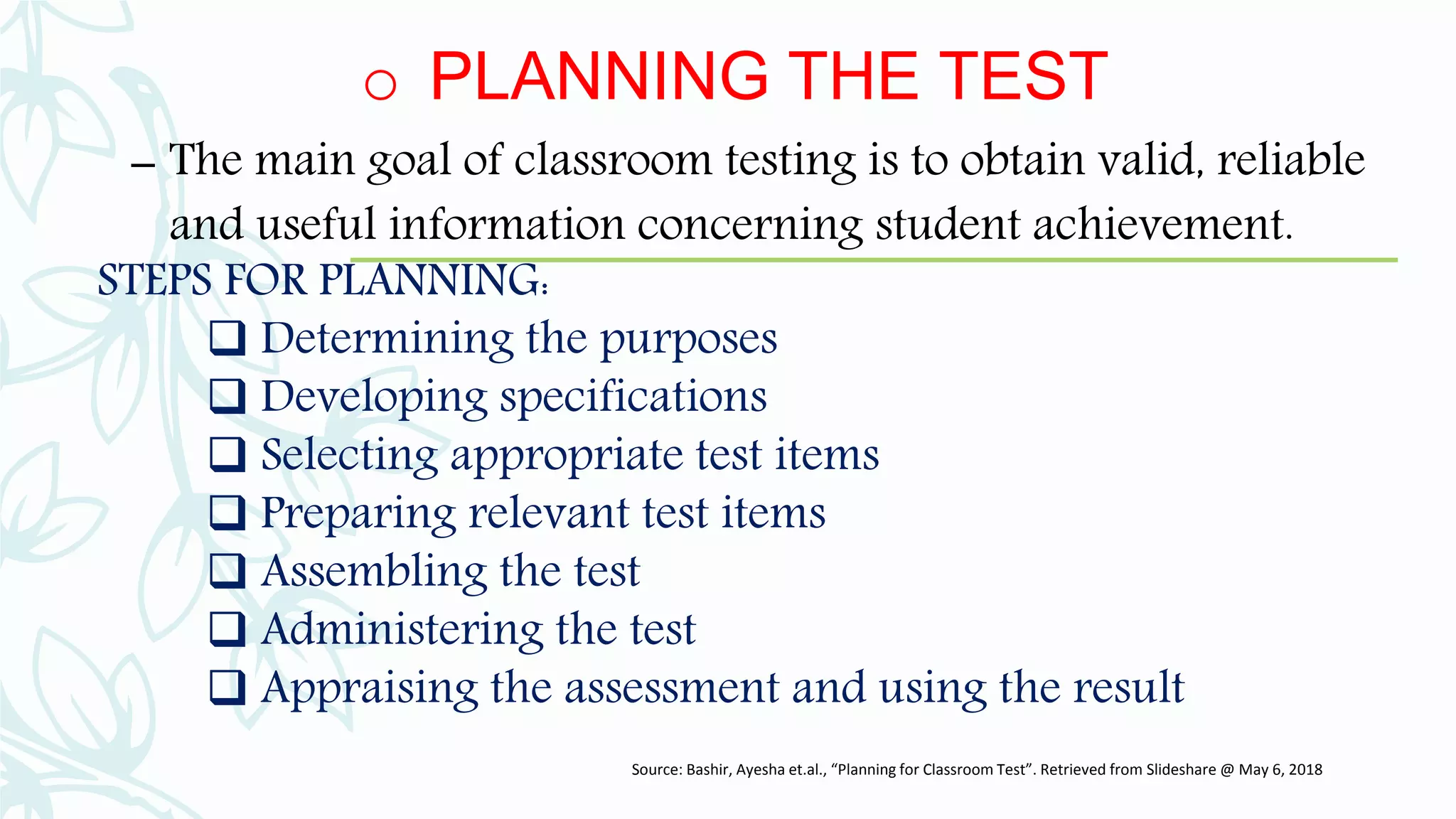
o PLANNING THE TEST
– The main goal of classroom testing is to obtain valid, reliable
and useful information concerning student achievement.
STEPS FOR PLANNING:
 Determining the purposes
 Developing specifications
 Selecting appropriate test items
 Preparing relevant test items
 Assembling the test
 Administering the test
 Appraising the assessment and using the result
Source: Bashir, Ayesha et.al., “Planning for Classroom Test”. Retrieved from Slideshare @ May 6, 2018
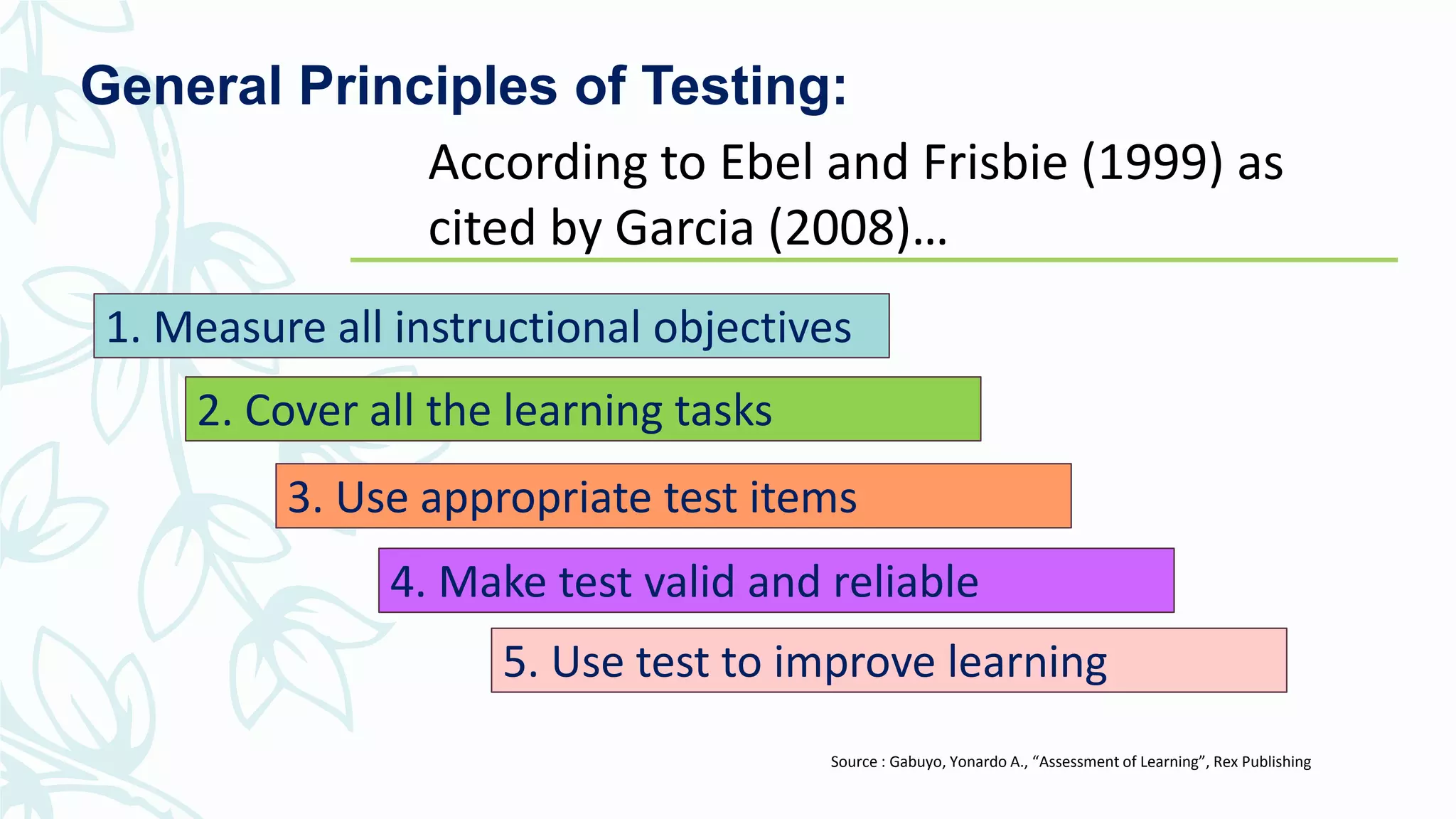
General Principles of Testing:
According to Ebel and Frisbie (1999) as
cited by Garcia (2008)…
1. Measure all instructional objectives
2. Cover all the learning tasks
3. Use appropriate test items
4. Make test valid and reliable
5. Use test to improve learning
Source : Gabuyo, Yonardo A., “Assessment of Learning”, Rex Publishing
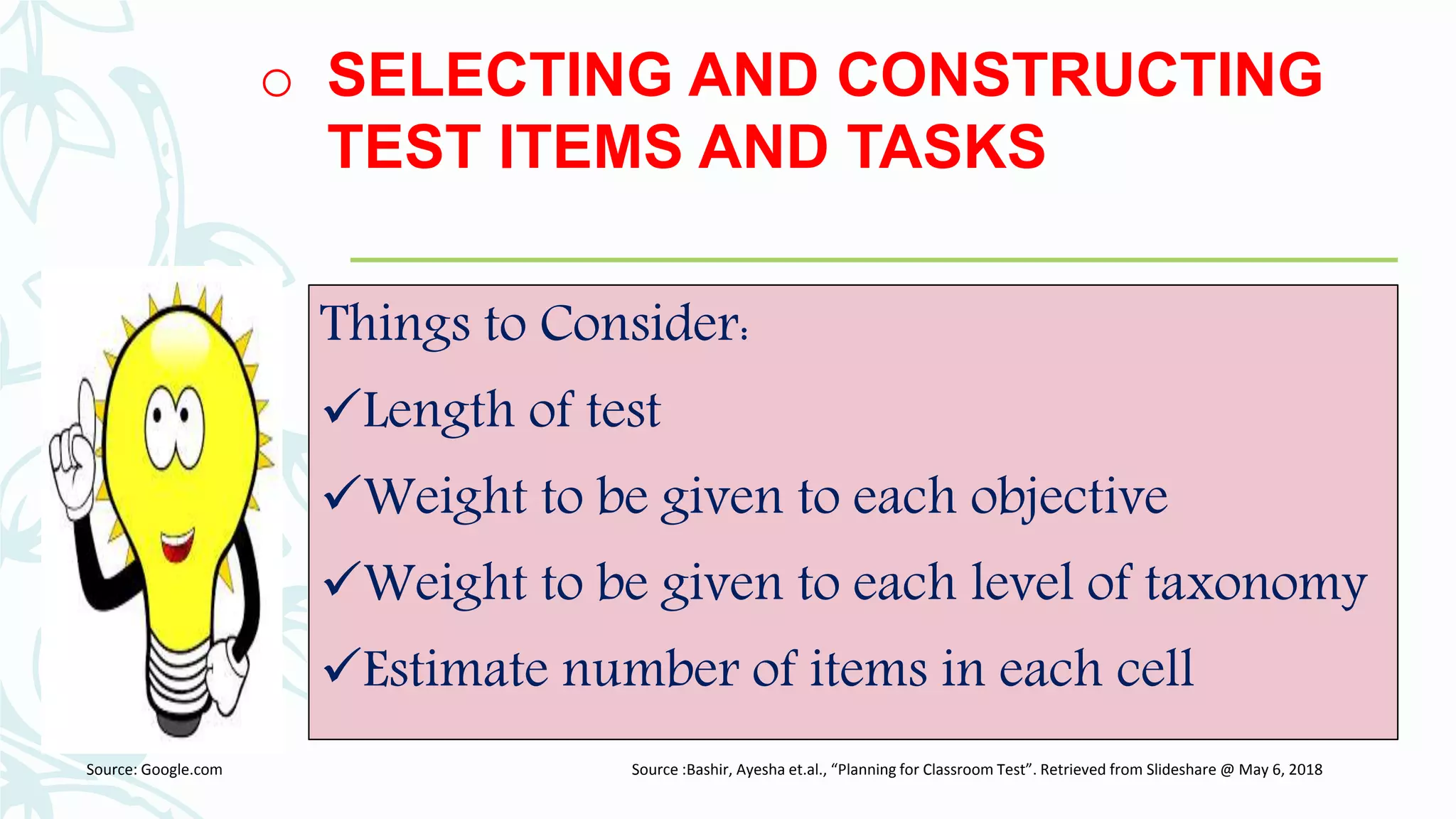
o SELECTING AND CONSTRUCTING
TEST ITEMS AND TASKS
Things to Consider:
Length of test
Weight to be given to each objective
Weight to be given to each level of taxonomy
Estimate number of items in each cell
Source :Bashir, Ayesha et.al., “Planning for Classroom Test”. Retrieved from Slideshare @ May 6, 2018Source: Google.com
… in selecting appropriate type of test items, the tests
constructed by teachers maybe classified as 1) Objective Type
and 2) Essay Type
Objective
Type
Supply Type
• Short
Answer
• Completion
Type
Selection Type
• True or
false
• Matching
Type
• Multiple
Choice
Strengths
 Can have
many items
 Highly
structured
 Scoring quick,
easy, accurate
Limitations
 Cannot assess
higher level
skills (problem
formulation,
organization,
creativity)
Source : Bashir, Ayesha et.al., “Planning for Classroom Test”. Retrieved from Slideshare @ May 6, 2018
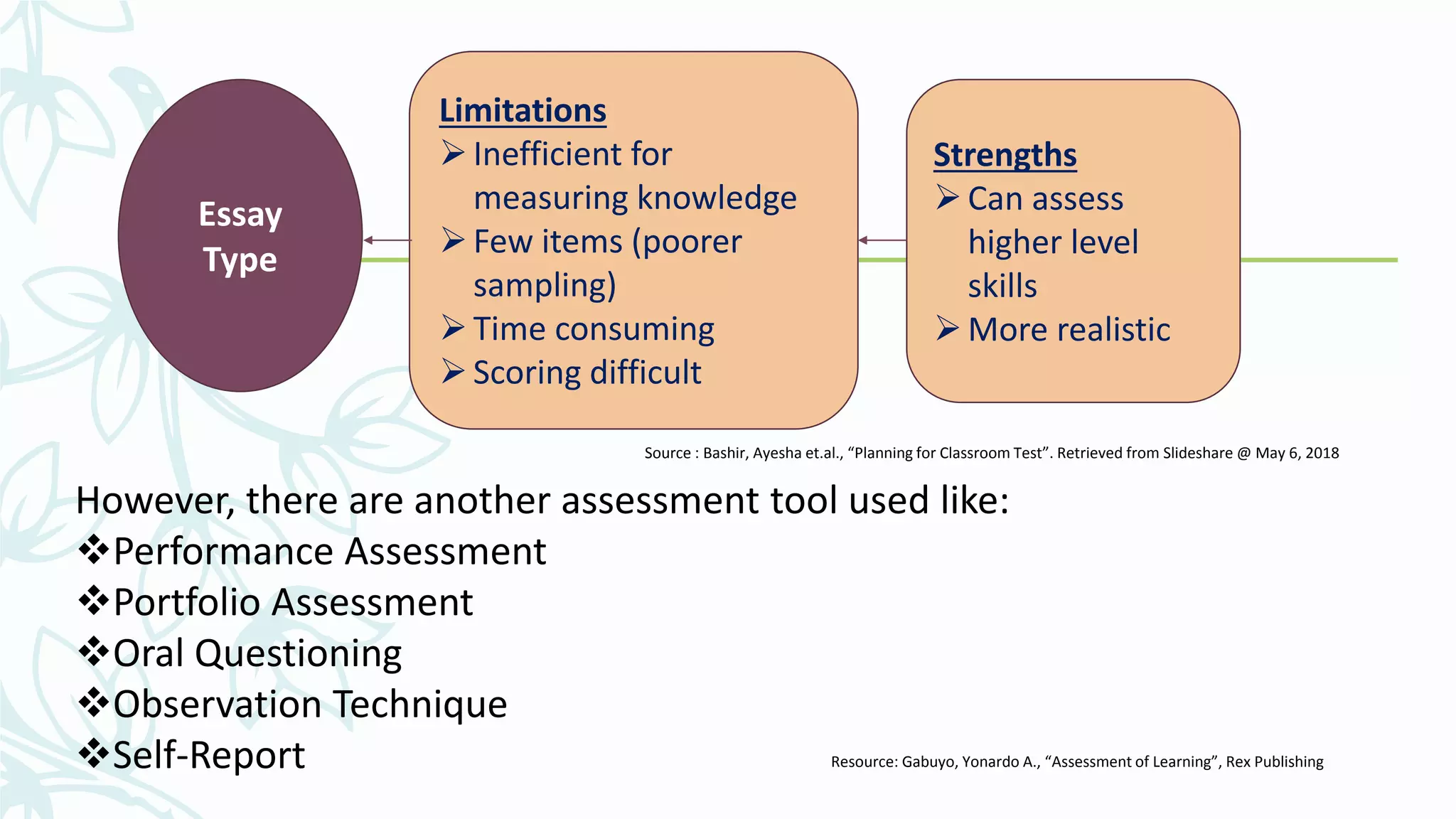
Essay
Type
Strengths
Can assess
higher level
skills
More realistic
Limitations
Inefficient for
measuring knowledge
Few items (poorer
sampling)
Time consuming
Scoring difficult
However, there are another assessment tool used like:
Performance Assessment
Portfolio Assessment
Oral Questioning
Observation Technique
Self-Report
Source : Bashir, Ayesha et.al., “Planning for Classroom Test”. Retrieved from Slideshare @ May 6, 2018
Resource: Gabuyo, Yonardo A., “Assessment of Learning”, Rex Publishing
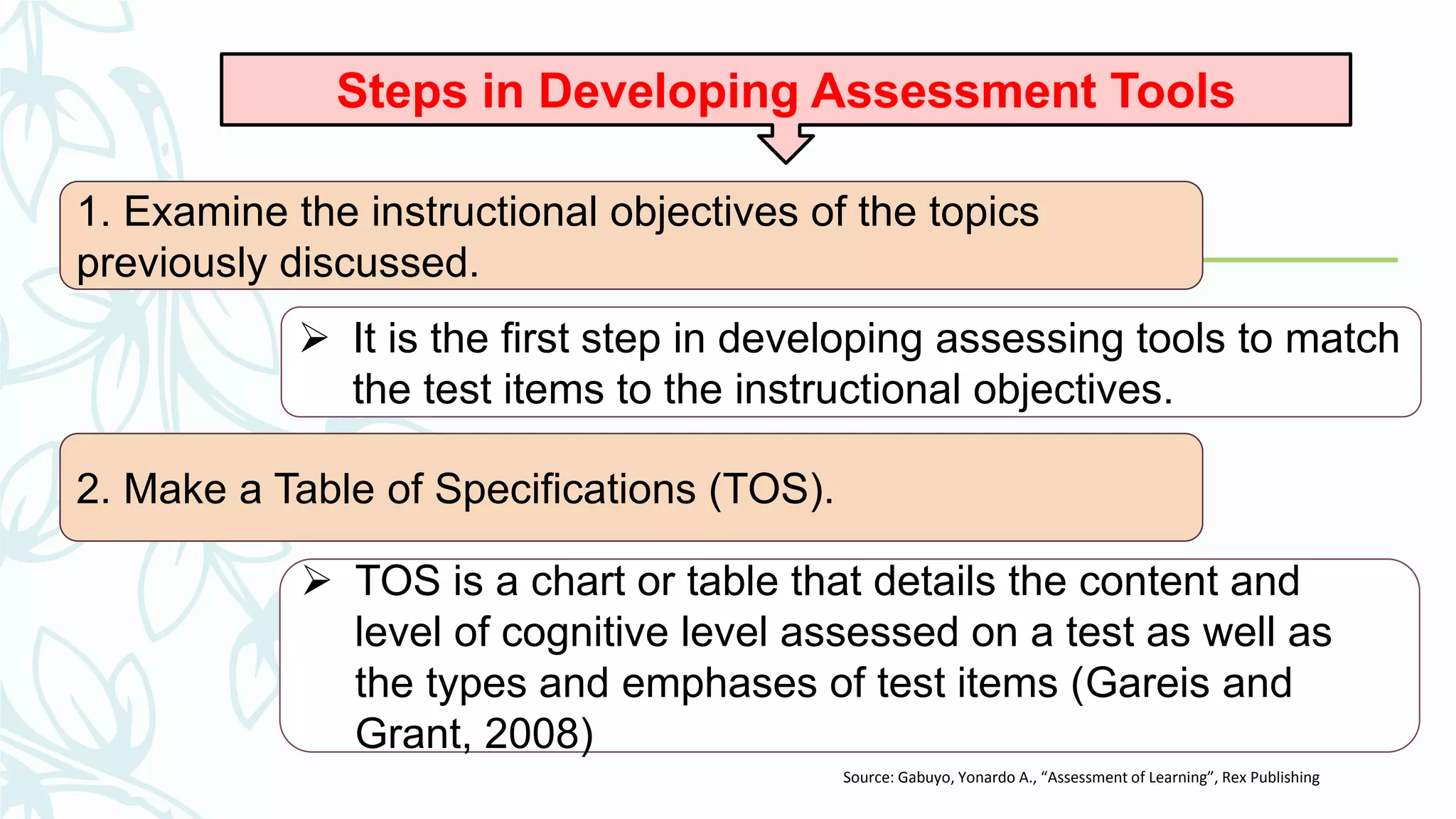
Steps in Developing Assessment Tools
1. Examine the instructional objectives of the topics
previously discussed.
 It is the first step in developing assessing tools to match
the test items to the instructional objectives.
2. Make a Table of Specifications (TOS).
 TOS is a chart or table that details the content and
level of cognitive level assessed on a test as well as
the types and emphases of test items (Gareis and
Grant, 2008)
Source: Gabuyo, Yonardo A., “Assessment of Learning”, Rex Publishing
General guidelines for test items constructions (Kubiszyn and Borich
2007)
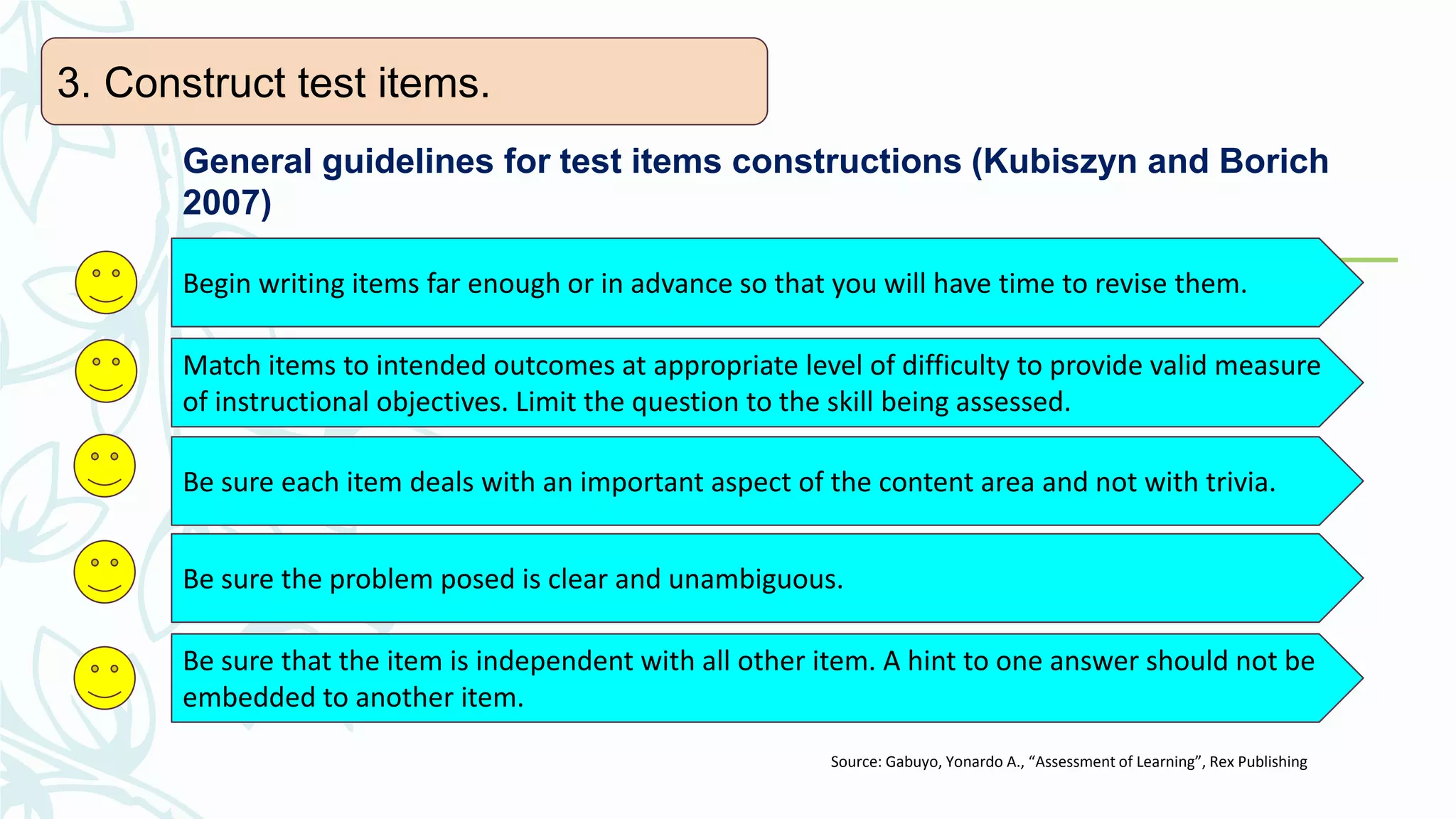
Begin writing items far enough or in advance so that you will have time to revise them.
Match items to intended outcomes at appropriate level of difficulty to provide valid measure
of instructional objectives. Limit the question to the skill being assessed.
Be sure each item deals with an important aspect of the content area and not with trivia.
Be sure the problem posed is clear and unambiguous.
Be sure that the item is independent with all other item. A hint to one answer should not be
embedded to another item.
Source: Gabuyo, Yonardo A., “Assessment of Learning”, Rex Publishing
3. Construct test items.
Be sure the item has one or best answer on which experts would agree.
Prevent unintended clues to an answer in the statement or questions. Grammatical
inconsistencies such as a or an give clues to the correct answers to those students who are
not well prepared for the test.
Avoid replication of the textbook in writing test items; do not quote directly from the textual
materials.
Avoid trick or catch questions in an achievement test. Do not waste time testing how ell the
students can interpret your intentions.
Try to write items that require higher order thinking skills,
Source: Gabuyo, Yonardo A., “Assessment of Learning”, Rex Publishing
General guidelines in Constructing Multiple-choice Test
Multiple-Choice Test: used to measure knowledge outcomes and other types of
learning outcomes such as comprehension and applications.
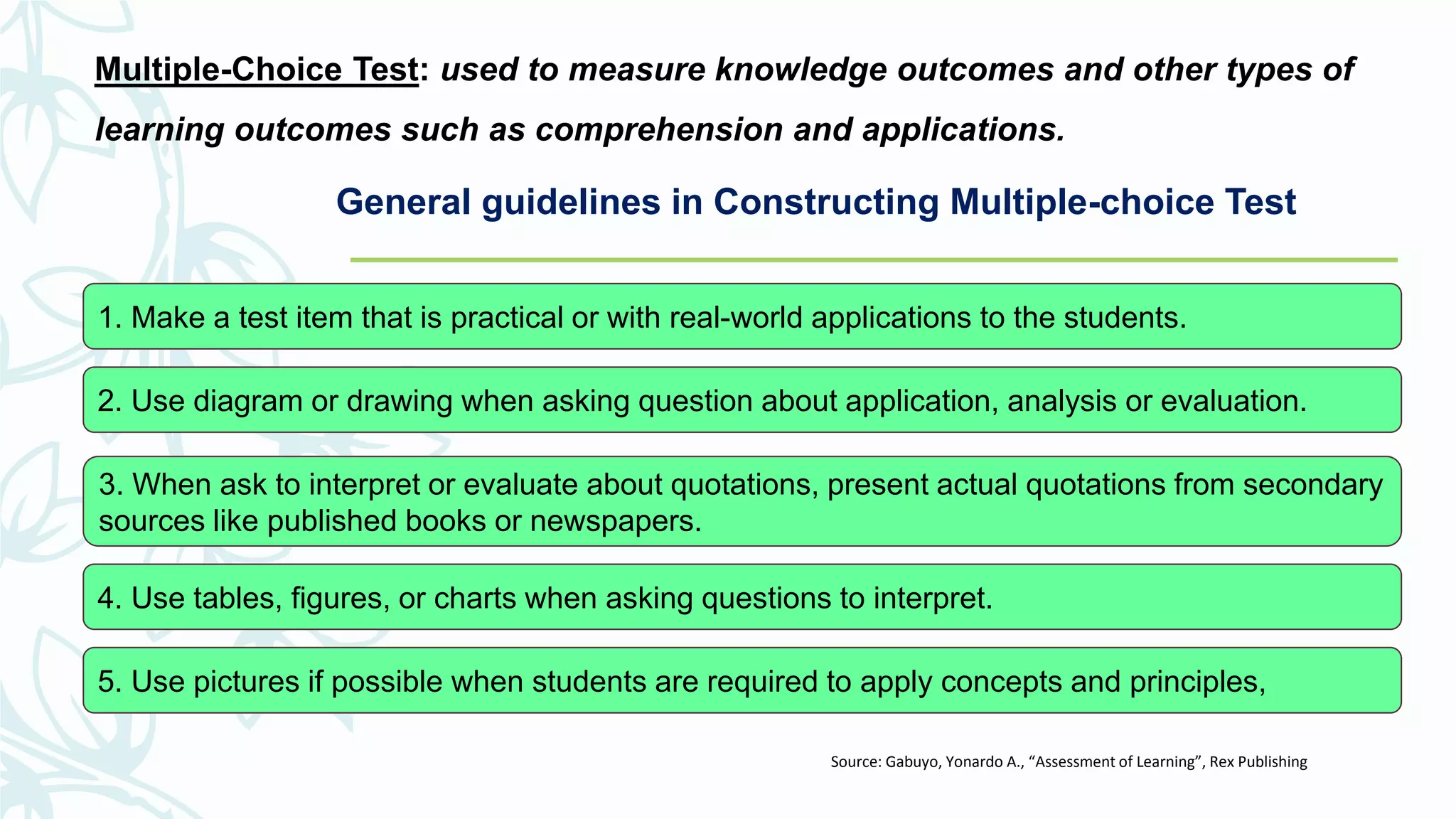
1. Make a test item that is practical or with real-world applications to the students.
2. Use diagram or drawing when asking question about application, analysis or evaluation.
3. When ask to interpret or evaluate about quotations, present actual quotations from secondary
sources like published books or newspapers.
4. Use tables, figures, or charts when asking questions to interpret.
5. Use pictures if possible when students are required to apply concepts and principles,
Source: Gabuyo, Yonardo A., “Assessment of Learning”, Rex Publishing
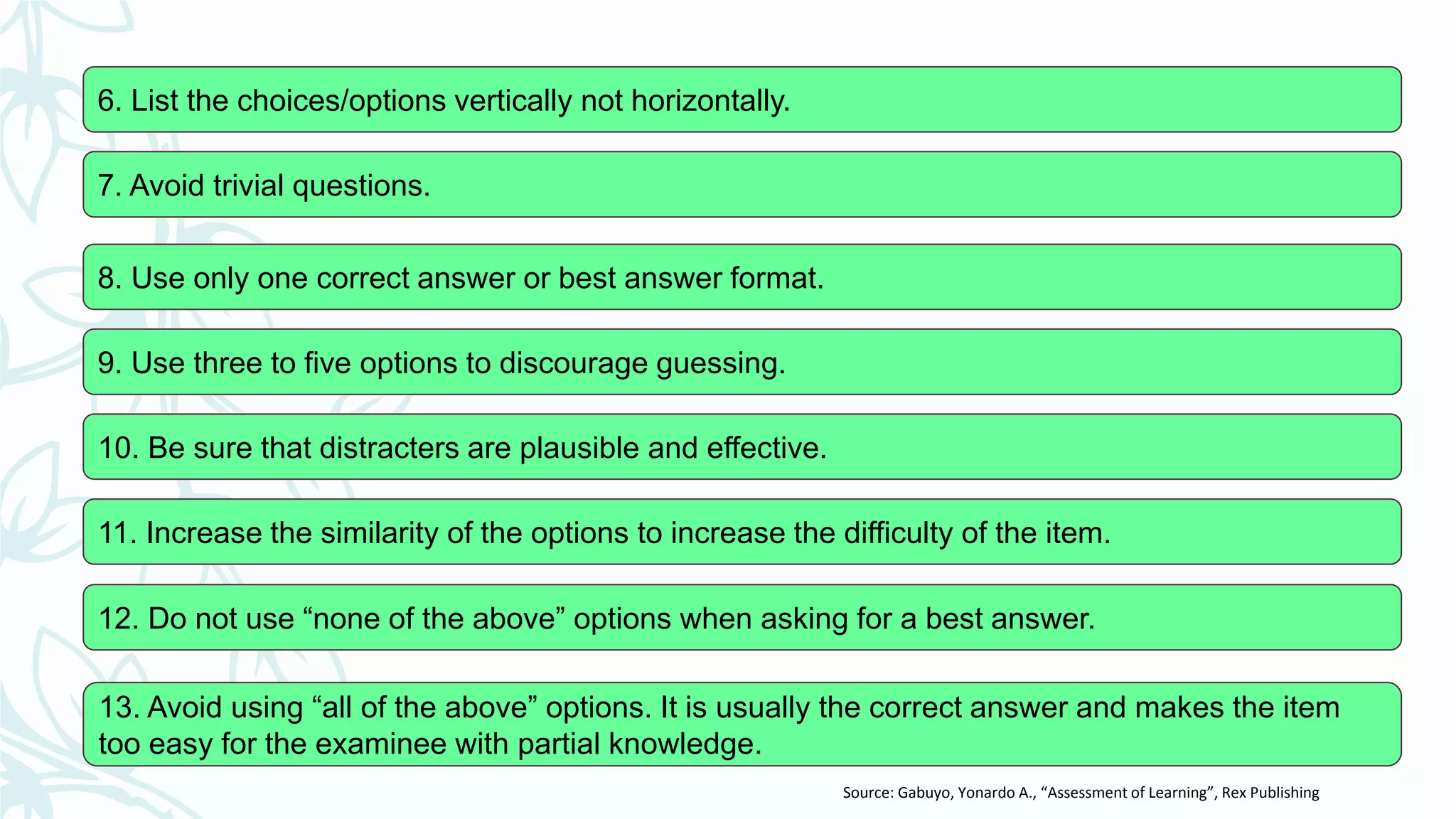
6. List the choices/options vertically not horizontally.
7. Avoid trivial questions.
8. Use only one correct answer or best answer format.
9. Use three to five options to discourage guessing.
10. Be sure that distracters are plausible and effective.
11. Increase the similarity of the options to increase the difficulty of the item.
12. Do not use “none of the above” options when asking for a best answer.
13. Avoid using “all of the above” options. It is usually the correct answer and makes the item
too easy for the examinee with partial knowledge.
Source: Gabuyo, Yonardo A., “Assessment of Learning”, Rex Publishing
Matching Type Test: consists of two columns. Column A contains the descriptions
(left) and Column B contains the options (right).
General guidelines in Constructing Matching Type Test
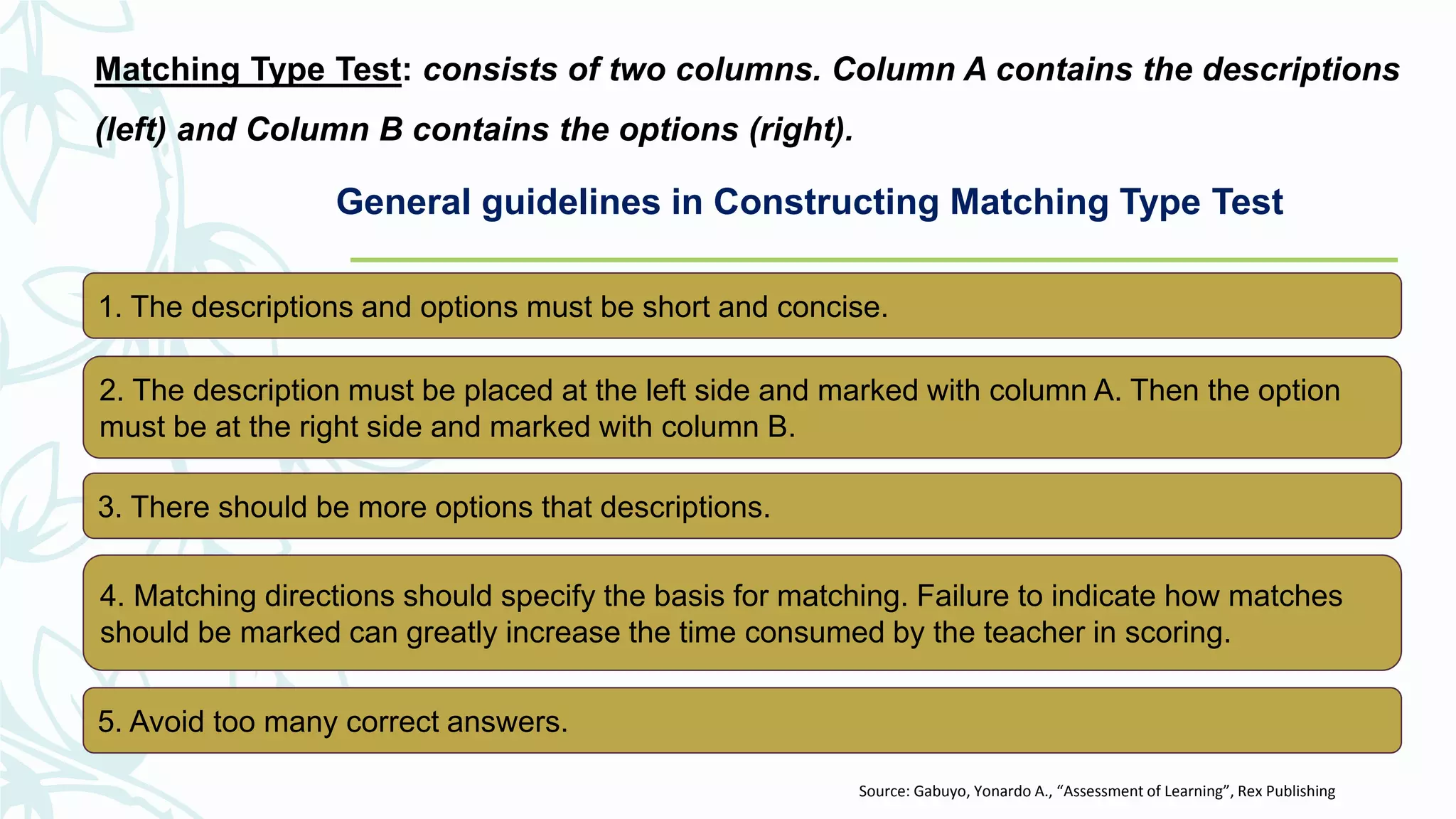
1. The descriptions and options must be short and concise.
2. The description must be placed at the left side and marked with column A. Then the option
must be at the right side and marked with column B.
3. There should be more options that descriptions.
4. Matching directions should specify the basis for matching. Failure to indicate how matches
should be marked can greatly increase the time consumed by the teacher in scoring.
5. Avoid too many correct answers.
Source: Gabuyo, Yonardo A., “Assessment of Learning”, Rex Publishing
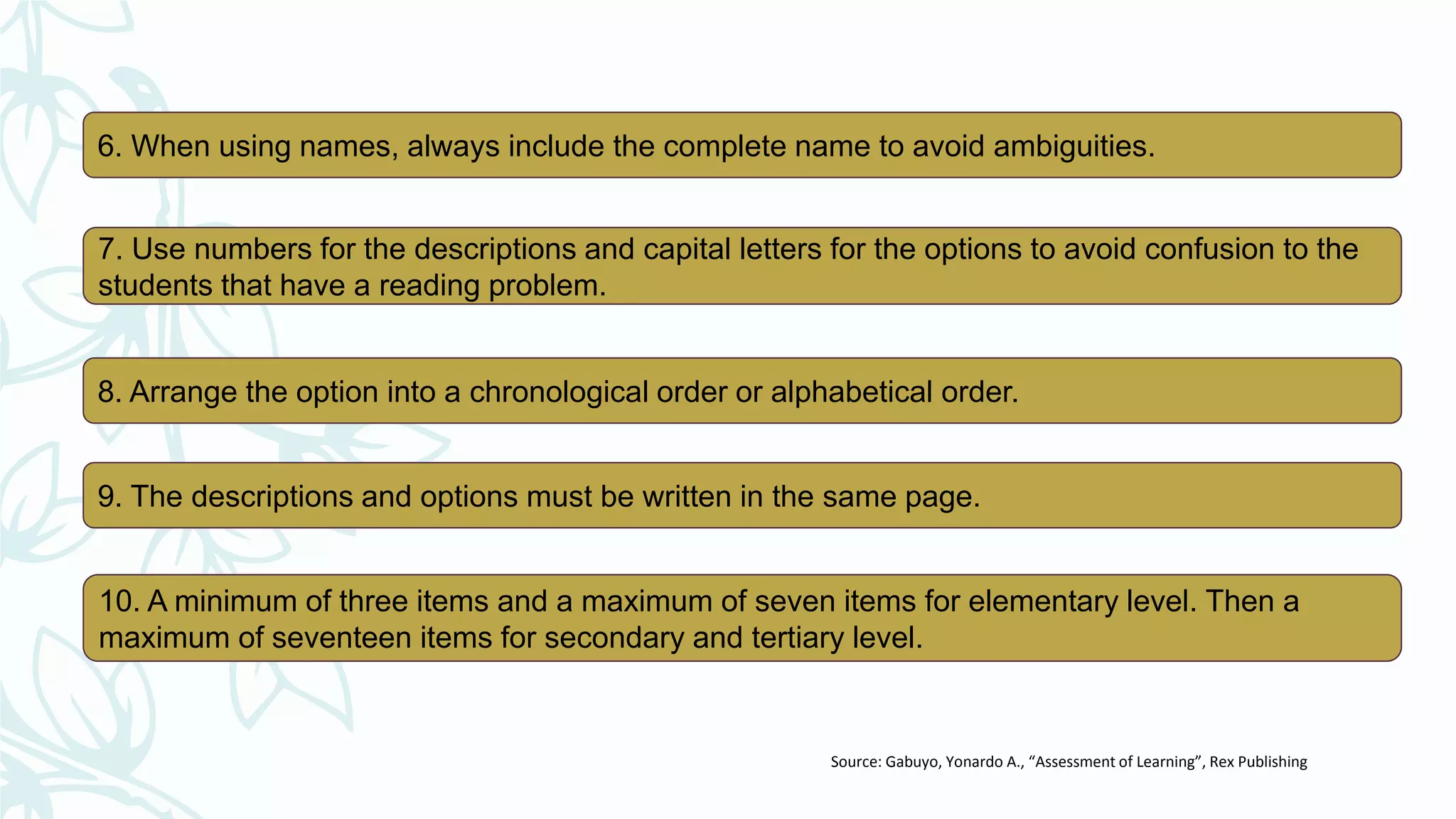
6. When using names, always include the complete name to avoid ambiguities.
7. Use numbers for the descriptions and capital letters for the options to avoid confusion to the
students that have a reading problem.
8. Arrange the option into a chronological order or alphabetical order.
9. The descriptions and options must be written in the same page.
10. A minimum of three items and a maximum of seven items for elementary level. Then a
maximum of seventeen items for secondary and tertiary level.
Source: Gabuyo, Yonardo A., “Assessment of Learning”, Rex Publishing
True or False Type Test: consists of two columns. Column A contains the
descriptions (left) and Column B contains the options (right).
General guidelines in Constructing True or False Type Test
1. Avoid writing a very long statement. Eliminate unnecessary word(s) in the statement.
2. It should contain only one idea in each item except sentences expressing cause-effect
relationship.
3. Avoid using opinion-based statement, if cannot be avoided, the statement should be
attributed to somebody.
4. Avoid using negative or double negatives. Construct the statement positively. If this cannot be
avoided, bold negative words or underlined it to call the attention of the examinees.
Source: Gabuyo, Yonardo A., “Assessment of Learning”, Rex Publishing
5. Avoid specific determiner such as “never”, “always”, “all”, “none”, for they tend to appear in
the statements that are false.
6. Avoid specific determiner such as “some”, sometimes”, and “may” for they tend to appear in
the statements that are true.
7. Avoid grammatical clues that lead to a correct answer such as “the”, “a”, and “an”.
8. Avoid statement that are directly taken from the books.
9. Avoid arranging the statements in a logical order or with specific patterns.
10. Make the directions very clear.
Source: Gabuyo, Yonardo A., “Assessment of Learning”, Rex Publishing
Supply Type Test (Subject Tests): requires the students to create and
supply their won answer to perform a certain task to show mastery of
knowledge or skills. It is also known as “constructed response test”. It
is classified into two as:
a. Short answer or completion type
b. Essay type test
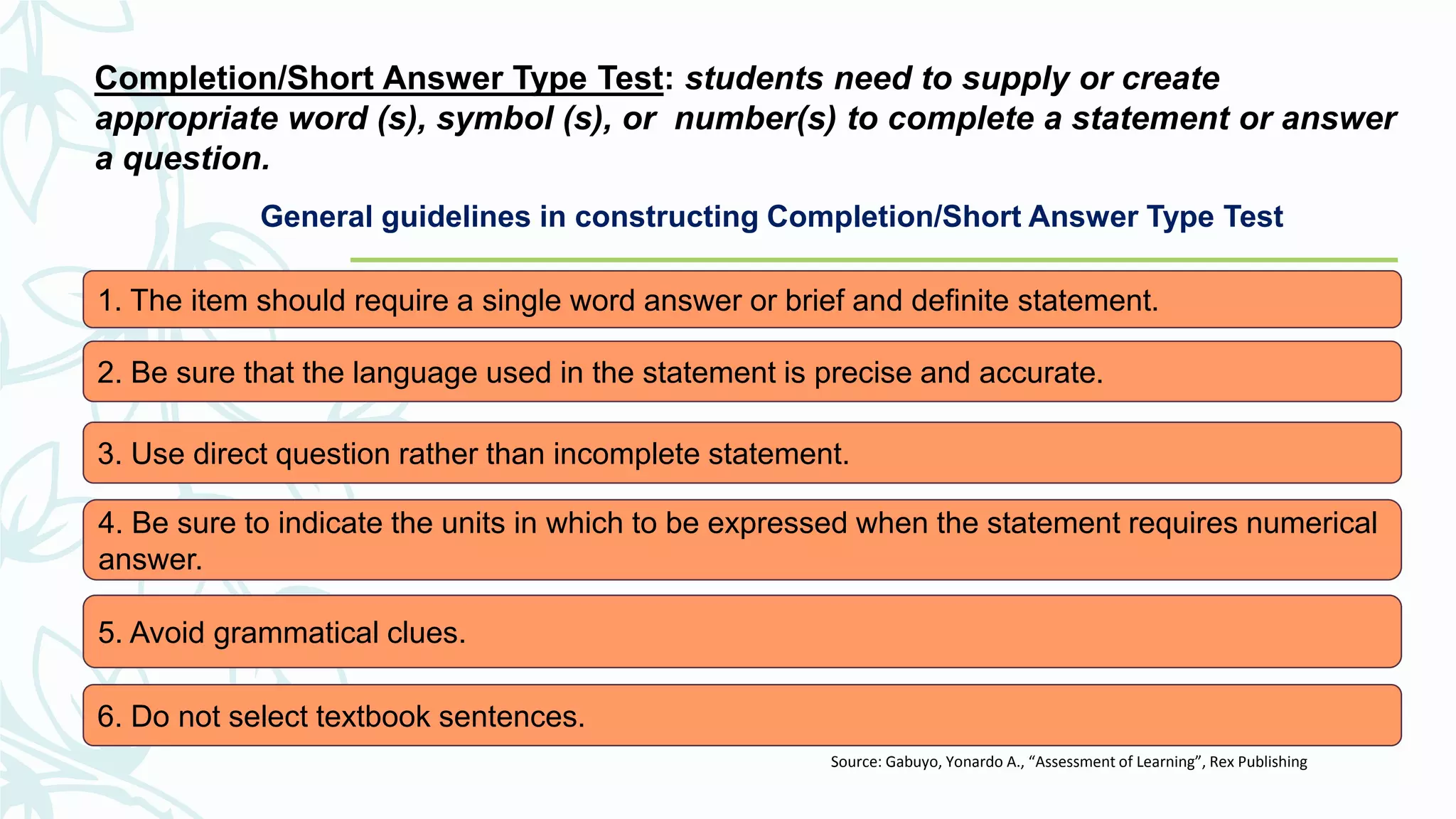
Completion/Short Answer Type Test: students need to supply or create
appropriate word (s), symbol (s), or number(s) to complete a statement or answer
a question.
General guidelines in constructing Completion/Short Answer Type Test
1. The item should require a single word answer or brief and definite statement.
2. Be sure that the language used in the statement is precise and accurate.
3. Use direct question rather than incomplete statement.
4. Be sure to indicate the units in which to be expressed when the statement requires numerical
answer.
5. Avoid grammatical clues.
6. Do not select textbook sentences.
Source: Gabuyo, Yonardo A., “Assessment of Learning”, Rex Publishing
Essay Type Test: is appropriate when assessing students’ ability to organize and
present their original ideas.
General guidelines in constructing Essay Type Test
1. Construct essay question used to measure complex learning outcomes.
2. Formulate essay questions that present a clear tasks to be performed.
3. An item should be stated precisely and it must clearly focus on the desired answer.
4. All students should answer the same questions.
5. Number of points and time spent in answering the question must be indicated in each item.
6. Specify the number of words, paragraph or the number of sentences for the answer.
7. The scoring system must be discussed or presented to the students.
Source: Gabuyo, Yonardo A., “Assessment of Learning”, Rex Publishing
Checklist for Constructing Test Items
YES NO
1. The item is appropriate to measure a learning objective.
2. The item format is the most effective means of measuring the desired
knowledge.
3. The item is clearly worded and can be easily understood by the largest
student population.
4. The items of the same format are grouped together.
5. There are various items types included in the assessment.
6. The students have enough time to answer all the items.
7. The test instructions are specified and clear.
8. The number of questions targeting each objective matches the weight of
importance of that objective.
9. The scoring guidelines are discussed clearly and available to students.
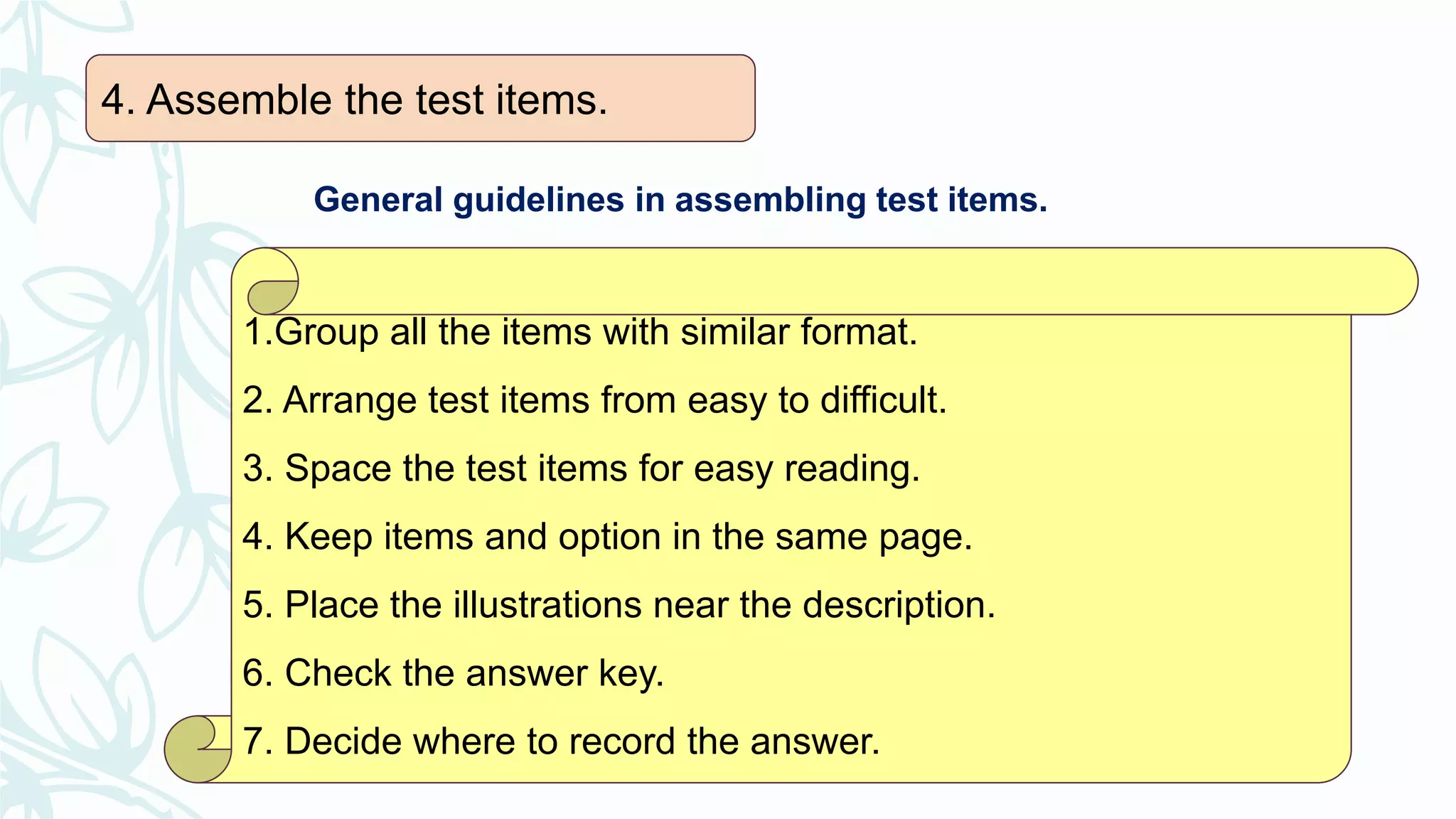
4. Assemble the test items.
General guidelines in assembling test items.
1.Group all the items with similar format.
2. Arrange test items from easy to difficult.
3. Space the test items for easy reading.
4. Keep items and option in the same page.
5. Place the illustrations near the description.
6. Check the answer key.
7. Decide where to record the answer.
5. Check the assembled test items.
 It is very important to proofread the test items for
typographical and grammatical errors and make
necessary corrections, if any.
6. Write directions.
 Check the test directions for each item format to be
sure that it is clear for the students to understand.
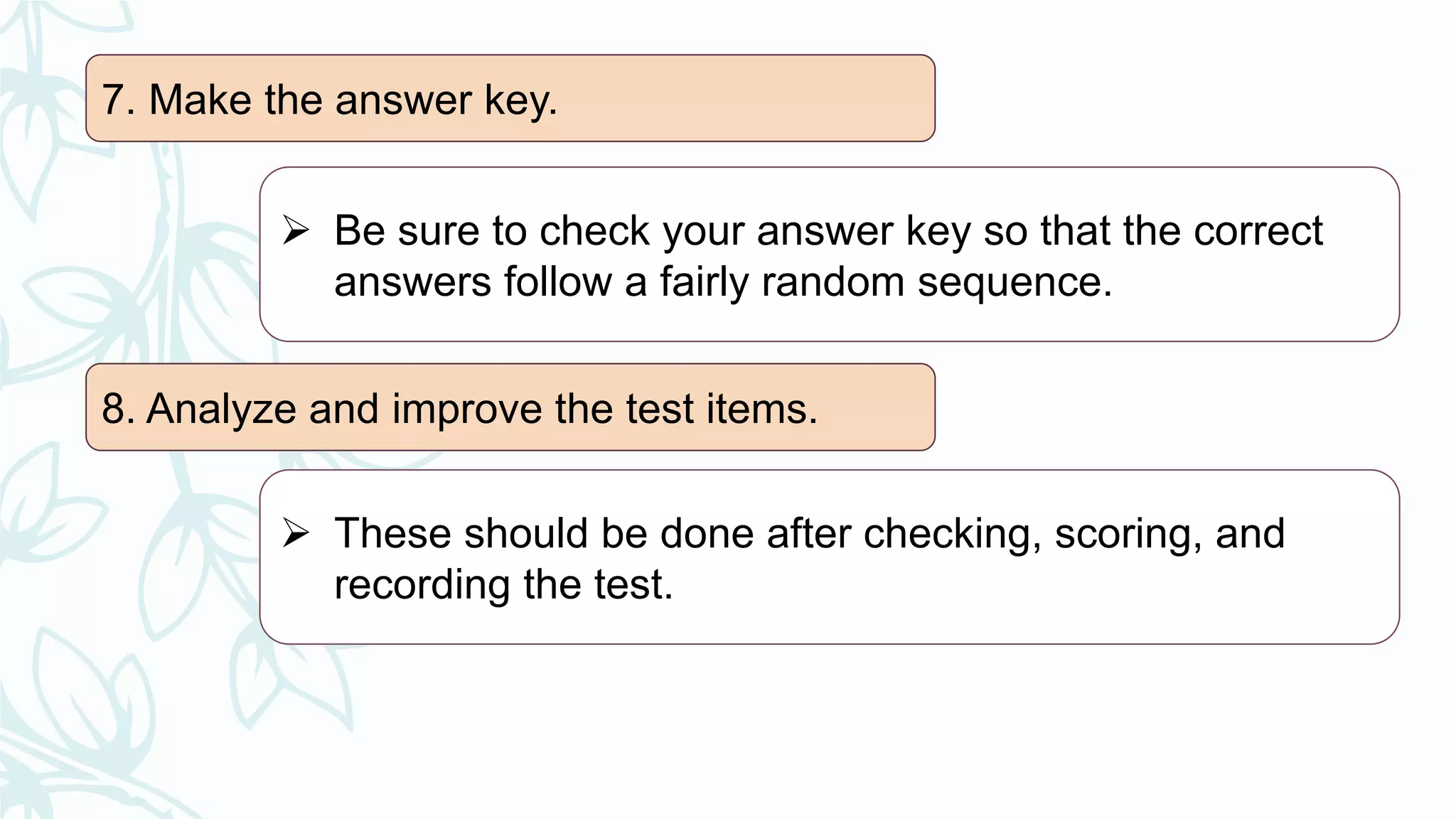
7. Make the answer key.
 Be sure to check your answer key so that the correct
answers follow a fairly random sequence.
8. Analyze and improve the test items.
 These should be done after checking, scoring, and
recording the test.
o IMPROVING A CLASSROOM-
BASED ASSESSMENT TEST
FRIDAY
Blueprint or Draft
TEST WITH A
PURPOSE
Source: Google.com
Source: https://www.usnews.com/education/blogs/high-school-notes/2014/05/12/3-ways-high-school-teachers-
can-improve-assessments
“So you’re being
concise and
purposeful on
you’re
assessment.”
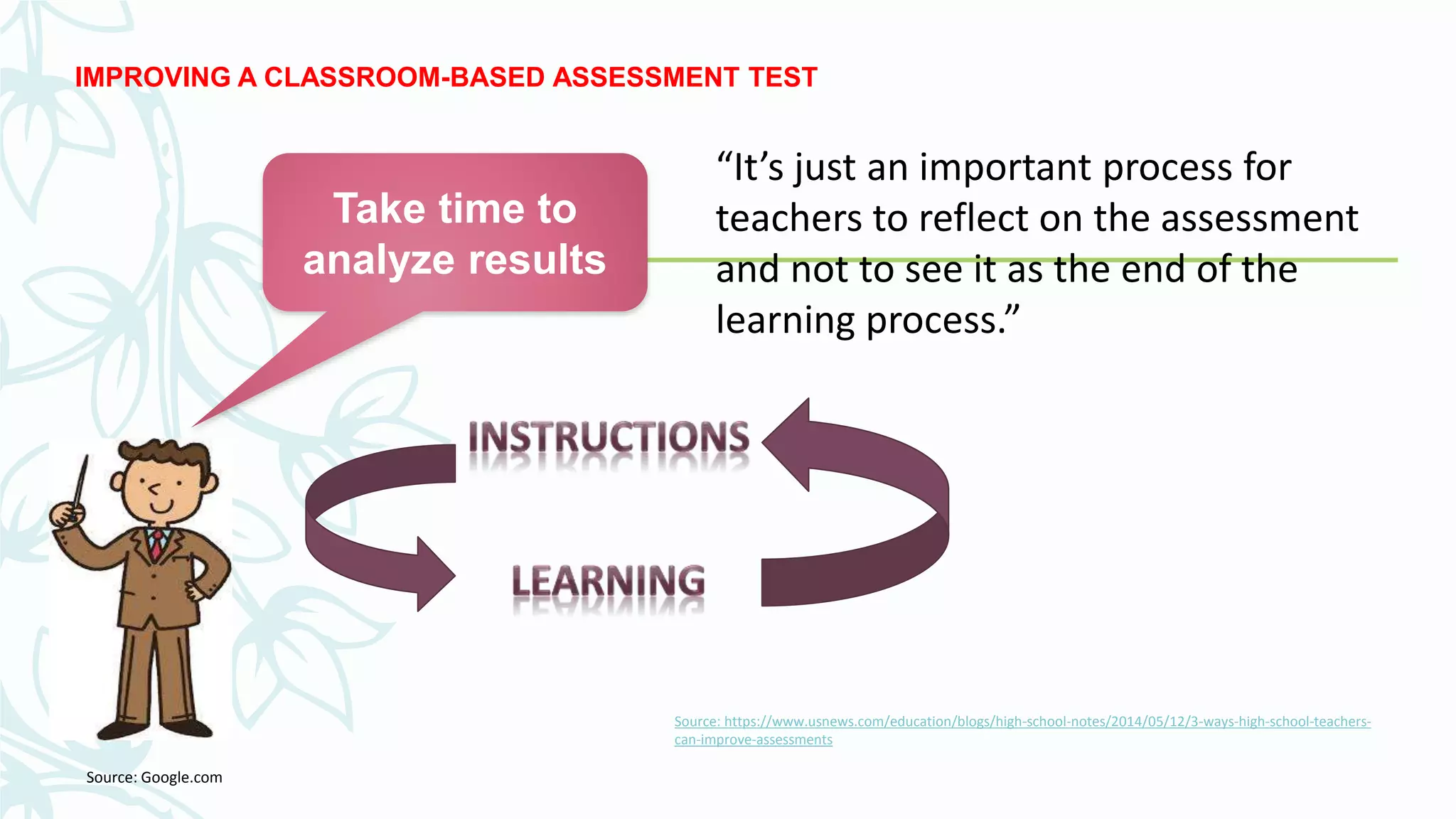
IMPROVING A CLASSROOM-BASED ASSESSMENT TEST
Take time to
analyze results
Source: Google.com
Source: https://www.usnews.com/education/blogs/high-school-notes/2014/05/12/3-ways-high-school-teachers-
can-improve-assessments
“It’s just an important process for
teachers to reflect on the assessment
and not to see it as the end of the
learning process.”
IMPROVING A CLASSROOM-BASED ASSESSMENT TEST
Collaborate with
Colleagues
Source: Google.com
Fellow teachers
can give honest
feedback.
Source: https://www.usnews.com/education/blogs/high-school-notes/2014/05/12/3-ways-high-school-teachers-
can-improve-assessments
"You may have asked a question
and thought it made perfect sense
and then someone else reads it and
they are confused by it."
https://ph.images.search.yahoo.com/
mgmo26

Developing Classroom-based Assessment Tools

  • 1.
    * Planning theTest * Selecting and Constructing Test Items and Tasks * Improving a Classroom-Based Assessment Reporter: MARY GRACE M. ORTIZ MAT - ENGLISH DEVELOPING TOOLS FOR CLASSROOM- BASED ASSESSMENT
  • 2.
    is an integralpart of instruction that enhances, empowers, and celebrates student learning.
  • 3.
     The processof collecting, synthesizing and interpreting information to aid in classroom decision making.(Airasian 2005) Definitions:  Assessment refers to assessment carried out by teachers in the classroom. (Mckay 2006)  Plays a significant role in collecting information about learners' learning and can also be used to support teachers' teaching and learning (Rea-Dickins, 2001). Source:https://www.ukessays.com/essays/english-language/definitions-of-assessment-and-classroom-based-assessment- english-language-essay.php
  • 4.
    – Classroom-Based Assessmentsare the occasions when the teacher assesses the students in the specific assessment(s) that are set out in the subject or short course specification. – The Classroom-Based Assessment can be produced in written, digital, visual or audio formats and it may be supported in these formats through the use of an interview or presentation. Source: https://www.curriculumonline.ie/Junior-cycle/Short-Courses/SPHE/Assessment-and-reporting/Classroom- Based-Assessment. Retrieved May 7
  • 5.
    o PLANNING THETEST – The main goal of classroom testing is to obtain valid, reliable and useful information concerning student achievement. STEPS FOR PLANNING:  Determining the purposes  Developing specifications  Selecting appropriate test items  Preparing relevant test items  Assembling the test  Administering the test  Appraising the assessment and using the result Source: Bashir, Ayesha et.al., “Planning for Classroom Test”. Retrieved from Slideshare @ May 6, 2018
  • 6.
    General Principles ofTesting: According to Ebel and Frisbie (1999) as cited by Garcia (2008)… 1. Measure all instructional objectives 2. Cover all the learning tasks 3. Use appropriate test items 4. Make test valid and reliable 5. Use test to improve learning Source : Gabuyo, Yonardo A., “Assessment of Learning”, Rex Publishing
  • 7.
    o SELECTING ANDCONSTRUCTING TEST ITEMS AND TASKS Things to Consider: Length of test Weight to be given to each objective Weight to be given to each level of taxonomy Estimate number of items in each cell Source :Bashir, Ayesha et.al., “Planning for Classroom Test”. Retrieved from Slideshare @ May 6, 2018Source: Google.com
  • 8.
    … in selectingappropriate type of test items, the tests constructed by teachers maybe classified as 1) Objective Type and 2) Essay Type Objective Type Supply Type • Short Answer • Completion Type Selection Type • True or false • Matching Type • Multiple Choice Strengths  Can have many items  Highly structured  Scoring quick, easy, accurate Limitations  Cannot assess higher level skills (problem formulation, organization, creativity) Source : Bashir, Ayesha et.al., “Planning for Classroom Test”. Retrieved from Slideshare @ May 6, 2018
  • 9.
    Essay Type Strengths Can assess higher level skills Morerealistic Limitations Inefficient for measuring knowledge Few items (poorer sampling) Time consuming Scoring difficult However, there are another assessment tool used like: Performance Assessment Portfolio Assessment Oral Questioning Observation Technique Self-Report Source : Bashir, Ayesha et.al., “Planning for Classroom Test”. Retrieved from Slideshare @ May 6, 2018 Resource: Gabuyo, Yonardo A., “Assessment of Learning”, Rex Publishing
  • 10.
    Steps in DevelopingAssessment Tools 1. Examine the instructional objectives of the topics previously discussed.  It is the first step in developing assessing tools to match the test items to the instructional objectives. 2. Make a Table of Specifications (TOS).  TOS is a chart or table that details the content and level of cognitive level assessed on a test as well as the types and emphases of test items (Gareis and Grant, 2008) Source: Gabuyo, Yonardo A., “Assessment of Learning”, Rex Publishing
  • 11.
    General guidelines fortest items constructions (Kubiszyn and Borich 2007) Begin writing items far enough or in advance so that you will have time to revise them. Match items to intended outcomes at appropriate level of difficulty to provide valid measure of instructional objectives. Limit the question to the skill being assessed. Be sure each item deals with an important aspect of the content area and not with trivia. Be sure the problem posed is clear and unambiguous. Be sure that the item is independent with all other item. A hint to one answer should not be embedded to another item. Source: Gabuyo, Yonardo A., “Assessment of Learning”, Rex Publishing 3. Construct test items.
  • 12.
    Be sure theitem has one or best answer on which experts would agree. Prevent unintended clues to an answer in the statement or questions. Grammatical inconsistencies such as a or an give clues to the correct answers to those students who are not well prepared for the test. Avoid replication of the textbook in writing test items; do not quote directly from the textual materials. Avoid trick or catch questions in an achievement test. Do not waste time testing how ell the students can interpret your intentions. Try to write items that require higher order thinking skills, Source: Gabuyo, Yonardo A., “Assessment of Learning”, Rex Publishing
  • 13.
    General guidelines inConstructing Multiple-choice Test Multiple-Choice Test: used to measure knowledge outcomes and other types of learning outcomes such as comprehension and applications. 1. Make a test item that is practical or with real-world applications to the students. 2. Use diagram or drawing when asking question about application, analysis or evaluation. 3. When ask to interpret or evaluate about quotations, present actual quotations from secondary sources like published books or newspapers. 4. Use tables, figures, or charts when asking questions to interpret. 5. Use pictures if possible when students are required to apply concepts and principles, Source: Gabuyo, Yonardo A., “Assessment of Learning”, Rex Publishing
  • 14.
    6. List thechoices/options vertically not horizontally. 7. Avoid trivial questions. 8. Use only one correct answer or best answer format. 9. Use three to five options to discourage guessing. 10. Be sure that distracters are plausible and effective. 11. Increase the similarity of the options to increase the difficulty of the item. 12. Do not use “none of the above” options when asking for a best answer. 13. Avoid using “all of the above” options. It is usually the correct answer and makes the item too easy for the examinee with partial knowledge. Source: Gabuyo, Yonardo A., “Assessment of Learning”, Rex Publishing
  • 15.
    Matching Type Test:consists of two columns. Column A contains the descriptions (left) and Column B contains the options (right). General guidelines in Constructing Matching Type Test 1. The descriptions and options must be short and concise. 2. The description must be placed at the left side and marked with column A. Then the option must be at the right side and marked with column B. 3. There should be more options that descriptions. 4. Matching directions should specify the basis for matching. Failure to indicate how matches should be marked can greatly increase the time consumed by the teacher in scoring. 5. Avoid too many correct answers. Source: Gabuyo, Yonardo A., “Assessment of Learning”, Rex Publishing
  • 16.
    6. When usingnames, always include the complete name to avoid ambiguities. 7. Use numbers for the descriptions and capital letters for the options to avoid confusion to the students that have a reading problem. 8. Arrange the option into a chronological order or alphabetical order. 9. The descriptions and options must be written in the same page. 10. A minimum of three items and a maximum of seven items for elementary level. Then a maximum of seventeen items for secondary and tertiary level. Source: Gabuyo, Yonardo A., “Assessment of Learning”, Rex Publishing
  • 17.
    True or FalseType Test: consists of two columns. Column A contains the descriptions (left) and Column B contains the options (right). General guidelines in Constructing True or False Type Test 1. Avoid writing a very long statement. Eliminate unnecessary word(s) in the statement. 2. It should contain only one idea in each item except sentences expressing cause-effect relationship. 3. Avoid using opinion-based statement, if cannot be avoided, the statement should be attributed to somebody. 4. Avoid using negative or double negatives. Construct the statement positively. If this cannot be avoided, bold negative words or underlined it to call the attention of the examinees. Source: Gabuyo, Yonardo A., “Assessment of Learning”, Rex Publishing
  • 18.
    5. Avoid specificdeterminer such as “never”, “always”, “all”, “none”, for they tend to appear in the statements that are false. 6. Avoid specific determiner such as “some”, sometimes”, and “may” for they tend to appear in the statements that are true. 7. Avoid grammatical clues that lead to a correct answer such as “the”, “a”, and “an”. 8. Avoid statement that are directly taken from the books. 9. Avoid arranging the statements in a logical order or with specific patterns. 10. Make the directions very clear. Source: Gabuyo, Yonardo A., “Assessment of Learning”, Rex Publishing
  • 19.
    Supply Type Test(Subject Tests): requires the students to create and supply their won answer to perform a certain task to show mastery of knowledge or skills. It is also known as “constructed response test”. It is classified into two as: a. Short answer or completion type b. Essay type test
  • 20.
    Completion/Short Answer TypeTest: students need to supply or create appropriate word (s), symbol (s), or number(s) to complete a statement or answer a question. General guidelines in constructing Completion/Short Answer Type Test 1. The item should require a single word answer or brief and definite statement. 2. Be sure that the language used in the statement is precise and accurate. 3. Use direct question rather than incomplete statement. 4. Be sure to indicate the units in which to be expressed when the statement requires numerical answer. 5. Avoid grammatical clues. 6. Do not select textbook sentences. Source: Gabuyo, Yonardo A., “Assessment of Learning”, Rex Publishing
  • 21.
    Essay Type Test:is appropriate when assessing students’ ability to organize and present their original ideas. General guidelines in constructing Essay Type Test 1. Construct essay question used to measure complex learning outcomes. 2. Formulate essay questions that present a clear tasks to be performed. 3. An item should be stated precisely and it must clearly focus on the desired answer. 4. All students should answer the same questions. 5. Number of points and time spent in answering the question must be indicated in each item. 6. Specify the number of words, paragraph or the number of sentences for the answer. 7. The scoring system must be discussed or presented to the students. Source: Gabuyo, Yonardo A., “Assessment of Learning”, Rex Publishing
  • 22.
    Checklist for ConstructingTest Items YES NO 1. The item is appropriate to measure a learning objective. 2. The item format is the most effective means of measuring the desired knowledge. 3. The item is clearly worded and can be easily understood by the largest student population. 4. The items of the same format are grouped together. 5. There are various items types included in the assessment. 6. The students have enough time to answer all the items. 7. The test instructions are specified and clear. 8. The number of questions targeting each objective matches the weight of importance of that objective. 9. The scoring guidelines are discussed clearly and available to students.
  • 23.
    4. Assemble thetest items. General guidelines in assembling test items. 1.Group all the items with similar format. 2. Arrange test items from easy to difficult. 3. Space the test items for easy reading. 4. Keep items and option in the same page. 5. Place the illustrations near the description. 6. Check the answer key. 7. Decide where to record the answer.
  • 24.
    5. Check theassembled test items.  It is very important to proofread the test items for typographical and grammatical errors and make necessary corrections, if any. 6. Write directions.  Check the test directions for each item format to be sure that it is clear for the students to understand.
  • 25.
    7. Make theanswer key.  Be sure to check your answer key so that the correct answers follow a fairly random sequence. 8. Analyze and improve the test items.  These should be done after checking, scoring, and recording the test.
  • 26.
    o IMPROVING ACLASSROOM- BASED ASSESSMENT TEST FRIDAY Blueprint or Draft TEST WITH A PURPOSE Source: Google.com Source: https://www.usnews.com/education/blogs/high-school-notes/2014/05/12/3-ways-high-school-teachers- can-improve-assessments “So you’re being concise and purposeful on you’re assessment.”
  • 27.
    IMPROVING A CLASSROOM-BASEDASSESSMENT TEST Take time to analyze results Source: Google.com Source: https://www.usnews.com/education/blogs/high-school-notes/2014/05/12/3-ways-high-school-teachers- can-improve-assessments “It’s just an important process for teachers to reflect on the assessment and not to see it as the end of the learning process.”
  • 28.
    IMPROVING A CLASSROOM-BASEDASSESSMENT TEST Collaborate with Colleagues Source: Google.com Fellow teachers can give honest feedback. Source: https://www.usnews.com/education/blogs/high-school-notes/2014/05/12/3-ways-high-school-teachers- can-improve-assessments "You may have asked a question and thought it made perfect sense and then someone else reads it and they are confused by it."
  • 29.
  • 30.