2.1-2.2 Powerpoint
    By Nathan Rosenberg
Elements

•   There currently are 118 elements

•   A element is a substance that cannot be broken down into simpler
    substances

•   A element has a fixed composition because it contains only one type of
    atom
Pure Substances


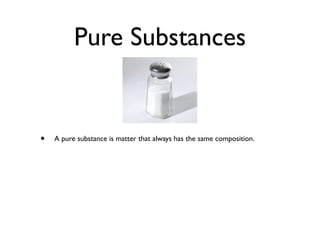
•   A pure substance is matter that always has the same composition.
Compounds

•   A compound is a substance that is made from two or more simpler
    substances

•   The simpler substances are either elements or other compounds

•   Oxygen is a compound

•   Silicon is a compound
Mixtures


•   The properties of a mixture can vary because the composition is not fixed.

•   When ingredients are not evenly distributed.
Physical Properties
•   Viscosity is the resistance to flowing .

•   Conductivity is a materials ability to allow heat to flow through it.

•   Malleability is the ability of a solid to be hammered without shattering

•   Hardness can be compared by scratching two materials and seeing which
    scratches which.

•   Melting and boiling point

•   Density can be used to test purity of a subject
Evaporation
•   A process used to isolate a solid dissolved in a liquid

•   Warning: You are not going to isolate all of the substances
Filtration
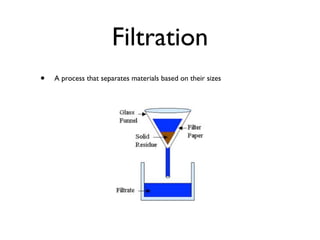
•   A process that separates materials based on their sizes
Distillation
•   A process that separates the substances in solution based on Boiling point
Flammability and
             Reactivity

•   Flammability is a material’s ability to burn is the presence of oxygen.

•   The property that describes how readily a substance combines chemically
    with other substances is reactivity.

•   Flammability and reactivity are both qualitative results.
Recognizing Chemical
      Change

• A change in color
• Production of gas
• Formation of a precipitate
Is a change chemical or
        Physical

•   When matter undergoes a chemical change, the composition of the matter
    changes . When matter undergoes a physical change, the composition of the
    matter remains the same.
1. What is a mixture?
2. What is the down
side to evaporation?
3. How do you
recognize chemical
      change?
4. How do you perform
     a distillation?
5.How do you know if
a change is chemical or
       physical?

Science party

  • 1.
    2.1-2.2 Powerpoint By Nathan Rosenberg
  • 2.
    Elements • There currently are 118 elements • A element is a substance that cannot be broken down into simpler substances • A element has a fixed composition because it contains only one type of atom
  • 3.
    Pure Substances • A pure substance is matter that always has the same composition.
  • 4.
    Compounds • A compound is a substance that is made from two or more simpler substances • The simpler substances are either elements or other compounds • Oxygen is a compound • Silicon is a compound
  • 5.
    Mixtures • The properties of a mixture can vary because the composition is not fixed. • When ingredients are not evenly distributed.
  • 6.
    Physical Properties • Viscosity is the resistance to flowing . • Conductivity is a materials ability to allow heat to flow through it. • Malleability is the ability of a solid to be hammered without shattering • Hardness can be compared by scratching two materials and seeing which scratches which. • Melting and boiling point • Density can be used to test purity of a subject
  • 7.
    Evaporation • A process used to isolate a solid dissolved in a liquid • Warning: You are not going to isolate all of the substances
  • 8.
    Filtration • A process that separates materials based on their sizes
  • 9.
    Distillation • A process that separates the substances in solution based on Boiling point
  • 10.
    Flammability and Reactivity • Flammability is a material’s ability to burn is the presence of oxygen. • The property that describes how readily a substance combines chemically with other substances is reactivity. • Flammability and reactivity are both qualitative results.
  • 11.
    Recognizing Chemical Change • A change in color • Production of gas • Formation of a precipitate
  • 12.
    Is a changechemical or Physical • When matter undergoes a chemical change, the composition of the matter changes . When matter undergoes a physical change, the composition of the matter remains the same.
  • 13.
    1. What isa mixture?
  • 14.
    2. What isthe down side to evaporation?
  • 15.
    3. How doyou recognize chemical change?
  • 16.
    4. How doyou perform a distillation?
  • 17.
    5.How do youknow if a change is chemical or physical?