REPUBLIC ACT NO. 9003 Overview of Ecological Solid Waste Management Act of 2000
Solid Waste discarded household and commercial waste non-hazardous institutional and industrial waste street sweepings construction debris agricultural waste
Classification of Waste as defined by RA 9003 Compostables Recyclables Special Wastes Non-recyclables/residuals
Solid waste is now considered one of the most critical problems of the Philippines
The Ecological Solid Waste Management Act RA 9003 An Act providing for an ecological solid waste management program, creating the necessary institutional mechanisms, declaring certain prohibited acts. Was passed by the Congress and Senate on December 2000 and signed by the President on January 26, 2001.
Salient Features of RA 9003 Creation of the National Solid Waste Management Commission, National Ecological Center and LGU Solid Waste Management Boards  Creation of multi-purpose Environmental Cooperatives or Associations in every LGU Waste segregation, waste reduction and recycling programs
Salient Features of RA 9003 Construction of Material Recovery Facilities/Systems Conversion of open dumpsites to sanitary landfills Integration of Ecological Waste Management concepts in academic curricula for formal and non-formal education Administrative and enforcement procedures
Institutional Structure Ecological Solid Waste Management Act Local Government Units National Solid Waste  Management  Commission Waste Generators/ Citizens
INSTITUTIONAL MECHANISM  (National Level) The National Solid Waste  Management  Commission Created under the Office of the President EMB of the DENR provides secretariat support Secretariat to be headed by an Executive Director to be nominated by the Commission and appointed by the Chairman Composed of 14 members from the government and 3 from the private sector
INSTITUTIONAL MECHANISM  (National Level) Government Sector: DENR (Chairman) PIA DILG   MMDA  DOST  TESDA DPWH   League of Provinces DOH League of Cities DTI League of Municipalities DA  Liga ng mga Barangay Non-Government Sector: 1 representative from the NGO 1 representative from the recycling industry 1 representative from the manufacturing/ packaging industry Private sector representatives shall be appointed by the President for a term of 3 years.
Role of the DENR as the Lead Agency provide technical and other capability building assistance and support to LGUs recommend policies to eliminate barriers to waste reduction programs exercise visitorial and enforcement powers to ensure strict compliance issue rules and regulations
National Ecology Center Facilitate training & education in integrated ecological solid waste management; Establish solid waste management information database; Establish a national recycling network; Provide technical assistance in pilot modeling of solid waste management facilities.
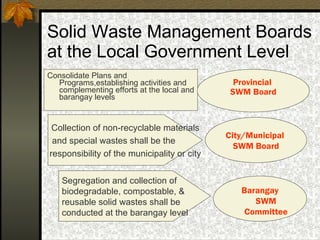
Solid Waste Management Boards at the Local Government Level Consolidate Plans and Programs,establishing activities and complementing efforts at the local and barangay levels Collection of non-recyclable   materials and special wastes shall   be the   responsibility of the   municipality or   city Provincial  SWM Board City/Municipal  SWM Board Barangay SWM Committee Segregation and collection of  biodegradable, compostable, & reusable solid wastes shall be  conducted at the barangay level
Functional Elements/Mechanics of Solid Waste Management Waste Generation On-site Storage Transfer & Transport Collection Processing/ Treatment Disposal
Ecological Solid Waste Management Systematic administration of activities that provide for segregation at source, segregated transport, storage, transfer, processing, treatment and disposal of solid waste and all other waste management activities that do not harm the environment.
Approach to Ecological Solid Waste Management Source reduction & minimization of wastes  Resource recovery,  recycling & reuse at the community/barangay level Collection, proper transfer & transport of wastes  by city/municipality Management/ destruction or  reuse of residuals / final disposal
Requirements for Segregation & Volume Reduction Separate containers for compostables, recyclables, special wastes and residuals Separate collection schedules / separate trucks or haulers / compartmentalized collection vehicles Material Recovery Facilities for recyclables & biodegradables Inventory of markets for composts and recyclables
Recycling Program Environmentally preferable purchase Specifications, product descriptions and standards Eco-labeling Non-environmentally acceptable products Reclamation programs and buy-back centers
Management of Residuals  & Final Disposal Sites Closure of all open dumpsites Conversion of all open dumpsites to controlled dumps within 3 years Minimum requirements in siting, designing and operation of disposal sites Sanitary landfills
Business and Industry Role The Commission shall encourage commercial and industrial establishments, through appropriate incentives other than tax incentives to: initiate, participate and invest in integrated EWM Projects manufacture environment-friendly products introduce, develop and adopt innovative processes  recycle and re-use materials conserve raw materials and energy reduce waste  prevent pollution undertake community activities to promote and propagate  effective SWM practices
Prohibited Acts P 300 – P1,000  Or Imprisonment of 1 – 15 days Open burning of solid waste P 300 – P1,000  Or Community service between 1 – 15 days   Littering, throwing and dumping of waste matters in public places and water bodies Fines/Penalties Violation
Prohibited Acts P 1,000 – P 3,000  Or  Imprisonment of 15 days to 6 months Collection and transport of non-segregated or unsorted waste Squatting in open dumpsite and landfills Open dumping, burying of biodegradable & non-biodegradable materials in flood prone areas Unauthorized removal of recyclable materials for collection by authorized persons Fines/Penalties Violation
Prohibited Acts P500,000.00  Or  Imprisonment of 1 to 3 years Operation of open dumpsites Manufacture, distribution or use of non-environmentally acceptable packaging materials Importation of consumer products packaged in non-environmentally acceptable materials Fines/Penalties Violation
Prohibited Acts P 10,000 – P 200,000 Or  Imprisonment of 30 days to 3 years Importation of toxic wastes misrepresented as “recyclable” or “with recyclable content” Transport and dumping in bulk of collected domestic, industrial, commercial and institutional wastes in areas other than centers or facilities prescribed by law Fines/Penalties Violation
Prohibited Acts P100,000 – P 1M Or Imprisonment of 1 to 6 years Construction, expansion or operation of waste management facilities without an Environmental Compliance Certificate Construction of any establishment within 200 meters from open or controlled dump sites and sanitary landfills Construction or operation of landfills or any waste disposal facility within or near an aquifer, groundwater reservoir or watershed Fines/Penalties Violation
Conceptual Framework of RA 9003 Residuals Management Compostables Recyclables Non-recyclables Special Wastes Junkyards/Factories Gardens/ Farms MRF Municipality/ City level Collection by municipality/city level Barangay Level
THANK YOU! Department of Environment & Natural Resources Environmental Management Bureau – NCR 5 th  Flr. Hizon Bldg.,  27-29 Quezon Ave., Quezon City Telefax: 781-0471 Website: www.emb.gov.ph

03 ra9003-pco

  • 1.
    REPUBLIC ACT NO.9003 Overview of Ecological Solid Waste Management Act of 2000
  • 2.
    Solid Waste discardedhousehold and commercial waste non-hazardous institutional and industrial waste street sweepings construction debris agricultural waste
  • 3.
    Classification of Wasteas defined by RA 9003 Compostables Recyclables Special Wastes Non-recyclables/residuals
  • 4.
    Solid waste isnow considered one of the most critical problems of the Philippines
  • 5.
    The Ecological SolidWaste Management Act RA 9003 An Act providing for an ecological solid waste management program, creating the necessary institutional mechanisms, declaring certain prohibited acts. Was passed by the Congress and Senate on December 2000 and signed by the President on January 26, 2001.
  • 6.
    Salient Features ofRA 9003 Creation of the National Solid Waste Management Commission, National Ecological Center and LGU Solid Waste Management Boards Creation of multi-purpose Environmental Cooperatives or Associations in every LGU Waste segregation, waste reduction and recycling programs
  • 7.
    Salient Features ofRA 9003 Construction of Material Recovery Facilities/Systems Conversion of open dumpsites to sanitary landfills Integration of Ecological Waste Management concepts in academic curricula for formal and non-formal education Administrative and enforcement procedures
  • 8.
    Institutional Structure EcologicalSolid Waste Management Act Local Government Units National Solid Waste Management Commission Waste Generators/ Citizens
  • 9.
    INSTITUTIONAL MECHANISM (National Level) The National Solid Waste Management Commission Created under the Office of the President EMB of the DENR provides secretariat support Secretariat to be headed by an Executive Director to be nominated by the Commission and appointed by the Chairman Composed of 14 members from the government and 3 from the private sector
  • 10.
    INSTITUTIONAL MECHANISM (National Level) Government Sector: DENR (Chairman) PIA DILG MMDA DOST TESDA DPWH League of Provinces DOH League of Cities DTI League of Municipalities DA Liga ng mga Barangay Non-Government Sector: 1 representative from the NGO 1 representative from the recycling industry 1 representative from the manufacturing/ packaging industry Private sector representatives shall be appointed by the President for a term of 3 years.
  • 11.
    Role of theDENR as the Lead Agency provide technical and other capability building assistance and support to LGUs recommend policies to eliminate barriers to waste reduction programs exercise visitorial and enforcement powers to ensure strict compliance issue rules and regulations
  • 12.
    National Ecology CenterFacilitate training & education in integrated ecological solid waste management; Establish solid waste management information database; Establish a national recycling network; Provide technical assistance in pilot modeling of solid waste management facilities.
  • 13.
    Solid Waste ManagementBoards at the Local Government Level Consolidate Plans and Programs,establishing activities and complementing efforts at the local and barangay levels Collection of non-recyclable materials and special wastes shall be the responsibility of the municipality or city Provincial SWM Board City/Municipal SWM Board Barangay SWM Committee Segregation and collection of biodegradable, compostable, & reusable solid wastes shall be conducted at the barangay level
  • 14.
    Functional Elements/Mechanics ofSolid Waste Management Waste Generation On-site Storage Transfer & Transport Collection Processing/ Treatment Disposal
  • 15.
    Ecological Solid WasteManagement Systematic administration of activities that provide for segregation at source, segregated transport, storage, transfer, processing, treatment and disposal of solid waste and all other waste management activities that do not harm the environment.
  • 16.
    Approach to EcologicalSolid Waste Management Source reduction & minimization of wastes Resource recovery, recycling & reuse at the community/barangay level Collection, proper transfer & transport of wastes by city/municipality Management/ destruction or reuse of residuals / final disposal
  • 17.
    Requirements for Segregation& Volume Reduction Separate containers for compostables, recyclables, special wastes and residuals Separate collection schedules / separate trucks or haulers / compartmentalized collection vehicles Material Recovery Facilities for recyclables & biodegradables Inventory of markets for composts and recyclables
  • 18.
    Recycling Program Environmentallypreferable purchase Specifications, product descriptions and standards Eco-labeling Non-environmentally acceptable products Reclamation programs and buy-back centers
  • 19.
    Management of Residuals & Final Disposal Sites Closure of all open dumpsites Conversion of all open dumpsites to controlled dumps within 3 years Minimum requirements in siting, designing and operation of disposal sites Sanitary landfills
  • 20.
    Business and IndustryRole The Commission shall encourage commercial and industrial establishments, through appropriate incentives other than tax incentives to: initiate, participate and invest in integrated EWM Projects manufacture environment-friendly products introduce, develop and adopt innovative processes recycle and re-use materials conserve raw materials and energy reduce waste prevent pollution undertake community activities to promote and propagate effective SWM practices
  • 21.
    Prohibited Acts P300 – P1,000 Or Imprisonment of 1 – 15 days Open burning of solid waste P 300 – P1,000 Or Community service between 1 – 15 days Littering, throwing and dumping of waste matters in public places and water bodies Fines/Penalties Violation
  • 22.
    Prohibited Acts P1,000 – P 3,000 Or Imprisonment of 15 days to 6 months Collection and transport of non-segregated or unsorted waste Squatting in open dumpsite and landfills Open dumping, burying of biodegradable & non-biodegradable materials in flood prone areas Unauthorized removal of recyclable materials for collection by authorized persons Fines/Penalties Violation
  • 23.
    Prohibited Acts P500,000.00 Or Imprisonment of 1 to 3 years Operation of open dumpsites Manufacture, distribution or use of non-environmentally acceptable packaging materials Importation of consumer products packaged in non-environmentally acceptable materials Fines/Penalties Violation
  • 24.
    Prohibited Acts P10,000 – P 200,000 Or Imprisonment of 30 days to 3 years Importation of toxic wastes misrepresented as “recyclable” or “with recyclable content” Transport and dumping in bulk of collected domestic, industrial, commercial and institutional wastes in areas other than centers or facilities prescribed by law Fines/Penalties Violation
  • 25.
    Prohibited Acts P100,000– P 1M Or Imprisonment of 1 to 6 years Construction, expansion or operation of waste management facilities without an Environmental Compliance Certificate Construction of any establishment within 200 meters from open or controlled dump sites and sanitary landfills Construction or operation of landfills or any waste disposal facility within or near an aquifer, groundwater reservoir or watershed Fines/Penalties Violation
  • 26.
    Conceptual Framework ofRA 9003 Residuals Management Compostables Recyclables Non-recyclables Special Wastes Junkyards/Factories Gardens/ Farms MRF Municipality/ City level Collection by municipality/city level Barangay Level
  • 27.
    THANK YOU! Departmentof Environment & Natural Resources Environmental Management Bureau – NCR 5 th Flr. Hizon Bldg., 27-29 Quezon Ave., Quezon City Telefax: 781-0471 Website: www.emb.gov.ph