Group 7INVERSE MATRIXMEMBER’S NAME :   Victoria RosNoorAfidah Bt. MohdYatimTeh Ying Zhe                                       Ng Kah Soon
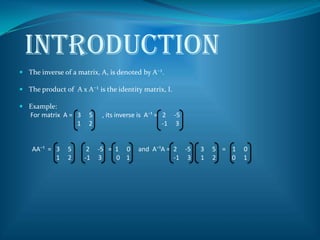
IntroductionThe inverse of a matrix, A, is denoted by A⁻¹.The product of  A x A⁻¹ is the identity matrix, I.  Example:       For matrix  A =   3     5      , its inverse is  A⁻¹ =   2     -5                                    1     2                                           -1     3 AA⁻¹  =   3     5         2     -5   =  1     0     and  A⁻¹A =  2     -5      3     5    =    1     0  1     2 -1     3         0    1                           -1     3      1     2          0     1
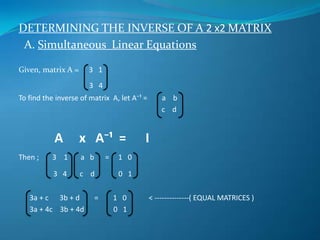
DETERMINING THE INVERSE OF A 2 x2 MATRIX  A. Simultaneous  Linear EquationsGiven, matrix A =     3   13   4To find the inverse of matrix  A, let A⁻¹ =        a    b                                                                              c    dA     x   A⁻¹  =      IThen ; 3    1       a   b      =     1   03   4       c    d             0   1      3a + c      3b + d        =        1   0            < --------------( EQUAL MATRICES )      3a + 4c    3b + 4d                0   1
3a + c = 1 ------------ ①                                  3b + d = 0 ---------- ③                     3a + 4c = 0 ----------- ②                                 3b + 4d = 1 --------  ④①  -  ② : -3c = 1                                           ③ - ④ : -3d = -1                           c =-1/3                                                                d = 1/3Substitute c = -1/3in equation ①.               Substitute d = 1/3 in equation ③.           3a + (-1/3) = 1                                                          3b + (1/3) = 0                  ->       a = 4/9                                                            ->     b = -1/9    Therefore, A⁻¹ =     4/9    -1/9                                -1/3     1/3To check the answer : AA⁻¹ =      3  1          4/9   -1/9                  3  4        -1/3    1/3            =     1  0       = I (Identity matrix)                    0  1
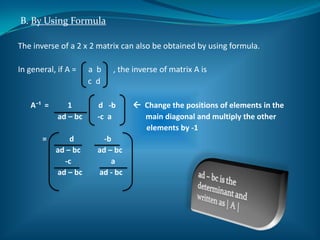
 B. By Using FormulaThe inverse of a 2 x 2 matrix can also be obtained by using formula.In general, if A =      a  b      , the inverse of matrix A is                                   c  dA⁻¹  =          1              d   -b           Change the positions of elements in the                     ad – bc        -c  a                  main diagonal and multiply the other                                                                    elements by -1             =            d                -b                    ad – bc         ad – bc                         -c                     a                     ad – bc         ad - bcad – bc is the determinant and written as | A |
Example 1 :1. Find the inverse of the following matrices, by using the formula.(a)  G =       4  3           (b)   H =     5  2                      2  2                            10  4SOLUTION (a) Determinant, |G| = ad-bc                     (b)  Determinant, |H| = ad- bc                                        = (4 x 2) – (3 x2 )                                            = (5 x 4) – ( 2 x 10)                                         = 2                                                                    = 0 Therefore, G⁻¹  =   ½     2  -3                                  Therefore, H⁻¹ does not exist.                                         -2  4                                   =     1   -3/2                                         -1     2
Example 2 :Determine whether matrix A is the inverse of matrix B.(a)      A =    3  4     ,  B =    7  -4                    5  7                  -5  3SOLUTION AB =     3  4      7  -4                             5  7     -5  3                    =   21+(-20)     -12+12                         35+(-35)      -20+21                    =       1  0                             0  1          ->     AB = I and  BA = 1
EXERCISE1. The inverse matrix of   3  2     is m   5  n     .                                             6  5              -6  3Find the values of  m and n.SOLUTIONThe inverse matrix of    3  2     =                1                5  -2                                          6  5              3 x 5 – 2 x 6     -6  3                                                     =  1/3   5  -2         compare with       m   5  n                                                                 -6  3                                               -6  3 Therefore, m = 1/3, n = -2
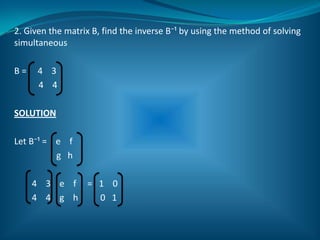
2. Given the matrix B, find the inverse B⁻¹ by using the method of solving simultaneousB =     4    3           4    4SOLUTIONLet B⁻¹ =    e    f                   g   h        4    3    e    f     =   1    0        4    4    g    h          0   1
4e + 3g     4f + 3h   =    1    0    4e +4g      4f + 4h          0    14e + 3g = 1 ----------①                    4f + 3h = 0 ----------③  4e + 4g = 0 ----------②                    4f + 4h = 1 ----------④② - ① :             g = -1                    ④ - ③ :             h = 1So,     4e + 3(-1) = 1                           So,     4f + 3(1) = 0                         e = 1                                                   f = - 3\4Therefore, B⁻¹ =    1     -3\4                               -1        1
3.  A  =    2   5            B =    8  5                 3   8                     3   2SOLUTIONBA  =      7  -4       3  4               -5  3         5  7       =      21+ (-20)    28+(-28)                -15 +15    -20+21        =     1  0               0  1
 4.  Find the inverse A⁻¹,of  A  =  2  -3                                                              4   -7SOLUTION       2  -3      =  -14 + 12       4  -7       = -2              ad-bcA⁻¹    =    1      -7   3            |A|     -4   2         =     1      -7   3               -2      -4    2         =    3.5   -1.5                 2        -1
THANK YOU                                    * * YOU MAY CLAP YOUR HANDS NOW**

Inverse matrix pptx

  • 1.
    Group 7INVERSE MATRIXMEMBER’SNAME : Victoria RosNoorAfidah Bt. MohdYatimTeh Ying Zhe Ng Kah Soon
  • 2.
    IntroductionThe inverse ofa matrix, A, is denoted by A⁻¹.The product of A x A⁻¹ is the identity matrix, I. Example: For matrix A = 3 5 , its inverse is A⁻¹ = 2 -5 1 2 -1 3 AA⁻¹ = 3 5 2 -5 = 1 0 and A⁻¹A = 2 -5 3 5 = 1 0 1 2 -1 3 0 1 -1 3 1 2 0 1
  • 3.
    DETERMINING THE INVERSEOF A 2 x2 MATRIX A. Simultaneous Linear EquationsGiven, matrix A = 3 13 4To find the inverse of matrix A, let A⁻¹ = a b c dA x A⁻¹ = IThen ; 3 1 a b = 1 03 4 c d 0 1 3a + c 3b + d = 1 0 < --------------( EQUAL MATRICES ) 3a + 4c 3b + 4d 0 1
  • 4.
    3a + c= 1 ------------ ① 3b + d = 0 ---------- ③ 3a + 4c = 0 ----------- ② 3b + 4d = 1 -------- ④① - ② : -3c = 1 ③ - ④ : -3d = -1 c =-1/3 d = 1/3Substitute c = -1/3in equation ①. Substitute d = 1/3 in equation ③. 3a + (-1/3) = 1 3b + (1/3) = 0 -> a = 4/9 -> b = -1/9 Therefore, A⁻¹ = 4/9 -1/9 -1/3 1/3To check the answer : AA⁻¹ = 3 1 4/9 -1/9 3 4 -1/3 1/3 = 1 0 = I (Identity matrix) 0 1
  • 5.
    B. ByUsing FormulaThe inverse of a 2 x 2 matrix can also be obtained by using formula.In general, if A = a b , the inverse of matrix A is c dA⁻¹ = 1 d -b  Change the positions of elements in the ad – bc -c a main diagonal and multiply the other elements by -1 = d -b ad – bc ad – bc -c a ad – bc ad - bcad – bc is the determinant and written as | A |
  • 6.
    Example 1 :1.Find the inverse of the following matrices, by using the formula.(a) G = 4 3 (b) H = 5 2 2 2 10 4SOLUTION (a) Determinant, |G| = ad-bc (b) Determinant, |H| = ad- bc = (4 x 2) – (3 x2 ) = (5 x 4) – ( 2 x 10) = 2 = 0 Therefore, G⁻¹ = ½ 2 -3 Therefore, H⁻¹ does not exist. -2 4 = 1 -3/2 -1 2
  • 7.
    Example 2 :Determinewhether matrix A is the inverse of matrix B.(a) A = 3 4 , B = 7 -4 5 7 -5 3SOLUTION AB = 3 4 7 -4 5 7 -5 3 = 21+(-20) -12+12 35+(-35) -20+21 = 1 0 0 1 -> AB = I and BA = 1
  • 8.
    EXERCISE1. The inversematrix of 3 2 is m 5 n . 6 5 -6 3Find the values of m and n.SOLUTIONThe inverse matrix of 3 2 = 1 5 -2 6 5 3 x 5 – 2 x 6 -6 3 = 1/3 5 -2 compare with m 5 n -6 3 -6 3 Therefore, m = 1/3, n = -2
  • 9.
    2. Given thematrix B, find the inverse B⁻¹ by using the method of solving simultaneousB = 4 3 4 4SOLUTIONLet B⁻¹ = e f g h 4 3 e f = 1 0 4 4 g h 0 1
  • 10.
    4e + 3g 4f + 3h = 1 0 4e +4g 4f + 4h 0 14e + 3g = 1 ----------① 4f + 3h = 0 ----------③ 4e + 4g = 0 ----------② 4f + 4h = 1 ----------④② - ① : g = -1 ④ - ③ : h = 1So, 4e + 3(-1) = 1 So, 4f + 3(1) = 0 e = 1 f = - 3\4Therefore, B⁻¹ = 1 -3\4 -1 1
  • 11.
    3. A = 2 5 B = 8 5 3 8 3 2SOLUTIONBA = 7 -4 3 4 -5 3 5 7 = 21+ (-20) 28+(-28) -15 +15 -20+21 = 1 0 0 1
  • 12.
    4. Find the inverse A⁻¹,of A = 2 -3 4 -7SOLUTION 2 -3 = -14 + 12 4 -7 = -2  ad-bcA⁻¹ = 1 -7 3 |A| -4 2 = 1 -7 3 -2 -4 2 = 3.5 -1.5 2 -1
  • 13.
    THANK YOU      * * YOU MAY CLAP YOUR HANDS NOW**