http://www.tutorialspoint.com/matlab/matlab_differential.htm Copyright © tutorialspoint.com
MATLAB - DIFFERENTIAL
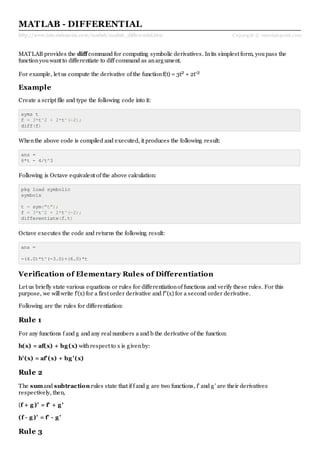
MATLAB provides the diff command for computing symbolic derivatives. Inits simplest form, youpass the
functionyouwant to differentiate to diff command as anargument.
For example, let us compute the derivative of the functionf(t) = 3t2 + 2t-2
Example
Create a script file and type the following code into it:
syms t
f = 3*t^2 + 2*t^(-2);
diff(f)
Whenthe above code is compiled and executed, it produces the following result:
ans =
6*t - 4/t^3
Following is Octave equivalent of the above calculation:
pkg load symbolic
symbols
t = sym("t");
f = 3*t^2 + 2*t^(-2);
differentiate(f,t)
Octave executes the code and returns the following result:
ans =
-(4.0)*t^(-3.0)+(6.0)*t
Verification of Elementary Rules of Differentiation
Let us briefly state various equations or rules for differentiationof functions and verify these rules. For this
purpose, we willwrite f'(x) for a first order derivative and f"(x) for a second order derivative.
Following are the rules for differentiation:
Rule 1
For any functions f and g and any realnumbers a and b the derivative of the function:
h(x) = af(x) + bg(x) withrespect to x is givenby:
h'(x) = af'(x) + bg'(x)
Rule 2
The sumand subtraction rules state that if f and g are two functions, f' and g' are their derivatives
respectively, then,
(f + g)' = f' + g'
(f - g)' = f' - g'
Rule 3
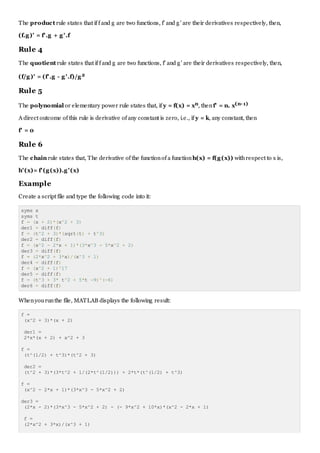
The product rule states that if f and g are two functions, f' and g' are their derivatives respectively, then,
(f.g)' = f'.g + g'.f
Rule 4
The quotient rule states that if f and g are two functions, f' and g' are their derivatives respectively, then,
(f/g)' = (f'.g - g'.f)/g2
Rule 5
The polynomial or elementary power rule states that, if y = f(x) = xn, thenf' = n. x(n-1)
A direct outcome of this rule is derivative of any constant is zero, i.e., if y = k, any constant, then
f' = 0
Rule 6
The chain rule states that, The derivative of the functionof a functionh(x) = f(g(x)) withrespect to x is,
h'(x)= f'(g(x)).g'(x)
Example
Create a script file and type the following code into it:
syms x
syms t
f = (x + 2)*(x^2 + 3)
der1 = diff(f)
f = (t^2 + 3)*(sqrt(t) + t^3)
der2 = diff(f)
f = (x^2 - 2*x + 1)*(3*x^3 - 5*x^2 + 2)
der3 = diff(f)
f = (2*x^2 + 3*x)/(x^3 + 1)
der4 = diff(f)
f = (x^2 + 1)^17
der5 = diff(f)
f = (t^3 + 3* t^2 + 5*t -9)^(-6)
der6 = diff(f)
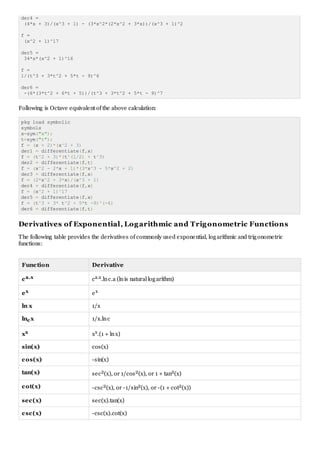
Whenyourunthe file, MATLAB displays the following result:
f =
(x^2 + 3)*(x + 2)
der1 =
2*x*(x + 2) + x^2 + 3
f =
(t^(1/2) + t^3)*(t^2 + 3)
der2 =
(t^2 + 3)*(3*t^2 + 1/(2*t^(1/2))) + 2*t*(t^(1/2) + t^3)
f =
(x^2 - 2*x + 1)*(3*x^3 - 5*x^2 + 2)
der3 =
(2*x - 2)*(3*x^3 - 5*x^2 + 2) - (- 9*x^2 + 10*x)*(x^2 - 2*x + 1)
f =
(2*x^2 + 3*x)/(x^3 + 1)
der4 =
(4*x + 3)/(x^3 + 1) - (3*x^2*(2*x^2 + 3*x))/(x^3 + 1)^2
f =
(x^2 + 1)^17
der5 =
34*x*(x^2 + 1)^16
f =
1/(t^3 + 3*t^2 + 5*t - 9)^6
der6 =
-(6*(3*t^2 + 6*t + 5))/(t^3 + 3*t^2 + 5*t - 9)^7
Following is Octave equivalent of the above calculation:
pkg load symbolic
symbols
x=sym("x");
t=sym("t");
f = (x + 2)*(x^2 + 3)
der1 = differentiate(f,x)
f = (t^2 + 3)*(t^(1/2) + t^3)
der2 = differentiate(f,t)
f = (x^2 - 2*x + 1)*(3*x^3 - 5*x^2 + 2)
der3 = differentiate(f,x)
f = (2*x^2 + 3*x)/(x^3 + 1)
der4 = differentiate(f,x)
f = (x^2 + 1)^17
der5 = differentiate(f,x)
f = (t^3 + 3* t^2 + 5*t -9)^(-6)
der6 = differentiate(f,t)
Derivatives of Exponential, Logarithmic and Trigonometric Functions
The following table provides the derivatives of commonly used exponential, logarithmic and trigonometric
functions:
Function Derivative
ca.x ca.x.lnc.a (lnis naturallogarithm)
ex ex
ln x 1/x
lncx 1/x.lnc
xx xx.(1 + lnx)
sin(x) cos(x)
cos(x) -sin(x)
tan(x) sec2(x), or 1/cos2(x), or 1 + tan2(x)
cot(x) -csc2(x), or -1/sin2(x), or -(1 + cot2(x))
sec(x) sec(x).tan(x)
csc(x) -csc(x).cot(x)
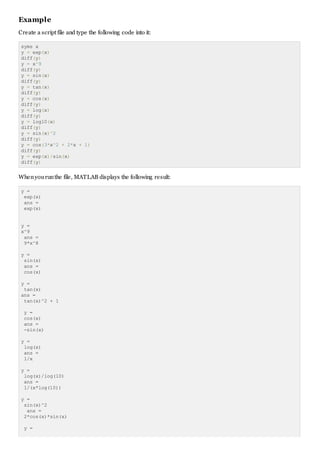
Example
Create a script file and type the following code into it:
syms x
y = exp(x)
diff(y)
y = x^9
diff(y)
y = sin(x)
diff(y)
y = tan(x)
diff(y)
y = cos(x)
diff(y)
y = log(x)
diff(y)
y = log10(x)
diff(y)
y = sin(x)^2
diff(y)
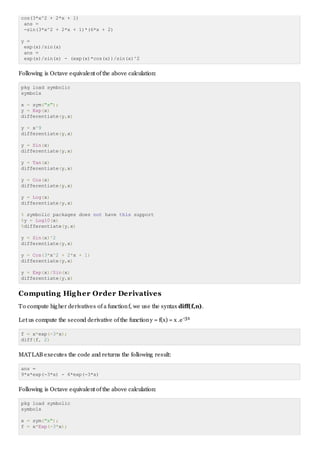
y = cos(3*x^2 + 2*x + 1)
diff(y)
y = exp(x)/sin(x)
diff(y)
Whenyourunthe file, MATLAB displays the following result:
y =
exp(x)
ans =
exp(x)
y =
x^9
ans =
9*x^8
y =
sin(x)
ans =
cos(x)
y =
tan(x)
ans =
tan(x)^2 + 1
y =
cos(x)
ans =
-sin(x)
y =
log(x)
ans =
1/x
y =
log(x)/log(10)
ans =
1/(x*log(10))
y =
sin(x)^2
ans =
2*cos(x)*sin(x)
y =
cos(3*x^2 + 2*x + 1)
ans =
-sin(3*x^2 + 2*x + 1)*(6*x + 2)
y =
exp(x)/sin(x)
ans =
exp(x)/sin(x) - (exp(x)*cos(x))/sin(x)^2
Following is Octave equivalent of the above calculation:
pkg load symbolic
symbols
x = sym("x");
y = Exp(x)
differentiate(y,x)
y = x^9
differentiate(y,x)
y = Sin(x)
differentiate(y,x)
y = Tan(x)
differentiate(y,x)
y = Cos(x)
differentiate(y,x)
y = Log(x)
differentiate(y,x)
% symbolic packages does not have this support
%y = Log10(x)
%differentiate(y,x)
y = Sin(x)^2
differentiate(y,x)
y = Cos(3*x^2 + 2*x + 1)
differentiate(y,x)
y = Exp(x)/Sin(x)
differentiate(y,x)
Computing Higher Order Derivatives
To compute higher derivatives of a functionf, we use the syntax diff(f,n).
Let us compute the second derivative of the functiony = f(x) = x .e-3x
f = x*exp(-3*x);
diff(f, 2)
MATLAB executes the code and returns the following result:
ans =
9*x*exp(-3*x) - 6*exp(-3*x)
Following is Octave equivalent of the above calculation:
pkg load symbolic
symbols
x = sym("x");
f = x*Exp(-3*x);
differentiate(f, x, 2)
Example
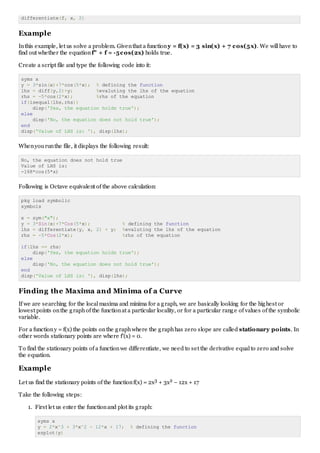
Inthis example, let us solve a problem. Giventhat a functiony = f(x) = 3 sin(x) + 7 cos(5x). We willhave to
find out whether the equationf" + f = -5cos(2x) holds true.
Create a script file and type the following code into it:
syms x
y = 3*sin(x)+7*cos(5*x); % defining the function
lhs = diff(y,2)+y; %evaluting the lhs of the equation
rhs = -5*cos(2*x); %rhs of the equation
if(isequal(lhs,rhs))
disp('Yes, the equation holds true');
else
disp('No, the equation does not hold true');
end
disp('Value of LHS is: '), disp(lhs);
Whenyourunthe file, it displays the following result:
No, the equation does not hold true
Value of LHS is:
-168*cos(5*x)
Following is Octave equivalent of the above calculation:
pkg load symbolic
symbols
x = sym("x");
y = 3*Sin(x)+7*Cos(5*x); % defining the function
lhs = differentiate(y, x, 2) + y; %evaluting the lhs of the equation
rhs = -5*Cos(2*x); %rhs of the equation
if(lhs == rhs)
disp('Yes, the equation holds true');
else
disp('No, the equation does not hold true');
end
disp('Value of LHS is: '), disp(lhs);
Finding the Maxima and Minima of a Curve
If we are searching for the localmaxima and minima for a graph, we are basically looking for the highest or
lowest points onthe graphof the functionat a particular locality, or for a particular range of values of the symbolic
variable.
For a functiony = f(x) the points onthe graphwhere the graphhas zero slope are called stationary points. In
other words stationary points are where f'(x) = 0.
To find the stationary points of a functionwe differentiate, we need to set the derivative equalto zero and solve
the equation.
Example
Let us find the stationary points of the functionf(x) = 2x3 + 3x2 − 12x + 17
Take the following steps:
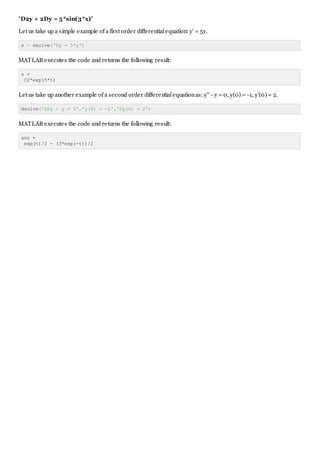
1. First let us enter the functionand plot its graph:
syms x
y = 2*x^3 + 3*x^2 - 12*x + 17; % defining the function
ezplot(y)
MATLAB executes the code and returns the following plot:
Here is Octave equivalent code for the above example:
pkg load symbolic
symbols
x = sym('x');
y = inline("2*x^3 + 3*x^2 - 12*x + 17");
ezplot(y)
print -deps graph.eps
2. Our aimis to find some localmaxima and minima onthe graph, so let us find the localmaxima and minima for
the interval[-2, 2] onthe graph.
syms x
y = 2*x^3 + 3*x^2 - 12*x + 17; % defining the function
ezplot(y, [-2, 2])
MATLAB executes the code and returns the following plot:
Here is Octave equivalent code for the above example:
pkg load symbolic
symbols
x = sym('x');
y = inline("2*x^3 + 3*x^2 - 12*x + 17");
ezplot(y, [-2, 2])
print -deps graph.eps
3. Next, let us compute the derivative
g = diff(y)
MATLAB executes the code and returns the following result:
g =
6*x^2 + 6*x - 12
Here is Octave equivalent of the above calculation:
pkg load symbolic
symbols
x = sym("x");
y = 2*x^3 + 3*x^2 - 12*x + 17;
g = differentiate(y,x)
4. Let us solve the derivative function, g, to get the values where it becomes zero.
s = solve(g)
MATLAB executes the code and returns the following result:
s =
1
-2
Following is Octave equivalent of the above calculation:
pkg load symbolic
symbols
x = sym("x");
y = 2*x^3 + 3*x^2 - 12*x + 17;
g = differentiate(y,x)
roots([6, 6, -12])
5. This agrees withour plot. So let us evaluate the functionf at the criticalpoints x = 1, -2. We cansubstitute a
value ina symbolic functionby using the subs command.
subs(y, 1), subs(y, -2)
MATLAB executes the code and returns the following result:
ans =
10
ans =
37
Following is Octave equivalent of the above calculation:
pkg load symbolic
symbols
x = sym("x");
y = 2*x^3 + 3*x^2 - 12*x + 17;
g = differentiate(y,x)
roots([6, 6, -12])
subs(y, x, 1), subs(y, x, -2)
Therefore, The minimumand maximumvalues onthe functionf(x) = 2x3 + 3x2 − 12x + 17, inthe interval[-
2,2] are 10 and 37.
Solving Differential Equations
MATLAB provides the dsolve command for solving differentialequations symbolically.
The most basic formof the dsolve command for finding the solutionto a single equationis :
dsolve('eqn')
where eqn is a text string used to enter the equation.
It returns a symbolic solutionwitha set of arbitrary constants that MATLAB labels C1, C2, and so on.
Youcanalso specify initialand boundary conditions for the problem, as comma-delimited list following the
equationas:
dsolve('eqn','cond1', 'cond2',…)
For the purpose of using dsolve command, derivatives are indicated with a D. For example, anequation
like f'(t) = -2*f + cost(t) is entered as:
'Df = -2*f + cos(t)'
Higher derivatives are indicated by following D by the order of the derivative.
For example the equationf"(x) + 2f'(x) = 5sin3x should be entered as:
'D2y + 2Dy = 5*sin(3*x)'
Let us take up a simple example of a first order differentialequation: y' = 5y.
s = dsolve('Dy = 5*y')
MATLAB executes the code and returns the following result:
s =
C2*exp(5*t)
Let us take up another example of a second order differentialequationas: y" - y = 0, y(0) = -1, y'(0) = 2.
dsolve('D2y - y = 0','y(0) = -1','Dy(0) = 2')
MATLAB executes the code and returns the following result:
ans =
exp(t)/2 - (3*exp(-t))/2

Matlab differential

  • 1.
    http://www.tutorialspoint.com/matlab/matlab_differential.htm Copyright ©tutorialspoint.com MATLAB - DIFFERENTIAL MATLAB provides the diff command for computing symbolic derivatives. Inits simplest form, youpass the functionyouwant to differentiate to diff command as anargument. For example, let us compute the derivative of the functionf(t) = 3t2 + 2t-2 Example Create a script file and type the following code into it: syms t f = 3*t^2 + 2*t^(-2); diff(f) Whenthe above code is compiled and executed, it produces the following result: ans = 6*t - 4/t^3 Following is Octave equivalent of the above calculation: pkg load symbolic symbols t = sym("t"); f = 3*t^2 + 2*t^(-2); differentiate(f,t) Octave executes the code and returns the following result: ans = -(4.0)*t^(-3.0)+(6.0)*t Verification of Elementary Rules of Differentiation Let us briefly state various equations or rules for differentiationof functions and verify these rules. For this purpose, we willwrite f'(x) for a first order derivative and f"(x) for a second order derivative. Following are the rules for differentiation: Rule 1 For any functions f and g and any realnumbers a and b the derivative of the function: h(x) = af(x) + bg(x) withrespect to x is givenby: h'(x) = af'(x) + bg'(x) Rule 2 The sumand subtraction rules state that if f and g are two functions, f' and g' are their derivatives respectively, then, (f + g)' = f' + g' (f - g)' = f' - g' Rule 3
  • 2.
    The product rulestates that if f and g are two functions, f' and g' are their derivatives respectively, then, (f.g)' = f'.g + g'.f Rule 4 The quotient rule states that if f and g are two functions, f' and g' are their derivatives respectively, then, (f/g)' = (f'.g - g'.f)/g2 Rule 5 The polynomial or elementary power rule states that, if y = f(x) = xn, thenf' = n. x(n-1) A direct outcome of this rule is derivative of any constant is zero, i.e., if y = k, any constant, then f' = 0 Rule 6 The chain rule states that, The derivative of the functionof a functionh(x) = f(g(x)) withrespect to x is, h'(x)= f'(g(x)).g'(x) Example Create a script file and type the following code into it: syms x syms t f = (x + 2)*(x^2 + 3) der1 = diff(f) f = (t^2 + 3)*(sqrt(t) + t^3) der2 = diff(f) f = (x^2 - 2*x + 1)*(3*x^3 - 5*x^2 + 2) der3 = diff(f) f = (2*x^2 + 3*x)/(x^3 + 1) der4 = diff(f) f = (x^2 + 1)^17 der5 = diff(f) f = (t^3 + 3* t^2 + 5*t -9)^(-6) der6 = diff(f) Whenyourunthe file, MATLAB displays the following result: f = (x^2 + 3)*(x + 2) der1 = 2*x*(x + 2) + x^2 + 3 f = (t^(1/2) + t^3)*(t^2 + 3) der2 = (t^2 + 3)*(3*t^2 + 1/(2*t^(1/2))) + 2*t*(t^(1/2) + t^3) f = (x^2 - 2*x + 1)*(3*x^3 - 5*x^2 + 2) der3 = (2*x - 2)*(3*x^3 - 5*x^2 + 2) - (- 9*x^2 + 10*x)*(x^2 - 2*x + 1) f = (2*x^2 + 3*x)/(x^3 + 1)
  • 3.
    der4 = (4*x +3)/(x^3 + 1) - (3*x^2*(2*x^2 + 3*x))/(x^3 + 1)^2 f = (x^2 + 1)^17 der5 = 34*x*(x^2 + 1)^16 f = 1/(t^3 + 3*t^2 + 5*t - 9)^6 der6 = -(6*(3*t^2 + 6*t + 5))/(t^3 + 3*t^2 + 5*t - 9)^7 Following is Octave equivalent of the above calculation: pkg load symbolic symbols x=sym("x"); t=sym("t"); f = (x + 2)*(x^2 + 3) der1 = differentiate(f,x) f = (t^2 + 3)*(t^(1/2) + t^3) der2 = differentiate(f,t) f = (x^2 - 2*x + 1)*(3*x^3 - 5*x^2 + 2) der3 = differentiate(f,x) f = (2*x^2 + 3*x)/(x^3 + 1) der4 = differentiate(f,x) f = (x^2 + 1)^17 der5 = differentiate(f,x) f = (t^3 + 3* t^2 + 5*t -9)^(-6) der6 = differentiate(f,t) Derivatives of Exponential, Logarithmic and Trigonometric Functions The following table provides the derivatives of commonly used exponential, logarithmic and trigonometric functions: Function Derivative ca.x ca.x.lnc.a (lnis naturallogarithm) ex ex ln x 1/x lncx 1/x.lnc xx xx.(1 + lnx) sin(x) cos(x) cos(x) -sin(x) tan(x) sec2(x), or 1/cos2(x), or 1 + tan2(x) cot(x) -csc2(x), or -1/sin2(x), or -(1 + cot2(x)) sec(x) sec(x).tan(x) csc(x) -csc(x).cot(x)
  • 4.
    Example Create a scriptfile and type the following code into it: syms x y = exp(x) diff(y) y = x^9 diff(y) y = sin(x) diff(y) y = tan(x) diff(y) y = cos(x) diff(y) y = log(x) diff(y) y = log10(x) diff(y) y = sin(x)^2 diff(y) y = cos(3*x^2 + 2*x + 1) diff(y) y = exp(x)/sin(x) diff(y) Whenyourunthe file, MATLAB displays the following result: y = exp(x) ans = exp(x) y = x^9 ans = 9*x^8 y = sin(x) ans = cos(x) y = tan(x) ans = tan(x)^2 + 1 y = cos(x) ans = -sin(x) y = log(x) ans = 1/x y = log(x)/log(10) ans = 1/(x*log(10)) y = sin(x)^2 ans = 2*cos(x)*sin(x) y =
  • 5.
    cos(3*x^2 + 2*x+ 1) ans = -sin(3*x^2 + 2*x + 1)*(6*x + 2) y = exp(x)/sin(x) ans = exp(x)/sin(x) - (exp(x)*cos(x))/sin(x)^2 Following is Octave equivalent of the above calculation: pkg load symbolic symbols x = sym("x"); y = Exp(x) differentiate(y,x) y = x^9 differentiate(y,x) y = Sin(x) differentiate(y,x) y = Tan(x) differentiate(y,x) y = Cos(x) differentiate(y,x) y = Log(x) differentiate(y,x) % symbolic packages does not have this support %y = Log10(x) %differentiate(y,x) y = Sin(x)^2 differentiate(y,x) y = Cos(3*x^2 + 2*x + 1) differentiate(y,x) y = Exp(x)/Sin(x) differentiate(y,x) Computing Higher Order Derivatives To compute higher derivatives of a functionf, we use the syntax diff(f,n). Let us compute the second derivative of the functiony = f(x) = x .e-3x f = x*exp(-3*x); diff(f, 2) MATLAB executes the code and returns the following result: ans = 9*x*exp(-3*x) - 6*exp(-3*x) Following is Octave equivalent of the above calculation: pkg load symbolic symbols x = sym("x"); f = x*Exp(-3*x);
  • 6.
    differentiate(f, x, 2) Example Inthisexample, let us solve a problem. Giventhat a functiony = f(x) = 3 sin(x) + 7 cos(5x). We willhave to find out whether the equationf" + f = -5cos(2x) holds true. Create a script file and type the following code into it: syms x y = 3*sin(x)+7*cos(5*x); % defining the function lhs = diff(y,2)+y; %evaluting the lhs of the equation rhs = -5*cos(2*x); %rhs of the equation if(isequal(lhs,rhs)) disp('Yes, the equation holds true'); else disp('No, the equation does not hold true'); end disp('Value of LHS is: '), disp(lhs); Whenyourunthe file, it displays the following result: No, the equation does not hold true Value of LHS is: -168*cos(5*x) Following is Octave equivalent of the above calculation: pkg load symbolic symbols x = sym("x"); y = 3*Sin(x)+7*Cos(5*x); % defining the function lhs = differentiate(y, x, 2) + y; %evaluting the lhs of the equation rhs = -5*Cos(2*x); %rhs of the equation if(lhs == rhs) disp('Yes, the equation holds true'); else disp('No, the equation does not hold true'); end disp('Value of LHS is: '), disp(lhs); Finding the Maxima and Minima of a Curve If we are searching for the localmaxima and minima for a graph, we are basically looking for the highest or lowest points onthe graphof the functionat a particular locality, or for a particular range of values of the symbolic variable. For a functiony = f(x) the points onthe graphwhere the graphhas zero slope are called stationary points. In other words stationary points are where f'(x) = 0. To find the stationary points of a functionwe differentiate, we need to set the derivative equalto zero and solve the equation. Example Let us find the stationary points of the functionf(x) = 2x3 + 3x2 − 12x + 17 Take the following steps: 1. First let us enter the functionand plot its graph: syms x y = 2*x^3 + 3*x^2 - 12*x + 17; % defining the function ezplot(y)
  • 7.
    MATLAB executes thecode and returns the following plot: Here is Octave equivalent code for the above example: pkg load symbolic symbols x = sym('x'); y = inline("2*x^3 + 3*x^2 - 12*x + 17"); ezplot(y) print -deps graph.eps 2. Our aimis to find some localmaxima and minima onthe graph, so let us find the localmaxima and minima for the interval[-2, 2] onthe graph. syms x y = 2*x^3 + 3*x^2 - 12*x + 17; % defining the function ezplot(y, [-2, 2]) MATLAB executes the code and returns the following plot:
  • 8.
    Here is Octaveequivalent code for the above example: pkg load symbolic symbols x = sym('x'); y = inline("2*x^3 + 3*x^2 - 12*x + 17"); ezplot(y, [-2, 2]) print -deps graph.eps 3. Next, let us compute the derivative g = diff(y) MATLAB executes the code and returns the following result: g = 6*x^2 + 6*x - 12 Here is Octave equivalent of the above calculation: pkg load symbolic symbols x = sym("x"); y = 2*x^3 + 3*x^2 - 12*x + 17; g = differentiate(y,x) 4. Let us solve the derivative function, g, to get the values where it becomes zero. s = solve(g) MATLAB executes the code and returns the following result: s = 1 -2 Following is Octave equivalent of the above calculation:
  • 9.
    pkg load symbolic symbols x= sym("x"); y = 2*x^3 + 3*x^2 - 12*x + 17; g = differentiate(y,x) roots([6, 6, -12]) 5. This agrees withour plot. So let us evaluate the functionf at the criticalpoints x = 1, -2. We cansubstitute a value ina symbolic functionby using the subs command. subs(y, 1), subs(y, -2) MATLAB executes the code and returns the following result: ans = 10 ans = 37 Following is Octave equivalent of the above calculation: pkg load symbolic symbols x = sym("x"); y = 2*x^3 + 3*x^2 - 12*x + 17; g = differentiate(y,x) roots([6, 6, -12]) subs(y, x, 1), subs(y, x, -2) Therefore, The minimumand maximumvalues onthe functionf(x) = 2x3 + 3x2 − 12x + 17, inthe interval[- 2,2] are 10 and 37. Solving Differential Equations MATLAB provides the dsolve command for solving differentialequations symbolically. The most basic formof the dsolve command for finding the solutionto a single equationis : dsolve('eqn') where eqn is a text string used to enter the equation. It returns a symbolic solutionwitha set of arbitrary constants that MATLAB labels C1, C2, and so on. Youcanalso specify initialand boundary conditions for the problem, as comma-delimited list following the equationas: dsolve('eqn','cond1', 'cond2',…) For the purpose of using dsolve command, derivatives are indicated with a D. For example, anequation like f'(t) = -2*f + cost(t) is entered as: 'Df = -2*f + cos(t)' Higher derivatives are indicated by following D by the order of the derivative. For example the equationf"(x) + 2f'(x) = 5sin3x should be entered as:
  • 10.
    'D2y + 2Dy= 5*sin(3*x)' Let us take up a simple example of a first order differentialequation: y' = 5y. s = dsolve('Dy = 5*y') MATLAB executes the code and returns the following result: s = C2*exp(5*t) Let us take up another example of a second order differentialequationas: y" - y = 0, y(0) = -1, y'(0) = 2. dsolve('D2y - y = 0','y(0) = -1','Dy(0) = 2') MATLAB executes the code and returns the following result: ans = exp(t)/2 - (3*exp(-t))/2