Presented by:
Ms. Elizabeth M.Sc (N)
Asst. Professor,
Dept of MSN
NNC, GNSU.
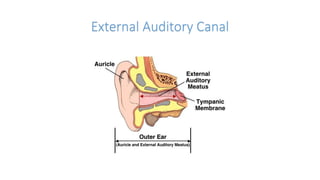
External Auditory Canal
Introduction
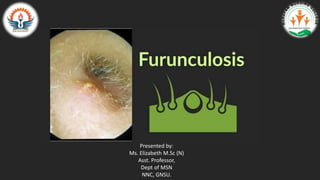
Furunculosis is a localized form of otitis externa resulting from infection of a single
hair follicle.
Inflammation of Hair follicle.
Hair follicle are only present in the lateral segment of the external auditory canal.
It is therefore,confined to the lateral canal.
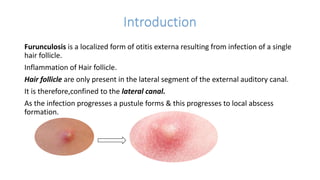
As the infection progresses a pustule forms & this progresses to local abscess
formation.
Risk Factor
People at risk
Allergy
Obese
over crowding
Poor nutrition
Teenage & young adults
Contact sports
Immunocompromised patients
Diabetes
Depression
Pt on Immunosuppressive drugs
Aetiology
• Staphylococcus aureus,
pseudomonas & proteus
• Local risk factors like heat,
humidity, trauma & maceration.
• Severe conditions appear to be
associated with recurrent
furunculosis include
hypogammaglobulinaemia &
DM.
Clinical Feature
• Pain
• Deafness
• Purulent Discharge
• Tenderness on moving pinna or pressing tragus
History Collection - The
affected ear is extremely painful
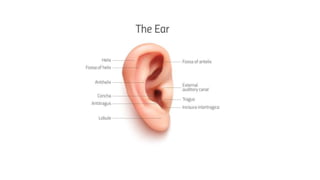
On palpation - the pinna &
tragus are tender.
Lab test CBC - ↑ WBC
C & S
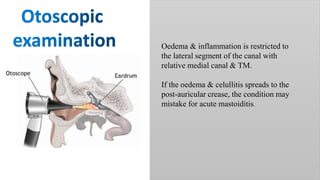
Oedema & inflammation is restricted to
the lateral segment of the canal with
relative medial canal & TM.
If the oedema & celullitis spreads to the
post-auricular crease, the condition may
mistake for acute mastoiditis.
Management options
otic Analgesics drops - Antipyrine, Benzocaine
Oral /systemic antibiotics
1. Macrolide- Clarithromycin, Azithromycin, Erythromycin
2. Cephalosporin - cephalexin, Cefazolin
or
Quinolone - Ciprofloxacin, gemifloxacin
Oral antibiotic recommended in early stage of disease.
Topical treatment
1. Antibiotic
2. Astringents - to reduce bleeding from minor abrasions
e.g. Topical aluminium chloride , aluminium acetate solution
3. Hygroscopic agents - dehydrating agents
e.g. aluminium acetate solution, Magnesium Carbonate.
Glycerol & 10% Ichthammol solution is hygroscopic &
antistaphylococcal action.
• Incision & drainage.
• For recurrent furunculosis
Eradication therapy with oral flucloxacillin for 14 days.
Correction of specific biochemical abnormalities (hypoferraemia, low serum
zinc) may lead to marked reduction of recurrent infections.
Outcome
If untreated, progress to abscess then discharge to EAC.
Adequate drainage the infection will resolve spontaneously.
Infection may spread to deeper plain pinna, post-auricular skin, parotid
gland.
Repeated infection can cause permanent scarring , fibrosis &stenosis of
External Auditory Canal (EAC).
Patient Education
• Warm compresses applied to the area for 20 minutes at least 3–4 times a day
may ease the discomfort and help encourage to drain.
• It can be very contagious. Do not share clothing, towels, bedding, or sporting
equipment with others
• Wash hands frequently
• Do not pop with a pin or needle. Doing so may make the infection worse.

Furunculosis

  • 1.
    Presented by: Ms. ElizabethM.Sc (N) Asst. Professor, Dept of MSN NNC, GNSU.
  • 2.
  • 4.
    Introduction Furunculosis is alocalized form of otitis externa resulting from infection of a single hair follicle. Inflammation of Hair follicle. Hair follicle are only present in the lateral segment of the external auditory canal. It is therefore,confined to the lateral canal. As the infection progresses a pustule forms & this progresses to local abscess formation.
  • 5.
    Risk Factor People atrisk Allergy Obese over crowding Poor nutrition Teenage & young adults Contact sports Immunocompromised patients Diabetes Depression Pt on Immunosuppressive drugs Aetiology • Staphylococcus aureus, pseudomonas & proteus • Local risk factors like heat, humidity, trauma & maceration. • Severe conditions appear to be associated with recurrent furunculosis include hypogammaglobulinaemia & DM.
  • 6.
    Clinical Feature • Pain •Deafness • Purulent Discharge • Tenderness on moving pinna or pressing tragus
  • 7.
    History Collection -The affected ear is extremely painful On palpation - the pinna & tragus are tender. Lab test CBC - ↑ WBC C & S
  • 8.
    Oedema & inflammationis restricted to the lateral segment of the canal with relative medial canal & TM. If the oedema & celullitis spreads to the post-auricular crease, the condition may mistake for acute mastoiditis.
  • 9.
    Management options otic Analgesicsdrops - Antipyrine, Benzocaine Oral /systemic antibiotics 1. Macrolide- Clarithromycin, Azithromycin, Erythromycin 2. Cephalosporin - cephalexin, Cefazolin or Quinolone - Ciprofloxacin, gemifloxacin Oral antibiotic recommended in early stage of disease.
  • 10.
    Topical treatment 1. Antibiotic 2.Astringents - to reduce bleeding from minor abrasions e.g. Topical aluminium chloride , aluminium acetate solution 3. Hygroscopic agents - dehydrating agents e.g. aluminium acetate solution, Magnesium Carbonate. Glycerol & 10% Ichthammol solution is hygroscopic & antistaphylococcal action.
  • 11.
    • Incision &drainage. • For recurrent furunculosis Eradication therapy with oral flucloxacillin for 14 days. Correction of specific biochemical abnormalities (hypoferraemia, low serum zinc) may lead to marked reduction of recurrent infections.
  • 12.
    Outcome If untreated, progressto abscess then discharge to EAC. Adequate drainage the infection will resolve spontaneously. Infection may spread to deeper plain pinna, post-auricular skin, parotid gland. Repeated infection can cause permanent scarring , fibrosis &stenosis of External Auditory Canal (EAC).
  • 13.
    Patient Education • Warmcompresses applied to the area for 20 minutes at least 3–4 times a day may ease the discomfort and help encourage to drain. • It can be very contagious. Do not share clothing, towels, bedding, or sporting equipment with others • Wash hands frequently • Do not pop with a pin or needle. Doing so may make the infection worse.