Mastering Your EQ – Emotional
Intelligence – The Differentiator
of Leadership Success
Dr. Jean Ann Larson, FACHE, LFHIMSS, FIISE, DSHS
Leadership Development Officer
February 10, 2017
Page 2
Agenda
 Why EQ?
 What is Emotional Intelligence?
 How does EQ work?
 What are the 5 parts of EQ?
 Applications in your professional and
personal Life - Application practice
 Creating a personalized action plan to
improve your EQ
Page 3
Objectives
Participants will gain an understanding of:
 The Fundamentals of EQ
 The Application of EQ in Your Personal and
Professional Life
 Practical Tools and Approaches to Improving
Your EQ
Page 4
Why EQ?
What if you had a tool
or method to help you:
 navigate
interpersonal
differences
 manage change
effectively, and
 build strong
relationships?
Page 5
Page 6
EQ Stats & Facts
Page 7
Traditional Focus
Page 8
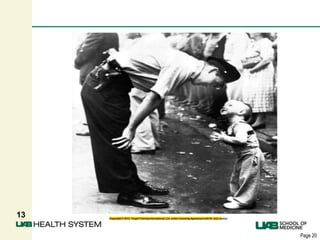
Take YOUR Emotional Temperature
Take your emotional temperature as you view
the images.
Page 9
Copyright © 2013. Target Training International, Ltd. under Licensing Agreement with Dr. Izzy Justice1
Page 10
Copyright © 2013. Target Training International, Ltd. under Licensing Agreement with Dr. Izzy Justice
2
Page 11
Copyright © 2013. Target Training International, Ltd. under Licensing Agreement with Dr. Izzy Justice
3
Page 12
Copyright © 2013. Target Training International, Ltd. under Licensing Agreement with Dr. Izzy Justice
4
Page 13
Copyright © 2013. Target Training International, Ltd. under Licensing Agreement with Dr. Izzy Justice
5
Page 14
Copyright © 2013. Target Training International, Ltd. under Licensing Agreement with Dr. Izzy Justice
6
Page 15
Copyright © 2013. Target Training International, Ltd. under Licensing Agreement with Dr. Izzy Justice
7
Page 16
Copyright © 2013. Target Training International, Ltd. under Licensing Agreement with Dr. Izzy Justice
8
Page 17
Copyright © 2013. Target Training International, Ltd. under Licensing Agreement with Dr. Izzy Justice
9
Page 18
Copyright © 2013. Target Training International, Ltd. under Licensing Agreement with Dr. Izzy Justice
10
Page 19
Copyright © 2013. Target Training International, Ltd. under Licensing Agreement with Dr. Izzy Justice
11
Page 20
Copyright © 2013. Target Training International, Ltd. under Licensing Agreement with Dr. Izzy Justice
13
Page 21
Copyright © 2013. Target Training International, Ltd. under Licensing Agreement with Dr. Izzy Justice
14
Page 23
What is Emotional Intelligence?
"Emotional intelligence is the ability to
perceive emotions, to access and
generate emotions so as to assist
thought, to understand emotions and
emotional knowledge, and to
reflectively regulate emotions so as to
promote emotional and intellectual
growth."
- Mayer & Salovey, 1997
Emotional intelligence (EI) is the ability
to understand and manage your own
emotions, and those of the people
around you. People with a high degree
of emotional intelligence know what
they're feeling, what their emotions
mean, and how these emotions can
affect other people.
– Source: Mindtools
Page 24
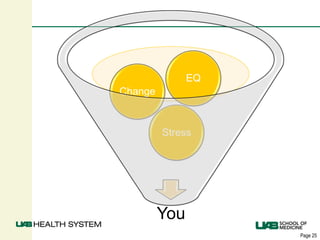
How does EQ work?
Page 25
You
Stress
Change
EQ
Page 26
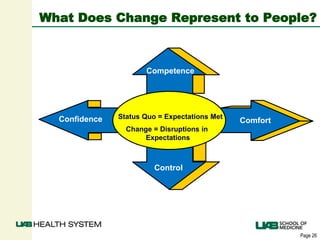
What Does Change Represent to People?
Competence
Comfort
Control
Confidence Status Quo = Expectations Met
Change = Disruptions in
Expectations
Page 27
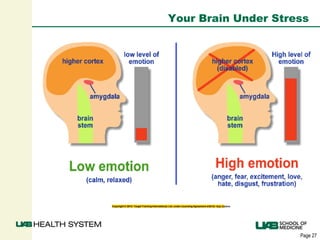
Your Brain Under Stress
Copyright © 2013. Target Training International, Ltd. under Licensing Agreement with Dr. Izzy Justice
Page 28
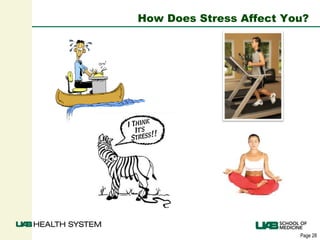
How Does Stress Affect You?
Page 29
The Effects of Stress on Everyday Life
Page 30
Negative Events and Interactions
Copyright © 2013. Target Training International, Ltd. under Licensing Agreement with Dr. Izzy Justice
Page 31
Stress Response
Copyright © 2013. Target Training International, Ltd. under Licensing Agreement with Dr. Izzy Justice
Page 32
Stressed State
 Have decreased cognitive
performance
 Have less oxygen available for
critical brain functions
 Tend to over generalize
 Respond with defensive action
 Perceive small stressors as worse
than they actually are
 Are easily aggravated
 Will struggle to get along with other
co-workers
 Cannot perform at your best
Page 33
Positive Events and Interactions
Copyright © 2013. Target Training International, Ltd. under Licensing Agreement with Dr. Izzy Justice
Page 34
Relaxation Response
Copyright © 2013. Target Training International, Ltd. under Licensing Agreement with Dr. Izzy Justice
Page 35
Non-stressed/Relaxation State
 Are intrinsically motivated
 Have improved cognitive functioning (i.e. rational, creative
thought)
 Are willing to do difficult things
 Are willing to take risks
 Think deeply about issues developing creative solutions
 Collaborate productively
 Are engaged
 Perform at higher levels
Page 36
Dimensions of EQ
 Self-Awareness
 Self-Regulation
 Motivation
 Empathy
 Social Skills
Page 37
Self-Awareness
The ability to recognize and understand your
moods, emotions and drives, as well as their
effect on others.
 Knowing how you’re feeling and why
 Knowing your personal strengths and limits
 Having a sense of your self-worth and
capabilities
Page 38
Self-Regulation
Self-Regulation is the ability to control or redirect
disruptive impulses and moods and the propensity to
suspend judgment and think before acting.
 Keeping disruptive emotions and impulses in check.
 Maintaining standards of honesty and integrity.
 Taking responsibility for personal performance.
 Flexibility and handling change.
 Being comfortable with novel ideas, approaches and new
information.
Page 39
Self-Regulation Exercise
 Think of a time when you practiced self-
regulation
 Now think of a time when you didn’t practice
self-regulation
Any regrets?
Page 40
Motivation
A passion to work for reasons that go beyond money or
status, and a propensity to pursue goals with energy and
persistence.
 Striving to improve or meet a standard of excellence.
 Aligning with the goals of group or organization.
 Readiness to act on opportunities.
 Persistence in pursuing goals despite obstacles and setbacks.
Page 41
Motivation Exercise
Think about someone you’ve observed who
seems to really love their job:
1.How can you tell someone is passionate about
their job?
2.What are the characteristics you observe?
3.Now think about your feelings about your own
job.
4.How do the two compare?
Page 42
Empathy
The ability to understand the emotional makeup of other
people.
 Sensing others’ feelings and perspectives and taking an
active interest in their concerns.
Sensing others’ development needs and bolstering their
abilities.
 Anticipation, recognizing and meeting the needs of others.
Cultivating opportunities through different kinds of people.
 Reading a group’s emotional currents and power
relationships.
Page 43
Empathy
http://youtu.be/cDDWvj_q-o8
Page 44
Social Skills
A proficiency in managing relationships and
building networks.
 Wielding effective tactics for persuasion.
 Listening openly and sending convincing messages.
 Negotiating and dissolving disagreements.
 Inspiring and guiding individuals and groups.
 Initiating or managing change.
 Nurturing instrumental relationships for building bonds.
 Working with others toward shared goals.
 Creating group synergy in pursuing collective goals.
Page 45
EQ Models
What could be
driving them
?
Me
Action
Others
Awareness
Page 46
EQ Models
Motivation
Why would I do it?
Why would they do it?
ME
Action
Others
Awareness
Self-Regulation
(Self Management)
What can I do about it?
How can I control it?
Social Skills
(Social Management)
What can we do about it?
What am I experiencing from
them?
Empathy
(Social Awareness)
How is everyone else
feeling?
How is it impacting
them?
Self-
Awareness
How am I feeling?
How is it
impacting me?
Page 47
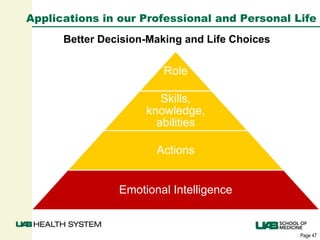
Applications in our Professional and Personal Life
Role
Skills,
knowledge,
abilities
Actions
Emotional Intelligence
Better Decision-Making and Life Choices
Page 49
In Short, EQ Helps you…
 Lead change more
effectively
 Engage your team
around shared goals
and objectives
 Manage stress
 Make better decisions
 Create and maintain
collaborative teams
Page 50
What area do you feel you need to work on to
improve your EQ?
1. Self-awareness
2. Self-regulation
3. Motivation
4. Empathy
5. Social Skills
Page 51
Ideas for improving EQ
 Improve your non-verbal communication
 Focus on the other person
 Make eye contact
 Pay attention to non-verbal cues
 Smile
 Use humor and play to deal with challenges
 Take hardships in stride
 Smooth over differences
 Simultaneously relax and energize yourself
 Be creative
 Resolve conflict positively and in a trust building way
 Stay focused in the present
 Choose your arguments
 Forgive
 End conflicts that cannot be resolved
Page 52
Improving Self-Awareness
 Practice self-reflection by recognizing your current emotional state – do
you experience discreet feelings and emotions? Can you name them?
 Once you identify the emotion, describe it aloud or write it down on
paper
 Feel your emotions physically
 To improve your ability to self-assess, ask a family member or trusted
advisor to describe your strengths and weaknesses
 Compare with your own self-assessment
 Pay attention to your emotions and behaviors and see if you recognize
patterns throughout the day
 Reflect on the connection between your emotions and your behavior
 Know who and what pushes your buttons
 Write in a journal about your emotional responses to situations that
were significant
Page 53
Improving Self-Regulation
 Practice self-restraint by listening first, pausing and then responding
 When becoming frustrated, identify what brought on that emotion
 Create effective responses to stressful situations by finding strategies for
altering a negative mood
 Discuss ways of dealing with change and stress with family members, friends
or a trusted advisor
 Focus on events that provide a sense of calm or positive emotions
 Ask yourself, "What is the worst thing that can happen?" in order to consider
the reality of the situation
 Journal occurrences during which you were able to regulate your responses
or emotions
 Begin regular exercise, yoga or meditation to increase your ability to manage
your emotions and relax both body and mind. Exercise regulates your
emotions by releasing endorphins, adrenaline, serotonin and dopamine
Page 54
Page 55
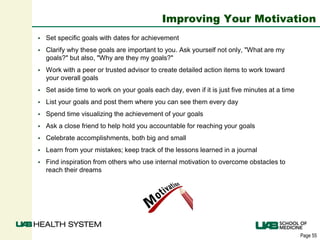
Improving Your Motivation
 Set specific goals with dates for achievement
 Clarify why these goals are important to you. Ask yourself not only, "What are my
goals?" but also, "Why are they my goals?"
 Work with a peer or trusted advisor to create detailed action items to work toward
your overall goals
 Set aside time to work on your goals each day, even if it is just five minutes at a time
 List your goals and post them where you can see them every day
 Spend time visualizing the achievement of your goals
 Ask a close friend to help hold you accountable for reaching your goals
 Celebrate accomplishments, both big and small
 Learn from your mistakes; keep track of the lessons learned in a journal
 Find inspiration from others who use internal motivation to overcome obstacles to
reach their dreams
Page 56
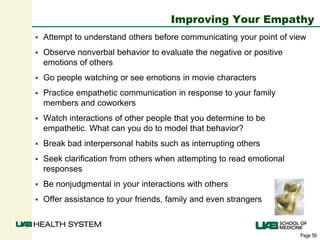
Improving Your Empathy
 Attempt to understand others before communicating your point of view
 Observe nonverbal behavior to evaluate the negative or positive
emotions of others
 Go people watching or see emotions in movie characters
 Practice empathetic communication in response to your family
members and coworkers
 Watch interactions of other people that you determine to be
empathetic. What can you do to model that behavior?
 Break bad interpersonal habits such as interrupting others
 Seek clarification from others when attempting to read emotional
responses
 Be nonjudgmental in your interactions with others
 Offer assistance to your friends, family and even strangers
Page 57
Improving Your Social Skills
 Be aware of the message your body language is communicating
 Ask those you admire to describe their experience when socializing with you
 Remember people's names. Everyone has a hard time with it
 Use memory techniques and be known as the one that remembers!
 After making a mistake, take accountability quickly and find ways to make
amends
 Describe scenarios to a trusted advisor in order to gain experiential
knowledge on how to increase your level of social skills (i.e. discuss the
details of a social function and what makes you uneasy)
 Take notice when emotions are taking over an interaction and then find ways
to remove yourself from the situation
 Be open and curious - Show a genuine curiosity for others' well-being
 Explain your decisions, don’t just make them
Page 58
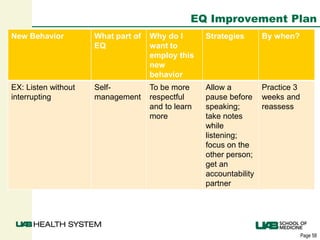
EQ Improvement Plan
New Behavior What part of
EQ
Why do I
want to
employ this
new
behavior
Strategies By when?
EX: Listen without
interrupting
Self-
management
To be more
respectful
and to learn
more
Allow a
pause before
speaking;
take notes
while
listening;
focus on the
other person;
get an
accountability
partner
Practice 3
weeks and
reassess
Page 59
Q&A, Evaluations and Next Steps
 What are you taking
forward from the
session?
 What new insights
have you gained?
 What new behaviors
will you try?
Page 60
Bibliography
 Emotional Intelligence: Why It Can Matter More than IQ, Daniel
Goleman, 1995.
 Emotional Intelligence 2.0, Jean Greaves, Travis Bradbury, 2009
 The Emotional Life of Your Brain, Richard Davidson and Sharon
Begley, 2012
 How to Improve Your Emotional Intelligence at Work and in
Relationships, Shawn Kent Hayashi, 2016
 The Leadership Code: 5 Rules to Lead By, Dave Ulrich, Norm
Smallwood, Kate Sweetman, 2008
 Leadership Vertigo: Why Even the Best Leaders Go Off Course and
How They Can Get Back On Track, S. Max Brown, Tanveer Naseer,
2014
 Mindset: The New Psychology of Success, Carol Dweck, 2006
 Bridging the Soft Skills Gap, Bruce Tulgan, 2015

Mastering Your EQ

  • 1.
    Mastering Your EQ– Emotional Intelligence – The Differentiator of Leadership Success Dr. Jean Ann Larson, FACHE, LFHIMSS, FIISE, DSHS Leadership Development Officer February 10, 2017
  • 2.
    Page 2 Agenda  WhyEQ?  What is Emotional Intelligence?  How does EQ work?  What are the 5 parts of EQ?  Applications in your professional and personal Life - Application practice  Creating a personalized action plan to improve your EQ
  • 3.
    Page 3 Objectives Participants willgain an understanding of:  The Fundamentals of EQ  The Application of EQ in Your Personal and Professional Life  Practical Tools and Approaches to Improving Your EQ
  • 4.
    Page 4 Why EQ? Whatif you had a tool or method to help you:  navigate interpersonal differences  manage change effectively, and  build strong relationships?
  • 5.
  • 6.
  • 7.
  • 8.
    Page 8 Take YOUREmotional Temperature Take your emotional temperature as you view the images.
  • 9.
    Page 9 Copyright ©2013. Target Training International, Ltd. under Licensing Agreement with Dr. Izzy Justice1
  • 10.
    Page 10 Copyright ©2013. Target Training International, Ltd. under Licensing Agreement with Dr. Izzy Justice 2
  • 11.
    Page 11 Copyright ©2013. Target Training International, Ltd. under Licensing Agreement with Dr. Izzy Justice 3
  • 12.
    Page 12 Copyright ©2013. Target Training International, Ltd. under Licensing Agreement with Dr. Izzy Justice 4
  • 13.
    Page 13 Copyright ©2013. Target Training International, Ltd. under Licensing Agreement with Dr. Izzy Justice 5
  • 14.
    Page 14 Copyright ©2013. Target Training International, Ltd. under Licensing Agreement with Dr. Izzy Justice 6
  • 15.
    Page 15 Copyright ©2013. Target Training International, Ltd. under Licensing Agreement with Dr. Izzy Justice 7
  • 16.
    Page 16 Copyright ©2013. Target Training International, Ltd. under Licensing Agreement with Dr. Izzy Justice 8
  • 17.
    Page 17 Copyright ©2013. Target Training International, Ltd. under Licensing Agreement with Dr. Izzy Justice 9
  • 18.
    Page 18 Copyright ©2013. Target Training International, Ltd. under Licensing Agreement with Dr. Izzy Justice 10
  • 19.
    Page 19 Copyright ©2013. Target Training International, Ltd. under Licensing Agreement with Dr. Izzy Justice 11
  • 20.
    Page 20 Copyright ©2013. Target Training International, Ltd. under Licensing Agreement with Dr. Izzy Justice 13
  • 21.
    Page 21 Copyright ©2013. Target Training International, Ltd. under Licensing Agreement with Dr. Izzy Justice 14
  • 22.
    Page 23 What isEmotional Intelligence? "Emotional intelligence is the ability to perceive emotions, to access and generate emotions so as to assist thought, to understand emotions and emotional knowledge, and to reflectively regulate emotions so as to promote emotional and intellectual growth." - Mayer & Salovey, 1997 Emotional intelligence (EI) is the ability to understand and manage your own emotions, and those of the people around you. People with a high degree of emotional intelligence know what they're feeling, what their emotions mean, and how these emotions can affect other people. – Source: Mindtools
  • 23.
  • 24.
  • 25.
    Page 26 What DoesChange Represent to People? Competence Comfort Control Confidence Status Quo = Expectations Met Change = Disruptions in Expectations
  • 26.
    Page 27 Your BrainUnder Stress Copyright © 2013. Target Training International, Ltd. under Licensing Agreement with Dr. Izzy Justice
  • 27.
    Page 28 How DoesStress Affect You?
  • 28.
    Page 29 The Effectsof Stress on Everyday Life
  • 29.
    Page 30 Negative Eventsand Interactions Copyright © 2013. Target Training International, Ltd. under Licensing Agreement with Dr. Izzy Justice
  • 30.
    Page 31 Stress Response Copyright© 2013. Target Training International, Ltd. under Licensing Agreement with Dr. Izzy Justice
  • 31.
    Page 32 Stressed State Have decreased cognitive performance  Have less oxygen available for critical brain functions  Tend to over generalize  Respond with defensive action  Perceive small stressors as worse than they actually are  Are easily aggravated  Will struggle to get along with other co-workers  Cannot perform at your best
  • 32.
    Page 33 Positive Eventsand Interactions Copyright © 2013. Target Training International, Ltd. under Licensing Agreement with Dr. Izzy Justice
  • 33.
    Page 34 Relaxation Response Copyright© 2013. Target Training International, Ltd. under Licensing Agreement with Dr. Izzy Justice
  • 34.
    Page 35 Non-stressed/Relaxation State Are intrinsically motivated  Have improved cognitive functioning (i.e. rational, creative thought)  Are willing to do difficult things  Are willing to take risks  Think deeply about issues developing creative solutions  Collaborate productively  Are engaged  Perform at higher levels
  • 35.
    Page 36 Dimensions ofEQ  Self-Awareness  Self-Regulation  Motivation  Empathy  Social Skills
  • 36.
    Page 37 Self-Awareness The abilityto recognize and understand your moods, emotions and drives, as well as their effect on others.  Knowing how you’re feeling and why  Knowing your personal strengths and limits  Having a sense of your self-worth and capabilities
  • 37.
    Page 38 Self-Regulation Self-Regulation isthe ability to control or redirect disruptive impulses and moods and the propensity to suspend judgment and think before acting.  Keeping disruptive emotions and impulses in check.  Maintaining standards of honesty and integrity.  Taking responsibility for personal performance.  Flexibility and handling change.  Being comfortable with novel ideas, approaches and new information.
  • 38.
    Page 39 Self-Regulation Exercise Think of a time when you practiced self- regulation  Now think of a time when you didn’t practice self-regulation Any regrets?
  • 39.
    Page 40 Motivation A passionto work for reasons that go beyond money or status, and a propensity to pursue goals with energy and persistence.  Striving to improve or meet a standard of excellence.  Aligning with the goals of group or organization.  Readiness to act on opportunities.  Persistence in pursuing goals despite obstacles and setbacks.
  • 40.
    Page 41 Motivation Exercise Thinkabout someone you’ve observed who seems to really love their job: 1.How can you tell someone is passionate about their job? 2.What are the characteristics you observe? 3.Now think about your feelings about your own job. 4.How do the two compare?
  • 41.
    Page 42 Empathy The abilityto understand the emotional makeup of other people.  Sensing others’ feelings and perspectives and taking an active interest in their concerns. Sensing others’ development needs and bolstering their abilities.  Anticipation, recognizing and meeting the needs of others. Cultivating opportunities through different kinds of people.  Reading a group’s emotional currents and power relationships.
  • 42.
  • 43.
    Page 44 Social Skills Aproficiency in managing relationships and building networks.  Wielding effective tactics for persuasion.  Listening openly and sending convincing messages.  Negotiating and dissolving disagreements.  Inspiring and guiding individuals and groups.  Initiating or managing change.  Nurturing instrumental relationships for building bonds.  Working with others toward shared goals.  Creating group synergy in pursuing collective goals.
  • 44.
    Page 45 EQ Models Whatcould be driving them ? Me Action Others Awareness
  • 45.
    Page 46 EQ Models Motivation Whywould I do it? Why would they do it? ME Action Others Awareness Self-Regulation (Self Management) What can I do about it? How can I control it? Social Skills (Social Management) What can we do about it? What am I experiencing from them? Empathy (Social Awareness) How is everyone else feeling? How is it impacting them? Self- Awareness How am I feeling? How is it impacting me?
  • 46.
    Page 47 Applications inour Professional and Personal Life Role Skills, knowledge, abilities Actions Emotional Intelligence Better Decision-Making and Life Choices
  • 47.
    Page 49 In Short,EQ Helps you…  Lead change more effectively  Engage your team around shared goals and objectives  Manage stress  Make better decisions  Create and maintain collaborative teams
  • 48.
    Page 50 What areado you feel you need to work on to improve your EQ? 1. Self-awareness 2. Self-regulation 3. Motivation 4. Empathy 5. Social Skills
  • 49.
    Page 51 Ideas forimproving EQ  Improve your non-verbal communication  Focus on the other person  Make eye contact  Pay attention to non-verbal cues  Smile  Use humor and play to deal with challenges  Take hardships in stride  Smooth over differences  Simultaneously relax and energize yourself  Be creative  Resolve conflict positively and in a trust building way  Stay focused in the present  Choose your arguments  Forgive  End conflicts that cannot be resolved
  • 50.
    Page 52 Improving Self-Awareness Practice self-reflection by recognizing your current emotional state – do you experience discreet feelings and emotions? Can you name them?  Once you identify the emotion, describe it aloud or write it down on paper  Feel your emotions physically  To improve your ability to self-assess, ask a family member or trusted advisor to describe your strengths and weaknesses  Compare with your own self-assessment  Pay attention to your emotions and behaviors and see if you recognize patterns throughout the day  Reflect on the connection between your emotions and your behavior  Know who and what pushes your buttons  Write in a journal about your emotional responses to situations that were significant
  • 51.
    Page 53 Improving Self-Regulation Practice self-restraint by listening first, pausing and then responding  When becoming frustrated, identify what brought on that emotion  Create effective responses to stressful situations by finding strategies for altering a negative mood  Discuss ways of dealing with change and stress with family members, friends or a trusted advisor  Focus on events that provide a sense of calm or positive emotions  Ask yourself, "What is the worst thing that can happen?" in order to consider the reality of the situation  Journal occurrences during which you were able to regulate your responses or emotions  Begin regular exercise, yoga or meditation to increase your ability to manage your emotions and relax both body and mind. Exercise regulates your emotions by releasing endorphins, adrenaline, serotonin and dopamine
  • 52.
  • 53.
    Page 55 Improving YourMotivation  Set specific goals with dates for achievement  Clarify why these goals are important to you. Ask yourself not only, "What are my goals?" but also, "Why are they my goals?"  Work with a peer or trusted advisor to create detailed action items to work toward your overall goals  Set aside time to work on your goals each day, even if it is just five minutes at a time  List your goals and post them where you can see them every day  Spend time visualizing the achievement of your goals  Ask a close friend to help hold you accountable for reaching your goals  Celebrate accomplishments, both big and small  Learn from your mistakes; keep track of the lessons learned in a journal  Find inspiration from others who use internal motivation to overcome obstacles to reach their dreams
  • 54.
    Page 56 Improving YourEmpathy  Attempt to understand others before communicating your point of view  Observe nonverbal behavior to evaluate the negative or positive emotions of others  Go people watching or see emotions in movie characters  Practice empathetic communication in response to your family members and coworkers  Watch interactions of other people that you determine to be empathetic. What can you do to model that behavior?  Break bad interpersonal habits such as interrupting others  Seek clarification from others when attempting to read emotional responses  Be nonjudgmental in your interactions with others  Offer assistance to your friends, family and even strangers
  • 55.
    Page 57 Improving YourSocial Skills  Be aware of the message your body language is communicating  Ask those you admire to describe their experience when socializing with you  Remember people's names. Everyone has a hard time with it  Use memory techniques and be known as the one that remembers!  After making a mistake, take accountability quickly and find ways to make amends  Describe scenarios to a trusted advisor in order to gain experiential knowledge on how to increase your level of social skills (i.e. discuss the details of a social function and what makes you uneasy)  Take notice when emotions are taking over an interaction and then find ways to remove yourself from the situation  Be open and curious - Show a genuine curiosity for others' well-being  Explain your decisions, don’t just make them
  • 56.
    Page 58 EQ ImprovementPlan New Behavior What part of EQ Why do I want to employ this new behavior Strategies By when? EX: Listen without interrupting Self- management To be more respectful and to learn more Allow a pause before speaking; take notes while listening; focus on the other person; get an accountability partner Practice 3 weeks and reassess
  • 57.
    Page 59 Q&A, Evaluationsand Next Steps  What are you taking forward from the session?  What new insights have you gained?  What new behaviors will you try?
  • 58.
    Page 60 Bibliography  EmotionalIntelligence: Why It Can Matter More than IQ, Daniel Goleman, 1995.  Emotional Intelligence 2.0, Jean Greaves, Travis Bradbury, 2009  The Emotional Life of Your Brain, Richard Davidson and Sharon Begley, 2012  How to Improve Your Emotional Intelligence at Work and in Relationships, Shawn Kent Hayashi, 2016  The Leadership Code: 5 Rules to Lead By, Dave Ulrich, Norm Smallwood, Kate Sweetman, 2008  Leadership Vertigo: Why Even the Best Leaders Go Off Course and How They Can Get Back On Track, S. Max Brown, Tanveer Naseer, 2014  Mindset: The New Psychology of Success, Carol Dweck, 2006  Bridging the Soft Skills Gap, Bruce Tulgan, 2015