Requirements prioritization in
Requirements engineering
Name :Shumail tariq
Class: Bse B3
Roll no : 002
Contents
.requirements prioritization
.advantages
.why prioritization
.methods
.software product line
.principles
.advantages
“Prioritization of requirements ensures
that analysis and implementation efforts
focus on the most critical requirements”
Requirements prioritization enables an analyst to ensure that
requirements are ranked and implemented in a top-down
approach.
The typical participants in the prioritization process include:
1) The project manager, who leads the process, arbitrates conflicts,
and adjusts inputs from the other participants if necessary
2) customer representatives, who supply the benefit and penalty
ratings
3) Development representatives, such as team technical leads, who
supply the cost and risk ratings.
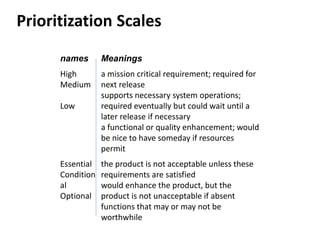
Prioritization Scales
names Meanings
High
Medium
Low
a mission critical requirement; required for
next release
supports necessary system operations;
required eventually but could wait until a
later release if necessary
a functional or quality enhancement; would
be nice to have someday if resources
permit
Essential
Condition
al
Optional
the product is not acceptable unless these
requirements are satisfied
would enhance the product, but the
product is not unacceptable if absent
functions that may or may not be
worthwhile
Prioritization Methods
Some of the more commonly used prioritization methods include:
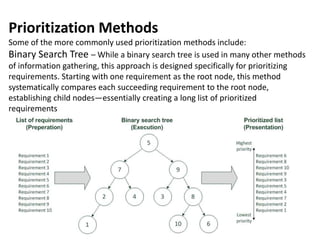
Binary Search Tree – While a binary search tree is used in many other methods
of information gathering, this approach is designed specifically for prioritizing
requirements. Starting with one requirement as the root node, this method
systematically compares each succeeding requirement to the root node,
establishing child nodes—essentially creating a long list of prioritized
requirements
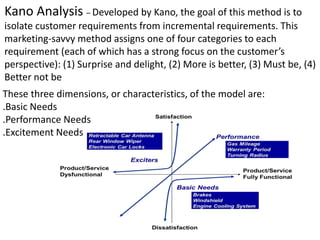
Kano Analysis – Developed by Kano, the goal of this method is to
isolate customer requirements from incremental requirements. This
marketing-savvy method assigns one of four categories to each
requirement (each of which has a strong focus on the customer’s
perspective): (1) Surprise and delight, (2) More is better, (3) Must be, (4)
Better not be
These three dimensions, or characteristics, of the model are:
.Basic Needs
.Performance Needs
.Excitement Needs
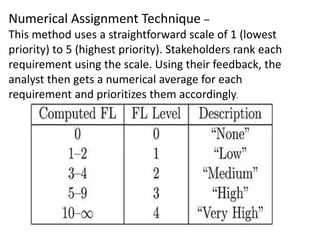
Numerical Assignment Technique –
This method uses a straightforward scale of 1 (lowest
priority) to 5 (highest priority). Stakeholders rank each
requirement using the scale. Using their feedback, the
analyst then gets a numerical average for each
requirement and prioritizes them accordingly.
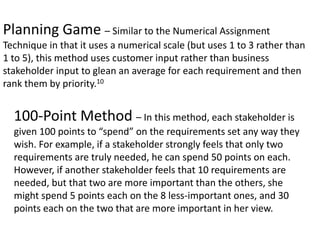
Planning Game – Similar to the Numerical Assignment
Technique in that it uses a numerical scale (but uses 1 to 3 rather than
1 to 5), this method uses customer input rather than business
stakeholder input to glean an average for each requirement and then
rank them by priority.10
100-Point Method – In this method, each stakeholder is
given 100 points to “spend” on the requirements set any way they
wish. For example, if a stakeholder strongly feels that only two
requirements are truly needed, he can spend 50 points on each.
However, if another stakeholder feels that 10 requirements are
needed, but that two are more important than the others, she
might spend 5 points each on the 8 less-important ones, and 30
points each on the two that are more important in her view.
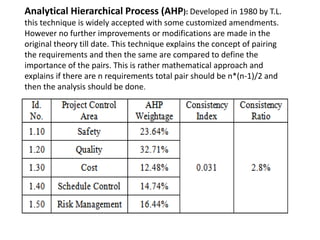
Analytical Hierarchical Process (AHP): Developed in 1980 by T.L.
this technique is widely accepted with some customized amendments.
However no further improvements or modifications are made in the
original theory till date. This technique explains the concept of pairing
the requirements and then the same are compared to define the
importance of the pairs. This is rather mathematical approach and
explains if there are n requirements total pair should be n*(n-1)/2 and
then the analysis should be done.
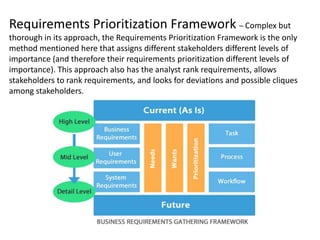
Requirements Prioritization Framework – Complex but
thorough in its approach, the Requirements Prioritization Framework is the only
method mentioned here that assigns different stakeholders different levels of
importance (and therefore their requirements prioritization different levels of
importance). This approach also has the analyst rank requirements, allows
stakeholders to rank requirements, and looks for deviations and possible cliques
among stakeholders.
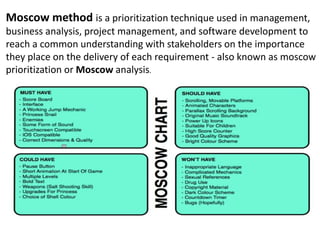
Moscow method is a prioritization technique used in management,
business analysis, project management, and software development to
reach a common understanding with stakeholders on the importance
they place on the delivery of each requirement - also known as moscow
prioritization or Moscow analysis.
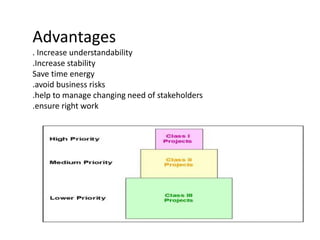
Advantages
. Increase understandability
.Increase stability
Save time energy
.avoid business risks
.help to manage changing need of stakeholders
.ensure right work
Mellon Software Engineering Institute defines a
software product line as "a set of software-
intensive systems that share a common, managed set
of features satisfying the specific needs of a particular
market segment or mission and that are developed
from a common set of core assets in a prescribed way.”
Software product line engineering is a paradigm to develop software
product lines and as such supports reuse, productivity and
quality of the systems. Unlike conventional software development
paradigms that aim to develop single systems, SPLE considers the
development of a family of software systems. As such SPLE adopts a
fundamentally different software life cycle approach than single
system development.
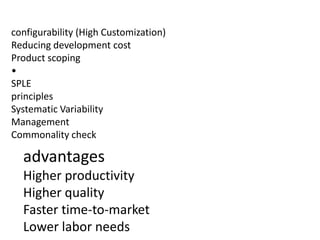
advantages
Higher productivity
Higher quality
Faster time-to-market
Lower labor needs
configurability (High Customization)
Reducing development cost
Product scoping
•
SPLE
principles
Systematic Variability
Management
Commonality check

Requirements prioritization

  • 1.
    Requirements prioritization in Requirementsengineering Name :Shumail tariq Class: Bse B3 Roll no : 002
  • 2.
  • 3.
    “Prioritization of requirementsensures that analysis and implementation efforts focus on the most critical requirements” Requirements prioritization enables an analyst to ensure that requirements are ranked and implemented in a top-down approach. The typical participants in the prioritization process include: 1) The project manager, who leads the process, arbitrates conflicts, and adjusts inputs from the other participants if necessary 2) customer representatives, who supply the benefit and penalty ratings 3) Development representatives, such as team technical leads, who supply the cost and risk ratings.
  • 4.
    Prioritization Scales names Meanings High Medium Low amission critical requirement; required for next release supports necessary system operations; required eventually but could wait until a later release if necessary a functional or quality enhancement; would be nice to have someday if resources permit Essential Condition al Optional the product is not acceptable unless these requirements are satisfied would enhance the product, but the product is not unacceptable if absent functions that may or may not be worthwhile
  • 5.
    Prioritization Methods Some ofthe more commonly used prioritization methods include: Binary Search Tree – While a binary search tree is used in many other methods of information gathering, this approach is designed specifically for prioritizing requirements. Starting with one requirement as the root node, this method systematically compares each succeeding requirement to the root node, establishing child nodes—essentially creating a long list of prioritized requirements
  • 6.
    Kano Analysis –Developed by Kano, the goal of this method is to isolate customer requirements from incremental requirements. This marketing-savvy method assigns one of four categories to each requirement (each of which has a strong focus on the customer’s perspective): (1) Surprise and delight, (2) More is better, (3) Must be, (4) Better not be These three dimensions, or characteristics, of the model are: .Basic Needs .Performance Needs .Excitement Needs
  • 7.
    Numerical Assignment Technique– This method uses a straightforward scale of 1 (lowest priority) to 5 (highest priority). Stakeholders rank each requirement using the scale. Using their feedback, the analyst then gets a numerical average for each requirement and prioritizes them accordingly.
  • 8.
    Planning Game –Similar to the Numerical Assignment Technique in that it uses a numerical scale (but uses 1 to 3 rather than 1 to 5), this method uses customer input rather than business stakeholder input to glean an average for each requirement and then rank them by priority.10 100-Point Method – In this method, each stakeholder is given 100 points to “spend” on the requirements set any way they wish. For example, if a stakeholder strongly feels that only two requirements are truly needed, he can spend 50 points on each. However, if another stakeholder feels that 10 requirements are needed, but that two are more important than the others, she might spend 5 points each on the 8 less-important ones, and 30 points each on the two that are more important in her view.
  • 10.
    Analytical Hierarchical Process(AHP): Developed in 1980 by T.L. this technique is widely accepted with some customized amendments. However no further improvements or modifications are made in the original theory till date. This technique explains the concept of pairing the requirements and then the same are compared to define the importance of the pairs. This is rather mathematical approach and explains if there are n requirements total pair should be n*(n-1)/2 and then the analysis should be done.
  • 11.
    Requirements Prioritization Framework– Complex but thorough in its approach, the Requirements Prioritization Framework is the only method mentioned here that assigns different stakeholders different levels of importance (and therefore their requirements prioritization different levels of importance). This approach also has the analyst rank requirements, allows stakeholders to rank requirements, and looks for deviations and possible cliques among stakeholders.
  • 12.
    Moscow method isa prioritization technique used in management, business analysis, project management, and software development to reach a common understanding with stakeholders on the importance they place on the delivery of each requirement - also known as moscow prioritization or Moscow analysis.
  • 13.
    Advantages . Increase understandability .Increasestability Save time energy .avoid business risks .help to manage changing need of stakeholders .ensure right work
  • 14.
    Mellon Software EngineeringInstitute defines a software product line as "a set of software- intensive systems that share a common, managed set of features satisfying the specific needs of a particular market segment or mission and that are developed from a common set of core assets in a prescribed way.” Software product line engineering is a paradigm to develop software product lines and as such supports reuse, productivity and quality of the systems. Unlike conventional software development paradigms that aim to develop single systems, SPLE considers the development of a family of software systems. As such SPLE adopts a fundamentally different software life cycle approach than single system development.
  • 16.
    advantages Higher productivity Higher quality Fastertime-to-market Lower labor needs configurability (High Customization) Reducing development cost Product scoping • SPLE principles Systematic Variability Management Commonality check