Strategic Thinking
5throck
June 2021
What is Strategic Thinking?
1
Where are
we now?
Where will
we be going?
How do
we get there?
Strategic Thinking
Current Status (X) Desired Status (Y)
What is Strategic Thinking?
2
▪ Strategic Thinking is the process of
establishing a plan to go from the current
state (X) to the desired goal (Y) and finding
ways to ensure that such a plan can proceed
properly.
‒ In the business strategy, after setting the
goal (Y) to be achieved, the necessary
matters for pursuing the goal are structured
and arranged, and then the contents of how
to achieve the goal are summarized.
‒ These tasks go through a lot of trial and
error when establishing and executing a
plan, and the process of continuously
adjusting them and obtaining desired
results can be said to be the core of
strategic thinking.
Where are
we now?
Where will
we be going?
How do
we get there?
Strategic Thinking
Current Status (X) Desired Status (Y)
Thinking Hazard
3
Source: 가슴 뛰는 삶, 강헌구
Normal
Outstanding
Strategic
Thinking
Thinking
Hazard
1. The purpose and direction of
problem solving are not clear.
2. Be constrained by false past
insights or achievements
3. Can't draw concrete
conclusions.
4. Don't take risks.
5. Don't want to take
responsibility.
6. Trying to maintain the status
quo and being inwardly
oriented.
7. Make gambling decisions that
rely on intuition and luck, not
on facts.
8. Only want immediate solutions
and quick endings.
9. Don't be patient or wait calmly
in the thinking process.
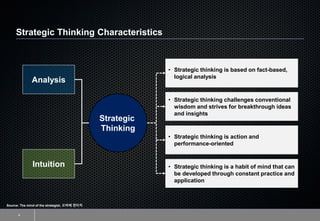
Strategic Thinking Characteristics
4
Source: The mind of the strategist, 오마에 겐이치
Strategic
Thinking
Analysis
Intuition
• Strategic thinking is based on fact-based,
logical analysis
• Strategic thinking challenges conventional
wisdom and strives for breakthrough ideas
and insights
• Strategic thinking is action and
performance-oriented
• Strategic thinking is a habit of mind that can
be developed through constant practice and
application
Structuring Strategic Thinking
5
Current
Status (X)
Desired Status (Y)
Undesired Status (Z)
Structuring Strategic Thinking
6
Current
Status (X)
Desired
Output (B)
Undesired
Output (C)
Average
Output (A)
Desired Status (Y)
Undesired Status (Z)
Structuring Strategic Thinking
7
Current
Status (X)
Opportunity
Threat
Desired
Output (B)
Undesired
Output (C)
Average
Output (A)
Desired Status (Y)
Undesired Status (Z)
Structuring Strategic Thinking
8
Current
Status (X)
Opportunity
Threat
Desired
Output (B)
Undesired
Output (C)
Average
Output (A)
Advantages
Issues
Desired Status (Y)
Undesired Status (Z)
Structuring Strategic Thinking
9
Current
Status (X)
Opportunity
Threat
Desired
Output (B)
Undesired
Output (C)
Average
Output (A)
Advantages
Issues
Benefit
Problem
Desired Status (Y)
Undesired Status (Z)
Structuring Strategic Thinking
10
Desired
Output (B)
Undesired
Output (C)
Average
Output (A)
Advantages
Issues
Benefit
Problem
Desired Status (Y)
Undesired Status (Z)
Structuring Strategic Thinking
11
Desired
Output (B)
Undesired
Output (C)
Average
Output (A)
Advantages
Issues
Benefit
Problem
Desired Status (Y)
Undesired Status (Z)
Cost
Solution
Structuring Strategic Thinking
12
Desired
Output (B)
Undesired
Output (C)
Average
Output (A)
Advantages
Issues
Benefit
Problem
Desired Status (Y)
Undesired Status (Z)
Cost
Solution
Make a decision
Should be fixed
Structuring Strategic Thinking
13
Desired
Output (B)
Undesired
Output (C)
Average
Output (A)
Advantages
Issues
Benefit
Problem
Desired Status (Y)
Undesired Status (Z)
Narrow
Problem
Structuring Strategic Thinking
14
Desired
Output (B)
Undesired
Output (C)
Average
Output (A)
Advantages
Issues
Benefit
Problem
Desired Status (Y)
Undesired Status (Z)
Narrow
Problem
Broad
Problem
Structuring Strategic Thinking
15
Desired
Output (B)
Undesired
Output (C)
Average
Output (A)
Advantages
Issues
Benefit
Problem
Desired Status (Y)
Undesired Status (Z)
Narrow
Problem
Broad
Problem
Goal-
oriented
Cause-
oriented
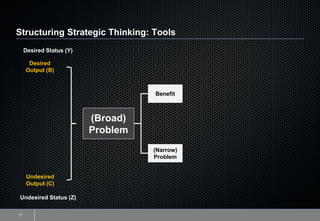
Structuring Strategic Thinking: Tools
16
Desired
Output (B)
Undesired
Output (C)
Desired Status (Y)
Undesired Status (Z)
(Broad)
Problem
Structuring Strategic Thinking: Tools
17
Desired
Output (B)
Undesired
Output (C)
Desired Status (Y)
Undesired Status (Z)
(Broad)
Problem
Benefit
(Narrow)
Problem
Structuring Strategic Thinking: Tools
18
Desired
Output (B)
Undesired
Output (C)
Desired Status (Y)
Undesired Status (Z)
(Broad)
Problem
Benefit
(Narrow)
Problem
Benefit-Cost
Analysis
Root-Cause
Analysis
Structuring Strategic Thinking
19
Desired
Output (B)
Undesired
Output (C)
Desired Status (Y)
Undesired Status (Z)
(Broad)
Problem
(Narrow)
Problem
Solution
Structuring Strategic Thinking
20
Desired
Output (B)
Undesired
Output (C)
Desired Status (Y)
Undesired Status (Z)
(Broad)
Problem
Benefit
(Narrow)
Problem
Solution
Cost
Structuring Strategic Thinking
21
Desired
Output (B)
Undesired
Output (C)
Desired Status (Y)
Undesired Status (Z)
(Broad)
Problem
Benefit
(Narrow)
Problem
Solution
Cost
Strategic Thinking
Approach
Strategic Thinking Approach
22
Fact-Based Thinking
Logical Thinking
Creative Thinking
Strategic
Thinking
Convergent
Thinking
(Structure
the problem)
Divergent
Thinking
(Finding the
Solution)
Strategic Thinking Approach: Problem & Solution
23
Just do it
Know Problem Don’t Know Problem
Know
Solution
Don’t Know
Solution
Do it Now - Urgent Important Matrix
24
Just do it
Strategic Thinking Approach: Problem & Solution
25
Just do it
Open
Innovation
Know Problem Don’t Know Problem
Know
Solution
Don’t Know
Solution
Strategic Thinking Approach: Problem & Solution
26
Just do it
Open
Innovation
Design
Thinking
Know Problem Don’t Know Problem
Know
Solution
Don’t Know
Solution
Strategic Thinking Approach: Problem & Solution
27
Just do it Structure the Problem
& Find the Solution
Open
Innovation
Design
Thinking
Know Problem Don’t Know Problem
Know
Solution
Don’t Know
Solution
Structure the Problem
28
▪ The important thing in problem analysis
method is to think within the principle of
structure, and structural thinking is possible
through "MECE" (Mutually Exclusive,
Collectively Exhaustive).
‒ "Mutually Exclusive" means to find
something mutually exclusive without
overlapping each other, and "Collectively
Exhaustive" means that if you put all the
findings together, it should be the same as
the whole of the problem.
‒ The principle of "MECE" is to specify a
problem in detail and make sure that each
is clearly separated and clear, and that all
issues related to the problem are included.
Structure the Problem: Visualization of MECE
29
A
B
C
Mutually Exclusive,
Not Collectively Exhaustive
Not Mutually Exclusive,
Collectively Exhaustive
A B C
Structure the Problem: Root-Cause Analysis
30
Problem
Issue
A
Issue
A-1
Issue
A-11
Issue
A-12
Issue
A-2
Issue
B
Issue
B-1
▪ A tool that subdivides a given problem,
divides it into smaller issues, and helps the
issues to be well structured.
‒ Starting from the top or left, starting from
the largest issue, subdividing into smaller
units in a logical order, and categorized
according to the MECE principle.
‒ When the lower issue is recombined
according to the MECE principle, it should
be defined in a form that can be sufficiently
explained.
Logical
Thinking
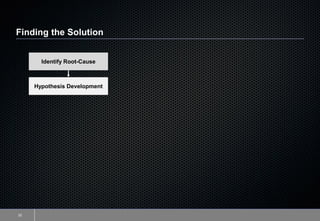
Finding the Solution
31
Identify Root-Cause
Finding the Solution
32
Identify Root-Cause
Hypothesis Development
Finding the Solution
33
Identify Root-Cause
Hypothesis Development
Determination of
hypothesis testing method
Finding the Solution
34
Identify Root-Cause
Hypothesis Development
Determination of
hypothesis testing method
Gathering Data
Finding the Solution
35
Identify Root-Cause
Hypothesis Development
Determination of
hypothesis testing method
Gathering Data
Testing the Hypothesis
Finding the Solution
36
Identify Root-Cause
Hypothesis Development
Determination of
hypothesis testing method
Gathering Data
Testing the Hypothesis
Refine Hypothesis
Finding the Solution
37
Identify Root-Cause
Hypothesis Development
Determination of
hypothesis testing method
Gathering Data
Testing the Hypothesis
Refine Hypothesis
Finding the Solution
38
Identify Root-Cause
Hypothesis Development
Determination of
hypothesis testing method
Gathering Data
Testing the Hypothesis
Refine Hypothesis
Draw conclusion
Finding the Solution
39
Identify Root-Cause
Hypothesis Development
Determination of
hypothesis testing method
Gathering Data
Testing the Hypothesis
Refine Hypothesis
Draw conclusion
Creative
Thinking
Fact-based
Thinking
Finding the Solution: Verification method
40
Issue
Assumption
A
Assumption
B
Assumption
C
Assumption
D
Assumption A-1
Assumption A-2
Assumption A-3
Assumption B-1
Assumption B-2
Assumption C-1
Assumption C-2
Assumption C-3
Assumption D-1
Assumption D-2
Verification method
Interview
Desktop Search
Survey
Interview
Desktop Search
Interview
Interview
Interview, Survey
Interview, Desktop Search
Desktop Search
Assumption
for problem solving
Interview, Survey & Desktop Search
41
▪ In order to find the best way to check for each
issue, it is checked whether the issue is
meaningful enough.
‒ In the case of an interview or FGI, it is very
important to find an appropriate target, and
the time and procedure required to find an
appropriate interviewee are often more
difficult than the actual interview process.
‒ In the case of survey, it is important to
define a target group and secure a number
of more than a certain parameter for each
target group, and it is necessary to design
to eliminate errors or biases that may occur
in sampling through this.
Problem specification and solution development
42
Problem Issue
Issue
Issue
Sub Issue
Hypothesis
derivation
Sub Issue
Gathering
Data
Gathering
Data
Gathering
Data
Gathering
Data
Testing the
Hypothesis
Testing the
Hypothesis
Draw
conclusion
Hypothesis
Development
Determination of hypothesis
testing method
Draw
conclusion
Identify Root-Cause
Making
Proposal
Draw
conclusion
Draw
conclusion
Proposal
Define the
problem
Refine
Hypothesis
Draw conclusions: Why So & So What
43
Conclusion
So What
(High-level solution)
So What
(High-level solution)
So What
(Specific solution)
So What
(Specific solution)
So What
(Specific solution)
So What
(Specific solution)
Draw conclusions: Why So & So What
44
Conclusion
So What
(High-level solution)
So What
(High-level solution)
So What
(Specific solution)
So What
(Specific solution)
So What
(Specific solution)
So What
(Specific solution)
MECE
Draw conclusions: Why So & So What
45
Conclusion
So What
(High-level solution)
So What
(High-level solution)
So What
(Specific solution)
So What
(Specific solution)
So What
(Specific solution)
So What
(Specific solution)
MECE
Why so
Strategic Thinking: Insight
46
• Inquiry that can not
be resolved easily
• The state where
basic knowledge
related to the
inquiry can be
utilized
• Comes as a release to the
tension of inquiry
• Is the outcome of the process
to discover the overall
structure of the problem
situation and psychologically
restructurize it
• Comes suddenly and
unexpectedly
• Is to clearly perceive the
solution of the abstract
problem
• Promotes to obtain another
new insight
• New judgement is
made
• The problem is
solved
• Previous insight is
retained and
transferred, and it
also facilitates the
generation of fresh
insight
• Insight passes into
the habitual texture
of one's min
Antecedents Insight Consequences
Source: Identity antecedents and consequences of insight
Thank you for
Listening!
The ownership of the individual images used here is owned by
the individual authors, and this work is available under the
Creative Commons Korea Attribution-Same Condition Change
Permit 2.0 Korea License.

Strategic Thinking

  • 1.
  • 2.
    What is StrategicThinking? 1 Where are we now? Where will we be going? How do we get there? Strategic Thinking Current Status (X) Desired Status (Y)
  • 3.
    What is StrategicThinking? 2 ▪ Strategic Thinking is the process of establishing a plan to go from the current state (X) to the desired goal (Y) and finding ways to ensure that such a plan can proceed properly. ‒ In the business strategy, after setting the goal (Y) to be achieved, the necessary matters for pursuing the goal are structured and arranged, and then the contents of how to achieve the goal are summarized. ‒ These tasks go through a lot of trial and error when establishing and executing a plan, and the process of continuously adjusting them and obtaining desired results can be said to be the core of strategic thinking. Where are we now? Where will we be going? How do we get there? Strategic Thinking Current Status (X) Desired Status (Y)
  • 4.
    Thinking Hazard 3 Source: 가슴뛰는 삶, 강헌구 Normal Outstanding Strategic Thinking Thinking Hazard 1. The purpose and direction of problem solving are not clear. 2. Be constrained by false past insights or achievements 3. Can't draw concrete conclusions. 4. Don't take risks. 5. Don't want to take responsibility. 6. Trying to maintain the status quo and being inwardly oriented. 7. Make gambling decisions that rely on intuition and luck, not on facts. 8. Only want immediate solutions and quick endings. 9. Don't be patient or wait calmly in the thinking process.
  • 5.
    Strategic Thinking Characteristics 4 Source:The mind of the strategist, 오마에 겐이치 Strategic Thinking Analysis Intuition • Strategic thinking is based on fact-based, logical analysis • Strategic thinking challenges conventional wisdom and strives for breakthrough ideas and insights • Strategic thinking is action and performance-oriented • Strategic thinking is a habit of mind that can be developed through constant practice and application
  • 6.
    Structuring Strategic Thinking 5 Current Status(X) Desired Status (Y) Undesired Status (Z)
  • 7.
    Structuring Strategic Thinking 6 Current Status(X) Desired Output (B) Undesired Output (C) Average Output (A) Desired Status (Y) Undesired Status (Z)
  • 8.
    Structuring Strategic Thinking 7 Current Status(X) Opportunity Threat Desired Output (B) Undesired Output (C) Average Output (A) Desired Status (Y) Undesired Status (Z)
  • 9.
    Structuring Strategic Thinking 8 Current Status(X) Opportunity Threat Desired Output (B) Undesired Output (C) Average Output (A) Advantages Issues Desired Status (Y) Undesired Status (Z)
  • 10.
    Structuring Strategic Thinking 9 Current Status(X) Opportunity Threat Desired Output (B) Undesired Output (C) Average Output (A) Advantages Issues Benefit Problem Desired Status (Y) Undesired Status (Z)
  • 11.
    Structuring Strategic Thinking 10 Desired Output(B) Undesired Output (C) Average Output (A) Advantages Issues Benefit Problem Desired Status (Y) Undesired Status (Z)
  • 12.
    Structuring Strategic Thinking 11 Desired Output(B) Undesired Output (C) Average Output (A) Advantages Issues Benefit Problem Desired Status (Y) Undesired Status (Z) Cost Solution
  • 13.
    Structuring Strategic Thinking 12 Desired Output(B) Undesired Output (C) Average Output (A) Advantages Issues Benefit Problem Desired Status (Y) Undesired Status (Z) Cost Solution Make a decision Should be fixed
  • 14.
    Structuring Strategic Thinking 13 Desired Output(B) Undesired Output (C) Average Output (A) Advantages Issues Benefit Problem Desired Status (Y) Undesired Status (Z) Narrow Problem
  • 15.
    Structuring Strategic Thinking 14 Desired Output(B) Undesired Output (C) Average Output (A) Advantages Issues Benefit Problem Desired Status (Y) Undesired Status (Z) Narrow Problem Broad Problem
  • 16.
    Structuring Strategic Thinking 15 Desired Output(B) Undesired Output (C) Average Output (A) Advantages Issues Benefit Problem Desired Status (Y) Undesired Status (Z) Narrow Problem Broad Problem Goal- oriented Cause- oriented
  • 17.
    Structuring Strategic Thinking:Tools 16 Desired Output (B) Undesired Output (C) Desired Status (Y) Undesired Status (Z) (Broad) Problem
  • 18.
    Structuring Strategic Thinking:Tools 17 Desired Output (B) Undesired Output (C) Desired Status (Y) Undesired Status (Z) (Broad) Problem Benefit (Narrow) Problem
  • 19.
    Structuring Strategic Thinking:Tools 18 Desired Output (B) Undesired Output (C) Desired Status (Y) Undesired Status (Z) (Broad) Problem Benefit (Narrow) Problem Benefit-Cost Analysis Root-Cause Analysis
  • 20.
    Structuring Strategic Thinking 19 Desired Output(B) Undesired Output (C) Desired Status (Y) Undesired Status (Z) (Broad) Problem (Narrow) Problem Solution
  • 21.
    Structuring Strategic Thinking 20 Desired Output(B) Undesired Output (C) Desired Status (Y) Undesired Status (Z) (Broad) Problem Benefit (Narrow) Problem Solution Cost
  • 22.
    Structuring Strategic Thinking 21 Desired Output(B) Undesired Output (C) Desired Status (Y) Undesired Status (Z) (Broad) Problem Benefit (Narrow) Problem Solution Cost Strategic Thinking Approach
  • 23.
    Strategic Thinking Approach 22 Fact-BasedThinking Logical Thinking Creative Thinking Strategic Thinking Convergent Thinking (Structure the problem) Divergent Thinking (Finding the Solution)
  • 24.
    Strategic Thinking Approach:Problem & Solution 23 Just do it Know Problem Don’t Know Problem Know Solution Don’t Know Solution
  • 25.
    Do it Now- Urgent Important Matrix 24 Just do it
  • 26.
    Strategic Thinking Approach:Problem & Solution 25 Just do it Open Innovation Know Problem Don’t Know Problem Know Solution Don’t Know Solution
  • 27.
    Strategic Thinking Approach:Problem & Solution 26 Just do it Open Innovation Design Thinking Know Problem Don’t Know Problem Know Solution Don’t Know Solution
  • 28.
    Strategic Thinking Approach:Problem & Solution 27 Just do it Structure the Problem & Find the Solution Open Innovation Design Thinking Know Problem Don’t Know Problem Know Solution Don’t Know Solution
  • 29.
    Structure the Problem 28 ▪The important thing in problem analysis method is to think within the principle of structure, and structural thinking is possible through "MECE" (Mutually Exclusive, Collectively Exhaustive). ‒ "Mutually Exclusive" means to find something mutually exclusive without overlapping each other, and "Collectively Exhaustive" means that if you put all the findings together, it should be the same as the whole of the problem. ‒ The principle of "MECE" is to specify a problem in detail and make sure that each is clearly separated and clear, and that all issues related to the problem are included.
  • 30.
    Structure the Problem:Visualization of MECE 29 A B C Mutually Exclusive, Not Collectively Exhaustive Not Mutually Exclusive, Collectively Exhaustive A B C
  • 31.
    Structure the Problem:Root-Cause Analysis 30 Problem Issue A Issue A-1 Issue A-11 Issue A-12 Issue A-2 Issue B Issue B-1 ▪ A tool that subdivides a given problem, divides it into smaller issues, and helps the issues to be well structured. ‒ Starting from the top or left, starting from the largest issue, subdividing into smaller units in a logical order, and categorized according to the MECE principle. ‒ When the lower issue is recombined according to the MECE principle, it should be defined in a form that can be sufficiently explained. Logical Thinking
  • 32.
  • 33.
    Finding the Solution 32 IdentifyRoot-Cause Hypothesis Development
  • 34.
    Finding the Solution 33 IdentifyRoot-Cause Hypothesis Development Determination of hypothesis testing method
  • 35.
    Finding the Solution 34 IdentifyRoot-Cause Hypothesis Development Determination of hypothesis testing method Gathering Data
  • 36.
    Finding the Solution 35 IdentifyRoot-Cause Hypothesis Development Determination of hypothesis testing method Gathering Data Testing the Hypothesis
  • 37.
    Finding the Solution 36 IdentifyRoot-Cause Hypothesis Development Determination of hypothesis testing method Gathering Data Testing the Hypothesis Refine Hypothesis
  • 38.
    Finding the Solution 37 IdentifyRoot-Cause Hypothesis Development Determination of hypothesis testing method Gathering Data Testing the Hypothesis Refine Hypothesis
  • 39.
    Finding the Solution 38 IdentifyRoot-Cause Hypothesis Development Determination of hypothesis testing method Gathering Data Testing the Hypothesis Refine Hypothesis Draw conclusion
  • 40.
    Finding the Solution 39 IdentifyRoot-Cause Hypothesis Development Determination of hypothesis testing method Gathering Data Testing the Hypothesis Refine Hypothesis Draw conclusion Creative Thinking Fact-based Thinking
  • 41.
    Finding the Solution:Verification method 40 Issue Assumption A Assumption B Assumption C Assumption D Assumption A-1 Assumption A-2 Assumption A-3 Assumption B-1 Assumption B-2 Assumption C-1 Assumption C-2 Assumption C-3 Assumption D-1 Assumption D-2 Verification method Interview Desktop Search Survey Interview Desktop Search Interview Interview Interview, Survey Interview, Desktop Search Desktop Search Assumption for problem solving
  • 42.
    Interview, Survey &Desktop Search 41 ▪ In order to find the best way to check for each issue, it is checked whether the issue is meaningful enough. ‒ In the case of an interview or FGI, it is very important to find an appropriate target, and the time and procedure required to find an appropriate interviewee are often more difficult than the actual interview process. ‒ In the case of survey, it is important to define a target group and secure a number of more than a certain parameter for each target group, and it is necessary to design to eliminate errors or biases that may occur in sampling through this.
  • 43.
    Problem specification andsolution development 42 Problem Issue Issue Issue Sub Issue Hypothesis derivation Sub Issue Gathering Data Gathering Data Gathering Data Gathering Data Testing the Hypothesis Testing the Hypothesis Draw conclusion Hypothesis Development Determination of hypothesis testing method Draw conclusion Identify Root-Cause Making Proposal Draw conclusion Draw conclusion Proposal Define the problem Refine Hypothesis
  • 44.
    Draw conclusions: WhySo & So What 43 Conclusion So What (High-level solution) So What (High-level solution) So What (Specific solution) So What (Specific solution) So What (Specific solution) So What (Specific solution)
  • 45.
    Draw conclusions: WhySo & So What 44 Conclusion So What (High-level solution) So What (High-level solution) So What (Specific solution) So What (Specific solution) So What (Specific solution) So What (Specific solution) MECE
  • 46.
    Draw conclusions: WhySo & So What 45 Conclusion So What (High-level solution) So What (High-level solution) So What (Specific solution) So What (Specific solution) So What (Specific solution) So What (Specific solution) MECE Why so
  • 47.
    Strategic Thinking: Insight 46 •Inquiry that can not be resolved easily • The state where basic knowledge related to the inquiry can be utilized • Comes as a release to the tension of inquiry • Is the outcome of the process to discover the overall structure of the problem situation and psychologically restructurize it • Comes suddenly and unexpectedly • Is to clearly perceive the solution of the abstract problem • Promotes to obtain another new insight • New judgement is made • The problem is solved • Previous insight is retained and transferred, and it also facilitates the generation of fresh insight • Insight passes into the habitual texture of one's min Antecedents Insight Consequences Source: Identity antecedents and consequences of insight
  • 48.
    Thank you for Listening! Theownership of the individual images used here is owned by the individual authors, and this work is available under the Creative Commons Korea Attribution-Same Condition Change Permit 2.0 Korea License.