Building Java Programs
Chapter 13
Sorting
reading: 13.3, 13.4
2
Perl is a scripting language generally used for text processing.
Matches valid dates in m/d/y format:
^(?:(?:(?:0?[13578]|1[02])(/|-|.)31)1|(?:(?:0?[13-9]|1[0-
2])(/|-|.)(?:29|30)2))(?:(?:1[6-9]|[2-
9]d)?d{2})$|^(?:0?2(/|-|.)293(?:(?:(?:1[6-9]|[2-
9]d)?(?:0[48]|[2468][048]|[13579][26])|(?:(?:16|[2468][048]
|[3579][26])00))))$|^(?:(?:0?[1-9])|(?:1[0-2]))(/|-
|.)(?:0?[1-9]|1d|2[0-8])4(?:(?:1[6-9]|[2-9]d)?d{2})$
Seriously.
3
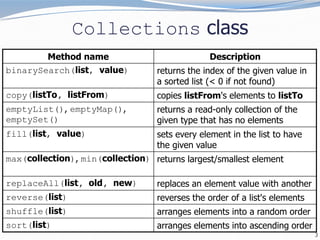
Collections class
Method name Description
binarySearch(list, value) returns the index of the given value in
a sorted list (< 0 if not found)
copy(listTo, listFrom) copies listFrom's elements to listTo
emptyList(), emptyMap(),
emptySet()
returns a read-only collection of the
given type that has no elements
fill(list, value) sets every element in the list to have
the given value
max(collection), min(collection) returns largest/smallest element
replaceAll(list, old, new) replaces an element value with another
reverse(list) reverses the order of a list's elements
shuffle(list) arranges elements into a random order
sort(list) arranges elements into ascending order
4
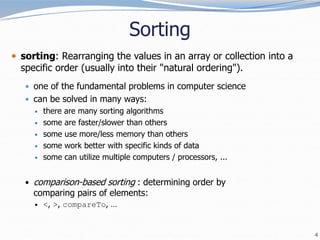
Sorting
 sorting: Rearranging the values in an array or collection into a
specific order (usually into their "natural ordering").
 one of the fundamental problems in computer science
 can be solved in many ways:
 there are many sorting algorithms
 some are faster/slower than others
 some use more/less memory than others
 some work better with specific kinds of data
 some can utilize multiple computers / processors, ...
 comparison-based sorting : determining order by
comparing pairs of elements:
 <, >, compareTo, …
5
Sorting methods in Java
 The Arrays and Collections classes in java.util have a
static method sort that sorts the elements of an array/list
String[] words = {"foo", "bar", "baz", "ball"};
Arrays.sort(words);
System.out.println(Arrays.toString(words));
// [ball, bar, baz, foo]
List<String> words2 = new ArrayList<String>();
for (String word : words) {
words2.add(word);
}
Collections.sort(words2);
System.out.println(words2);
// [ball, bar, baz, foo]
6
Sorting algorithms
 bogo sort: shuffle and pray
 bubble sort: swap adjacent pairs that are out of order
 selection sort: look for the smallest element, move to front
 insertion sort: build an increasingly large sorted front portion
 merge sort: recursively divide the array in half and sort it
 heap sort: place the values into a sorted tree structure
 quick sort: recursively partition array based on a middle value
other specialized sorting algorithms:
 bucket sort: cluster elements into smaller groups, sort them
 radix sort: sort integers by last digit, then 2nd to last, then ...
 ...
7
Bogo sort
 bogo sort: Orders a list of values by repetitively shuffling them and
checking if they are sorted.
 name comes from the word "bogus"
The algorithm:
 Scan the list, seeing if it is sorted. If so, stop.
 Else, shuffle the values in the list and repeat.
 This sorting algorithm (obviously) has terrible performance!
 What is its runtime?
8
Bogo sort code
// Places the elements of a into sorted order.
public static void bogoSort(int[] a) {
while (!isSorted(a)) {
shuffle(a);
}
}
// Returns true if a's elements are in sorted order.
public static boolean isSorted(int[] a) {
for (int i = 0; i < a.length - 1; i++) {
if (a[i] > a[i + 1]) {
return false;
}
}
return true;
}
9
Bogo sort code, cont'd.
// Shuffles an array of ints by randomly swapping each
// element with an element ahead of it in the array.
public static void shuffle(int[] a) {
for (int i = 0; i < a.length - 1; i++) {
// pick a random index in [i+1, a.length-1]
int range = a.length - 1 - (i + 1) + 1;
int j = (int) (Math.random() * range + (i + 1));
swap(a, i, j);
}
}
// Swaps a[i] with a[j].
public static void swap(int[] a, int i, int j) {
if (i != j) {
int temp = a[i];
a[i] = a[j];
a[j] = temp;
}
}
10
Selection sort
 selection sort: Orders a list of values by repeatedly putting the
smallest or largest unplaced value into its final position.
The algorithm:
 Look through the list to find the smallest value.
 Swap it so that it is at index 0.
 Look through the list to find the second-smallest value.
 Swap it so that it is at index 1.
...
 Repeat until all values are in their proper places.
11
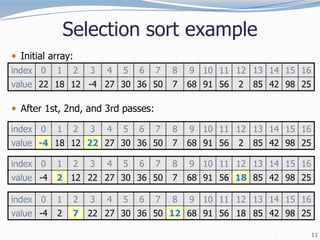
Selection sort example
 Initial array:
 After 1st, 2nd, and 3rd passes:
index 0 1 2 3 4 5 6 7 8 9 10 11 12 13 14 15 16
value 22 18 12 -4 27 30 36 50 7 68 91 56 2 85 42 98 25
index 0 1 2 3 4 5 6 7 8 9 10 11 12 13 14 15 16
value -4 18 12 22 27 30 36 50 7 68 91 56 2 85 42 98 25
index 0 1 2 3 4 5 6 7 8 9 10 11 12 13 14 15 16
value -4 2 12 22 27 30 36 50 7 68 91 56 18 85 42 98 25
index 0 1 2 3 4 5 6 7 8 9 10 11 12 13 14 15 16
value -4 2 7 22 27 30 36 50 12 68 91 56 18 85 42 98 25
12
Selection sort code
// Rearranges the elements of a into sorted order using
// the selection sort algorithm.
public static void selectionSort(int[] a) {
for (int i = 0; i < a.length - 1; i++) {
// find index of smallest remaining value
int min = i;
for (int j = i + 1; j < a.length; j++) {
if (a[j] < a[min]) {
min = j;
}
}
// swap smallest value its proper place, a[i]
swap(a, i, min);
}
}
13
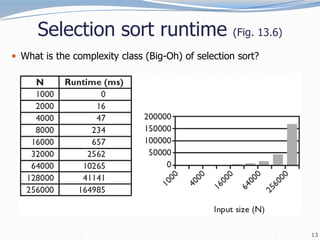
Selection sort runtime (Fig. 13.6)
 What is the complexity class (Big-Oh) of selection sort?
14
Similar algorithms
 bubble sort: Make repeated passes, swapping adjacent values
 slower than selection sort (has to do more swaps)
 insertion sort: Shift each element into a sorted sub-array
 faster than selection sort (examines fewer values)
index 0 1 2 3 4 5 6 7 8 9 10 11 12 13 14 15 16
value 22 18 12 -4 27 30 36 50 7 68 91 56 2 85 42 98 25
index 0 1 2 3 4 5 6 7 8 9 10 11 12 13 14 15 16
value 18 12 -4 22 27 30 36 7 50 68 56 2 85 42 91 25 98
22 50 91 98
index 0 1 2 3 4 5 6 7 8 9 10 11 12 13 14 15 16
value -4 12 18 22 27 30 36 50 7 68 91 56 2 85 42 98 25
7
sorted sub-array (indexes 0-7)
15
Merge sort
 merge sort: Repeatedly divides the data in half, sorts each half,
and combines the sorted halves into a sorted whole.
The algorithm:
 Divide the list into two roughly equal halves.
 Sort the left half.
 Sort the right half.
 Merge the two sorted halves into one sorted list.
 Often implemented recursively.
 An example of a "divide and conquer" algorithm.
 Invented by John von Neumann in 1945
16
Merge sort example
index 0 1 2 3 4 5 6 7
value 22 18 12 -4 58 7 31 42
22 18 12 -4
22 18
22 18
18 22
merge
split
12 -4
12 -4
-4 12
merge
split
split
-4 12 18 22
58 7 31 42
58 7
58 7
7 58
merge
split
31 42
31 42
31 42
merge
split
split
7 31 42 58
-4 7 12 18 22 31 42 58
split
merge merge
merge
17
Merge halves code
// Merges the left/right elements into a sorted result.
// Precondition: left/right are sorted
public static void merge(int[] result, int[] left,
int[] right) {
int i1 = 0; // index into left array
int i2 = 0; // index into right array
for (int i = 0; i < result.length; i++) {
if (i2 >= right.length ||
(i1 < left.length && left[i1] <= right[i2])) {
result[i] = left[i1]; // take from left
i1++;
} else {
result[i] = right[i2]; // take from right
i2++;
}
}
}
18
Merge sort code
// Rearranges the elements of a into sorted order using
// the merge sort algorithm.
public static void mergeSort(int[] a) {
// split array into two halves
int[] left = Arrays.copyOfRange(a, 0, a.length/2);
int[] right = Arrays.copyOfRange(a, a.length/2,
a.length);
// sort the two halves
...
// merge the sorted halves into a sorted whole
merge(a, left, right);
}
19
Merge sort code 2
// Rearranges the elements of a into sorted order using
// the merge sort algorithm (recursive).
public static void mergeSort(int[] a) {
if (a.length >= 2) {
// split array into two halves
int[] left = Arrays.copyOfRange(a, 0, a.length/2);
int[] right = Arrays.copyOfRange(a, a.length/2,
a.length);
// sort the two halves
mergeSort(left);
mergeSort(right);
// merge the sorted halves into a sorted whole
merge(a, left, right);
}
}
20
Merge sort runtime
 What is the complexity class (Big-Oh) of merge sort?

14-sorting (3).ppt

  • 1.
    Building Java Programs Chapter13 Sorting reading: 13.3, 13.4
  • 2.
    2 Perl is ascripting language generally used for text processing. Matches valid dates in m/d/y format: ^(?:(?:(?:0?[13578]|1[02])(/|-|.)31)1|(?:(?:0?[13-9]|1[0- 2])(/|-|.)(?:29|30)2))(?:(?:1[6-9]|[2- 9]d)?d{2})$|^(?:0?2(/|-|.)293(?:(?:(?:1[6-9]|[2- 9]d)?(?:0[48]|[2468][048]|[13579][26])|(?:(?:16|[2468][048] |[3579][26])00))))$|^(?:(?:0?[1-9])|(?:1[0-2]))(/|- |.)(?:0?[1-9]|1d|2[0-8])4(?:(?:1[6-9]|[2-9]d)?d{2})$ Seriously.
  • 3.
    3 Collections class Method nameDescription binarySearch(list, value) returns the index of the given value in a sorted list (< 0 if not found) copy(listTo, listFrom) copies listFrom's elements to listTo emptyList(), emptyMap(), emptySet() returns a read-only collection of the given type that has no elements fill(list, value) sets every element in the list to have the given value max(collection), min(collection) returns largest/smallest element replaceAll(list, old, new) replaces an element value with another reverse(list) reverses the order of a list's elements shuffle(list) arranges elements into a random order sort(list) arranges elements into ascending order
  • 4.
    4 Sorting  sorting: Rearrangingthe values in an array or collection into a specific order (usually into their "natural ordering").  one of the fundamental problems in computer science  can be solved in many ways:  there are many sorting algorithms  some are faster/slower than others  some use more/less memory than others  some work better with specific kinds of data  some can utilize multiple computers / processors, ...  comparison-based sorting : determining order by comparing pairs of elements:  <, >, compareTo, …
  • 5.
    5 Sorting methods inJava  The Arrays and Collections classes in java.util have a static method sort that sorts the elements of an array/list String[] words = {"foo", "bar", "baz", "ball"}; Arrays.sort(words); System.out.println(Arrays.toString(words)); // [ball, bar, baz, foo] List<String> words2 = new ArrayList<String>(); for (String word : words) { words2.add(word); } Collections.sort(words2); System.out.println(words2); // [ball, bar, baz, foo]
  • 6.
    6 Sorting algorithms  bogosort: shuffle and pray  bubble sort: swap adjacent pairs that are out of order  selection sort: look for the smallest element, move to front  insertion sort: build an increasingly large sorted front portion  merge sort: recursively divide the array in half and sort it  heap sort: place the values into a sorted tree structure  quick sort: recursively partition array based on a middle value other specialized sorting algorithms:  bucket sort: cluster elements into smaller groups, sort them  radix sort: sort integers by last digit, then 2nd to last, then ...  ...
  • 7.
    7 Bogo sort  bogosort: Orders a list of values by repetitively shuffling them and checking if they are sorted.  name comes from the word "bogus" The algorithm:  Scan the list, seeing if it is sorted. If so, stop.  Else, shuffle the values in the list and repeat.  This sorting algorithm (obviously) has terrible performance!  What is its runtime?
  • 8.
    8 Bogo sort code //Places the elements of a into sorted order. public static void bogoSort(int[] a) { while (!isSorted(a)) { shuffle(a); } } // Returns true if a's elements are in sorted order. public static boolean isSorted(int[] a) { for (int i = 0; i < a.length - 1; i++) { if (a[i] > a[i + 1]) { return false; } } return true; }
  • 9.
    9 Bogo sort code,cont'd. // Shuffles an array of ints by randomly swapping each // element with an element ahead of it in the array. public static void shuffle(int[] a) { for (int i = 0; i < a.length - 1; i++) { // pick a random index in [i+1, a.length-1] int range = a.length - 1 - (i + 1) + 1; int j = (int) (Math.random() * range + (i + 1)); swap(a, i, j); } } // Swaps a[i] with a[j]. public static void swap(int[] a, int i, int j) { if (i != j) { int temp = a[i]; a[i] = a[j]; a[j] = temp; } }
  • 10.
    10 Selection sort  selectionsort: Orders a list of values by repeatedly putting the smallest or largest unplaced value into its final position. The algorithm:  Look through the list to find the smallest value.  Swap it so that it is at index 0.  Look through the list to find the second-smallest value.  Swap it so that it is at index 1. ...  Repeat until all values are in their proper places.
  • 11.
    11 Selection sort example Initial array:  After 1st, 2nd, and 3rd passes: index 0 1 2 3 4 5 6 7 8 9 10 11 12 13 14 15 16 value 22 18 12 -4 27 30 36 50 7 68 91 56 2 85 42 98 25 index 0 1 2 3 4 5 6 7 8 9 10 11 12 13 14 15 16 value -4 18 12 22 27 30 36 50 7 68 91 56 2 85 42 98 25 index 0 1 2 3 4 5 6 7 8 9 10 11 12 13 14 15 16 value -4 2 12 22 27 30 36 50 7 68 91 56 18 85 42 98 25 index 0 1 2 3 4 5 6 7 8 9 10 11 12 13 14 15 16 value -4 2 7 22 27 30 36 50 12 68 91 56 18 85 42 98 25
  • 12.
    12 Selection sort code //Rearranges the elements of a into sorted order using // the selection sort algorithm. public static void selectionSort(int[] a) { for (int i = 0; i < a.length - 1; i++) { // find index of smallest remaining value int min = i; for (int j = i + 1; j < a.length; j++) { if (a[j] < a[min]) { min = j; } } // swap smallest value its proper place, a[i] swap(a, i, min); } }
  • 13.
    13 Selection sort runtime(Fig. 13.6)  What is the complexity class (Big-Oh) of selection sort?
  • 14.
    14 Similar algorithms  bubblesort: Make repeated passes, swapping adjacent values  slower than selection sort (has to do more swaps)  insertion sort: Shift each element into a sorted sub-array  faster than selection sort (examines fewer values) index 0 1 2 3 4 5 6 7 8 9 10 11 12 13 14 15 16 value 22 18 12 -4 27 30 36 50 7 68 91 56 2 85 42 98 25 index 0 1 2 3 4 5 6 7 8 9 10 11 12 13 14 15 16 value 18 12 -4 22 27 30 36 7 50 68 56 2 85 42 91 25 98 22 50 91 98 index 0 1 2 3 4 5 6 7 8 9 10 11 12 13 14 15 16 value -4 12 18 22 27 30 36 50 7 68 91 56 2 85 42 98 25 7 sorted sub-array (indexes 0-7)
  • 15.
    15 Merge sort  mergesort: Repeatedly divides the data in half, sorts each half, and combines the sorted halves into a sorted whole. The algorithm:  Divide the list into two roughly equal halves.  Sort the left half.  Sort the right half.  Merge the two sorted halves into one sorted list.  Often implemented recursively.  An example of a "divide and conquer" algorithm.  Invented by John von Neumann in 1945
  • 16.
    16 Merge sort example index0 1 2 3 4 5 6 7 value 22 18 12 -4 58 7 31 42 22 18 12 -4 22 18 22 18 18 22 merge split 12 -4 12 -4 -4 12 merge split split -4 12 18 22 58 7 31 42 58 7 58 7 7 58 merge split 31 42 31 42 31 42 merge split split 7 31 42 58 -4 7 12 18 22 31 42 58 split merge merge merge
  • 17.
    17 Merge halves code //Merges the left/right elements into a sorted result. // Precondition: left/right are sorted public static void merge(int[] result, int[] left, int[] right) { int i1 = 0; // index into left array int i2 = 0; // index into right array for (int i = 0; i < result.length; i++) { if (i2 >= right.length || (i1 < left.length && left[i1] <= right[i2])) { result[i] = left[i1]; // take from left i1++; } else { result[i] = right[i2]; // take from right i2++; } } }
  • 18.
    18 Merge sort code //Rearranges the elements of a into sorted order using // the merge sort algorithm. public static void mergeSort(int[] a) { // split array into two halves int[] left = Arrays.copyOfRange(a, 0, a.length/2); int[] right = Arrays.copyOfRange(a, a.length/2, a.length); // sort the two halves ... // merge the sorted halves into a sorted whole merge(a, left, right); }
  • 19.
    19 Merge sort code2 // Rearranges the elements of a into sorted order using // the merge sort algorithm (recursive). public static void mergeSort(int[] a) { if (a.length >= 2) { // split array into two halves int[] left = Arrays.copyOfRange(a, 0, a.length/2); int[] right = Arrays.copyOfRange(a, a.length/2, a.length); // sort the two halves mergeSort(left); mergeSort(right); // merge the sorted halves into a sorted whole merge(a, left, right); } }
  • 20.
    20 Merge sort runtime What is the complexity class (Big-Oh) of merge sort?