Return on
InvestmentReturn on your EQ-i®
investment
The EQ-i®
is the first scientifically validated emotional intelligence tool in the world.
That’s impressive, we agree… but your next question is likely, “but does it work?”
Emotional Intelligence &
Like most business people, you need to be bottom line focused
and show real results in order to get buy-in from your
key decision makers and clients.
In other words, you need to prove how the EQ-i will
really make a difference in:
• the TRAINING and DEVELOPMENT of your employees,
• the development of your LEADERS, and
• the SELECTION of highly qualified future leaders to your organization
We know what you’re up against. It’s not enough to say that it will work. You need to bring to the
table evidence of a clear return on investment; that is: clear statistics and research that link the
EQ-i to:
• Higher sales and profits
• Increased performance
• Improved customer satisfaction
• Decreased attrition rates
• Reduction in training costs
So we want you to hear it right from them and show you their stories of success. “They” are the
reputable organizations that have used the EQ-i and gone on to see exceptional performance
improvements, and real bottom line results. These success stories go beyond mere testimonials.
They give evidence of what you’re looking for: specific, measurable, and scientifically vali-
dated results that prove the EQ-i will be your most valuable and successful assessment tool for
selecting and developing leaders of tomorrow.
THE PROOF IS IN THE RESULTS…	
…and we have the results to prove it
American
Express (Case 1)
Purpose
To predict key characteristics associated with top performance from which
selection criteria can be generated
Results
This case study features information sourced from the 2007 and 2008 International Conference on
Emotional Intelligence materials.
Two different metrics were used to determine success in the role of customer focused sales associates:
customer satisfaction and sales. As part of a star performer study, MHS created four performance groups:
1) those who scored well on both metrics, 2) those who scored high on customer satisfaction and low in
sales, 3) those who scored high on sales and low in customer satisfaction, and 4) those who scored low
on both metrics. These representatives also completed the EQ-i assessment. Those who scored well on
both metrics had the highest EQ-i scores (see chart.)
ROI Impact
The EQ-i predictive model accounted for significant differences between high and low performing sales
representatives. The EQ-i accounted for:
• 48% of the variance in performance, or in other words, almost one-half of the skill set required
of a successful customer focused sales associate.
Takeaway
Using the EQ-i predictive model for Training and Recruitment leads to:
• Higher sales
• Better performance
11595
High Performance-Combined Metric
Low Performance-Combined Metric
High Client Satisfaction
High Sales
Total
EQ-i
100 105 110
Highest EQ-i
American
Express (Case 2)
Purpose
To develop a training and development program with a strong scientific basis as well as a
measurable implementation and evaluation process
Results
This case study features information sourced from the 2007 and 2008 International Conference on
Emotional Intelligence materials.
The EQ-i program was implemented within AMEX’s Consumer Card Service Delivery Network which
spanned four states and 2000 leaders. Departmental “teams” from AMEX were assessed as a group on
their EI skill sets. Each team worked on key challenge areas as identified through the EQ-i group report.
The most interesting outcome from this study was the subsequent evaluation which measured the pro-
gram impact in the short and long term. Using the Kirkpatrick model of evaluation (based on a 5.0 point
scale), the results from the EQ-i based leadership program were outstanding.
ROI Impact
A follow-up survey in 2004 was conducted with 50 AMEX leaders who completed the EI-based high
potential program and then were promoted. This survey showed that:
• 100% of respondents stated that knowing their EI strengths and
opportunities helped them in transitioning to a higher level role.
Takeaway
Using the EQ-i for Leadership Development generates:
• Smoother transitions to leadership roles = reduction in training costs
• Better leadership performance
900 People Surveyed
Level 1 (reaction) : averaged 5 out of 5 strongly agreed that EI program was
valuable, provided an awareness of EI strengths/opportunities and provided
information that could be leveraged to grow and/or improve.
Level 3 (behaviour): averaged 4.85 strongly agreed with the statement: “I have
become more effective in the EQ-i areas or skills I identified as development over
the past 6 months.”
Level 4 (results): averaged 4.14 out of 5 agreed with the statement: “I have
seen an improvement in a business metric due to my work on EQ areas.”
Fortune 100
Insurance Company
Purpose
To predict key characteristics associated with top performance and develop selection
criteria for future agents
Results
First, a subjective rating was used to determine performance levels amongst General Agents (GAs) at the
insurance company. Agents completed the EQ-i and were rated by two VPs as high or low performers.
The sales teams of the highly rated GAs significantly outperformed the other teams in terms of sales.
As you can see from the graph below, the EQ-i can be used to predict characteristics associated with
high performance. High performers consistently scored higher in most emotional intelligence character-
istics; most notably: assertiveness, self-actualization, empathy, problem solving, and happiness.
ROI Impact
The company looked at the four-year compound annual growth rate (CAGR) of their General Agent teams. 
For these high performer teams,
• Growth was 15%, much higher than the -1% achieved by the teams of the low performing GAs.
Takeaway
Using the EQ-i for Selection generates:
• Higher performing employees
• Decreased attrition rates
125
120
115
110
105
100
95
90
Self-Regard
EQ-iSubscaleScores
EQ-i Subscales
Em
otionalSelf-Awareness
Assertiveness
Independence
Self-ActualizationEm
pathy
SocialResponsibility
InterpersonalRelationships
StressTolerance
Im
pulse
Control
RealityTestingFlexibility
Problem
SolvingOptim
ismHappiness
High Performers		 Low Performers
High EQ-i =
High Performers
United States Air Force (Case 1)
Purpose
To determine the differences between successful and unsuccessful United States Air Force
recruiters in order to decrease attrition
Results
In 1995, USAF recruiters were suffering from high rates of first-year turnover. In their efforts to increase
recruiter retention, the USAF used the EQ-i assessment to study the differences between successful
and unsuccessful recruiters. Notable score differences between the two groups were evident in areas
such as: assertiveness, self-actualization, stress tolerance, flexibility, problem solving, and happiness.
ROI Impact
Using their findings from the EQ-i, the USAF developed a
pre-employment screening system. These findings led to the following:
• 92% increase in retention,
• $2.7-million in training cost savings in the first year alone,
• a report to a congressional sub-committee stating that Air Force
recruiters are twice as productive as recruiters in other branches
of the armed forces. (Gourville, 2000; Handley, 1997).
Takeaway
Using the EQ-i predictive model for Selection generates:
• Large reductions in training costs
• Decreased attrition rates
• Increased productivity
104
102
100
98
96
94
92
90
Self-Regard
EQ-iSubscaleScores
EQ-i Subscales
Em
otionalSelf-Awareness
Assertiveness
Independence
Self-ActualizationEm
pathy
SocialResponsibility
InterpersonalRelationships
StressTolerance
Im
pulse
Control
RealityTestingFlexibility
Problem
SolvingOptim
ismHappiness
High EQ-i =
Successful
New Recruits
Successful New Recruits		
Unsuccessful New Recruits
United States Air Force (Case 2)
Purpose
To explore the impact of emotional intelligence skills on the success of USAF Pararescue
Jumper (PJ) trainees
Results
In 2009, approximately 82% of those who entered the USAF PJ training were not successfully complet-
ing the program. As part of the recruiting process, trainees had been asked to demonstrate the required
cognitive and physical abilities. The Air Force was further interested in exploring the impact of other fac-
tors, namely emotional intelligence skills, on trainee success. Comparing the EQ-i scores of trainees who
completed the program versus those who did not, five factors were linked to successful completion of
the program: flexibility, optimism, self-regard, happiness, and reality testing. In fact, trainees who scored
higher in these areas were two to three times more likely to successfully complete the program.
ROI Impact
This powerful information will be used by the Air Force to
offer guidance to trainees regarding their potential for success in the
program. The Air Force estimates the potential savings/cost avoidance at:
• $19 million per year in training costs.
Takeaway
Using the EQ-i predictive model for Selection and Training generates:
• Large reductions in training costs
• Reduced attrition rates
113
111
109
107
105
103
101
99
97
Self-Regard
EQ-i Subscales
Em
otionalSelf-Awareness
Assertiveness
Independence
Self-ActualizationEm
pathy
SocialResponsibility
InterpersonalRelationships
StressTolerance
Im
pulse
Control
RealityTestingFlexibility
Problem
SolvingOptim
ismHappiness
High EQ-i =
Successful
New Recruits
Successful New Recruits		
Unsuccessful New Recruits
EQ-iSubscaleScores
11595
High Performers
Low Performers
Total
EQ-i
100 105 110
115
110
105
100
95
90
Self-Regard
EQ-iSubscaleScores
EQ-i Subscales
Em
otionalSelf-Awareness
Assertiveness
Independence
Self-ActualizationEm
pathy
SocialResponsibility
InterpersonalRelationships
StressTolerance
Im
pulse
Control
RealityTestingFlexibility
Problem
SolvingOptim
ismHappiness
High EQ-i =
High Performers
High Performers
Low Performers
New Zealand Telecom
Purpose
To understand the relationship between EQ-i and leadership competencies to enhance the
training and coaching of leaders in their organization
Results
New Zealand Telecom categorized 70 senior leaders into high and low performance groups based on
established leadership performance indicators. As shown below, high performers had significantly higher
EQ-i scores than the lower performers.
The chart below maps out the most important emotional and social skills for achieving success amongst
leaders in the Telecom organization, most notably: self-actualization, stress tolerance, and happiness.
ROI Impact
The EQ-i study resulted in significant bottom line findings that New Zealand Telecom now integrates into
their training and coaching initiatives.
• 48% of what differentiated the high and low performing leaders could be attributed to EI
attributes. In other words, almost one-half of the skill set required for successful execution
of this organization’s leadership competencies is comprised of emotional and social skills.
Takeaway
Using the EQ-i predictive model for Training and Coaching generates:
• A roadmap for leadership success
• Better performing leaders
Debt Collection Agency
Purpose
To assess the secrets to success in recovering client money
Results
The EQ-i assessment was completed by the company’s most and least succesful collections agents. The
more successful collection agents had significantly elevated scores in areas that you might guess would be
important for conducting collections work; areas such as: assertiveness, independence and problem solv-
ing. Other important attributes that perhaps are less obvious include: self-actualization, happiness, and the
“right” mix of empathy and impulse control. We say the right “mix”, because having “more” empathy or im-
pulse control is not always the best thing.  In the case of debt collectors, the higher performers scored sig-
nificantly lower than their low performing co-workers on empathy and impulse control. EQ-i analysts must
look at the right mix that works for high performers from specific companies and industries.
ROI Impact
The results for this study were obtained over a six-month period, with significant findings:
• Superior collectors brought in 100% of their quotas, compared with their less successful peers,
who languished at 47 percent.
• Collectors who were hired according to the new EQ-i model and were also trained against the new
criteria, achieved 163% to objective in their first year. Even low performers who had EQ-i training
brought in 80% of quota within 3 months.
Takeaway
Using the EQ-i predictive model for Recruitment and Training generates:
• Higher performing recruits
• Higher performance from otherwise low performers
High Cash Collectors		 Low Cash Collectors
115
110
105
100
95
EQ-iSubscaleScores
EQ-i Subscales
Assertiveness
IndependenceSelf-Actualization
Em
pathy
Im
pulse
ControlProblem
Solving
Optim
ism
Happiness
The “right” mix
of EQ-i skills =
High Cash
Collectors
Center for Creative
Leadership (CCL)
Purpose
To evaluate key emotional intelligence characteristics that define high performing leaders
Results
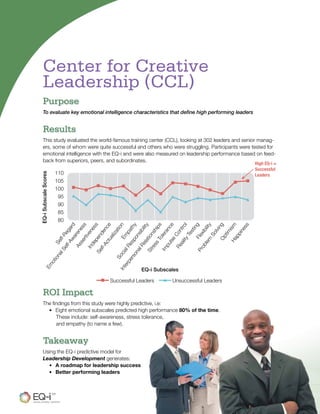
This study evaluated the world-famous training center (CCL), looking at 302 leaders and senior manag-
ers, some of whom were quite successful and others who were struggling. Participants were tested for
emotional intelligence with the EQ-i and were also measured on leadership performance based on feed-
back from superiors, peers, and subordinates.
ROI Impact
The findings from this study were highly predictive, i.e:
• Eight emotional subscales predicted high performance 80% of the time.
These include: self-awareness, stress tolerance,
and empathy (to name a few).
Takeaway
Using the EQ-i predictive model for
Leadership Development generates:
• A roadmap for leadership success
• Better performing leaders
110
105
100
95
90
85
80
Self-Regard
EQ-iSubscaleScores
EQ-i Subscales
Em
otionalSelf-Awareness
Assertiveness
Independence
Self-ActualizationEm
pathy
SocialResponsibility
InterpersonalRelationships
StressTolerance
Im
pulse
Control
RealityTestingFlexibility
Problem
SolvingOptim
ismHappiness
Successful Leaders	 Unsuccessful Leaders
High EQ-i =
Successful
Leaders
CIBC
Purpose
To determine key emotional intelligence characteristics
that define successful sales representatives at CIBC
Results
The CIBC Global Private Banking and Trust team conducted a study where their high and low performing
sales representatives were given the EQ-i assessment. Many EI skill-sets are clearly conducive to higher
performance. As shown in the chart below, the two key EI skill-sets for success were interpersonal skills
and self-actualization. Interestingly, having a lower score in impulse control in combination with higher
scores in other EI areas, translated into higher performance amongst sales representatives.
ROI Impact
CIBC now uses the EQ-i study results as a predictive model for both the selection of new personnel and
in leadership development. This is because they found that:
• An individual’s EQ-i test scores accounted for 32% of his or her booked sales and
71% of pipeline sales.
Takeaway
Using the EQ-i predictive model for Selection and Leadership Development generates:
• Better selection of sales representatives
• Higher performance from sales representatives
112
109
106
103
100
97
94
91
Self-Regard
EQ-iSubscaleScores
EQ-i Subscales
Em
otionalSelf-Awareness
Assertiveness
Independence
Self-ActualizationEm
pathy
SocialResponsibility
InterpersonalRelationships
StressTolerance
Im
pulse
Control
RealityTestingFlexibility
Problem
SolvingOptim
ismHappiness
Successful Sales Associates	 Unsuccessful Sales Associates
High EQ-i =
Successful
Sales Associates
Call: 808-792-3688

MHS_Brief_ROI_Edited

  • 1.
    Return on InvestmentReturn onyour EQ-i® investment The EQ-i® is the first scientifically validated emotional intelligence tool in the world. That’s impressive, we agree… but your next question is likely, “but does it work?” Emotional Intelligence &
  • 2.
    Like most businesspeople, you need to be bottom line focused and show real results in order to get buy-in from your key decision makers and clients. In other words, you need to prove how the EQ-i will really make a difference in: • the TRAINING and DEVELOPMENT of your employees, • the development of your LEADERS, and • the SELECTION of highly qualified future leaders to your organization We know what you’re up against. It’s not enough to say that it will work. You need to bring to the table evidence of a clear return on investment; that is: clear statistics and research that link the EQ-i to: • Higher sales and profits • Increased performance • Improved customer satisfaction • Decreased attrition rates • Reduction in training costs So we want you to hear it right from them and show you their stories of success. “They” are the reputable organizations that have used the EQ-i and gone on to see exceptional performance improvements, and real bottom line results. These success stories go beyond mere testimonials. They give evidence of what you’re looking for: specific, measurable, and scientifically vali- dated results that prove the EQ-i will be your most valuable and successful assessment tool for selecting and developing leaders of tomorrow. THE PROOF IS IN THE RESULTS… …and we have the results to prove it
  • 3.
    American Express (Case 1) Purpose Topredict key characteristics associated with top performance from which selection criteria can be generated Results This case study features information sourced from the 2007 and 2008 International Conference on Emotional Intelligence materials. Two different metrics were used to determine success in the role of customer focused sales associates: customer satisfaction and sales. As part of a star performer study, MHS created four performance groups: 1) those who scored well on both metrics, 2) those who scored high on customer satisfaction and low in sales, 3) those who scored high on sales and low in customer satisfaction, and 4) those who scored low on both metrics. These representatives also completed the EQ-i assessment. Those who scored well on both metrics had the highest EQ-i scores (see chart.) ROI Impact The EQ-i predictive model accounted for significant differences between high and low performing sales representatives. The EQ-i accounted for: • 48% of the variance in performance, or in other words, almost one-half of the skill set required of a successful customer focused sales associate. Takeaway Using the EQ-i predictive model for Training and Recruitment leads to: • Higher sales • Better performance 11595 High Performance-Combined Metric Low Performance-Combined Metric High Client Satisfaction High Sales Total EQ-i 100 105 110 Highest EQ-i
  • 4.
    American Express (Case 2) Purpose Todevelop a training and development program with a strong scientific basis as well as a measurable implementation and evaluation process Results This case study features information sourced from the 2007 and 2008 International Conference on Emotional Intelligence materials. The EQ-i program was implemented within AMEX’s Consumer Card Service Delivery Network which spanned four states and 2000 leaders. Departmental “teams” from AMEX were assessed as a group on their EI skill sets. Each team worked on key challenge areas as identified through the EQ-i group report. The most interesting outcome from this study was the subsequent evaluation which measured the pro- gram impact in the short and long term. Using the Kirkpatrick model of evaluation (based on a 5.0 point scale), the results from the EQ-i based leadership program were outstanding. ROI Impact A follow-up survey in 2004 was conducted with 50 AMEX leaders who completed the EI-based high potential program and then were promoted. This survey showed that: • 100% of respondents stated that knowing their EI strengths and opportunities helped them in transitioning to a higher level role. Takeaway Using the EQ-i for Leadership Development generates: • Smoother transitions to leadership roles = reduction in training costs • Better leadership performance 900 People Surveyed Level 1 (reaction) : averaged 5 out of 5 strongly agreed that EI program was valuable, provided an awareness of EI strengths/opportunities and provided information that could be leveraged to grow and/or improve. Level 3 (behaviour): averaged 4.85 strongly agreed with the statement: “I have become more effective in the EQ-i areas or skills I identified as development over the past 6 months.” Level 4 (results): averaged 4.14 out of 5 agreed with the statement: “I have seen an improvement in a business metric due to my work on EQ areas.”
  • 5.
    Fortune 100 Insurance Company Purpose Topredict key characteristics associated with top performance and develop selection criteria for future agents Results First, a subjective rating was used to determine performance levels amongst General Agents (GAs) at the insurance company. Agents completed the EQ-i and were rated by two VPs as high or low performers. The sales teams of the highly rated GAs significantly outperformed the other teams in terms of sales. As you can see from the graph below, the EQ-i can be used to predict characteristics associated with high performance. High performers consistently scored higher in most emotional intelligence character- istics; most notably: assertiveness, self-actualization, empathy, problem solving, and happiness. ROI Impact The company looked at the four-year compound annual growth rate (CAGR) of their General Agent teams.  For these high performer teams, • Growth was 15%, much higher than the -1% achieved by the teams of the low performing GAs. Takeaway Using the EQ-i for Selection generates: • Higher performing employees • Decreased attrition rates 125 120 115 110 105 100 95 90 Self-Regard EQ-iSubscaleScores EQ-i Subscales Em otionalSelf-Awareness Assertiveness Independence Self-ActualizationEm pathy SocialResponsibility InterpersonalRelationships StressTolerance Im pulse Control RealityTestingFlexibility Problem SolvingOptim ismHappiness High Performers Low Performers High EQ-i = High Performers
  • 6.
    United States AirForce (Case 1) Purpose To determine the differences between successful and unsuccessful United States Air Force recruiters in order to decrease attrition Results In 1995, USAF recruiters were suffering from high rates of first-year turnover. In their efforts to increase recruiter retention, the USAF used the EQ-i assessment to study the differences between successful and unsuccessful recruiters. Notable score differences between the two groups were evident in areas such as: assertiveness, self-actualization, stress tolerance, flexibility, problem solving, and happiness. ROI Impact Using their findings from the EQ-i, the USAF developed a pre-employment screening system. These findings led to the following: • 92% increase in retention, • $2.7-million in training cost savings in the first year alone, • a report to a congressional sub-committee stating that Air Force recruiters are twice as productive as recruiters in other branches of the armed forces. (Gourville, 2000; Handley, 1997). Takeaway Using the EQ-i predictive model for Selection generates: • Large reductions in training costs • Decreased attrition rates • Increased productivity 104 102 100 98 96 94 92 90 Self-Regard EQ-iSubscaleScores EQ-i Subscales Em otionalSelf-Awareness Assertiveness Independence Self-ActualizationEm pathy SocialResponsibility InterpersonalRelationships StressTolerance Im pulse Control RealityTestingFlexibility Problem SolvingOptim ismHappiness High EQ-i = Successful New Recruits Successful New Recruits Unsuccessful New Recruits
  • 7.
    United States AirForce (Case 2) Purpose To explore the impact of emotional intelligence skills on the success of USAF Pararescue Jumper (PJ) trainees Results In 2009, approximately 82% of those who entered the USAF PJ training were not successfully complet- ing the program. As part of the recruiting process, trainees had been asked to demonstrate the required cognitive and physical abilities. The Air Force was further interested in exploring the impact of other fac- tors, namely emotional intelligence skills, on trainee success. Comparing the EQ-i scores of trainees who completed the program versus those who did not, five factors were linked to successful completion of the program: flexibility, optimism, self-regard, happiness, and reality testing. In fact, trainees who scored higher in these areas were two to three times more likely to successfully complete the program. ROI Impact This powerful information will be used by the Air Force to offer guidance to trainees regarding their potential for success in the program. The Air Force estimates the potential savings/cost avoidance at: • $19 million per year in training costs. Takeaway Using the EQ-i predictive model for Selection and Training generates: • Large reductions in training costs • Reduced attrition rates 113 111 109 107 105 103 101 99 97 Self-Regard EQ-i Subscales Em otionalSelf-Awareness Assertiveness Independence Self-ActualizationEm pathy SocialResponsibility InterpersonalRelationships StressTolerance Im pulse Control RealityTestingFlexibility Problem SolvingOptim ismHappiness High EQ-i = Successful New Recruits Successful New Recruits Unsuccessful New Recruits EQ-iSubscaleScores
  • 8.
    11595 High Performers Low Performers Total EQ-i 100105 110 115 110 105 100 95 90 Self-Regard EQ-iSubscaleScores EQ-i Subscales Em otionalSelf-Awareness Assertiveness Independence Self-ActualizationEm pathy SocialResponsibility InterpersonalRelationships StressTolerance Im pulse Control RealityTestingFlexibility Problem SolvingOptim ismHappiness High EQ-i = High Performers High Performers Low Performers New Zealand Telecom Purpose To understand the relationship between EQ-i and leadership competencies to enhance the training and coaching of leaders in their organization Results New Zealand Telecom categorized 70 senior leaders into high and low performance groups based on established leadership performance indicators. As shown below, high performers had significantly higher EQ-i scores than the lower performers. The chart below maps out the most important emotional and social skills for achieving success amongst leaders in the Telecom organization, most notably: self-actualization, stress tolerance, and happiness. ROI Impact The EQ-i study resulted in significant bottom line findings that New Zealand Telecom now integrates into their training and coaching initiatives. • 48% of what differentiated the high and low performing leaders could be attributed to EI attributes. In other words, almost one-half of the skill set required for successful execution of this organization’s leadership competencies is comprised of emotional and social skills. Takeaway Using the EQ-i predictive model for Training and Coaching generates: • A roadmap for leadership success • Better performing leaders
  • 9.
    Debt Collection Agency Purpose Toassess the secrets to success in recovering client money Results The EQ-i assessment was completed by the company’s most and least succesful collections agents. The more successful collection agents had significantly elevated scores in areas that you might guess would be important for conducting collections work; areas such as: assertiveness, independence and problem solv- ing. Other important attributes that perhaps are less obvious include: self-actualization, happiness, and the “right” mix of empathy and impulse control. We say the right “mix”, because having “more” empathy or im- pulse control is not always the best thing.  In the case of debt collectors, the higher performers scored sig- nificantly lower than their low performing co-workers on empathy and impulse control. EQ-i analysts must look at the right mix that works for high performers from specific companies and industries. ROI Impact The results for this study were obtained over a six-month period, with significant findings: • Superior collectors brought in 100% of their quotas, compared with their less successful peers, who languished at 47 percent. • Collectors who were hired according to the new EQ-i model and were also trained against the new criteria, achieved 163% to objective in their first year. Even low performers who had EQ-i training brought in 80% of quota within 3 months. Takeaway Using the EQ-i predictive model for Recruitment and Training generates: • Higher performing recruits • Higher performance from otherwise low performers High Cash Collectors Low Cash Collectors 115 110 105 100 95 EQ-iSubscaleScores EQ-i Subscales Assertiveness IndependenceSelf-Actualization Em pathy Im pulse ControlProblem Solving Optim ism Happiness The “right” mix of EQ-i skills = High Cash Collectors
  • 10.
    Center for Creative Leadership(CCL) Purpose To evaluate key emotional intelligence characteristics that define high performing leaders Results This study evaluated the world-famous training center (CCL), looking at 302 leaders and senior manag- ers, some of whom were quite successful and others who were struggling. Participants were tested for emotional intelligence with the EQ-i and were also measured on leadership performance based on feed- back from superiors, peers, and subordinates. ROI Impact The findings from this study were highly predictive, i.e: • Eight emotional subscales predicted high performance 80% of the time. These include: self-awareness, stress tolerance, and empathy (to name a few). Takeaway Using the EQ-i predictive model for Leadership Development generates: • A roadmap for leadership success • Better performing leaders 110 105 100 95 90 85 80 Self-Regard EQ-iSubscaleScores EQ-i Subscales Em otionalSelf-Awareness Assertiveness Independence Self-ActualizationEm pathy SocialResponsibility InterpersonalRelationships StressTolerance Im pulse Control RealityTestingFlexibility Problem SolvingOptim ismHappiness Successful Leaders Unsuccessful Leaders High EQ-i = Successful Leaders
  • 11.
    CIBC Purpose To determine keyemotional intelligence characteristics that define successful sales representatives at CIBC Results The CIBC Global Private Banking and Trust team conducted a study where their high and low performing sales representatives were given the EQ-i assessment. Many EI skill-sets are clearly conducive to higher performance. As shown in the chart below, the two key EI skill-sets for success were interpersonal skills and self-actualization. Interestingly, having a lower score in impulse control in combination with higher scores in other EI areas, translated into higher performance amongst sales representatives. ROI Impact CIBC now uses the EQ-i study results as a predictive model for both the selection of new personnel and in leadership development. This is because they found that: • An individual’s EQ-i test scores accounted for 32% of his or her booked sales and 71% of pipeline sales. Takeaway Using the EQ-i predictive model for Selection and Leadership Development generates: • Better selection of sales representatives • Higher performance from sales representatives 112 109 106 103 100 97 94 91 Self-Regard EQ-iSubscaleScores EQ-i Subscales Em otionalSelf-Awareness Assertiveness Independence Self-ActualizationEm pathy SocialResponsibility InterpersonalRelationships StressTolerance Im pulse Control RealityTestingFlexibility Problem SolvingOptim ismHappiness Successful Sales Associates Unsuccessful Sales Associates High EQ-i = Successful Sales Associates
  • 12.