









Emotional Intelligence: 
Aligning Intent & Impact 
The Foundation for Medical Excellence 
Lisa Goren
IS MEANING… 
"What man actually needs is not a tensionless state but 
rather the striving and struggling for some goal worthy 
of him. 
What he needs is not the discharge of tension at any 
cost, but the call of a potential meaning waiting to be 
fulfilled by him." 
– Victor Frankl, “Man’s Search for Meaning”
UNCOVERING YOUR MEANING 
• How would those closest to you describe you? 
• What are you unwilling to compromise on? 
• What guides your thoughts, decisions and 
behaviors? 
• What do you stand for? (not, what are you good at)
The ideal destination…
JOURNEY
Is not always the ideal 
journey…
DESINTATION
“In medicine, we often forget that leadership is really 
about leading people. We often substitute fund of 
knowledge, clinical skills, seniority, even income – but 
those are only attributes and ultimately have little to 
do with true leadership… 
10/16/14 LEGACY HEALTH 10
…Leadership is the ability to listen, translate, decide 
and motivate others. The lack of leadership is often 
more apparent in hospitals, medical schools and health 
care organizations because we’re not trained to 
recognize true leadership.” 
--Dr. Freddie Chen 
10/16/14 LEGACY HEALTH 11
OBJECTIVES 
• Define Emotional Intelligence 
• Understand the link between (awareness) and 
impact (behavior) in personal and professional 
interactions 
• Learn strategies for improving well-being through 
leveraging Emotional Intelligence
What is Emotional Intelligence? 
Emotional intelligence is not about being nice all the time. 
It is about being honest. 
Emotional intelligence is not about being “touchy-feely.” 
It is about being aware of your feelings, and those of 
others. 
Emotional intelligence is not about being emotional. 
It is about being smart with your emotions.
“We are being judged by a new yardstick; not just 
how smart we are, or by our training and expertise, 
but also how well we handle ourselves and each 
other.” 
--Daniel Goleman, Ph.D.
EMOTIONAL INTELLIGENCE (EQ) 
Includes high degrees of self-awareness, 
self-regulation, motivation, empathy, and 
social skill. 
Goleman, 1995
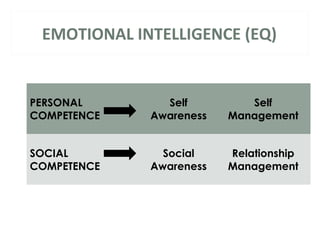
EMOTIONAL INTELLIGENCE (EQ) 
PERSONAL 
COMPETENCE 
Self 
Awareness 
Self 
Management 
SOCIAL 
COMPETENCE 
Social 
Awareness 
Relationship 
Management
EMOTIONAL INTELLIGENCE (EQ) 
• Self-awareness - ability to read one's emotions and 
recognize their impact while using gut feeling to 
guide decisions 
• Self-management – ability to control one's 
emotions and impulses and adapt to changing 
circumstances 
Goleman, 1998
EMOTIONAL INTELLIGENCE (EQ) 
• Social awareness - ability to sense, understand, and 
react to other's emotions while comprehending 
social networks 
• Relationship management - the ability to inspire, 
influence, and develop others while managing 
conflict 
Goleman, 1998
IT’S REALLY ABOUT ATTENTION 
• Attention is constantly under assault from internal and 
external stimuli 
• Effective leadership is based on knowing what to focus on 
• Cultivating the ability to harness one’s attention is a 
differentiator 
• Focused leaders can command a full range of their own 
attention 
You can’t be mindful if you’re mindfull
IMAGINE IF YOU COULD… 
• Be in touch with your internal world, 
• Control your impulses, 
• Be aware of how others see you 
•Weed out distractions 
What would be possible?
Cultivating your Emotional Intelligence is 
key to your success
THREE KEY QUESTIONS 
• Who am I? 
• Self-Awareness & Self-Management 
• Who are you? 
• Awareness of others & Relational-Management 
• Who are we? 
• Awareness of the team & Team Management
Key Question #1: Who am I?
Learning Emotions
LEARNING EMOTIONS 
• Growing up 
•Medical school 
• Practice 
• Life events
EMOTIONAL AVOIDANCE 
• Creating distractions- Mindless behaviors, 
addictions, electronics, crammed schedule 
• Choosing a default- Anger, joking, sadness, 
blame 
• Shutting off- Disconnecting from any emotion
EMOTIONAL ABUNDANCE 
• Empathy—Creating understanding & support 
• Humor—Creating space for learning and growth 
• Courage—Taking risks and sticking with it 
• Vulnerability—Revealing and making mistakes 
• Optimism—Encouraging hope & innovation
FROM THE INSIDE OUT 
• What three adjectives you would use to describe 
your personality? 
• How do these change on good days vs. bad days? 
• Using a scale of 1-10, how do you rate your ability to 
connect and build rapport?
FROM THE OUTSIDE IN 
• What three adjectives would others use to describe 
your personality? 
• How do these change on good days vs. bad days? 
• If others were using a scale of 1-10, how would they 
rate your ability to connect and build rapport?
MIND THE GAP 
• What do you notice about differences between 
‘good’ days and ‘bad’ days? 
• What do you notice about differences between your 
perspective and the perspective of others? 
• Realizations or ah ha’s?
Key Question #2: 
Who are you?
EMOTIONAL INTELLIGENCE (EI) 
• IQ and technical skills are considered ‘threshold 
capabilities’— they are entry level requirements, or 
“what helps you get the job” 
• EQ is proving to be the strongest indicator of success 
in the work world – contributing to leadership 
success as much as 85-90%* 
*Nadler, Reldan S., Leading with Emotional Intelligence
“Physician leaders are working in rapidly evolving systems and 
must respond to increasing and changing demands. Emotional 
Intelligence correlates significantly and positively with job 
performance beyond that which can be explained by cognitive 
ability and other personality factors.” 
(Monroe & English, 2013)
MOOD CONTAGION & 
OUR SOCIAL BRAINS 
• Our social brains cause us to transfer emotions 
• Unintentional imitation of mood behavior 
• Induces mood state 
• Induces behavioral congruence 
• The person with the most power sets the tone 
(Neumann & Strack, 2000) (Goleman, 2014)
DEFINING IMPACT 
1. To strike one thing against another; forceful 
contact; collision 
2. To drive or press closely or firmly into something; 
pack in; congest 
3. To influence or have an effect on 
(Dictionary.com) 
10/16/14 LEGACY HEALTH 36
A PHYSICIAN’S IMPACT 
• Being ‘on stage’ 
• Having the loudest voice 
• Setting a tone 
• Changing a mood 
• Creating ‘truths’ 
• Modeling what is acceptable 
10/16/14 LEGACY HEALTH 37
Key Question #3: Who are we?
AN EPIDEMIC 
• Medical errors would rank 5th on the list of top ten 
causes of death in the US 
• Lack of effective communication and collaboration as 
leading contributor to medical errors 
(Joint Commission, 2005)
BARRIERS TO COLLABORATION 
•Working in silos 
• Autonomy 
• Low trust 
• Poor communication 
• Power 
• Unclear roles/responsibilities/accountability 
• Disruptive behavior 
• Too much to do in too little time
NOTICING 
• How would outsiders describe your team? 
• How does your team interact on a good day? 
• How does your team interact on a bad day? 
• How does your team recover from bad days?
Can EI be learned?
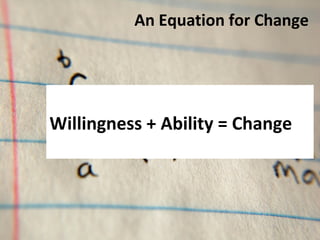
An Equation for Change 
Willingness + Ability = Change
A SUCKER’S CHOICE 
• You don’t have to choose between thinking & feeling 
• Value both forms of intellect 
• Learn to integrate and leverage strengths of both
This will just 
be a little 
uncomfortable…
BUILDING EI MUSCLES 
• Minimize distractions through cultivating mindfulness 
• Perform a brief emotional check up 
• Check in with others directly and through observation 
• Air, food, water, shelter 
• Engage optimism 
• Watch yourself from the outside 
• Find an outlet 
• Take accountability 
• Exercise forgiveness & empathy
THANK YOU 
Lisa Goren 
Program Director 
Physician Alignment & Engagement 
Legacy Health 
lgoren@lhs.org

L goren plenary emotional intelligence

  • 1.
    Emotional Intelligence: AligningIntent & Impact The Foundation for Medical Excellence Lisa Goren
  • 4.
    IS MEANING… "Whatman actually needs is not a tensionless state but rather the striving and struggling for some goal worthy of him. What he needs is not the discharge of tension at any cost, but the call of a potential meaning waiting to be fulfilled by him." – Victor Frankl, “Man’s Search for Meaning”
  • 5.
    UNCOVERING YOUR MEANING • How would those closest to you describe you? • What are you unwilling to compromise on? • What guides your thoughts, decisions and behaviors? • What do you stand for? (not, what are you good at)
  • 6.
  • 7.
  • 8.
    Is not alwaysthe ideal journey…
  • 9.
  • 10.
    “In medicine, weoften forget that leadership is really about leading people. We often substitute fund of knowledge, clinical skills, seniority, even income – but those are only attributes and ultimately have little to do with true leadership… 10/16/14 LEGACY HEALTH 10
  • 11.
    …Leadership is theability to listen, translate, decide and motivate others. The lack of leadership is often more apparent in hospitals, medical schools and health care organizations because we’re not trained to recognize true leadership.” --Dr. Freddie Chen 10/16/14 LEGACY HEALTH 11
  • 12.
    OBJECTIVES • DefineEmotional Intelligence • Understand the link between (awareness) and impact (behavior) in personal and professional interactions • Learn strategies for improving well-being through leveraging Emotional Intelligence
  • 13.
    What is EmotionalIntelligence? Emotional intelligence is not about being nice all the time. It is about being honest. Emotional intelligence is not about being “touchy-feely.” It is about being aware of your feelings, and those of others. Emotional intelligence is not about being emotional. It is about being smart with your emotions.
  • 14.
    “We are beingjudged by a new yardstick; not just how smart we are, or by our training and expertise, but also how well we handle ourselves and each other.” --Daniel Goleman, Ph.D.
  • 15.
    EMOTIONAL INTELLIGENCE (EQ) Includes high degrees of self-awareness, self-regulation, motivation, empathy, and social skill. Goleman, 1995
  • 16.
    EMOTIONAL INTELLIGENCE (EQ) PERSONAL COMPETENCE Self Awareness Self Management SOCIAL COMPETENCE Social Awareness Relationship Management
  • 17.
    EMOTIONAL INTELLIGENCE (EQ) • Self-awareness - ability to read one's emotions and recognize their impact while using gut feeling to guide decisions • Self-management – ability to control one's emotions and impulses and adapt to changing circumstances Goleman, 1998
  • 18.
    EMOTIONAL INTELLIGENCE (EQ) • Social awareness - ability to sense, understand, and react to other's emotions while comprehending social networks • Relationship management - the ability to inspire, influence, and develop others while managing conflict Goleman, 1998
  • 19.
    IT’S REALLY ABOUTATTENTION • Attention is constantly under assault from internal and external stimuli • Effective leadership is based on knowing what to focus on • Cultivating the ability to harness one’s attention is a differentiator • Focused leaders can command a full range of their own attention You can’t be mindful if you’re mindfull
  • 20.
    IMAGINE IF YOUCOULD… • Be in touch with your internal world, • Control your impulses, • Be aware of how others see you •Weed out distractions What would be possible?
  • 21.
    Cultivating your EmotionalIntelligence is key to your success
  • 22.
    THREE KEY QUESTIONS • Who am I? • Self-Awareness & Self-Management • Who are you? • Awareness of others & Relational-Management • Who are we? • Awareness of the team & Team Management
  • 23.
  • 24.
  • 25.
    LEARNING EMOTIONS •Growing up •Medical school • Practice • Life events
  • 26.
    EMOTIONAL AVOIDANCE •Creating distractions- Mindless behaviors, addictions, electronics, crammed schedule • Choosing a default- Anger, joking, sadness, blame • Shutting off- Disconnecting from any emotion
  • 27.
    EMOTIONAL ABUNDANCE •Empathy—Creating understanding & support • Humor—Creating space for learning and growth • Courage—Taking risks and sticking with it • Vulnerability—Revealing and making mistakes • Optimism—Encouraging hope & innovation
  • 28.
    FROM THE INSIDEOUT • What three adjectives you would use to describe your personality? • How do these change on good days vs. bad days? • Using a scale of 1-10, how do you rate your ability to connect and build rapport?
  • 29.
    FROM THE OUTSIDEIN • What three adjectives would others use to describe your personality? • How do these change on good days vs. bad days? • If others were using a scale of 1-10, how would they rate your ability to connect and build rapport?
  • 31.
    MIND THE GAP • What do you notice about differences between ‘good’ days and ‘bad’ days? • What do you notice about differences between your perspective and the perspective of others? • Realizations or ah ha’s?
  • 32.
    Key Question #2: Who are you?
  • 33.
    EMOTIONAL INTELLIGENCE (EI) • IQ and technical skills are considered ‘threshold capabilities’— they are entry level requirements, or “what helps you get the job” • EQ is proving to be the strongest indicator of success in the work world – contributing to leadership success as much as 85-90%* *Nadler, Reldan S., Leading with Emotional Intelligence
  • 34.
    “Physician leaders areworking in rapidly evolving systems and must respond to increasing and changing demands. Emotional Intelligence correlates significantly and positively with job performance beyond that which can be explained by cognitive ability and other personality factors.” (Monroe & English, 2013)
  • 35.
    MOOD CONTAGION & OUR SOCIAL BRAINS • Our social brains cause us to transfer emotions • Unintentional imitation of mood behavior • Induces mood state • Induces behavioral congruence • The person with the most power sets the tone (Neumann & Strack, 2000) (Goleman, 2014)
  • 36.
    DEFINING IMPACT 1.To strike one thing against another; forceful contact; collision 2. To drive or press closely or firmly into something; pack in; congest 3. To influence or have an effect on (Dictionary.com) 10/16/14 LEGACY HEALTH 36
  • 37.
    A PHYSICIAN’S IMPACT • Being ‘on stage’ • Having the loudest voice • Setting a tone • Changing a mood • Creating ‘truths’ • Modeling what is acceptable 10/16/14 LEGACY HEALTH 37
  • 38.
    Key Question #3:Who are we?
  • 39.
    AN EPIDEMIC •Medical errors would rank 5th on the list of top ten causes of death in the US • Lack of effective communication and collaboration as leading contributor to medical errors (Joint Commission, 2005)
  • 40.
    BARRIERS TO COLLABORATION •Working in silos • Autonomy • Low trust • Poor communication • Power • Unclear roles/responsibilities/accountability • Disruptive behavior • Too much to do in too little time
  • 41.
    NOTICING • Howwould outsiders describe your team? • How does your team interact on a good day? • How does your team interact on a bad day? • How does your team recover from bad days?
  • 42.
    Can EI belearned?
  • 43.
    An Equation forChange Willingness + Ability = Change
  • 44.
    A SUCKER’S CHOICE • You don’t have to choose between thinking & feeling • Value both forms of intellect • Learn to integrate and leverage strengths of both
  • 45.
    This will just be a little uncomfortable…
  • 46.
    BUILDING EI MUSCLES • Minimize distractions through cultivating mindfulness • Perform a brief emotional check up • Check in with others directly and through observation • Air, food, water, shelter • Engage optimism • Watch yourself from the outside • Find an outlet • Take accountability • Exercise forgiveness & empathy
  • 47.
    THANK YOU LisaGoren Program Director Physician Alignment & Engagement Legacy Health lgoren@lhs.org

Editor's Notes

  • #3 Clear beginning, end and lanes. Know what’s coming up and plenty of time to react to surprises. The end is fairly predictable.
  • #4 Today it’s less clear, like driving in the fog and rain. Acute versus chronic management. Organizational accountability versus personal accountability. Status quo versus moving target. Clear endings
  • #16 Here’s what’s missing…
  • #17 Some history of EQ theory s/b in the notes – mention Daniel Goleman and others
  • #23 The team may be with the patient, with other members of the care team, etc.
  • #26 We learn emotions from an early age, our training then becomes formalized and then it is solidified through professional endeavors. We learn how to create boundaries and what ‘professional’ and ‘strong’ look like. Vulnerability is not rewarded. Only recently has emotional intelligence entered graduate medical education (McGill Journal of Medicine, JAMA have published articles about the benefits of EI to medical practice)
  • #35 American Medical Association Journal of Ethics
  • #36 Yes, moods are contagious. The observer unconsciously mimics the mood behavior of the other person and then the mood state is eventually felt/experienced by the observer. We are active ingredients in each other’s biology.
  • #40 Lack of communication creates situations where medical errors can occur. These errors have the potential to cause severe injury or unexpected patient death. Medical errors, especially those caused by a failure to communicate, are a pervasive problem in today’s health care organizations. According to the Joint Commission (formerly the Joint Commission on Accreditation of Healthcare Organizations, JCHAO), if medical errors appeared on the National Center for Health Statistic’s list of the top 10 causes of death in the United States, they would rank number 5—ahead of accidents, diabetes, and Alzheimer’s disease, as well as AIDS, breast cancer, and gunshot wounds.1 The 1999 Institute of Medicine (IOM) report, To Err Is Human: Building a Safer Health System, revealed that between 44,000 and 98,000 people die every year in U.S. hospitals because of medical errors.2 Even more disturbing, communication failures are the leading root cause of the sentinel events reported to the Joint Commission from 1995 to 2004. More specifically, the Joint Commission cites communication failures as the leading root cause for medication errors, delays in treatment, and wrong-site surgeries, as well as the second most frequently cited root cause for operative and postoperative events and fatal falls.1 Traditional medical education emphasizes the importance of error-free practice, utilizing
  • #43 It is possible through practice. E.g. empathy can be learned by putting yourself in an uncomfortable situation or by really listening.
  • #44 It is possible through practice. E.g. empathy can be learned by putting yourself in an uncomfortable situation or by really listening.
  • #46 Physicians like competence and like everyone, they like comfort. You have to live with a bit of discomfort in order to build new EI (or any) skills.
  • #47 Optimism has been linked to higher levels of EI and higher levels of producitivity 70 primary care physicians in Rochester Intensive educational program in mindfulness Significant outcomes Improvements in mindfulness Burnout reduced Mood disturbance decreased Empathy toward patients increased Improvement in personality factors of conscientiousness and emotional stability Krasner MS, et al. JAMA 2009;302:1284-1293 Qualitative study of 20 physician-participants Three aspects of training most helpful Sharing personal experiences with colleagues reduced isolation. Mindfulness skills improved attention and deep listening, developed adaptive reserve. Developing greater self-awareness was transformative. Beckman HB, et al. Acad Med 2012;87:1-5