
Massively multiplayer object sharing Rashmi Sinha www.slideshare.net www.rashmisinha.com
The plan What is social sharing? SlideShare Some theory  Some design principles
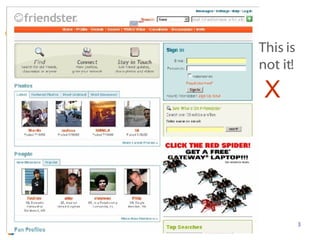
This is not it! X
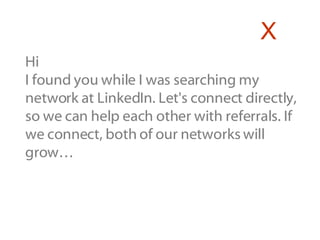
Hi I found you while I was searching my network at LinkedIn. Let's connect directly, so we can help each other with referrals. If we connect, both of our networks will grow… X
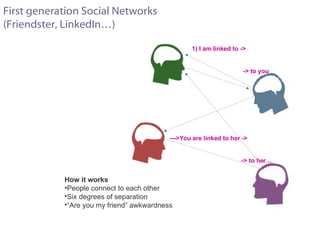
First generation Social Networks (Friendster, LinkedIn…) How it works People connect to each other Six degrees of separation “ Are you my friend” awkwardness 1) I am linked to -> -> to you  --->You are linked to her -> -> to her…
Second generation social networks  Put objects at the center Objects invite us to Connect Play Reach out
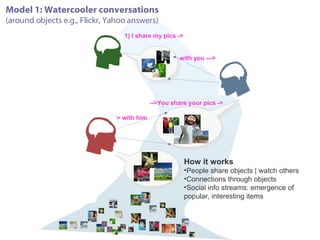
Model 1: Watercooler conversations  (around objects e.g., Flickr, Yahoo answers) 1) I share my pics ->   -> with you --->   -->You share your pics -> ---> with him How it works People share objects | watch others Connections through objects Social info streams: emergence of popular, interesting items
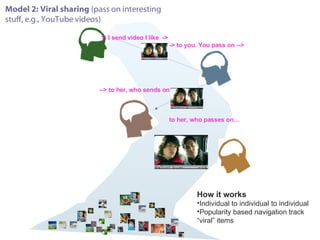
Model 2:   Viral sharing  (pass on interesting stuff, e.g., YouTube videos) How it works Individual to individual to individual Popularity based navigation track “viral” items 1) I send video I like  -> -> to you. You pass on -->   --> to her, who sends on to her, who passes on…
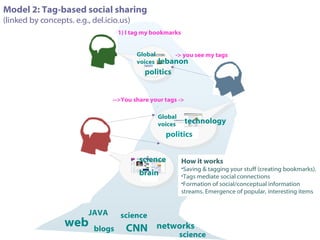
Model 2: Tag-based social sharing  (linked by concepts. e.g., del.icio.us) 1) I tag my bookmarks   -> you see my tags  -->You share your tags -> How it works Saving & tagging your stuff (creating bookmarks). Tags mediate social connections Formation of social/conceptual information streams. Emergence of popular, interesting items  politics lebanon Global voices politics technology Global voices web JAVA CNN networks blogs science science science brain
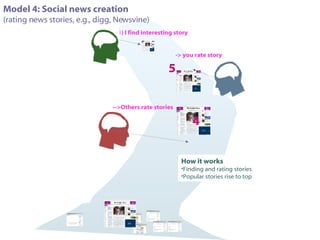
Model 4: Social news creation  (rating news stories, e.g., digg, Newsvine) 1) I find interesting story   -> you rate story  -->Others rate stories How it works Finding and rating stories Popular stories rise to top 5 4
 
Presentations as objects of sharing What to share? digital representation is incomplete Social practices around presentations Mirroring them Creating new ones Building community
The plan What is social sharing? SlideShare   Some theory  Some design principles
Designing for the individual Usability Findability  Interactions and their flow …
Designing for the group How people interact Rules for interaction Product of interaction Collaboration, joint decision… Problems with groups
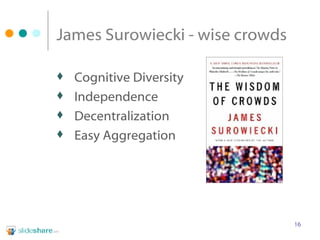
James Surowiecki - wise crowds Cognitive Diversity Independence Decentralization Easy Aggregation
Cognitive Diversity Good answers need many perspectives Groups become homogenous New (similar) members don’t bring new info Diversity reduces groupthink Groupthink works by shielding members from outside opinions Diversity reduces conformity
Independence People’s mistakes don’t get correlated (uncorrelated mistakes averaged out) Encourages people to bring in new viewpoints (diversity) Concept of  Social Proof Milgram experiment
Decentralization “ A crowd of decentralized people working to solve a problem on their own without any central effort to guide them, come up with better solutions, rather than a top-down driven solution.”   Suroweicki
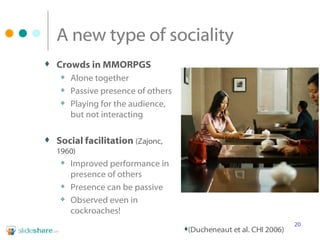
A new type of sociality Crowds in MMORPGS Alone together  Passive presence of others Playing for the audience, but not interacting Social facilitation   (Zajonc, 1960) Improved performance in presence of others Presence can be passive Observed even in cockroaches! (Ducheneaut et al. CHI 2006)
“ Community in MMORPGs … narrowly defined, with references to mythical old villages where everybody knows and interacts with everybody… WoW illustrates, a large community of gamers can thrive in a context where relationships are much more indirect” Ducheneaut et al., 2006
Duncan Watts and the “rich get richer” effect
Popularity is becoming popular No more multi-level menus! Navigation is all about popularity Top100 lists
Is Web2.0 democratic? Anyone can create a blog post pictures, videos and slideshows But who gets heard?
Duncan Watts experiment Two worlds Individual Social Influence – 8 separate worlds
The dilemma of the system creator Social influence will play a role. Trends will be created  Our principles Everything should have its moment in the sun Let people connect locally System should not be inflexible
Models of popularity based navigation Single simple metric  (e.g., Digg) Single complex metric  (e.g., Flickr) Multiple Simple Metrics  (e.g., YouTube, SlideShare) Different metrics reflect diff qualities Let people choose
Digg as a social system Focused in time Focused on topics (tech) and user type One metric: the Digg Quick, engaging Encourages mobs
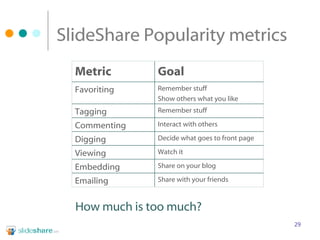
SlideShare Popularity metrics How much is too much? Remember stuff Tagging Share with your friends Emailing Share on your blog Embedding Watch it Viewing Decide what goes to front page Digging Interact with others Commenting Remember stuff Show others what you like Favoriting Goal Metric
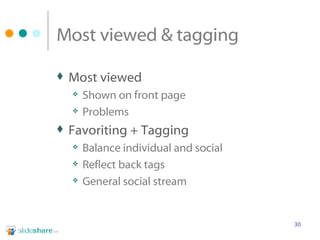
Most viewed & tagging Most viewed Shown on front page Problems Favoriting + Tagging Balance individual and social Reflect back tags General social stream
The plan What is social sharing? SlideShare Some theory  Some design principles
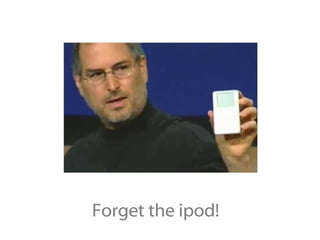
Forget the ipod!
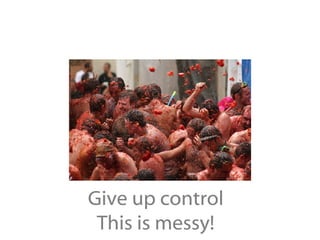
Give up control This is messy!
1. Make system personally useful For end-user system should have strong personal use Memorable Personal Snippets (e.g., Del.icio.us & Flickr) Self-expression (e.g., Newsvine) Social status: Digg Don’t count on altruism System should thrive on people’s selfishness
Bite-sized self-expression Creative self-expression Artistic expression or Humor (Flickr, YouTube) Individual contribution can be small Create sets & lists Do Mashups Simple, guessable URLs for everything  Leave room for games & social play Appreciation Stalking (some!) Gossip
2. Symbiotic relationship between personal & social Personal snippets > Social stream Pictures > Organized by Events Music > Organized by Playlists
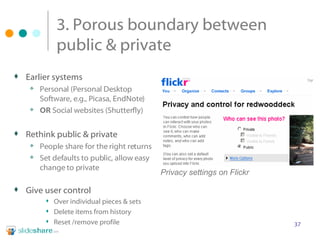
3. Porous boundary between public & private Earlier systems Personal (Personal Desktop Software, e.g., Picasa, EndNote) OR  Social websites (Shutterfly) Rethink public & private People share for the right returns Set defaults to public, allow easy change to private Give user control Over individual pieces & sets Delete items from history Reset /remove profile  Privacy settings on Flickr
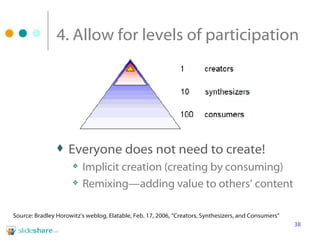
4. Allow for levels of participation Everyone does not need to create! Implicit creation (creating by consuming) Remixing—adding value to others’ content Source: Bradley Horowitz’s weblog, Elatable, Feb. 17, 2006, “Creators, Synthesizers, and Consumers”
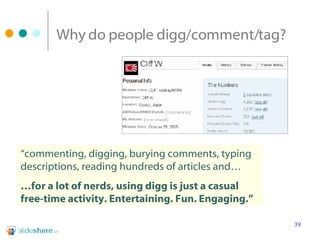
Why do people digg/comment/tag? “ commenting, digging, burying comments, typing descriptions, reading hundreds of articles and… … for a lot of nerds, using digg is just a casual free-time activity. Entertaining. Fun. Engaging.”
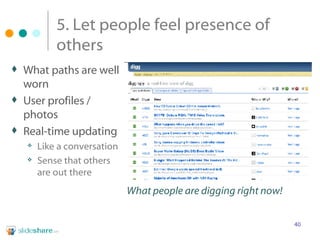
5. Let people feel presence of others What paths are well worn User profiles / photos Real-time updating Like a conversation Sense that others are out there What people are digging right now!
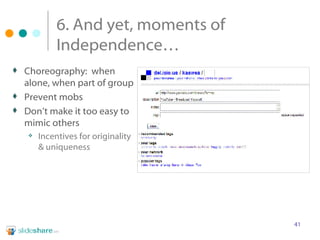
6. And yet, moments of Independence… Choreography:  when alone, when part of group Prevent mobs Don’t make it too easy to mimic others Incentives for originality & uniqueness
Allow for alternative viewpoints Social sites can lead to tyranny of dominant view People of a group agree Viewpoint rises to top (popularity lists, tag clouds)
7. Enable Serendipity  Don’t make navigation all about popularity Access to some popular stuff (keep this fast moving) Make the “long tail” accessible Popularity as a jump off point to other ways of exploring Provide personalization Recommendations using collaborative filtering Similar tags, content, others Ad-hoc groups?
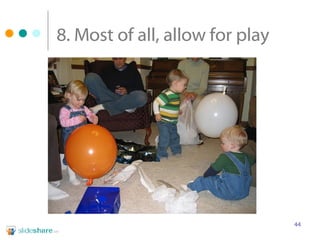
8. Most of all, allow for play
Challenges Dominated by relatively few users Systems represent their viewpoints Minority views get lost. Consensus view bubbles up Giving alternative viewpoints a voice? Surfacing expertise How to reflect outside expertise? Weigh it differently?
Questions? Find me:  www.slideshare.net/rashmi C ollection of wiki slides:  http:// www.slideshare.net/tag/wikis

Massively multiplayer object sharing

  • 1.
    Massively multiplayer objectsharing Rashmi Sinha www.slideshare.net www.rashmisinha.com
  • 2.
    The plan Whatis social sharing? SlideShare Some theory Some design principles
  • 3.
  • 4.
    Hi I foundyou while I was searching my network at LinkedIn. Let's connect directly, so we can help each other with referrals. If we connect, both of our networks will grow… X
  • 5.
    First generation SocialNetworks (Friendster, LinkedIn…) How it works People connect to each other Six degrees of separation “ Are you my friend” awkwardness 1) I am linked to -> -> to you --->You are linked to her -> -> to her…
  • 6.
    Second generation socialnetworks Put objects at the center Objects invite us to Connect Play Reach out
  • 7.
    Model 1: Watercoolerconversations (around objects e.g., Flickr, Yahoo answers) 1) I share my pics -> -> with you ---> -->You share your pics -> ---> with him How it works People share objects | watch others Connections through objects Social info streams: emergence of popular, interesting items
  • 8.
    Model 2: Viral sharing (pass on interesting stuff, e.g., YouTube videos) How it works Individual to individual to individual Popularity based navigation track “viral” items 1) I send video I like -> -> to you. You pass on --> --> to her, who sends on to her, who passes on…
  • 9.
    Model 2: Tag-basedsocial sharing (linked by concepts. e.g., del.icio.us) 1) I tag my bookmarks -> you see my tags -->You share your tags -> How it works Saving & tagging your stuff (creating bookmarks). Tags mediate social connections Formation of social/conceptual information streams. Emergence of popular, interesting items politics lebanon Global voices politics technology Global voices web JAVA CNN networks blogs science science science brain
  • 10.
    Model 4: Socialnews creation (rating news stories, e.g., digg, Newsvine) 1) I find interesting story -> you rate story -->Others rate stories How it works Finding and rating stories Popular stories rise to top 5 4
  • 11.
  • 12.
    Presentations as objectsof sharing What to share? digital representation is incomplete Social practices around presentations Mirroring them Creating new ones Building community
  • 13.
    The plan Whatis social sharing? SlideShare Some theory Some design principles
  • 14.
    Designing for theindividual Usability Findability Interactions and their flow …
  • 15.
    Designing for thegroup How people interact Rules for interaction Product of interaction Collaboration, joint decision… Problems with groups
  • 16.
    James Surowiecki -wise crowds Cognitive Diversity Independence Decentralization Easy Aggregation
  • 17.
    Cognitive Diversity Goodanswers need many perspectives Groups become homogenous New (similar) members don’t bring new info Diversity reduces groupthink Groupthink works by shielding members from outside opinions Diversity reduces conformity
  • 18.
    Independence People’s mistakesdon’t get correlated (uncorrelated mistakes averaged out) Encourages people to bring in new viewpoints (diversity) Concept of Social Proof Milgram experiment
  • 19.
    Decentralization “ Acrowd of decentralized people working to solve a problem on their own without any central effort to guide them, come up with better solutions, rather than a top-down driven solution.” Suroweicki
  • 20.
    A new typeof sociality Crowds in MMORPGS Alone together Passive presence of others Playing for the audience, but not interacting Social facilitation (Zajonc, 1960) Improved performance in presence of others Presence can be passive Observed even in cockroaches! (Ducheneaut et al. CHI 2006)
  • 21.
    “ Community inMMORPGs … narrowly defined, with references to mythical old villages where everybody knows and interacts with everybody… WoW illustrates, a large community of gamers can thrive in a context where relationships are much more indirect” Ducheneaut et al., 2006
  • 22.
    Duncan Watts andthe “rich get richer” effect
  • 23.
    Popularity is becomingpopular No more multi-level menus! Navigation is all about popularity Top100 lists
  • 24.
    Is Web2.0 democratic?Anyone can create a blog post pictures, videos and slideshows But who gets heard?
  • 25.
    Duncan Watts experimentTwo worlds Individual Social Influence – 8 separate worlds
  • 26.
    The dilemma ofthe system creator Social influence will play a role. Trends will be created Our principles Everything should have its moment in the sun Let people connect locally System should not be inflexible
  • 27.
    Models of popularitybased navigation Single simple metric (e.g., Digg) Single complex metric (e.g., Flickr) Multiple Simple Metrics (e.g., YouTube, SlideShare) Different metrics reflect diff qualities Let people choose
  • 28.
    Digg as asocial system Focused in time Focused on topics (tech) and user type One metric: the Digg Quick, engaging Encourages mobs
  • 29.
    SlideShare Popularity metricsHow much is too much? Remember stuff Tagging Share with your friends Emailing Share on your blog Embedding Watch it Viewing Decide what goes to front page Digging Interact with others Commenting Remember stuff Show others what you like Favoriting Goal Metric
  • 30.
    Most viewed &tagging Most viewed Shown on front page Problems Favoriting + Tagging Balance individual and social Reflect back tags General social stream
  • 31.
    The plan Whatis social sharing? SlideShare Some theory Some design principles
  • 32.
  • 33.
    Give up controlThis is messy!
  • 34.
    1. Make systempersonally useful For end-user system should have strong personal use Memorable Personal Snippets (e.g., Del.icio.us & Flickr) Self-expression (e.g., Newsvine) Social status: Digg Don’t count on altruism System should thrive on people’s selfishness
  • 35.
    Bite-sized self-expression Creativeself-expression Artistic expression or Humor (Flickr, YouTube) Individual contribution can be small Create sets & lists Do Mashups Simple, guessable URLs for everything Leave room for games & social play Appreciation Stalking (some!) Gossip
  • 36.
    2. Symbiotic relationshipbetween personal & social Personal snippets > Social stream Pictures > Organized by Events Music > Organized by Playlists
  • 37.
    3. Porous boundarybetween public & private Earlier systems Personal (Personal Desktop Software, e.g., Picasa, EndNote) OR Social websites (Shutterfly) Rethink public & private People share for the right returns Set defaults to public, allow easy change to private Give user control Over individual pieces & sets Delete items from history Reset /remove profile Privacy settings on Flickr
  • 38.
    4. Allow forlevels of participation Everyone does not need to create! Implicit creation (creating by consuming) Remixing—adding value to others’ content Source: Bradley Horowitz’s weblog, Elatable, Feb. 17, 2006, “Creators, Synthesizers, and Consumers”
  • 39.
    Why do peopledigg/comment/tag? “ commenting, digging, burying comments, typing descriptions, reading hundreds of articles and… … for a lot of nerds, using digg is just a casual free-time activity. Entertaining. Fun. Engaging.”
  • 40.
    5. Let peoplefeel presence of others What paths are well worn User profiles / photos Real-time updating Like a conversation Sense that others are out there What people are digging right now!
  • 41.
    6. And yet,moments of Independence… Choreography: when alone, when part of group Prevent mobs Don’t make it too easy to mimic others Incentives for originality & uniqueness
  • 42.
    Allow for alternativeviewpoints Social sites can lead to tyranny of dominant view People of a group agree Viewpoint rises to top (popularity lists, tag clouds)
  • 43.
    7. Enable Serendipity Don’t make navigation all about popularity Access to some popular stuff (keep this fast moving) Make the “long tail” accessible Popularity as a jump off point to other ways of exploring Provide personalization Recommendations using collaborative filtering Similar tags, content, others Ad-hoc groups?
  • 44.
    8. Most ofall, allow for play
  • 45.
    Challenges Dominated byrelatively few users Systems represent their viewpoints Minority views get lost. Consensus view bubbles up Giving alternative viewpoints a voice? Surfacing expertise How to reflect outside expertise? Weigh it differently?
  • 46.
    Questions? Find me: www.slideshare.net/rashmi C ollection of wiki slides: http:// www.slideshare.net/tag/wikis