Tagging – From Personal to Social: Some Observations & Design Principles Rashmi Sinha Uzanto
Structure of Talk My Perspective Tagging on a Personal Level Compared to categorization Social Systems formed by Tagging Tagging & Wisdom of Crowds Some weaknesses 9 Design Principles
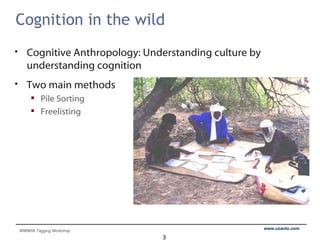
Cognition in the wild Cognitive Anthropology: Understanding culture by understanding cognition Two main methods Pile Sorting Freelisting
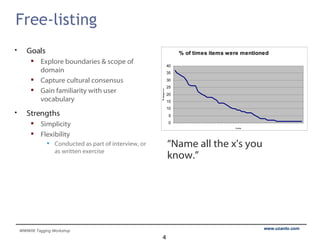
Free-listing Goals Explore boundaries & scope of  domain Capture cultural consensus Gain familiarity with user vocabulary  Strengths Simplicity Flexibility Conducted as part of interview, or as written exercise  “ Name all the x's you know.”
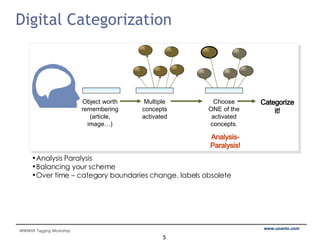
Digital Categorization Multiple concepts activated Choose ONE of the activated concepts. Categorize it! Object worth remembering (article, image…) Analysis-Paralysis! Analysis Paralysis Balancing your scheme Over time – category boundaries change, labels obsolete
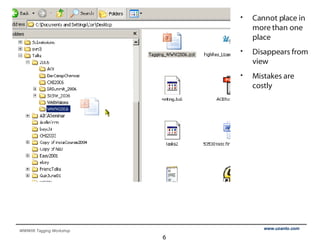
Cannot place in more than one place Disappears from view Mistakes are costly
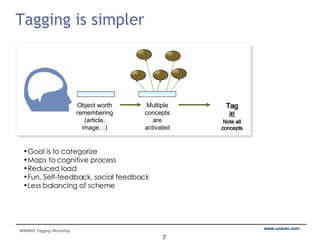
Tagging is simpler Multiple concepts are activated Tag it! Note all concepts Object worth remembering (article, image…) Goal is to categorize Maps to cognitive process Reduced load Fun, Self-feedback, social feedback Less balancing of scheme
Tagging still leads to anxiety Differs from person to person And by domain Solution not simpler input process (though that could help) Confidence in finding
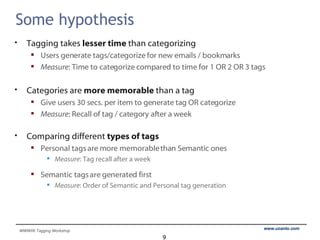
Some hypothesis Tagging takes  lesser time  than categorizing Users generate tags/categorize for new emails / bookmarks Measure : Time to categorize compared to time for 1 OR 2 OR 3 tags Categories are  more memorable  than a tag Give users 30 secs. per item to generate tag OR categorize Measure : Recall of tag / category after a week Comparing different  types of tags Personal tags are more memorable than Semantic ones Measure : Tag recall after a week Semantic tags are generated first Measure : Order of Semantic and Personal tag generation
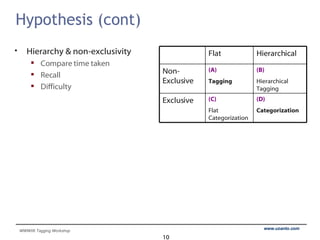
Hypothesis (cont)  Hierarchy & non-exclusivity Compare time taken Recall Difficulty (D) Categorization (C)   Flat Categorization Exclusive (B)   Hierarchical Tagging (A) Tagging Non-Exclusive Hierarchical Flat
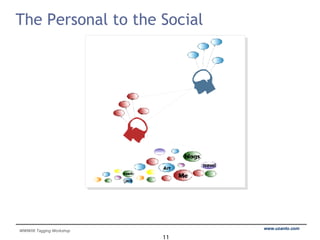
The Personal to the Social
Browsing alone
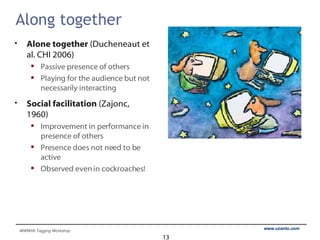
Along together Alone together  (Ducheneaut et al. CHI 2006) Passive presence of others Playing for the audience but not necessarily interacting Social facilitation  (Zajonc, 1960) Improvement in performance in presence of others Presence does not need to be active Observed even in cockroaches!
Tagging as second generation social network Actually useful! Lots of weak ties (Granovetter:  The strength of weak ties ) Social networks emphasize strong ties (lists of contacts, friendship ratings) Objects (tags) mediate social relationships  Objects are reasons people affiliate with each other Provide context for relationship. Means for new relationships. Theory:  Object centered sociality  (sociologist Karin Knorr Cetina) Application: Interest based groups Collaborative Tagging & Expertise in the Enterprise (John & Seligman) Fringe Contacts: People Tagging for the Enterprise (Ferrell & Lau)
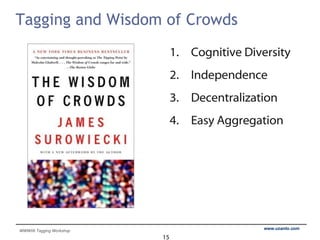
Tagging and Wisdom of Crowds Cognitive Diversity Independence Decentralization Easy Aggregation
1. Cognitive Diversity Need many perspectives for good answers Groups become homogenous Members bring less and less new information in Varying levels of insight & knowledge provide good mix Better than everyone having a lot of knowledge! Diversity reduces groupthink Groupthink works by shielding members from outside opinions Rationalize away counterarguments Diversity reduces conformity Chance that you will change opinion to match group
2. Independence Keeps people’s mistakes from getting correlated (uncorrelated mistakes averaged out) Encourages people to bring in new viewpoints (diversity) Concept of  Social Proof Milgram experiment People assume that groups know what they are doing Assuming crowd is wise, leads to herd like behavior Can sometimes lead to good decisions
2. Independence (cont.) Information Cascades Sequence of uninformed choices, building upon each other Example: Thai & Indian restaurant Information is imperfect – sometimes incorrect, sometimes correct Decisions made in sequence Everyone relies on own information And what everyone else is doing Wrong information propagates down in a chain Ideal when people make decision relying on private information Compare Del.icio.us & digg Information Cascades can be good Example: Iowa farmers decision about hybrid corn
Imitation & Suggestion  Intelligent & mindless imitation Human beings are imitation machines Imitation is a good thing Bad when you don’t reply on private information And don’t make independent judgment Example: Japanese macaques learning to separate wheat from stones Build some method to let people evaluate tag suggestions Imitation & Suggestion in Tagging Systems Lazy Sheep bookmarklet Google Suggest approach Towards the Semantic Web: Collaborative Tag Suggestions (Xu et al.) Implicit Tagging using Donated Bookmarks (Markines, et al.)
3. Decentralization Encourages independence Takes advantage of tacit knowledge People have specialized knowledge that might not be  communicable to right person in centralized structure Problems: Valuable information uncovered in one part of the system does not get communicated to another part Need some type of loose coordination “ A crowd of decentralized people working to solve a problem on their own without any central effort to guide them, come up with better solutions, rather than a top-down driven solution.”   Suroweicki
4. Easy Aggregation A decentralized system can pick right solution  With easy way for information to be aggregated across system Example: Francis Galton A crowd of people made independent decisions He added the votes
Some Weaknesses of tag-based Social Systems
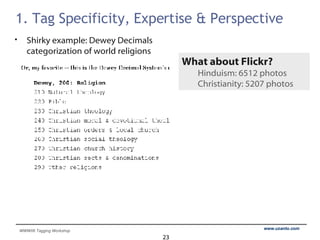
1. Tag Specificity, Expertise & Perspective Shirky example: Dewey Decimals categorization of world religions What about Flickr? Hinduism: 6512 photos Christianity: 5207 photos
Tagging systems are better, but… Tagging systems represent people who participate in them Their viewpoints & perspective Types of biases In-groups might use more specific tags than Out-groups Experts might use more specific tags than novices
2. No easy way to show minority viewpoint Consensus viewpoint bubbles up How to give alternative viewpoints a voice? Example: Catholic Church recognizes Devil’s advocate
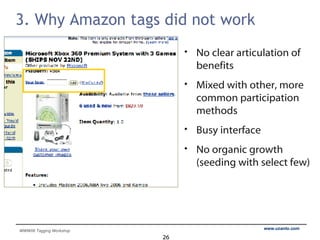
3. Why Amazon tags did not work  No clear articulation of benefits Mixed with other, more common participation methods Busy interface No organic growth (seeding with select few)
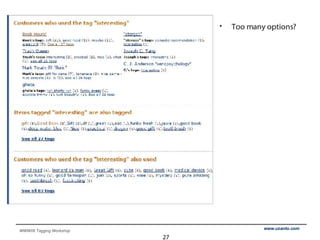
Too many options?
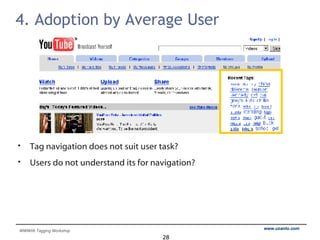
4. Adoption by Average User Tag navigation does not suit user task? Users do not understand its for navigation?
Design Principles for Tagging Systems
#1: Make System Personally Useful For end-user system should have strong personal use Memorable Personal Snippets (e.g., Del.icio.us & Flickr) Self-expression (e.g., Newsvine) My expertise or interests (RawSugar) Don’t count on altruism System should thrive on people’s selfishness Incent the behavior you want Clearly communicate benefits to users Create a positive reinforcement cycle
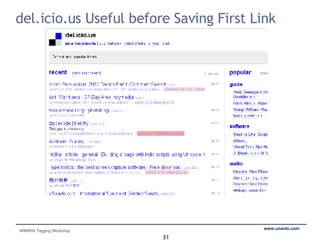
del.icio.us Useful before Saving First Link
#2:Identify Symbiotic Relationship Between Personal & Social Individual participation in system should naturally aggregate into social stream What personal snippets do people like to share? Personal snippets > Social stream Example Pictures > Organized by Events Music > Organized by Playlists
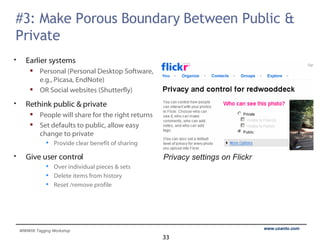
#3: Make Porous Boundary Between Public & Private Earlier systems Personal (Personal Desktop Software, e.g., Picasa, EndNote) OR Social websites (Shutterfly) Rethink public & private People will share for the right returns Set defaults to public, allow easy change to private Provide clear benefit of sharing Give user control Over individual pieces & sets Delete items from history Reset /remove profile  Privacy settings on Flickr
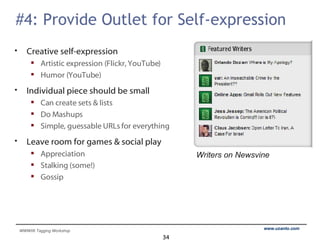
#4: Provide Outlet for Self-expression Creative self-expression Artistic expression (Flickr, YouTube) Humor (YouTube) Individual piece should be small Can create sets & lists Do Mashups Simple, guessable URLs for everything  Leave room for games & social play Appreciation Stalking (some!) Gossip Writers on Newsvine
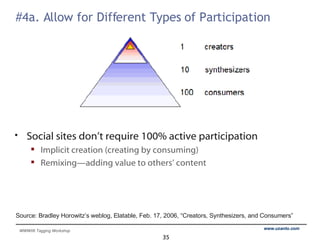
#4a. Allow for Different Types of Participation Social sites don’t require 100% active participation Implicit creation (creating by consuming) Remixing—adding value to others’ content Source: Bradley Horowitz’s weblog, Elatable, Feb. 17, 2006, “Creators, Synthesizers, and Consumers”
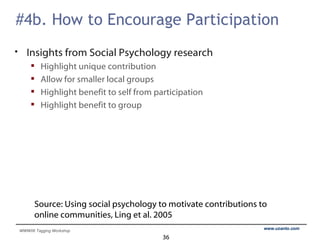
#4b. How to Encourage Participation Insights from Social Psychology research Highlight unique contribution Allow for smaller local groups Highlight benefit to self from participation Highlight benefit to group Source: Using social psychology to motivate contributions to online communities, Ling et al. 2005
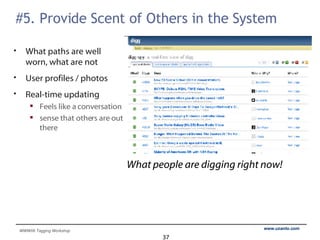
#5. Provide Scent of Others in the System What paths are well worn, what are not User profiles / photos Real-time updating Feels like a conversation sense that others are out there What people are digging right now!
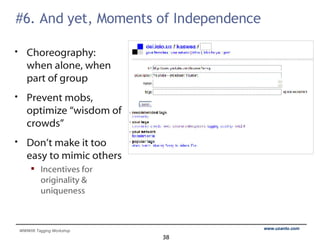
#6. And yet, Moments of Independence Choreography:  when alone, when part of group Prevent mobs, optimize “wisdom of crowds” Don’t make it too easy to mimic others Incentives for originality & uniqueness
#7. Enable Serendipity  Don’t make navigation all about popularity Access to some popular stuff (keep this fast moving) Make the “long tail” accessible Use popularity as a jump off point to other ways of exploring Provide personalization Recommendations using collaborative filtering Similar tags, content, others Ad-hoc groups?
#8. Allow for alternative viewpoints & perspectives Tags bias perspective in specific manner People of a group know more  Likely to use more specific tags Hence less exposure (no hierarchy) Similar problem for experts
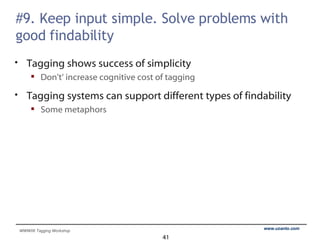
#9. Keep input simple. Solve problems with good findability Tagging shows success of simplicity Don't’ increase cognitive cost of tagging Tagging systems can support different types of findability Some metaphors
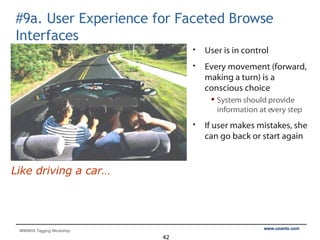
#9a. User Experience for Faceted Browse Interfaces User is in control Every movement (forward, making a turn) is a conscious choice System should provide information at every step If user makes mistakes, she can go back or start again Like driving a car…
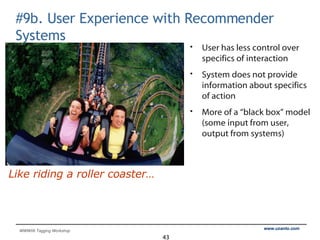
#9b. User Experience with Recommender Systems User has less control over specifics of interaction System does not provide information about specifics of action More of a “black box” model (some input from user, output from systems) Like riding a roller coaster…
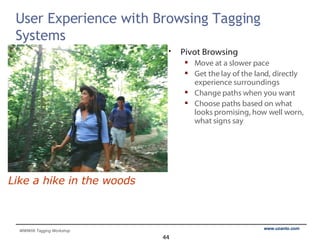
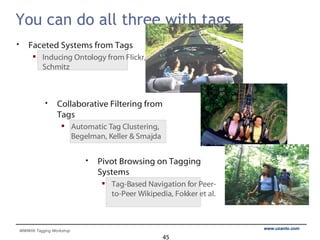
User Experience with Browsing Tagging Systems Pivot Browsing Move at a slower pace Get the lay of the land, directly experience surroundings Change paths when you want Choose paths based on what looks promising, how well worn, what signs say Like a hike in the woods
You can do all three with tags Faceted Systems from Tags Inducing Ontology from Flickr, Schmitz Collaborative Filtering from Tags Automatic Tag Clustering, Begelman, Keller & Smajda Pivot Browsing on Tagging Systems Tag-Based Navigation for Peer-to-Peer Wikipedia, Fokker et al.
Parting thoughts Tagging is in the eyes of the tagger Can implicit tagging be tagging? Tagging by others is more useful than tagging by self Is tagging about harnessing consensus or personal perspective? Will Categorization will be back? Better interface Non-exclusive
Questions? [email_address] URLs www.uzanto.com www.rashmisinha.com
“In essence tag systems mirror the pagerank structure of Google's system, but make the internal structures browsable and viewable directly.” Lee Iverson

Tagging from personal to social

  • 1.
    Tagging – FromPersonal to Social: Some Observations & Design Principles Rashmi Sinha Uzanto
  • 2.
    Structure of TalkMy Perspective Tagging on a Personal Level Compared to categorization Social Systems formed by Tagging Tagging & Wisdom of Crowds Some weaknesses 9 Design Principles
  • 3.
    Cognition in thewild Cognitive Anthropology: Understanding culture by understanding cognition Two main methods Pile Sorting Freelisting
  • 4.
    Free-listing Goals Exploreboundaries & scope of domain Capture cultural consensus Gain familiarity with user vocabulary Strengths Simplicity Flexibility Conducted as part of interview, or as written exercise “ Name all the x's you know.”
  • 5.
    Digital Categorization Multipleconcepts activated Choose ONE of the activated concepts. Categorize it! Object worth remembering (article, image…) Analysis-Paralysis! Analysis Paralysis Balancing your scheme Over time – category boundaries change, labels obsolete
  • 6.
    Cannot place inmore than one place Disappears from view Mistakes are costly
  • 7.
    Tagging is simplerMultiple concepts are activated Tag it! Note all concepts Object worth remembering (article, image…) Goal is to categorize Maps to cognitive process Reduced load Fun, Self-feedback, social feedback Less balancing of scheme
  • 8.
    Tagging still leadsto anxiety Differs from person to person And by domain Solution not simpler input process (though that could help) Confidence in finding
  • 9.
    Some hypothesis Taggingtakes lesser time than categorizing Users generate tags/categorize for new emails / bookmarks Measure : Time to categorize compared to time for 1 OR 2 OR 3 tags Categories are more memorable than a tag Give users 30 secs. per item to generate tag OR categorize Measure : Recall of tag / category after a week Comparing different types of tags Personal tags are more memorable than Semantic ones Measure : Tag recall after a week Semantic tags are generated first Measure : Order of Semantic and Personal tag generation
  • 10.
    Hypothesis (cont) Hierarchy & non-exclusivity Compare time taken Recall Difficulty (D) Categorization (C) Flat Categorization Exclusive (B) Hierarchical Tagging (A) Tagging Non-Exclusive Hierarchical Flat
  • 11.
    The Personal tothe Social
  • 12.
  • 13.
    Along together Alonetogether (Ducheneaut et al. CHI 2006) Passive presence of others Playing for the audience but not necessarily interacting Social facilitation (Zajonc, 1960) Improvement in performance in presence of others Presence does not need to be active Observed even in cockroaches!
  • 14.
    Tagging as secondgeneration social network Actually useful! Lots of weak ties (Granovetter: The strength of weak ties ) Social networks emphasize strong ties (lists of contacts, friendship ratings) Objects (tags) mediate social relationships Objects are reasons people affiliate with each other Provide context for relationship. Means for new relationships. Theory: Object centered sociality (sociologist Karin Knorr Cetina) Application: Interest based groups Collaborative Tagging & Expertise in the Enterprise (John & Seligman) Fringe Contacts: People Tagging for the Enterprise (Ferrell & Lau)
  • 15.
    Tagging and Wisdomof Crowds Cognitive Diversity Independence Decentralization Easy Aggregation
  • 16.
    1. Cognitive DiversityNeed many perspectives for good answers Groups become homogenous Members bring less and less new information in Varying levels of insight & knowledge provide good mix Better than everyone having a lot of knowledge! Diversity reduces groupthink Groupthink works by shielding members from outside opinions Rationalize away counterarguments Diversity reduces conformity Chance that you will change opinion to match group
  • 17.
    2. Independence Keepspeople’s mistakes from getting correlated (uncorrelated mistakes averaged out) Encourages people to bring in new viewpoints (diversity) Concept of Social Proof Milgram experiment People assume that groups know what they are doing Assuming crowd is wise, leads to herd like behavior Can sometimes lead to good decisions
  • 18.
    2. Independence (cont.)Information Cascades Sequence of uninformed choices, building upon each other Example: Thai & Indian restaurant Information is imperfect – sometimes incorrect, sometimes correct Decisions made in sequence Everyone relies on own information And what everyone else is doing Wrong information propagates down in a chain Ideal when people make decision relying on private information Compare Del.icio.us & digg Information Cascades can be good Example: Iowa farmers decision about hybrid corn
  • 19.
    Imitation & Suggestion Intelligent & mindless imitation Human beings are imitation machines Imitation is a good thing Bad when you don’t reply on private information And don’t make independent judgment Example: Japanese macaques learning to separate wheat from stones Build some method to let people evaluate tag suggestions Imitation & Suggestion in Tagging Systems Lazy Sheep bookmarklet Google Suggest approach Towards the Semantic Web: Collaborative Tag Suggestions (Xu et al.) Implicit Tagging using Donated Bookmarks (Markines, et al.)
  • 20.
    3. Decentralization Encouragesindependence Takes advantage of tacit knowledge People have specialized knowledge that might not be communicable to right person in centralized structure Problems: Valuable information uncovered in one part of the system does not get communicated to another part Need some type of loose coordination “ A crowd of decentralized people working to solve a problem on their own without any central effort to guide them, come up with better solutions, rather than a top-down driven solution.” Suroweicki
  • 21.
    4. Easy AggregationA decentralized system can pick right solution With easy way for information to be aggregated across system Example: Francis Galton A crowd of people made independent decisions He added the votes
  • 22.
    Some Weaknesses oftag-based Social Systems
  • 23.
    1. Tag Specificity,Expertise & Perspective Shirky example: Dewey Decimals categorization of world religions What about Flickr? Hinduism: 6512 photos Christianity: 5207 photos
  • 24.
    Tagging systems arebetter, but… Tagging systems represent people who participate in them Their viewpoints & perspective Types of biases In-groups might use more specific tags than Out-groups Experts might use more specific tags than novices
  • 25.
    2. No easyway to show minority viewpoint Consensus viewpoint bubbles up How to give alternative viewpoints a voice? Example: Catholic Church recognizes Devil’s advocate
  • 26.
    3. Why Amazontags did not work No clear articulation of benefits Mixed with other, more common participation methods Busy interface No organic growth (seeding with select few)
  • 27.
  • 28.
    4. Adoption byAverage User Tag navigation does not suit user task? Users do not understand its for navigation?
  • 29.
    Design Principles forTagging Systems
  • 30.
    #1: Make SystemPersonally Useful For end-user system should have strong personal use Memorable Personal Snippets (e.g., Del.icio.us & Flickr) Self-expression (e.g., Newsvine) My expertise or interests (RawSugar) Don’t count on altruism System should thrive on people’s selfishness Incent the behavior you want Clearly communicate benefits to users Create a positive reinforcement cycle
  • 31.
    del.icio.us Useful beforeSaving First Link
  • 32.
    #2:Identify Symbiotic RelationshipBetween Personal & Social Individual participation in system should naturally aggregate into social stream What personal snippets do people like to share? Personal snippets > Social stream Example Pictures > Organized by Events Music > Organized by Playlists
  • 33.
    #3: Make PorousBoundary Between Public & Private Earlier systems Personal (Personal Desktop Software, e.g., Picasa, EndNote) OR Social websites (Shutterfly) Rethink public & private People will share for the right returns Set defaults to public, allow easy change to private Provide clear benefit of sharing Give user control Over individual pieces & sets Delete items from history Reset /remove profile Privacy settings on Flickr
  • 34.
    #4: Provide Outletfor Self-expression Creative self-expression Artistic expression (Flickr, YouTube) Humor (YouTube) Individual piece should be small Can create sets & lists Do Mashups Simple, guessable URLs for everything Leave room for games & social play Appreciation Stalking (some!) Gossip Writers on Newsvine
  • 35.
    #4a. Allow forDifferent Types of Participation Social sites don’t require 100% active participation Implicit creation (creating by consuming) Remixing—adding value to others’ content Source: Bradley Horowitz’s weblog, Elatable, Feb. 17, 2006, “Creators, Synthesizers, and Consumers”
  • 36.
    #4b. How toEncourage Participation Insights from Social Psychology research Highlight unique contribution Allow for smaller local groups Highlight benefit to self from participation Highlight benefit to group Source: Using social psychology to motivate contributions to online communities, Ling et al. 2005
  • 37.
    #5. Provide Scentof Others in the System What paths are well worn, what are not User profiles / photos Real-time updating Feels like a conversation sense that others are out there What people are digging right now!
  • 38.
    #6. And yet,Moments of Independence Choreography: when alone, when part of group Prevent mobs, optimize “wisdom of crowds” Don’t make it too easy to mimic others Incentives for originality & uniqueness
  • 39.
    #7. Enable Serendipity Don’t make navigation all about popularity Access to some popular stuff (keep this fast moving) Make the “long tail” accessible Use popularity as a jump off point to other ways of exploring Provide personalization Recommendations using collaborative filtering Similar tags, content, others Ad-hoc groups?
  • 40.
    #8. Allow foralternative viewpoints & perspectives Tags bias perspective in specific manner People of a group know more Likely to use more specific tags Hence less exposure (no hierarchy) Similar problem for experts
  • 41.
    #9. Keep inputsimple. Solve problems with good findability Tagging shows success of simplicity Don't’ increase cognitive cost of tagging Tagging systems can support different types of findability Some metaphors
  • 42.
    #9a. User Experiencefor Faceted Browse Interfaces User is in control Every movement (forward, making a turn) is a conscious choice System should provide information at every step If user makes mistakes, she can go back or start again Like driving a car…
  • 43.
    #9b. User Experiencewith Recommender Systems User has less control over specifics of interaction System does not provide information about specifics of action More of a “black box” model (some input from user, output from systems) Like riding a roller coaster…
  • 44.
    User Experience withBrowsing Tagging Systems Pivot Browsing Move at a slower pace Get the lay of the land, directly experience surroundings Change paths when you want Choose paths based on what looks promising, how well worn, what signs say Like a hike in the woods
  • 45.
    You can doall three with tags Faceted Systems from Tags Inducing Ontology from Flickr, Schmitz Collaborative Filtering from Tags Automatic Tag Clustering, Begelman, Keller & Smajda Pivot Browsing on Tagging Systems Tag-Based Navigation for Peer-to-Peer Wikipedia, Fokker et al.
  • 46.
    Parting thoughts Taggingis in the eyes of the tagger Can implicit tagging be tagging? Tagging by others is more useful than tagging by self Is tagging about harnessing consensus or personal perspective? Will Categorization will be back? Better interface Non-exclusive
  • 47.
    Questions? [email_address] URLswww.uzanto.com www.rashmisinha.com
  • 48.
    “In essence tagsystems mirror the pagerank structure of Google's system, but make the internal structures browsable and viewable directly.” Lee Iverson