Web 2.0: The Next Wave of Collaboration and Storytelling NITLE Emerging  Technologies workshop December, 2006 Union College
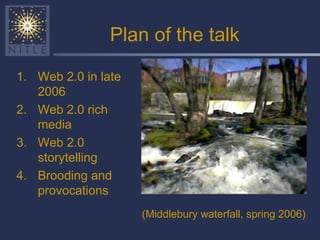
Plan of the talk Web 2.0 in late 2006 Web 2.0 rich media Web 2.0 storytelling Brooding and provocations (Middlebury waterfall, spring 2006)
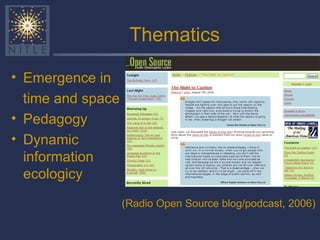
Thematics Emergence in time and space Pedagogy Dynamic information ecologicy (Radio Open Source blog/podcast, 2006)
One metaphor Web 2.0 and education is like gaming and education: awareness is difficult Huge, financially and quantitatively successful worlds Global and rapidly developing Bad anxieties, policies, and media coverage
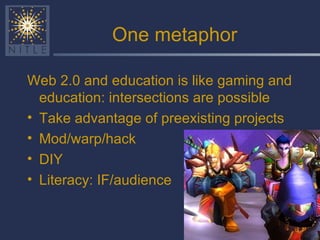
One metaphor Web 2.0 and education is like gaming and education: intersections are possible Take advantage of preexisting projects Mod/warp/hack  DIY Literacy: IF/audience
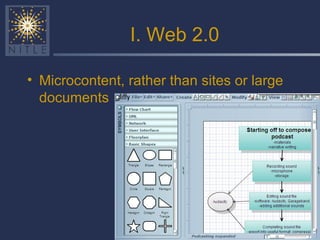
I. Web 2.0 Microcontent, rather than sites or large documents
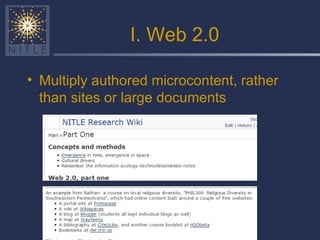
I. Web 2.0 Multiply authored microcontent, rather than sites or large documents
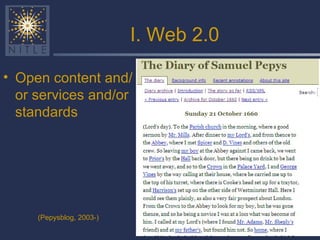
I. Web 2.0 Open content and/or services and/or standards (Pepysblog, 2003-)
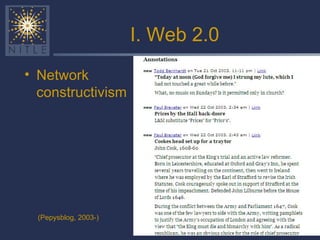
I. Web 2.0 Network constructivism (Pepysblog, 2003-)
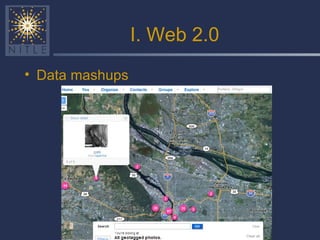
I. Web 2.0 Data mashups
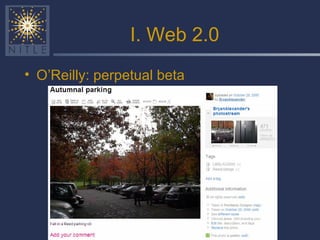
I. Web 2.0 O’Reilly: perpetual beta
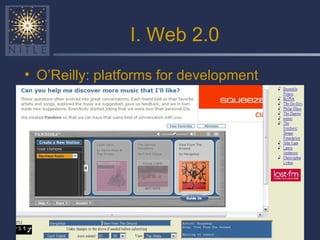
I. Web 2.0 O’Reilly: platforms for development
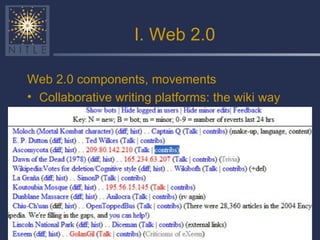
I. Web 2.0 Web 2.0 components, movements Collaborative writing platforms: the wiki way
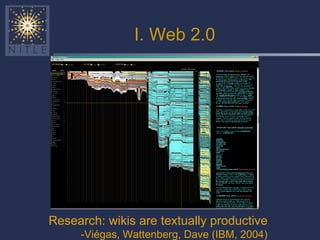
I. Web 2.0 Wiki pedagogies Collective research Group writing Document editing Information literacy
I. Web 2.0 Research: wikis are textually productive -Viégas, Wattenberg, Dave (IBM, 2004)
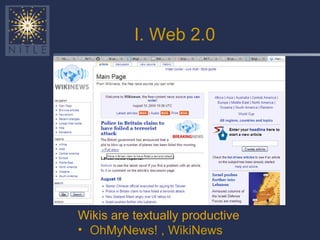
I. Web 2.0 Wikis are textually productive OhMyNews! , WikiNews
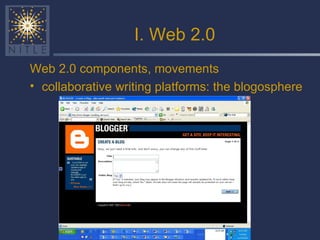
I. Web 2.0 Web 2.0 components, movements collaborative writing platforms: the blogosphere
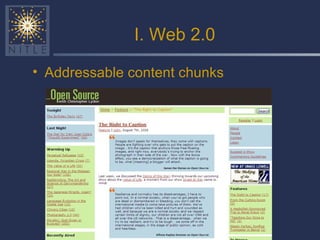
I. Web 2.0 Addressable content chunks
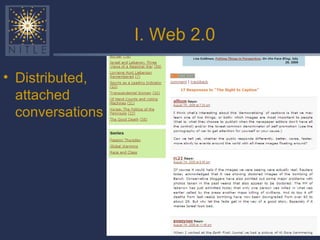
I. Web 2.0 Distributed, attached  conversations
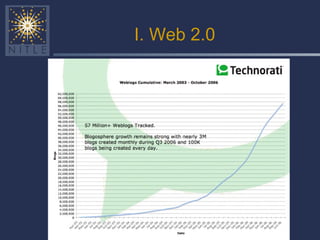
I. Web 2.0 State of the blogosphere 57 million blogs tracked by Technorati: “ As of October 2006, about 100,000 new weblogs were created each day… the doubling of the blogosphere has slowed a bit (every 236 days or so…” (David Sifry, November 2006)  Chart follows…
I. Web 2.0
I. Web 2.0 State of the blogosphere 12 people million using three platforms, including LiveJournal: majority women (Anil Dash, MeshForum 2006) Diversity: diaries, public intellectuals, carnivals, knitters, moblogs, warblogs home and abroad…
I. Web 2.0 State of the blogosphere Did popular CMS/LMSes keep higher education from contributing? Did academia’s lack of engagement make it harder to catch up now? (cf Technorati 2006 November report)
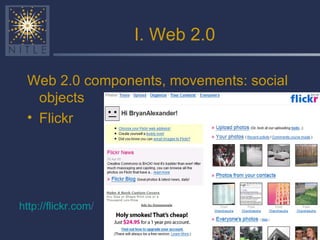
I. Web 2.0 Web 2.0 components, movements: social objects Flickr http:// flickr.com /
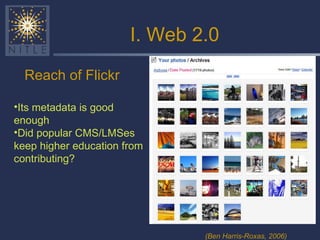
I. Web 2.0 Reach of Flickr 100  million  images, as of Feb 2006 As of October 2006, 4 million Flickr members (3/4  not  in the US) 1 million photos uploaded  each day ( http://www.radioopensource.org/photography-20/  )
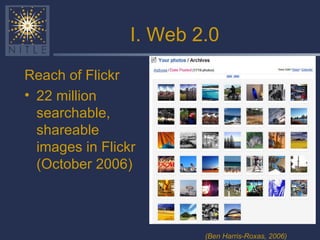
I. Web 2.0 Reach of Flickr 22 million searchable, shareable images in Flickr (October 2006) (Ben Harris-Roxas, 2006)
I. Web 2.0 Reach of Flickr (Ben Harris-Roxas, 2006) Its metadata is good enough Did popular CMS/LMSes keep higher education from contributing?
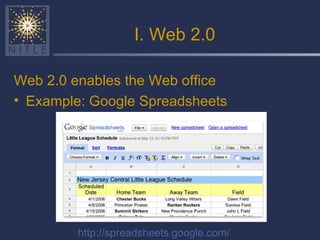
I. Web 2.0 Web 2.0 enables the Web office Example: Google Spreadsheets http://spreadsheets.google.com/
I. Web 2.0 What can we learn from this? Ton Zylstra: “ In general you could say that both Flickr and delicious work in a triangle: person, picture/bookmark, and tag(s). Or more abstract a person,  an object of sociality , and some descriptor...”
I. Web 2.0 “… In every triangle there always needs to be a person and  an object of sociality . The third point of the triangle is free to define[,] as it were.” - http://www.zylstra.org , 2006 (emphases added)
I. Web 2.0 What can we learn from this? Jyri Engesrom is succinct: “ The fallacy is to think that social networks are just made up of people. They're not; social networks consist of  people who are connected by a shared object .” - http://www.zengestrom.com/ , 2005
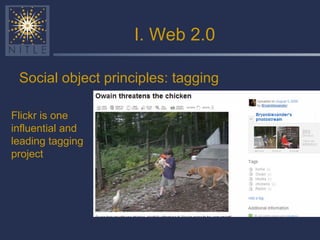
I. Web 2.0 Social object principles: tagging Flickr is one influential and leading tagging project
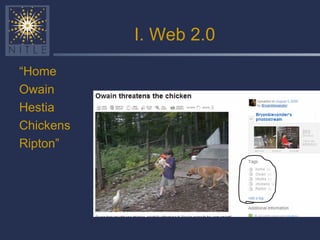
I. Web 2.0 “ Home Owain Hestia Chickens Ripton”
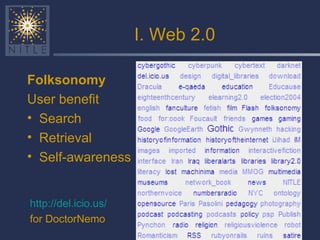
I. Web 2.0 Folksonomy   User benefit Search Retrieval Self-awareness http://del.icio.us/ for DoctorNemo
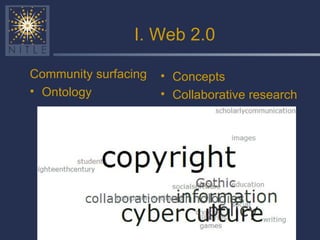
I. Web 2.0 Community surfacing Ontology Concepts  Collaborative research
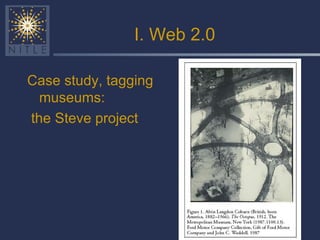
I. Web 2.0 Case study, tagging museums: the Steve project
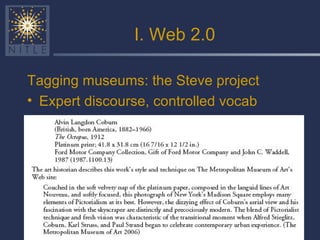
I. Web 2.0 Tagging museums: the Steve project Expert discourse, controlled vocab
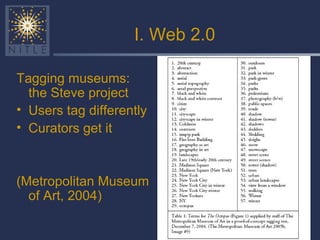
I. Web 2.0 Tagging museums: the Steve project Users tag differently Curators get it (Metropolitan Museum of Art, 2004)
Web 2.0 Tagging libraries: PennTags Coded locally
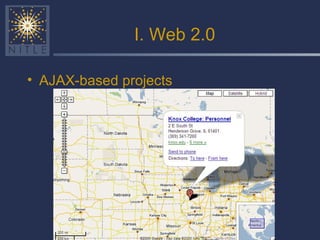
I. Web 2.0 AJAX-based projects
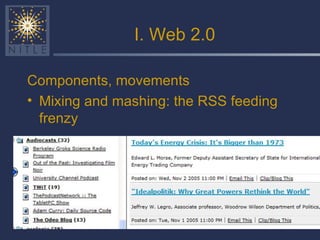
I. Web 2.0 Components, movements Mixing and mashing: the RSS feeding frenzy
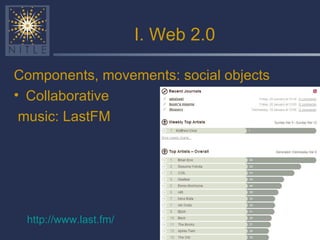
I. Web 2.0 Components, movements: social objects Collaborative music: LastFM http:// www.last.fm /
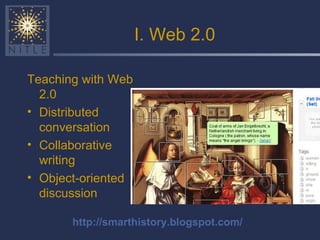
I. Web 2.0 Teaching with Web 2.0 Distributed conversation Collaborative writing Object-oriented discussion http://smarthistory.blogspot.com/
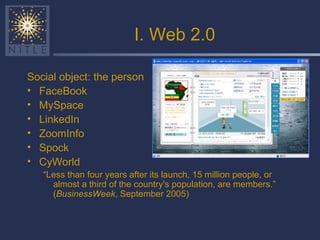
I. Web 2.0 Social object: the person FaceBook MySpace LinkedIn ZoomInfo Spock CyWorld “ Less than four years after its launch, 15 million people, or almost a third of the country's population, are members.” ( BusinessWeek , September 2005)
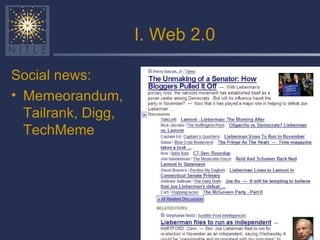
I. Web 2.0 Social news: Memeorandum, Tailrank, Digg, TechMeme
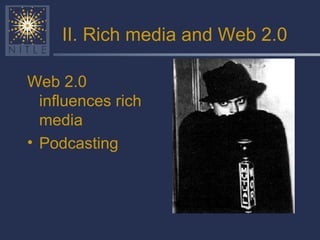
II. Rich media and Web 2.0 Web 2.0 influences rich media Podcasting
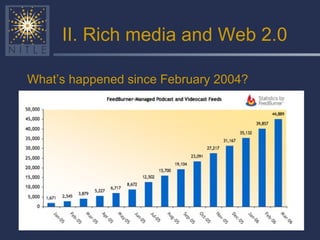
II. Rich media and Web 2.0 What’s happened since February 2004?
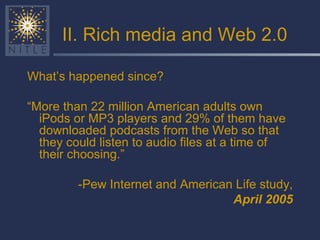
II. Rich media and Web 2.0 What’s happened since? “ More than 22 million American adults own iPods or MP3 players and 29% of them have downloaded podcasts from the Web so that they could listen to audio files at a time of their choosing.” -Pew Internet and American Life study, April 2005
II. Rich media and Web 2.0 What’s happened since? Neologisms: godcasting nanocasting podfading podsafe podspamming podvertising porncasting
II. Rich media and Web 2.0 Podcasts and teaching: profcasting Bryn Mawr College: Michelle Francl, chemistry Duke: Classroom recording Learning objects: Gardner Campbell, University of Richmond Duke: Course content dissemination Information literacy
II. Rich media and Web 2.0 Podcasts and research Public intellectual Out of the Past Engines of Our Ingenuity  Napoleon 101 In Our Time Trudi Abel,  “Digital Durham and the New South” (Duke University, 2006) Duke: Field recording
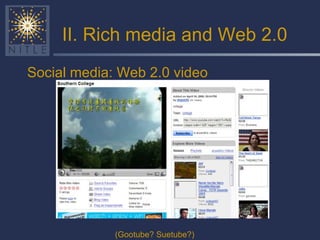
II. Rich media and Web 2.0 Social media: Web 2.0 video (Gootube? Suetube?)
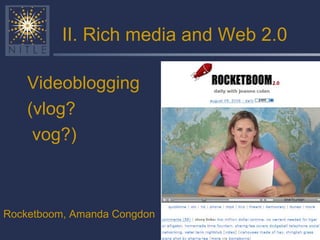
II. Rich media and Web 2.0 Videoblogging (vlog? vog?) Rocketboom, Amanda Congdon
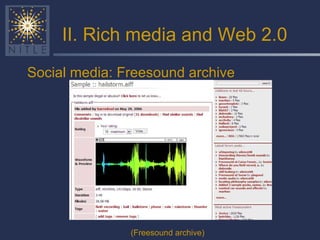
II. Rich media and Web 2.0 Social media: Freesound archive (Freesound archive)
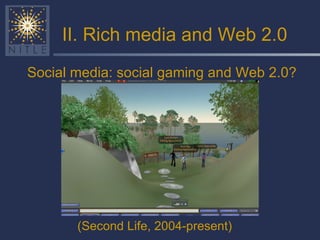
II. Rich media and Web 2.0 (Second Life, 2004-present) Social media: social gaming and Web 2.0?
II. Rich media and Web 2.0 Size of Second Life: 1 million residents, October 2006 “ the new golf”, Second Life (Joi Ito) Compare the field 6 million players, World of Warcraft 1 million players, Virtual Magic Kingdom Diversity: platform, genre, content
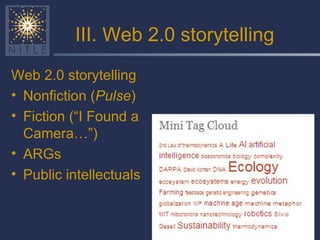
III. Web 2.0 storytelling Web 2.0 storytelling Nonfiction ( Pulse ) Fiction (“I Found a Camera…”) ARGs Public intellectuals
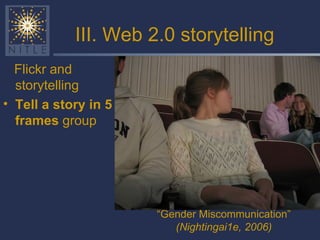
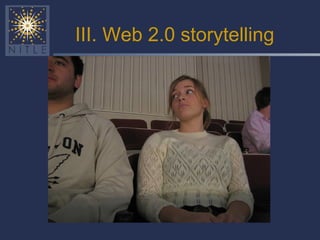
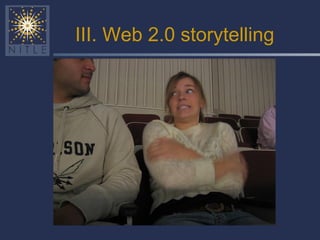
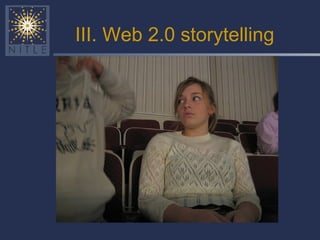
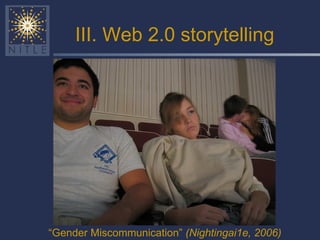
III. Web 2.0 storytelling Flickr and storytelling Tell a story in 5 frames  group “ Gender Miscommunication” (Nightingai1e, 2006)
III. Web 2.0 storytelling
III. Web 2.0 storytelling “ Gender Miscommunication”  (Nightingai1e, 2006)
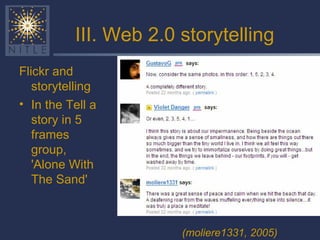
III. Web 2.0 storytelling Flickr and storytelling In the Tell a story in 5 frames group, 'Alone With The Sand' (moliere1331, 2005)
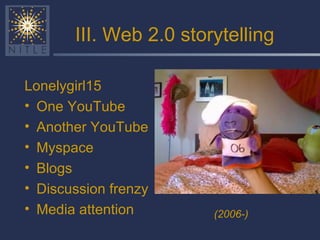
III. Web 2.0 storytelling Lonelygirl15 One YouTube Another YouTube Myspace Blogs Discussion frenzy Media attention (2006-)
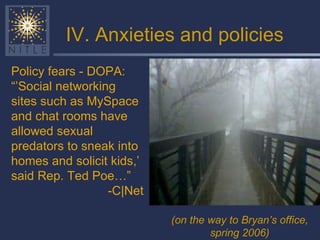
IV. Anxieties and policies Policy fears - DOPA: “’ Social networking sites such as MySpace and chat rooms have allowed sexual predators to sneak into homes and solicit kids,’ said Rep. Ted Poe…” -C|Net (on the way to Bryan’s office, spring 2006)
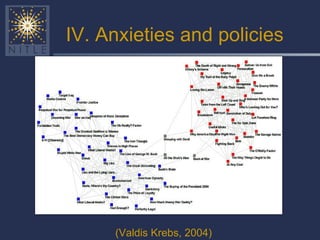
IV. Anxieties and policies (Valdis Krebs, 2004)
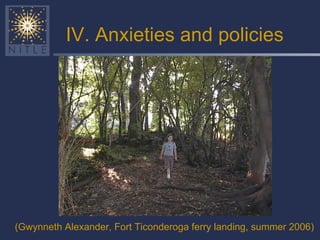
IV. Anxieties and policies (Gwynneth Alexander, Fort Ticonderoga ferry landing, summer 2006)
National Institute for Technology and Liberal Education  http:// nitle.org   NITLE blog  http://b2e.nitle.org   NITLE Lab  http:// nitle.org/index.php/nitle/laboratory

Web 2.0 intro

  • 1.
    Web 2.0: TheNext Wave of Collaboration and Storytelling NITLE Emerging Technologies workshop December, 2006 Union College
  • 2.
    Plan of thetalk Web 2.0 in late 2006 Web 2.0 rich media Web 2.0 storytelling Brooding and provocations (Middlebury waterfall, spring 2006)
  • 3.
    Thematics Emergence intime and space Pedagogy Dynamic information ecologicy (Radio Open Source blog/podcast, 2006)
  • 4.
    One metaphor Web2.0 and education is like gaming and education: awareness is difficult Huge, financially and quantitatively successful worlds Global and rapidly developing Bad anxieties, policies, and media coverage
  • 5.
    One metaphor Web2.0 and education is like gaming and education: intersections are possible Take advantage of preexisting projects Mod/warp/hack DIY Literacy: IF/audience
  • 6.
    I. Web 2.0Microcontent, rather than sites or large documents
  • 7.
    I. Web 2.0Multiply authored microcontent, rather than sites or large documents
  • 8.
    I. Web 2.0Open content and/or services and/or standards (Pepysblog, 2003-)
  • 9.
    I. Web 2.0Network constructivism (Pepysblog, 2003-)
  • 10.
    I. Web 2.0Data mashups
  • 11.
    I. Web 2.0O’Reilly: perpetual beta
  • 12.
    I. Web 2.0O’Reilly: platforms for development
  • 13.
    I. Web 2.0Web 2.0 components, movements Collaborative writing platforms: the wiki way
  • 14.
    I. Web 2.0Wiki pedagogies Collective research Group writing Document editing Information literacy
  • 15.
    I. Web 2.0Research: wikis are textually productive -Viégas, Wattenberg, Dave (IBM, 2004)
  • 16.
    I. Web 2.0Wikis are textually productive OhMyNews! , WikiNews
  • 17.
    I. Web 2.0Web 2.0 components, movements collaborative writing platforms: the blogosphere
  • 18.
    I. Web 2.0Addressable content chunks
  • 19.
    I. Web 2.0Distributed, attached conversations
  • 20.
    I. Web 2.0State of the blogosphere 57 million blogs tracked by Technorati: “ As of October 2006, about 100,000 new weblogs were created each day… the doubling of the blogosphere has slowed a bit (every 236 days or so…” (David Sifry, November 2006) Chart follows…
  • 21.
  • 22.
    I. Web 2.0State of the blogosphere 12 people million using three platforms, including LiveJournal: majority women (Anil Dash, MeshForum 2006) Diversity: diaries, public intellectuals, carnivals, knitters, moblogs, warblogs home and abroad…
  • 23.
    I. Web 2.0State of the blogosphere Did popular CMS/LMSes keep higher education from contributing? Did academia’s lack of engagement make it harder to catch up now? (cf Technorati 2006 November report)
  • 24.
    I. Web 2.0Web 2.0 components, movements: social objects Flickr http:// flickr.com /
  • 25.
    I. Web 2.0Reach of Flickr 100 million images, as of Feb 2006 As of October 2006, 4 million Flickr members (3/4 not in the US) 1 million photos uploaded each day ( http://www.radioopensource.org/photography-20/ )
  • 26.
    I. Web 2.0Reach of Flickr 22 million searchable, shareable images in Flickr (October 2006) (Ben Harris-Roxas, 2006)
  • 27.
    I. Web 2.0Reach of Flickr (Ben Harris-Roxas, 2006) Its metadata is good enough Did popular CMS/LMSes keep higher education from contributing?
  • 28.
    I. Web 2.0Web 2.0 enables the Web office Example: Google Spreadsheets http://spreadsheets.google.com/
  • 29.
    I. Web 2.0What can we learn from this? Ton Zylstra: “ In general you could say that both Flickr and delicious work in a triangle: person, picture/bookmark, and tag(s). Or more abstract a person, an object of sociality , and some descriptor...”
  • 30.
    I. Web 2.0“… In every triangle there always needs to be a person and an object of sociality . The third point of the triangle is free to define[,] as it were.” - http://www.zylstra.org , 2006 (emphases added)
  • 31.
    I. Web 2.0What can we learn from this? Jyri Engesrom is succinct: “ The fallacy is to think that social networks are just made up of people. They're not; social networks consist of people who are connected by a shared object .” - http://www.zengestrom.com/ , 2005
  • 32.
    I. Web 2.0Social object principles: tagging Flickr is one influential and leading tagging project
  • 33.
    I. Web 2.0“ Home Owain Hestia Chickens Ripton”
  • 34.
    I. Web 2.0Folksonomy User benefit Search Retrieval Self-awareness http://del.icio.us/ for DoctorNemo
  • 35.
    I. Web 2.0Community surfacing Ontology Concepts Collaborative research
  • 36.
    I. Web 2.0Case study, tagging museums: the Steve project
  • 37.
    I. Web 2.0Tagging museums: the Steve project Expert discourse, controlled vocab
  • 38.
    I. Web 2.0Tagging museums: the Steve project Users tag differently Curators get it (Metropolitan Museum of Art, 2004)
  • 39.
    Web 2.0 Tagginglibraries: PennTags Coded locally
  • 40.
    I. Web 2.0AJAX-based projects
  • 41.
    I. Web 2.0Components, movements Mixing and mashing: the RSS feeding frenzy
  • 42.
    I. Web 2.0Components, movements: social objects Collaborative music: LastFM http:// www.last.fm /
  • 43.
    I. Web 2.0Teaching with Web 2.0 Distributed conversation Collaborative writing Object-oriented discussion http://smarthistory.blogspot.com/
  • 44.
    I. Web 2.0Social object: the person FaceBook MySpace LinkedIn ZoomInfo Spock CyWorld “ Less than four years after its launch, 15 million people, or almost a third of the country's population, are members.” ( BusinessWeek , September 2005)
  • 45.
    I. Web 2.0Social news: Memeorandum, Tailrank, Digg, TechMeme
  • 46.
    II. Rich mediaand Web 2.0 Web 2.0 influences rich media Podcasting
  • 47.
    II. Rich mediaand Web 2.0 What’s happened since February 2004?
  • 48.
    II. Rich mediaand Web 2.0 What’s happened since? “ More than 22 million American adults own iPods or MP3 players and 29% of them have downloaded podcasts from the Web so that they could listen to audio files at a time of their choosing.” -Pew Internet and American Life study, April 2005
  • 49.
    II. Rich mediaand Web 2.0 What’s happened since? Neologisms: godcasting nanocasting podfading podsafe podspamming podvertising porncasting
  • 50.
    II. Rich mediaand Web 2.0 Podcasts and teaching: profcasting Bryn Mawr College: Michelle Francl, chemistry Duke: Classroom recording Learning objects: Gardner Campbell, University of Richmond Duke: Course content dissemination Information literacy
  • 51.
    II. Rich mediaand Web 2.0 Podcasts and research Public intellectual Out of the Past Engines of Our Ingenuity Napoleon 101 In Our Time Trudi Abel, “Digital Durham and the New South” (Duke University, 2006) Duke: Field recording
  • 52.
    II. Rich mediaand Web 2.0 Social media: Web 2.0 video (Gootube? Suetube?)
  • 53.
    II. Rich mediaand Web 2.0 Videoblogging (vlog? vog?) Rocketboom, Amanda Congdon
  • 54.
    II. Rich mediaand Web 2.0 Social media: Freesound archive (Freesound archive)
  • 55.
    II. Rich mediaand Web 2.0 (Second Life, 2004-present) Social media: social gaming and Web 2.0?
  • 56.
    II. Rich mediaand Web 2.0 Size of Second Life: 1 million residents, October 2006 “ the new golf”, Second Life (Joi Ito) Compare the field 6 million players, World of Warcraft 1 million players, Virtual Magic Kingdom Diversity: platform, genre, content
  • 57.
    III. Web 2.0storytelling Web 2.0 storytelling Nonfiction ( Pulse ) Fiction (“I Found a Camera…”) ARGs Public intellectuals
  • 58.
    III. Web 2.0storytelling Flickr and storytelling Tell a story in 5 frames group “ Gender Miscommunication” (Nightingai1e, 2006)
  • 59.
    III. Web 2.0storytelling
  • 60.
    III. Web 2.0storytelling
  • 61.
    III. Web 2.0storytelling
  • 62.
    III. Web 2.0storytelling “ Gender Miscommunication” (Nightingai1e, 2006)
  • 63.
    III. Web 2.0storytelling Flickr and storytelling In the Tell a story in 5 frames group, 'Alone With The Sand' (moliere1331, 2005)
  • 64.
    III. Web 2.0storytelling Lonelygirl15 One YouTube Another YouTube Myspace Blogs Discussion frenzy Media attention (2006-)
  • 65.
    IV. Anxieties andpolicies Policy fears - DOPA: “’ Social networking sites such as MySpace and chat rooms have allowed sexual predators to sneak into homes and solicit kids,’ said Rep. Ted Poe…” -C|Net (on the way to Bryan’s office, spring 2006)
  • 66.
    IV. Anxieties andpolicies (Valdis Krebs, 2004)
  • 67.
    IV. Anxieties andpolicies (Gwynneth Alexander, Fort Ticonderoga ferry landing, summer 2006)
  • 68.
    National Institute forTechnology and Liberal Education http:// nitle.org NITLE blog http://b2e.nitle.org NITLE Lab http:// nitle.org/index.php/nitle/laboratory