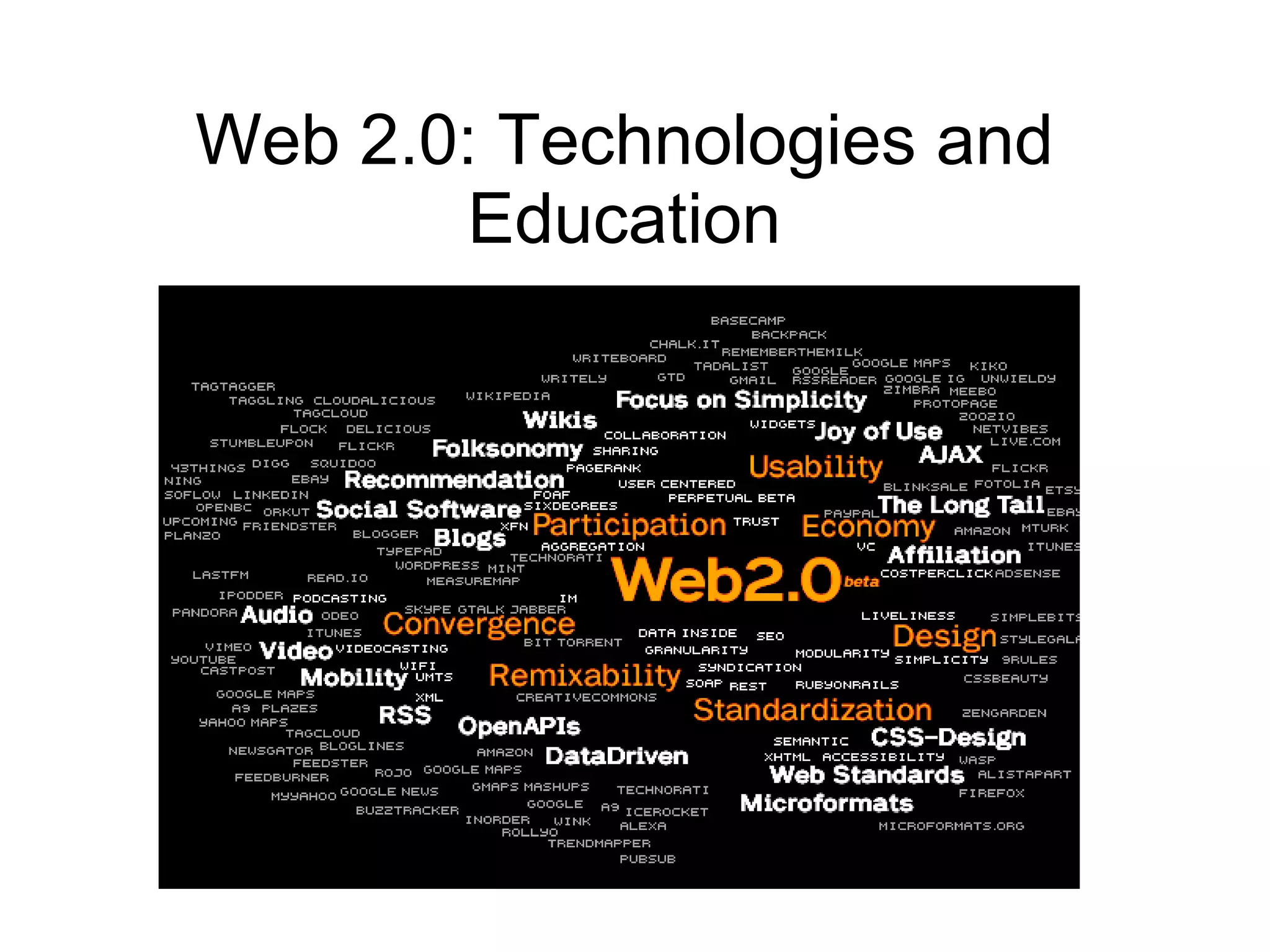
Web 2.0: Technologies and Education
What is Web 2.0? What is Web 2.0 ?!?
Web 2.0 Web 2.0, a phrase coined by Dale Dougherty in 2003 made famous in a paper called What is Web 2.0: Design Patterns and Business Models for the Next Generation of Software by Tim O’Reilly it is not a set technological standard or protocol it is a term to describe the movement/revolution about the social connection and interaction of the web and services and technologies that sponsor and promote it.  the “second phase” of the internet 2006 Time Person of the Year: You
Web 2.0 the meaning varies Dave Winer [a software developer and entrepreneur] says: “Web 2.0 is a marketing concept used by venture capitalists and conference promoters to try to call another bubble into existence.” Om Malik [a technology writer] says: “Web 2.0 as a collection of technologies - be it VoIP, Digital Media, XML, RSS, Google Maps… whatever … that leverage the power of always on, high speed connections and treat broadband as a platform, and not just a pipe to connect.” kind of a buzz word
What was Web 1.0? Web 1.0 was about reading, Web 2.0 is about writing  Web 1.0 was about companies, Web 2.0 is about communities  Web 1.0 was about client-server, Web 2.0 is about peer to peer  Web 1.0 was about HTML, Web 2.0 is about XML  Web 1.0 was about home pages, Web 2.0 is about blogs  Web 1.0 was about lectures, Web 2.0 is about conversation  Web 1.0 was about advertising, Web 2.0 is about word of mouth  Web 1.0 was about services sold over the web, Web 2.0 is about web services  From Darren Barefoot, a technology writer modern vs. post-modern ways of thinking
Examples of Web 2.0 Blogs Wikis Tagging Multimedia Sharing RSS Podcasting Second Life
BLOGS blog or weblog simple webpage consisting of brief postings of opinion, information, etc. blogosphere a collective term encompassing all blogs and their interconnections  chronologically ordered exchange of ideas from single author to unlimited readers real time not journal time (ie. daily or weekly) has links and comment fields
BLOGS Examples of Blogs: http://www.insidethecbc.com/ http://www.engadget.com/ Examples of Blog Sevices: Blogger/Blogspot https://www.blogger.com/start http://canuckshockey.blogspot.com/ BlogsCanada http://www.blogscanada.ca/
WIKIS a webpage or set of webpages that can be easily edited by anyone with access collaborative tool now available as an option in major software packages has a history function to view previous versions ease of use vs. malicious editing and vandalism though things can be quickly corrected
WIKIS Wikipedia  the most well-known wiki accuracy is comparable to a regular encyclopedia disputed though http://www.wikipedia.org/ SFU related wikis: SFU Cognitive Science http://www.zanyt.com/cogs_wiki/index.php?title=Welcome LIDC http://wiki.lidc.sfu.ca/HomePage
TAGGING a tag is a keyword attached to a digital object  very often used in searches eg. Flickr and YouTube
TAGGING searching Flickr for “fat” and “cat” tags will give results showing a overweight cats or other things called “fat cat”, such as the “Fat Cat” pub…
MULTIMEDIA SHARING areas and services that facilitate the sharing and storage of digital media eg. Flickr, YouTube, etc. distribution on a massive scale productions are high quality, but on low cost digital media technology
RSS RSS = Really Simple Syndication  allows a user to subscribe to a “feed” and gain content thru a subscription RSS icon up-to-date information from websites, blogs, etc. without having to go to the original source common in news websites or other websites that are continually updated with information
RSS The RSS icon will appear in the address field of most modern web-browsers to indicate that the website has an RSS feed  Click on it to subscribe to the feed in this case, the CNN.com feed for all the updates to CNN.com
PODCASTING a podcast is an audio file uploaded to a host server and subscribed to via RSS easy to get new, updated content will run on more than just iTunes eg. Odeo.com, MyPodcast.com, etc. lots of potential for educational purposes more on this later…
Second Life a popular, virtual 3D world where a user can construct an avatar and other 3D environments and explore them looks like a game, but not really a game… venue for socializing and interacting various agencies and entities have a presence in Second Life including SFU and the VPD
Second Life
THE SIX BIG IDEAS BEHIND WEB 2.0 from  What is Web 2.0? Ideas, technologies and implications for education  by Paul Anderson  Individual production and User Generated Content Harness the power of the crowd Data on an epic scale Architecture of Participation Network Effects Openness
1. Individual production and User Generated Content content added very easily to media sites eg. MySpace, YouTube, etc. content can be searched with tags people writing blogs and contributing to wikis user generated content also called content self-publishing, personal publishing, self-expression. new, cheap, accessible and quality tools lower entry bar eg. digital cameras, mobile phones with devices, video cameras, etc. similar to computers, printers and paper desktop publishing in early 80s “ everybody can do it, but not anybody can do it” talent still distinguishes
1. Individual production and User Generated Content existing/traditional media sources are threatened and are adapting  shows now have podcasts or can be downloaded from iTunes store RadioHead, NIN, etc. now giving away music redefinition/reinterpretation of audience more authors than readers blogs that are never read… contributors are driven by attention rather than financial motives threats to structure and authority traditional media sources are structured, edited and sources verified not like the internet…
2. Harness the power of the crowd collective intelligence information = intelligence (?) as group can be collectively more intelligent than a single individual eg. ask the audience on who wants to be a millionaire hazards: “ groupthink”, lack of a deep level critical thinking, etc. “ crowd sourcing” “was coined by Wired journalist Jeff Howe to conceptualize a process of Web-based out-sourcing for the procurement of media content, small tasks, even solutions to scientific problems from the crowd gathered on the Internet.” eg. websites with stock materials, like shutterstock.com, istockphoto, etc. threat to existing photographic professionals content not good, but good enough eg. websites like Innocentive match scientists with R&D clients
2. Harness the power of the crowd Folksonomy: “ Folksonomy is the result of personal free tagging of information and objects (anything with a URL) for one's own retrieval. The tagging is done in a social environment (shared and open to others). The act of tagging is done by the person consuming the information.” VanderWal, 2005, blog entry. tags are meant to connect, not categorize tags are created in a social context with people using their own vocabulary and meanings (relative to a community) tags are not created in formal taxonomy nor have standard meanings remember the search for “fat” and “cat”…?
2. Harness the power of the crowd example: consider a search on YouTube.com for “evan” this can mean: A trailer for the movie “Evan Almighty” The “Evan” from the movie “SuperBad” And many more “evan”s… each person adding a video to YouTube.com puts an “evan” tag with it…(among other tags) YouTube.com does not control or categorize the content to have a standard meaning for “evan”
3. Data on an epic scale information, data, etc. generated is staggering in its quantity with multiple sources and contributors ‘ datafication’ of the world services exist to collect and manage this data eg. Google the use of these services makes these services smarter data mining techniques eg. the monitoring of collective buying habits to make suggestions to individual users eg. Netflix, Amazon, etc. data becomes a resource privacy issues and implications who owns this data?
4. Architecture of Participation how a website is designed affects the participation eg. pay vs. free eg. classmates.com vs. facebook.com -eg. amount of steps to register with website a website can get better the more a person uses it it adapts to the person eg. recommendations from a website, or a website connecting likeminded people open-source software ie. the sharing of ideas and content for reuse and new combinations
5. Network Effects “ The Network Effect is a general economic term used to describe the increase in value to the existing users of a service in which there is some form of interaction with others, as more and more people start to use it” eg. FaceBook not all users have the same value some are more valuable to user than other eg. family, friends, acquaintances, co-workers, strangers, etc. the flipside: the lock-in to technology as more people use a certain product or service, it becomes difficult to switch to another product or service (that may be better) because there a few people to share with eg. VHS vs. Beta eg. Blu-ray vs HD-DVD it shows the needs for interoperability
5. Network Effects many things on the internet are unequal  there are artificial barriers that make it easier for some and extremely difficult for others ie. popularity, promotion, position on search engine, placement on webpage, etc. there is a counter-movement to with the “democratization of the tools of production” as amateurs are able to flood the internet with content
6. Openness “ The development of the Web has seen a wide range of legal, regulatory, political and cultural developments surrounding the control, access and rights of digital content.” you don’t have to pay for stuff now! eg. music, movies, software… web 2.0 stresses openness open standards, open-source software, free data  eg. the push for Open Document Format (or ODF)  all to be used and reused freely for the common goal of open innovation eg. FireFox and its plug-ins
EDUCATIONAL AND INSTRUCTIONAL ISSUES: “ In these scenarios, education is more like a conversation and learning content is something you perform some kind of operation on rather than ‘just’ reading it.“ Problems: users are in a 24/7 environment economic divide among user’s home resources differing skill levels privacy and plagiarism issues of online collaborations shared authorship and assessments the lack of understanding about student learning modes and social aspect of the software
EDUCATIONAL AND INSTRUCTIONAL ISSUES: the redefinition of the teacher/student structure from teacher-centered instruction to student-centered learning/creating how does education deal with the traditional hierarchies of knowledge and the new web 2.0 reality?

Web2

  • 1.
    Web 2.0: Technologiesand Education
  • 2.
    What is Web2.0? What is Web 2.0 ?!?
  • 3.
    Web 2.0 Web2.0, a phrase coined by Dale Dougherty in 2003 made famous in a paper called What is Web 2.0: Design Patterns and Business Models for the Next Generation of Software by Tim O’Reilly it is not a set technological standard or protocol it is a term to describe the movement/revolution about the social connection and interaction of the web and services and technologies that sponsor and promote it. the “second phase” of the internet 2006 Time Person of the Year: You
  • 4.
    Web 2.0 themeaning varies Dave Winer [a software developer and entrepreneur] says: “Web 2.0 is a marketing concept used by venture capitalists and conference promoters to try to call another bubble into existence.” Om Malik [a technology writer] says: “Web 2.0 as a collection of technologies - be it VoIP, Digital Media, XML, RSS, Google Maps… whatever … that leverage the power of always on, high speed connections and treat broadband as a platform, and not just a pipe to connect.” kind of a buzz word
  • 5.
    What was Web1.0? Web 1.0 was about reading, Web 2.0 is about writing Web 1.0 was about companies, Web 2.0 is about communities Web 1.0 was about client-server, Web 2.0 is about peer to peer Web 1.0 was about HTML, Web 2.0 is about XML Web 1.0 was about home pages, Web 2.0 is about blogs Web 1.0 was about lectures, Web 2.0 is about conversation Web 1.0 was about advertising, Web 2.0 is about word of mouth Web 1.0 was about services sold over the web, Web 2.0 is about web services From Darren Barefoot, a technology writer modern vs. post-modern ways of thinking
  • 6.
    Examples of Web2.0 Blogs Wikis Tagging Multimedia Sharing RSS Podcasting Second Life
  • 7.
    BLOGS blog orweblog simple webpage consisting of brief postings of opinion, information, etc. blogosphere a collective term encompassing all blogs and their interconnections chronologically ordered exchange of ideas from single author to unlimited readers real time not journal time (ie. daily or weekly) has links and comment fields
  • 8.
    BLOGS Examples ofBlogs: http://www.insidethecbc.com/ http://www.engadget.com/ Examples of Blog Sevices: Blogger/Blogspot https://www.blogger.com/start http://canuckshockey.blogspot.com/ BlogsCanada http://www.blogscanada.ca/
  • 9.
    WIKIS a webpageor set of webpages that can be easily edited by anyone with access collaborative tool now available as an option in major software packages has a history function to view previous versions ease of use vs. malicious editing and vandalism though things can be quickly corrected
  • 10.
    WIKIS Wikipedia the most well-known wiki accuracy is comparable to a regular encyclopedia disputed though http://www.wikipedia.org/ SFU related wikis: SFU Cognitive Science http://www.zanyt.com/cogs_wiki/index.php?title=Welcome LIDC http://wiki.lidc.sfu.ca/HomePage
  • 11.
    TAGGING a tagis a keyword attached to a digital object very often used in searches eg. Flickr and YouTube
  • 12.
    TAGGING searching Flickrfor “fat” and “cat” tags will give results showing a overweight cats or other things called “fat cat”, such as the “Fat Cat” pub…
  • 13.
    MULTIMEDIA SHARING areasand services that facilitate the sharing and storage of digital media eg. Flickr, YouTube, etc. distribution on a massive scale productions are high quality, but on low cost digital media technology
  • 14.
    RSS RSS =Really Simple Syndication allows a user to subscribe to a “feed” and gain content thru a subscription RSS icon up-to-date information from websites, blogs, etc. without having to go to the original source common in news websites or other websites that are continually updated with information
  • 15.
    RSS The RSSicon will appear in the address field of most modern web-browsers to indicate that the website has an RSS feed Click on it to subscribe to the feed in this case, the CNN.com feed for all the updates to CNN.com
  • 16.
    PODCASTING a podcastis an audio file uploaded to a host server and subscribed to via RSS easy to get new, updated content will run on more than just iTunes eg. Odeo.com, MyPodcast.com, etc. lots of potential for educational purposes more on this later…
  • 17.
    Second Life apopular, virtual 3D world where a user can construct an avatar and other 3D environments and explore them looks like a game, but not really a game… venue for socializing and interacting various agencies and entities have a presence in Second Life including SFU and the VPD
  • 18.
  • 19.
    THE SIX BIGIDEAS BEHIND WEB 2.0 from What is Web 2.0? Ideas, technologies and implications for education by Paul Anderson Individual production and User Generated Content Harness the power of the crowd Data on an epic scale Architecture of Participation Network Effects Openness
  • 20.
    1. Individual productionand User Generated Content content added very easily to media sites eg. MySpace, YouTube, etc. content can be searched with tags people writing blogs and contributing to wikis user generated content also called content self-publishing, personal publishing, self-expression. new, cheap, accessible and quality tools lower entry bar eg. digital cameras, mobile phones with devices, video cameras, etc. similar to computers, printers and paper desktop publishing in early 80s “ everybody can do it, but not anybody can do it” talent still distinguishes
  • 21.
    1. Individual productionand User Generated Content existing/traditional media sources are threatened and are adapting shows now have podcasts or can be downloaded from iTunes store RadioHead, NIN, etc. now giving away music redefinition/reinterpretation of audience more authors than readers blogs that are never read… contributors are driven by attention rather than financial motives threats to structure and authority traditional media sources are structured, edited and sources verified not like the internet…
  • 22.
    2. Harness thepower of the crowd collective intelligence information = intelligence (?) as group can be collectively more intelligent than a single individual eg. ask the audience on who wants to be a millionaire hazards: “ groupthink”, lack of a deep level critical thinking, etc. “ crowd sourcing” “was coined by Wired journalist Jeff Howe to conceptualize a process of Web-based out-sourcing for the procurement of media content, small tasks, even solutions to scientific problems from the crowd gathered on the Internet.” eg. websites with stock materials, like shutterstock.com, istockphoto, etc. threat to existing photographic professionals content not good, but good enough eg. websites like Innocentive match scientists with R&D clients
  • 23.
    2. Harness thepower of the crowd Folksonomy: “ Folksonomy is the result of personal free tagging of information and objects (anything with a URL) for one's own retrieval. The tagging is done in a social environment (shared and open to others). The act of tagging is done by the person consuming the information.” VanderWal, 2005, blog entry. tags are meant to connect, not categorize tags are created in a social context with people using their own vocabulary and meanings (relative to a community) tags are not created in formal taxonomy nor have standard meanings remember the search for “fat” and “cat”…?
  • 24.
    2. Harness thepower of the crowd example: consider a search on YouTube.com for “evan” this can mean: A trailer for the movie “Evan Almighty” The “Evan” from the movie “SuperBad” And many more “evan”s… each person adding a video to YouTube.com puts an “evan” tag with it…(among other tags) YouTube.com does not control or categorize the content to have a standard meaning for “evan”
  • 25.
    3. Data onan epic scale information, data, etc. generated is staggering in its quantity with multiple sources and contributors ‘ datafication’ of the world services exist to collect and manage this data eg. Google the use of these services makes these services smarter data mining techniques eg. the monitoring of collective buying habits to make suggestions to individual users eg. Netflix, Amazon, etc. data becomes a resource privacy issues and implications who owns this data?
  • 26.
    4. Architecture ofParticipation how a website is designed affects the participation eg. pay vs. free eg. classmates.com vs. facebook.com -eg. amount of steps to register with website a website can get better the more a person uses it it adapts to the person eg. recommendations from a website, or a website connecting likeminded people open-source software ie. the sharing of ideas and content for reuse and new combinations
  • 27.
    5. Network Effects“ The Network Effect is a general economic term used to describe the increase in value to the existing users of a service in which there is some form of interaction with others, as more and more people start to use it” eg. FaceBook not all users have the same value some are more valuable to user than other eg. family, friends, acquaintances, co-workers, strangers, etc. the flipside: the lock-in to technology as more people use a certain product or service, it becomes difficult to switch to another product or service (that may be better) because there a few people to share with eg. VHS vs. Beta eg. Blu-ray vs HD-DVD it shows the needs for interoperability
  • 28.
    5. Network Effectsmany things on the internet are unequal there are artificial barriers that make it easier for some and extremely difficult for others ie. popularity, promotion, position on search engine, placement on webpage, etc. there is a counter-movement to with the “democratization of the tools of production” as amateurs are able to flood the internet with content
  • 29.
    6. Openness “The development of the Web has seen a wide range of legal, regulatory, political and cultural developments surrounding the control, access and rights of digital content.” you don’t have to pay for stuff now! eg. music, movies, software… web 2.0 stresses openness open standards, open-source software, free data eg. the push for Open Document Format (or ODF) all to be used and reused freely for the common goal of open innovation eg. FireFox and its plug-ins
  • 30.
    EDUCATIONAL AND INSTRUCTIONALISSUES: “ In these scenarios, education is more like a conversation and learning content is something you perform some kind of operation on rather than ‘just’ reading it.“ Problems: users are in a 24/7 environment economic divide among user’s home resources differing skill levels privacy and plagiarism issues of online collaborations shared authorship and assessments the lack of understanding about student learning modes and social aspect of the software
  • 31.
    EDUCATIONAL AND INSTRUCTIONALISSUES: the redefinition of the teacher/student structure from teacher-centered instruction to student-centered learning/creating how does education deal with the traditional hierarchies of knowledge and the new web 2.0 reality?