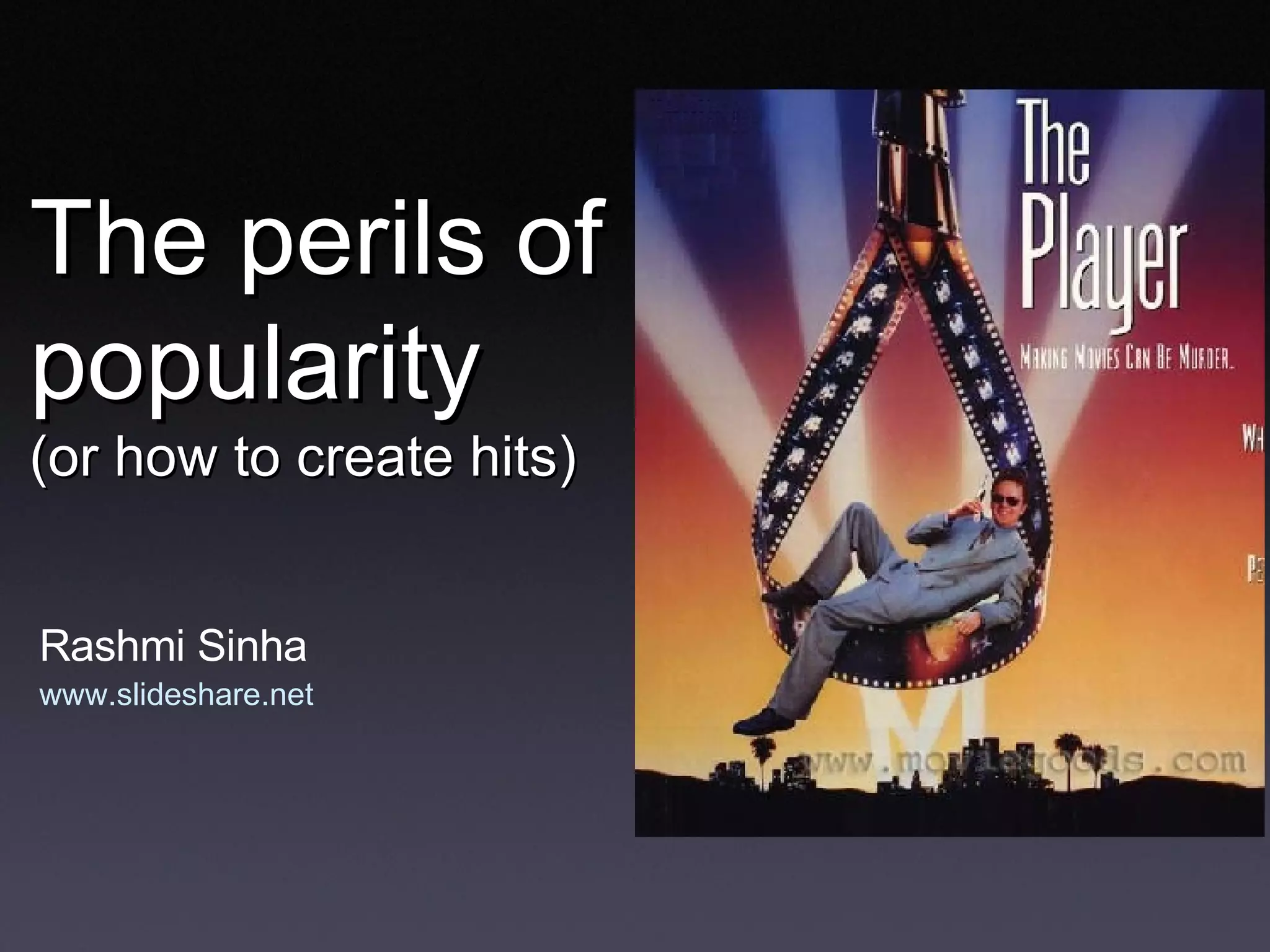
The perils of popularity  (or how to create hits) Rashmi Sinha www.slideshare.net
5  observations   about today’s web  3  models   of popularity 10  principles   for design
5  observations
1.  Second generation  social networks Sharing in large networks, versus own site Human crawlers Urban sociality
First generation Social Networks (Friendster, LinkedIn…) How it works People connect to each other Six degrees of separation “ Are you my friend” awkwardness 1) I am linked to -> -> to you  --->You are linked to her -> -> to her…
Hi I found you while I was searching my network at LinkedIn. Let's connect directly, so we can help each other with referrals. If we connect, both of our networks will grow… X
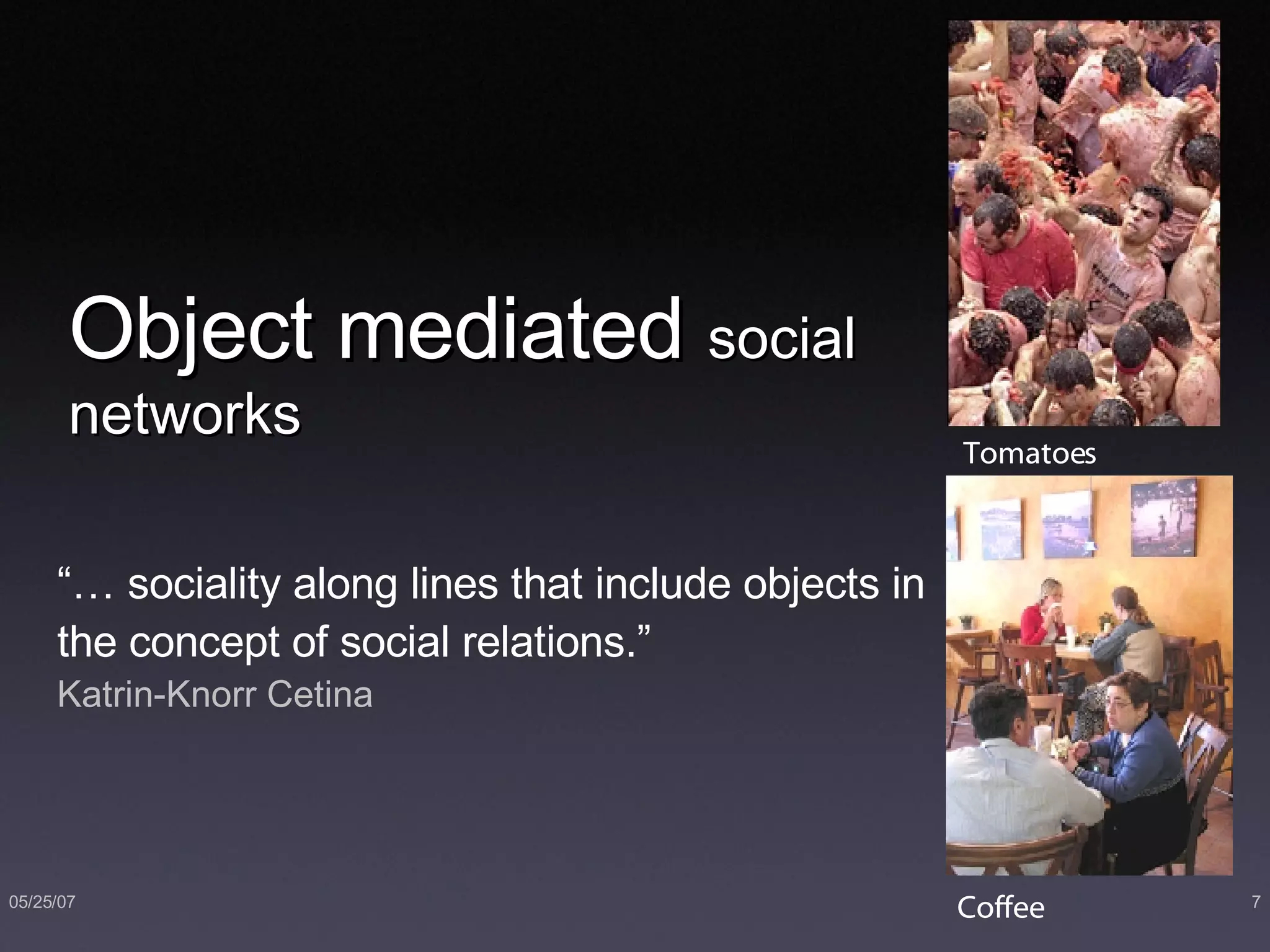
Object mediated  social networks “… sociality along lines that include objects in the concept of social relations.”  Katrin-Knorr Cetina Coffee Tomatoes
Model a: Watercooler conversations  (around objects e.g., Flickr, Yahoo answers) 1) I share my pics ->   -> with you --->   -->You share your pics -> ---> with him How it works People share objects | watch others Connections through objects Social info streams: emergence of popular, interesting items
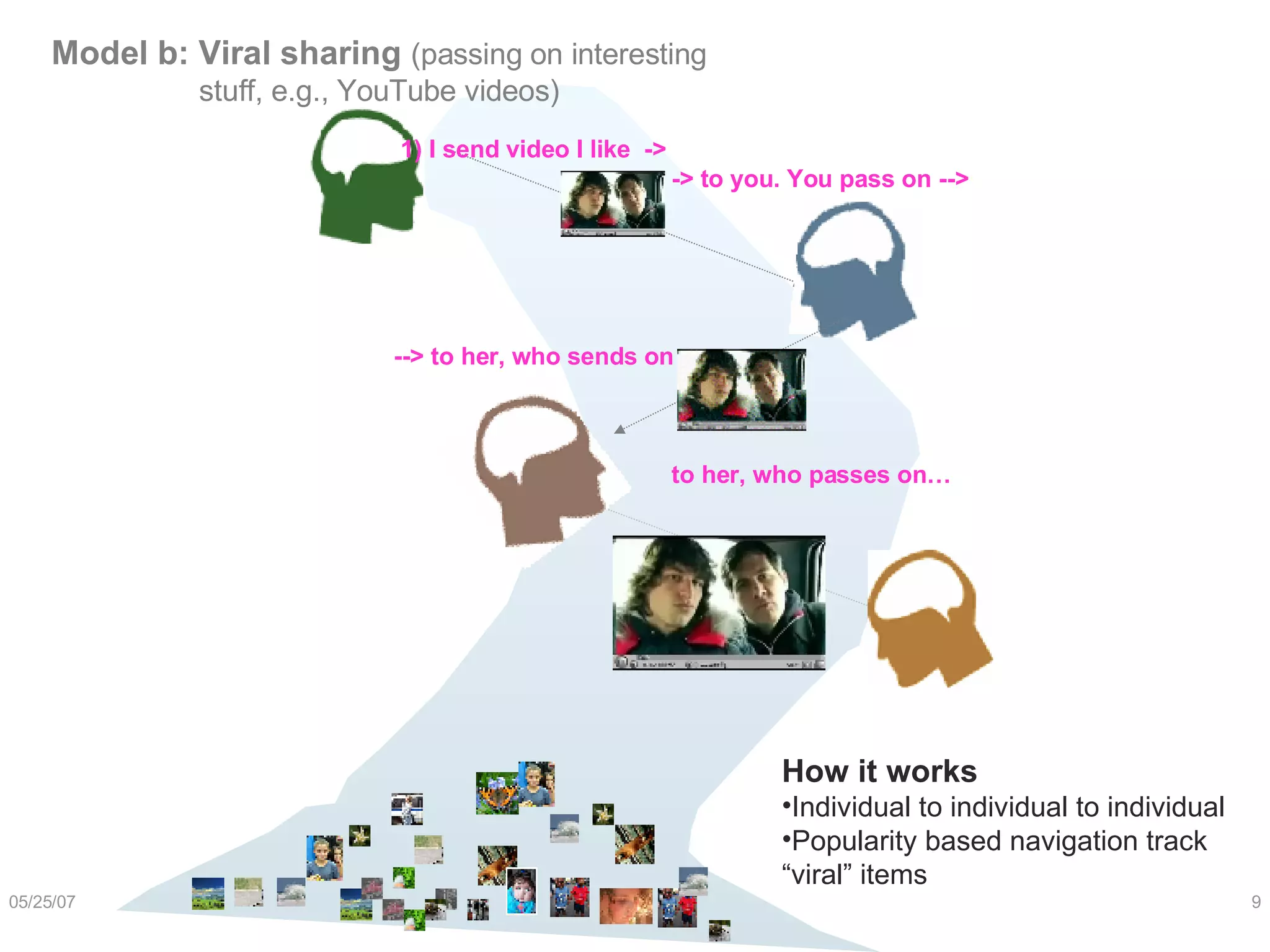
Model b: Viral sharing  (passing on interesting stuff, e.g., YouTube videos) How it works Individual to individual to individual Popularity based navigation track “viral” items 1) I send video I like  -> -> to you. You pass on -->   --> to her, who sends on to her, who passes on…
Model c: Tag-based social sharing  (linked by concepts. e.g., del.icio.us) 1) I tag my bookmarks   -> you see my tags  -->You share your tags -> How it works Saving & tagging your stuff (creating bookmarks). Tags mediate social connections Formation of social/conceptual information streams. Emergence of popular, interesting items  politics lebanon Global voices politics technology Global voices web JAVA CNN networks blogs science science science brain
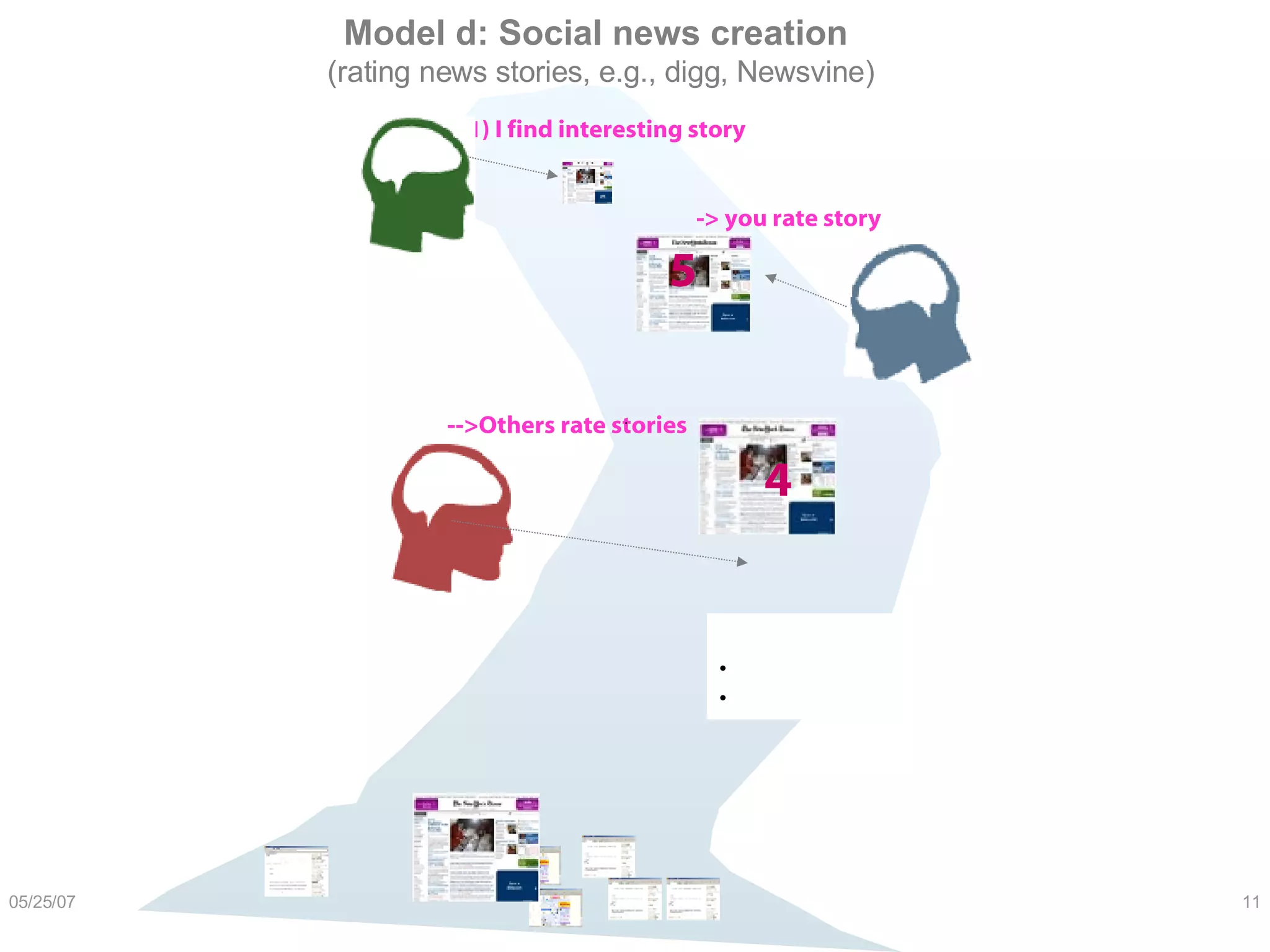
Model d: Social news creation  (rating news stories, e.g., digg, Newsvine) 1) I find interesting story   -> you rate story  -->Others rate stories How it works Finding and rating stories Popular stories rise to top 5 4
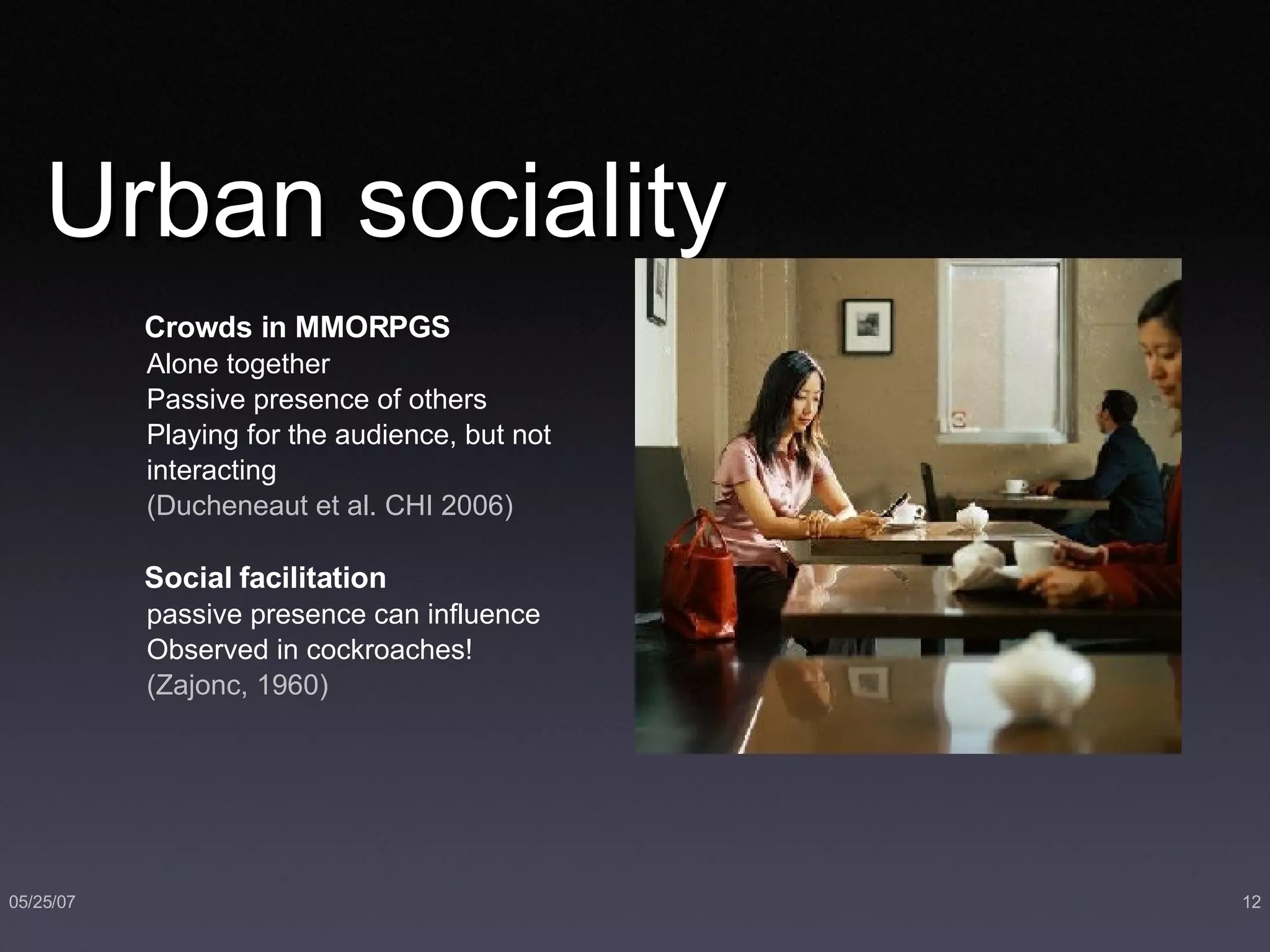
Urban sociality Crowds in MMORPGS Alone together  Passive presence of others Playing for the audience, but not interacting (Ducheneaut et al. CHI 2006) Social facilitation   passive presence can influence Observed in cockroaches! (Zajonc, 1960)
2. Sharing is  relevant to search Conversations around objects: community meets catalog
Popularity  is popular on sharing sites No multi-level menus! Navigation = Top100 lists, tag clouds
Did Paul Ford speak too soon?
The sharing imperative
is starting to influence search
 
Sharing  compared to   search shared by creator smaller reach higher quality centralized repositories relatively homogenous social activity inside indicates relevancy, popularity
3.  conformity effects  in social decisions sequential decisions even 3 is enough
How Influence Works   The  individual Conversion (private  acceptance) Independence Counterconformity Information Influence  Normative Influence Interpersonal Influence Compliance Social Influence
Social influence   in web-based systems Cognitive Diversity Independence Decentralization Easy Aggregation
3.  rich get richer  effects at network level
Duncan Watts  experiments Two worlds Individual Social Influence – 8 separate worlds Theory of cumulative advantage
4.  Era of hits  is not over
Long tail   hypothesis democratized production > more inventory democratized distribution > more consumption lowered search costs > reach niches
N Sync  vs.  lonely girl
 
System designer  as studio boss People want a shared reality Mechanisms emerge to create trends
Creating trends Everything starts as equal People can connect locally Highlight alternative viewpoints System should be flexible
3   models of sociality Google Digg YouTube
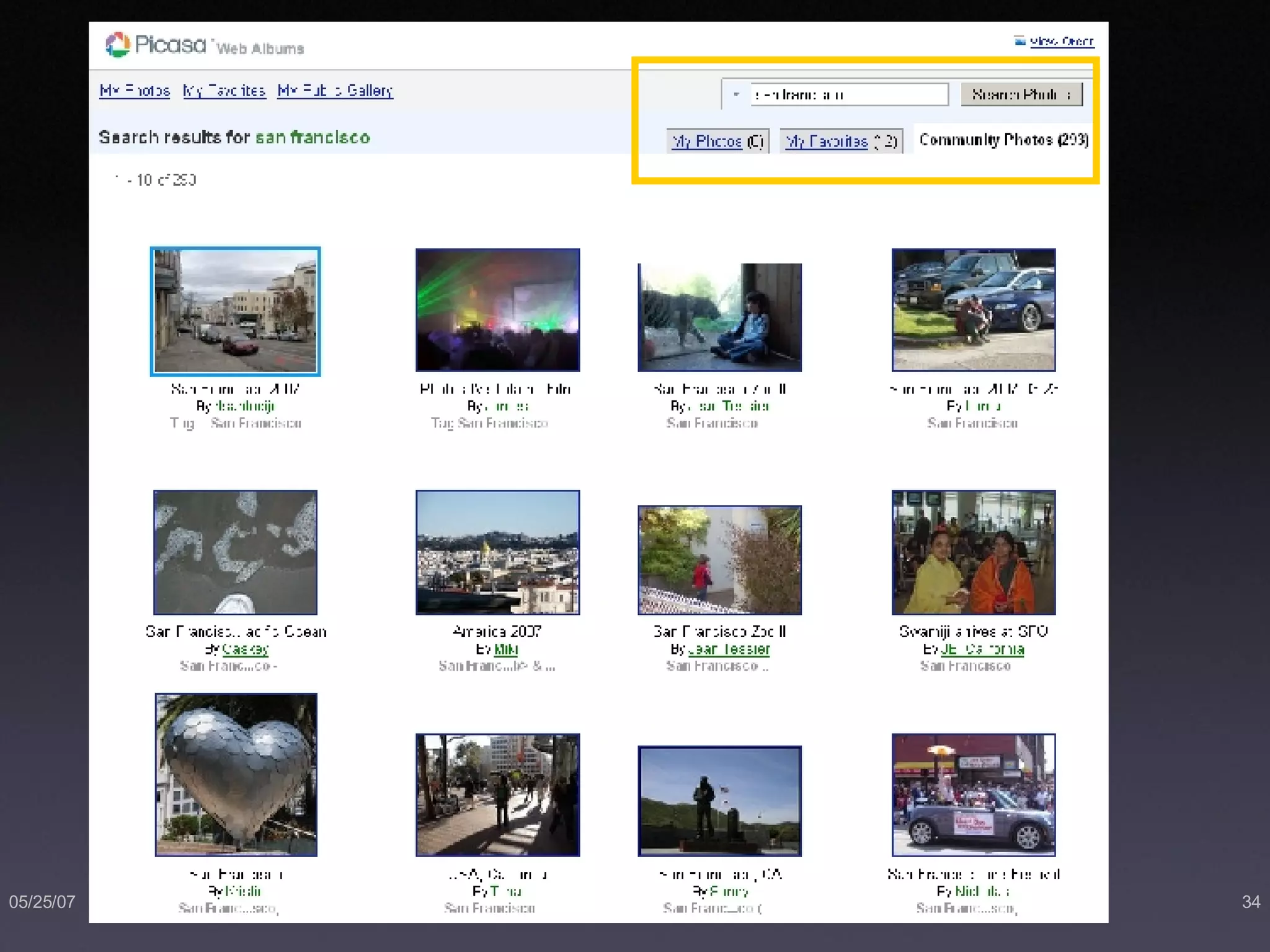
Google -  Blind sociality less social engagement sequential conformity reduced
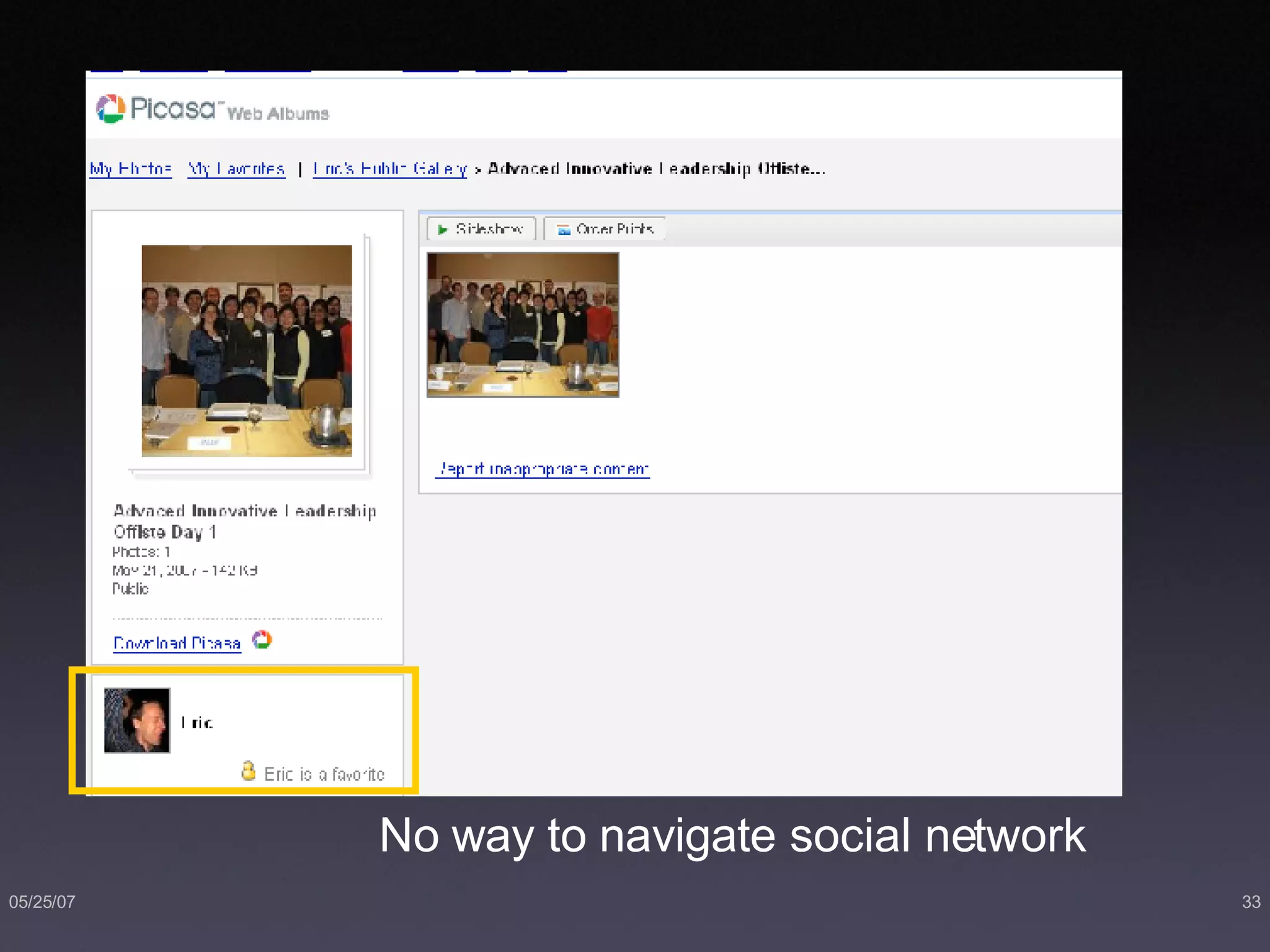
No way to navigate social network


Digg as a laser beam Focused  in time on tech topics young male users
encourages   mobs Quick, engaging, transparent metric Sequential decisions
Youtube -  promiscuous   popularity Many metrics Different strokes for different folks
Popularity on   SlideShare Keep it on your desktop Download Remember stuff, tell someone you like their stuff Favorite & tag Share with your friends Email Share on your blog Embed Watch it View Interact with others Comment Goal Metric
Most viewed shown on front page content it surfaces
Most  favorited & tagged balance individual and social reflect back tags in social stream main social gesture
 
10  principles to design for sharing
Forget the ipod!
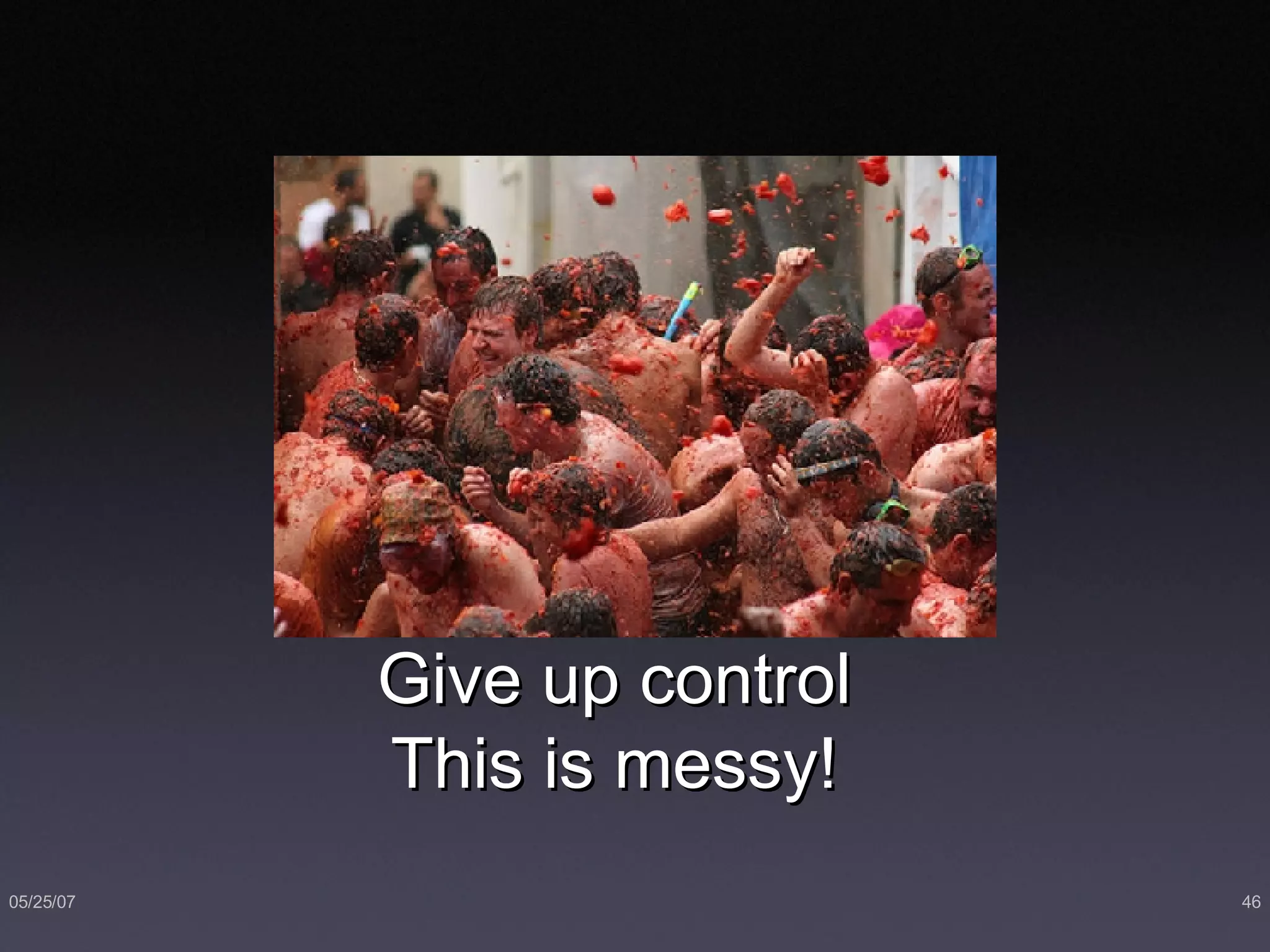
Give up control This is messy!
1. Make system   personally useful memorable personal snippets (e.g., Del.icio.us & Flickr) Self-expression (e.g., Newsvine) Social status: Digg Don’t count on altruism thrive on people’s selfishness
 
2. Symbiotic relationship between   personal & social Small individual contributions can be collected and mashed-up Simple, guessable URLs for everything  Personal snippets > Social stream Pictures > by Events Music > by Playlists
3. Porous boundary  between public & private Personal desktop software vs. social websites People will share for the right returns defaults to public, can change to private user has control individual pieces & sets Privacy settings on Flickr
4.  levels of   participation Everyone does not need to create! Implicit creation (creating by consuming) Remixing—adding value to others’ content Source: Bradley Horowitz’s weblog, Elatable, Feb. 17, 2006, “Creators, Synthesizers, and Consumers”
5. Let people feel   presence of others Sense that others are out there what paths are worn real time updating
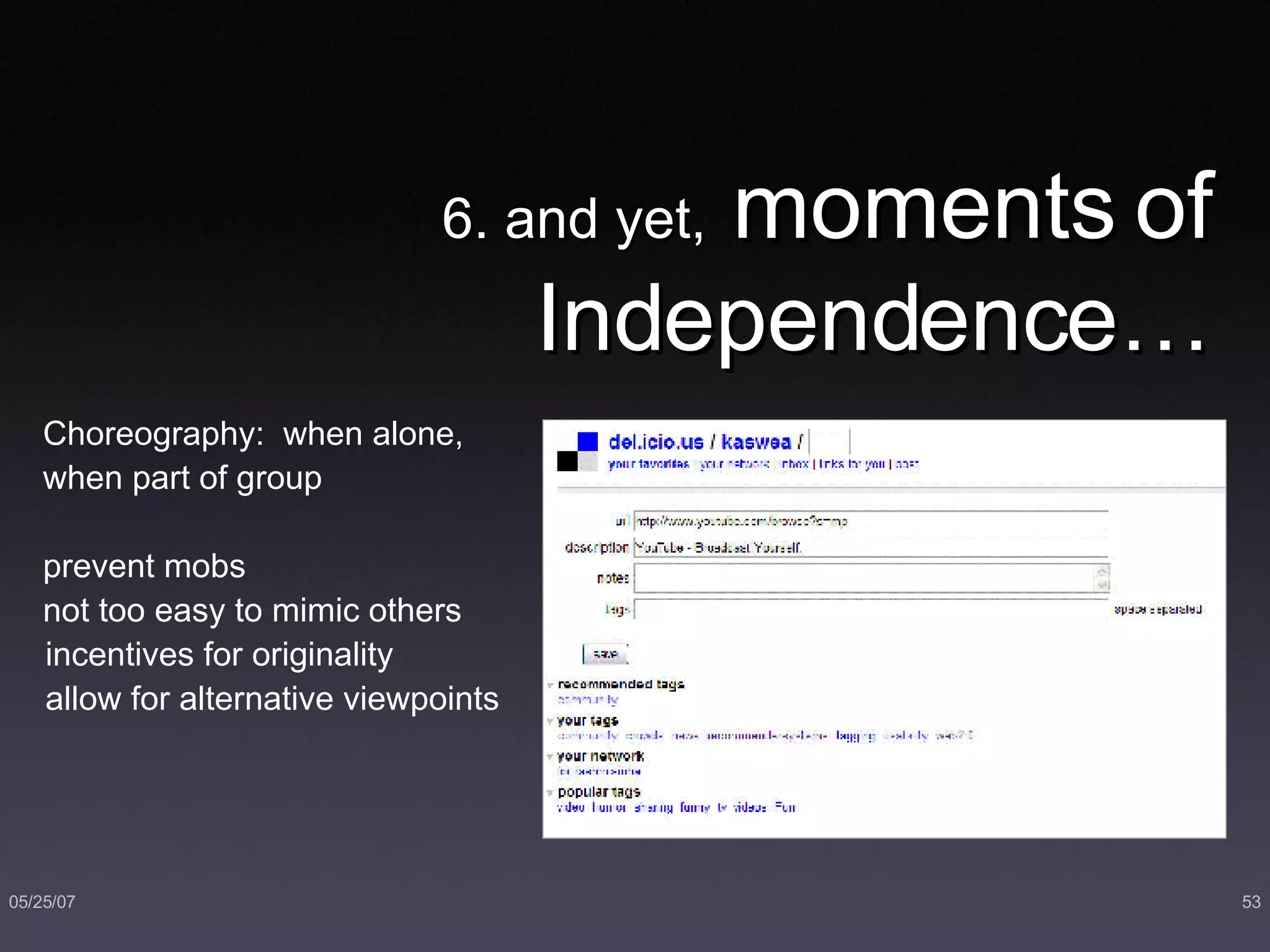
6. and yet,  moments of Independence… Choreography:  when alone, when part of group prevent mobs not too easy to mimic others incentives for originality allow for alternative viewpoints
7. Add in  serendipity  navigation not just about popularity access to some popular stuff (keep this fast moving) make “long tail” accessible popularity as a jump off point to other ways of exploring personalization & recommendations ad-hoc groups?
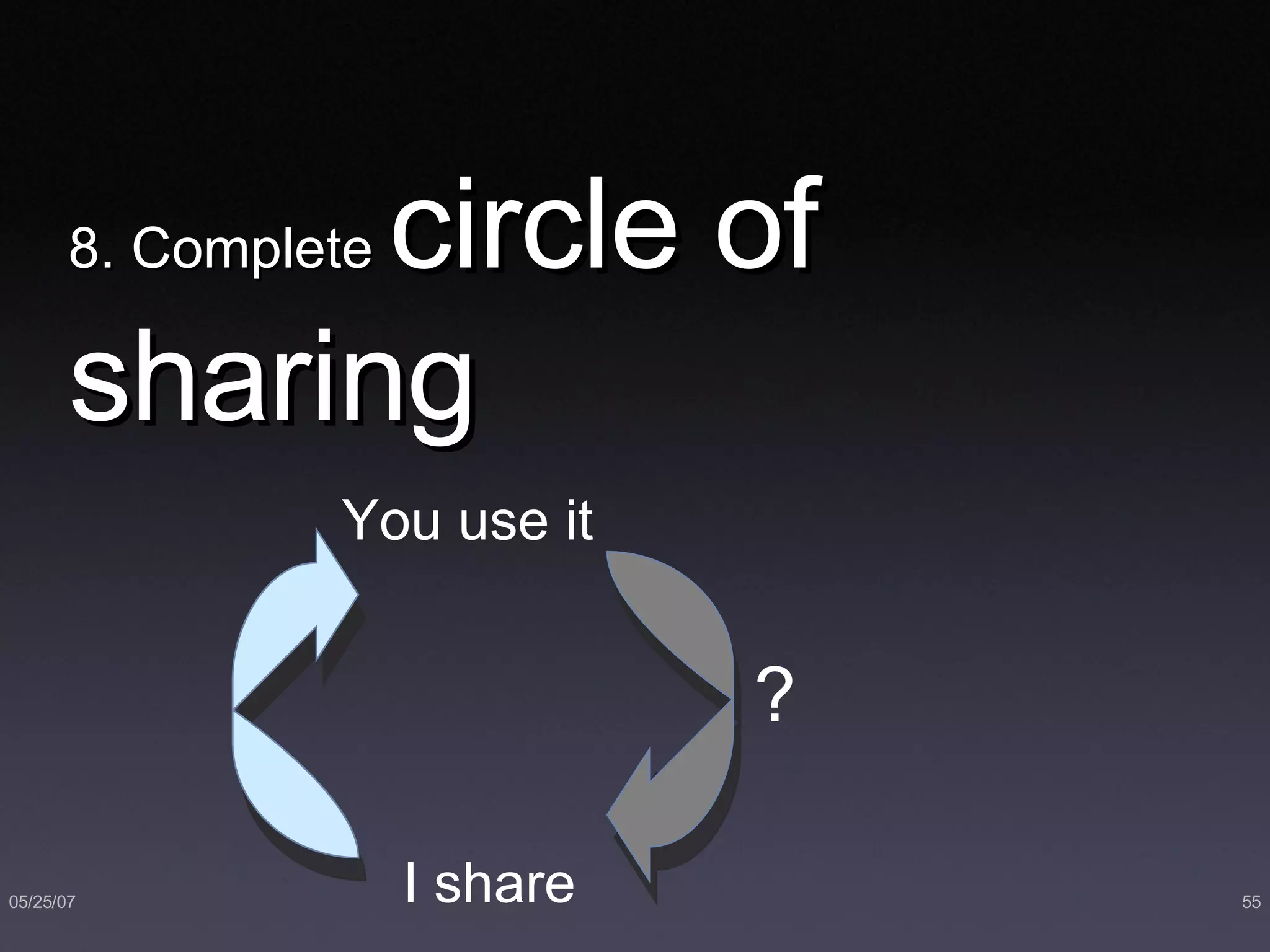
8. Complete  circle of sharing I share  You use it ?
9. Add in a  dash of experts contest on SlideShare: both judges & popular votes
10. Most of all,  allow for play
Finally  your slides at http://www.slideshare.net/tag/yrb find me at  http://www.slideshare.net/rashmi

Perils of Popularity

  • 1.
    The perils ofpopularity (or how to create hits) Rashmi Sinha www.slideshare.net
  • 2.
    5 observations about today’s web 3 models of popularity 10 principles for design
  • 3.
  • 4.
    1. Secondgeneration social networks Sharing in large networks, versus own site Human crawlers Urban sociality
  • 5.
    First generation SocialNetworks (Friendster, LinkedIn…) How it works People connect to each other Six degrees of separation “ Are you my friend” awkwardness 1) I am linked to -> -> to you --->You are linked to her -> -> to her…
  • 6.
    Hi I foundyou while I was searching my network at LinkedIn. Let's connect directly, so we can help each other with referrals. If we connect, both of our networks will grow… X
  • 7.
    Object mediated social networks “… sociality along lines that include objects in the concept of social relations.” Katrin-Knorr Cetina Coffee Tomatoes
  • 8.
    Model a: Watercoolerconversations (around objects e.g., Flickr, Yahoo answers) 1) I share my pics -> -> with you ---> -->You share your pics -> ---> with him How it works People share objects | watch others Connections through objects Social info streams: emergence of popular, interesting items
  • 9.
    Model b: Viralsharing (passing on interesting stuff, e.g., YouTube videos) How it works Individual to individual to individual Popularity based navigation track “viral” items 1) I send video I like -> -> to you. You pass on --> --> to her, who sends on to her, who passes on…
  • 10.
    Model c: Tag-basedsocial sharing (linked by concepts. e.g., del.icio.us) 1) I tag my bookmarks -> you see my tags -->You share your tags -> How it works Saving & tagging your stuff (creating bookmarks). Tags mediate social connections Formation of social/conceptual information streams. Emergence of popular, interesting items politics lebanon Global voices politics technology Global voices web JAVA CNN networks blogs science science science brain
  • 11.
    Model d: Socialnews creation (rating news stories, e.g., digg, Newsvine) 1) I find interesting story -> you rate story -->Others rate stories How it works Finding and rating stories Popular stories rise to top 5 4
  • 12.
    Urban sociality Crowdsin MMORPGS Alone together Passive presence of others Playing for the audience, but not interacting (Ducheneaut et al. CHI 2006) Social facilitation passive presence can influence Observed in cockroaches! (Zajonc, 1960)
  • 13.
    2. Sharing is relevant to search Conversations around objects: community meets catalog
  • 14.
    Popularity ispopular on sharing sites No multi-level menus! Navigation = Top100 lists, tag clouds
  • 15.
    Did Paul Fordspeak too soon?
  • 16.
  • 17.
    is starting toinfluence search
  • 18.
  • 19.
    Sharing comparedto search shared by creator smaller reach higher quality centralized repositories relatively homogenous social activity inside indicates relevancy, popularity
  • 20.
    3. conformityeffects in social decisions sequential decisions even 3 is enough
  • 21.
    How Influence Works The individual Conversion (private acceptance) Independence Counterconformity Information Influence Normative Influence Interpersonal Influence Compliance Social Influence
  • 22.
    Social influence in web-based systems Cognitive Diversity Independence Decentralization Easy Aggregation
  • 23.
    3. richget richer effects at network level
  • 24.
    Duncan Watts experiments Two worlds Individual Social Influence – 8 separate worlds Theory of cumulative advantage
  • 25.
    4. Eraof hits is not over
  • 26.
    Long tail hypothesis democratized production > more inventory democratized distribution > more consumption lowered search costs > reach niches
  • 27.
    N Sync vs. lonely girl
  • 28.
  • 29.
    System designer as studio boss People want a shared reality Mechanisms emerge to create trends
  • 30.
    Creating trends Everythingstarts as equal People can connect locally Highlight alternative viewpoints System should be flexible
  • 31.
    3 models of sociality Google Digg YouTube
  • 32.
    Google - Blind sociality less social engagement sequential conformity reduced
  • 33.
    No way tonavigate social network
  • 34.
  • 35.
  • 36.
  • 37.
    Digg as alaser beam Focused in time on tech topics young male users
  • 38.
    encourages mobs Quick, engaging, transparent metric Sequential decisions
  • 39.
    Youtube - promiscuous popularity Many metrics Different strokes for different folks
  • 40.
    Popularity on SlideShare Keep it on your desktop Download Remember stuff, tell someone you like their stuff Favorite & tag Share with your friends Email Share on your blog Embed Watch it View Interact with others Comment Goal Metric
  • 41.
    Most viewed shownon front page content it surfaces
  • 42.
    Most favorited& tagged balance individual and social reflect back tags in social stream main social gesture
  • 43.
  • 44.
    10 principlesto design for sharing
  • 45.
  • 46.
    Give up controlThis is messy!
  • 47.
    1. Make system personally useful memorable personal snippets (e.g., Del.icio.us & Flickr) Self-expression (e.g., Newsvine) Social status: Digg Don’t count on altruism thrive on people’s selfishness
  • 48.
  • 49.
    2. Symbiotic relationshipbetween personal & social Small individual contributions can be collected and mashed-up Simple, guessable URLs for everything Personal snippets > Social stream Pictures > by Events Music > by Playlists
  • 50.
    3. Porous boundary between public & private Personal desktop software vs. social websites People will share for the right returns defaults to public, can change to private user has control individual pieces & sets Privacy settings on Flickr
  • 51.
    4. levelsof participation Everyone does not need to create! Implicit creation (creating by consuming) Remixing—adding value to others’ content Source: Bradley Horowitz’s weblog, Elatable, Feb. 17, 2006, “Creators, Synthesizers, and Consumers”
  • 52.
    5. Let peoplefeel presence of others Sense that others are out there what paths are worn real time updating
  • 53.
    6. and yet, moments of Independence… Choreography: when alone, when part of group prevent mobs not too easy to mimic others incentives for originality allow for alternative viewpoints
  • 54.
    7. Add in serendipity navigation not just about popularity access to some popular stuff (keep this fast moving) make “long tail” accessible popularity as a jump off point to other ways of exploring personalization & recommendations ad-hoc groups?
  • 55.
    8. Complete circle of sharing I share You use it ?
  • 56.
    9. Add ina dash of experts contest on SlideShare: both judges & popular votes
  • 57.
    10. Most ofall, allow for play
  • 58.
    Finally yourslides at http://www.slideshare.net/tag/yrb find me at http://www.slideshare.net/rashmi