You 2.0:   The underlying Web 2.0 concepts empowering you today by Avi Jhangiani Email:  [email_address] Blog:  http://YouAreNew.blogspot.com
Contents Introduction to the web Web 2.0 – Do you know when you see it? What are the underlying concepts of Web 2.0?
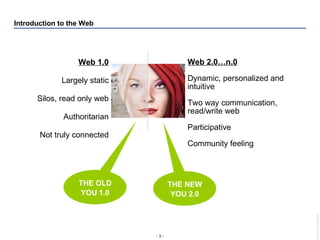
Introduction to the Web Web 1.0 Largely static Silos, read only web Authoritarian Not truly connected Web 2.0…n.0 Dynamic, personalized and intuitive Two way communication, read/write web Participative Community feeling THE OLD YOU 1.0 THE NEW YOU 2.0
What is Web 2.0? Web 2.0, simply, is an upgrade to the internet The term “Web 2.0” comes from the following  concepts  or themes that can be observed on the internet today Social networking Collaboration Broadcasting Rich user interfaces Service orientation The following slides will introduce these emerging trends and help you recognize to Web 2.0 when you experience it.
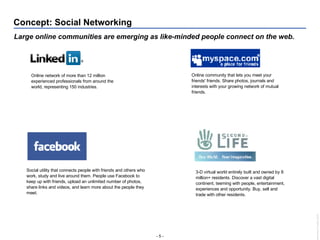
Concept: Social Networking Large online communities are emerging as like-minded people connect on the web. Online network of more than 12 million experienced professionals from around the world, representing 150 industries.  Online community that lets you meet your friends' friends. Share photos, journals and interests with your growing network of mutual friends.  3-D virtual world entirely built and owned by 8 million+ residents. Discover a vast digital continent, teeming with people, entertainment, experiences and opportunity. Buy, sell and trade with other residents. Social utility that connects people with friends and others who work, study and live around them. People use Facebook to keep up with friends, upload an unlimited number of photos, share links and videos, and learn more about the people they meet.
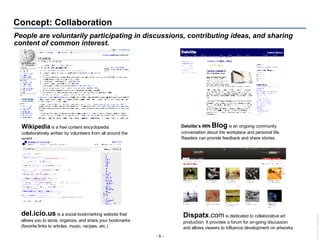
Concept: Collaboration People are voluntarily participating in discussions, contributing ideas, and sharing content of common interest. Wikipedia  is a free content encyclopedia collaboratively written by volunteers from all around the world. Deloitte’s WIN  Blog  is an ongoing community conversation about the workplace and personal life. Readers can provide feedback and share stories. Dispatx .com  is dedicated to collaborative art production. It provides a forum for on-going discussion and allows viewers to influence development on artworks. del.icio.us  is a social bookmarking website that allows you to store, organize, and share your bookmarks (favorite links to articles, music, recipes, etc.)
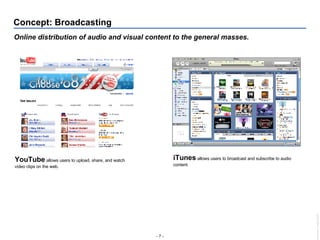
Concept: Broadcasting Online distribution of audio and visual content to the general masses. YouTube  allows users to upload, share, and watch video clips on the web.  iTunes   allows users to broadcast and subscribe to audio content.
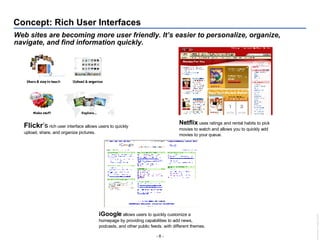
Concept: Rich User Interfaces Web sites are becoming more user friendly. It’s easier to personalize, organize, navigate, and find information quickly. Flickr ’s  rich user interface allows users to quickly upload, share, and organize pictures. Netflix  uses ratings and rental habits to pick movies to watch and allows you to quickly add movies to your queue. iGoogle  allows users to quickly customize a homepage by providing capabilities to add news, podcasts, and other public feeds. with different themes.
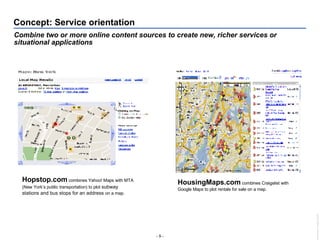
Concept: Service orientation Combine two or more online content sources to create new, richer services or situational applications   Hopstop.com  combines Yahoo! Maps with MTA (New York’s public transportation) to plot  subway stations and bus stops   for an address  on a map. HousingMaps.com  combines Craigslist with Google Maps to plot rentals for sale on a map.
Bring about the change, web 2.0 is here to help! The emerging trends on the internet today empowers you Make use of the underlying concepts discussed in this presentation Become a part of an online community, contribute, and broadcast your content… If you have questions or comments, send them to: Avi Jhangiani Email:  [email_address] Or post them at Blog:  http://YouAreNew.blogspot.com

You 2.0

  • 1.
    You 2.0: The underlying Web 2.0 concepts empowering you today by Avi Jhangiani Email: [email_address] Blog: http://YouAreNew.blogspot.com
  • 2.
    Contents Introduction tothe web Web 2.0 – Do you know when you see it? What are the underlying concepts of Web 2.0?
  • 3.
    Introduction to theWeb Web 1.0 Largely static Silos, read only web Authoritarian Not truly connected Web 2.0…n.0 Dynamic, personalized and intuitive Two way communication, read/write web Participative Community feeling THE OLD YOU 1.0 THE NEW YOU 2.0
  • 4.
    What is Web2.0? Web 2.0, simply, is an upgrade to the internet The term “Web 2.0” comes from the following concepts or themes that can be observed on the internet today Social networking Collaboration Broadcasting Rich user interfaces Service orientation The following slides will introduce these emerging trends and help you recognize to Web 2.0 when you experience it.
  • 5.
    Concept: Social NetworkingLarge online communities are emerging as like-minded people connect on the web. Online network of more than 12 million experienced professionals from around the world, representing 150 industries. Online community that lets you meet your friends' friends. Share photos, journals and interests with your growing network of mutual friends. 3-D virtual world entirely built and owned by 8 million+ residents. Discover a vast digital continent, teeming with people, entertainment, experiences and opportunity. Buy, sell and trade with other residents. Social utility that connects people with friends and others who work, study and live around them. People use Facebook to keep up with friends, upload an unlimited number of photos, share links and videos, and learn more about the people they meet.
  • 6.
    Concept: Collaboration Peopleare voluntarily participating in discussions, contributing ideas, and sharing content of common interest. Wikipedia is a free content encyclopedia collaboratively written by volunteers from all around the world. Deloitte’s WIN Blog is an ongoing community conversation about the workplace and personal life. Readers can provide feedback and share stories. Dispatx .com is dedicated to collaborative art production. It provides a forum for on-going discussion and allows viewers to influence development on artworks. del.icio.us is a social bookmarking website that allows you to store, organize, and share your bookmarks (favorite links to articles, music, recipes, etc.)
  • 7.
    Concept: Broadcasting Onlinedistribution of audio and visual content to the general masses. YouTube allows users to upload, share, and watch video clips on the web. iTunes allows users to broadcast and subscribe to audio content.
  • 8.
    Concept: Rich UserInterfaces Web sites are becoming more user friendly. It’s easier to personalize, organize, navigate, and find information quickly. Flickr ’s rich user interface allows users to quickly upload, share, and organize pictures. Netflix uses ratings and rental habits to pick movies to watch and allows you to quickly add movies to your queue. iGoogle allows users to quickly customize a homepage by providing capabilities to add news, podcasts, and other public feeds. with different themes.
  • 9.
    Concept: Service orientationCombine two or more online content sources to create new, richer services or situational applications Hopstop.com combines Yahoo! Maps with MTA (New York’s public transportation) to plot subway stations and bus stops for an address on a map. HousingMaps.com combines Craigslist with Google Maps to plot rentals for sale on a map.
  • 10.
    Bring about thechange, web 2.0 is here to help! The emerging trends on the internet today empowers you Make use of the underlying concepts discussed in this presentation Become a part of an online community, contribute, and broadcast your content… If you have questions or comments, send them to: Avi Jhangiani Email: [email_address] Or post them at Blog: http://YouAreNew.blogspot.com