Overview:
  •   The Major Social Networks
  •   Anatomy of a Social Network
  •   Social Networks in Learning
  •   Platforms and Programs
  •   Learning Network
      Applications
1. The Major Social Networks
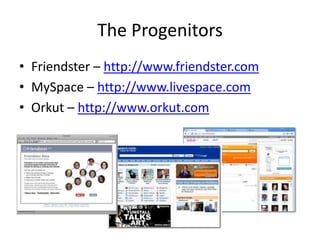
The Progenitors
• Friendster – http://www.friendster.com
• MySpace – http://www.livespace.com
• Orkut – http://www.orkut.com
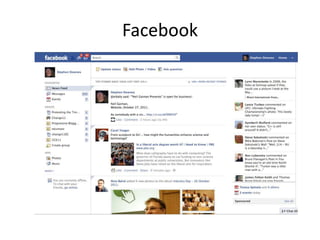
Facebook
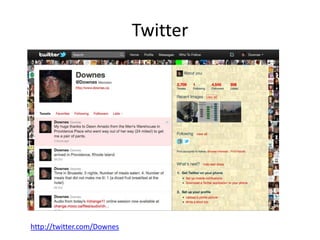
Twitter


http://twitter.com/Downes
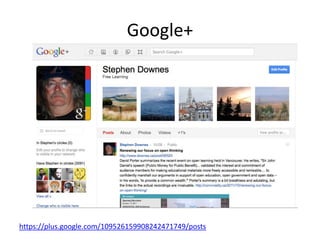
Google+


https://plus.google.com/109526159908242471749/posts
Some of the Others:
• Flickr – http://www.flickr.com
• LinkedIn – http://www.linkedin.com
• YouTube – http://www.youtube.com
2. Anatomy of a Social Network
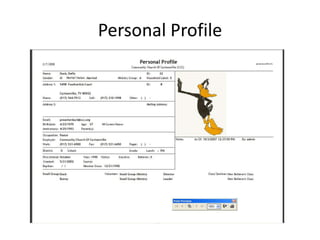
Personal Profile
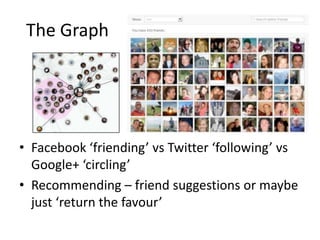
The Graph


• Facebook ‘friending’ vs Twitter ‘following’ vs
  Google+ ‘circling’
• Recommending – friend suggestions or maybe
  just ‘return the favour’
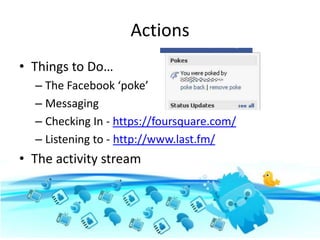
Actions
• Things to Do…
  – The Facebook ‘poke’
  – Messaging
  – Checking In - https://foursquare.com/
  – Listening to - http://www.last.fm/
• The activity stream
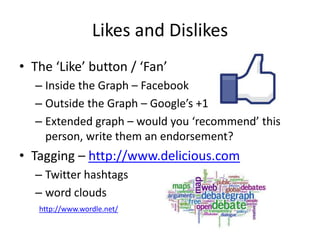
Likes and Dislikes
• The ‘Like’ button / ‘Fan’
  – Inside the Graph – Facebook
  – Outside the Graph – Google’s +1
  – Extended graph – would you ‘recommend’ this
    person, write them an endorsement?
• Tagging – http://www.delicious.com
  – Twitter hashtags
  – word clouds
   http://www.wordle.net/
Groups
• Explicit group formation:
  – Google Groups, Yahoo Groups
• Object-based group formation
  – Facebook ‘causes’, ‘like’, etc.
  – Events
Sharing
• Media – photo, video and audio uploads
• Artwork – DeviantArt -
  http://www.deviantart.com/
• Experiences
    – the Twitter hashtag again
• Places – 4Square


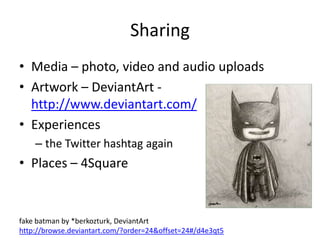
fake batman by *berkozturk, DeviantArt
http://browse.deviantart.com/?order=24&offset=24#/d4e3qt5
Reputation
• Klout – http://www.klout.com
• HootSuite - http://hootsuite.com/social-analytics
• Social media key elements: PageRank, eBay
  Reputation, Amazon Reviews
• Achievement: ‘become mayor’, ‘unlock badge’
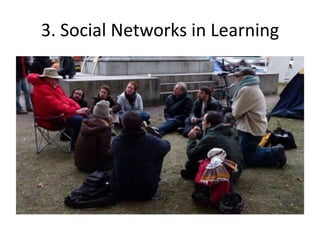
3. Social Networks in Learning
Some Benefits
• It’s free
• It cuts down on isolation
• It builds tolerance and understanding of
  diversity
• It amplifies passions
• It’s more open, and education needs to be
  more open
George Couros, Connected Principals, Why Social Media Can and Is
Changing Education
http://www.connectedprincipals.com/archives/3024
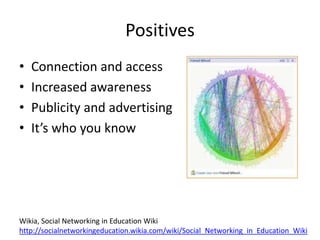
Positives
•   Connection and access
•   Increased awareness
•   Publicity and advertising
•   It’s who you know


Wikia, Social Networking in Education Wiki
http://socialnetworkingeducation.wikia.com/wiki/Social_Networking_in_Education_Wiki
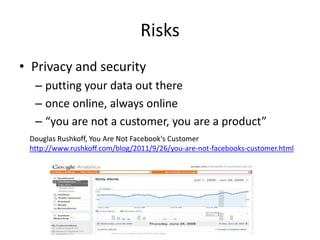
Risks
• Privacy and security
  – putting your data out there
  – once online, always online
  – “you are not a customer, you are a product”
 Douglas Rushkoff, You Are Not Facebook's Customer
 http://www.rushkoff.com/blog/2011/9/26/you-are-not-facebooks-customer.html
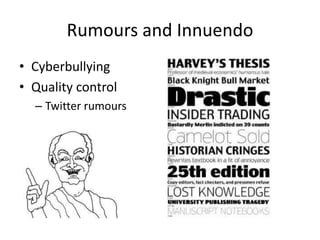
Rumours and Innuendo
• Cyberbullying
• Quality control
  – Twitter rumours
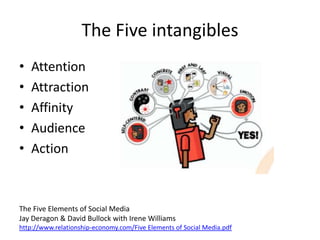
The Five intangibles
•   Attention
•   Attraction
•   Affinity
•   Audience
•   Action


The Five Elements of Social Media
Jay Deragon & David Bullock with Irene Williams
http://www.relationship-economy.com/Five Elements of Social Media.pdf
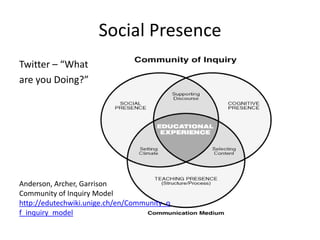
Social Presence
Twitter – “What
are you Doing?”


Anderson, Archer, Garrison
Community of Inquiry Model
http://edutechwiki.unige.ch/en/Community_o
f_inquiry_model
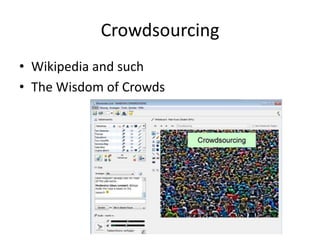
Crowdsourcing
• Wikipedia and such
• The Wisdom of Crowds
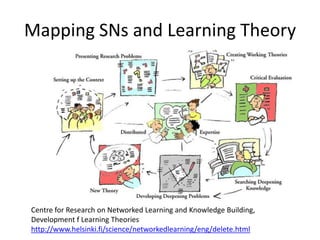
Mapping SNs and Learning Theory


Centre for Research on Networked Learning and Knowledge Building,
Development f Learning Theories
http://www.helsinki.fi/science/networkedlearning/eng/delete.html
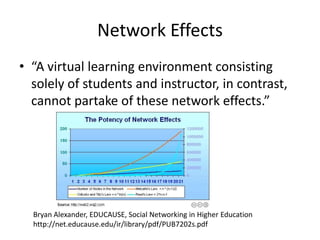
Network Effects
• “A virtual learning environment consisting
  solely of students and instructor, in contrast,
  cannot partake of these network effects.”


  Bryan Alexander, EDUCAUSE, Social Networking in Higher Education
  http://net.educause.edu/ir/library/pdf/PUB7202s.pdf
Social Network Policies
• Schools banning Facebook?
• “Discussions of privacy and copyright, and
  questions about creativity and appropriation,
  citizenship, and governance can become
  grounded in years of social media experience.”
  – Alexander

  Digizen, Case Study: Example Acceptable Use Policy
  http://old.digizen.org/cyberbullying/fullguidance/resources/caseexample.as
  px
Some SN Education Platforms
• Ning – http://www.ning.com
• Elgg - http://elgg.org/
… and communities:
  – Classroom 2.0 - http://www.classroom20.com/
  – -Association for Social Media in Higher Education -
    http://www.socialmediahighered.com/
4. Platforms and Programs
To Understand Platforms…
• Think of Mobile computing:
  – iPod, iPhone, iPad
  – Android, Windows Mobile, Blackberry
• Next, think of ‘the App store’
  – eg., the Apple app store
• Apply the concept to a social network
  – inside the social network is an ‘app store’
  – these apps access SN data and functionality
Some Analogies
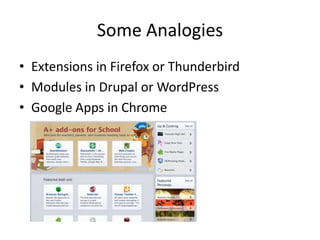
• Extensions in Firefox or Thunderbird
• Modules in Drupal or WordPress
• Google Apps in Chrome
Connecting


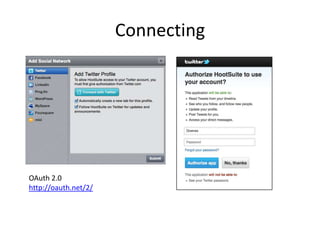
OAuth 2.0
http://oauth.net/2/
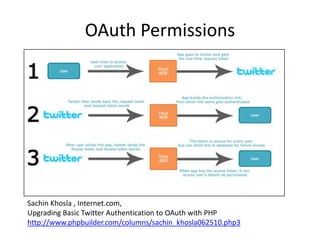
OAuth Permissions


Sachin Khosla , Internet.com,
Upgrading Basic Twitter Authentication to OAuth with PHP
http://www.phpbuilder.com/columns/sachin_khosla062510.php3
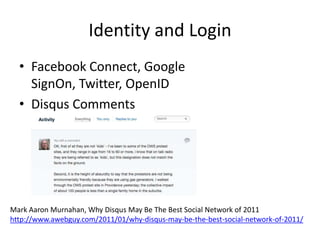
Identity and Login
  • Facebook Connect, Google
    SignOn, Twitter, OpenID
  • Disqus Comments


Mark Aaron Murnahan, Why Disqus May Be The Best Social Network of 2011
http://www.awebguy.com/2011/01/why-disqus-may-be-the-best-social-network-of-2011/
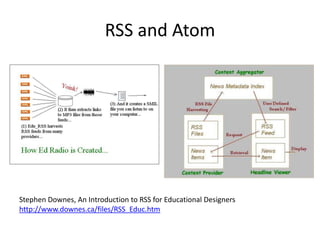
RSS and Atom


Stephen Downes, An Introduction to RSS for Educational Designers
http://www.downes.ca/files/RSS_Educ.htm
5. Learning Network Applications
Distributed SN Architectures
• Napster, Gnutella, BitTorrent
• OpenID Again
• Diaspora - https://joindiaspora.com/
  – Distributed Social Networking Protocol -
    http://www.complang.org/dsnp/
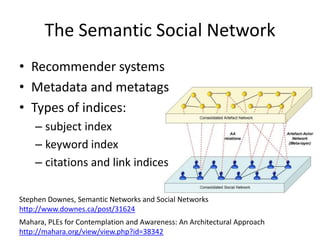
The Semantic Social Network
• Recommender systems
• Metadata and metatags
• Types of indices:
    – subject index
    – keyword index
    – citations and link indices

Stephen Downes, Semantic Networks and Social Networks
http://www.downes.ca/post/31624
Mahara, PLEs for Contemplation and Awareness: An Architectural Approach
http://mahara.org/view/view.php?id=38342
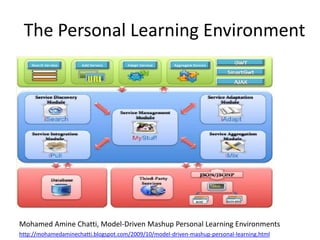
The Personal Learning Environment


Mohamed Amine Chatti, Model-Driven Mashup Personal Learning Environments
http://mohamedaminechatti.blogspot.com/2009/10/model-driven-mashup-personal-learning.html
Network Functionality
• Pattern Recognition
    – eg. from partial data – eg. face recognition
    – Regression (prediction)
• Similarity Functions
    – network-based recommendation
• Clustering
• Self-Organizing Feature Map (SOFP)
Statsoft, Neural Networks
http://www.statsoft.com/textbook/neural-networks/
Emergent Properties
• The whole is not the
  sum of the parts
• Jarche: “Culture is an
  emergent property of
  people working
  together. Leadership is
  also an emergent
  property.”
Harold Jarche, Leadership emerges from network culture
http://www.jarche.com/2011/10/leadership-emerges-from-network-culture/
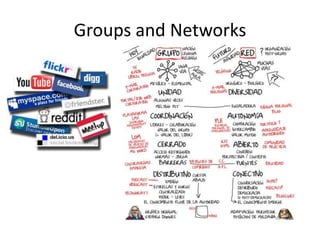
Groups and Networks
Some other References


Thomas Vander Wal
Personal InfoCloud, The Elements in the Social Software Stack
http://www.personalinfocloud.com/2008/01/the-elements-in.html


Martin Bryant, TheNextWeb, Anatomy of a Twitter rumor: When a story’s too juicy
not to retweet http://thenextweb.com/socialmedia/2011/07/28/anatomy-of-a-
twitter-rumor-when-a-storys-too-juicy-not-to-retweet/
http://www.downes.ca

Social Networks

  • 2.
    Overview: • The Major Social Networks • Anatomy of a Social Network • Social Networks in Learning • Platforms and Programs • Learning Network Applications
  • 3.
    1. The MajorSocial Networks
  • 4.
    The Progenitors • Friendster– http://www.friendster.com • MySpace – http://www.livespace.com • Orkut – http://www.orkut.com
  • 5.
  • 6.
  • 7.
  • 8.
    Some of theOthers: • Flickr – http://www.flickr.com • LinkedIn – http://www.linkedin.com • YouTube – http://www.youtube.com
  • 9.
    2. Anatomy ofa Social Network
  • 10.
  • 11.
    The Graph • Facebook‘friending’ vs Twitter ‘following’ vs Google+ ‘circling’ • Recommending – friend suggestions or maybe just ‘return the favour’
  • 12.
    Actions • Things toDo… – The Facebook ‘poke’ – Messaging – Checking In - https://foursquare.com/ – Listening to - http://www.last.fm/ • The activity stream
  • 13.
    Likes and Dislikes •The ‘Like’ button / ‘Fan’ – Inside the Graph – Facebook – Outside the Graph – Google’s +1 – Extended graph – would you ‘recommend’ this person, write them an endorsement? • Tagging – http://www.delicious.com – Twitter hashtags – word clouds http://www.wordle.net/
  • 14.
    Groups • Explicit groupformation: – Google Groups, Yahoo Groups • Object-based group formation – Facebook ‘causes’, ‘like’, etc. – Events
  • 15.
    Sharing • Media –photo, video and audio uploads • Artwork – DeviantArt - http://www.deviantart.com/ • Experiences – the Twitter hashtag again • Places – 4Square fake batman by *berkozturk, DeviantArt http://browse.deviantart.com/?order=24&offset=24#/d4e3qt5
  • 16.
    Reputation • Klout –http://www.klout.com • HootSuite - http://hootsuite.com/social-analytics • Social media key elements: PageRank, eBay Reputation, Amazon Reviews • Achievement: ‘become mayor’, ‘unlock badge’
  • 17.
    3. Social Networksin Learning
  • 18.
    Some Benefits • It’sfree • It cuts down on isolation • It builds tolerance and understanding of diversity • It amplifies passions • It’s more open, and education needs to be more open George Couros, Connected Principals, Why Social Media Can and Is Changing Education http://www.connectedprincipals.com/archives/3024
  • 19.
    Positives • Connection and access • Increased awareness • Publicity and advertising • It’s who you know Wikia, Social Networking in Education Wiki http://socialnetworkingeducation.wikia.com/wiki/Social_Networking_in_Education_Wiki
  • 20.
    Risks • Privacy andsecurity – putting your data out there – once online, always online – “you are not a customer, you are a product” Douglas Rushkoff, You Are Not Facebook's Customer http://www.rushkoff.com/blog/2011/9/26/you-are-not-facebooks-customer.html
  • 21.
    Rumours and Innuendo •Cyberbullying • Quality control – Twitter rumours
  • 22.
    The Five intangibles • Attention • Attraction • Affinity • Audience • Action The Five Elements of Social Media Jay Deragon & David Bullock with Irene Williams http://www.relationship-economy.com/Five Elements of Social Media.pdf
  • 23.
    Social Presence Twitter –“What are you Doing?” Anderson, Archer, Garrison Community of Inquiry Model http://edutechwiki.unige.ch/en/Community_o f_inquiry_model
  • 24.
    Crowdsourcing • Wikipedia andsuch • The Wisdom of Crowds
  • 25.
    Mapping SNs andLearning Theory Centre for Research on Networked Learning and Knowledge Building, Development f Learning Theories http://www.helsinki.fi/science/networkedlearning/eng/delete.html
  • 26.
    Network Effects • “Avirtual learning environment consisting solely of students and instructor, in contrast, cannot partake of these network effects.” Bryan Alexander, EDUCAUSE, Social Networking in Higher Education http://net.educause.edu/ir/library/pdf/PUB7202s.pdf
  • 27.
    Social Network Policies •Schools banning Facebook? • “Discussions of privacy and copyright, and questions about creativity and appropriation, citizenship, and governance can become grounded in years of social media experience.” – Alexander Digizen, Case Study: Example Acceptable Use Policy http://old.digizen.org/cyberbullying/fullguidance/resources/caseexample.as px
  • 28.
    Some SN EducationPlatforms • Ning – http://www.ning.com • Elgg - http://elgg.org/ … and communities: – Classroom 2.0 - http://www.classroom20.com/ – -Association for Social Media in Higher Education - http://www.socialmediahighered.com/
  • 29.
  • 30.
    To Understand Platforms… •Think of Mobile computing: – iPod, iPhone, iPad – Android, Windows Mobile, Blackberry • Next, think of ‘the App store’ – eg., the Apple app store • Apply the concept to a social network – inside the social network is an ‘app store’ – these apps access SN data and functionality
  • 31.
    Some Analogies • Extensionsin Firefox or Thunderbird • Modules in Drupal or WordPress • Google Apps in Chrome
  • 32.
  • 33.
    OAuth Permissions Sachin Khosla, Internet.com, Upgrading Basic Twitter Authentication to OAuth with PHP http://www.phpbuilder.com/columns/sachin_khosla062510.php3
  • 34.
    Identity and Login • Facebook Connect, Google SignOn, Twitter, OpenID • Disqus Comments Mark Aaron Murnahan, Why Disqus May Be The Best Social Network of 2011 http://www.awebguy.com/2011/01/why-disqus-may-be-the-best-social-network-of-2011/
  • 35.
    RSS and Atom StephenDownes, An Introduction to RSS for Educational Designers http://www.downes.ca/files/RSS_Educ.htm
  • 36.
    5. Learning NetworkApplications
  • 37.
    Distributed SN Architectures •Napster, Gnutella, BitTorrent • OpenID Again • Diaspora - https://joindiaspora.com/ – Distributed Social Networking Protocol - http://www.complang.org/dsnp/
  • 38.
    The Semantic SocialNetwork • Recommender systems • Metadata and metatags • Types of indices: – subject index – keyword index – citations and link indices Stephen Downes, Semantic Networks and Social Networks http://www.downes.ca/post/31624 Mahara, PLEs for Contemplation and Awareness: An Architectural Approach http://mahara.org/view/view.php?id=38342
  • 39.
    The Personal LearningEnvironment Mohamed Amine Chatti, Model-Driven Mashup Personal Learning Environments http://mohamedaminechatti.blogspot.com/2009/10/model-driven-mashup-personal-learning.html
  • 40.
    Network Functionality • PatternRecognition – eg. from partial data – eg. face recognition – Regression (prediction) • Similarity Functions – network-based recommendation • Clustering • Self-Organizing Feature Map (SOFP) Statsoft, Neural Networks http://www.statsoft.com/textbook/neural-networks/
  • 41.
    Emergent Properties • Thewhole is not the sum of the parts • Jarche: “Culture is an emergent property of people working together. Leadership is also an emergent property.” Harold Jarche, Leadership emerges from network culture http://www.jarche.com/2011/10/leadership-emerges-from-network-culture/
  • 42.
  • 43.
    Some other References ThomasVander Wal Personal InfoCloud, The Elements in the Social Software Stack http://www.personalinfocloud.com/2008/01/the-elements-in.html Martin Bryant, TheNextWeb, Anatomy of a Twitter rumor: When a story’s too juicy not to retweet http://thenextweb.com/socialmedia/2011/07/28/anatomy-of-a- twitter-rumor-when-a-storys-too-juicy-not-to-retweet/
  • 44.