Computer networking
 
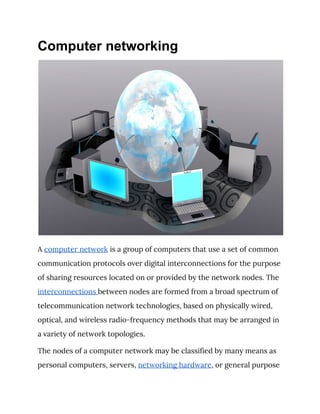
A ​computer network​ is a group of computers that use a set of common 
communication protocols over digital interconnections for the purpose 
of sharing resources located on or provided by the network nodes. The 
interconnections ​between nodes are formed from a broad spectrum of 
telecommunication network technologies, based on physically wired, 
optical, and wireless radio-frequency methods that may be arranged in 
a variety of network topologies. 
The nodes of a computer network may be classified by many means as 
personal computers, servers, ​networking hardware​, or general purpose 
hosts. They are identified by hostnames and network addresses. 
Hostnames serve as memorable labels for the nodes, rarely changed 
after initial assignment. Network addresses serve for locating and 
identifying ​the nodes by communication protocols such as the Internet 
Protocol. 
AddressBazar.com is an Bangladeshi Online Yellow Page. From here you
will find important and necessary information of various ​Computer
networking​ related organizations in Bangladesh.
Computer networks may be classified by many criteria, for example, the 
transmission medium used to carry signals, bandwidth, 
communications protocols to organize network traffic, the network 
size, the topology, traffic control mechanism, and organizational intent. 
Computer networks support many applications and services, such as 
access to the World Wide Web, digital video, digital audio, shared use of 
application and storage servers, printers, and fax machines, and use of 
email and instant messaging applications. 
History
Computer networking​ may be considered a branch of computer 
science, computer engineering, and telecommunications, since it relies 
on the theoretical and practical application of the related disciplines. 
Computer networking was influenced by a wide array of technology 
developments and historical milestones. 
● In the late 1950s, early networks of computers included the 
U.S. military radar system Semi-Automatic Ground 
Environment (SAGE). 
 
● In 1959, ​Christopher Strachey​ filed a patent application for 
time-sharing and John McCarthy initiated the first project to 
implement time-sharing of user programs at MIT. Stratchey 
passed the concept on to J. C. R. Licklider at the inaugural 
UNESCO Information Processing Conference in Paris that year. 
McCarthy was instrumental in the creation of three of the 
earliest time-sharing systems (Compatible Time-Sharing 
System in 1961, BBN Time-Sharing System in 1962, and 
Dartmouth Time Sharing System in 1963). 
● In 1959, Anatolii Ivanovich Kitov proposed to the Central 
Committee of the Communist Party of the Soviet Union a 
detailed plan for the re-organisation of the control of the 
Soviet armed forces and of the Soviet economy on the basis of 
a network of computing centres, the OGAS. 
● In 1959, the MOS transistor was invented by Mohamed Atalla 
and Dawon Kahng at Bell Labs. It later became one of the basic 
building blocks and "work horses" of virtually any element of 
communications infrastructure. 
● In 1960, the commercial airline reservation system 
semi-automatic business research environment (SABRE) went 
online with two connected mainframes. 
● In 1963, J. C. R. Licklider sent a memorandum to office 
colleagues discussing the concept of the "Intergalactic 
Computer Network", a computer network intended to allow 
general communications among computer users. 
● Throughout the 1960s, Paul Baran and Donald Davies 
independently developed the concept of packet switching to 
transfer information between computers over a network. 
Davies pioneered the implementation of the concept with the 
NPL network, a local area network at the National Physical 
Laboratory (United Kingdom) using a line speed of 768 kbit/s. 
● In 1965, Western Electric introduced the first widely used 
telephone switch that implemented computer control in the 
switching fabric. 
● In 1969, the first four nodes of the ARPANET were connected 
using 50 kbit/s circuits between the University of California at 
Los Angeles, the Stanford Research Institute, the University of 
California at Santa Barbara, and the University of Utah. In the 
1970s, Leonard Kleinrock carried out mathematical work to 
model the performance of packet-switched networks, which 
underpinned the development of the ARPANET. His theoretical 
work on hierarchical routing in the late 1970s with student 
Farouk Kamoun remains critical to the operation of the 
Internet today. 
● In 1972, ​commercial services​ using X.25 were deployed, and 
later used as an underlying infrastructure for expanding 
TCP/IP networks. 
● In 1973, the French CYCLADES network was the first to make 
the hosts responsible for the reliable delivery of data, rather 
than this being a centralized service of the network itself. 
● In 1973, Robert Metcalfe wrote a formal memo at Xerox PARC 
describing Ethernet, a networking system that was based on 
the Aloha network, developed in the 1960s by Norman 
Abramson and colleagues at the University of Hawaii. In July 
1976, Robert Metcalfe and David Boggs published their paper 
"Ethernet: Distributed Packet Switching for Local Computer 
Networks” and collaborated on several patents received in 1977 
and 1978. 
● In 1974, Vint Cerf, Yogen Dalal, and Carl Sunshine published the 
Transmission Control Protocol (TCP) specification, RFC ​675​, 
coining the term Internet as a shorthand for internetworking. 
● In 1976, John Murphy of Datapoint Corporation created 
ARCNET, a token-passing network first used to share storage 
devices. 
● In 1977, the first long-distance fiber network was deployed by 
GTE in Long Beach, California. 
● In 1977, Xerox Network Systems (XNS) was developed by Robert 
Metcalfe and Yogen Dalal at Xerox. 
● In 1979, Robert Metcalfe pursued making Ethernet an open 
standard. 
● In 1980, Ethernet was upgraded from the original 2.94 Mbit/s 
protocol to the 10 Mbit/s protocol, which was developed by 
Ron Crane, Bob Garner, Roy Ogus, and Yogen Dalal. 
● In 1995, the transmission speed capacity for Ethernet increased 
from 10 Mbit/s to 100 Mbit/s. By 1998, Ethernet supported 
transmission speeds of a Gigabit. Subsequently, higher speeds 
of up to 400 Gbit/s were added (as of 2018). The scaling of 
Ethernet has been a contributing factor to its continued use. 
Use
 
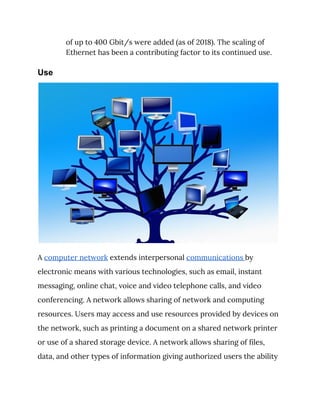
A ​computer network​ extends interpersonal ​communications ​by 
electronic means with various technologies, such as email, instant 
messaging, online chat, voice and video telephone calls, and video 
conferencing. A network allows sharing of network and computing 
resources. Users may access and use resources provided by devices on 
the network, such as printing a document on a shared network printer 
or use of a shared storage device. A network allows sharing of files, 
data, and other types of information giving authorized users the ability 
to access information stored on other computers on the network. 
Distributed computing uses computing resources across a network to 
accomplish tasks. 
Network packet
Most modern computer networks use protocols based on packet-mode 
transmission. A network packet is a formatted unit of data carried by a 
packet-switched network. The physical link technologies of packet 
networks typically limit the size of packets to a certain maximum 
transmission unit (MTU). A longer message is fragmented before it is 
transferred and once the packets arrive, they are reassembled to 
construct the original message. 
Packets consist of two types of data: control information and user data 
(payload). The control information provides data the network needs to 
deliver the user data, for example, source and destination network 
addresses, error detection codes, and sequencing information. 
Typically, control information is found in packet headers and trailers, 
with payload data in between. 
With packets, the bandwidth of the ​transmission ​medium can be better 
shared among users than if the network were circuit switched. When 
one user is not sending packets, the link can be filled with packets from 
other users, and so the cost can be shared, with relatively little 
interference, provided the link isn't overused. Often the route a packet 
needs to take through a network is not immediately available. In that 
case, the packet is queued and waits until a link is free. 
Network topology
 
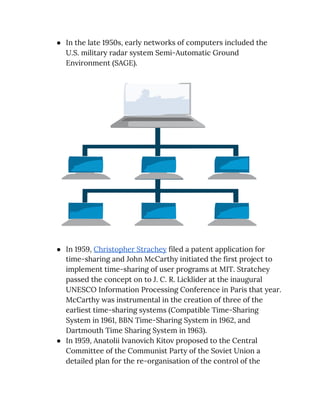
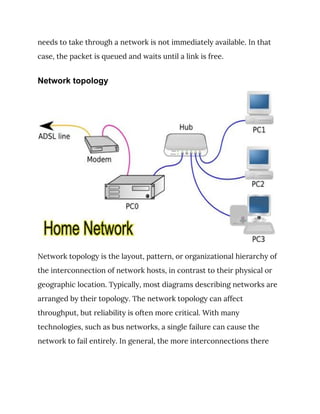
Network topology is the layout, pattern, or organizational hierarchy of 
the interconnection of network hosts, in contrast to their physical or 
geographic location. Typically, most diagrams describing networks are 
arranged by their topology. The network topology can affect 
throughput, but reliability is often more critical. With many 
technologies, such as bus networks, a single failure can cause the 
network to fail entirely. In general, the more interconnections there 
are, the more robust the network is; but the more expensive it is to 
install. 
Common layouts are: 
● Bus network: all nodes are connected to a common medium 
along this medium. This was the layout used in the original 
Ethernet, called 10BASE5 and 10BASE2. This is still a common 
topology on the data link layer, although modern physical layer 
variants use point-to-point links instead. 
● Star network: all nodes are connected to a special central node. 
This is the typical layout found in a Wireless LAN, where each 
wireless client connects to the central Wireless access point. 
● Ring network: each node is connected to its left and right 
neighbour node, such that all nodes are connected and that 
each node can reach each other node by traversing nodes left- 
or rightwards. The Fiber Distributed Data Interface (FDDI) 
made use of such a topology. 
● Mesh network: each node is connected to an arbitrary number 
of neighbours in such a way that there is at least one traversal 
from any node to any other. 
● Fully connected network: each node is connected to every 
other node in the network. 
● Tree network: nodes are arranged hierarchically. 
The physical layout of the nodes in a network may not necessarily 
reflect the network topology. As an example, with FDDI, the network 
topology is a ring, but the physical topology is often a star, because all 
neighboring connections can be routed via a central physical location. 
Physical layout is not completely irrelevant, however, as common 
ducting and equipment locations can represent single points of failure 
due to issues like fires, power failures and flooding. 
 

Computer networking

  • 1.
    Computer networking   A ​computernetwork​ is a group of computers that use a set of common  communication protocols over digital interconnections for the purpose  of sharing resources located on or provided by the network nodes. The  interconnections ​between nodes are formed from a broad spectrum of  telecommunication network technologies, based on physically wired,  optical, and wireless radio-frequency methods that may be arranged in  a variety of network topologies.  The nodes of a computer network may be classified by many means as  personal computers, servers, ​networking hardware​, or general purpose 
  • 2.
    hosts. They areidentified by hostnames and network addresses.  Hostnames serve as memorable labels for the nodes, rarely changed  after initial assignment. Network addresses serve for locating and  identifying ​the nodes by communication protocols such as the Internet  Protocol.  AddressBazar.com is an Bangladeshi Online Yellow Page. From here you will find important and necessary information of various ​Computer networking​ related organizations in Bangladesh. Computer networks may be classified by many criteria, for example, the  transmission medium used to carry signals, bandwidth,  communications protocols to organize network traffic, the network  size, the topology, traffic control mechanism, and organizational intent.  Computer networks support many applications and services, such as  access to the World Wide Web, digital video, digital audio, shared use of  application and storage servers, printers, and fax machines, and use of  email and instant messaging applications.  History Computer networking​ may be considered a branch of computer  science, computer engineering, and telecommunications, since it relies  on the theoretical and practical application of the related disciplines.  Computer networking was influenced by a wide array of technology  developments and historical milestones. 
  • 3.
    ● In thelate 1950s, early networks of computers included the  U.S. military radar system Semi-Automatic Ground  Environment (SAGE).    ● In 1959, ​Christopher Strachey​ filed a patent application for  time-sharing and John McCarthy initiated the first project to  implement time-sharing of user programs at MIT. Stratchey  passed the concept on to J. C. R. Licklider at the inaugural  UNESCO Information Processing Conference in Paris that year.  McCarthy was instrumental in the creation of three of the  earliest time-sharing systems (Compatible Time-Sharing  System in 1961, BBN Time-Sharing System in 1962, and  Dartmouth Time Sharing System in 1963).  ● In 1959, Anatolii Ivanovich Kitov proposed to the Central  Committee of the Communist Party of the Soviet Union a  detailed plan for the re-organisation of the control of the 
  • 4.
    Soviet armed forcesand of the Soviet economy on the basis of  a network of computing centres, the OGAS.  ● In 1959, the MOS transistor was invented by Mohamed Atalla  and Dawon Kahng at Bell Labs. It later became one of the basic  building blocks and "work horses" of virtually any element of  communications infrastructure.  ● In 1960, the commercial airline reservation system  semi-automatic business research environment (SABRE) went  online with two connected mainframes.  ● In 1963, J. C. R. Licklider sent a memorandum to office  colleagues discussing the concept of the "Intergalactic  Computer Network", a computer network intended to allow  general communications among computer users.  ● Throughout the 1960s, Paul Baran and Donald Davies  independently developed the concept of packet switching to  transfer information between computers over a network.  Davies pioneered the implementation of the concept with the  NPL network, a local area network at the National Physical  Laboratory (United Kingdom) using a line speed of 768 kbit/s.  ● In 1965, Western Electric introduced the first widely used  telephone switch that implemented computer control in the  switching fabric.  ● In 1969, the first four nodes of the ARPANET were connected  using 50 kbit/s circuits between the University of California at  Los Angeles, the Stanford Research Institute, the University of  California at Santa Barbara, and the University of Utah. In the  1970s, Leonard Kleinrock carried out mathematical work to  model the performance of packet-switched networks, which  underpinned the development of the ARPANET. His theoretical  work on hierarchical routing in the late 1970s with student  Farouk Kamoun remains critical to the operation of the  Internet today. 
  • 5.
    ● In 1972,​commercial services​ using X.25 were deployed, and  later used as an underlying infrastructure for expanding  TCP/IP networks.  ● In 1973, the French CYCLADES network was the first to make  the hosts responsible for the reliable delivery of data, rather  than this being a centralized service of the network itself.  ● In 1973, Robert Metcalfe wrote a formal memo at Xerox PARC  describing Ethernet, a networking system that was based on  the Aloha network, developed in the 1960s by Norman  Abramson and colleagues at the University of Hawaii. In July  1976, Robert Metcalfe and David Boggs published their paper  "Ethernet: Distributed Packet Switching for Local Computer  Networks” and collaborated on several patents received in 1977  and 1978.  ● In 1974, Vint Cerf, Yogen Dalal, and Carl Sunshine published the  Transmission Control Protocol (TCP) specification, RFC ​675​,  coining the term Internet as a shorthand for internetworking.  ● In 1976, John Murphy of Datapoint Corporation created  ARCNET, a token-passing network first used to share storage  devices.  ● In 1977, the first long-distance fiber network was deployed by  GTE in Long Beach, California.  ● In 1977, Xerox Network Systems (XNS) was developed by Robert  Metcalfe and Yogen Dalal at Xerox.  ● In 1979, Robert Metcalfe pursued making Ethernet an open  standard.  ● In 1980, Ethernet was upgraded from the original 2.94 Mbit/s  protocol to the 10 Mbit/s protocol, which was developed by  Ron Crane, Bob Garner, Roy Ogus, and Yogen Dalal.  ● In 1995, the transmission speed capacity for Ethernet increased  from 10 Mbit/s to 100 Mbit/s. By 1998, Ethernet supported  transmission speeds of a Gigabit. Subsequently, higher speeds 
  • 6.
    of up to400 Gbit/s were added (as of 2018). The scaling of  Ethernet has been a contributing factor to its continued use.  Use   A ​computer network​ extends interpersonal ​communications ​by  electronic means with various technologies, such as email, instant  messaging, online chat, voice and video telephone calls, and video  conferencing. A network allows sharing of network and computing  resources. Users may access and use resources provided by devices on  the network, such as printing a document on a shared network printer  or use of a shared storage device. A network allows sharing of files,  data, and other types of information giving authorized users the ability 
  • 7.
    to access informationstored on other computers on the network.  Distributed computing uses computing resources across a network to  accomplish tasks.  Network packet Most modern computer networks use protocols based on packet-mode  transmission. A network packet is a formatted unit of data carried by a  packet-switched network. The physical link technologies of packet  networks typically limit the size of packets to a certain maximum  transmission unit (MTU). A longer message is fragmented before it is  transferred and once the packets arrive, they are reassembled to  construct the original message.  Packets consist of two types of data: control information and user data  (payload). The control information provides data the network needs to  deliver the user data, for example, source and destination network  addresses, error detection codes, and sequencing information.  Typically, control information is found in packet headers and trailers,  with payload data in between.  With packets, the bandwidth of the ​transmission ​medium can be better  shared among users than if the network were circuit switched. When  one user is not sending packets, the link can be filled with packets from  other users, and so the cost can be shared, with relatively little  interference, provided the link isn't overused. Often the route a packet 
  • 8.
    needs to takethrough a network is not immediately available. In that  case, the packet is queued and waits until a link is free.  Network topology   Network topology is the layout, pattern, or organizational hierarchy of  the interconnection of network hosts, in contrast to their physical or  geographic location. Typically, most diagrams describing networks are  arranged by their topology. The network topology can affect  throughput, but reliability is often more critical. With many  technologies, such as bus networks, a single failure can cause the  network to fail entirely. In general, the more interconnections there 
  • 9.
    are, the morerobust the network is; but the more expensive it is to  install.  Common layouts are:  ● Bus network: all nodes are connected to a common medium  along this medium. This was the layout used in the original  Ethernet, called 10BASE5 and 10BASE2. This is still a common  topology on the data link layer, although modern physical layer  variants use point-to-point links instead.  ● Star network: all nodes are connected to a special central node.  This is the typical layout found in a Wireless LAN, where each  wireless client connects to the central Wireless access point.  ● Ring network: each node is connected to its left and right  neighbour node, such that all nodes are connected and that  each node can reach each other node by traversing nodes left-  or rightwards. The Fiber Distributed Data Interface (FDDI)  made use of such a topology.  ● Mesh network: each node is connected to an arbitrary number  of neighbours in such a way that there is at least one traversal  from any node to any other.  ● Fully connected network: each node is connected to every  other node in the network.  ● Tree network: nodes are arranged hierarchically.  The physical layout of the nodes in a network may not necessarily  reflect the network topology. As an example, with FDDI, the network  topology is a ring, but the physical topology is often a star, because all  neighboring connections can be routed via a central physical location.  Physical layout is not completely irrelevant, however, as common 
  • 10.
    ducting and equipmentlocations can represent single points of failure  due to issues like fires, power failures and flooding.